REVIEW 4 major objections 5 minor 65 references
Self-Supervised Representation Learning via Neighborhood-Relational Encoding
T0 review · 4 major / 5 minor · reviewed 2026-08-14 · deepseek-v4-flash
Pith's one-line read Adding a neighborhood-relational loss to autoencoders yields more discriminative self-supervised visual features, improving five vision tasks without labels.
desk verdict The headline claim that Eφ directly encodes neighborhood relations is not supported by the loss, which regularizes the reconstruction in a frozen pretrained space; the paper is a useful extension with mixed evidence. read the letter →
The pith
A machine-rendered reading of the paper's core claim, the machinery that carries it, and where it could break.
The reading
What carries the argument
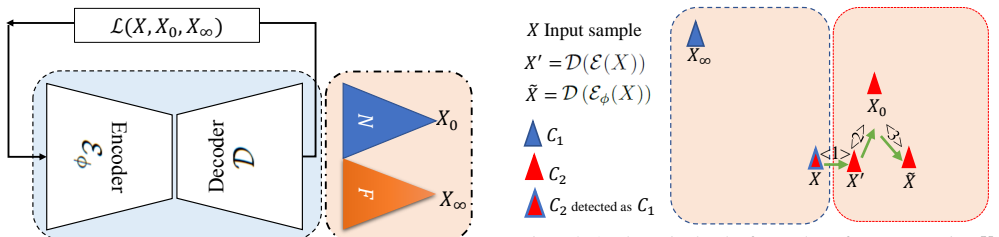
The load-bearing object is the three-term loss in Eq. (1): reconstruction fidelity, attraction to nearest latent-space neighbors, and repulsion from far-away samples, all evaluated by cosine similarity in the latent space $R_A$ of a pretrained reconstruction-only encoder $A$. The modules $N$ and $F$ select the neighbors $X_0$ and $X_\infty$: $N$ returns the sample with maximum cosine similarity to the reconstruction $X'$ in $R_A$, and $F$ returns the minimum, with a clustering shortcut for large datasets. This loss converts a pointwise autoencoder into a kernel-like embedding that preserves local neighborhood structure.
What would settle it
On the paper's MNIST setup, compute the class-agreement rate between each training image and its cosine-nearest neighbor in the pretrained autoencoder's latent space; if that rate is close to 10%, the relational loss has no semantic signal to amplify, and replacing the selected neighbors with random images should leave NRE's accuracy no better than the plain autoencoder baseline.
Extended reading notes
Core claim
The paper's central claim is that an encoder-decoder trained with the loss $\mathcal{L} = \lambda_1 D(R_A(X),R_A(X')) + \lambda_2 \sum_i D(R_A(X'),R_A(X_{0i})) + \lambda_3 \sum_i S(R_A(X'),R_A(X_{\infty i}))$ produces a latent representation $E_\varphi(X)$ that is more discriminative than a standard autoencoder code, because the loss embeds neighborhood relations into the representation. The first term keeps faithful reconstruction; the second pulls the reconstruction toward samples $X_0$ that are close to $X$ in the latent space of a pretrained autoencoder $A$; the third repels it from far-away samples $X_\infty$. Here $D$ and $S$ are distance and cosine similarity in $R_A$. The paper argues this turns the autoencoder into a kernel embedding that preserves the local geometric manifold, and reports that the resulting representation improves downstream tasks while remaining robust to outliers and noise.
Load-bearing premise
The entire relational signal rests on the assumption that in the latent space of a reconstruction-only autoencoder, each image's nearest neighbors are usually from the same class and its farthest neighbors from another class, so that pushing reconstructions along those directions teaches semantics rather than low-level appearance.
Editorial extensions
If this is right
- A reconstruction-only autoencoder can be upgraded into a more discriminative self-supervised feature extractor by adding the relational loss, with no label information required.
- The learned encoder can serve as pretraining for classification, detection, and segmentation networks, improving over standard autoencoder pretraining and several existing pretext baselines on PASCAL VOC.
- Reconstructing an input with the trained relational autoencoder before classification acts as a defense against adversarial examples, recovering accuracy lost to gradient-based attacks more effectively than a reconstruction-only refinement baseline.
- The reconstruction error of the relational autoencoder can serve directly as a video anomaly score, matching specialized spatio-temporal anomaly detectors on the UCSD Ped2 dataset.
Reading between the lines
- The same recipe could be stacked on richer pretrained encoders: if the neighbor selector starts from a contrastive or cluster-based latent space instead of a reconstruction-only one, the relational loss may compound the semantic signal.
- The method implies a direct transfer test: on datasets where reconstruction-only latent neighbors are semantically unreliable, NRE's gain over a plain autoencoder should shrink, so measuring neighbor class agreement can predict where the method pays off.
- Because the paper fixes $\lambda_1 > \lambda_2, \lambda_3$ and leaves scheduling to future work, adaptive schedules that start reconstruction-heavy and shift toward relational terms are a natural next experiment.
- The clustered approximation of $N$ and $F$ means neighborhoods are only as good as the clusters; better unsupervised clusterings should directly improve the learned representation without changing the loss.
Signed reviews
Editorial analysis
A structured set of objections, weighed in public.
Referee Report
Summary. The paper proposes Neighborhood-Relational Encoding (NRE), an encoder-decoder training objective for self-supervised representation learning. A pretrained autoencoder A defines a latent space RA in which cosine similarity selects nearby (X0) and far-away (X∞) samples for each training image. The proposed loss (Eq. 1/5) combines a reconstruction-like term, a pull toward neighbor reconstructions, and a push away from distant samples. The authors claim that this makes the encoder Eφ a discriminative, manifold-preserving kernel embedding, and evaluate the learned representation on MNIST classification, PASCAL VOC classification/detection/segmentation, FGSM adversarial defense, and UCSD Ped2 anomaly detection. Reported results are competitive with several self-supervised baselines.
Significance. If the central claim were established, NRE would be a simple and broadly applicable self-supervised objective: adding neighborhood-relational terms to an autoencoder could improve separation and robustness across several tasks without labels. The paper also addresses a relevant question, namely whether reconstruction-only pretext tasks can be usefully augmented by inter-sample relations, and the evaluation spans multiple applications, which is a strength. However, the significance is currently conditional: Eq. (1) does not directly constrain Eφ(X), the objective has no pixel-level reconstruction term, and the experimental evidence lacks error bars and ablations. The underlying idea is promising, but the manuscript as written does not yet demonstrate the claimed mechanism.
major comments (4)
- [Section 3.1, Eq. (1)] The central claim is that Eφ(X) encodes neighborhood relations and acts as a kernel embedding, but the objective does not constrain Eφ(X) directly. Every relational term in Eq. (1) and Eq. (5) is evaluated on the reconstructed image X'=D(E(X)) in the frozen latent space RA of the pretrained encoder A: λ2 Σ D(RA(X'),RA(X0_i)) and λ3 Σ S(RA(X'),RA(X∞_i)). There is no term such as D(Eφ(X),Eφ(X0)) or D(RA(Eφ(X)),RA(Eφ(X0))). Since D is trained jointly, the objective can be satisfied by an encoder that stores only the information needed to produce an RA-corrected reconstruction, without making Eφ(X) closer to Eφ(X0) than a plain autoencoder code would be. The Section 3.2 bullet claiming that 'Eφ is forced to map sample X to a latent-space with enough neighborhood information' and the Conclusion's claim that Eφ is a kernel embedding are therefore unsupported by the reported loss. The authors should either add a term that directly regularizes Eφ(X) in a defined metric, or provide quantitative evidence (e.g., kNN accuracy, neighborhood agreement, or t-SNE separability measured in Eφ space) that the current objective actually induces neighborhood structure in Eφ's output.
- [Section 3.1, Eq. (1)] The loss function contains no pixel-level reconstruction term. The only link to the original input X is λ1 D(RA(X),RA(X')), a distance in the pretrained latent space. Because A is a many-to-one encoder, RA(X') being close to RA(X) does not imply that X' is close to X in image space. Consequently, the Section 3.2 bullet asserting that after training the network 'is still able to efficiently reconstruct the input samples' and the qualitative support of Figure 4 are not guaranteed by the training objective. This matters for the autoencoder-based applications: anomaly detection uses ||X-Xhat||2 as the anomaly score (Section 4.5), and adversarial defense relies on the refinement being a faithful reconstruction. The paper should report quantitative reconstruction error (MSE or SSIM) on the test set; if reconstruction quality degrades, Eq. (5) should be augmented with a pixel-level reconstruction term.
- [Section 3.1 and Section 3.2] All neighbor labels X0 and X∞ are obtained from cosine similarity in the latent space RA of a pretrained autoencoder A that is trained by reconstruction on the same unlabeled data. The method therefore partially distills the geometry of A rather than discovering semantic relations directly. If RA clusters by low-level appearance rather than by class, the relational loss will pull reconstructions toward unrelated images and degrade the representation. The paper provides no ablation varying the quality or capacity of A (e.g., latent dimension, training length, or replacing RA with pixel-space features), and no report of nearest-neighbor agreement in RA. This is a concrete correctness risk: without such an ablation, a reader cannot tell whether the reported gains come from NRE itself or from the pretrained encoder's latent geometry. The authors should add ablations that vary A and should quantify how often the selected X0 and X∞ are semantically consistent.
- [Section 4, Tables 1-4] The experimental section reports single runs without standard deviations or number of seeds. The method has several free hyperparameters (λ1, λ2, λ3, T, K) that are manually chosen per task (Section 4.1 and Section 5), so the absence of error bars and sensitivity analysis weakens the claim of state-of-the-art or comparable performance. For example, in Table 4, NRE0.6,0.2,0.2 achieves 17.5% EER while NRE0.6,0.4,0 achieves 14%, a large spread on the same dataset; this difference is not discussed, and the comparison to Deep-cascade (9%) and ALOCC (13%) is not convincingly 'comparable.' At minimum, the authors should report multiple runs and a sensitivity table for T and K.
minor comments (5)
- [Throughout] There are multiple typos and inconsistent terms, e.g., 'dicriminative' in the Abstract, 'de-nsoing' in Section 2, 'classication' in Section 4.3, and 'Compassion results' in the Table 1 caption. A careful proofreading pass is needed.
- [Section 3 and Eq. (1)] The notation for the reconstruction is inconsistent: X' is first introduced as the output of the pretrained AE, then used in Eq. (1) as the output of the trained D(E(X)), and later X~ denotes the trained reconstruction. This should be unified to avoid confusion.
- [Section 3.2] The second bullet contains an unreadable formula: 'Pc(Eφ(X))| 1 3, 1 3, 1 3 > Pc(Eφ(X))|1,0,0' is missing subscripts and parentheses. It should be written as, for example, P_c(D(Eφ(X))) with λ values as subscripts, or replaced with a clear prose statement.
- [Section 3.1] The sentence describing the pretrained encoder A is a run-on: 'A is composed of several convolutional, sub-sampling, and fully connected layers There is a ReLU layer on top of RA...' It should be split and the architecture should be specified in the main text or in a stable supplementary document, since the linked repository is not part of the manuscript.
- [Section 3.2, Eq. (5)] For T > 1, Eq. (5) sums T distance terms and T similarity terms without normalizing by T, so the effective weight of the relational terms grows with T. This makes λ2 and λ3 not comparable across different T settings; consider averaging or reweighting the sums.
Circularity Check
No construction-level circularity; the encoder-space claim is under-supported, but it does not reduce to the paper's inputs by definition.
full rationale
The central derivation is not circular. The NRE objective in Eq. (1) is an explicit loss on the reconstructed image X' = D(E(X)), measured in the fixed latent space RA of a pretrained autoencoder A; the neighbor choices in Eqs. (2) and (3) are also defined by cosine similarity in RA. This makes the method a two-stage self-distillation that uses RA's geometry as a self-supervised target, which is self-referential only in the loose sense that the supervision is generated from the same unlabeled data. There is no construction-level identity: the loss does not set Eφ(X) equal to Eφ(X0) or to any neighbor target, and the downstream evaluations (SVM, Fast R-CNN, FCN, anomaly detection) are independent of the pretraining objective. The paper's assertion that Eφ(X) itself is forced to preserve neighborhood structure is under-supported because every relational term in Eq. (1) is evaluated on RA(D(E(X))) rather than on Eφ(X); this is a correctness or architectural-support gap, not a circularity. Self-citations such as [51] provide motivation but are not load-bearing as uniqueness theorems or as the source of the loss. Hyperparameters λ are task-specific choices, not fitted parameters renamed as predictions. Accordingly, no specific circular step can be exhibited, and the appropriate score is 0.
Assumptions & free parameters
free parameters (3)
- lambda_1, lambda_2, lambda_3 =
(0.5,0.2,0.3) for MNIST; (0.5,0.25,0.25) for PASCAL; (0.6,0.2,0.2) or (0.6,0.4,0) for anomaly/adversarial
- T =
1 (explicitly for anomaly detection, presumably elsewhere)
- K (number of clusters) =
400 for ImageNet
assumptions (4)
- domain assumption The latent space RA of a reconstruction-trained autoencoder provides semantically meaningful image similarity.
- domain assumption With high probability, X0 belongs to the same class as X and X∞ to a different class.
- domain assumption Clustering into K=400 clusters and searching only within the same cluster yields sufficiently accurate nearest neighbors.
- domain assumption The encoder-decoder architecture is expressive enough to encode neighborhood relations from the loss.
Cite this review
Pith. "Pith review of Self-Supervised Representation Learning via Neighborhood-Relational Encoding." pith.science (2026). https://pith.science/paper/PY3DAY6B
@misc{pith2026190810455,
  author       = {Pith},
  title        = {Pith review of: Self-Supervised Representation Learning via Neighborhood-Relational Encoding},
  year         = {2026},
  howpublished = {\url{https://pith.science/paper/PY3DAY6B}},
  note         = {Machine review of arXiv:1908.10455}
}
read the original abstract
In this paper, we propose a novel self-supervised representation learning by taking advantage of a neighborhood-relational encoding (NRE) among the training data. Conventional unsupervised learning methods only focused on training deep networks to understand the primitive characteristics of the visual data, mainly to be able to reconstruct the data from a latent space. They often neglected the relation among the samples, which can serve as an important metric for self-supervision. Different from the previous work, NRE aims at preserving the local neighborhood structure on the data manifold. Therefore, it is less sensitive to outliers. We integrate our NRE component with an encoder-decoder structure for learning to represent samples considering their local neighborhood information. Such discriminative and unsupervised representation learning scheme is adaptable to different computer vision tasks due to its independence from intense annotation requirements. We evaluate our proposed method for different tasks, including classification, detection, and segmentation based on the learned latent representations. In addition, we adopt the auto-encoding capability of our proposed method for applications like defense against adversarial example attacks and video anomaly detection. Results confirm the performance of our method is better or at least comparable with the state-of-the-art for each specific application, but with a generic and self-supervised approach.
Figures


Figures from the paper (1 more)

Reference graph
Works this paper leans on
-
[1]
Tensorflow: a system for large-scale machine learning
Mart ´ın Abadi, Paul Barham, Jianmin Chen, Zhifeng Chen, Andy Davis, Jeffrey Dean, Matthieu Devin, Sanjay Ghe- mawat, Geoffrey Irving, Michael Isard, et al. Tensorflow: a system for large-scale machine learning. In OSDI, vol- ume 16, pages 265–283, 2016
work page 2016
-
[2]
Pulkit Agrawal, Joao Carreira, and Jitendra Malik. Learning to see by moving. In ICCV, pages 37–45, 2015
work page 2015
-
[3]
Rep- resentation learning: A review and new perspectives
Yoshua Bengio, Aaron Courville, and Pascal Vincent. Rep- resentation learning: A review and new perspectives. IEEE transactions on pattern analysis and machine intelligence , 35(8):1798–1828, 2013
work page 2013
-
[4]
Marco Bertini, Alberto Del Bimbo, and Lorenzo Sei- denari. Multi-scale and real-time non-parametric approach for anomaly detection and localization.Computer Vision and Image Understanding, 116(3):320–329, 2012
work page 2012
-
[5]
Detecting irregularities in images and in video
Oren Boiman and Michal Irani. Detecting irregularities in images and in video. International journal of computer vi- sion, 74(1):17–31, 2007
work page 2007
-
[6]
Lstm self-supervision for de- tailed behavior analysis
Biagio Brattoli, Uta B ¨uchler, Anna-Sophia Wahl, Martin E Schwab, and Bj ¨orn Ommer. Lstm self-supervision for de- tailed behavior analysis. In CVPR, volume 2, 2017
work page 2017
-
[7]
Deep clustering for unsupervised learning of visual features
Mathilde Caron, Piotr Bojanowski, Armand Joulin, and Matthijs Douze. Deep clustering for unsupervised learning of visual features. In ECCV, 2018
2018
-
[8]
Antoni Chan and Nuno Vasconcelos. Ucsd pedestrian dataset. IEEE Trans. on Pattern Analysis and Machine In- telligence (TPAMI), 30(5):909–926, 2008
work page 2008
Show all 65 references
-
[9]
Stacked similarity-aware au- toencoders
Wenqing Chu and Deng Cai. Stacked similarity-aware au- toencoders. In Proceedings of the 26th International Joint Conference on Artificial Intelligence , pages 1561–1567. AAAI Press, 2017
2017
-
[10]
Nearest neighbor pattern classification
Thomas Cover and Peter Hart. Nearest neighbor pattern classification. IEEE transactions on information theory , 13(1):21–27, 1967
1967
-
[11]
Imagenet: A large-scale hierarchical image database
Jia Deng, Wei Dong, Richard Socher, Li-Jia Li, Kai Li, and Li Fei-Fei. Imagenet: A large-scale hierarchical image database. In CVPR, pages 248–255. Ieee, 2009
2009
-
[12]
Unsuper- vised visual representation learning by context prediction
Carl Doersch, Abhinav Gupta, and Alexei A Efros. Unsuper- vised visual representation learning by context prediction. In CVPR, pages 1422–1430, 2015
2015
-
[13]
Ad- versarial feature learning
Jeff Donahue, Philipp Kr ¨ahenb¨uhl, and Trevor Darrell. Ad- versarial feature learning. arXiv preprint arXiv:1605.09782, 2016
2016 arXiv
-
[14]
The pascal visual object classes challenge: A retrospective.Inter- national journal of computer vision, 111(1):98–136, 2015
Mark Everingham, SM Ali Eslami, Luc Van Gool, Christo- pher KI Williams, John Winn, and Andrew Zisserman. The pascal visual object classes challenge: A retrospective.Inter- national journal of computer vision, 111(1):98–136, 2015
2015
-
[15]
The pascal visual object classes (voc) challenge
Mark Everingham, Luc Van Gool, Christopher KI Williams, John Winn, and Andrew Zisserman. The pascal visual object classes (voc) challenge. International journal of computer vision, 88(2):303–338, 2010
2010
-
[16]
Un- supervised representation learning by predicting image rota- tions
Spyros Gidaris, Praveer Singh, and Nikos Komodakis. Un- supervised representation learning by predicting image rota- tions. In ICLR, 2018
2018
-
[17]
Fast r-cnn
Ross Girshick. Fast r-cnn. In ICCV, pages 1440–1448, 2015
2015
-
[18]
A kernel view of the dimensionality reduction of manifolds
Jihun Ham, Daniel D Lee, Sebastian Mika, and Bernhard Sch¨olkopf. A kernel view of the dimensionality reduction of manifolds. In Proceedings of the twenty-first international conference on Machine learning, page 47, 2004
2004
-
[19]
Neighborhood preserving embedding
Xiaofei He, Deng Cai, Shuicheng Yan, and Hong-Jiang Zhang. Neighborhood preserving embedding. In ICCV, vol- ume 2, pages 1208–1213. IEEE, 2005
2005
-
[20]
Reducing the dimensionality of data with neural networks
Geoffrey E Hinton and Ruslan R Salakhutdinov. Reducing the dimensionality of data with neural networks. science, 313(5786):504–507, 2006
2006
-
[21]
Learning image representations tied to ego-motion
Dinesh Jayaraman and Kristen Grauman. Learning image representations tied to ego-motion. In ICCV, pages 1413– 1421, 2015
2015
-
[22]
Self-supervised feature learn- ing by learning to spot artifacts
Simon Jenni and Paolo Favaro. Self-supervised feature learn- ing by learning to spot artifacts. InCVPR, pages 2733–2742, 2018
2018
-
[23]
Large-scale video classification with convolutional neural networks
Andrej Karpathy, George Toderici, Sanketh Shetty, Thomas Leung, Rahul Sukthankar, and Li Fei-Fei. Large-scale video classification with convolutional neural networks. In CVPR, pages 1725–1732, 2014
2014
-
[24]
Observe locally, infer globally: a space-time mrf for detecting abnormal activi- ties with incremental updates
Jaechul Kim and Kristen Grauman. Observe locally, infer globally: a space-time mrf for detecting abnormal activi- ties with incremental updates. In CVPR, pages 2921–2928, 2009
2009
-
[25]
Data-dependent initializations of convolutional neu- ral networks
Philipp Kr ¨ahenb¨uhl, Carl Doersch, Jeff Donahue, and Trevor Darrell. Data-dependent initializations of convolutional neu- ral networks. arXiv preprint arXiv:1511.06856, 2015
2015 arXiv
-
[26]
Imagenet classification with deep convolutional neural net- works
Alex Krizhevsky, Ilya Sutskever, and Geoffrey E Hinton. Imagenet classification with deep convolutional neural net- works. In Advances in neural information processing sys- tems, pages 1097–1105, 2012
2012
-
[27]
Learning representations for automatic colorization
Gustav Larsson, Michael Maire, and Gregory Shakhnarovich. Learning representations for automatic colorization. In ECCV, pages 577–593. Springer, 2016
2016
-
[28]
Mnist dataset
Yann LeCun, Corinna Cortes, and Christopher Burges. Mnist dataset. URL http://yann. lecun. com/exdb/mnist, 1998
1998
-
[29]
Unsupervised representation learning by sort- ing sequences
Hsin-Ying Lee, Jia-Bin Huang, Maneesh Singh, and Ming- Hsuan Yang. Unsupervised representation learning by sort- ing sequences. In ICCV, pages 667–676. IEEE, 2017
2017
-
[30]
Unsupervised person re-identification by deep learning tracklet association
Minxian Li, Xiatian Zhu, and Shaogang Gong. Unsupervised person re-identification by deep learning tracklet association. In ECCV, 2018
2018
-
[31]
Anomaly detection and localization in crowded scenes.IEEE transactions on pattern analysis and machine intelligence , 36(1):18–32, 2014
Weixin Li, Vijay Mahadevan, and Nuno Vasconcelos. Anomaly detection and localization in crowded scenes.IEEE transactions on pattern analysis and machine intelligence , 36(1):18–32, 2014
2014
-
[32]
Fully convolutional networks for semantic segmentation
Jonathan Long, Evan Shelhamer, and Trevor Darrell. Fully convolutional networks for semantic segmentation. In CVPR, pages 3431–3440, 2015
2015
-
[33]
Anomaly detection in crowded scenes
Vijay Mahadevan, Weixin Li, Viral Bhalodia, and Nuno Vas- concelos. Anomaly detection in crowded scenes. In CVPR, pages 1975–1981, 2010
1975
-
[34]
Adversarial autoencoders
Alireza Makhzani, Jonathon Shlens, Navdeep Jaitly, Ian Goodfellow, and Brendan Frey. Adversarial autoencoders. arXiv preprint arXiv:1511.05644, 2015
2015 arXiv
-
[35]
Magnet: a two-pronged de- fense against adversarial examples
Dongyu Meng and Hao Chen. Magnet: a two-pronged de- fense against adversarial examples. In Proceedings of the 2017 ACM SIGSAC Conference on Computer and Commu- nications Security, pages 135–147. ACM, 2017
2017
-
[36]
Shuf- fle and learn: unsupervised learning using temporal order verification
Ishan Misra, C Lawrence Zitnick, and Martial Hebert. Shuf- fle and learn: unsupervised learning using temporal order verification. In ECCV, pages 527–544. Springer, 2016
2016
-
[37]
Unsupervised learning of visual representations by solving jigsaw puzzles
Mehdi Noroozi and Paolo Favaro. Unsupervised learning of visual representations by solving jigsaw puzzles. In European Conference on Computer Vision , pages 69–84. Springer, 2016
2016
-
[38]
Rep- resentation learning by learning to count
Mehdi Noroozi, Hamed Pirsiavash, and Paolo Favaro. Rep- resentation learning by learning to count
-
[39]
Ambient sound provides supervision for visual learning
Andrew Owens, Jiajun Wu, Josh H McDermott, William T Freeman, and Antonio Torralba. Ambient sound provides supervision for visual learning. In ECCV, pages 801–816. Springer, 2016
2016
-
[40]
cleverhans v2
Nicolas Papernot, Nicholas Carlini, Ian Goodfellow, Reuben Feinman, Fartash Faghri, Alexander Matyasko, Karen Ham- bardzumyan, Yi-Lin Juang, Alexey Kurakin, Ryan Sheatsley, et al. cleverhans v2. 0.0: an adversarial machine learning li- brary. preprint arXiv:1610.00768, 2016
-
[41]
Learning features by watching objects move
Deepak Pathak, Ross B Girshick, Piotr Doll ´ar, Trevor Dar- rell, and Bharath Hariharan. Learning features by watching objects move. In CVPR, volume 1, page 7, 2017
2017
-
[42]
Context encoders: Feature learn- ing by inpainting
Deepak Pathak, Philipp Kr ¨ahenb¨uhl, Jeff Donahue, Trevor Darrell, and Alexei Efros. Context encoders: Feature learn- ing by inpainting. In CVPR, 2016
2016
-
[43]
Context encoders: Feature learning by inpainting
Deepak Pathak, Philipp Krahenbuhl, Jeff Donahue, Trevor Darrell, and Alexei A Efros. Context encoders: Feature learning by inpainting. In CVPR, pages 2536–2544, 2016
2016
-
[44]
Abnormal event detection in videos using generative adversarial nets
Mahdyar Ravanbakhsh, Moin Nabi, Enver Sangineto, Lu- cio Marcenaro, Carlo Regazzoni, and Nicu Sebe. Abnormal event detection in videos using generative adversarial nets. In IEEE International Conference on Image Processing (ICIP), 2017
2017
-
[45]
Training adversarial discriminators for cross- channel abnormal event detection in crowds
Mahdyar Ravanbakhsh, Enver Sangineto, Moin Nabi, and Nicu Sebe. Training adversarial discriminators for cross- channel abnormal event detection in crowds. arXiv preprint arXiv:1706.07680, 2017
2017 arXiv
-
[46]
Video anomaly de- tection and localisation based on the sparsity and reconstruc- tion error of auto-encoder
M Sabokrou, M Fathy, and M Hoseini. Video anomaly de- tection and localisation based on the sparsity and reconstruc- tion error of auto-encoder. Electronics Letters, 52(13):1122– 1124
-
[47]
Real-time anomaly detection and lo- calization in crowded scenes
Mohammad Sabokrou, Mahmood Fathy, Mojtaba Hoseini, and Reinhard Klette. Real-time anomaly detection and lo- calization in crowded scenes. In CVPR Workshops, pages 56–62, 2015
2015
-
[48]
Fast and accurate detection and localization of abnormal behavior in crowded scenes
Mohammad Sabokrou, Mahmood Fathy, Zahra Moayed, and Reinhard Klette. Fast and accurate detection and localization of abnormal behavior in crowded scenes. Machine Vision and Applications, 28(8):965–985, 2017
2017
-
[49]
Deep-cascade: Cascading 3d deep neu- ral networks for fast anomaly detection and localization in crowded scenes
Mohammad Sabokrou, Mohsen Fayyaz, Mahmood Fathy, and Reinhard Klette. Deep-cascade: Cascading 3d deep neu- ral networks for fast anomaly detection and localization in crowded scenes. IEEE Transactions on Image Processing , 26(4):1992–2004, 2017
1992
-
[50]
Deep-anomaly: Fully convolutional neural network for fast anomaly detection in crowded scenes
Mohammad Sabokrou, Mohsen Fayyaz, Mahmood Fathy, Zahra Moayed, and Reinhard Klette. Deep-anomaly: Fully convolutional neural network for fast anomaly detection in crowded scenes. Computer Vision and Image Understand- ing, 172:88–97, 2018
2018
-
[51]
Adversarially learned one-class classifier for novelty detection
Mohammad Sabokrou, Mohammad Khalooei, Mahmood Fathy, and Ehsan Adeli. Adversarially learned one-class classifier for novelty detection. In CVPR, pages 3379–3388, 2018
2018
-
[52]
Avid: Adversarial visual irregularity detection
Mohammad Sabokrou, Masoud Pourreza, Mohsen Fayyaz, Rahim Entezari, Mahmood Fathy, J ¨urgen Gall, and Ehsan Adeli. Avid: Adversarial visual irregularity detection. ACCV, 2018
2018
-
[53]
Defense-gan: Protecting classifiers against adversarial at- tacks using generative models
Pouya Samangouei, Maya Kabkab, and Rama Chellappa. Defense-gan: Protecting classifiers against adversarial at- tacks using generative models. ICLR, 2018
2018
-
[54]
Unsupervised feature ranking and selection based on autoencoders
Sasan Sharifipour, Hossein Fayyazi, Mohammad Sabokrou, and Ehsan Adeli. Unsupervised feature ranking and selection based on autoencoders. In ICASSP, pages 3172–3176. IEEE, 2019
2019
-
[55]
Kernel methods for pattern analysis
John Shawe-Taylor, Nello Cristianini, et al. Kernel methods for pattern analysis. Cambridge university press, 2004
2004
-
[56]
Support vector machines
Vladimir Vapnik, Isabel Guyon, and Trevor Hastie. Support vector machines. Mach. Learn, 20(3):273–297, 1995
1995
-
[57]
Extracting and composing robust features with denoising autoencoders
Pascal Vincent, Hugo Larochelle, Yoshua Bengio, and Pierre-Antoine Manzagol. Extracting and composing robust features with denoising autoencoders. In Proceedings of the 25th international conference on Machine learning , pages 1096–1103. ACM, 2008
2008
-
[58]
Feature se- lection guided auto-encoder
Shuyang Wang, Zhengming Ding, and Yun Fu. Feature se- lection guided auto-encoder. In AAAI, pages 2725–2731, 2017
2017
-
[59]
Unsupervised learning of visual representations using videos
Xiaolong Wang and Abhinav Gupta. Unsupervised learning of visual representations using videos. InICCV, pages 2794– 2802, 2015
2015
-
[60]
Image quality assessment: from error visibility to structural similarity
Zhou Wang, Alan C Bovik, Hamid R Sheikh, and Eero P Si- moncelli. Image quality assessment: from error visibility to structural similarity. IEEE transactions on image processing, 13(4):600–612, 2004
2004
-
[61]
Unsupervised feature learning via non-parametric instance discrimination
Zhirong Wu, Yuanjun Xiong, X Yu Stella, and Dahua Lin. Unsupervised feature learning via non-parametric instance discrimination. In CVPR, pages 3733–3742, 2018
2018
-
[62]
Learning deep representations of appearance and mo- tion for anomalous event detection
Dan Xu, Elisa Ricci, Yan Yan, Jingkuan Song, and Nicu Sebe. Learning deep representations of appearance and mo- tion for anomalous event detection. In BMVC, 2015
2015
-
[63]
Color- ful image colorization
Richard Zhang, Phillip Isola, and Alexei A Efros. Color- ful image colorization. In ECCV, pages 649–666. Springer, 2016
2016
-
[64]
Split-brain autoencoders: Unsupervised learning by cross-channel pre- diction
Richard Zhang, Phillip Isola, and Alexei A Efros. Split-brain autoencoders: Unsupervised learning by cross-channel pre- diction. In CVPR, volume 1, page 5, 2017
2017
-
[65]
Variational autoencoder with truncated mixture of gaussians for func- tional connectivity analysis
Qingyu Zhao, Nicolas Honnorat, Ehsan Adeli, Adolf Pfef- ferbaum, Edith V Sullivan, and Kilian M Pohl. Variational autoencoder with truncated mixture of gaussians for func- tional connectivity analysis. In International Conference on Information Processing in Medical Imaging, p...
2019
Reviewed August 14, 2026 · model on record in the stance chip above.
Discussion (0). Continue with ORCID to comment.