REVIEW 3 major objections 3 minor 57 references
On computing the nonlinearity interval in parametric semidefinite optimization
T0 review · 3 major / 3 minor · reviewed 2026-08-14 · deepseek-v4-flash
Pith's one-line read This paper proves that the transition points of the optimal partition in parametric semidefinite optimization form a finite set and gives a numerical algebraic geometry procedure that locates them and the surrounding invariancy and…
desk verdict Solid theory and a useful numerical pipeline, but the transition-point classification in Algorithm 4 rests on an invalid inference from Lemma 1, so the full partition algorithm is not yet proved correct. read the letter →
The pith
A machine-rendered reading of the paper's core claim, the machinery that carries it, and where it could break.
The reading
What carries the argument
The load-bearing object is the polynomial optimality system $F(V,\epsilon)=0$, written in the variables $V=(\operatorname{svec}(X); y; \operatorname{svec}(S))$ with complementarity $XS=0$ expressed through the symmetric Kronecker product. Its Jacobian $J(V,\epsilon)$ plays two roles: nonsingularity makes the optimal solution the unique analytic branch by the implicit function theorem, and singularity marks the candidate boundary points. The branch is tracked by the homotopy ODE $dV/d\epsilon = -J(V,\epsilon)^{-1}\,\partial F(V,\epsilon)/\partial \epsilon$, and at each singular point a numerical local dimension test decides whether the point is a transition point. The optimal partition $(B,T,N)$, built from the column spaces of maximally complementary optimal solutions, is the combinatorial object whose invariance or variation defines the intervals being computed.
What would settle it
Construct a parametric SDO whose optimality system has a singular parameter value whose accumulation point is an isolated solution, but where the ranks of maximally complementary optimal solutions are unchanged on both sides; Algorithm 4 would label that parameter a transition point although no rank change occurs.
Extended reading notes
Core claim
The central claim is that parametric SDO along a fixed direction has a finite combinatorial skeleton: the set of transition points is finite, so the interior of the domain is a finite union of invariancy intervals (optimal partition constant), nonlinearity intervals (ranks of $X^*(\epsilon)$ and $S^*(\epsilon)$ constant, partition varying), and isolated transition points. Under a local nonsingularity condition, namely the Jacobian of the polynomial optimality system $F(V,\epsilon)=0$ being nonsingular along the tracked branch, the boundary points of these intervals can be computed by following the unique analytic optimal solution with an ODE until the Jacobian becomes singular, then classifying each singular point via the local dimension of the algebraic solution set at its accumulation point. With a global nonsingularity condition the procedure yields a complete, finite partition of $\operatorname{int}(E)$. The same analysis shows that Painlevé-Kuratowski continuity of the optimal set mapping can fail on a nonlinearity interval, and that even a continuous selection through the relative interiors of the optimal sets may fail to exist.
Load-bearing premise
The classification step assumes that when the algebraic solution set has local dimension zero at a singular accumulation point, that parameter value must be a transition point, even though the lemma invoked would only force a nonlinearity interval under strict complementarity and continuity conditions that are not established there.
Editorial extensions
If this is right
- The finiteness of transition points means $\operatorname{int}(E)$ has a finite description: all invariancy intervals, nonlinearity intervals, and transition points can in principle be listed rather than sampled.
- Inside a nonlinearity interval the ranks of maximally complementary optimal solutions stay fixed, so nearby parameter values share the same rank structure and can be handled without resolving the SDO from scratch.
- At any transition point, strict complementarity and nondegeneracy fail, so interior-point methods lose quadratic convergence there; the paper raises this as a complexity question on the closure of nonlinearity intervals.
- The optimal set mapping is generically continuous only up to a first-category set, and even on nonlinearity intervals inner continuity can fail; sensitivity analyses must therefore check continuity at each point rather than assume it from rank stability.
Reading between the lines
- The polynomial-tracking approach should extend to perturbations of the right-hand side $b$ or the constraint matrices $A_i$, since those also preserve the KKT polynomial structure; the paper only develops the fixed-direction objective perturbation.
- The classification step for isolated singular points could be hardened by explicitly comparing ranks of maximally complementary optimal solutions across the point, as is already done in the positive-dimensional case; this would cover the possibility of an isolated singular point that is not a transition point.
- Because continuous selections through relative interiors can fail on nonlinearity intervals, any warm-start or reoptimization scheme should follow the algebraic branch of optimal solutions, not a face of the optimal set.
Signed reviews
Editorial analysis
A structured set of objections, weighed in public.
Referee Report
Summary. The paper studies parametric semidefinite optimization problems (P_epsilon)/(D_epsilon) with the objective perturbed along a fixed direction. It reviews invariancy sets, nonlinearity intervals, and transition points, and proves that the set of transition points is finite (Theorem 1) using semi-algebraicity. It also shows that the optimal set mapping may fail to be continuous on a nonlinearity interval (Example 1). Under a local nonsingularity condition, the paper develops a numerical algebraic geometry methodology (Algorithms 1-4) for computing invariancy intervals, nonlinearity intervals, and transition points, and under a global nonsingularity condition it claims a full decomposition of int(E). The algorithms are tested on several numerical examples. The ODE tracking framework in Theorem 2 is standard and appears correct, and the semi-algebraic finiteness proof is a solid theoretical contribution. The main weakness is the classification step in Algorithm 4, where the claim that an isolated singular point is necessarily a transition point is not justified.
Significance. If the algorithmic correctness were fully established, this would be the first comprehensive computational procedure for partitioning the parameter space of a parametric SDO problem into invariancy intervals, nonlinearity intervals, and transition points, which is of clear interest for sensitivity analysis, reoptimization, and warm-starting interior-point methods. The paper provides a rigorous proof of finiteness of transition points, a correct analytic continuation argument under nonsingularity (Theorem 2), and reproducible numerical experiments on meaningful examples. These are genuine strengths. However, the classification rule for isolated singular points in Algorithm 4 is currently unsupported, and since this step is load-bearing for the claimed full decomposition, the theoretical underpinning of the algorithm needs repair.
major comments (3)
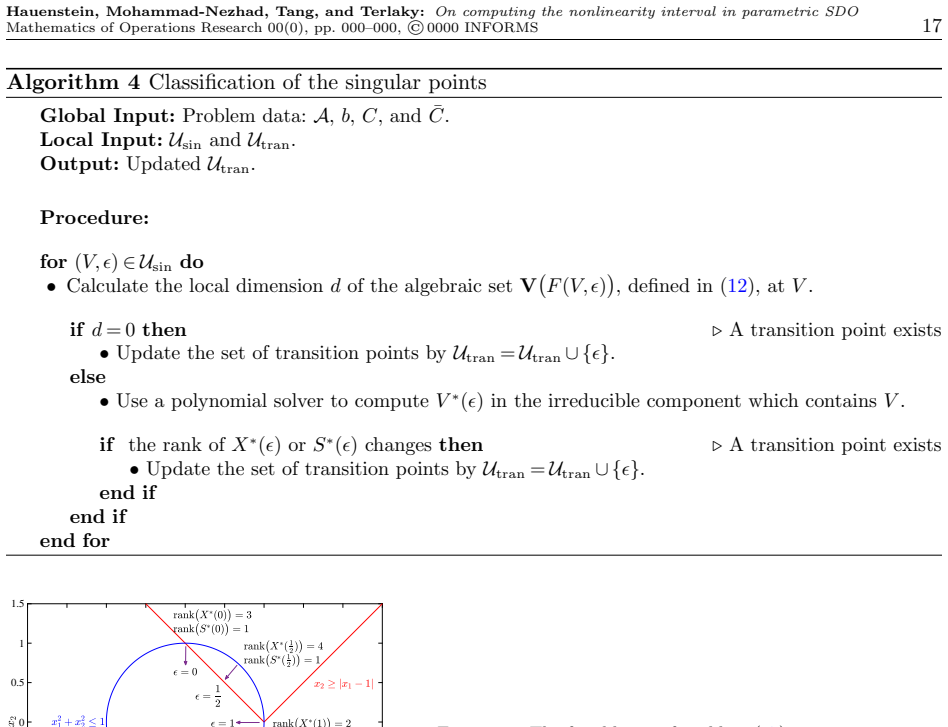
- [Section 4.1.2, Algorithm 4] The d=0 branch asserts: 'If V(F(V, epshat)) has local dimension zero at Va(epshat), then we can conclude from Lemma 1 that epshat is a transition point, since Va(epshat) turns out to be the unique optimal solution.' This does not follow. Lemma 1 requires strict complementarity and continuity of the optimal set mappings P* and D* at epshat; local dimension zero supplies neither. Moreover, Lemma 1's conclusion is that epshat belongs to a nonlinearity interval, which is the opposite of being a transition point. Lemma 2 shows that strict complementarity failure alone makes the Jacobian singular even if the ranks of maximally complementary solutions are locally constant, so an isolated singular non-transition point is not ruled out. If such a point exists, the d=0 branch would misclassify it as a transition point, and Algorithm 1 would incorrectly remove it from Unon, splitting a nonlinearity interval and destroying the claimed finite partition. The authors should either prove that for the SDO optimality system (10) an isolated singular solution implies a rank change, or replace the d=0 criterion with a direct rank-change test applied to a maximally complementary solution, as in the d>0 branch.
- [Section 3, Lemma 1] The proof of Lemma 1 is incomplete. It establishes that the ranks of X*(epsilon) and S*(epsilon) are constant in a neighborhood of epsbar, but Definition 4 requires that the optimal partition pi(epsilon) is injective on the nonlinearity interval, i.e., epsilon1 != epsilon2 implies pi(epsilon1) != pi(epsilon2). The assumption that {epsbar} is a singleton invariancy set only implies that pi is not constant on any neighborhood of epsbar; it does not rule out two distinct nearby points having the same partition. Thus the conclusion that epsbar belongs to a nonlinearity interval does not follow from the stated argument. This gap matters because Lemma 1 is explicitly invoked in the d=0 classification in Algorithm 4, compounding the unsupported step identified above.
- [Section 4.1.2] The sentence 'since Va(epshat) turns out to be the unique optimal solution' is not justified. The numerical local dimension test at the point Va(epshat) only certifies that Va(epshat) is isolated within its irreducible component of the complex algebraic set V(F(V, epshat)). It does not exclude other irreducible components that may contain additional isolated real optimal solutions, nor does it rule out other optimal solutions not reached by the tracked branch. Uniqueness of the optimal solution at epshat must be established separately, for example by computing all real solutions of F(V, epshat)=0 that satisfy the semidefinite constraints (11), before any lemma requiring uniqueness can be applied.
minor comments (3)
- [Algorithm 2] The update rule for Utran is written as a set-builder expression that is hard to read; it should be phrased as 'add alpha_inv to Utran if alpha_inv > Emin, and add beta_inv to Utran if beta_inv < Emax'.
- [Section 5.1, Table 2] The column 'Approximate singular point' contains values such as 0.025 and 0.0025; a short explanation of the stopping criterion used to select the last mesh point would help the reader interpret the mesh-dependent convergence behavior.
- [Introduction] The phrase 'since the set of transition points is finite, see Theorem 1, the numerical inaccuracy could lead one to miss a transition point' is slightly confusing: the finiteness is a property of the exact problem, not of the numerical mesh; consider rephrasing to indicate that the mesh might not resolve a transition point.
Circularity Check
No circularity: the finiteness proof is a self-contained semialgebraic argument, and the computational claims are validated against independent closed-form examples.
full rationale
The paper's central derivation chain is not circular. Theorem 1, the finiteness of transition points, is proved in the appendix from the semi-algebraicity of the rank sets S(theta,sigma), with the equivalence between transition points and boundary points established directly from Definition 5; no fitted quantity or prior self-citation carries the argument. Lemma 1 and Theorem 2 are proved from strict complementarity, continuity, and the analytic implicit function theorem, not from the conclusion they support. Proposition 5 is derived from constructible-set projections, and Proposition 6 is a generic-data argument citing external algebraic-geometry results. The algorithms are numerical-algebraic-geometry implementations (Davidenko ODE tracking, local dimension tests, adaptive precision in Bertini) and are checked against analytic examples such as problem (7), (17), (18), and (9). Self-citations appear ([32] for singularity-detection implementation details, [42] for definitions and an example, [43] for an analogous SOC proof), but none of these is the load-bearing reduction of the paper's target result: [32] supplies a subroutine, and the finiteness theorem and ODE uniqueness are proved in the paper itself. The one genuine weakness is Section 4.1.2 / Algorithm 4, where local dimension zero at Va(epshat) is used to conclude 'we can conclude from Lemma 1 that epshat is a transition point, since Va(epshat) turns out to be the unique optimal solution.' Lemma 1 requires strict complementarity and continuity hypotheses that local dimension zero does not provide, and the paper's Example 1 shows singular non-transition points exist. That is a soundness gap in the classification rule, not a circular definition, fitted prediction, or self-citation reduction, so it does not raise the circularity score above 0.
Assumptions & free parameters
free parameters (3)
- increment change Delta_epsilon =
0.05 x 2^-j, 0.03 x 2^-j, 0.005 in examples
- Jacobian singularity detection threshold =
minimum modulus of Jacobian eigenvalues below 1e-5
- initial point epsilon_init =
1/4, 1/2, 0 across examples
assumptions (7)
- domain assumption Assumption 1: the coefficient matrices Ai are linearly independent.
- domain assumption Assumption 2: the interior point condition holds for both (P_epsilon) and (D_epsilon) at epsilon = 0.
- standard math Semi-algebraic subsets of R have finite boundary, and projections of semi-algebraic sets are semi-algebraic (Tarski-Seidenberg).
- standard math The analytic implicit function theorem and uniqueness of solutions to the Davidenko ODE (14).
- standard math Generic properties: nondegeneracy and strict complementarity are generic, and generic (A,b,C) yield isolated nonsingular solutions of F(V,0)=0.
- domain assumption Every transition point is a singular point of the polynomial system (10).
- ad hoc to paper Algorithm 4 classification: local dimension zero at Va(epshat) implies epshat is a transition point.
Cite this review
Pith. "Pith review of On computing the nonlinearity interval in parametric semidefinite optimization." pith.science (2026). https://pith.science/paper/REAXUEOC
@misc{pith2026190810499,
  author       = {Pith},
  title        = {Pith review of: On computing the nonlinearity interval in parametric semidefinite optimization},
  year         = {2026},
  howpublished = {\url{https://pith.science/paper/REAXUEOC}},
  note         = {Machine review of arXiv:1908.10499}
}
read the original abstract
This paper revisits the parametric analysis of semidefinite optimization problems with respect to the perturbation of the objective function along a fixed direction. We review the notions of invariancy set, nonlinearity interval, and transition point of the optimal partition, and we investigate their characterizations. We show that the set of transition points is finite and the continuity of the optimal set mapping, on the basis of Painlev\'e-Kuratowski set convergence, might fail on a nonlinearity interval. Under a local nonsingularity condition, we then develop a methodology, stemming from numerical algebraic geometry, to efficiently compute nonlinearity intervals and transition points of the optimal partition. Finally, we support the theoretical results by applying our procedure to some numerical examples.
Figures

Figures from the paper (3 more)


Reference graph
Works this paper leans on
-
[1]
I. Adler and R. D. C. Monteiro, A geometric view of parametric linear programming, Algorithmica, 8 (1992), pp. 161–176
work page 1992
-
[2]
A. Alfakih and H. Wolkowicz , Matrix completion problems , in Handbook of Semidefinite Pro- gramming: Theory, Algorithms, and Applications, H. Wolkowicz, R. Saigal, and L. Vandenberghe, eds., Springer, New York, NY, USA, 2000, pp. 533–545
work page 2000
-
[3]
F. Alizadeh, J.-P. A. Haeberly, and M. L. Overton , Complementarity and nondegeneracy in semidefinite programming, Mathematical Programming, 77 (1997), pp. 111–128
work page 1997
-
[4]
, Primal-dual interior-point methods for semidefinite programming: Convergence rates, stability and numerical results, SIAM Journal on Optimization, 8 (1998), pp. 746–768
work page 1998
-
[5]
S. Basu, R. Pollack, and M.-F. Roy, Algorithms in Real Algebraic Geometry, Springer, New York, NY, USA, 2006
work page 2006
-
[6]
D. J. Bates, J. D. Hauenstein, C. Peterson, and A. J. Sommese , A numerical local dimension test for points on the solution set of a system of polynomial equations , SIAM Journal on Numerical Analysis, 47 (2009), pp. 3608–3623
work page 2009
-
[7]
D. J. Bates, J. D. Hauenstein, A. J. Sommese, and C. W. Wampler , Bertini: Software for Numerical Algebraic Geometry. Available at bertini.nd.edu, 2006
work page 2006
-
[8]
, Adaptive multiprecision path tracking, SIAM Journal on Numerical Analysis, 46 (2008), pp. 722– 746. Hauenstein, Mohammad-Nezhad, T ang, and T erlaky: On computing the nonlinearity interval in parametric SDO 24 Mathematics of Operations Research 00(0), pp. 000–000, © 0000 INFORMS
work page 2008
Show all 57 references
-
[9]
D. J. Bates, A. J. Sommese, J. D. Hauenstein, and C. W. Wampler , Numerically Solving Polynomial Systems with Bertini , Society for Industrial and Applied Mathematics, Philadelphia, PA, USA, 2013
2013
-
[10]
Berkelaar, B
A. Berkelaar, B. Jansen, C. Roos, and T. Terlaky, Sensitivity analysis in (degenerate) quadratic programming, Tech. Rep. 96-26, Delft University of Technology, Netherlands, 1996
1996
-
[11]
A. B. Berkelaar, C. Roos, and T. Terlaky , The optimal set and optimal partition approach to linear and quadratic programming , in Advances in Sensitivity Analysis and Parametric Programming, T. Gal and H. J. Greenberg, eds., vol. 6 of International Series in Operations Resear...
1997
-
[12]
Blekherman, P
G. Blekherman, P. A. Parrilo, and R. R. Thomas , Semidefinite Optimization and Convex Alge- braic Geometry, Society for Industrial and Applied Mathematics, Philadelphia, PA, USA, 2012
2012
-
[13]
J. F. Bonnans and H. Ram´ırez C, Perturbation analysis of second-order cone programming problems, Mathematical Programming, 104 (2005), pp. 205–227
2005
-
[14]
J. F. Bonnans and A. Shapiro , Optimization problems with perturbations: A guided tour , SIAM Review, 40 (1998), pp. 228–264
1998
-
[15]
J. F. Bonnans and A. Shapiro , Perturbation Analysis of Optimization Problems , Springer, New York, NY, USA, 2000
2000
-
[16]
J. C. Butcher , Numerical Methods for Ordinary Differential Equations , John Wiley & Sons, New York, NY, USA, 2003
2003
-
[17]
Cheung, S
Y.-L. Cheung, S. Schurr, and H. Wolkowicz , Preprocessing and regularization for degenerate semidefinite programs, in Computational and Analytical Mathematics, D. H. Bailey, H. H. Bauschke, P. Borwein, F. Garvan, M. Th´ era, J. D. Vanderwerff, and H. Wolkowicz, eds., New York, N...
2013
-
[18]
Cifuentes, S
D. Cifuentes, S. Agarwal, P. Parrilo, and R. Thomas , On the local stability of semidefinite relaxations, 2017. arXiv:1710.04287 https://arxiv.org/abs/1710.04287
2017 arXiv
-
[19]
Davidenko, On a new method of numerical solution of systems of nonlinear equations , Dokl
D. Davidenko, On a new method of numerical solution of systems of nonlinear equations , Dokl. Akad. Nauk USSR, 88 (1953), pp. 601–602
1953
-
[20]
de Klerk , Aspects of Semidefinite Programming: Interior Point Algorithms and Selected Applica- tions, vol
E. de Klerk , Aspects of Semidefinite Programming: Interior Point Algorithms and Selected Applica- tions, vol. 65 of Series Applied Optimization, Springer, New York, NY, USA, 2002
2002
-
[21]
de Klerk, C
E. de Klerk, C. Roos, and T. Terlaky , Initialization in semidefinite programming via a self-dual skew-symmetric embedding, Operations Research Letters, 20 (1997), pp. 213 – 221
1997
-
[22]
de Klerk, C
E. de Klerk, C. Roos, and T. Terlaky , Infeasible-start semidefinite programming algorithms via self-dual embeddings , in Topics in Semidefinite and Interior Point Methods, P. M. Pardalos and H. Wolkowicz, eds., vol. 18 of Fields Institute communications, American Mathematical S...
1998
-
[23]
Dieudonn´e, Foundations of Modern Analysis , Academic Press, Inc., New York, NY, USA, 1960
J. Dieudonn´e, Foundations of Modern Analysis , Academic Press, Inc., New York, NY, USA, 1960
1960
-
[24]
A. V. Fiacco , Sensitivity analysis for nonlinear programming using penalty methods , Mathematical Programming, 10 (1976), pp. 287–311
1976
-
[25]
A. V. Fiacco, Introduction to Sensitivity and Stability Analysis in Nonlinear Programming , Academic Press, Inc., New York, NY, USA, 1983
1983
-
[26]
A. V. Fiacco and G. P. McCormick, Nonlinear Programming: Sequential Unconstrained Minimiza- tion Techniques, Society for Industrial and Applied Mathematics, Philadelphia, PA, USA, 1990
1990
-
[27]
Goldfarb and K
D. Goldfarb and K. Scheinberg , On parametric semidefinite programming , Applied Numerical Mathematics, 29 (1999), pp. 361–377
1999
-
[28]
J.-P. A. Haeberly , Remarks on nondegeneracy in mixed semidefinite-quadratic programming , 1998. Unpublished memorandum, available from http://citeseerx.ist.psu.edu/viewdoc/download?doi= 10.1.1.43.7501&rep=rep1&type=pdf
1998
-
[29]
Halick ´a, E
M. Halick ´a, E. de Klerk, and C. Roos , On the convergence of the central path in semidefinite optimization, SIAM Journal on Optimization, 12 (2002), pp. 1090–1099. Hauenstein, Mohammad-Nezhad, T ang, and T erlaky: On computing the nonlinearity interval in parametric SDO Mathe...
2002
-
[30]
J. D. Hauenstein, I. Haywood, and A. C. Liddell, Jr. , An a posteriori certification algorithm for Newton homotopies, in ISSAC 2014—Proceedings of the 39th International Symposium on Symbolic and Algebraic Computation, ACM, New York, 2014, pp. 248–255
2014
-
[31]
J. D. Hauenstein and A. J. Sommese , What is numerical algebraic geometry? , Journal of Symbolic Computation, 79 (2017), pp. 499 – 507
2017
-
[32]
J. D. Hauenstein and T. Tang , On semidefinite programming under perturbations with unknown boundaries, (2018). Available at https://www3.nd.edu/~jhauenst/preprints/htSDPperturb.pdf
2018
-
[33]
J. D. Hauenstein and C. W. Wampler , Isosingular sets and deflation , Foundations of Computa- tional Mathematics, 13 (2013), pp. 371–403
2013
-
[34]
W. W. Hogan, Point-to-set maps in mathematical programming, SIAM Review, 15 (1973), pp. 591–603
1973
-
[35]
R. A. Horn and C. R. Johnson, Matrix Analysis, Cambridge University Press, New York, NY, USA, 2 ed., 2012
2012
-
[36]
Jansen, C
B. Jansen, C. Roos, and T. Terlaky , An interior point method approach to postoptimal and para- metric analysis in linear programming , Tech. Rep. 92-21, Delft University of Technology, Netherlands, 1993
1993
-
[37]
R. E. Kalaba, E. Zagustin, W. Holbrow, and R. Huss , A modification of Davidenko’s method for nonlinear systems , Computers & Mathematics with Applications, 3 (1977), pp. 315 – 319
1977
-
[38]
Kojima, Strongly stable stationary solutions in nonlinear programs , in Analysis and Computation of Fixed Points, S
M. Kojima, Strongly stable stationary solutions in nonlinear programs , in Analysis and Computation of Fixed Points, S. M. Robinson, ed., Academic Press, Inc., New York, NY, USA, 1980, pp. 93 – 138
1980
-
[39]
S. G. Krantz and H. R. Parks , A Primer of Real Analytic Functions , Springer, New York, NY, USA, 2002
2002
-
[40]
J. M. Lee, Introduction to Smooth Manifolds , Springer, New York, NY, USA, 2013
2013
-
[41]
Mohammad-Nezhad and T
A. Mohammad-Nezhad and T. Terlaky, On the identification of the optimal partition for semidef- inite optimization, INFOR: Information Systems and Operational Research, 58 (2020), pp. 225–263
2020
-
[42]
Mohammad-Nezhad and T
A. Mohammad-Nezhad and T. Terlaky , Parametric analysis of semidefinite optimization , Opti- mization, 69 (2020), pp. 187–216
2020
-
[43]
Mohammad-Nezhad and T
A. Mohammad-Nezhad and T. Terlaky , On the sensitivity of the optimal partition for parametric second-order conic optimization, 2021. To appear in Mathematical Programming B https://arxiv. org/abs/1910.03684
2021 arXiv
-
[44]
J. R. Munkres, Topology, Prentice Hall, Upper Saddle River, NJ, USA, 2000
2000
-
[45]
Nesterov and A
Y. Nesterov and A. Nemirovskii , Interior-Point Polynomial Algorithms in Convex Programming , Society for Industrial and Applied Mathematics, Philadelphia, PA, USA, 1994
1994
-
[46]
J. Nie, K. Ranestad, and B. Sturmfels , The algebraic degree of semidefinite programming, Math- ematical Programming, 122 (2010), pp. 379–405
2010
-
[47]
Ortega and W
J. Ortega and W. Rheinboldt , Iterative Solution of Nonlinear Equations in Several Variables , Academic Press, Inc., San Diego, CA, USA, 1970
1970
-
[48]
S. M. Robinson, Generalized equations and their solutions, part II: Applications to nonlinear program- ming, in Optimality and Stability in Mathematical Programming, M. Guignard, ed., Springer, Berlin, Heidelberg, 1982, pp. 200–221
1982
-
[49]
Rockafellar, Convex Analysis, Princeton University Press, Princeton, NJ, USA, 1970
R. Rockafellar, Convex Analysis, Princeton University Press, Princeton, NJ, USA, 1970
1970
-
[50]
Rockafellar and A
R. Rockafellar and A. Dontchev, Implicit Functions and Solution Mappings: A View from Vari- ational Analysis, Springer, New York, NY, USA, 2014
2014
-
[51]
Rockafellar and R
R. Rockafellar and R. J.-B. Wets, Variational Analysis, vol. 317, Springer, New York, NY, USA, 2009
2009
-
[52]
Shapiro, First and second order analysis of nonlinear semidefinite programs , Mathematical Pro- gramming, 77 (1997), pp
A. Shapiro, First and second order analysis of nonlinear semidefinite programs , Mathematical Pro- gramming, 77 (1997), pp. 301–320
1997
-
[53]
A. J. Sommese and C. W. Wampler, The Numerical Solution of Systems of Polynomials Arising in Engineering and Science, WORLD SCIENTIFIC, 2005. Hauenstein, Mohammad-Nezhad, T ang, and T erlaky: On computing the nonlinearity interval in parametric SDO 26 Mathematics of Operations...
2005
-
[54]
J. J. Sylvester, LX. on a remarkable discovery in the theory of canonical forms and of hyperdetermi- nants, The London, Edinburgh, and Dublin Philosophical Magazine and Journal of Science, 2 (1851), pp. 391–410
-
[55]
M. J. Todd, Semidefinite optimization, Acta Numerica, 10 (2001), pp. 515–560
2001
-
[56]
C. W. Wampler, J. D. Hauenstein, and A. J. Sommese, Mechanism mobility and a local dimension test, Mechanism and Machine Theory, 46 (2011), pp. 1193–1206
2011
-
[57]
E. A. Yildirim , Unifying optimal partition approach to sensitivity analysis in conic optimization , Journal of Optimization Theory and Applications, 122 (2004), pp. 405–423
2004
Reviewed August 14, 2026 · model on record in the stance chip above.
Discussion (0). Continue with ORCID to comment.