REVIEW 3 major objections 6 minor 58 references
Self-supervised blur detection from synthetically blurred scenes
T0 review · 3 major / 6 minor · reviewed 2026-08-14 · deepseek-v4-flash
Pith's one-line read A deep blur detector can be trained entirely on synthetically blurred natural images and still match or beat fully supervised networks on real photos.
desk verdict Strong synthetic-data pipeline with a useful transfer result, but the 'never saw real blur' claim is overstated because real blur labels are used for early stopping and hyperparameter selection. read the letter →
The pith
A machine-rendered reading of the paper's core claim, the machinery that carries it, and where it could break.
The reading
What carries the argument
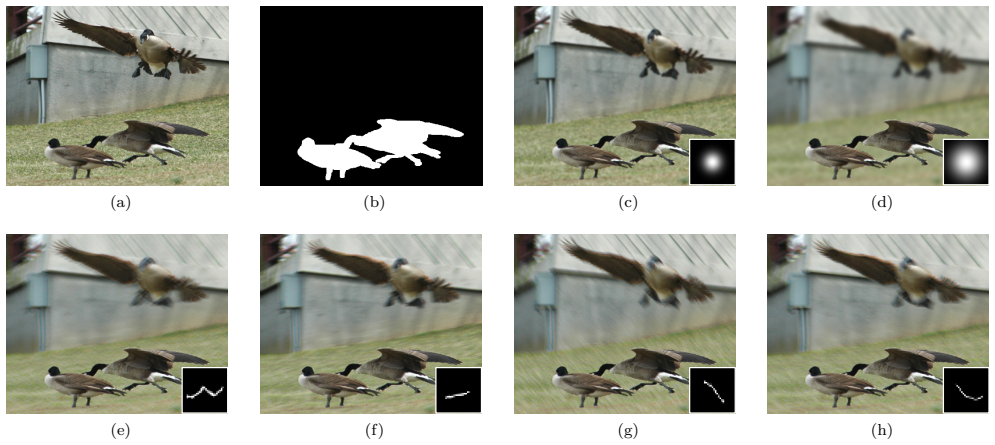
The carrying mechanism is the procedural synthetic-blur data stream: an off-the-shelf semantic-segmentation network (DeepLabv3 with a ResNet-101 backbone) is trained on image and ground-truth mask pairs generated by taking natural images, selecting a blur region from an MCG object proposal (a class-agnostic object candidate mask) or a semantic segmentation mask, inpainting the foreground to remove halo artifacts, and blurring the background with a randomized Gaussian or elastically deformed linear-motion kernel. The proposal mask itself serves as the ground-truth blur label, and mask inversion with probability $p_{inv}$ prevents the network from learning that blurred regions are always the background. This turns the annotation-scarcity problem into an on-the-fly data-generation problem.
What would settle it
Take real photos with spatially varying blur—for instance a defocus gradient where sharpness changes continuously from near to far, or object motion blur that partially occludes the foreground—and run the self-supervised model; if AUC/AP drops sharply relative to the Shi et al. and Zhao et al. benchmarks, the model has learned the uniform-kernel synthetic signature rather than general blur.
Extended reading notes
Core claim
The paper claims that a CNN trained exclusively on synthetically blurred natural images can localize real blur in photographs better than a fully supervised, task-specific CNN. In the self-supervised setting the network never sees a real blurred image, yet on the 500-image even half of the Shi et al. benchmark it reports an overall AUC of 0.933 and AP of 0.924, above the fully supervised Deep Blur Mapping baseline's 0.922 AUC and 0.912 AP. On the cross-dataset defocus-only test of Zhao et al., direct application gives 0.950 AUC versus 0.923 for that same baseline. Adding a small number of real annotated images in a semi-supervised variant yields 0.941 AUC and 0.934 AP overall, the best results among all compared methods.
Load-bearing premise
The whole approach rests on the assumption that blurring the background of an image with one uniform filter, applied to a clean object region, resembles real blur closely enough; if real blurred photos differ in how blur varies across space and crosses object edges, the model may be detecting the artificial signature rather than blur itself.
Editorial extensions
If this is right
- A practical blur detector can be trained with zero human blur annotations, using only unlabeled natural images and an object proposer.
- The same synthetic pairs improve semi-supervised training: joint training with even a small number of real annotated images outperforms fully supervised training on the same small set.
- The generator's blur-type mix acts as a control knob: training only on defocus blur gives the best defocus detection, while mixing in motion blur regularizes motion-blur detection.
- Because no blur-specific labels are required, the recipe transfers to imaging domains without blur annotations, such as infrared, histological whole-slide images, or scanned documents.
- Using an off-the-shelf architecture isolates the training procedure's contribution: a fully supervised fine-tuned model on the target data does not reach the self-supervised variant's overall numbers, attributing the gain to the synthetic generation strategy.
Reading between the lines
- Because the network only ever sees a single global blur kernel per image, its reported success may reflect a learned contrast between sharp object boundaries and heavily smoothed backgrounds; a natural stress test is to train with spatially varying blur gradients and check whether real-world generalization improves further.
- The same degrade-then-segment recipe could bootstrap other dense prediction tasks, such as depth-from-defocus or saliency, by replacing the blur generator with a task-specific degradation model and keeping the object-hypothesis masks as label regions.
- The semi-supervised curves suggest synthetic data acts as a regularizer; at even larger real-label counts the marginal benefit may fade, and identifying that saturation point would tell practitioners when to stop collecting real annotations.
- Since object proposals are class-agnostic, the self-supervised variant should transfer to image domains with object categories very different from Pascal VOC; direct tests on medical or aerial imagery would confirm whether the transfer is driven by generic objectness or by the training set's low-level statistics.
Signed reviews
Editorial analysis
A structured set of objections, weighed in public.
Referee Report
Summary. The paper proposes a framework for blur detection (dense segmentation of blurred regions) that avoids manual blur-mask annotation. It generates synthetic partially blurred images by applying Gaussian defocus or deformed linear motion blur to regions defined by object proposals (MCG) or semantic segmentation masks from Pascal VOC, with an inpainting step to remove halo artifacts. The generated image/mask pairs are used to train an off-the-shelf DeepLabv3-ResNet101 network in three configurations: purely synthetic (self-supervised), using semantic masks (weakly supervised), and joint training with a small number of real blur images (semi-supervised). Experiments are reported on Shi et al.'s 1000-image blur dataset (even/odd split) and Zhao et al.'s defocus dataset. The self-supervised variant reports overall AUC 0.933 and AP 0.924, outperforming the fully supervised Deep Blur Mapping method of Ma et al. (0.922/0.912) and a fully supervised DeepLabv3 baseline (0.923/0.922).
Significance. If the headline result is robust, the paper makes a valuable contribution: it shows that procedurally blurred images generated over object proposals can transfer to real blur detection at or above fully supervised performance, which would be useful for domains where blur annotations are unavailable. The paper is strengthened by releasing code and models, by evaluating on a second dataset for cross-dataset generalization, and by including ablations on blur type and on the number of real annotated images in the semi-supervised setting. The claims are falsifiable and the experimental framework is clearly described, so the main question is whether the reported comparison is as clean as stated.
major comments (3)
- [§3.2 and §4] The paper's headline claim that the self-supervised model is trained 'without ever observing any real blurred image' is not accurate as stated. Section 3.2 states that the model trains 'until the validation loss stagnates for 20 epochs' and that 'the setup yielding the lowest validation loss was kept for evaluation,' while Section 4 defines the validation set as 100 labeled real blurred images from the odd split of Shi et al. Real blur labels are therefore used for early stopping and hyperparameter selection. The gradient-level training signal remains synthetic, but the reported AUC/AP values are conditional on access to a labeled sample from the target distribution. Please rerun the self-supervised experiment with a fixed epoch budget, or perform model selection on a synthetic validation set, or explicitly qualify the 'without ever observing' claim.
- [Table 1 and §4.1] All results are reported on a single even/odd split with no error bars, confidence intervals, or significance tests. The phrase 'significantly better' is not supported by the reported numbers; the overall margin over Ma et al. is 0.011 in AUC and 0.012 in AP, which may be within run-to-run variation for a single training run. Please provide multiple split evaluations, bootstrap confidence intervals, or statistical significance tests for the headline comparison against fully supervised methods.
- [§2.2, §2.3, Eq. (1)] The synthetic blur model applies a single spatially uniform kernel to all background pixels and removes the foreground by inpainting before blurring. Real blur is spatially varying, arises from depth or object motion, and is often not aligned with object-proposal boundaries. The cross-dataset test on Zhao et al. partially addresses generalization, but the paper does not test whether the model is exploiting inpainting signatures or the statistics of procedural object masks rather than blur itself. Please add an ablation without inpainting, an analysis of failure cases on real images whose blur does not follow object masks, or another direct test of whether the learned representation is truly blur-based.
minor comments (6)
- [§2.1.2] Calling MCG 'virtually parameter-free' is misleading because MCG has internal parameters and a learned scoring function; consider using 'off-the-shelf' instead.
- [§3.2] Please report the ranges and grid used for learning rate, weight decay, and the early-stopping patience; the current description ('a reduced number of hyperparameter tuning configurations') is insufficient for reproducibility.
- [Footnote 3 and Table 1] The difference in evaluation protocol for Ma et al. is material; consider reporting both per-image and per-dataset AP metrics in the main table rather than only in a footnote.
- [Table 2] Define DF and MT in the table caption; the abbreviations are introduced only in the text below the table.
- [Table 1 caption] The row labeled 'Fully supervised' should state explicitly that it is DeepLabv3-ResNet101 fine-tuned on the 400 odd-split images, to avoid confusion with Ma et al.'s fully supervised model.
- [Table 3] Clarify whether Zhao et al.'s row corresponds to a model trained on their own dataset, since the other rows are direct transfers of models trained on Shi et al.
Circularity Check
Target-domain validation for early stopping and hyperparameter selection leaks real blur labels into the 'never saw real blur' claim; no other circularity found.
-
fitted input called prediction
[Abstract; Section 3.2 (Training procedure); Section 4 (Experimental Results)]
"even without ever observing any real blurred image ... We employ a negative log-likelihood loss that we minimize using the Adam optimizer, and let the model train until the validation loss stagnates for 20 epochs. A reduced number of hyperparameter tuning configurations was tried for each of the experimental setting, and the setup yielding the lowest validation loss was kept for evaluation. ... Meanwhile, a 20% of the odd subset (100 images) is used for validation"
Real-blur labels enter the model-selection loop: Section 3.2 early-stops and chooses hyperparameters by validation loss, and Section 4 defines that validation set as 100 real blurred Shi et al. images. Thus the reported even-subset AUC/AP is conditional on target-domain validation, contradicting the Abstract's 'without ever observing any real blurred image.' This is a fitted-input problem: training length and configuration are fit to real blur labels before the 'prediction' on the even subset. It does not make the test values equal to validation labels by construction, but it means the headline comparison is not a pure zero-real-blur evaluation.
full rationale
There is no formal derivation chain in the paper: the synthetic training stream is generated by Eq. (1) (Gaussian or deformed-motion kernels applied outside MCG/VOC-derived masks), and the network is a standard DeepLabv3-ResNet101 evaluated on external benchmarks (Shi et al. even partition; Zhao et al. cross-dataset). That part is self-contained and not circular. The one substantive circularity-adjacent issue is the use of 100 real blurred images as a validation set for early stopping and hyperparameter selection, which is a target-domain selection leak rather than a construction-level equivalence: a retest with a fixed epoch budget or synthetic-only validation could change the margin. Self-citations present in the references (e.g., [30], [39]) are survey-level examples and are not load-bearing. The central transfer claim therefore has independent empirical content, but the headline 'without ever observing any real blurred image' is overstated as written.
Assumptions & free parameters
free parameters (4)
- Blur kernel parameters (sigma, motion length, angle, elastic deformation) =
Unspecified random ranges
- Blur mask inversion probability p_inv =
Unspecified
- Learning rate =
1e-5
- Weight decay =
5e-4
assumptions (4)
- domain assumption Real defocus and object-motion blur are adequately represented by a single per-image Gaussian or non-linear motion kernel applied uniformly to the background region.
- domain assumption Object proposal masks, after random inversion, produce blur labels whose statistics match real blur localization.
- domain assumption Inpainting the foreground before blurring removes halo artifacts sufficiently so the network learns blur, not inpainting or boundary artifacts.
- domain assumption COCO-pretrained DeepLabv3 features transfer to the blur segmentation task.
Cite this review
Pith. "Pith review of Self-supervised blur detection from synthetically blurred scenes." pith.science (2026). https://pith.science/paper/7Z5LPVS2
@misc{pith2026190810638,
  author       = {Pith},
  title        = {Pith review of: Self-supervised blur detection from synthetically blurred scenes},
  year         = {2026},
  howpublished = {\url{https://pith.science/paper/7Z5LPVS2}},
  note         = {Machine review of arXiv:1908.10638}
}
read the original abstract
Blur detection aims at segmenting the blurred areas of a given image. Recent deep learning-based methods approach this problem by learning an end-to-end mapping between the blurred input and a binary mask representing the localization of its blurred areas. Nevertheless, the effectiveness of such deep models is limited due to the scarcity of datasets annotated in terms of blur segmentation, as blur annotation is labour intensive. In this work, we bypass the need for such annotated datasets for end-to-end learning, and instead rely on object proposals and a model for blur generation in order to produce a dataset of synthetically blurred images. This allows us to perform self-supervised learning over the generated image and ground truth blur mask pairs using CNNs, defining a framework that can be employed in purely self-supervised, weakly supervised or semi-supervised configurations. Interestingly, experimental results of such setups over the largest blur segmentation datasets available show that this approach achieves state of the art results in blur segmentation, even without ever observing any real blurred image.
Figures


Figures from the paper (3 more)


Reference graph
Works this paper leans on
-
[1]
S. Zhang, X. Shen, Z. Lin, R. Mch, J. P. Costeira, J. M. F. Moura, Learning to Understand Image Blur, in: Proceedings of the IEEE Conference on Computer Vision and Pattern Recognition, 2018, pp. 6586–6595. URL http://openaccess.thecvf.com/content_cvpr_2018/ html/Zhang_Learning_to_Understand_CVPR_2018_paper.html
work page 2018
-
[2]
S. Bae, F. Durand, Defocus Magnification, Computer Graphics Forum 26 (3) (2007) 571–579.doi:10.1111/j.1467-8659.2007. 01080.x. URL https://onlinelibrary.wiley.com/doi/abs/10.1111/j. 1467-8659.2007.01080.x
arXiv 2007
-
[3]
S. A. Golestaneh, L. J. Karam, Spatially-Varying Blur De- tection Based on Multiscale Fused and Sorted Transform Coefficients of Gradient Magnitudes, in: Proceedings of the IEEE Conference on Computer Vision and Pattern Recogni- tion, 2017, pp. 5800–5809. URL http://openaccess.thecvf.com/content_cvpr_2017/ html/Golestaneh_Spatially-Varying_Blur_Detection_CV...
work page 2017
-
[4]
X. Zhang, R. Wang, X. Jiang, W. Wang, W. Gao, Spatially vari- ant defocus blur map estimation and deblurring from a single image, Journal of Visual Communication and Image Represen- tation 35 (2016) 257–264. doi:10.1016/j.jvcir.2016.01.002. URL http://www.sciencedirect.com/science/article/pii/ S1047320316000031
-
[5]
J. Pan, Z. Hu, Z. Su, H.-Y. Lee, M.-H. Yang, Soft-Segmentation Guided Object Motion Deblurring, in: Proceedings of the IEEE Conference on Computer Vision and Pattern Recognition, 2016, pp. 459–468. URL https://www.cv-foundation.org/openaccess/content_ cvpr_2016/html/Pan_Soft-Segmentation_Guided_Object_ CVPR_2016_paper.html
work page 2016
-
[6]
J. Shi, L. Xu, J. Jia, Just noticeable defocus blur detection and estimation, in: Proceedings of the IEEE Conference on Computer Vision and Pattern Recognition, 2015, pp. 657–665
work page 2015
-
[7]
J. Gast, A. Sellent, S. Roth, Parametric Object Motion From Blur, in: Proceedings of the IEEE Conference on Computer Vision and Pattern Recognition, 2016, pp. 1846–1854. URL https://www.cv-foundation.org/openaccess/content_ cvpr_2016/html/Gast_Parametric_Object_Motion_CVPR_2016_ paper.html
work page 2016
-
[8]
S. Gur, L. Wolf, Single Image Depth Estimation Trained via Depth From Defocus Cues, in: Proceedings of the IEEE Conference on Computer Vision and Pattern Recognition, 2019, pp. 7683–7692. URL http://openaccess.thecvf.com/content_CVPR_2019/ html/Gur_Single_Image_Depth_Estimation_Trained_via_ Depth_From_Defocus_Cues_CVPR_2019_paper.html
work page 2019
Show all 58 references
-
[9]
X. Ding, Z. Chen, Improving Saliency Detection Based on Mod- eling Photographer’s Intention, IEEE Transactions on Multime- dia 21 (1) (2019) 124–134. doi:10.1109/TMM.2018.2851389
2019
-
[10]
Pertuz, M
S. Pertuz, M. A. Garcia, D. Puig, Focus-aided scene segmen- tation, Computer Vision and Image Understanding 133 (2015) 66–75. doi:10.1016/j.cviu.2014.09.009
2015 doi
-
[11]
J. Shi, L. Xu, J. Jia, Discriminative Blur Detection Features, in: Proceedings of the IEEE Conference on Computer Vision and Pattern Recognition, 2014, pp. 2965–2972. doi:10.1109/ CVPR.2014.379
2014
-
[12]
C. Tang, C. Hou, Z. Song, Defocus map estimation from a sin- gle image via spectrum contrast, Optics Letters 38 (10) (2013) 1706–1708. doi:10.1364/OL.38.001706. URL https://www.osapublishing.org/ol/abstract.cfm?uri= ol-38-10-1706
2013 doi
-
[13]
Favaro, S
P. Favaro, S. Soatto, M. Burger, S. J. Osher, Shape from Defocus via Diffusion, IEEE Transactions on Pattern Anal- ysis and Machine Intelligence 30 (3) (2008) 518–531. doi: 10.1109/TPAMI.2007.1175. 11
2008
-
[14]
C. Zhou, S. Lin, S. Nayar, Coded aperture pairs for depth from defocus, in: Proceedings of the International Conference on Computer Vision, 2009, pp. 325–332. doi:10.1109/ICCV.2009. 5459268
2009 doi
-
[15]
C. Zhou, O. Cossairt, S. Nayar, Depth from Diffusion, in: Pro- ceedings of the IEEE Conference on Computer Vision and Pat- tern Recognition, 2010, pp. 1110–1117. doi:10.1109/CVPR. 2010.5540090
2010
-
[16]
X. Zhu, S. Cohen, S. Schiller, P. Milanfar, Estimating Spatially Varying Defocus Blur From A Single Image, IEEE Transactions on Image Processing 22 (12) (2013) 4879–4891. doi:10.1109/ TIP.2013.2279316
2013
-
[17]
D. J. Chen, H. T. Chen, L. W. Chang, Fast defocus map esti- mation, in: Proceedings of the IEEE International Conference on Image Processing, 2016, pp. 3962–3966. doi:10.1109/ICIP. 2016.7533103
2016
-
[18]
X. Yi, M. Eramian, LBP-Based Segmentation of Defocus Blur, IEEE Transactions on Image Processing 25 (4) (2016) 1626–
2016
-
[19]
Y. Pang, H. Zhu, X. Li, J. Pan, Motion blur detection with an indicator function for surveillance machines, IEEE Transactions on Industrial Electronics 63 (9) (2016) 5592–5601
2016
-
[20]
T. Zhu, L. J. Karam, Efficient perceptual-based spatially vary- ing out-of-focus blur detection, in: Proceedings of the IEEE International Conference on Image Processing, 2016, pp. 2673–
2016
-
[21]
R. Liu, Z. Li, J. Jia, Image partial blur detection and clas- sification, in: Proceedings of the IEEE Conference on Com- puter Vision and Pattern Recognition, 2008, pp. 1–8. doi: 10.1109/CVPR.2008.4587465
2008
-
[22]
Chakrabarti, T
A. Chakrabarti, T. Zickler, W. T. Freeman, Analyzing spatially- varying blur, in: Proceedings of the IEEE Conference on Com- puter Vision and Pattern Recognition, 2010, pp. 2512–2519. doi:10.1109/CVPR.2010.5539954
2010
-
[23]
B. Su, S. Lu, C. L. Tan, Blurred Image Region Detection and Classification, in: Proceedings of the ACM International Con- ference on Multimedia, MM ’11, ACM, New York, NY, USA, 2011, pp. 1397–1400. doi:10.1145/2072298.2072024. URL http://doi.acm.org/10.1145/2072298.2072024
2011
-
[24]
S. Zhuo, T. Sim, Defocus map estimation from a single image, Pattern Recognition 44 (9) (2011) 1852–1858. doi:10.1016/j. patcog.2011.03.009. URL http://www.sciencedirect.com/science/article/pii/ S003132031100094X
2011 doi
-
[25]
Y. Pang, H. Zhu, X. Li, X. Li, Classifying Discriminative Fea- tures for Blur Detection, IEEE Transactions on Cybernetics 46 (10) (2016) 2220–2227. doi:10.1109/TCYB.2015.2472478
2016
-
[26]
C. Tang, J. Wu, Y. Hou, P. Wang, W. Li, A Spectral and Spatial Approach of Coarse-to-Fine Blurred Image Region Detection, IEEE Signal Processing Letters 23 (11) (2016) 1652–1656. doi: 10.1109/LSP.2016.2611608
2016
-
[27]
Shelhamer, J
E. Shelhamer, J. Long, T. Darrell, Fully Convolutional Net- works for Semantic Segmentation, IEEE Transactions on Pat- tern Analysis and Machine Intelligence PP (99) (2016) 1–1. doi:10.1109/TPAMI.2016.2572683
2016
-
[28]
L.-C. Chen, G. Papandreou, F. Schroff, H. Adam, Rethink- ing Atrous Convolution for Semantic Image Segmentation, arXiv:1706.05587 [cs]. URL http://arxiv.org/abs/1706.05587
-
[29]
K. He, G. Gkioxari, P. Dollr, R. Girshick, Mask R-CNN, in: Proceedings of the International Conference on Computer Vi- sion, Venice, Italy, 2017. URL http://openaccess.thecvf.com/ICCV2017_search.py
2017
-
[30]
X. Liu, J. van de Weijer, A. D. Bagdanov, Leveraging Unlabeled Data for Crowd Counting by Learning to Rank, in: Proceed- ings of the IEEE Conference on Computer Vision and Pattern Recognition, Salt Lake City, USA, 2018. URL http://arxiv.org/abs/1803.03095
2018 arXiv
-
[31]
K. Ma, H. Fu, T. Liu, Z. Wang, D. Tao, Deep Blur Map- ping: Exploiting High-Level Semantics by Deep Neural Net- works, IEEE Transactions on Image Processing 27 (10) (2018) 5155–5166. doi:10.1109/TIP.2018.2847421
2018
-
[32]
B. Kim, H. Son, S.-J. Park, S. Cho, S. Lee, Defocus and Mo- tion Blur Detection with Deep Contextual Features, Computer Graphics Forum 37 (7) (2018) 277–288. doi:10.1111/cgf. 13567. URL https://onlinelibrary.wiley.com/doi/full/10.1111/ cgf.13567
2018 doi
-
[33]
Park, Y.-W
J. Park, Y.-W. Tai, D. Cho, I. So Kweon, A Unified Approach of Multi-Scale Deep and Hand-Crafted Features for Defocus Estimation, in: Proceedings of the IEEE Conference on Com- puter Vision and Pattern Recognition, 2017, pp. 1736–1745. URL http://openaccess.thecvf.com/content_c...
2017
-
[34]
K. Zeng, Y. Wang, J. Mao, J. Liu, W. Peng, N. Chen, A Lo- cal Metric for Defocus Blur Detection Based on CNN Feature Learning, IEEE Transactions on Image Processing 28 (5) (2019) 2107–2115. doi:10.1109/TIP.2018.2881830
2019
-
[35]
W. Zhao, F. Zhao, D. Wang, H. Lu, Defocus Blur Detection via Multi-Stream Bottom-Top-Bottom Fully Convolutional Network, in: Proceedings of the IEEE Conference on Computer Vision and Pattern Recognition, 2018, pp. 3080–3088. URL http://openaccess.thecvf.com/content_cvpr_2018/ ...
2018
-
[36]
W. Zhao, F. Zhao, D. Wang, H. Lu, Defocus Blur Detection via Multi-Stream Bottom-Top-Bottom Network, IEEE Trans- actions on Pattern Analysis and Machine Intelligence (2019) 1–1doi:10.1109/TPAMI.2019.2906588
2019
-
[37]
Ledig, L
C. Ledig, L. Theis, F. Huszar, J. Caballero, A. Aitken, A. Te- jani, J. Totz, Z. Wang, W. Shi, Photo-Realistic Single Im- age Super-Resolution Using a Generative Adversarial Network, arXiv:1609.04802 [cs]. URL http://arxiv.org/abs/1609.04802
-
[38]
Pathak, P
D. Pathak, P. Krahenbuhl, J. Donahue, T. Darrell, A. A. Efros, Context Encoders: Feature Learning by Inpainting, in: Pro- ceedings of the IEEE Conference on Computer Vision and Pat- tern Recognition, 2016
2016
-
[39]
X. Liu, J. van de Weijer, A. D. Bagdanov, RankIQA: Learning From Rankings for No-Reference Image Quality Assessment, in: Proceedings of the International Conference on Computer Vi- sion, 2017
2017
-
[40]
Zhang, P
R. Zhang, P. Isola, A. A. Efros, E. Shechtman, O. Wang, The Unreasonable Effectiveness of Deep Networks as a Perceptual Metric, in: Proceedings of the IEEE Conference on Computer Vision and Pattern Recognition, 2018. URL https://richzhang.github.io/PerceptualSimilarity/
2018
-
[41]
Novotny, S
D. Novotny, S. Albanie, D. Larlus, A. Vedaldi, Self-Supervised Learning of Geometrically Stable Features Through Proba- bilistic Introspection, in: Proceedings of the IEEE Conference on Computer Vision and Pattern Recognition, 2018, pp. 3637–3645. URL http://openaccess.thecvf....
2018
-
[42]
Jenni, P
S. Jenni, P. Favaro, Self-Supervised Feature Learning by Learning to Spot Artifacts, in: Proceedings of the IEEE Conference on Computer Vision and Pattern Recognition, 2018, pp. 2733–2742. URL http://openaccess.thecvf.com/content_cvpr_2018/ html/Jenni_Self-Supervised_Feature_L...
2018
-
[43]
Kupyn, V
O. Kupyn, V. Budzan, M. Mykhailych, D. Mishkin, J. Matas, DeblurGAN: Blind Motion Deblurring Using Conditional Adversarial Networks, in: Proceedings of the IEEE Conference on Computer Vision and Pattern Recognition, 2018, pp. 8183–8192. URL http://openaccess.thecvf.com/content...
2018
-
[44]
Purohit, A
K. Purohit, A. B. Shah, A. N. Rajagopalan, Learning Based Sin- gle Image Blur Detection and Segmentation, in: Proceedings of the IEEE International Conference on Image Processing, 2018, pp. 2202–2206. doi:10.1109/ICIP.2018.8451765. 12
2018
-
[45]
Krahenbuhl, V
P. Krahenbuhl, V. Koltun, Learning to Propose Objects, in: Proceedings of the IEEE Conference on Computer Vision and Pattern Recognition, 2015, pp. 1574–1582. URL https://www.cv-foundation.org/openaccess/content_ cvpr_2015/html/Krahenbuhl_Learning_to_Propose_2015_ CVPR_paper.html
2015
-
[46]
S. Chen, H. Shen, Multispectral Image Out-of-Focus Deblurring Using Interchannel Correlation, IEEE Transactions on Image Processing 24 (11) (2015) 4433–4445. doi:10.1109/TIP.2015. 2465162
2015 doi
-
[47]
X. M. Lopez, E. D’Andrea, P. Barbot, A.-S. Bridoux, S. Rorive, I. Salmon, O. Debeir, C. Decaestecker, An Automated Blur Detection Method for Histological Whole Slide Imaging, PLOS ONE 8 (12) (2013) e82710. doi:10.1371/journal.pone.0082710. URL https://journals.plos.org/plosone...
2013 doi
-
[48]
Maheshwari, P
S. Maheshwari, P. K. Rai, G. Sharma, V. Gandhi, Document Blur Detection Using Edge Profile Mining, in: Proceedings of the Tenth Indian Conference on Computer Vision, Graphics and Image Processing, ICVGIP ’16, ACM, New York, NY, USA, 2016, pp. 23:1–23:7. doi:10.1145/3009977.3009...
2016
-
[49]
Everingham, S
M. Everingham, S. M. A. Eslami, L. V. Gool, C. K. I. Williams, J. Winn, A. Zisserman, The Pascal Visual Object Classes Chal- lenge: A Retrospective, International Journal of Computer Vi- sion 111 (1) (2015) 98–136. doi:10.1007/s11263-014-0733-5 . URL https://link.springer.com/...
2015 doi
-
[50]
Pont-Tuset, P
J. Pont-Tuset, P. Arbelez, J. T. Barron, F. Marques, J. Ma- lik, Multiscale Combinatorial Grouping for Image Segmentation and Object Proposal Generation, IEEE Transactions on Pat- tern Analysis and Machine Intelligence 39 (1) (2017) 128–140. doi:10.1109/TPAMI.2016.2537320
2017
-
[51]
Telea, An Image Inpainting Technique Based on the Fast Marching Method, Journal of Graphics Tools 9 (1) (2004) 23–
A. Telea, An Image Inpainting Technique Based on the Fast Marching Method, Journal of Graphics Tools 9 (1) (2004) 23–
2004
-
[52]
L.-C. Chen, G. Papandreou, I. Kokkinos, K. Murphy, A. L. Yuille, Semantic Image Segmentation with Deep Convolutional Nets and Fully Connected CRFs, in: International Conference on Learning Representations, 2015, arXiv: 1412.7062. URL http://arxiv.org/abs/1412.7062
2015 arXiv
-
[53]
F. Yu, V. Koltun, Multi-Scale Context Aggregation by Dilated Convolutions, in: International Conference on Learning Repre- sentations, 2016. URL http://arxiv.org/abs/1511.07122
2016 arXiv
-
[54]
URL https://doi.org/10.1080/10867651.2004.10487596
doi:10.1080/10867651.2004.10487596. URL https://doi.org/10.1080/10867651.2004.10487596
2004
-
[55]
Tsai, W.-C
Y.-H. Tsai, W.-C. Hung, S. Schulter, K. Sohn, M.-H. Yang, M. Chandraker, Learning to Adapt Structured Output Space for Semantic Segmentation, in: Proceedings of the IEEE Conference on Computer Vision and Pattern Recognition, 2018, pp. 7472–7481. doi:10.1109/CVPR.2018.00780. UR...
2018
-
[57]
T.-Y. Lin, M. Maire, S. Belongie, J. Hays, P. Perona, D. Ramanan, P. Dollr, C. L. Zitnick, Microsoft COCO: Common Objects in Context, in: Proceedings of the Eu- ropean Conference on Computer Vision, Lecture Notes in Computer Science, Springer, Cham, 2014, pp. 740–755. doi:10.1...
2014 doi
-
[1638]
doi:10.1109/TIP.2016.2528042
2016
-
[2677]
doi:10.1109/ICIP.2016.7532844
2016
Reviewed August 14, 2026 · model on record in the stance chip above.
Discussion (0). Continue with ORCID to comment.