REVIEW 3 major objections 6 minor 34 references
Bandwidth Allocation and Resource Adjustment for Stability Enhancement in Complex Networks
T0 review · 3 major / 6 minor · reviewed 2026-08-14 · deepseek-v4-flash
Pith's one-line read This paper shows that optimized bandwidth allocation and resource adjustment can turn a power-law tail of overloaded links into a Gaussian tail, allowing full network protection with a much smaller total bandwidth budget.
desk verdict The minlink bandwidth allocation result is solid and worth knowing, but the paper's analytic Gaussian-tail claim for the minflow scheme rests on a false identity in Appendix 3; the qualitative conclusion still holds on simulations. read the letter →
The pith
A machine-rendered reading of the paper's core claim, the machinery that carries it, and where it could break.
The reading
What carries the argument
The central object is the discrete Green's function $G$, the pseudoinverse of the graph Laplacian $L$, which maps node resources to chemical potentials: $\mu = G\Lambda$. For quadratic transportation cost, the current on link $(ij)$ is $y_{ij} = \sum_l (G_{jl} - G_{il})\Lambda_l$, the same map used in DC power-flow transfer factors. Its role is to turn assumed independent node fluctuations with variances $\langle\delta\Lambda_i^2\rangle$ into link flow variances $\langle\delta y_{ij}^2\rangle = \sum_k (G_{jk} - G_{ik})^2\langle\delta\Lambda_k^2\rangle$, which then enter the allocation optimality conditions: $P_{ij}(\Delta L_{ij}) = \lambda$ for minlink, and $\Delta L_{ij} \propto \sqrt{\langle\delta y_{ij}^2\rangle}$ for minflow. This reduces stability design to one linear computation of the Green's function followed by per-link scalar decisions, and the same variance predictions drive the optimal resource-adjustment optimization.
What would settle it
On a real or simulated test network, measure node-level fluctuations and link-flow variances, then compare the measured variances with the Green's-function prediction $\langle\delta y_{ij}^2\rangle = \sum_k (G_{jk} - G_{ik})^2\langle\delta\Lambda_k^2\rangle$. If the mismatch is systematic, the independence premise fails. A second test: introduce correlated regional fluctuations into the RTS-96 test network and run minlink and minflow; if the overload fraction stops decaying as $\exp(-\varepsilon^2/2k^2)$ or the actual optimum allocation differs from the predicted one, the guarantee is broken.
Extended reading notes
Core claim
The paper's central claim is that flow fluctuations in a cost-minimizing flow network are propagated linearly from node-resource fluctuations by the pseudoinverse of the graph Laplacian, so each link's flow variance is a weighted sum of node variances with known coefficients. Under that variance map, protection becomes a constrained optimization: choose link tolerances to minimize either the expected number of overloaded links (minlink) or the expected excess current (minflow), keeping total added bandwidth fixed. The optimal allocations concentrate bandwidth on links with weak or moderate fluctuations instead of spreading it proportionally to base flow. Analytically, the overload fraction of proportionate allocation decays as $\varepsilon^{-1}$, while minlink and minflow decay as approximately $\exp(-\varepsilon^2/2k^2)$, replacing a heavy power-law tail with a Gaussian tail. The resource-adjustment scheme minimizes overload probability by reallocating node resources under a fixed total-change budget, and its flow reductions are correlated with the bandwidth-optimal allocations except at relay nodes that reroute reductions without shedding their own load.
Load-bearing premise
The load-bearing premise is that node-level resource fluctuations are independent with known variances and that link flow fluctuations can be treated as independent in the analytical performance predictions; if fluctuations are correlated or the variances are unknown, the optimal allocations lose their guarantee and the exponential convergence result no longer follows.
Editorial extensions
If this is right
- For a fixed bandwidth budget, minlink and minflow reduce the overloaded-link fraction from a $\varepsilon^{-1}$ power-law tail to a Gaussian tail; equivalently, complete protection requires significantly less total bandwidth.
- Network operators can identify the most fragile links from node fluctuation variances and one precomputed Green's function, without repeated full-network simulations.
- The resource-adjustment scheme provides a budget-constrained load-shedding rule that minimizes expected overloads, improving on proportionate reduction of all supplies.
- The same allocation formulas extend to non-Gaussian fluctuations: for long-tailed stable resource noise, minlink and minflow still outperform proportionate allocation, while a Gaussian assumption is near-optimal for excess current but suboptimal for overload count.
- Because bandwidth-optimal links and resource-adjustment links coincide, design-stage capacity additions and real-time load shedding reinforce the same set of links, giving a coherent two-stage protection strategy.
Reading between the lines
- An implication the paper leaves implicit is that the proportionate scheme's waste is concentrated on low-flow links, so a cheap heuristic that first freezes near-zero-flow links and then optimizes only the remaining links should recover most of the Gaussian-tail benefit at lower computational cost.
- The variance-propagation formula naturally defines a per-link vulnerability index—squared Green's-function sensitivity weighted by node variances—that could be used outside the paper's optimization context as a screening tool for cascading-failure risk.
- If the independence assumption is challenged, a direct extension would include a covariance matrix for node fluctuations; the predicted optimum would then shift bandwidth toward links whose Green's-function vectors align with the dominant covariance eigenvectors, a testable generalization.
- The observed relay nodes suggest a control-layer addition: explicitly rewarding nodes that reroute reductions without shedding their own load could reduce the number of active participants needed to reach a target overload probability.
Signed reviews
Editorial analysis
A structured set of objections, weighed in public.
Referee Report
Summary. Tsang and Wong study a DC power-flow/resource-allocation model with a quadratic transportation cost. They express link flows through the pseudoinverse of the graph Laplacian, the discrete Green's function, and derive the variance of flow fluctuations induced by independent node-resource fluctuations (Eq. 16). They then propose two bandwidth-allocation schemes, minlink (Eq. 22), minimizing the expected number of overloaded links, and minflow (Eq. 26), minimizing expected excess current, under a fixed total bandwidth budget, together with a numerical resource-adjustment scheme (Eq. 36) for load shedding. The paper claims that these optimized schemes make the overload probability decay as a Gaussian tail exp(-epsilon^2/2k^2), whereas proportionate allocation only decays as epsilon^{-1}, and supports this with simulations on ER, BA, RTS96, and IEEE-300 networks and with Levy-stable fluctuations.
Significance. The paper connects a standard power-engineering object, the PTDF matrix in the DC approximation, to a water-filling optimization for bandwidth allocation. The minlink and minflow formulas are derived rather than fitted, and the absence of free parameters in the allocation rules is a strength, as is the validation on standard IEEE test systems. If the asymptotic claims survive correction, the paper provides a practical design rule for bandwidth and tolerance allocation with a substantial improvement over proportionate allocation. However, the current manuscript contains a flawed analytical step in the minflow asymptotics, and the claimed exponential rate is not yet established.
major comments (3)
- [Appendix 3, Eqs. (56)-(58)] The derivation of Eq. (58) is mathematically invalid. The left-hand side of Eq. (56) contains sqrt(sum_l a_l^2 Lambda_l^2), which is not the absolute value of the Gaussian sum sum_l a_l Lambda_l unless the coefficient vector has a single nonzero entry. A weighted sum of squares of independent Gaussians is a chi-type variable, not the square of a Gaussian variable. The sentence preceding Eq. (57) is therefore incorrect, and the moment replacement epsilon' k N integral Dy y^2 = epsilon N integral Dy |y| is not justified. Even under that replacement, the standard Gaussian moments give epsilon' = sqrt(2/pi) epsilon/k, not epsilon' = (sqrt(pi)/2) epsilon/k as stated in Eq. (58). Consequently Eqs. (61) and (62) do not follow, and the claimed Gaussian-tail scaling for the minflow scheme is not supported analytically. The simulation evidence for the qualitative advantage of minflow may still stand, but the asymptotic formula must be corrected or explicitly labeled as an empirical observation.
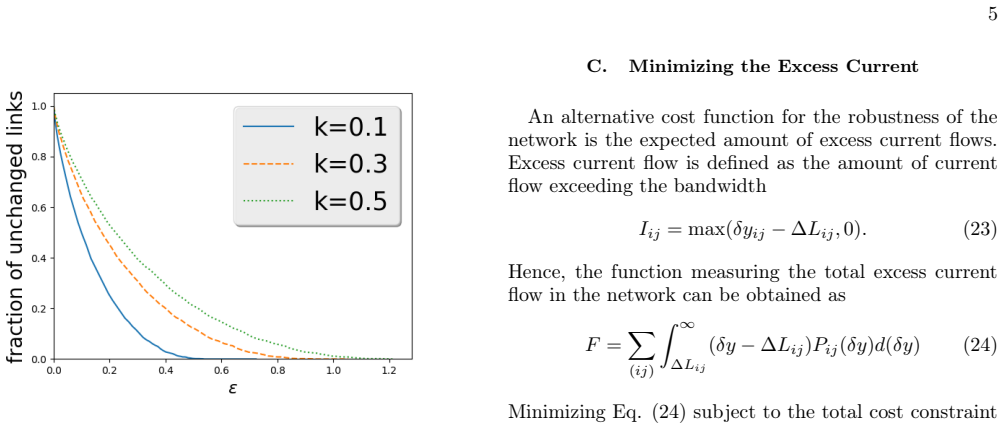
- [Fig. 1 caption and Appendix 1] The caption of Fig. 1 states that the analytical result is displaced downwards after divided by 2 for visualization. A factor-of-two rescaling is a quantitative modification, not a visualization offset; if the analytical curve must be divided by two to lie on the simulation data, the claim of excellent agreement is not supported. The authors should either derive this factor from Eqs. (40)-(42) or present the comparison without rescaling. Because the epsilon^{-1} scaling of the proportionate scheme is the baseline against which the optimized schemes are compared, this unexplained factor matters for the paper's central quantitative narrative.
- [Appendix 1, Eq. (40), and Sec. II.C] The analytical performance calculations replace the per-link fluctuation scale sigma_delta_y of Eq. (16) by a single global scale k sigma_y (Eq. (37) and Eq. (40)). This ignores the link-to-link variation of sum_l (G_jl - G_il)^2 Lambda_l^2 and also ignores the correlation between the baseline flow y_ij and the fluctuation amplitude sigma_delta_y. The conditions under which such a mean-field replacement is accurate, for example dense graphs or self-averaging over many links, are not stated. Since all subsequent analytical curves in the Appendix rely on this replacement, the analytic support for the plotted agreement is weaker than the text suggests.
minor comments (6)
- [Sec. III.A] The shorthand 'proport' is used before its definition in Sec. III.B; the three scheme names should be defined together at first use.
- [Throughout] The name 'Erdos-Renyi' is spelled 'Erdos-Renyi' in the text; the standard spelling is 'Erdos-Renyi' or 'Erdos-Renyi' with the appropriate diacritics.
- [Appendix 1, Eq. (45)] The expression for P_prop^C in Eq. (45) and its large-epsilon limit in Eq. (46) should be checked: the auxiliary variable y appears both in the integrand and in the integration measure, and the displayed integral may have a missing prefactor.
- [Sec. IV, Eq. (36)] The erfc argument in Eq. (36) contains sgn(-y0_ij) z_ij, but the preceding text defines overload through |y_ij| > L_ij; the sign convention should be explained and the derivation of Eq. (36) should be expanded.
- [Fig. 2 caption] The caption says the figure is for a random network with fixed connectivity d_i = 3, but the network size, number of samples, and other parameters are not given in the caption or the surrounding text.
- [Conclusion] The conclusion contains a typographical double period in the sentence ending 'in the presence of fluctuations..'.
Circularity Check
No circularity found: the optimized allocation schemes are derived from the stated model via Lagrangian optimization and are not re-descriptions of their outputs.
full rationale
The paper's central derivation chain is self-contained and non-circular. The flow fluctuations are obtained from the discrete Green's function (Eq. 10), the variance formula follows by direct linear algebra (Eq. 16), and the minlink and minflow allocation rules come from minimizing explicit objective functions (Eqs. 19 and 24) under a fixed total-bandwidth constraint (Eq. 20). The Appendix then evaluates the resulting Gaussian tail asymptotics from these rules; no fitted parameter is renamed as a prediction, and no result is defined in terms of the quantity it claims to derive. The model-specific assumption that resource fluctuations have zero mean and known variances is an input to the optimization, not a circularly chosen output. The comparisons against simulations use the same fluctuation statistics, but that is conventional a priori modeling rather than fitting to the predicted overload fractions. The self-citations to the authors' earlier work (e.g., Refs. [8], [20], [27]) provide background models or extensions and are not load-bearing for the uniqueness or correctness of the bandwidth allocation derivation. One genuine concern is in Appendix 3: Eqs. (56)-(58) treat a sum of squared Green's-function terms as the square of a Gaussian variable, which is not generally justified, so the Gaussian-tail scaling exp(-epsilon^2/2k^2) for minflow is not established as stated. This is a mathematical/correctness issue, not circularity, since the claim does not reduce to its own input by construction.
Assumptions & free parameters
free parameters (3)
- Fluctuation parameter k =
0.1 in simulations
- Load-shedding ratio c =
0 to 0.6 varied in Fig. 5; 0.3 in Figs. 6-8
- Standard deviation of initial resource distribution =
10 in Fig. 3, 1 in Fig. 5
assumptions (5)
- standard math The network flow optimization with quadratic cost is solved by the pseudoinverse of the graph Laplacian (discrete Green's function).
- domain assumption Resource fluctuations are independent across nodes with zero mean and known variances.
- ad hoc to paper Flow fluctuations are treated as independent across links in the analytical performance calculations.
- domain assumption Gaussian or Lévy-stable distribution of resource fluctuations.
- domain assumption Power grid in the DC approximation with unit line susceptances.
Cite this review
Pith. "Pith review of Bandwidth Allocation and Resource Adjustment for Stability Enhancement in Complex Networks." pith.science (2026). https://pith.science/paper/SMEWIDLZ
@misc{pith2026190810671,
  author       = {Pith},
  title        = {Pith review of: Bandwidth Allocation and Resource Adjustment for Stability Enhancement in Complex Networks},
  year         = {2026},
  howpublished = {\url{https://pith.science/paper/SMEWIDLZ}},
  note         = {Machine review of arXiv:1908.10671}
}
read the original abstract
We introduce the discrete Green's function to elucidate how resource fluctuations determine flow fluctuations in a network optimizing a global cost function. To enhance the robustness of the network against fluctuations, we develop the schemes of optimal bandwidth allocation in links and optimal resource adjustment in nodes. With the total bandwidth of the network fixed, the approach of optimal bandwidth allocation is to increase the bandwidth in links such that the number of overloaded links or the amount of excess flows in networks under fluctuations can be minimized. Similarly, the approach of optimal resource adjustment is to minimize the number of overloaded links in networks under fluctuations with the total resource change in the network fixed. Compared with the conventional approach of proportionate bandwidth assignment or resource reduction, it is found that the optimized bandwidth allocation or resource adjustment can highly enhance the stability of the networks against fluctuations. The changes of loads and currents prescribed by the optimal bandwidth allocation and resource adjustment schemes are correlated with each other, except for some nodes that exhibit relay effects.
Figures


Figures from the paper (5 more)




Reference graph
Works this paper leans on
-
[1]
The Proportionate Scheme Consider the resource fluctuations follow Gaussian dis- tribution with mean equal to 0 and⟨δΛ2 i⟩ = k2(Λ0 i )2, where k is the fluctuation parameter. Then the flow fluctuations will also follow a Gaussian distribution with mean 0 and variance σ2 δy =k2σ2 y. (37) To study the performance of the bandwidth allocation schemes, we express ...
-
[2]
The Minlink Scheme We further study the behavior of the minlink algo- rithm in which ∆Lij is given by Eq. (22). Let ρ = 1/(λ √ 2πσδy). From the constraint Eq. (20), we have 2 ˆ ρ 0 Dyσδyy √ 2 ln (ρ y ) = 2ε ˆ ∞ 0 Dzσyz. (47) This results in an equation forε, ε =k √ 2π ˆ ρ 0 Dyy √ 2 ln (ρ y ) . (48) The average overload probability using theminlink algo- r...
-
[3]
(20), ε′∑ (ij) √ ⟨δy2 ij⟩ =ε ∑ (ij |yij|
The Minflow Scheme Finally, for theminflowalgorithm, we can expressε′ in terms ofε using Eq. (20), ε′∑ (ij) √ ⟨δy2 ij⟩ =ε ∑ (ij |yij|. (55) Using Eqs. (16) and (10), we can write ε′k ∑ (ij) √∑ l (Gjl−Gil)2Λ2 l =ε ∑ (ij) | ∑ l (Gjl−Gil)Λl|. (56) Notethatinsidethesquarerootsignonthelefthandside, the term is the square of a Gaussian variable with mean 0 and va...
-
[4]
Ro- bustness of networks against fluctuation-induced cascad- ing failures
Dominik Heide, Mirko Schäfer, and Martin Greiner. Ro- bustness of networks against fluctuation-induced cascad- ing failures. Physical Review E, 77(5):056103, 2008
work page 2008
-
[5]
Daniel Bienstock, Michael Chertkov, and Sean Har- nett. Chance-constrained optimal power flow: Risk- aware network control under uncertainty.SIAM Review, 56(3):461–495, 2014
work page 2014
-
[6]
North american blackout time series statistics and implications for blackout risk
Benjamin A Carreras, David E Newman, and Ian Dob- son. North american blackout time series statistics and implications for blackout risk. IEEE Transactions on Power Systems, 31(6):4406–4414, 2016
work page 2016
-
[7]
The economic impacts of the august 2003 blackout.Washington, DC, 2004
Electricity Consumers Resource Council. The economic impacts of the august 2003 blackout.Washington, DC, 2004
work page 2003
-
[8]
Non-gaussian power grid frequency fluctuations characterized by lévy-stable laws and superstatistics
Benjamin Schäfer, Christian Beck, Kazuyuki Aihara, Dirk Witthaut, and Marc Timme. Non-gaussian power grid frequency fluctuations characterized by lévy-stable laws and superstatistics. Nature Energy, 3(2):119, 2018
work page 2018
Show all 34 references
-
[9]
Structure, scal- ing, and phase transition in the optimal transport net- work
Steffen Bohn and Marcelo O Magnasco. Structure, scal- ing, and phase transition in the optimal transport net- work. Physical Review Letters, 98(8):088702, 2007
2007
-
[10]
From the physics of interacting polymers to optimizing routes on the London underground.Proceedings of the National Academy of Sciences, 110(34):13717–13722, 2013
Chi Ho Yeung, David Saad, and KY Michael Wong. From the physics of interacting polymers to optimizing routes on the London underground.Proceedings of the National Academy of Sciences, 110(34):13717–13722, 2013
2013
-
[11]
For the quadratic cost function, using Eq
and it will be shown to be equivalent to power grid networks in the direct current (DC) approximation. For the quadratic cost function, using Eq. (4), one can obtain the chemical potentials as ∑ j Lijµj = Λi, (6) where L is the Laplacian matrix given by L =D−A. (7) In the abov...
-
[12]
Cascade-based attacks on complex networks
Adilson E Motter and Ying-Cheng Lai. Cascade-based attacks on complex networks. Physical Review E , 66(6):065102, 2002
2002
-
[13]
Optimal control of cascading power grid failures
Daniel Bienstock. Optimal control of cascading power grid failures. In 2011 50th IEEE Conference on De- cision and Control and European Control Conference , pages 2166–2173. IEEE, 2011
2011
-
[14]
Michael Wong and David Saad
K.Y. Michael Wong and David Saad. Inference and op- timization of real edges on sparse graphs: A statistical physics perspective. Physical Review E , 76(1):011115, 2007
2007
-
[15]
Complex networks: principles, methods and applications
Vito Latora, Vincenzo Nicosia, and Giovanni Russo. Complex networks: principles, methods and applications . Cambridge University Press, 2017
2017
-
[16]
Random walks and electric networks, Mathematical Association of America,
Peter G Doyle and J Laurie Snell. Random walks and electric networks, Mathematical Association of America,
-
[17]
http://www.ee.washington.edu/research/pstca/ pf300/pg_tca300bus.htm
-
[18]
Fan Chung and S.-T. Yau. Discrete green’s functions. Journal of Combinatorial Theory, Series A , 91(1):191– 214, 2000
2000
-
[19]
A dual method for computing power transfer distribu- tion factors
Henrik Ronellenfitsch, Marc Timme, and Dirk Witthaut. A dual method for computing power transfer distribu- tion factors. IEEE Transactions on Power Systems , 32(2):1007–1015, 2016
2016
-
[20]
Wood and Bruce F Wollenberg.Power Genera- tion, Operation, and Control
Allen J. Wood and Bruce F Wollenberg.Power Genera- tion, Operation, and Control . John Wiley & Sons, 2012
2012
-
[21]
Scaling of transmission ca- pacities in coarse-grained renewable electricity networks
Mirko Schäfer, S Bugge Siggaard, Kun Zhu, C Risager Poulsen, and Martin Greiner. Scaling of transmission ca- pacities in coarse-grained renewable electricity networks. EPL (Europhysics Letters), 119(3):38004, 2017
2017
-
[22]
The IEEE reliability test system-1996
Cliff Grigg, Peter Wong, Paul Albrecht, Ron Allan, Murty Bhavaraju, Roy Billinton, Quan Chen, Clement Fong, Suheil Haddad, Sastry Kuruganty, et al. The IEEE reliability test system-1996. a report prepared by the re- liability test system task force of the application of prob- a...
1996
-
[23]
Michael Wong and David Saad
K.Y. Michael Wong and David Saad. Equilibration through local information exchange in networks.Physical Review E, 74(1):010104, 2006
2006
-
[24]
Convex opti- mization
Stephen Boyd and Lieven Vandenberghe. Convex opti- mization. Cambridge university press, 2004
2004
-
[25]
Optimizing synchroniza- tion stability of the kuramoto model in complex networks and power grids.Physical Review E, 95(1):012207, 2017
Bo Li and KY Michael Wong. Optimizing synchroniza- tion stability of the kuramoto model in complex networks and power grids.Physical Review E, 95(1):012207, 2017
2017
-
[26]
Henry Tsang, Bo Li, and K.Y
K.Y. Henry Tsang, Bo Li, and K.Y. Michael Wong. En- hancing synchronization stability in complex networks with probabilistic natural frequencies. In International Conference on Complex Networks and their Applications , pages 854–865. Springer, 2018
2018
-
[27]
Michael Wong
Elizabeth Harrison, David Saad, and K.Y. Michael Wong. Optimal distribution in smart grids with volatile renewable sources using a message passing algorithm.In- ternational Journal of Smart Grid and Clean Energy , 5(4):221–228, 2016
2016
-
[28]
Optimal transportation network with concave cost functions: loop analysis and algorithms
Zhen Shao and Haijun Zhou. Optimal transportation network with concave cost functions: loop analysis and algorithms. Physical Review E, 75(6):066112, 2007
2007
-
[30]
World Scientific Publishing Company, 1987
Marc Mézard, Giorgio Parisi, and Miguel Virasoro.Spin glass theory and beyond: An Introduction to the Replica Method and Its Applications . World Scientific Publishing Company, 1987
1987
-
[31]
Probabilistic reasoning in intelligent sys- tems: networks of plausible inference
Judea Pearl. Probabilistic reasoning in intelligent sys- tems: networks of plausible inference . Elsevier, 2014
2014
-
[32]
Correctness of local probability propaga- tion in graphical models with loops.Neural computation, 12(1):1–41, 2000
Yair Weiss. Correctness of local probability propaga- tion in graphical models with loops.Neural computation, 12(1):1–41, 2000
2000
-
[34]
Power grid vulnerability to geographically correlated failures- analysis and con- trol implications
Andrey Bernstein, Daniel Bienstock, David Hay, Meric Uzunoglu, and Gil Zussman. Power grid vulnerability to geographically correlated failures- analysis and con- trol implications. In IEEE INFOCOM 2014-IEEE Con- 13 ference on Computer Communications, pages 2634–2642. IEEE, 2014
2014
-
[96]
power network [16] and the IEEE 300-Bus System [17]. The ER network is constructed byN = 1000 nodes with the connecting probabilityp = 0.005 and the BA network withN = 1000 is constructed by attaching two edges from a new node to existing nodes with the proba- bilityp =di/∑ jd...
-
[1984]
arXiv preprint math.PR/0001057
Reviewed August 14, 2026 · model on record in the stance chip above.
Discussion (0). Continue with ORCID to comment.