REVIEW 2 major objections 5 minor 49 references
Spin functional renormalization group for quantum Heisenberg ferromagnets: Magnetization and magnon damping in two dimensions
T0 review · 2 major / 5 minor · reviewed 2026-08-14 · deepseek-v4-flash
Pith's one-line read Spin renormalization group matches 2D Heisenberg ferromagnet Monte Carlo at low temperatures
desk verdict Ward-identity closure is a real method advance and the low-temperature Monte Carlo agreement is promising, but the uncontrolled tree-level initial conditions and the susceptibility prefactor discrepancy keep the quantitative claim provisional. read the letter →
The pith
A machine-rendered reading of the paper's core claim, the machinery that carries it, and where it could break.
The reading
What carries the argument
The machinery is a hybrid generating functional $\Gamma_\Lambda[m,\varphi]$ depending on transverse magnetization $m$ and a longitudinal exchange field $\varphi$, which obeys an exact Wetterich-type flow equation and has well-defined initial conditions even when all exchange couplings are switched off. In the truncation used for the numerical results, the decisive element is the Ward identity $\chi_\perp = M/H$, which fixes the zero-momentum magnon self-energy in terms of the flowing magnetization and removes any fine-tuning of the initial gap. Around that core, the calculation uses a sharp momentum cutoff, a total-derivative substitution for vertex corrections, and a recursive form of the generalized Wick theorem in frequency space to supply the initial single-spin correlation functions.
What would settle it
A high-precision Monte Carlo calculation for the nearest-neighbour model at $H/J \approx 0.05$ and $T/J \approx 0.3$ that disagrees with the SFRG magnetization curve by more than the statistical error would falsify the claimed quantitative agreement; equivalently, a controlled Monte Carlo simulation of the same model with long-range exchange, where the tree-level initial vertices are justified, would show whether the initial-condition approximation is the source of any discrepancy.
Extended reading notes
Core claim
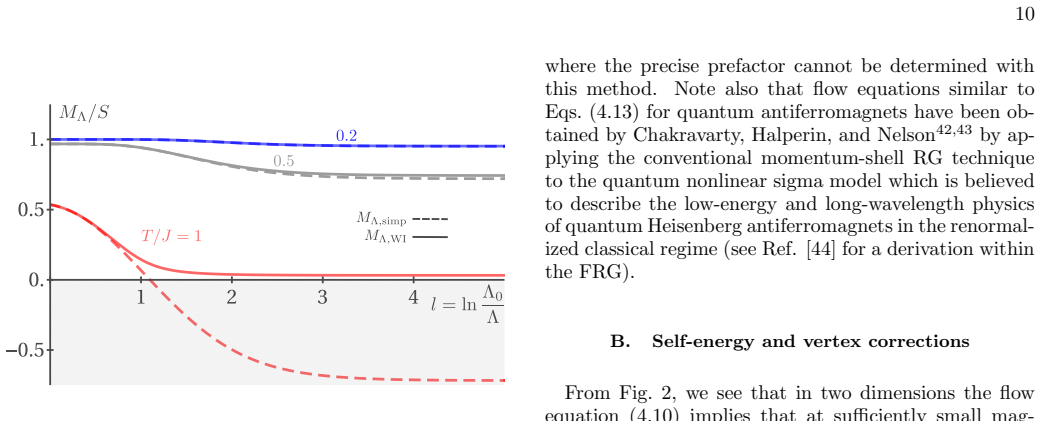
The paper's central claim is that a truncated SFRG flow closed by the Ward identity $\chi_\perp = M/H$ produces a finite magnetic equation of state $M(H,T)$ for a two-dimensional Heisenberg ferromagnet, including fields so small that perturbative spin-wave theory diverges. The closure ties the flowing magnon gap $\Delta_\Lambda = H M_0/M_\Lambda$ to the magnetization, so the gap vanishes exactly with $H$ whenever $M$ remains finite; this is what prevents the magnetization from flowing to unphysical negative values and encodes the absence of long-range order for $H=0$ at finite $T$. In the zero-field limit the flow gives a transverse susceptibility $\chi \approx (M_0/T) e^{4\pi J S^2/T}$ and a correlation length $\xi/a \approx \sqrt{JS/T}\, e^{2\pi J S^2/T}$, and it yields a wave-function renormalization factor $Z$ that vanishes in the limit $H \to 0$ at fixed temperature. The same framework produces the damping of magnons from coupling to classical longitudinal fluctuations, with spectral lineshapes that are asymmetric rather than Lorentzian.
Load-bearing premise
The flow's initial vertices are computed in the tree approximation, which is mathematically controlled only when the exchange interaction is long-ranged, but the quantitative comparison against Monte Carlo uses a nearest-neighbour model and the paper gives no error estimate for that mismatch.
Editorial extensions
If this is right
- For $H=0$ and finite $T$ in two dimensions, the SFRG flow gives zero spontaneous magnetization and a finite transverse correlation length, consistent with the rigorous prohibition of long-range order.
- For finite fields, the magnetization curves agree with Monte Carlo at low temperatures: up to $T\sim J$ for not-too-small fields, and up to $T\lesssim 0.2J$ when $H\ll J$.
- The zero-field susceptibility and correlation length grow exponentially as temperature drops, with the spin stiffness setting the activation scale.
- Magnon damping from longitudinal fluctuations grows at intermediate temperatures and produces an asymmetric spectral lineshape.
- The recursive Wick theorem gives a practical algorithm for the exact connected correlation functions of a single spin, which can initialize any spin-based RG or diagrammatic scheme.
Reading between the lines
- Inference beyond the paper: the same Ward-identity closure should transfer to frustrated or antiferromagnetic spin systems where longitudinal fluctuations are important, with the recursive Wick theorem supplying initial data.
- The one-loop susceptibility prefactor differs from earlier one-loop calculations; a two-loop SFRG calculation would test whether the missing factor is an artefact of neglecting the frequency and momentum dependence of the self-energy.
- The small-field damping formula is phenomenological because self-energy effects are inserted through the renormalized gap and wave-function factor; a fully self-consistent calculation is a concrete next step and would sharpen the predicted spectral asymmetry.
- An immediate check is to compare the same flow against Monte Carlo for a long-range-exchange model, where the paper's initial conditions are controlled and the claimed agreement is on the firmest ground.
Signed reviews
Editorial analysis
A structured set of objections, weighed in public.
Referee Report
Summary. The paper develops a spin functional renormalization group (SFRG) for quantum Heisenberg ferromagnets, working directly with spin operators rather than with boson or fermion representations. The central formal result is a Wetterich-type equation for a hybrid generating functional of irreducible vertices, followed by a vertex-expansion truncation. For two-dimensional ferromagnets the authors close the flow of the magnetization with a Ward identity of the form χ⊥ = M/H, compute M(H,T), the transverse correlation length, and a wave-function renormalization, and compare their magnetization curves with Monte Carlo data of Ref. [36]. They also compute magnon damping due to classical longitudinal fluctuations. A claimed by-product is a recursive form of the generalized Wick theorem for spin operators in frequency space.
Significance. If the central quantitative claim holds, this is a significant methodological advance: the SFRG supplies a parameter-free closed flow equation for the magnetization of a quantum Heisenberg ferromagnet that correctly produces the absence of long-range order at finite temperature in two dimensions and yields a finite correlation length for H = 0, without imposing the vanishing of M as an input. The exact flow equations (2.19), (2.26), the careful derivation of the Ward identity in Appendix C, and the explicit tree-level initial vertices in Appendix D are valuable and carefully executed. The paper also establishes a clean relation between the SFRG and the earlier momentum-shell RG of Ref. [37]. The recursive Wick-theorem result in Appendix B is a useful technical contribution. However, the decisive quantitative test against nearest-neighbor Monte Carlo rests on an assumption about the initial conditions that is not controlled for the literal model simulated, and the way the Ward identity is imposed at intermediate scales goes beyond the exact identity; these issues need to be addressed before the quantitative reliability claim can be accepted.
major comments (2)
- [Sec. IV B 1 and Appendix C, Eqs. (4.18)-(4.22)] The quantitative comparison with Monte Carlo uses the nearest-neighbor Heisenberg model, but the initial conditions (3.24)-(3.31) and the tree-level vertices (D7) and (D10) are derived in Appendix D under the assumption that the exchange range r0 satisfies k0 a << 1, so that loop corrections are suppressed by the inverse range. For the nearest-neighbor model the small parameter is of order one, and the paper acknowledges this in Sec. IV C and footnote 40 without giving an error estimate. This is not a harmless presentation point: M0 enters the flow equations directly, and Γ+−z and Γ++−− enter via Eqs. (4.43) and (4.52), so an O(1) error in the initial vertices can shift M(H,T). The susceptibility discrepancy in Eq. (4.30) relative to the one-loop and two-loop results of Ref. [37] shows that truncation errors affect at least one low-temperature observable, so the finite-field magnetization agreement alone does not certify that the initial-condition error is negligible. The authors should either present a controlled long-range calculation (e.g., finite-range exchange with extrapolation toward the nearest-neighbor limit) or provide a quantitative estimate of the omitted loop corrections at the initial scale.
- [Sec. IV C and Fig. 4] The Ward identity χ⊥ = M/H is derived in Appendix C for an isotropic model with Jz_ij = J⊥_ij = -V_ij (see Eq. (C6) and the sentence preceding it). In the deformation scheme actually used, the sharp transverse regulator (3.22) makes the model anisotropic at every intermediate scale Λ, because Jz_Λ = Jz while J⊥_Λ(k) = Θ(k−Λ)J⊥(k). The derivation of the exact identity therefore does not apply to the flowing vertices for Λ > 0. Imposing Γ+−_Λ(0) = H/M_Λ in Eq. (4.18) is thus an additional truncation assumption rather than an exact consequence of the Ward identity, and it determines the crucial gap Δ_Λ via Eq. (4.21). The authors should justify this assumption, for example by deriving the modified Ward identity for the anisotropic deformed model and estimating the size of the anisotropy terms, or by testing an alternative implementation in which the exact identity is enforced only at the end of the flow.
minor comments (5)
- [Sec. IV A] The sentence 'the transverse single-scale propagator defined in Eq. (4.20)' is incorrect: Eq. (4.20) appears later, in Sec. IV B 1. The reference should be to Eq. (4.6) or to the immediately preceding definition.
- [Appendix B] There is a duplicated word in the text 'have have first been derived by VLP'; one 'have' should be removed.
- [References] Reference [23] is usually cited as 'N. D. Mermin and H. Wagner', and the name 'Prokrovskii' in Ref. [45] should be 'Pokrovskii' (equivalently transliterated 'Pokrovskii').
- [Sec. IV C] The statement that the SFRG magnetization curves 'agree with controlled Monte Carlo simulations' would be easier to evaluate if the figure showed Monte Carlo error bars or if a quantitative deviation (e.g., maximum relative difference over a stated temperature range) were reported; currently the agreement is assessed only visually.
- [Sec. V] Equation (5.3) is presented as a phenomenological replacement of H by Δ and ω by ω/Z; the paper correctly notes that a consistent renormalization of higher-order vertices is beyond its scope. This caveat should be stated more prominently in the main text where the damping result is first introduced, since the result is not derived from the SFRG flow in the same sense as the magnetization.
Circularity Check
No circularity: the SFRG magnetization is obtained from a closed, parameter-free flow closed by a derived Ward identity and benchmarked against independent Monte Carlo data.
full rationale
The derivation is self-contained. The Ward identity chi_perp = M/H is not imposed as an ansatz; Appendix C derives it from the Heisenberg equation of motion (Eq. C6), and Sec. IV.B states 'we give a rigorous derivation of this identity using the Heisenberg equations of motion.' The flow equations (4.51)-(4.52) are integrated from tree-level mean-field initial conditions (3.24)-(3.31) with no parameters fitted to the Monte Carlo data of Ref. [36]; the comparison in Fig. 4 is an external benchmark. The relation Gamma^{+−}_Lambda(0)=H/M_Lambda is a truncation that enforces the exact Ward identity at every scale, but the magnetization is the nontrivial solution of a differential equation (4.52), not equal to the input by construction. The acknowledged mismatch between the long-range assumption behind the tree initial conditions and the nearest-neighbor Monte Carlo model (Sec. IV.C, footnote 40) is a controlled-approximation and correctness concern, not circularity. Self-citations to Refs. [1] and [37] identify the framework and show consistency with earlier RG flow equations, but they are not the load-bearing evidence: the central quantitative claim is checked against independent Monte Carlo simulations.
Assumptions & free parameters
assumptions (6)
- domain assumption Vertex expansion of the effective action is truncated at fourth order in the fields.
- ad hoc to paper Tree approximation for initial vertices, controlled for long-range exchange, is applied to the nearest-neighbor model used in numerical comparisons.
- ad hoc to paper The Ward identity chi_perp = M/H is imposed on the flowing vertices at every scale Lambda, not only at the end of the flow.
- domain assumption Derivatives of the Brillouin function are exponentially small at low temperatures and are neglected in the magnetization and wave-function renormalization flows.
- domain assumption The Katanin substitution replaces the single-scale propagator by a total derivative to approximate vertex corrections.
- standard math Sharp momentum cutoff with the Morris identity (4.5) regularizes the flow.
Cite this review
Pith. "Pith review of Spin functional renormalization group for quantum Heisenberg ferromagnets: Magnetization and magnon damping in two dimensions." pith.science (2026). https://pith.science/paper/DRDF66CP
@misc{pith2026190810753,
  author       = {Pith},
  title        = {Pith review of: Spin functional renormalization group for quantum Heisenberg ferromagnets: Magnetization and magnon damping in two dimensions},
  year         = {2026},
  howpublished = {\url{https://pith.science/paper/DRDF66CP}},
  note         = {Machine review of arXiv:1908.10753}
}
abstract
We use the spin functional renormalization group recently developed by two of us [J. Krieg and P. Kopietz, Phys. Rev. B $\bf{99}$, 060403(R) (2019)] to calculate the magnetization $M ( H , T )$ and the damping of magnons due to classical longitudinal fluctuations of quantum Heisenberg ferromagnets. In order to guarantee that for vanishing magnetic field $H \rightarrow 0$ the magnon spectrum is gapless when the spin rotational invariance is spontaneously broken, we use a Ward identity to express the magnon self-energy in terms of the magnetization. In two dimensions our approach correctly predicts the absence of long-range magnetic order for $H=0$ at finite temperature $T$. The magnon spectrum then exhibits a gap from which we obtain the transverse correlation length. We also calculate the wave-function renormalization factor of the magnons. As a mathematical by-product, we derive a recursive form of the generalized Wick theorem for spin operators in frequency space which facilitates the calculation of arbitrary time-ordered connected correlation functions of an isolated spin in a magnetic field.
Figures


Figures from the paper (2 more)


Reference graph
Works this paper leans on
-
[36]
P. Henelius, A. W. Sandvik, C. Timm, and S. M. Girvin, Monte Carlo study of a two-dimensional quantum ferromagnet , Phys. Rev. B 61 , 364 (2000)
work page 2000
-
[37]
P. Kopietz and S. Chakravarty, Low-temperature behavior of the correlation length and the susceptibility of a quantum Heisenberg ferromagnet in two dimensions , Phys. Rev. B 40 , 4858 (1989)
work page 1989
-
[1]
J. Krieg and P. Kopietz, Exact renormalization group for quantum spin systems , Phys. Rev. B 99 , 060403(R) (2019)
work page 2019
-
[2]
V. G. Vaks, A. I. Larkin, and S. A. Pikin, Thermodynamics of an ideal ferromagnetic substance , Zh. Eksp. Teor. Fiz. 53 , 281 (1967) [Sov. Phys. JETP 26 , 188 (1968)]
work page 1967
-
[3]
V. G. Vaks, A. I. Larkin, and S. A. Pikin, Spin waves and correlation functions in a ferromagnetic , Zh. Eksp. Teor. Fiz. 53 , 1089 (1967) [Sov. Phys. JETP 26 , 647 (1968)]
work page 1967
-
[4]
Yu. A. Izyumov and Yu. N. Skryabin, Statistical Mechanics of Magnetically Ordered Systems , (Springer, Berlin, 1988)
work page 1988
- [5]
-
[6]
J. M. Pawlowski, Aspects of the functional renormalization group , Ann. Phys. 312 , 2831 (2007)
work page 2007
Show all 49 references
-
[7]
Kopietz, L
P. Kopietz, L. Bartosch, and F. Sch\" u tz, Introduction to the Functional Renormalization Group , (Springer, Berlin, 2010)
2010
-
[8]
Metzner, M
W. Metzner, M. Salmhofer, C. Honerkamp, V. Meden, and K. Sch\" o nhammer, Functional renormalization group approach to correlated fermion systems , Rev. Mod. Phys. 84 , 299 (2012)
2012
-
[9]
Wetterich, Exact evolution equation for the effective potential , Phys
C. Wetterich, Exact evolution equation for the effective potential , Phys. Lett. B 301 , 90 (1993)
1993
-
[10]
Machado and N
T. Machado and N. Dupuis, From local to critical fluctuations in lattice models: A nonperturbative renormalization-group approach , Phys. Rev. E 82 , 041128 (2010)
2010
-
[11]
Ran c on and N
A. Ran c on and N. Dupuis, Nonperturbative renormalization group approach to the Bose-Hubbard model , Phys. Rev. B 83 , 172501 (2011)
2011
-
[12]
Ran c on and N
A. Ran c on and N. Dupuis, Nonperturbative renormalization group approach to strongly correlated lattice bosons , Phys. Rev. B 84 , 174513 (2011)
2011
-
[13]
Ran c on and N
A. Ran c on and N. Dupuis, Universal thermodynamics of a two-dimensional Bose gas , Phys. Rev. A 85 , 063607 (2012)
2012
-
[14]
Ran c on and N
A. Ran c on and N. Dupuis, Thermodynamics of a Bose gas near the superfluid-Mott-insulator transition , Phys. Rev. A 86 , 043624 (2012)
2012
-
[15]
Ran c on, Nonperturbative renormalization group approach to quantum XY spin models , Phys
A. Ran c on, Nonperturbative renormalization group approach to quantum XY spin models , Phys. Rev. B 89 , 214418 (2014)
2014
-
[16]
Reuther and P
J. Reuther and P. W\" o lfle, J_1 - J_2 frustrated two-dimensional Heisenberg model: Random phase approximation and functional renormalization group , Phys. Rev. B 81 , 144410 (2010)
2010
-
[17]
Reuther and R
J. Reuther and R. Thomale, Functional renormalization group for the anisotropic triangular antiferromagnet , Phys. Rev. B 83 , 024402 (2011)
2011
-
[18]
Reuther, R
J. Reuther, R. Thomale, and S. Trebst, Finite-temperature phase diagram of the Heisenberg-Kitaev model , Phys. Rev. B 84 , 100406(R) (2011)
2011
-
[19]
F. L. Buessen and S. Trebst, Competing magnetic orders and spin liquids in two- and three-dimensional kagome systems: Pseudofermion functional renormalization group perspective , Phys. Rev. B 94 , 235138 (2016)
2016
-
[20]
Coleman, Introduction to Many-Body Physics (Cambridge University Press, Cambridge UK, 2015)
P. Coleman, Introduction to Many-Body Physics (Cambridge University Press, Cambridge UK, 2015)
2015
-
[21]
Kopietz and T
P. Kopietz and T. Busche, Exact renormalization group flow equations for nonrelativistic fermions: Scaling toward the Fermi surface , Phys. Rev. B 64 , 155101 (2001)
2001
-
[22]
Tarasevych, J
D. Tarasevych, J. Krieg, and P. Kopietz, A rich man's derivation of scaling laws of the Kondo model , Phys. Rev. B 98 , 235133 (2018)
2018
-
[23]
Mermin and H
D. Mermin and H. Wagner, Absence of Ferromagnetism or Antiferromagnetism in One- or Two-Dimensional Isotropic Heisenberg Models , Phys. Rev. Lett. 17 , 1133 (1966); Erratum ibid. 17 , 1307 (1966)
1966
-
[24]
C. P. Hofmann, Spontaneous magnetization of the O(3) ferromagnet at low temperatures , Phys. Rev. B 65 , 094430 (2002)
2002
-
[25]
Takahashi, Quantum Heisenberg ferromagnets in one and two dimensions at low temperature , Prog
M. Takahashi, Quantum Heisenberg ferromagnets in one and two dimensions at low temperature , Prog. Theor. Phys. Suppl. 87 , 233 (1986)
1986
-
[26]
Takahashi, Few-dimensional Heisenberg ferromagnets at low temperature , Phys
M. Takahashi, Few-dimensional Heisenberg ferromagnets at low temperature , Phys. Rev. Lett. 58 , 168 (1987)
1987
-
[27]
Kollar, I
M. Kollar, I. Spremo, and P. Kopietz, Spin-wave theory at constant order parameter , Phys. Rev. B 67 , 104427 (2003)
2003
-
[28]
D. P. Arovas and A. Auerbach, Functional integral theories of low-dimensional quantum Heisenberg models , Phys. Rev. B 38 , 316 (1988)
1988
-
[29]
Chubukov, Schwinger bosons and hydrodynamics of two-dimensional magnets , Phys
A. Chubukov, Schwinger bosons and hydrodynamics of two-dimensional magnets , Phys. Rev. B 44 , 12318 (1991)
1991
-
[30]
A. E. Trumper, L. O. Manuel, C. J. Gazza, and H. A. Ceccatto, Schwinger-Boson Approach to Quantum Spin Systems: Gaussian Fluctuations in the ``Natural'' Gauge , Phys. Rev. Lett. 78 , 2216 (1997)
1997
-
[31]
C. Timm, S. M. Girvin, P. Henelius, and A. W. Sandvik, 1/N expansion for two-dimensional quantum ferromagnets , Phys. Rev. B 58 , 1464 (1998)
1998
-
[32]
E. A. Ghioldi, M. G. Gonzalez, S.-S. Zhang, Y. Kamiya, L. O. Manuel, A. E. Trumper, and C. D. Batista, Dynamical structure factor of the triangular antiferromagnet: Schwinger boson theory beyond mean field , Phys. Rev. B 98 , 184403 (2018)
2018
-
[33]
S. V. Tyablikov, Methods in the Quantum Theory of Magnetism , (Springer, New York, 1967)
1967
-
[34]
Junger, D
I. Junger, D. Ihle, J. Richter, and A. Kl\" u mper, Green-function theory of the Heisenberg ferromagnet in a magnetic field , Phys. Rev. B 70 , 104419 (2004)
2004
-
[35]
Juh\' a sz Junger, D
I. Juh\' a sz Junger, D. Ihle, L. Bogacz, and W. Janke, Thermodynamics of Heisenberg ferromagnets with arbitrary spin in a magnetic field , Phys. Rev. B 77 , 174411 (2008)
2008
-
[38]
Kopietz, P
P. Kopietz, P. Scharf, M. S. Skaf, and S. Chakravarty, The magnetic Properties of Solid ^3 He in Two Dimensions , Europhys. Lett. 9 , 465 (1989)
1989
-
[39]
Sch\" u tz and P
F. Sch\" u tz and P. Kopietz, Functional renormalization group with vacuum expectation values and spontaneous symmetry breaking , J. Phys. A: Math. Gen. 39 , 8205 (2006)
2006
-
[40]
This is consistent with our definition J = _0 / ( M_0 a^2) in Eq
For a Heisenberg ferromagnet with nearest neighbor exchange J the bare dispersion of long-wavelength magnons is E_ k = _0 k^2 with _0 = J M_0 a^2 . This is consistent with our definition J = _0 / ( M_0 a^2) in Eq. ( eq:Jdef ). However, as emphasized in the main text after Eq. ...
-
[41]
T. R. Morris, The exact renormalization group and approximate solutions , Int. J. Mod. Phys. A 9 , 2411 (1994)
1994
-
[42]
Chakravarty, B
S. Chakravarty, B. I. Halperin, and D. R. Nelson, Low-temperature behavior of two-dimensional quantum antiferromagnets , Phys. Rev. Lett. 60 , 1057 (1988)
1988
-
[43]
Chakravarty, B
S. Chakravarty, B. I. Halperin, and D. R. Nelson, Two-dimensional quantum Heisenberg antiferromagnet at low temperatures , Phys. Rev. B 39 , 2344 (1989)
1989
-
[44]
Ran c on, O
A. Ran c on, O. Kodio, N. Dupuis, and P. Lecheminant, Thermodynamics in the vicinity of a relativistic quantum critical point in 2+1 dimensions , Phys. Rev. E 88 , 012113 (2013)
2013
-
[45]
A. Z. Patashinskii and V. L. Prokrovskii, Longitudinal susceptibility and correlations in degenerate systems , Zh. Eksp. Teor. Fiz. 64 , 1445 (1973) [Sov. Phys. JETP 37 , 733 (1973)]
1973
-
[46]
A. A. Katanin, Fulfillment of Ward identities in the functional renormalization group approach , Phys. Rev. B 70 , 115109 (2004)
2004
-
[47]
Yu. A. Izyumov, N. I. Chaschin, and V. Yu. Yushankai, Longitudinal spin dynamics in the Heisenberg ferromagnet: Diagrammatic approach , Phys. Rev. B 65 , 214425 (2002)
2002
-
[48]
S. V. Maleev, Diffusion of magnetization in a Heisenberg ferromagnet above the Curie point , Zh. Eksp. Teor. Fiz. 65 , 1237 (1973) [Sov. Phys. JETP 38 , 613 (1974)]
1973
-
[49]
J. F. Rodriguez-Nieva, D. Podolsky, and E. Demler, Hydrodynamic sound modes and viscous damping in a magnon fluid , arXiv:1810.12333
Reviewed August 14, 2026 · model on record in the stance chip above.
Discussion (0). Continue with ORCID to comment.