REVIEW 4 major objections 6 minor 44 references
Vortices and composite order in $\mathrm{SU}(N)$ theories coupled to Abelian gauge field
T0 review · 4 major / 6 minor · reviewed 2026-08-14 · deepseek-v4-flash
Pith's one-line read At sufficiently large gauge-field coupling, SU(N) Ginzburg-Landau models with N>2 have two phase transitions, with a CP^{N-1}-neutral intermediate phase that cannot be mapped onto an O(M) model.
desk verdict Solid Monte Carlo evidence for a new CP^{N-1}-neutral phase in SU(N) gauge models with N>2, under a fixed-density constraint the paper never relaxes. read the letter →
The pith
A machine-rendered reading of the paper's core claim, the machinery that carries it, and where it could break.
The reading
What carries the argument
The load-bearing machinery is the rewriting of the Hamiltonian into charged, magnetic, and neutral terms, $$h = \tfrac12 $j^{2}$ + \tfrac12(\nabla\times A)^2 + \sum_{i,j>i}|\psi_i|^2|\psi_j|^2(\nabla\varphi_{ij})^2 + \tfrac12\sum_i(\nabla|\psi_i|)^2,$$ together with the hard constraint $\sum_i|\psi_i|^2=1$. The constraint turns the neutral sector into a $CP^{N-1}$ target space, the space of N complex amplitudes of fixed total density modulo a common phase, whose degrees of freedom are the phase differences $\varphi_{ij}$ and relative-density gradients. The paper's scenario is that integer-flux composite vortices, objects with winding in every component, are the cheapest excitations when all densities are nonzero; at large q they are tightly bound composites of fractional-flux pieces, so their proliferation removes the Meissner effect while leaving the phase-difference and relative-density sector ordered. The measured quantities are the dual stiffness $\rho$, which vanishes in the Meissner state, and the helicity modulus $\Upsilon$, which detects neutral order; their finite-size crossings locate the two transitions.
What would settle it
Simulate the N=3, q=6 model with a soft total-density potential such as $\lambda(\sum_i|\psi_i|^2-1)^2$ at finite $\lambda$ and check whether the $L\Upsilon$ crossing for the neutral transition persists as $\lambda\to\infty$; separately, measure the latent heat or Binder cumulant at the charged transition for q=7, because a clear first-order signature would invalidate the continuous-transition crossings used to locate the split.
Extended reading notes
Core claim
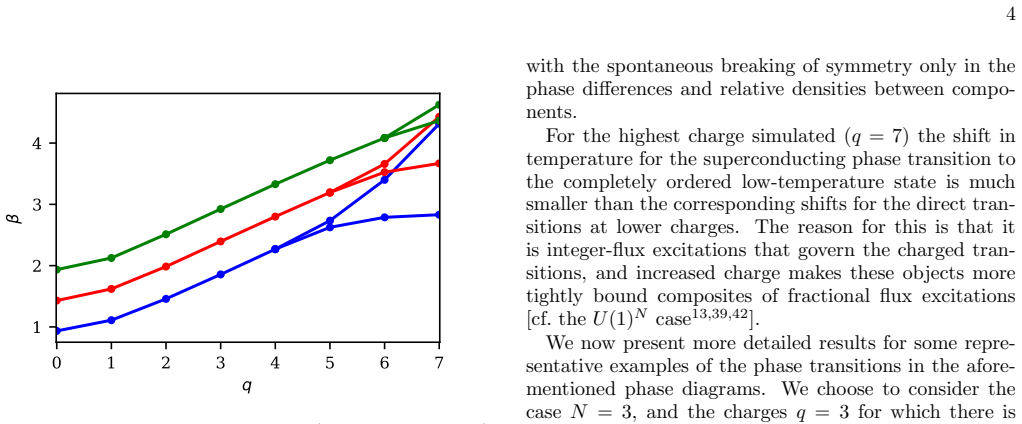
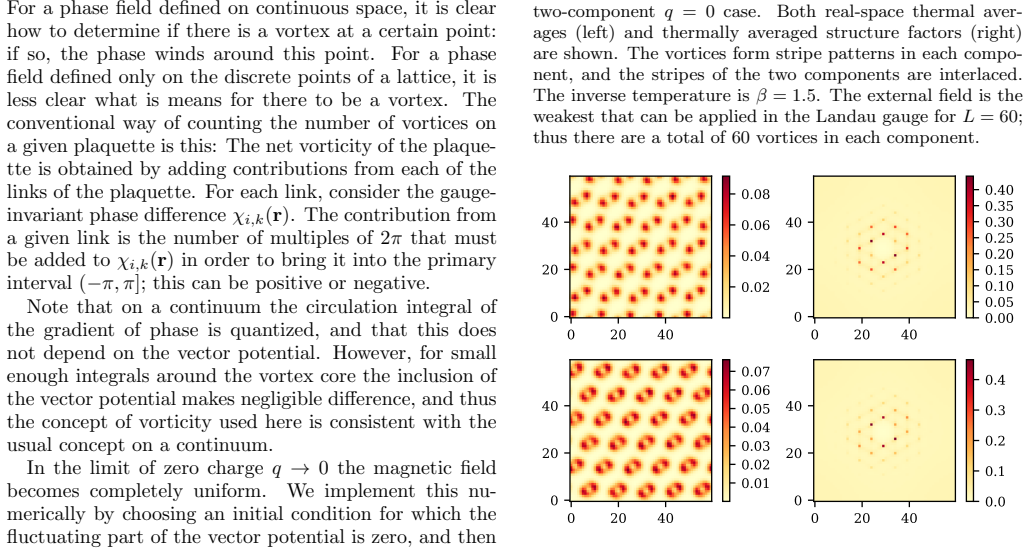
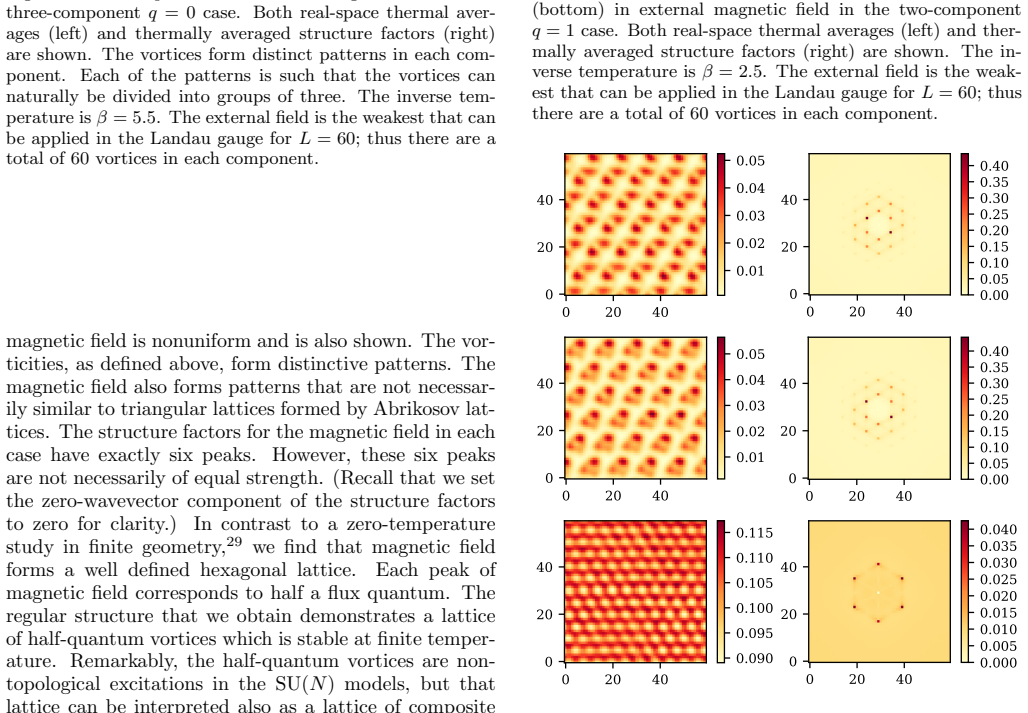
The discovery claimed is that at sufficiently large gauge-field coupling q the SU(N) Ginzburg-Landau model in three dimensions, for N=3 and N=4 studied here (with N=2 for comparison), exhibits two separate phase transitions as temperature is lowered. Between the symmetric phase and the fully ordered low-temperature phase sits a $CP^{{N-1}}$-neutral phase: a state with no Meissner effect but a nonzero helicity modulus for phase-difference combinations, meaning spontaneous breaking only of relative-phase and relative-density symmetries. Because the hard constraint $\sum_i|\psi_i|^2=1$ makes the neutral sector a $CP^{N-1}$ target space, and because for N>2 the residual symmetry group is not the $S^{2}$ or $S^{1}$ type that appears in SU(2) models, the authors argue this intermediate phase cannot be represented as an O(M) model. The Monte Carlo study of magnetic response shows that in an external field the low-temperature state is a vortex lattice; for q=0 and N=3 the vortices group into triplets, and for q=1 in the two-component case a hexagonal lattice of half-quantum-flux objects appears, interpreted as a lattice of composite integer-flux objects with split cores.
Load-bearing premise
The model fixes the total density $\sum_i|\psi_i|^2=1$ exactly at every lattice site, and the transition temperatures are read from finite-size crossings; if that hard constraint is relaxed, or if the charged transition is weakly first order, the intermediate $CP^{N-1}$-neutral phase and its claimed non-O(M) character could shift or disappear.
Editorial extensions
If this is right
- For the studied N=3 and N=4 cases at large q, the phase diagram has two transitions, and the paper's mechanism implies the same split should occur for all N>2 at sufficiently strong coupling.
- The intermediate CP^{N-1}-neutral phase has no Meissner effect but retains phase-difference and relative-density order, so it is a distinct thermodynamic state with two heat-capacity peaks.
- Because the neutral sector is CP^{N-1} and not O(M) for N>2, this composite phase falls outside the SU(2) and U(1)^N paired-phase classifications.
- In an external magnetic field at low temperature the systems form vortex lattices even though individual integer-flux vortices are not energetically stable; at q=1 the two-component lattice is a hexagonal array of half-quantum-flux objects.
Reading between the lines
- If the CP^{N-1}-neutral phase survives when the hard density constraint is relaxed to a soft potential, it would be a finite-temperature example of composite order outside the O(M) duality description, offering a concrete test case for deconfined-criticality scenarios in lattice gauge theories.
- Varying q continuously in the two-component model and tracking the six-peak magnetic structure factor would show whether the half-quantum vortex lattice persists beyond q=1 or crosses over to a conventional Abrikosov lattice as composite vortices merge.
- The N=4 response to an external field is not reported; if the N=3 triplet grouping becomes a quadruplet grouping, that would confirm the composite-vortex interpretation is generic in N.
Signed reviews
Editorial analysis
A structured set of objections, weighed in public.
Referee Report
Summary. The paper studies SU(N)-symmetric Ginzburg-Landau models coupled to a non-compact Abelian gauge field in three dimensions, with a hard constraint on the total matter density. For N=3 and N=4 it presents Monte Carlo evidence that, at sufficiently large gauge coupling q, the single superconducting transition splits into two: a lower-temperature transition where the Meissner effect disappears and an upper transition where the neutral CP^{N-1} sector disorders. The intermediate phase is termed the CP^{N-1}-neutral phase, and the paper argues it cannot be mapped onto an O(M) model for N>2. The paper also studies vortex configurations in an external magnetic field, finding regular vortex lattices in both the q=0 and finite-q cases despite the absence of a conserved U(1) topological invariant.
Significance. If the central claim holds, the paper identifies a new type of composite-order phase in multicomponent gauge theories with N>2, going beyond the well-studied U(1)xU(1) and SU(2) cases. The numerical evidence for N=3, q=6 is a strength: the authors use finite-size scaling of both the dual stiffness and the helicity modulus, parallel tempering, reweighting, and bootstrap errors, with system sizes up to L=40-48. The vortex-lattice results in external fields are also concrete and falsifiable. However, the significance is moderated by the fact that the central claim is established only for the fixed-total-density model, and the paper does not quantify the extrapolation of crossing temperatures or rule out weakly first-order transitions.
major comments (4)
- [Section II, after Eq. (1)] The hard constraint sum_i |psi_i|^2 = 1 is load-bearing for the central claim, because it is what projects the matter fields onto S^{2N-1}/U(1) = CP^{N-1} and hence what makes Eq. (13) the CP^{N-1}-neutral sector. The abstract and conclusion state results for 'SU(N)-symmetric Ginzburg-Landau models' without this qualifier, yet the paper never studies the soft-density version in which the total-density mode fluctuates and couples to the charged current in Eq. (3). Since the existence and the non-O(M) character of the intermediate phase depend on this restriction, the claim as stated is overbroad; the authors should either restrict the abstract and conclusions to fixed-total-density models or provide evidence that the split transition survives when the total-density mode is allowed to fluctuate.
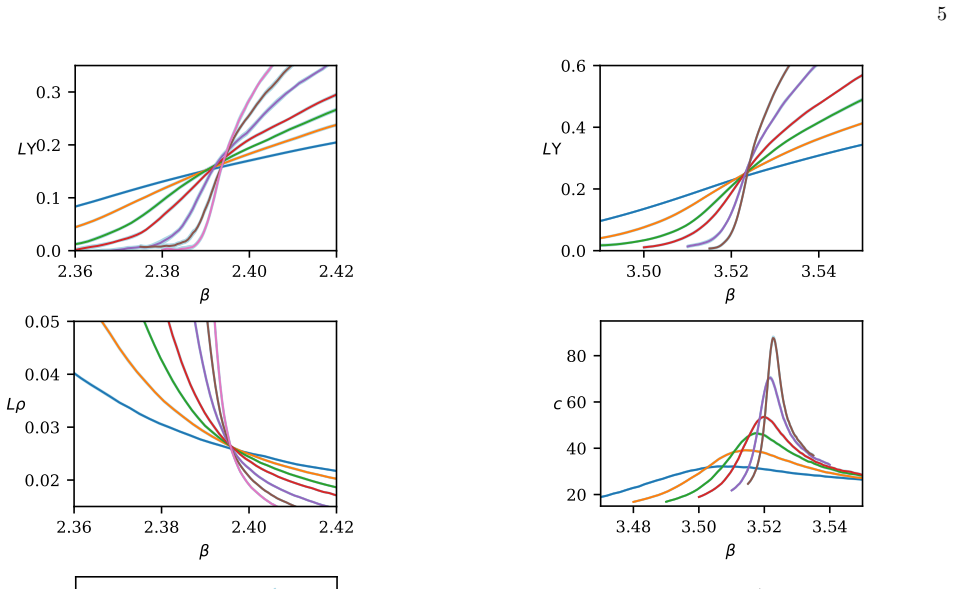
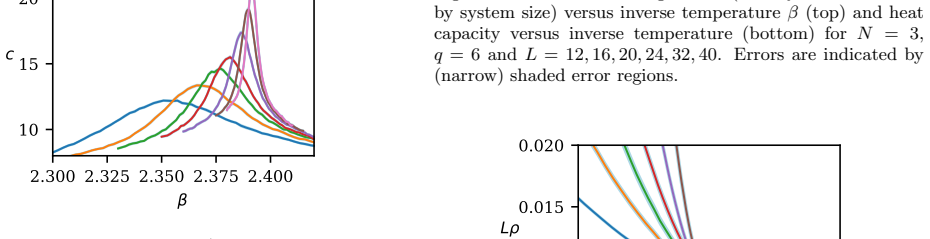
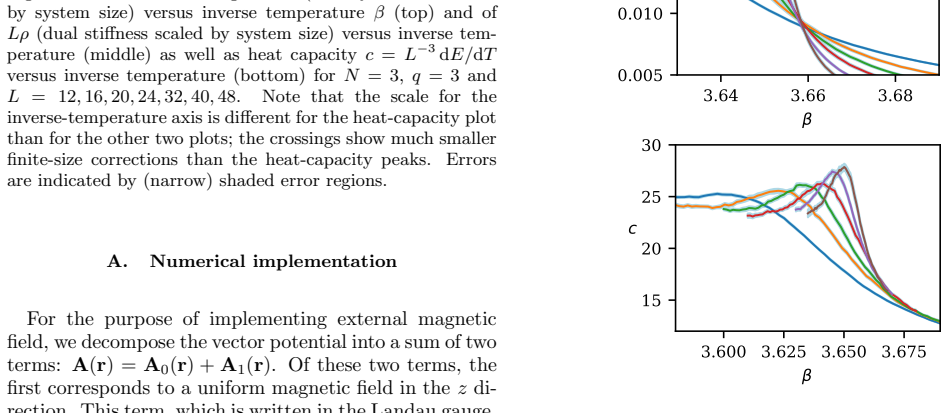
- [Section IV.A-IV.C] The finite-size crossing temperatures for L*Upsilon and L*rho are not tabulated or extrapolated, and no criterion is given for distinguishing continuous from weakly first-order transitions. Since the separation of the two transitions is the quantitative basis for the split-transition claim, the paper should report the crossing values, their extrapolation to L -> infinity, and an order-of-transition analysis (e.g., histogram or Binder cumulant) for at least the N=3, q=6 case.
- [Section IV.C, Fig. 1] The phase diagram for N=4 is presented without any finite-size crossing data, while the detailed evidence is given only for N=3 at q=3 and q=6. Since the abstract emphasizes N>2, the N=4 branch of the central claim needs either corresponding data or an explicit statement that it is an extrapolation from the N=3 case.
- [Section IV.C, after Eq. (13)] The statement that for N>2 the neutral phase 'cannot be mapped onto an O(M) model' is asserted rather than demonstrated. The symmetry argument identifies CP^{N-1} as the target manifold of the neutral sector, but the paper does not rule out an effective description in terms of O(M) variables after the charged sector is disordered; the authors should specify what 'mapped onto' means (target-space topology, critical exponents, or both) and provide the corresponding argument.
minor comments (6)
- [Throughout] There are several typos, including 'quantium' (Introduction), 'gauage' (Introduction), 'disaplayed' (figure captions), 'apear' (Section IV.B), and 'reweigting' (Section IV.B).
- [Section IV.B] The phrase 'Form this is follows that' should be 'From this it follows that'.
- [Section V.B and Figs. 5-10] The text uses both 'q -> 0' and 'q = 0' for the zero-charge case; please unify the notation and clarify how the q=0 limit is implemented given that the vector potential still appears in the Hamiltonian.
- [Eq. (8)] The wave vector q in the exponential of the dual stiffness conflicts notationally with the electric charge q used elsewhere; consider renaming one of them.
- [Section IV.B] The statement that 'the phase-sum helicity modulus being the special case where the constant of proportionality is zero' is confusing; clarify that the proportionality constant for the phase-sum combination is zero, rather than implying the modulus itself is zero in a special case.
- [Fig. 1] The phase diagram would benefit from a table of the numerical crossing temperatures and their errors, since the lines are described only as a guide to the eye.
Circularity Check
The CP^{N-1}-neutral label is definitional (hard density constraint), but the two-transition and vortex-lattice claims are independent numerical measurements.
-
self definitional
[Section II after Eq. (1); Section IV.B; Section IV.C, Eq. (13)]
"The amplitudes are subjected to the constraint that the total superconducting density ∑_i|ψ_i|^2 = 1, but are otherwise allowed to fluctuate. ... The model has a neutral sector that we call CP^{N−1} neutral sector. ... Instead these are CP^{N−1}-neutral phases where there is order associated with the spontaneous breaking of symmetry only in the phase differences and relative densities between components."
The hard constraint ∑_i|ψ_i|^2=1 makes the neutral target space S^{2N-1}/U(1) = CP^{N-1} by construction, so Eq. (13) is the CP^{N-1} sigma model by definition. Therefore labeling the intermediate phase 'CP^{N-1}-neutral' and asserting it 'cannot be mapped onto an O(N) model' restates the model's definition rather than being derived from the Monte Carlo data. This does not touch the independent numerical content: the split-transition phase diagram (Figs. 2-4) and the vortex lattices (Figs. 5-10) are measurements, not fits to the claim.
full rationale
The central phase-diagram and vortex-lattice claims are self-contained numerical results: they come from finite-size crossings of LΥ and Lρ, heat-capacity peaks, and direct imaging/vorticity measurements, not from fitting parameters to the claimed transitions. The only definitional reduction is the CP^{N-1} nomenclature, which is built into the model through the fixed-total-density constraint after Eq. (1). That is a labeling issue, not a fitted prediction. Self-citations (e.g., Refs. 9, 25, 29, 31, 40) supply methodology and background and are not load-bearing for the new numerical findings. The unstudied soft-density limit is a limitation of scope, not circularity.
Assumptions & free parameters
assumptions (4)
- ad hoc to paper Fixed total superconducting density: sum_i |psi_i|^2 = 1
- domain assumption Transitions located by LΥ and Lρ finite-size crossings are continuous second-order transitions
- domain assumption Non-compact Abelian gauge field with minimal coupling
- standard math All helicity moduli are proportional, with the phase-sum modulus identically zero
invented entities (1)
-
CP^{N-1}-neutral phase
Cite this review
Pith. "Pith review of Vortices and composite order in $\mathrm{SU}(N)$ theories coupled to Abelian gauge field." pith.science (2026). https://pith.science/paper/A6BHIT2Q
@misc{pith2026190810847,
  author       = {Pith},
  title        = {Pith review of: Vortices and composite order in $\mathrmSU(N)$ theories coupled to Abelian gauge field},
  year         = {2026},
  howpublished = {\url{https://pith.science/paper/A6BHIT2Q}},
  note         = {Machine review of arXiv:1908.10847}
}
abstract
We consider $\mathrm{SU}(N)$-symmetric Ginzburg-Landau models coupled to non-compact Abelian gauge field focusing on the case $N > 2$ at finite temperature. We show that, at least for sufficiently large gauge-field coupling constants, these models have two phase transitions. The intermediate phase between the symmetric and low-temperature phases is a state with composite neutral order and no Meissner effect. In this neutral phase the system spontaneously breaks only the symmetry associated with phase differences and density differences between components. For $N > 2$, in contrast to the $SU(2)$ case, the neutral state cannot be mapped onto an $\mathrm{O}(M)$ model. We term this state ${\mathbb{C}{P}}^{N-1}$-neutral phase. We also show that while $\mathrm{SU}(N)$-symmetric Ginzburg-Landau models are not superconductors or superfluids in the usual sense, their state in external field at sufficiently low temperature is a vortex lattice.
Figures
Figures from the paper (6 more)



Reference graph
Works this paper leans on
-
[1]
author author C. Dasgupta \ and\ author B. I. \ Halperin ,\ 10.1103/PhysRevLett.47.1556 journal journal Phys. Rev. Lett. \ volume 47 ,\ pages 1556 ( year 1981 ) NoStop
-
[2]
author author M. E. \ Peskin ,\ http://dx.doi.org/10.1016/0003-4916(78)90252-X journal journal Ann. Phys. \ volume 113 ,\ pages 122 ( year 1978 ) NoStop
-
[3]
Babaev , author A
author author E. Babaev , author A. Sudb , \ and\ author N. Ashcroft ,\ @noop journal journal Nature \ volume 431 ,\ pages 666 ( year 2004 ) NoStop
2004
- [4]
-
[5]
author author Y. Wang \ and\ author L. Fu ,\ @noop journal journal Physical review letters \ volume 119 ,\ pages 187003 ( year 2017 ) NoStop
work page 2017
-
[6]
author author Y. Wang , author G. Y. \ Cho , author T. L. \ Hughes , \ and\ author E. Fradkin ,\ @noop journal journal Physical Review B \ volume 93 ,\ pages 134512 ( year 2016 ) NoStop
work page 2016
-
[7]
author author T. Senthil , author A. Vishwanath , author L. Balents , author S. Sachdev , \ and\ author M. P. A. \ Fisher ,\ 10.1126/science.1091806 journal journal Science \ volume 303 ,\ pages 1490 ( year 2004 ) ,\ http://arxiv.org/abs/http://science.sciencemag.org/content/303/5663/1490.full.pdf http://science.sciencemag.org/content/303/5663/1490.full.p...
-
[8]
author author A. Kuklov , author N. Prokof'ev , author B. Svistunov , \ and\ author M. Troyer ,\ https://doi.org/10.1016/j.aop.2006.04.007 journal journal Ann. Phys. \ volume 321 ,\ pages 1602 ( year 2006 ) ,\ note july 2006 Special Issue NoStop
Show all 44 references
-
[9]
author author O. I. \ Motrunich \ and\ author A. Vishwanath ,\ https://arxiv.org/abs/0805.1494 journal journal arXiv \ ( year 2008 ) ,\ http://arxiv.org/abs/0805.1494v1 0805.1494v1 NoStop
2008 arXiv
-
[10]
Kuklov , author M
author author A. Kuklov , author M. Matsumoto , author N. Prokof'ev , author B. Svistunov , \ and\ author M. Troyer ,\ https://arxiv.org/abs/0805.2578v1 journal journal arXiv \ ( year 2008 a ) ,\ http://arxiv.org/abs/0805.2578v1 0805.2578v1 NoStop
2008 arXiv
-
[11]
Chen , author Y
author author K. Chen , author Y. Huang , author Y. Deng , author A. B. \ Kuklov , author N. V. \ Prokof'ev , \ and\ author B. V. \ Svistunov ,\ 10.1103/PhysRevLett.110.185701 journal journal Phys. Rev. Lett. \ volume 110 ,\ pages 185701 ( year 2013 ) NoStop
-
[12]
Babaev ,\ @noop journal journal arXiv preprint cond-mat/0201547 \ ( year 2015 ) NoStop
author author E. Babaev ,\ @noop journal journal arXiv preprint cond-mat/0201547 \ ( year 2015 ) NoStop
2015 arXiv
-
[13]
Smiseth , author E
author author J. Smiseth , author E. Sm rgrav , author E. Babaev , \ and\ author A. Sudb ,\ 10.1103/PhysRevB.71.214509 journal journal Phys. Rev. B \ volume 71 ,\ eid 214509 ( year 2005 ) NoStop
2005 doi
-
[14]
Sm rgrav , author E
author author E. Sm rgrav , author E. Babaev , author J. Smiseth , \ and\ author A. Sudb ,\ 10.1103/PhysRevLett.95.135301 journal journal Phys. Rev. Lett. \ volume 95 ,\ pages 135301 ( year 2005 ) NoStop
2005 doi
-
[15]
author author E. V. \ Herland , author E. Babaev , \ and\ author A. Sudb ,\ 10.1103/PhysRevB.82.134511 journal journal Phys. Rev. B \ volume 82 ,\ pages 134511 ( year 2010 ) NoStop
2010 doi
-
[16]
Kuklov , author N
author author A. Kuklov , author N. Prokof'ev , \ and\ author B. Svistunov ,\ 10.1103/PhysRevLett.92.030403 journal journal Phys. Rev. Lett. \ volume 92 ,\ pages 030403 ( year 2004 a ) NoStop
2004 doi
-
[17]
Kuklov , author N
author author A. Kuklov , author N. Prokof'ev , \ and\ author B. Svistunov ,\ 10.1103/PhysRevLett.92.050402 journal journal Phys. Rev. Lett. \ volume 92 ,\ pages 050402 ( year 2004 b ) NoStop
2004 doi
-
[18]
author author A. B. \ Kuklov \ and\ author B. V. \ Svistunov ,\ 10.1103/PhysRevLett.90.100401 journal journal Phys. Rev. Lett. \ volume 90 ,\ pages 100401 ( year 2003 ) NoStop
2003 doi
-
[19]
Berg , author E
author author E. Berg , author E. Fradkin , \ and\ author S. A. \ Kivelson ,\ http://dx.doi.org/10.1038/nphys1389 journal journal Nature Physics \ volume 5 ,\ pages 830 ( year 2009 ) NoStop
2009 doi
-
[20]
Agterberg \ and\ author H
author author D. Agterberg \ and\ author H. Tsunetsugu ,\ http://dx.doi.org/10.1038/nphys999 journal journal Nature Physics \ volume 4 ,\ pages 639 ( year 2008 ) NoStop
2008 doi
-
[21]
Radzihovsky \ and\ author A
author author L. Radzihovsky \ and\ author A. Vishwanath ,\ @noop journal journal Physical review letters \ volume 103 ,\ pages 010404 ( year 2009 ) NoStop
2009
-
[22]
Svistunov , author E
author author B. Svistunov , author E. Babaev , \ and\ author N. Prokofev ,\ @noop title Superfluid States of Matter \ ( publisher CRC Press ,\ year 2015 ) NoStop
2015
-
[23]
author author P. R. \ Thomas \ and\ author M. Stone ,\ http://dx.doi.org/10.1016/0550-3213(78)90383-8 journal journal Nucl. Phys. B \ volume 144 ,\ pages 513 ( year 1978 ) NoStop
1978 doi
-
[24]
author author A. B. \ Kuklov , author M. Matsumoto , author N. V. \ Prokof'ev , author B. V. \ Svistunov , \ and\ author M. Troyer ,\ 10.1103/PhysRevLett.101.050405 journal journal Phys. Rev. Lett. \ volume 101 ,\ pages 050405 ( year 2008 b ) NoStop
-
[25]
author author E. V. \ Herland , author T. A. \ Bojesen , author E. Babaev , \ and\ author A. Sudb ,\ 10.1103/PhysRevB.87.134503 journal journal Phys. Rev. B \ volume 87 ,\ pages 134503 ( year 2013 ) NoStop
2013 doi
-
[26]
Banerjee , author M
author author D. Banerjee , author M. Dalmonte , author M. M \"u ller , author E. Rico , author P. Stebler , author U.-J. \ Wiese , \ and\ author P. Zoller ,\ @noop journal journal Physical review letters \ volume 109 ,\ pages 175302 ( year 2012 ) NoStop
2012
-
[27]
Zohar , author J
author author E. Zohar , author J. I. \ Cirac , \ and\ author B. Reznik ,\ @noop journal journal Reports on Progress in Physics \ volume 79 ,\ pages 014401 ( year 2015 ) NoStop
2015
-
[28]
Achucarro \ and\ author T
author author A. Achucarro \ and\ author T. Vachaspati ,\ @noop journal journal Physics Reports \ volume 327 ,\ pages 347 ( year 2000 ) NoStop
2000
-
[29]
Garaud \ and\ author E
author author J. Garaud \ and\ author E. Babaev ,\ 10.1103/PhysRevB.90.214524 journal journal Phys. Rev. B \ volume 90 ,\ pages 214524 ( year 2014 ) NoStop
2014 doi
-
[30]
author author B. V. \ Svistunov , author E. S. \ Babaev , \ and\ author N. V. \ Prokof'ev ,\ @noop title Superfluid states of matter \ ( publisher Crc Press ,\ year 2015 ) NoStop
2015
-
[31]
author author P. N. \ Galteland , author E. Babaev , \ and\ author A. Sudb ,\ 10.1103/PhysRevA.91.013605 journal journal Phys. Rev. A \ volume 91 ,\ pages 013605 ( year 2015 ) NoStop
2015 doi
-
[32]
Harada , author T
author author K. Harada , author T. Suzuki , author T. Okubo , author H. Matsuo , author J. Lou , author H. Watanabe , author S. Todo , \ and\ author N. Kawashima ,\ @noop journal journal Physical Review B \ volume 88 ,\ pages 220408 ( year 2013 ) NoStop
2013
-
[33]
author author R. K. \ Kaul ,\ @noop journal journal Physical Review B \ volume 84 ,\ pages 054407 ( year 2011 ) NoStop
2011
-
[34]
author author R. K. \ Kaul \ and\ author A. W. \ Sandvik ,\ @noop journal journal Physical review letters \ volume 108 ,\ pages 137201 ( year 2012 ) NoStop
2012
-
[35]
Ihrig , author N
author author B. Ihrig , author N. Zerf , author P. Marquard , author I. F. \ Herbut , \ and\ author M. M. \ Scherer ,\ @noop journal journal arXiv preprint arXiv:1907.08140 \ ( year 2019 ) NoStop
1907 arXiv
-
[36]
Fejos \ and\ author T
author author G. Fejos \ and\ author T. Hatsuda ,\ https://arxiv.org/abs/1705.07333 journal journal arXiv \ ( year 2017 ) ,\ http://arxiv.org/abs/1705.07333v1 1705.07333v1 NoStop
2017 arXiv
-
[37]
Gorbenko , author S
author author V. Gorbenko , author S. Rychkov , \ and\ author B. Zan ,\ @noop journal journal Journal of High Energy Physics \ volume 2018 ,\ pages 108 ( year 2018 ) NoStop
2018
-
[38]
author author F. S. \ Nogueira \ and\ author A. Sudb ,\ @noop journal journal EPL (Europhysics Letters) \ volume 104 ,\ pages 56004 ( year 2013 ) NoStop
2013
-
[39]
Babaev ,\ 10.1103/PhysRevLett.89.067001 journal journal Phys
author author E. Babaev ,\ 10.1103/PhysRevLett.89.067001 journal journal Phys. Rev. Lett. \ volume 89 ,\ pages 067001 ( year 2002 ) NoStop
2002 doi
-
[40]
Carlstr\"om \ and\ author E
author author J. Carlstr\"om \ and\ author E. Babaev ,\ 10.1103/PhysRevB.91.140504 journal journal Phys. Rev. B \ volume 91 ,\ pages 140504 ( year 2015 ) NoStop
2015 doi
-
[41]
author author E. K. \ Dahl , author E. Babaev , author S. Kragset , \ and\ author A. Sudb ,\ 10.1103/PhysRevB.77.144519 journal journal Phys. Rev. B \ volume 77 ,\ pages 144519 ( year 2008 ) NoStop
2008 doi
-
[42]
author author K. A. H. \ Sellin \ and\ author E. Babaev ,\ 10.1103/PhysRevB.93.054524 journal journal Phys. Rev. B \ volume 93 ,\ pages 054524 ( year 2016 ) NoStop
2016 doi
-
[43]
Garaud , author J
author author J. Garaud , author J. Carlstr \"o m , author E. Babaev , \ and\ author M. Speight ,\ 10.1103/PhysRevB.87.014507 journal journal Phys. Rev. B \ volume 87 ,\ eid 014507 ( year 2013 ) NoStop
2013 doi
-
[44]
Garaud , author J
author author J. Garaud , author J. Carlstr \"o m , \ and\ author E. Babaev ,\ 10.1103/PhysRevLett.107.197001 journal journal Phys. Rev. Lett. \ volume 107 ,\ eid 197001 ( year 2011 ) NoStop
2011 doi
Reviewed August 14, 2026 · model on record in the stance chip above.
Discussion (0). Continue with ORCID to comment.