REVIEW 1 major objections 4 minor 1 cited by
Sheaves of maximal intersection and multiplicities of stable log maps
T0 review · 1 major / 4 minor · reviewed 2026-08-14 · deepseek-v4-flash
Pith's one-line read Two glued rational curves contribute exactly the smaller of their two tangency orders to the log Gromov-Witten count, with each of the d log maps carrying multiplicity min(e1,e2).
desk verdict Real new results on log GW multiplicities; main caveat is an unproved genericity assumption in the two-curve formula. read the letter →
The pith
A machine-rendered reading of the paper's core claim, the machinery that carries it, and where it could break.
The reading
What carries the argument
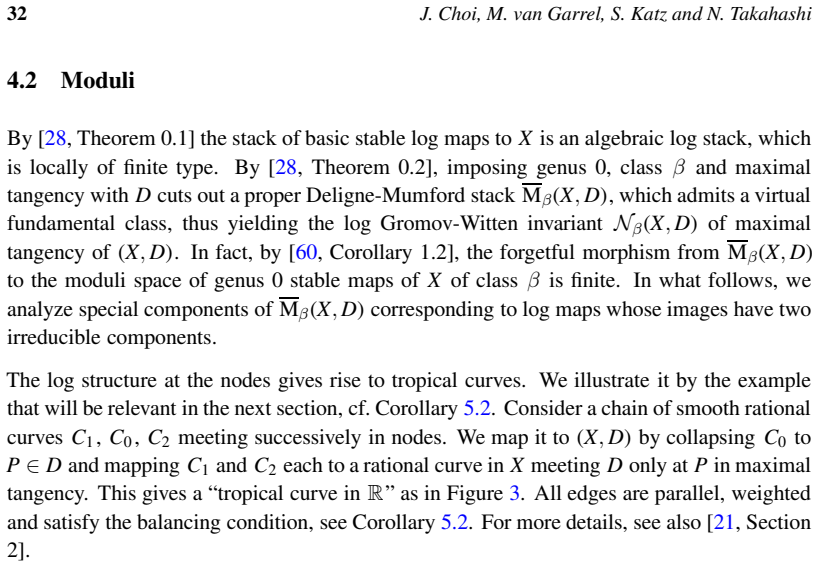
The load-bearing object in the first half is the moduli space $\mathrm{MMI}_\beta$ of sheaves of maximal intersection: torsion-free rank-one sheaves $F$ supported on integral curves of class $\beta$ whose restriction to $D$ is $\mathcal{O}_{wP}$ with $w=\beta\cdot D$. Theorem 1.11 proves that $\mathrm{MMI}_\beta$ and its point-fixed variant are nonsingular of dimension $2p_a(\beta)=\beta^2-w+2$, a logarithmic analogue of unobstructedness for sheaves on K3 surfaces; this smoothness is what forces infinitesimal deformations of a log map with image $C$ to factor through $C$, yielding Corollary 1.12. The second half carries out a fully explicit log deformation theory. The relevant domain is a chain $C_1\cup C_0\cup C_2$ with the middle component collapsed to $P$, the basic log structure is encoded by the coprime pair $(e_1,e_2)$ and by a $d$-th root $c_p$, and the extension calculation in Section 5 shows exactly which lifts survive to order $\min(e_1,e_2)$, giving $d$ isolated points of length $\min(e_1,e_2)$.
What would settle it
Compute the same local contribution in a one-parameter family of divisors D in which two A1-curves develop contact at P of order greater than min(d1,d2), using the deformation equations of Section 5; Theorem 1.14 predicts exactly d isolated log maps of length min(e1,e2), so any other count would show that the generic-intersection hypothesis is doing real work.
Extended reading notes
Core claim
On a smooth surface $X$ with an effective divisor $D$, the paper studies genus-0 basic stable log maps of maximal tangency to $D$. Corollary 1.12 states that if $X$ is a smooth projective rational surface, $K_X+D\sim 0$, $P\in D_{\mathrm{sm}}$, and $C$ is an irreducible rational curve of class $\beta$ maximally tangent to $D$ at $P$ and smooth at $P$, then the normalization map $\mathbb{P}^1\to C$ contributes $l(C)$ to $N_\beta(X,D)$, where $l(C)$ is the Euler characteristic of the compactified Jacobian of $C$. Theorem 1.14 concerns two proper integral rational curves $Z_1,Z_2$ with $(K_X+D)\cdot Z_i=0$, both maximally tangent to $D$ at the same point $P$, with immersive normalizations and with $(Z_1.Z_2)_P=\min(d_1,d_2)$ for $d_i=D\cdot Z_i$. Writing $d_1=de_1$, $d_2=de_2$ with $\gcd(e_1,e_2)=1$, the theorem asserts that the stack $M_{\beta_1+\beta_2}(X,D)$ contains exactly $d$ stable log maps with image $Z_1\cup Z_2$, each an isolated point of length $\min(e_1,e_2)$; their combined contribution to $N_{\beta_1+\beta_2}(X,D)$ is therefore $\min(d_1,d_2)$. The paper also shows by example that the relevant component of the log moduli space is not isomorphic to the corresponding relative stable map component, even though the two theories give the same numerical invariants.
Load-bearing premise
The count rests on the assertion that the two curves meet each other at P in the least special way possible, namely with intersection multiplicity equal to the smaller of their two tangency orders, which the authors conjecture holds for a general divisor D but do not prove.
Editorial extensions
If this is right
- Under Condition ($\bullet$), Corollary 1.13 gives an enumerative meaning to the log BPS number at a $\beta$-primitive point: it is the sum of $l(C)$ over rational unibranch curves in the linear system, subject to Conjecture 1.8.
- In the tropical-vertex example obtained by blowing up $\mathbb{P}^2$ at six points, combining Corollary 1.12 with Theorem 1.14 reproduces $N_\beta(S,D)=18$, matching the tropical multiplicity count and confirming deformation invariance through Euler numbers.
- The log and relative moduli spaces are locally non-isomorphic near a two-component image: there are $d$ log maps of length $\min(e_1,e_2)$ versus one relative map of length $\min(d_1,d_2)$, yet by the comparison theorem the total contribution to the invariant agrees.
- At a flex point of $(\mathbb{P}^2,E)$, the decomposition takes the form $113 = 5 + 24 + 2\cdot \mathrm{Contr} + k_5$, so determining the remaining component would determine $k_5$, the number of degree-5 rational curves maximally tangent at a flex.
Reading between the lines
- If the smoothness of $\mathrm{MMI}_\beta$ is a genuine logarithmic analogue of K3 sheaf unobstructedness, then a sheaf-theoretic Euler-characteristic count should reproduce the log BPS numbers after the same kind of substitution used in the local BPS correspondence; the paper does not develop this.
- The separation of the total contribution into $d$ log lifts times a length $\min(e_1,e_2)$ suggests that for a union of $k$ maximally tangent components the count may be governed by the gcds of the tangency orders; the three-line case from Section 2.2.4, whose contribution is 3, is a concrete place to test this.
- If Condition ($\bullet$) fails, the clean sum in Corollary 1.13 could acquire correction terms from curves with worse singularities at $P$; a low-degree exhaustive enumeration on a del Pezzo surface would show whether such corrections actually occur.
- The root-of-unity data $c_p$ distinguishing the $d$ log maps have no relative counterpart, so refined invariants that keep track of these data might be visible tropically as a choice of edge weights in a scattering diagram.
Signed reviews
Editorial analysis
A structured set of objections, weighed in public.
Referee Report
Summary. This paper studies genus 0 maximally tangent stable log maps to a smooth surface with a divisor D, focusing on the contributions of zero-dimensional components of the moduli space to the log Gromov-Witten invariants N_beta(X,D). It proves two main results. (A) Corollary 1.12 states that an irreducible rational A1-curve C that is smooth at the contact point P contributes its ordinary stable map multiplicity l(C) to N_beta; this is deduced from the smoothness of a newly introduced moduli space MMI_beta of 'sheaves of maximal intersection' (Theorem 3.12). (B) Theorem 1.14 states that for two immersed rigid A1-curves Z1, Z2 satisfying (K_X+D).Z_i=0 and meeting D at the same smooth point P with intersection multiplicity (Z1.Z2)_P = min(d1,d2), there are exactly d=gcd(d1,d2) basic stable log maps with image Z1 union Z2, each isolated with multiplicity min(e1,e2), so together they contribute min(d1,d2) to the invariant. The proof occupies Section 5 and is an explicit coordinate computation of the log structures and deformation theory. Section 6 compares the result with relative stable maps in a concrete example.
Significance. If correct, these are the first explicit computations of log Gromov-Witten contributions for non-rigid and reducible image curves. The introduction of the moduli space MMI_beta and its nonsingularity (Theorem 3.12) is a novel sheaf-theoretic tool that parallels the K3 surface story. The results feed directly into applications to log BPS numbers and local BPS invariants, as illustrated in Section 2.3, and the paper includes a fully worked example recovering N_beta=18 for a weak del Pezzo surface, with a comparison to tropical multiplicity. The proofs are lengthy, detailed, and transparent, using explicit coordinate models for the log structures, and the paper contains a useful example contrasting log and relative stable maps (Section 6).
major comments (1)
- [Section 5.5, Lemma 5.16] The proof that v=0 in the case n=e1 uses the inequality A1(0)(B'_2(0))^d != A2(0)(B'_1(0))^d, which is equivalent to the genericity hypothesis (Z1.Z2)_P = min(d1,d2). For d1 != d2 this condition is automatic (Remark 1.15), but for d1 = d2 it is an extra assumption that is only conjectured to hold for general D. The applications in Section 2.3 and Example 6.1 satisfy the condition, but the paper should explicitly state that Theorem 1.14 is conditional on this hypothesis and that it must be verified in each equal-degree application. This is a limitation of the theorem's scope rather than an error in the proof.
minor comments (4)
- [Introduction, Section 1.1] The phrase 'remedy to that shortcoming' should be 'remedy that shortcoming'.
- [Section 3, proof of Theorem 3.12] The computation of dim Ext^1(F,F(-D)) = beta^2 + 1 would be clearer with an explicit expansion of the Riemann-Roch calculation; the current sentence is terse.
- [Section 5, Notation 5.9] For N=2, the notation Bji is later abbreviated to Bi; a brief remark that B_i = B_2i in the rest of Section 5 would improve readability.
- [Section 6, Example 6.1] It would be helpful to explicitly state that the two choices u2 = +/-1/2 correspond to the two log maps counted by d=2 and that (Z'_1.Z'_2)_P = 2 verifies the genericity hypothesis of Theorem 1.14.
Circularity Check
No significant circularity: the main formulas are derived from independent moduli and deformation-theoretic calculations.
full rationale
The paper's central claims, Corollary 1.12 and Theorem 1.14, are not obtained by fitting, renaming, or self-referential definition. Corollary 1.12 is quoted from the authors' prior work [21] but is explicitly conditional on Theorem 1.11, and Theorem 1.11 (nonsingularity of MMI_beta and MMI^P_beta) is proved in Section 3 of the present paper using the relative compactified Picard scheme and standard moduli-of-sheaves techniques. Thus the chain is not circular: the prior conditional statement is being supplied with the missing ingredient here. Theorem 1.14 is proved by explicit deformation theory in Section 5: the number d of log maps is obtained from d2-th roots of unity and the identification modulo gcd(d1,d2), and the length min{e1,e2} is obtained by showing that extensions exist up to order e1-1 but not e1, using Lemma 5.16. The genericity hypothesis (Z1.Z2)_P = min{d1,d2} is a geometric input used to rule out unwanted extensions; it is not a restatement of the output contribution min{d1,d2}, which is a derived enumerative consequence. The paper's self-citations to [20,21] concern background classification of stable log maps and previously proved conditional results, and they are not load-bearing in a way that reduces the main theorems to their own conclusions. Remark 1.15 flags that the genericity condition is only conjectural for general D, which is a limitation on applicability rather than evidence of circular reasoning. No parameter fitting, no renaming of a known result, and no imported uniqueness theorem is present. The derivation is self-contained given the stated assumptions.
Assumptions & free parameters
assumptions (7)
- domain assumption Log Gromov-Witten invariants exist as virtual counts via proper Deligne-Mumford stacks of basic stable log maps
- domain assumption The forgetful morphism from stable log maps to stable maps is finite
- domain assumption Structure of genus 0 maximal tangency log maps with two non-collapsed components
- domain assumption Conjecture 1.8 equating log BPS numbers and local BPS numbers
- domain assumption Condition (bullet): rational curves in the linear system unibranch at P are smooth at P
- domain assumption Generic intersection condition (Z1.Z2)_P = min(d1,d2)
- domain assumption Kato's log smooth deformation theorem and the relative stable map result of Takahashi
invented entities (1)
-
Moduli space MMI_beta of sheaves of maximal intersection
Cite this review
Pith. "Pith review of Sheaves of maximal intersection and multiplicities of stable log maps." pith.science (2026). https://pith.science/paper/EFDY46WX
@misc{pith2026190810906,
  author       = {Pith},
  title        = {Pith review of: Sheaves of maximal intersection and multiplicities of stable log maps},
  year         = {2026},
  howpublished = {\url{https://pith.science/paper/EFDY46WX}},
  note         = {Machine review of arXiv:1908.10906}
}
read the original abstract
A great number of theoretical results are known about log Gromov-Witten invariants, but few calculations are worked out. In this paper we restrict to surfaces and to genus 0 stable log maps of maximal tangency. We ask how various natural components of the moduli space contribute to the log Gromov-Witten invariants. The first such calculation by Gross-Pandharipande-Siebert deals with multiple covers over rigid curves in the log Calabi-Yau setting. As a natural continuation, in this paper we compute the contributions of non-rigid irreducible curves in the log Calabi-Yau setting and that of the union of two rigid curves in general position. For the former, we construct and study a moduli space of "logarithmic" 1-dimensional sheaves and compare the resulting multiplicity with tropical multiplicity. For the latter, we explicitly describe the components of the moduli space and work out the logarithmic deformation theory in full, which we then compare with the deformation theory of the analogous relative stable maps.
Figures

Figures from the paper (1 more)

Forward citations
Cited by 1 Pith paper
-
On the log-local principle for the toric boundary
For Q-factorial projective toric varieties whose toric boundary divisors are nef, the genus-zero log and local Gromov-Witten invariants with point and descendant insertions agree after the log-local normalization, and...
Reference graph
Works this paper leans on
-
[1]
D Abramovich, Q Chen, Stable logarithmic maps to DeligneFaltings pairs II, Asian J. Math. 18 (2014) 465–488
work page 2014
-
[2]
D Abramovich, B Fantechi, Orbifold techniques in degeneration formulas , Ann. Sc. Norm. Super. Pisa Cl. Sci. (5) 16 (2016) 519–579
work page 2016
-
[3]
D Abramovich, S Marcus, J Wise, Comparison theorems for GromovWitten invariants of smooth pairs and of degenerations , Ann. Inst. Fourier (Grenoble) 64 (2014) 1611–1667
work page 2014
-
[4]
Real and complex singularities (Proc. Ninth Nordic Summer School/NA VF Sympos. Math., Oslo, 1976)
A B Altman, A Iarrobino , S L Kleiman, Irreducibility of the compactified Jacobian , from “Real and complex singularities (Proc. Ninth Nordic Summer School/NA VF Sympos. Math., Oslo, 1976)”, Sijthoff and Noordhoff, Alphen aan den Rijn (1 977) 1–12
work page 1976
-
[5]
P S Aspinwall, D R Morrison, T opological field theory and rational curves , Comm. Math. Phys. 151 (1993) 245–262
work page 1993
-
[6]
L Barrott, N Nabijou, T angent curves to degenerating hypersurfaces arXiv:2007.05016, 2020
arXiv 2007
-
[7]
A Beauville, Counting rational curves on K 3 surfaces, Duke Math. J. 97 (1999) 99–108
work page 1999
-
[8]
P Bousseau , A proof of N. Takahashi’s conjecture on genus zero GromovWi tten theory of (P2, E) and a refined sheaves/Gromov–Witten correspondence arXiv:1909.02992, 2019
Show all 61 references
-
[9]
P Bousseau , Scattering diagrams, stability conditions, and coherent s heaves on P2 arXiv:1909.02985, 2019
1909
-
[10]
P Bousseau , A Brini , M van Garrel , On the loglocal principle for the toric boundary arXiv:1908.04371, 2019 Sheaves of maximal intersection and multiplicities of stab le log maps 51
1908 arXiv
-
[11]
P Bousseau, A Brini, M van Garrel, Stable maps to Looijenga pairs arXiv:2011.08830, 2020
2011 arXiv
-
[12]
P Bousseau , A Brini , M van Garrel , Stable maps to Looijenga pairs: orbifold examples arXiv:2012.10353, 2020
2012 arXiv
-
[13]
T Bridgeland , Stability conditions on a noncompact CalabiYau threefol d, Comm. Math. Phys. 266 (2006) 715–733
2006
-
[14]
L Caporaso, J Coelho, E Esteves, Abel maps of Gorenstein curves, Rend. Circ. Mat. Palermo (2) 57 (2008) 33–59
2008
-
[15]
Enumerative geometry and classical algebraic geometry (Nice, 1981)
F Catanese , PluricanonicalGorensteincurves, from “Enumerative geometry and classical algebraic geometry (Nice, 1981)”, Progr. Math. 24, Birkh ¨auser Boston, Boston, MA (1982) 51–95
1982
-
[16]
Algebraic Geom
Q Chen , The degeneration formula for logarithmic expanded degener ations, J. Algebraic Geom. 23 (2014) 341–392
2014
-
[17]
Q Chen, Stable logarithmic maps to DeligneFaltings pairs I , Ann. of Math. (2) 180 (2014) 455–521
2014
-
[18]
Algebraic Geom
X Chen, Rational curves on K 3 surfaces, J. Algebraic Geom. 8 (1999) 245–278
1999
-
[19]
T M Chiang, A Klemm , ST Yau , E Zaslow , Local mirror symmetry: calculations and interpretations, Adv. Theor. Math. Phys. 3 (1999) 495–565
1999
-
[20]
J Choi , M van Garrel , S Katz , N T akahashi, Local BPS invariants: enumerative aspects and wallcrossing, Int. Math. Res. Not. IMRN (2020) 5450–5475
2020
-
[21]
J Choi, M van Garrel, S Katz, N T akahashi, Log BPS numbers of log CalabiYau surfaces , Trans. Amer. Math. Soc. 374 (2021) 687–732
2021
-
[22]
Algebraic Geom
B Fantechi , L G ¨ottsche, D van Straten , Euler number of the compactified Jacobian and multiplicity of rational curves , J. Algebraic Geom. 8 (1999) 115–133
1999
-
[23]
M van Garrel , T Graber , H Ruddat , Local GromovWitten invariants are log invariants , Adv. Math. 350 (2019) 860–876
2019
-
[24]
CalabiYau varieties: arithmetic, geometry and phy sics
M van Garrel , D P Overholser, H Ruddat , Enumerative aspects of the GrossSiebert pro gram, from “CalabiYau varieties: arithmetic, geometry and phy sics”, Fields Inst. Monogr. 34, Fields Inst. Res. Math. Sci., Toronto, ON (2015) 337–420
2015
-
[25]
Number Theory Phys
M van Garrel , T W H Wong, G Zaimi, Integrality of relative BPS state counts of toric del Pezzo surfaces, Commun. Number Theory Phys. 7 (2013) 671–687
2013
-
[26]
T Gr ¨afnitz, Tropical correspondence for smooth del Pezzo log CalabiY a u pairs arXiv:2005.14018, 2020
2005 arXiv
-
[27]
M Gross , R Pandharipande , B Siebert , The tropical vertex , Duke Math. J. 153 (2010) 297–362
2010
-
[28]
M Gross, B Siebert, Logarithmic GromovWitten invariants, J. Amer. Math. Soc. 26 (2013) 451–510
2013
-
[29]
D Huybrechts, M Lehn, The Geometry of Moduli Spaces of Sheaves , 2 edition, Cambridge Mathematical Library, Cambridge University Press (2010)
2010
-
[30]
EN Ionel , T H Parker , The GopakumarVafa formula for symplectic manifolds , Ann. of Math. (2) 187 (2018) 1–64 52 J. Choi, M. van Garrel, S. Katz and N. T akahashi
2018
-
[31]
F Kato, Log smooth deformation and moduli of log smooth curves, Internat. J. Math. 11 (2000) 215–232
2000
-
[32]
Differential Geom
S Katz, Genus zero GopakumarVafa invariants of contractible curv es, J. Differential Geom. 79 (2008) 185–195
2008
-
[33]
B Kim, H Lho, H Ruddat, The degeneration formula for stable log maps arXiv:1803.04210, 2018
2018 arXiv
-
[34]
A Klemm, D Maulik, R Pandharipande, E Scheidegger, NoetherLefschetz theory and the YauZaslow conjecture, J. Amer. Math. Soc. 23 (2010) 1013–1040
2010
-
[35]
The moduli space of curves (Texel Island, 1994)
M Kontsevich , Enumeration of rational curves via torus actions , from “The moduli space of curves (Texel Island, 1994)”, Progr. Math. 129, Birkh ¨auser Boston, Boston, MA (1995) 335–368
1995
-
[36]
Differential Geom
J Li , Stable morphisms to singular schemes and relative stable mo rphisms, J. Differential Geom. 57 (2001) 509–578
2001
-
[37]
Differential Geom
J Li, A degeneration formula of GWinvariants , J. Differential Geom. 60 (2002) 199–293
2002
-
[38]
J Li, B Wu, Good degeneration of Quotschemes and coherent systems , Comm. Anal. Geom 23 (2015) 841–921
2015
-
[39]
Y S Lin, Open GromovWitten invariants on elliptic K3 surfaces and w allcrossing, Comm. Math. Phys. 349 (2017) 109–164
2017
-
[40]
Differential Geom
Y S Lin, Correspondence Theorem between Holomorphic Discs and Trop ical Discs on K3 Surfaces, J. Differential Geom. 117 (2021) 41–92
2021
-
[41]
T Mandel , Theta bases and log Gromov–Witten invariants of cluster var ieties arXiv:1903.03042, 2019
1903 arXiv
-
[42]
T Mandel, H Ruddat, Tropical quantum field theory, mirror polyvector fields, and multiplic ities of tropical curves arXiv:1902.07183, 2019
1902 arXiv
-
[43]
T Mandel , H Ruddat , Descendant log Gromov–Witten invariants for toric varieti es and tropical curves, Trans. Amer. Math. Soc. 373 (2020) 1109–1152
2020
-
[44]
The moduli space of curves (Texel Island, 1994)
Y I Manin , Generating functions in algebraic geometry and sums over tr ees, from “The moduli space of curves (Texel Island, 1994)”, Progr. Math. 1 29, Birkh ¨auser Boston, Boston, MA (1995) 401–417
1995
-
[45]
D Maulik, D Ranganathan, Logarithmic DonaldsonThomas theory arXiv:2006.06603, 2020
2006 arXiv
-
[46]
G Mikhalkin, Enumerative tropical algebraic geometry in R2 , J. Amer. Math. Soc. 18 (2005) 313–377
2005
-
[47]
S Mukai, Symplectic structure of the moduli space of sheaves on an abe lian or K 3 surface, Invent. Math. 77 (1984) 101–116
1984
-
[48]
N Nabijou , D Ranganathan , GromovWitten theory with maximal contacts arXiv:1908.04706, 2019
1908 arXiv
-
[49]
T Nishinou, B Siebert, T oric degenerations of toric varieties and tropical curves, Duke Math. J. 135 (2006) 1–51
2006
-
[50]
Lectures on geometry
R Pandharipande, Maps, sheaves and K 3 surfaces, from “Lectures on geometry”, Clay Lect. Notes, Oxford Univ. Press, Oxford (2017) 159–185 Sheaves of maximal intersection and multiplicities of stab le log maps 53
2017
-
[51]
D Ranganathan , Logarithmic GromovWitten theory with expansions arXiv:1903.09006, 2019
1903 arXiv
-
[52]
V Shende , Hilbert schemes of points on a locally planar curve and the Se veri strata of its versal deformation, Compos. Math. 148 (2012) 531–547
2012
-
[53]
N T akahashi, Curves in the complement of a smooth plane cubic whose normal izations are A1 arXiv:alggeom/9605007, 1996
1996
-
[54]
N T akahashi, On the multiplicity of reducible relative stable morphisms arXiv:1711.08173, 2017
2017 arXiv
-
[55]
N T akahashi, Log mirror symmetry and local mirror symmetry , Comm. Math. Phys. 220 (2001) 293–299
2001
-
[56]
Y T oda, Limit stable objects on CalabiYau 3folds , Duke Math. J. 149 (2009) 157–208
2009
-
[57]
DT/PT corresp ondence, J
Y T oda, Curve counting theories via stable objects I. DT/PT corresp ondence, J. Amer. Math. Soc. 23 (2010) 1119–1157
2010
-
[58]
Y T oda, Stability conditions and curve counting invariants on Cala biYau 3folds , Kyoto J. Math. 52 (2012) 1–50
2012
-
[59]
104 (1996) 135–151
C V oisin, A mathematical proof of a formula of Aspinwall and Morrison , Compositio Math. 104 (1996) 135–151
1996
-
[60]
J Wise, Uniqueness of minimal morphisms of logarithmic schemes , Algebr. Geom. 6 (2019) 50–63
2019
-
[61]
ST Yau, E Zaslow, BPS states, string duality, and nodal curves on K 3, Nuclear Phys. B 471 (1996) 503–512 Department of Mathematics & Research Institute of Natural S ciences, Sookmyung Women’s Univer sity, Cheongparo 47gil 100, Y oungsangu, Seoul 04310, Republic of Korea ...
1996
Reviewed August 14, 2026 · model on record in the stance chip above.
Discussion (0). Continue with ORCID to comment.