REVIEW 4 major objections 5 minor 48 references
SpatialNLI: A Spatial Domain Natural Language Interface to Databases Using Spatial Comprehension
T0 review · 4 major / 5 minor · reviewed 2026-08-14 · deepseek-v4-flash
Pith's one-line read SpatialNLI resolves ambiguous spatial phrases with an external comprehension model, injects the predicted type symbols into the question, and reports 90.4% denotation accuracy on Geoquery and 100% on Restaurant.
desk verdict The paper has a sensible idea—external spatial comprehension feeding type symbols into a seq2seq parser—but the unstated SC train/test split and a three-question margin make the SOTA claim not yet credible. read the letter →
The pith
A machine-rendered reading of the paper's core claim, the machinery that carries it, and where it could break.
The reading
What carries the argument
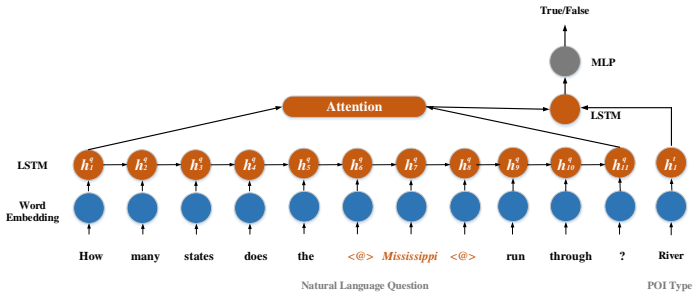
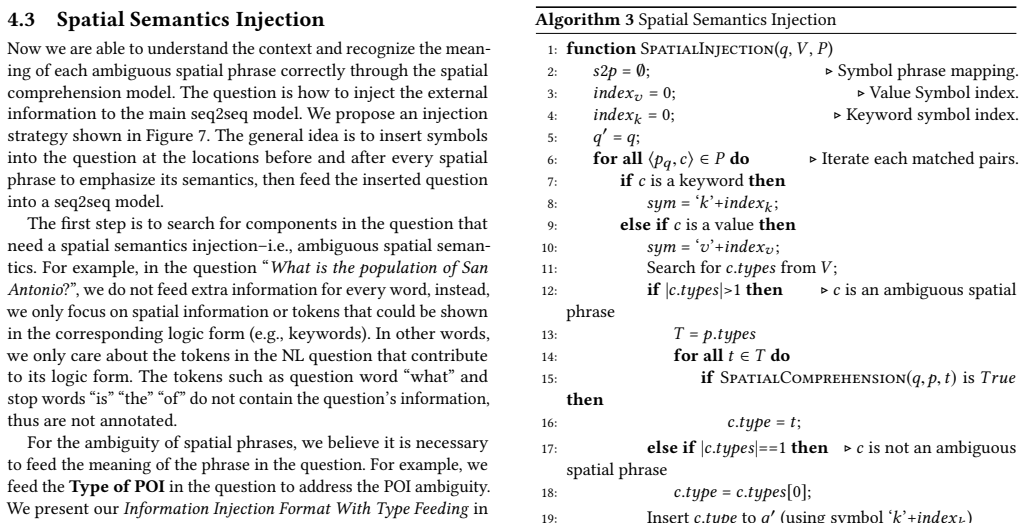
The load-bearing mechanism is a two-stage pipeline: SpatialMapper, a phrase-detection step that finds keywords and values by exact string match, edit distance, and pretrained word-vector cosine similarity against database contents; and the spatial comprehension model, which uses stacked LSTMs over the question and the candidate type with a shared attentive LSTM layer to predict true or false for each question-phrase-type triple, with the ambiguous phrase enclosed in special symbols. SpatialInjection writes the chosen type and a placeholder for the value into the question as special tokens, so the sequence-to-sequence parser can copy a single token instead of generating long entity names, and query recovery substitutes the original text back. The paper also augments the training data by shuffling prepositional phrases and recombining existing questions.
What would settle it
Run the full SpatialNLI pipeline on Geoquery test questions in which every ambiguous value is replaced by a synonym that is absent from the database and far from the original in the embedding space, such as a nickname for a river. If denotation accuracy drops sharply, the central claim is bounded by the phrase-detection step rather than by the comprehension model; if accuracy holds, the pipeline generalizes beyond exact or near-exact matches.
Extended reading notes
Core claim
The central claim is that spatial semantics should be computed outside the semantic parser and then physically inserted into the input text. The paper constructs an external spatial comprehension model that, for each ambiguous phrase, predicts the phrase's type by attending over the words of the question; the predicted type is inserted as a symbol such as "riverid" between special markers, the value itself is replaced by a placeholder symbol, the modified question is fed to a sequence-to-sequence model with a copying mechanism, and the resulting logical form is recovered by substituting the original phrases back. The reported outcome is 90.4% denotation accuracy on Geoquery, exceeding the 88.2% of a strong syntax-based parser, and 100% on Restaurant. Ablation experiments attribute most of the gain to symbol injection and type feeding, with spatial comprehension adding 4% on Geoquery and 3.9% on Restaurant.
Load-bearing premise
The pipeline assumes the phrase-detection step finds every keyword and value that matters and that the comprehension model predicts the right type for each ambiguous phrase; a miss or a wrong type propagates unchanged into the final query because the parser copies the injected symbol.
Editorial extensions
If this is right
- A neural semantic parser can be improved on spatial benchmarks by externalizing entity-type disambiguation instead of learning it from sparse question-query pairs.
- Replacing multi-token entity names with placeholder symbols shortens the generation path and should reduce entity-copy errors, which the Restaurant ablation supports.
- Prepositional-phrase shuffling and question recombination add training structures without new human annotation.
- Because the comprehension model reaches 98.1% question-level accuracy on the Geoquery test set, almost all ambiguous point-of-interest cases are resolved before the parser sees the question.
- Jointly training on Geoquery and Restaurant reaches 90.7% on Geoquery, suggesting the injected symbols serve as a shared representation across the two domains.
Reading between the lines
- A wrong type judgment by the comprehension model is never corrected downstream: the sequence-to-sequence model copies the injected symbol, so a single misclassification can turn into an executable query against the wrong table, and residual error on ambiguous questions is likely concentrated there.
- The phrase-detection step is a hidden precondition: a phrase missed by string match, edit distance, or word-vector similarity never reaches the comprehension model, so the end-to-end upper bound depends on the detector as much as on the neural components.
- The same externalize-and-inject pattern could transfer to other domains with encyclopedic ambiguity, such as biomedical entity types or temporal expressions, whenever the type vocabulary is fixed and discoverable from the database schema.
- The paper does not state whether the comprehension model's train/test split matches the parser's 600/280 Geoquery split, so the component accuracies and the end-to-end accuracy may not have been measured under identical conditions.
Signed reviews
Editorial analysis
A structured set of objections, weighed in public.
Referee Report
Summary. This paper proposes SpatialNLI, a natural-language interface to spatial databases. The system first detects spatial keywords and values with a mapper based on exact string match, edit distance, and GloVe cosine similarity; an external spatial comprehension model (a bidirectional attentive LSTM) then classifies the type of ambiguous point-of-interest names; the predicted type and detected terms are injected as special symbols into the question; a seq2seq parser with copying translates the modified question into a logical form; and a recovery module replaces symbols with the original phrases. The paper evaluates on Geoquery and Restaurant, reporting 90.4% and 100% denotation accuracy, respectively, and ablates the comprehension model, type feeding, information injection, copy mechanism, and data augmentation.
Significance. If the reported numbers are trustworthy, the paper makes a useful contribution by separating contextual spatial-semantic disambiguation from structural parsing and by showing that simple symbol injection can improve an existing seq2seq semantic parser. The evaluation is systematic: all ablation components are named, case studies illustrate the injection/recovery loop, and the code is released. However, the central claim of outperforming the state of the art rests on a 1.1-point margin on 280 Geoquery test questions, with no error bars or significance testing, and the training/test separation of the spatial comprehension model is not reported. These issues are load-bearing for the headline comparison, while the Restaurant result ties, rather than beats, the existing 100% baseline.
major comments (4)
- [Section 7.3 / Table 1] The train/test split used for the spatial comprehension (SC) model is not reported. Because the SC training labels in Figure 6 are read off the ground-truth logical form, the claimed 4.0-point gain from the '- Spatial Comprehension' ablation and the 90.4% headline accuracy are fully interpretable only if the SC model never sees a test question's logical form during training and if the SC split coincides with the parser's standard 600/280 Geoquery split. Please state the exact SC split, the label-generation rule, and confirm that no test-question-derived record is used in SC training.
- [Table 2 / Section 7.4] The headline comparison lacks error bars and significance testing. On 280 Geoquery test questions, 90.4% versus JL16's 89.3% is about three questions, and the margin over TRANX's 88.2% is similarly narrow. The '- Spatial Comprehension' ablation at 86.4% is the output of a random-guess procedure whose variance is not reported. Please report means and standard deviations over multiple random seeds and a significance test, for example bootstrap or McNemar, for the comparisons that support the claim of outperforming the state of the art.
- [Section 7.4 / Figure 10] The paper does not analyze the failure path that its own case study demonstrates: when the SC model or the random-guess baseline selects the wrong type (stateid instead of riverid), the injected symbol is copied by the seq2seq model and the recovered query is wrong. Because the end-to-end gain is attributed to the comprehension model, the paper should report how many test questions have SC type errors and how often those errors propagate to denotation mismatches, rather than only reporting the aggregate Acc_qu.
- [Section 4.1 / Algorithm 2] SpatialMapper relies on exact string match, an edit-distance threshold tau_ed, and a GloVe cosine threshold tau_sem, but the paper reports no sensitivity analysis and no count of test questions for which a relevant keyword or value is missed. A phrase missed by the mapper is never disambiguated or injected, so the contribution of the comprehension model is bounded by the mapper's recall. Please report detection recall on the test sets and, if possible, the effect of varying the thresholds.
minor comments (5)
- [Section 3, paragraph following Figure 4] The sentence claiming that 'stateid will be inferred instead of riverid' appears to invert the correct and incorrect types: with the ground-truth type stateid(Mississippi), the failure case is riverid being inferred instead of stateid.
- [Section 7.3, Table 1 paragraph] The statement that 'we prove that Accrcd and Accqu are optimized simultaneously' is not supported by any proof in the paper; either provide a short argument or rephrase it as an empirical observation.
- [Abstract and Section 1] The abstract and introduction say SpatialNLI outperforms state-of-the-art methods, but Table 2(b) shows a tie with FKZ18 at 100% on Restaurant; please qualify the claim, for example 'matches or exceeds' or restrict the outperformance claim to Geoquery.
- [Section 7.1, Restaurant dataset] The paper does not report the training/test split used for Restaurant; since Table 2 reports a test accuracy, please specify the split or clarify how the 251 pairs are divided.
- [Section 5.1 / Table 2] The seq2seq model is described as following prior work [9], but [9] is not included in Table 2; please clarify whether [9] is an applicable baseline and, if so, add it to the comparison.
Circularity Check
No significant circularity: the end-to-end accuracy claim is tested on external benchmark datasets, and the spatial comprehension model is a separately trained classifier rather than a restatement of the parser's output.
full rationale
The paper's central claim is the denotation accuracy reported in Table 2 on Geoquery and Restaurant, both external benchmark datasets, so the headline result is not defined in terms of the system's own inputs. The spatial comprehension model is trained on question/POI-type records (Figure 6) and evaluated separately in Table 1; at inference, its predicted type is injected into the question, and the '- Spatial Comprehension' ablation replaces this prediction with a random guess. The paper quotes no construction by which the test-time type is taken from the ground-truth logical form. The seq2seq parser with symbol injection follows the same authors' prior work [9], but that citation supplies an architectural technique; the contribution is evaluated by ablations against external denotation accuracy rather than by citing [9] as proof, and the copying mechanism is also credited to the external JL16 [37]. Query recovery (Algorithm 4) is deterministic replacement of generated symbols with the originally detected phrases, which is bookkeeping rather than a predicted quantity. The unstated alignment of the spatial-comprehension train/test split with the parser's 600/280 Geoquery split is a potential experimental-reporting concern, but no quoted passage shows the spatial comprehension model being fitted to test logical forms, and no fitted parameter is renamed as a prediction. Under the rule that circularity must be exhibited by a specific reduction, no circular step is established.
Assumptions & free parameters
free parameters (6)
- semantic distance threshold tau_sem =
not reported in paper (example: semantic_distance('place','spot') < 0.368)
- edit distance threshold tau_ed =
not reported
- positive sample replication factor =
2
- spatial comprehension hidden units =
200
- seq2seq GRU hidden sizes =
encoder 800, decoder 1600
- beam search width =
5
assumptions (6)
- domain assumption Geoquery and Restaurant gold logical forms are correct, and denotation match is a valid measure of query accuracy.
- domain assumption Schema names and column values in the spatial databases align with the constants and keywords in the target logical forms.
- domain assumption POI type for an ambiguous phrase is determined by the question context and can be learned from training data.
- domain assumption GloVe embedding similarity captures semantic relatedness between natural language words and schema keywords.
- domain assumption Moving a prepositional phrase to the start or end of a sentence preserves the logical meaning of the question.
- domain assumption The spatial comprehension model's train and test splits align with the parser's splits, so its labels do not leak test answers.
invented entities (1)
-
Special symbol tokens <k_i>, <v_i>, <eok>, <eov>, and <@>
Cite this review
Pith. "Pith review of SpatialNLI: A Spatial Domain Natural Language Interface to Databases Using Spatial Comprehension." pith.science (2026). https://pith.science/paper/2IM7LYNV
@misc{pith2026190810917,
  author       = {Pith},
  title        = {Pith review of: SpatialNLI: A Spatial Domain Natural Language Interface to Databases Using Spatial Comprehension},
  year         = {2026},
  howpublished = {\url{https://pith.science/paper/2IM7LYNV}},
  note         = {Machine review of arXiv:1908.10917}
}
read the original abstract
A natural language interface (NLI) to databases is an interface that translates a natural language question to a structured query that is executable by database management systems (DBMS). However, an NLI that is trained in the general domain is hard to apply in the spatial domain due to the idiosyncrasy and expressiveness of the spatial questions. Inspired by the machine comprehension model, we propose a spatial comprehension model that is able to recognize the meaning of spatial entities based on the semantics of the context. The spatial semantics learned from the spatial comprehension model is then injected to the natural language question to ease the burden of capturing the spatial-specific semantics. With our spatial comprehension model and information injection, our NLI for the spatial domain, named SpatialNLI, is able to capture the semantic structure of the question and translate it to the corresponding syntax of an executable query accurately. We also experimentally ascertain that SpatialNLI outperforms state-of-the-art methods.
Figures


Figures from the paper (6 more)



Reference graph
Works this paper leans on
-
[9]
A Transfer-Learnable Natural Language Interface for Databases
Wenlu Wang, Yingtao Tian, Hongyu Xiong, Haixun Wang, and Wei-Shinn Ku. A transfer-learnable natural language interface for databases. arXiv preprint arXiv:1809.02649, 2018
work page Pith review arXiv 2018
-
[1]
Natural language interfaces to databases–an introduction
Ion Androutsopoulos, Graeme D Ritchie, and Peter Thanisch. Natural language interfaces to databases–an introduction. Natural language engineering, 1(1):29–81, 1995
work page 1995
-
[2]
Dataset for a neural natural language interface for databases (NNLIDB)
Florin Brad, Radu Cristian Alexandru Iacob, Ionel-Alexandru Hosu, and Traian Rebedea. Dataset for a neural natural language interface for databases (NNLIDB). In Proceedings of the Eighth International Joint Conference on Natural Language Processing, IJCNLP, pages 906–914, 2017
work page 2017
-
[3]
An End-to-end Neural Natural Language Interface for Databases
Prasetya Utama, Nathaniel Weir, Fuat Basik, Carsten Binnig, Ugur Çetintemel, Benjamin Hättasch, Amir Ilkhechi, Shekar Ramaswamy, and Arif Usta. An end- to-end neural natural language interface for databases. CoRR, abs/1804.00401, 2018
work page Pith review arXiv 2018
-
[4]
Nalir: an interactive natural language interface for querying relational databases
Fei Li and Hosagrahar Visvesvaraya Jagadish. Nalir: an interactive natural language interface for querying relational databases. In International Conference on Management of Data, SIGMOD , pages 709–712, 2014
work page 2014
-
[5]
Yunyao Li, Huahai Yang, and H. V. Jagadish. Nalix: an interactive natural language interface for querying XML. In Proceedings of the ACM SIGMOD International Conference on Management of Data , pages 900–902, 2005
work page 2005
-
[6]
Ana-Maria Popescu, Oren Etzioni, and Henry A. Kautz. Towards a theory of natural language interfaces to databases. In Proceedings of the 8th International Conference on Intelligent User Interfaces , 2003
work page 2003
-
[7]
Diptikalyan Saha, Avrilia Floratou, Karthik Sankaranarayanan, Umar Farooq Minhas, Ashish R. Mittal, and Fatma Özcan. ATHENA: an ontology-driven system for natural language querying over relational data stores. PVLDB, 9(12):1209– 1220, 2016
work page 2016
Show all 48 references
-
[8]
Learning a neural semantic parser from user feedback
Srinivasan Iyer, Ioannis Konstas, Alvin Cheung, Jayant Krishnamurthy, and Luke Zettlemoyer. Learning a neural semantic parser from user feedback. InProceedings of the 55th Annual Meeting of the Association for Computational Linguistics, ACL , pages 963–973, 2017
2017
-
[10]
A cross-domain natural language interface to databases using adversarial text method
Wenlu Wang. A cross-domain natural language interface to databases using adversarial text method. Database, 1:q2, 2019
2019
-
[11]
Efficient parallel spatial skyline evaluation using mapreduce
Wenlu Wang, Ji Zhang, M-T Sun, and W-S Ku. Efficient parallel spatial skyline evaluation using mapreduce. In Proceedings of the 20th international conference on extending database technology , 2017
2017
-
[12]
A scalable spatial skyline evaluation system utilizing parallel independent region groups.The VLDB Journal The International Journal on Very Large Data Bases , 28(1):73–98, 2019
Wenlu Wang, Ji Zhang, Min-Te Sun, and Wei-Shinn Ku. A scalable spatial skyline evaluation system utilizing parallel independent region groups.The VLDB Journal The International Journal on Very Large Data Bases , 28(1):73–98, 2019
2019
-
[13]
Dynamic indoor navigation with bayesian filters
Wenlu Wang and Wei-Shinn Ku. Dynamic indoor navigation with bayesian filters. SIGSPATIAL Special, 8(3):9–10, 2017
2017
-
[14]
Recommendation-based smart indoor navigation
Wenlu Wang and Wei-Shinn Ku. Recommendation-based smart indoor navigation. In Proceedings of the Second International Conference on Internet-of-Things Design and Implementation, pages 311–312. ACM, 2017
2017
-
[15]
Spatial semantics
Jordan Zlatev. Spatial semantics. The Oxford handbook of cognitive linguistics , pages 318–350, 2007
2007
-
[16]
TRANX: A transition-based neural abstract syntax parser for semantic parsing and code generation
Pengcheng Yin and Graham Neubig. TRANX: A transition-based neural abstract syntax parser for semantic parsing and code generation. In Proceedings of the 2018 Conference on Empirical Methods in Natural Language Processing, EMNLP , pages 7–12, 2018
2018
-
[17]
Bidirectional attention flow for machine comprehension
Min Joon Seo, Aniruddha Kembhavi, Ali Farhadi, and Hannaneh Hajishirzi. Bidirectional attention flow for machine comprehension. In 5th International Conference on Learning Representations, ICLR , 2017
2017
-
[18]
Machine comprehension using match-lstm and answer pointer
Shuohang Wang and Jing Jiang. Machine comprehension using match-lstm and answer pointer. In 5th International Conference on Learning Representations, ICLR , 2017
2017
-
[19]
Zettlemoyer and Michael Collins
Luke S. Zettlemoyer and Michael Collins. Learning to map sentences to logical form: Structured classification with probabilistic categorial grammars. In UAI ’05, Proceedings of the 21st Conference in Uncertainty in Artificial Intelligence , 2005
2005
-
[20]
Online learning of relaxed ccg grammars for parsing to logical form
Luke Zettlemoyer and Michael Collins. Online learning of relaxed ccg grammars for parsing to logical form. InProceedings of the 2007 Joint Conference on Empirical Methods in Natural Language Processing and Computational Natural Language Learning (EMNLP-CoNLL), 2007
2007
-
[21]
Zettlemoyer, Sharon Goldwater, and Mark Steedman
Tom Kwiatkowski, Luke S. Zettlemoyer, Sharon Goldwater, and Mark Steedman. Inducing probabilistic CCG grammars from logical form with higher-order uni- fication. In Proceedings of the 2010 Conference on Empirical Methods in Natural Language Processing, EMNLP, pages 1223–1233, 2010
2010
-
[22]
Zettlemoyer, Sharon Goldwater, and Mark Steedman
Tom Kwiatkowski, Luke S. Zettlemoyer, Sharon Goldwater, and Mark Steedman. Lexical generalization in CCG grammar induction for semantic parsing. In Proceedings of the 2011 Conference on Empirical Methods in Natural Language Processing, EMNLP, pages 1512–1523, 2011
2011
-
[23]
Scaling semantic parsers with on-the-fly ontology matching
Tom Kwiatkowski, Eunsol Choi, Yoav Artzi, and Luke Zettlemoyer. Scaling semantic parsers with on-the-fly ontology matching. In Proceedings of the 2013 conference on empirical methods in natural language processing , 2013
2013
-
[24]
Morpho-syntactic lex- ical generalization for ccg semantic parsing
Adrienne Wang, Tom Kwiatkowski, and Luke Zettlemoyer. Morpho-syntactic lex- ical generalization for ccg semantic parsing. In Proceedings of the 2014 Conference on Empirical Methods in Natural Language Processing (EMNLP) , 2014
2014
-
[25]
Type-driven incremental semantic parsing with polymorphism
Kai Zhao and Liang Huang. Type-driven incremental semantic parsing with polymorphism. In NAACL HLT 2015, The 2015 Conference of the North Ameri- can Chapter of the Association for Computational Linguistics: Human Language Technologies, pages 1416–1421, 2015
2015
-
[26]
Jordan, and Dan Klein
Percy Liang, Michael I. Jordan, and Dan Klein. Learning dependency-based compositional semantics. Computational Linguistics, 39(2):389–446, 2013
2013
-
[27]
Learning to parse database queries using inductive logic programming
John M Zelle and Raymond J Mooney. Learning to parse database queries using inductive logic programming. InProceedings of the national conference on artificial intelligence, pages 1050–1055, 1996
1996
-
[28]
Automated construction of database interfaces: Integrating statistical and relational learning for semantic parsing
Lappoon R Tang and Raymond J Mooney. Automated construction of database interfaces: Integrating statistical and relational learning for semantic parsing. In Proceedings of the 2000 Joint SIGDAT conference on Empirical methods in natu- ral language processing and very large cor...
2000
-
[29]
Using multiple clause constructors in inductive logic programming for semantic parsing
Lappoon R Tang and Raymond J Mooney. Using multiple clause constructors in inductive logic programming for semantic parsing. In European Conference on Machine Learning, pages 466–477. Springer, 2001
2001
-
[30]
A statistical semantic parser that integrates syntax and semantics
Ruifang Ge and Raymond J Mooney. A statistical semantic parser that integrates syntax and semantics. In Proceedings of the ninth conference on computational natural language learning. Association for Computational Linguistics, 2005
2005
-
[31]
Recurrent continuous translation models
Nal Kalchbrenner and Phil Blunsom. Recurrent continuous translation models. In Proceedings of the 2013 Conference on Empirical Methods in Natural Language Processing, pages 1700–1709, 2013
2013
-
[32]
Sequence to sequence learning with neural networks
Ilya Sutskever, Oriol Vinyals, and Quoc V Le. Sequence to sequence learning with neural networks. In Advances in neural information processing systems , pages 3104–3112, 2014
2014
-
[33]
Learning phrase repre- sentations using rnn encoder-decoder for statistical machine translation
Kyunghyun Cho, Bart Van Merriënboer, Caglar Gulcehre, Dzmitry Bahdanau, Fethi Bougares, Holger Schwenk, and Yoshua Bengio. Learning phrase repre- sentations using rnn encoder-decoder for statistical machine translation. arXiv preprint arXiv:1406.1078, 2014
2014 arXiv
-
[34]
Kummerfeld, Li Zhang, Karthik Ra- manathan, Sesh Sadasivam, Rui Zhang, and Dragomir R
Catherine Finegan-Dollak, Jonathan K. Kummerfeld, Li Zhang, Karthik Ra- manathan, Sesh Sadasivam, Rui Zhang, and Dragomir R. Radev. Improving text-to-sql evaluation methodology. In Proceedings of the 56th Annual Meeting of the Association for Computational Linguistics, ACL , p...
2018
-
[35]
Abstract syntax networks for code generation and semantic parsing
Maxim Rabinovich, Mitchell Stern, and Dan Klein. Abstract syntax networks for code generation and semantic parsing. In Proceedings of the 55th Annual Meeting of the Association for Computational Linguistics, ACL , pages 1139–1149, 2017
2017
-
[36]
Language to logical form with neural attention
Li Dong and Mirella Lapata. Language to logical form with neural attention. In Proceedings of the 54th Annual Meeting of the Association for Computational Linguistics, ACL, 2016
2016
-
[37]
Data recombination for neural semantic parsing
Robin Jia and Percy Liang. Data recombination for neural semantic parsing. In Proceedings of the 54th Annual Meeting of the Association for Computational Linguistics, ACL, 2016
2016
-
[38]
Transfer learning for neural semantic parsing
Xing Fan, Emilio Monti, Lambert Mathias, and Markus Dreyer. Transfer learning for neural semantic parsing. In Proceedings of the 2nd Workshop on Representation Learning for NLP, pages 48–56, 2017
2017
-
[39]
Neural architectures for multilingual semantic parsing
Raymond Hendy Susanto and Wei Lu. Neural architectures for multilingual semantic parsing. In Proceedings of the 55th Annual Meeting of the Association for Computational Linguistics, pages 38–44, 2017
2017
-
[40]
Neural semantic parsing over multiple knowledge-bases
Jonathan Herzig and Jonathan Berant. Neural semantic parsing over multiple knowledge-bases. In Proceedings of the 55th Annual Meeting of the Association for Computational Linguistics, ACL, pages 623–628, 2017
2017
-
[41]
Seq2sql: Generating struc- tured queries from natural language using reinforcement learning
Victor Zhong, Caiming Xiong, and Richard Socher. Seq2sql: Generating struc- tured queries from natural language using reinforcement learning. CoRR, abs/1709.00103, 2017
2017 arXiv
-
[42]
Annotation of spatial relations in natural language
Qijun Shen, Xueying Zhang, and Wenming Jiang. Annotation of spatial relations in natural language. In 2009 International Conference on Environmental Science and Information Application Technology, volume 3, pages 418–421. IEEE, 2009
2009
-
[43]
A linguis- tic ontology of space for natural language processing
John A Bateman, Joana Hois, Robert Ross, and Thora Tenbrink. A linguis- tic ontology of space for natural language processing. Artificial Intelligence, 174(14):1027–1071, 2010
2010
-
[44]
Relational learning for spatial relation extraction from natural language
Parisa Kordjamshidi, Paolo Frasconi, Martijn Van Otterlo, Marie-Francine Moens, and Luc De Raedt. Relational learning for spatial relation extraction from natural language. In International Conference on Inductive Logic Programming , pages 204–220. Springer, 2011
2011
-
[45]
Extracting spatial information from place descriptions
Arbaz Khan, Maria Vasardani, and Stephan Winter. Extracting spatial information from place descriptions. In COMP@ SIGSPATIAL, page 62, 2013
2013
-
[46]
Encoding spatial relations from natural language
Tiago Ramalho, Tomáš Kocisk`y, Frederic Besse, SM Eslami, Gábor Melis, Fabio Viola, Phil Blunsom, and Karl Moritz Hermann. Encoding spatial relations from natural language. arXiv preprint arXiv:1807.01670, 2018
2018 arXiv
-
[47]
Glove: Global vectors for word representation
Jeffrey Pennington, Richard Socher, and Christopher Manning. Glove: Global vectors for word representation. In Proceedings of the 2014 conference on empirical methods in natural language processing (EMNLP) , pages 1532–1543, 2014
2014
-
[48]
Building a semantic parser overnight
Yushi Wang, Jonathan Berant, and Percy Liang. Building a semantic parser overnight. In Proceedings of the 53rd Annual Meeting of the Association for Compu- tational Linguistics and the 7th International Joint Conference on Natural Language Processing, volume 1, pages 1332–1342, 2015
2015
Reviewed August 14, 2026 · model on record in the stance chip above.
Discussion (0). Continue with ORCID to comment.