REVIEW 3 major objections 7 minor 79 references
Multi-Level Bottom-Top and Top-Bottom Feature Fusion for Crowd Counting
T0 review · 3 major / 7 minor · reviewed 2026-08-14 · deepseek-v4-flash
Pith's one-line read A bidirectional, multi-level fusion scheme with scale-aware supervision reduces counting error in congested crowds.
desk verdict Solid incremental architecture paper; the ShanghaiTech-A SOTA claim rests on a small delta and the scale-supervision gain is not cleanly attributed. read the letter →
The pith
A machine-rendered reading of the paper's core claim, the machinery that carries it, and where it could break.
The reading
What carries the argument
The load-bearing object is the MBTTBF-SCFB network built on a VGG16 backbone. It contains a bottom-top branch that propagates spatial detail upward through two levels of fusion and a top-bottom branch that propagates semantic context downward through two levels, with a learned self-attention module combining the four resulting feature maps. The scale complementary feature extraction block (SCFB) is a cross-scale residual unit: for adjacent-layer features $F_i$ and $F_j$ it computes residuals and exchanges them ($\hat{F}_i = F_i + F_j^r$, $\hat{F}_j = F_j + F_i^r$) before convolution and loss. The scale-aware ground truth is generated by a Markov random field that combines SLIC superpixel segmentation and watershed segmentation of the head-annotation distance transform to estimate each head's Gaussian variance, after which heads are binned into four size classes to form maps $Y^s_3,\dots,Y^s_6$ that supervise the intermediate blocks. This machinery is what carries the claim that the network learns complementary rather than redundant scale features.
What would settle it
Compare the MRF segment-size estimates with manually measured head widths on a sample of ShanghaiTech-A or UCF-QNRF images, and retrain the SCFB network with density maps built from the measured sizes; if agreement is weak in dense regions, or if the measured-size maps do not preserve the reported MAE 60.2 and 97.5, the scale-aware supervision claim is falsified.
Extended reading notes
Core claim
The central claim is that multi-level bidirectional fusion, rather than one-directional propagation or late concatenation, is what lets a counting network combine spatial detail from shallow layers with semantic context from deep layers. The ablation supports this: on ShanghaiTech-A, mean absolute error falls from 78.3 for the VGG16 baseline to 63.2 for multi-level bottom-top/top-bottom fusion with concatenation, and then to 60.2 when the fusion blocks are replaced by scale-complementary blocks supervised by scale-aware ground-truth maps. The authors attribute the gain to cross-scale residual connections that make each branch encode what the adjacent scale lacks, and to four-bin density maps that push intermediate layers toward scale-specialized features. They report results on ShanghaiTech, UCF_CC_50, and UCF-QNRF and state that the proposed method outperforms several recent methods on all three datasets.
Load-bearing premise
The load-bearing premise is that the image segment around each annotated head, as measured by the Markov random field combining superpixels and watershed regions, matches the head's actual size in dense and occluded areas; if it does not, the scale-aware supervision is teaching the network to match noisy labels.
Editorial extensions
If this is right
- On UCF-QNRF, the reported MAE of 97.5 places the method ahead of the 107.0 reported for the context-aware baseline in the same comparison, on the largest of the three datasets.
- On ShanghaiTech-A, the reported MAE of 60.2 is the best in the paper's comparison table, and removing the scale-aware supervision raises it to 62.5 in the ablation.
- On ShanghaiTech-B and UCF_CC_50, the reported errors (MAE 8.0 and 233.1) trail the context-aware baseline, so the paper's 'several recent methods' claim is accurate but does not extend to every listed method.
- Because each ablation step improves MAE, the design's components contribute additively: bidirectionality, a second fusion level, cross-scale residuals, and scale-aware supervision each add a measurable gain.
Reading between the lines
- The scale-estimation step is never directly validated against measured head sizes, so part of the 2.3 MAE gain attributed to scale-aware supervision could be the network adapting to the MRF's estimate noise rather than to true head scale; a direct validation would settle this.
- The same bidirectional fusion and cross-scale residual recipe could transfer to other dense-object counting problems without scale labels, such as cell or animal counting, using image segmentation as the scale proxy.
- A clean test would retrain the SCFB blocks with scale maps computed from manually measured head sizes on a subset of UCF-QNRF; if MAE does not improve or degrades, the fusion architecture rather than the MRF scale estimates would be carrying the result.
- Because the network is built on VGG16 with many auxiliary losses, some of the improvement could be tied to the backbone's capacity and the extra supervision signals rather than to the fusion topology itself; the paper does not isolate that.
Signed reviews
Editorial analysis
A structured set of objections, weighed in public.
Referee Report
Summary. The paper proposes a crowd-counting network built on VGG16 that combines multi-level bottom-top and top-bottom fusion branches, scale-complementary feature extraction blocks (SCFB), and an MRF-based head-size estimation framework that generates four scale-aware density maps used as intermediate supervision. Experiments on ShanghaiTech Part A/B, UCF_CC_50, and UCF-QNRF report MAE/MSE values and show improvements over several recent methods, with headline results of 60.2 on ShanghaiTech Part A and 97.5 on UCF-QNRF.
Significance. If the results hold, the fusion scheme is a useful contribution to congested-scene counting: the architecture-only MBTTB-SCFB variant already outperforms CAN on UCF-QNRF (102.1 vs. 107.0), and the ablation study systematically compares multiple fusion topologies. However, the paper provides no code or repeated-run statistics, and the central scale-aware ground-truth contribution depends on an unvalidated MRF head-size estimator. The paper's own tables also contradict the introduction's claim of outperforming all existing methods, since CAN is better on ShanghaiTech Part B and UCF_CC_50. These issues make the strong comparative claims premature.
major comments (3)
- [Section 3.3 and Table 1, rows (viii)-(ix)] The only evidence that the MRF-based scale-aware ground truth is responsible for the improvement is the contrast between the SCFB-without-scale-supervision row (62.5 MAE on ShanghaiTech Part A) and the full SCFB row (60.2). This contrast changes two variables at once: the presence of additional auxiliary supervision and the correctness of the inferred head-size labels. Because Section 3.3 never quantitatively validates the MRF estimates against actual head sizes, and Figure 5 is qualitative only, the gain could come from a generic auxiliary-loss or deep-supervision effect rather than from genuine scale decomposition. I recommend adding a control that uses the same four-way auxiliary supervision with constant-variance labels, nearest-neighbor labels, or permuted scale-bin assignments; without such a control, the paper's principal contribution is not secured.
- [Section 1 and Section 5.3, Tables 2-4] The introduction states that the proposed method 'outperforms all existing methods by a significant margin,' but the paper's own tables show otherwise: on ShanghaiTech Part B the proposed method scores 8.0 MAE versus CAN's 7.8, and on UCF_CC_50 it scores 233.1 versus CAN's 212.2. Only the abstract's narrower claim of outperforming 'several recent methods' is consistent with the data. This overclaim should be corrected, and the comparative discussion should acknowledge the specific datasets where CAN is ahead.
- [Section 5.2-5.3, Tables 1-4] All reported comparisons are single MAE and MSE values with no error bars, multiple random seeds, repeated trials, or significance testing. Several headline differences are small: 60.2 versus 61.3 on ShanghaiTech Part A and 8.0 versus 7.8 on Part B are within typical run-to-run variation for crowd-counting models trained with different initializations. To support the state-of-the-art claim, the authors should report the mean and standard deviation over at least a few runs, or perform a paired test, and state the exact training/evaluation protocol used for each table.
minor comments (7)
- [Throughout] The dataset name is inconsistent: the abstract and Section 5.1 use 'UCF CROWD 50,' while Table 3 uses 'UCF CROWD 50' and the text elsewhere uses 'UCF CC 50' and 'UCF_CC_50.' Please standardize.
- [Section 5.2, ablation study text] The sentence 'simple fusion scheme of addition/concatenation (experiments (i) and (ii))' refers to the wrong rows; it should say experiments (ii) and (iii), since experiment (i) is the baseline without fusion.
- [Section 3.1, top-bottom fusion description] The paragraph beginning 'The second level of bottom-top fusion path' describes the top-bottom path; the phrase should read 'The second level of top-bottom fusion path' to avoid confusion.
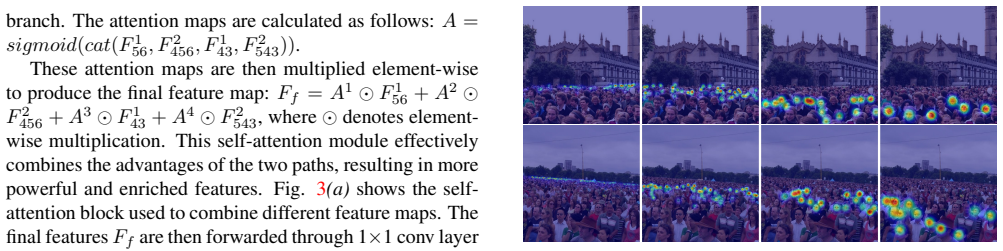
- [Section 3.1, attention module] The attention equation writes A = sigmoid(cat(F^1_56, F^2_456, F^1_43, F^2_543)), but the subsequent formula uses A1 through A4 as if they are per-branch maps; please clarify how the four-channel attention map is split and how spatial dimensions of the fused features are aligned.
- [Section 4, training details] Adam is described as having a 'momentum of 0.9'; this is imprecise because Adam uses beta1 and beta2 hyperparameters. Please specify the exact beta values and any weight decay or batch size.
- [Section 3.1, Eq. (1)] Equation (1) uses a single sigma for all heads, but Section 3.3 later assigns per-head variances from the MRF estimates. The notation should distinguish the constant-variance baseline from the scale-aware formulation.
- [Section 3.2, SCFB description] The definition of the final conv layers c3i and c3j as '{C32,1,1-R}' seems to indicate a filter size of 1x1 with 32 input channels, but the output channel count is unclear. Please specify the exact layer parameters and how intermediate density-map predictions are produced from these features.
Circularity Check
No circular dependency: the proposed architecture and scale-aware supervision are trained from annotations and evaluated on held-out test partitions.
full rationale
The paper's derivation chain is self-contained against external benchmarks. The proposed MBTTBF-SCFB network is trained end-to-end on ground-truth density maps constructed from head-location annotations, and the scale-aware intermediate ground truths (Sec. 3.2) are generated by an MRF procedure (Sec. 3.3) that combines the same annotations with superpixel/watershed segmentation of the input images. Nothing in the loss, architecture, or evaluation equates a predicted quantity with a fitted input: the network is not trained and tested on the same images, the MRF scale estimates are not claimed to be a predicted output, and the scale-aware maps are not derived from the network's own predictions. The ablation improving from 62.5 to 60.2 MAE with scale-aware supervision is an ordinary comparison of training-signal variants, not a forced identity. The paper cites the authors' prior crowd-counting work (CP-CNN, CMTL, HA-CCN) as related context, but the central novelty is not justified by a self-citation chain, and no uniqueness theorem or ansatz is imported from author-owned prior work. The lack of quantitative validation of MRF head-size estimates is a legitimate correctness/robustness concern, but it is not circularity under the defined criteria. Therefore no significant circularity is found.
Assumptions & free parameters
free parameters (6)
- Number of head-size scale categories =
4
- Number of fusion levels per direction =
2
- Dimensionality reduction channel width =
32
- SCFB internal channel width =
32
- Learning rate =
0.00005
- Attention module compression channels =
16 and 4
assumptions (4)
- domain assumption 2D Gaussian density maps represent crowd counts
- domain assumption Superpixel and watershed segment size estimates head size
- ad hoc to paper Four scale bins suffice for scale-aware supervision
- domain assumption VGG16 features are a suitable multi-scale backbone
Cite this review
Pith. "Pith review of Multi-Level Bottom-Top and Top-Bottom Feature Fusion for Crowd Counting." pith.science (2026). https://pith.science/paper/RBRJNS5Y
@misc{pith2026190810937,
  author       = {Pith},
  title        = {Pith review of: Multi-Level Bottom-Top and Top-Bottom Feature Fusion for Crowd Counting},
  year         = {2026},
  howpublished = {\url{https://pith.science/paper/RBRJNS5Y}},
  note         = {Machine review of arXiv:1908.10937}
}
read the original abstract
Crowd counting presents enormous challenges in the form of large variation in scales within images and across the dataset. These issues are further exacerbated in highly congested scenes. Approaches based on straightforward fusion of multi-scale features from a deep network seem to be obvious solutions to this problem. However, these fusion approaches do not yield significant improvements in the case of crowd counting in congested scenes. This is usually due to their limited abilities in effectively combining the multi-scale features for problems like crowd counting. To overcome this, we focus on how to efficiently leverage information present in different layers of the network. Specifically, we present a network that involves: (i) a multi-level bottom-top and top-bottom fusion (MBTTBF) method to combine information from shallower to deeper layers and vice versa at multiple levels, (ii) scale complementary feature extraction blocks (SCFB) involving cross-scale residual functions to explicitly enable flow of complementary features from adjacent conv layers along the fusion paths. Furthermore, in order to increase the effectiveness of the multi-scale fusion, we employ a principled way of generating scale-aware ground-truth density maps for training. Experiments conducted on three datasets that contain highly congested scenes (ShanghaiTech, UCF_CC_50, and UCF-QNRF) demonstrate that the proposed method is able to outperform several recent methods in all the datasets.
Figures


Figures from the paper (4 more)


Reference graph
Works this paper leans on
-
[1]
Radhakrishna Achanta, Appu Shaji, Kevin Smith, Aurelien Lucchi, Pascal Fua, Sabine S¨usstrunk, et al. Slic superpixels. Ecole Polytechnique F ´ed´eral de Lausssanne (EPFL), Tech. Rep, 149300:155–162, 2010
work page 2010
-
[2]
Carlos Arteta, Victor Lempitsky, and Andrew Zisserman. Counting in the wild. In European Conference on Computer Vision, pages 483–498. Springer, 2016
work page 2016
-
[3]
Divide and grow: Capturing huge diversity in crowd images with incrementally growing cnn
Deepak Babu Sam, Neeraj N Sajjan, R Venkatesh Babu, and Mukundhan Srinivasan. Divide and grow: Capturing huge diversity in crowd images with incrementally growing cnn. In Proceedings of the IEEE Conference on Computer Vision and Pattern Recognition, pages 3618–3626, 2018
work page 2018
-
[4]
The watershed transformation ap- plied to image segmentation
Serge Beucher et al. The watershed transformation ap- plied to image segmentation. SCANNING MICROSCOPY- SUPPLEMENT-, pages 299–299, 1992
work page 1992
-
[5]
Crowdnet: A deep convolutional network for dense crowd counting
Lokesh Boominathan, Srinivas SS Kruthiventi, and R Venkatesh Babu. Crowdnet: A deep convolutional network for dense crowd counting. In Proceedings of the 2016 ACM on Multimedia Conference , pages 640–644. ACM, 2016
work page 2016
-
[6]
A unified multi-scale deep convolutional neural network for fast object detection
Zhaowei Cai, Quanfu Fan, Rogerio S Feris, and Nuno Vas- concelos. A unified multi-scale deep convolutional neural network for fast object detection. In European Conference on Computer Vision, pages 354–370. Springer, 2016
work page 2016
-
[7]
Scale aggregation network for accurate and efficient crowd count- ing
Xinkun Cao, Zhipeng Wang, Yanyun Zhao, and Fei Su. Scale aggregation network for accurate and efficient crowd count- ing. In European Conference on Computer Vision , pages 757–773. Springer, 2018
work page 2018
-
[8]
Privacy preserving crowd monitoring: Counting people without people models or tracking
Antoni B Chan, Zhang-Sheng John Liang, and Nuno Vas- concelos. Privacy preserving crowd monitoring: Counting people without people models or tracking. In Computer Vi- sion and Pattern Recognition, 2008. CVPR 2008. IEEE Con- ference on, pages 1–7. IEEE, 2008
work page 2008
Show all 79 references
-
[9]
Feature mining for localised crowd counting
Ke Chen, Chen Change Loy, Shaogang Gong, and Tony Xi- ang. Feature mining for localised crowd counting. In Euro- pean Conference on Computer Vision, 2012
2012
-
[10]
Re- verse attention for salient object detection
Shuhan Chen, Xiuli Tan, Ben Wang, and Xuelong Hu. Re- verse attention for salient object detection. In Proceedings of the European Conference on Computer Vision (ECCV) , pages 234–250, 2018
2018
-
[11]
Convolutional neural networks for counting fish in fisheries surveillance video
Geoffrey French, Mark Fisher, Michal Mackiewicz, and Coby Needle. Convolutional neural networks for counting fish in fisheries surveillance video. In British Machine Vi- sion Conference Workshop. BMV A Press, 2015
2015
-
[12]
Laplacian pyramid reconstruction and refinement for semantic segmentation
Golnaz Ghiasi and Charless C Fowlkes. Laplacian pyramid reconstruction and refinement for semantic segmentation. In European Conference on Computer Vision, pages 519–534. Springer, 2016
2016
-
[13]
Hypercolumns for object segmentation and fine-grained localization
Bharath Hariharan, Pablo Arbel ´aez, Ross Girshick, and Ji- tendra Malik. Hypercolumns for object segmentation and fine-grained localization. In Proceedings of the IEEE con- ference on computer vision and pattern recognition , pages 447–456, 2015
2015
-
[14]
Deeply supervised salient object detection with short connections
Qibin Hou, Ming-Ming Cheng, Xiaowei Hu, Ali Borji, Zhuowen Tu, and Philip HS Torr. Deeply supervised salient object detection with short connections. In Proceedings of the IEEE Conference on Computer Vision and Pattern Recognition, pages 3203–3212, 2017
2017
-
[15]
Meng-Ru Hsieh, Yen-Liang Lin, and Winston H. Hsu. Drone-based object counting by spatially regularized re- gional proposal networks. In The IEEE International Con- ference on Computer Vision (ICCV), 2017
2017
-
[16]
Finding tiny faces
Peiyun Hu and Deva Ramanan. Finding tiny faces. In Pro- ceedings of the IEEE conference on computer vision and pat- tern recognition, pages 951–959, 2017
2017
-
[17]
Multi-source multi-scale counting in extremely dense crowd images
Haroon Idrees, Imran Saleemi, Cody Seibert, and Mubarak Shah. Multi-source multi-scale counting in extremely dense crowd images. In Proceedings of the IEEE Conference on Computer Vision and Pattern Recognition , pages 2547– 2554, 2013
2013
-
[18]
De- tecting humans in dense crowds using locally-consistent scale prior and global occlusion reasoning
Haroon Idrees, Khurram Soomro, and Mubarak Shah. De- tecting humans in dense crowds using locally-consistent scale prior and global occlusion reasoning. IEEE trans- actions on pattern analysis and machine intelligence , 37(10):1986–1998, 2015
1986
-
[19]
Composition loss for counting, density map estimation and localization in dense crowds
Haroon Idrees, Muhmmad Tayyab, Kishan Athrey, Dong Zhang, Somaya Al-Maadeed, Nasir Rajpoot, and Mubarak Shah. Composition loss for counting, density map estimation and localization in dense crowds. In European Conference on Computer Vision, pages 544–559. Springer, 2018
2018
-
[20]
Crowd counting and density estimation by trellis encoder- decoder network
Xiaolong Jiang, Zehao Xiao, Baochang Zhang, Xiantong Zhen, Xianbin Cao, David Doermann, and Ling Shao. Crowd counting and density estimation by trellis encoder- decoder network. arXiv preprint arXiv:1903.00853, 2019
1903 arXiv
-
[21]
Beyond count- ing: Comparisons of density maps for crowd analysis tasks-counting, detection, and tracking
Di Kang, Zheng Ma, and Antoni B Chan. Beyond count- ing: Comparisons of density maps for crowd analysis tasks-counting, detection, and tracking. arXiv preprint arXiv:1705.10118, 2017
2017 arXiv
-
[22]
Learning to count objects in images
Victor Lempitsky and Andrew Zisserman. Learning to count objects in images. In Advances in Neural Information Pro- cessing Systems, pages 1324–1332, 2010
2010
-
[23]
Scale-aware fast r-cnn for pedestrian detection
Jianan Li, Xiaodan Liang, ShengMei Shen, Tingfa Xu, Ji- ashi Feng, and Shuicheng Yan. Scale-aware fast r-cnn for pedestrian detection. IEEE transactions on Multimedia , 20(4):985–996, 2018
2018
-
[24]
Estimating the number of people in crowded scenes by mid based foreground segmentation and head-shoulder detection
Min Li, Zhaoxiang Zhang, Kaiqi Huang, and Tieniu Tan. Estimating the number of people in crowded scenes by mid based foreground segmentation and head-shoulder detection. In Pattern Recognition, 2008. ICPR 2008. 19th International Conference on, pages 1–4. IEEE, 2008
2008
-
[25]
Markov random field models in computer vision
Stan Z Li. Markov random field models in computer vision. In European conference on computer vision, pages 361–370. Springer, 1994
1994
-
[26]
Crowded scene analysis: A sur- vey
Teng Li, Huan Chang, Meng Wang, Bingbing Ni, Richang Hong, and Shuicheng Yan. Crowded scene analysis: A sur- vey. IEEE Transactions on Circuits and Systems for Video Technology, 25(3):367–386, 2015
2015
-
[27]
Anomaly detection and localization in crowded scenes.IEEE transactions on pattern analysis and machine intelligence , 36(1):18–32, 2014
Weixin Li, Vijay Mahadevan, and Nuno Vasconcelos. Anomaly detection and localization in crowded scenes.IEEE transactions on pattern analysis and machine intelligence , 36(1):18–32, 2014
2014
-
[28]
Csrnet: Di- lated convolutional neural networks for understanding the highly congested scenes
Yuhong Li, Xiaofan Zhang, and Deming Chen. Csrnet: Di- lated convolutional neural networks for understanding the highly congested scenes. In Proceedings of the IEEE Con- ference on Computer Vision and Pattern Recognition, pages 1091–1100, 2018
2018
-
[29]
Refinenet: Multi-path refinement networks for high- resolution semantic segmentation
Guosheng Lin, Anton Milan, Chunhua Shen, and Ian Reid. Refinenet: Multi-path refinement networks for high- resolution semantic segmentation. In Proceedings of the IEEE conference on computer vision and pattern recogni- tion, pages 1925–1934, 2017
1925
-
[30]
Feature pyramid networks for object detection
Tsung-Yi Lin, Piotr Doll ´ar, Ross B Girshick, Kaiming He, Bharath Hariharan, and Serge J Belongie. Feature pyramid networks for object detection
-
[31]
Adcrowdnet: An attention-injective deformable convolutional network for crowd understanding
Ning Liu, Yongchao Long, Changqing Zou, Qun Niu, Li Pan, and Hefeng Wu. Adcrowdnet: An attention-injective deformable convolutional network for crowd understanding. arXiv preprint arXiv:1811.11968, 2018
2018 arXiv
-
[32]
Path aggregation network for instance segmentation
Shu Liu, Lu Qi, Haifang Qin, Jianping Shi, and Jiaya Jia. Path aggregation network for instance segmentation. In Pro- ceedings of the IEEE Conference on Computer Vision and Pattern Recognition, pages 8759–8768, 2018
2018
-
[33]
Context- aware crowd counting
Weizhe Liu, Mathieu Salzmann, and Pascal Fua. Context- aware crowd counting. In Proceedings of the IEEE Con- ference on Computer Vision and Pattern Recognition, pages 5099–5108, 2019
2019
-
[34]
Bagdanov
Xialei Liu, Joost van de Weijer, and Andrew D. Bagdanov. Leveraging unlabeled data for crowd counting by learning to rank. In The IEEE Conference on Computer Vision and Pattern Recognition (CVPR), June 2018
2018
-
[35]
Tasselnet: Counting maize tassels in the wild via local counts regression network
Hao Lu, Zhiguo Cao, Yang Xiao, Bohan Zhuang, and Chun- hua Shen. Tasselnet: Counting maize tassels in the wild via local counts regression network. Plant Methods, 13(1):79, 2017
2017
-
[36]
Anomaly detection in crowded scenes
Vijay Mahadevan, Weixin Li, Viral Bhalodia, and Nuno Vas- concelos. Anomaly detection in crowded scenes. In CVPR, volume 249, page 250, 2010
2010
-
[37]
Ssh: Single stage headless face detector
Mahyar Najibi, Pouya Samangouei, Rama Chellappa, and Larry S Davis. Ssh: Single stage headless face detector. In Proceedings of the IEEE International Conference on Com- puter Vision, pages 4875–4884, 2017
2017
-
[38]
Towards perspective-free object counting with deep learning
Daniel Onoro-Rubio and Roberto J L ´opez-Sastre. Towards perspective-free object counting with deep learning. In Eu- ropean Conference on Computer Vision , pages 615–629. Springer, 2016
2016
-
[39]
Count forest: Co-voting uncertain number of targets using random forest for crowd density estimation
Viet-Quoc Pham, Tatsuo Kozakaya, Osamu Yamaguchi, and Ryuzo Okada. Count forest: Co-voting uncertain number of targets using random forest for crowd density estimation. In Proceedings of the IEEE International Conference on Com- puter Vision, pages 3253–3261, 2015
2015
-
[40]
Learning to refine object segments
Pedro O Pinheiro, Tsung-Yi Lin, Ronan Collobert, and Piotr Doll´ar. Learning to refine object segments. In European Conference on Computer Vision , pages 75–91. Springer, 2016
2016
-
[41]
Top-down visual saliency guided by captions
Vasili Ramanishka, Abir Das, Jianming Zhang, and Kate Saenko. Top-down visual saliency guided by captions. In Proceedings of the IEEE Conference on Computer Vision and Pattern Recognition, pages 7206–7215, 2017
2017
-
[42]
Hy- perface: A deep multi-task learning framework for face de- tection, landmark localization, pose estimation, and gender recognition
Rajeev Ranjan, Vishal M Patel, and Rama Chellappa. Hy- perface: A deep multi-task learning framework for face de- tection, landmark localization, pose estimation, and gender recognition. IEEE Transactions on Pattern Analysis and Ma- chine Intelligence, 41(1):121–135, 2017
2017
-
[43]
Iterative crowd counting
Viresh Ranjan, Hieu Le, and Minh Hoai. Iterative crowd counting. In European Conference on Computer Vision , pages 278–293. Springer, 2018
2018
-
[44]
Density-aware person detection and tracking in crowds
Mikel Rodriguez, Ivan Laptev, Josef Sivic, and Jean-Yves Audibert. Density-aware person detection and tracking in crowds. In 2011 International Conference on Computer Vi- sion, pages 2423–2430. IEEE, 2011
2011
-
[45]
A multi-scale cnn for affordance segmentation in rgb images
Anirban Roy and Sinisa Todorovic. A multi-scale cnn for affordance segmentation in rgb images. In European confer- ence on computer vision, pages 186–201. Springer, 2016
2016
-
[46]
Crowd counting using multiple local features
David Ryan, Simon Denman, Clinton Fookes, and Sridha Sridharan. Crowd counting using multiple local features. In Digital Image Computing: Techniques and Applications,
-
[47]
Top-down feed- back for crowd counting convolutional neural network
Deepak Babu Sam and R Venkatesh Babu. Top-down feed- back for crowd counting convolutional neural network. In Thirty-Second AAAI Conference on Artificial Intelligence , 2018
2018
-
[48]
Venkatesh Babu
Deepak Babu Sam, Shiv Surya, and R. Venkatesh Babu. Switching convolutional neural network for crowd counting. In Proceedings of the IEEE Conference on Computer Vision and Pattern Recognition, 2017
2017
-
[49]
Crowd counting via adversarial cross-scale consistency pursuit
Zan Shen, Yi Xu, Bingbing Ni, Minsi Wang, Jianguo Hu, and Xiaokang Yang. Crowd counting via adversarial cross-scale consistency pursuit. In The IEEE Conference on Computer Vision and Pattern Recognition (CVPR), June 2018
2018
-
[50]
Re- visiting perspective information for efficient crowd counting
Miaojing Shi, Zhaohui Yang, Chao Xu, and Qijun Chen. Re- visiting perspective information for efficient crowd counting. In Proceedings of the IEEE Conference on Computer Vision and Pattern Recognition, pages 7279–7288, 2019
2019
-
[51]
Crowd counting with deep negative correlation learning
Zenglin Shi, Le Zhang, Yun Liu, Xiaofeng Cao, Yangdong Ye, Ming-Ming Cheng, and Guoyan Zheng. Crowd counting with deep negative correlation learning. InThe IEEE Confer- ence on Computer Vision and Pattern Recognition (CVPR) , June 2018
2018
-
[52]
Beyond skip connections: Top-down modu- lation for object detection
Abhinav Shrivastava, Rahul Sukthankar, Jitendra Malik, and Abhinav Gupta. Beyond skip connections: Top-down modu- lation for object detection. arXiv preprint arXiv:1612.06851, 2016
2016 arXiv
-
[53]
Simonyan and A
K. Simonyan and A. Zisserman. Very deep convolutional networks for large-scale image recognition. In International Conference on Learning Representations, 2015
2015
-
[54]
Inverse attention guided deep crowd counting network
Vishwanath Sindagi and Vishal Patel. Inverse attention guided deep crowd counting network. arXiv preprint, 2019
2019
-
[55]
Sindagi and Vishal M
Vishwanath A. Sindagi and Vishal M. Patel. Cnn-based cas- caded multi-task learning of high-level prior and density es- timation for crowd counting. In Advanced Video and Signal Based Surveillance (AVSS), 2017 IEEE International Con- ference on. IEEE, 2017
2017
-
[56]
Sindagi and Vishal M
Vishwanath A. Sindagi and Vishal M. Patel. Generating high-quality crowd density maps using contextual pyramid cnns. In The IEEE International Conference on Computer Vision (ICCV), Oct 2017
2017
-
[57]
A survey of re- cent advances in cnn-based single image crowd counting and density estimation
Vishwanath A Sindagi and Vishal M Patel. A survey of re- cent advances in cnn-based single image crowd counting and density estimation. Pattern Recognition Letters, 2017
2017
-
[58]
Ha-ccn: Hi- erarchical attention-based crowd counting network
Vishwanath A Sindagi and Vishal M Patel. Ha-ccn: Hi- erarchical attention-based crowd counting network. arXiv preprint arXiv:1907.10255, 2019
1907 arXiv
-
[59]
Traffic flow from a low frame rate city camera
Evgeny Toropov, Liangyan Gui, Shanghang Zhang, Satwik Kottur, and Jos´e MF Moura. Traffic flow from a low frame rate city camera. In Image Processing (ICIP), 2015 IEEE In- ternational Conference on, pages 3802–3806. IEEE, 2015
2015
-
[60]
Learning to count with cnn boosting
Elad Walach and Lior Wolf. Learning to count with cnn boosting. In European Conference on Computer Vision , pages 660–676. Springer, 2016
2016
-
[61]
Residual regression with semantic prior for crowd counting
Jia Wan, Wenhan Luo, Baoyuan Wu, Antoni B Chan, and Wei Liu. Residual regression with semantic prior for crowd counting. In Proceedings of the IEEE Conference on Com- puter Vision and Pattern Recognition , pages 4036–4045, 2019
2019
-
[62]
Deep people counting in extremely dense crowds
Chuan Wang, Hua Zhang, Liang Yang, Si Liu, and Xiaochun Cao. Deep people counting in extremely dense crowds. In Proceedings of the 23rd ACM international conference on Multimedia, pages 1299–1302. ACM, 2015
2015
-
[63]
Learning from synthetic data for crowd counting in the wild
Qi Wang, Junyu Gao, Wei Lin, and Yuan Yuan. Learning from synthetic data for crowd counting in the wild. arXiv preprint arXiv:1903.03303, 2019
1903 arXiv
-
[64]
Spatiotem- poral modeling for crowd counting in videos
Feng Xiong, Xingjian Shi, and Dit-Yan Yeung. Spatiotem- poral modeling for crowd counting in videos. In IEEE Inter- national Conference on Computer Vision. IEEE, 2017
2017
-
[65]
Crowd density estimation based on rich features and random projection forest
Bolei Xu and Guoping Qiu. Crowd density estimation based on rich features and random projection forest. In 2016 IEEE Winter Conference on Applications of Computer Vision (WACV), pages 1–8. IEEE, 2016
2016
-
[66]
Multi-scale bidirectional fcn for object skeleton extraction
Fan Yang, Xin Li, Hong Cheng, Yuxiao Guo, Leiting Chen, and Jianping Li. Multi-scale bidirectional fcn for object skeleton extraction. In Thirty-Second AAAI Conference on Artificial Intelligence, 2018
2018
-
[67]
Rajeev Yasarla and Vishal M. Patel. Uncertainty guided multi-scale residual learning-using a cycle spinning cnn for single image de-raining. In The IEEE Conference on Com- puter Vision and Pattern Recognition (CVPR), June 2019
2019
-
[68]
Crowd analysis: a survey
Beibei Zhan, Dorothy N Monekosso, Paolo Remagnino, Ser- gio A Velastin, and Li-Qun Xu. Crowd analysis: a survey. Machine Vision and Applications, 19(5-6):345–357, 2008
2008
-
[69]
Cross-scene crowd counting via deep convolutional neural networks
Cong Zhang, Hongsheng Li, Xiaogang Wang, and Xiaokang Yang. Cross-scene crowd counting via deep convolutional neural networks. In Proceedings of the IEEE Conference on Computer Vision and Pattern Recognition , pages 833–841, 2015
2015
-
[70]
Wide-area crowd counting via ground-plane density maps and multi-view fusion cnns
Qi Zhang and Antoni B Chan. Wide-area crowd counting via ground-plane density maps and multi-view fusion cnns. In Proceedings of the IEEE Conference on Computer Vision and Pattern Recognition, pages 8297–8306, 2019
2019
-
[71]
Understanding traffic density from large- scale web camera data
Shanghang Zhang, Guanhang Wu, Joao P Costeira, and Jos´e MF Moura. Understanding traffic density from large- scale web camera data. In IEEE Computer Vision and Pat- tern Recognition. IEEE, 2017
2017
-
[72]
Costeira, and Jos M
Shanghang Zhang, Guanhang Wu, Joo P. Costeira, and Jos M. F. Moura. Fcn-rlstm: Deep spatio-temporal neural net- works for vehicle counting in city cameras. In IEEE Inter- national Conference on Computer Vision. IEEE, 2017
2017
-
[73]
Progressive attention guided recurrent net- work for salient object detection
Xiaoning Zhang, Tiantian Wang, Jinqing Qi, Huchuan Lu, and Gang Wang. Progressive attention guided recurrent net- work for salient object detection. InProceedings of the IEEE Conference on Computer Vision and Pattern Recognition , pages 714–722, 2018
2018
-
[74]
Single-image crowd counting via multi-column convolutional neural network
Yingying Zhang, Desen Zhou, Siqin Chen, Shenghua Gao, and Yi Ma. Single-image crowd counting via multi-column convolutional neural network. In Proceedings of the IEEE Conference on Computer Vision and Pattern Recognition , pages 589–597, 2016
2016
-
[75]
Leveraging heterogeneous auxiliary tasks to assist crowd counting
Muming Zhao, Jian Zhang, Chongyang Zhang, and Wenjun Zhang. Leveraging heterogeneous auxiliary tasks to assist crowd counting. In Proceedings of the IEEE Conference on Computer Vision and Pattern Recognition, pages 12736– 12745, 2019
2019
-
[76]
Defocus blur detection via multi-stream bottom-top-bottom fully convolutional network
Wenda Zhao, Fan Zhao, Dong Wang, and Huchuan Lu. Defocus blur detection via multi-stream bottom-top-bottom fully convolutional network. In Proceedings of the IEEE conference on computer vision and pattern recognition , pages 3080–3088, 2018
2018
-
[77]
Crowd tracking with dynamic evolution of group structures
Feng Zhu, Xiaogang Wang, and Nenghai Yu. Crowd tracking with dynamic evolution of group structures. In European Conference on Computer Vision , pages 139–154. Springer, 2014
2014
-
[78]
Unpaired image-to-image translation using cycle- consistent adversarial networks
Jun-Yan Zhu, Taesung Park, Phillip Isola, and Alexei A Efros. Unpaired image-to-image translation using cycle- consistent adversarial networks. In Proceedings of the IEEE international conference on computer vision , pages 2223– 2232, 2017
2017
-
[2009]
IEEE, 2009
DICTA’09., pages 81–88. IEEE, 2009
2009
Reviewed August 14, 2026 · model on record in the stance chip above.
Discussion (0). Continue with ORCID to comment.