REVIEW 4 major objections 5 minor 81 references
Tilting Ice Giants with a Spin-Orbit Resonance
T0 review · 4 major / 5 minor · reviewed 2026-08-14 · deepseek-v4-flash
Pith's one-line read A massive circumplanetary disk could trap early Uranus in a spin-orbit resonance, tilting it to about 70 degrees and leaving a single modest impact to complete the 98-degree obliquity.
desk verdict A credible disk-driven mechanism for tilting the ice giants that deserves a serious referee, even though the key inclination assumption is unmodeled. read the letter →
The pith
A machine-rendered reading of the paper's core claim, the machinery that carries it, and where it could break.
The reading
What carries the argument
The load-bearing object is the secular spin-orbit resonance, specifically libration about Cassini state 2, in which the resonance angle $\Psi = \varphi_\alpha - \varphi_g$ (the longitude difference between the spin axis and the orbital pole projected onto the invariable plane) librates while the two vectors precess together. The central identity is the spin precession rate $\alpha = \frac{3n^2}{2}\frac{J_2+q}{K\omega + l}$, where $q$ is the effective quadrupole of the satellite or disk system; making $q$ large with a massive disk brings $\alpha$ into match with the orbital nodal precession rate $g$. The disk also shifts the Laplace radius outward because $R_L$ scales with the total quadrupole moment, so more of the disk's mass lies inside the warping radius and participates in the tilt. This is what converts a modest circumplanetary disk into a resonance driver.
What would settle it
A hydrodynamical calculation of ice giant formation showing that Uranus's circumplanetary disk never sustains $\sim 3\times10^{-4}$ Uranus masses for $\sim 1$ Myr while the orbit stays above $5^\circ$ inclination would falsify the resonance path.
Extended reading notes
Core claim
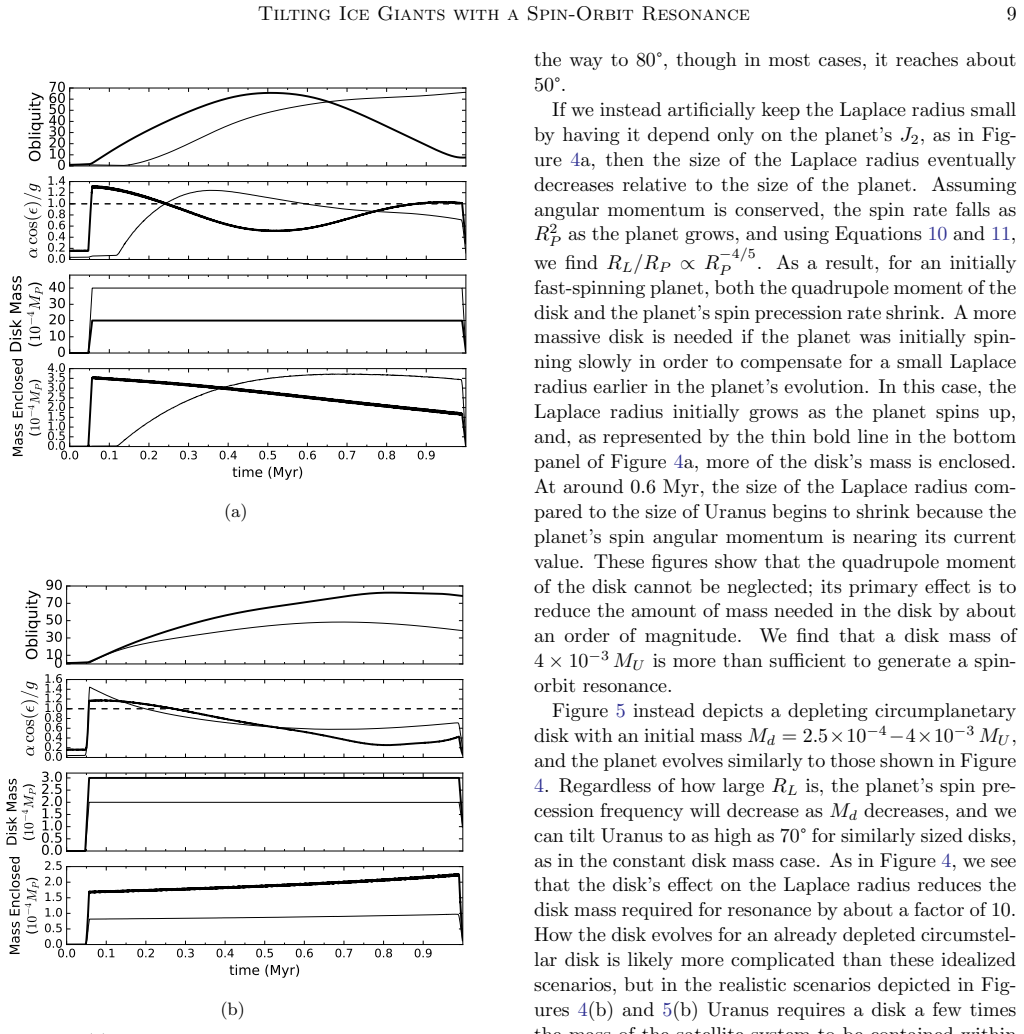
The central claim is that a circumplanetary disk containing $3\times10^{-4}$ to $4\times10^{-3}$ Uranus masses, extending to 0.1--0.5 Hill radii, can raise Uranus's spin precession rate enough to capture it into a secular spin-orbit resonance with its own orbital nodal precession. In this resonance the spin axis and orbital pole coprecess and the obliquity grows to about 70° within roughly 1 Myr as the planet accretes gas; the mechanism cannot exceed 90°, so a subsequent collision with a ~0.5 Earth-mass body is needed to reach 98°. The disk's quadrupole moment moves the Laplace radius outward, so a larger fraction of the disk contributes to pole precession and the required disk mass is only a few times the mass of the current satellite system. For Neptune, a less massive disk suffices to produce its 30° tilt. The authors argue that this hybrid resonance-plus-impact history is roughly an order of magnitude more likely than the existing pure giant-impact scenario and naturally preserves the near equality of the ice giants' spin periods.
Load-bearing premise
The scenario needs Uranus's orbital inclination to stay above about 5° for roughly a million years while the disk is present, but the planet's present inclination relative to the invariable plane is about 1° and the paper does not model how such a sustained elevated inclination arises.
Editorial extensions
If this is right
- If the resonance operated, Uranus's spin period would remain essentially the gas-accretion value, explaining why Uranus and Neptune spin within 6 percent of each other despite very different tilts.
- The disk masses required, $3\times10^{-4}$ to $4\times10^{-3}$ Uranus masses, fall in the range produced by ice giant circumplanetary disk models, so the scenario does not demand an implausibly large disk.
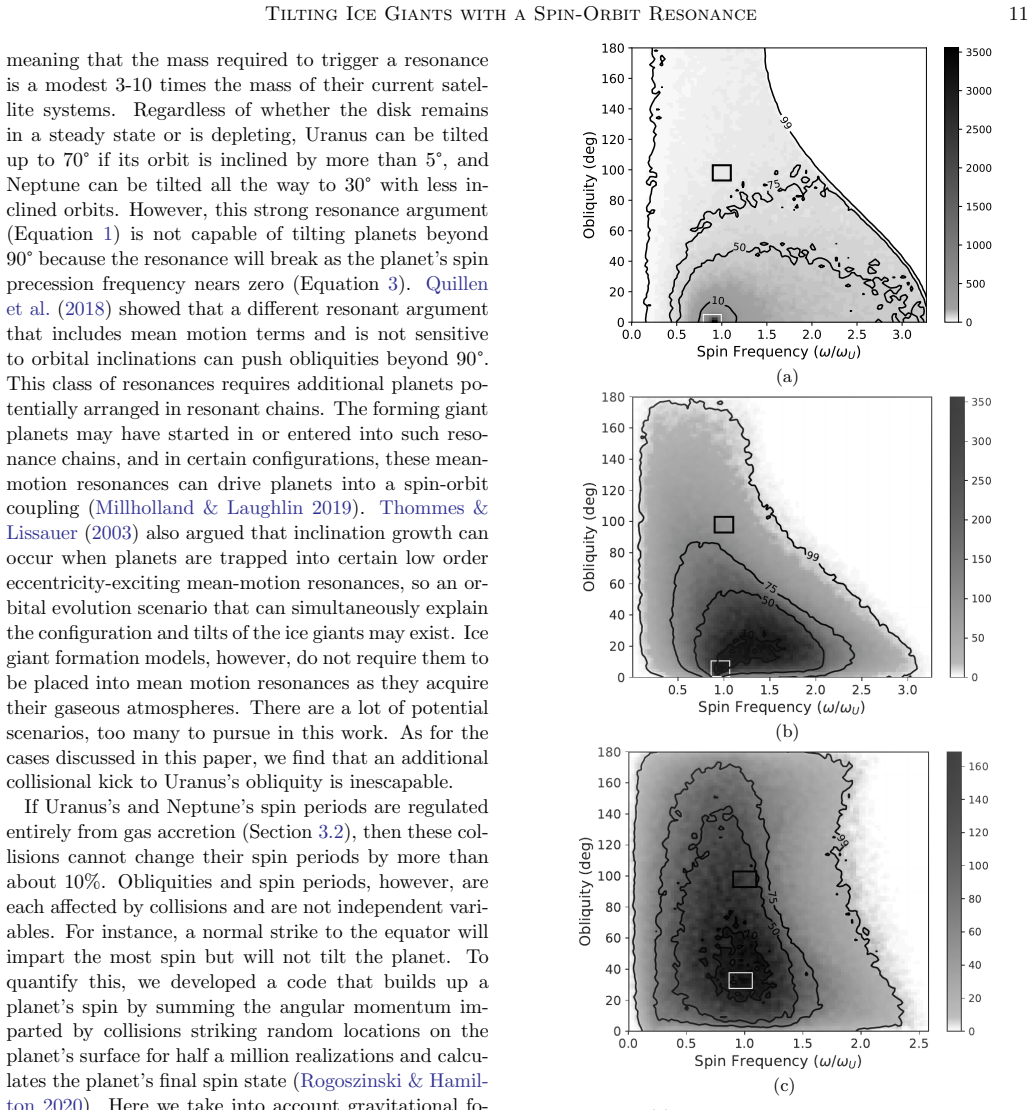
- A single 0.5 Earth-mass impact after resonance is about an order of magnitude more probable than the multiple giant impacts needed in the pure collision scenario.
- Neptune's 30° tilt could be explained by a less massive disk with no giant impacts at all.
- Because the secular resonance cannot push obliquity past 90°, the paper's scenario predicts that any successful tilt history for Uranus must include at least one late impactor.
Reading between the lines
- If this mechanism is right, the regular satellite system of Uranus should preserve a fossil of a heavier disk: the Laplace-plane transition may sit farther out than today's 76.5 Uranian radii, or the satellite spacing may reflect accretion from a disk several times more massive than the current system.
- The same resonance argument should apply to giant exoplanets with massive circumplanetary disks; a population of planets with obliquities near 70° and spin periods set by gas accretion would be a distinctive signature separable from impact histories.
- The paper's inclination requirement is a testable dynamical constraint: future models of ice giant scattering and mean-motion resonance capture should check whether orbital inclinations above 5° can be sustained for a Myr while the circumplanetary disk depletes.
- If later work shows that circumplanetary disks around ice giants are systematically less massive than $3\times10^{-4}$ Uranus masses, the hybrid scenario would need a heavier or longer-lived disk, pushing the burden back toward collisions.
Signed reviews
Editorial analysis
A structured set of objections, weighed in public.
Referee Report
Summary. The manuscript proposes that a massive circumplanetary disk around forming Uranus can raise the spin-axis precession rate sufficiently to capture the planet into a secular spin-orbit resonance, driving its obliquity to about 70 degrees within roughly one million years. A subsequent impact by a 0.5 Earth-mass object then completes the tilt to 98 degrees while leaving the spin period nearly unchanged. For Neptune, the authors argue, a less massive disk can produce its 30-degree obliquity without requiring giant collisions. The paper combines analytic derivations for disk-induced orbital precession and the Laplace radius with HNBody numerical integrations of the spin-orbit dynamics and Monte Carlo collision statistics, concluding that the hybrid resonance-plus-impact scenario improves the likelihood of producing Uranus's spin state by about an order of magnitude relative to multiple giant impacts. The key quantitative results are conditional on assumed constant orbital inclinations of 5 to 10 degrees and on an accretion history calibrated to the present spin period.
Significance. If the proposed mechanism operates, it offers an attractive origin for the ice giants' obliquities that naturally preserves the near-equal spin periods of Uranus and Neptune and reduces the required impactor mass. The appendices provide useful analytic derivations of nodal precession from a circumstellar disk and of the Laplace radius including a disk quadrupole, and the numerical integrations directly demonstrate resonance capture for the chosen parameters. The work also makes a falsifiable prediction: a circumplanetary disk of roughly 3e-4 to 4e-3 Uranus masses, extending to about 0.1 to 0.5 Hill radii, must be present during the roughly one-million-year accretion phase. The main weakness is that the resonance capture is strongly sensitive to the assumed orbital inclination, and the inclination history is not modeled; this missing piece limits the strength of the central claim.
major comments (4)
- [Section 4.3, Figure 3] The central scenario requires Uranus to maintain an orbital inclination above roughly 5 degrees, and in most integrations 10 degrees, for the full ~1 Myr disk lifetime, while Uranus's present inclination relative to the invariable plane is about 1 degree. The paper states in Section 4.3 that the evolution of the inclinations is unknown and then imposes a constant value, citing a damping timescale longer than 1 Myr. This is load-bearing because Figure 3 shows no appreciable tilt at 1 degree over 1 Myr, and the 10-Myr extension that reaches captures near 2 degrees exceeds the assumed disk lifetime. A quantitative treatment of inclination excitation and damping, or an explicit reframing of the result as conditional on an elevated sustained inclination, is needed to support the claim.
- [Section 3.2, Eq. (9)] The accretion efficiency lambda is tuned so that Uranus's final spin angular momentum matches its current value. Because the final spin period is thus used to calibrate the model, the statement that the scenario preserves the similar spin periods of Uranus and Neptune is weaker than a prediction. The paper should quantify how the resonance capture and final tilt depend on lambda within its plausible range, and should separate the calibrated spin-up history from the dynamically produced obliquity change.
- [Section 4.4, Figures 4 and 5] The integrations are presented as single representative trajectories rather than ensembles, so the probability of resonance capture and of reaching about 70 degrees is not quantified. Since the text notes that tilts above 70 degrees are only rarely generated, the end-to-end likelihood of the hybrid scenario, including the capture probability, the disk mass distribution, and the inclination history, should be estimated before comparing it to the giant-impact scenario.
- [Section 5, Figures 7 and 8] The order-of-magnitude likelihood gain claimed in the abstract is inferred by comparing simulations with different initial conditions: Figure 8a starts at epsilon_i = 75 degrees, T_i = 16 hr, with one 0.5 Earth-mass impactor, whereas Figure 7c starts at epsilon_i = 0 degrees, T_i = 68 hr, with two 0.5 Earth-mass impactors. The comparison conflates the benefit of a resonance-prepared high obliquity with the benefit of a slower initial spin and a smaller impactor; a matched comparison or a decomposition of the two effects is required.
minor comments (5)
- [Section 1] The sentence 'would neatly sidesteps every issue' contains a subject-verb agreement error; it should read 'would neatly sidestep every issue.'
- [Figure 3] Placing a vertical line at the present-day 1 degree inclination on the horizontal axis would make the gap between the assumed 5 to 10 degree values and the current value immediately visible.
- [Section 4.4] The captions of Figures 4 and 5 would benefit from stating the assumed surface-density power-law index and the disk outer radius in units of the Hill radius for each panel, since these directly control the Laplace radius and hence the required disk mass.
- [Appendix B] Equation B9 includes the factor (M_P + M_d), but the text immediately neglects M_d; stating this approximation in the main-text version (Equation 10) would avoid an apparent inconsistency.
- [Section 5] The quoted likelihood values l and l_U are presented without uncertainties; reporting Poisson errors or the number of successful realizations would help assess the robustness of the order-of-magnitude comparisons.
Circularity Check
No load-bearing circularity: the ~70-degree obliquity is an emergent integration output; the tuned spin parameter and assumed inclination are stated inputs, not derived predictions.
full rationale
The paper's central numerical result—Uranus reaching roughly 70 degrees of obliquity via capture into a secular spin-orbit resonance—is produced by integrating the spin-axis equation (Eq. 2) with the precession frequency alpha from Eq. 4, including the disk quadrupole q, against the orbital precession rate g. The 70-degree value is an output of the integrations, not an input: disk mass, surface-density profile, Laplace radius, and orbital inclination are varied in parameter surveys, and Figures 1-5 report the resulting obliquity changes. The resonance condition alpha cos(epsilon) approximately equal to g is derived from the same equations rather than imposed as the answer. The paper's one explicit calibration, the parameter lambda in Eq. 9, is tuned so that Uranus's final spin angular momentum matches its current value; however, the spin rate is not the claimed prediction, and the resonance's spin-preserving property follows from Eq. 2 changing only the direction of the spin axis. The assumed constant orbital inclination above about 5 degrees (Section 4.3, Figure 3) is a clearly stated boundary condition whose physical production is not modeled; this is a missing-support or correctness concern rather than circularity. Self-citations to the authors' prior work (Hamilton & Ward 2004; Ward & Hamilton 2004; Rauch & Hamilton 2002; Rogoszinski & Hamilton 2020) supply standard secular-resonance theory and code whose relevant behavior is reproduced in the present paper, so they are not load-bearing in a way that makes the derivation self-referential.
Assumptions & free parameters
free parameters (7)
- Accretion efficiency lambda =
tuned so final spin matches current Uranus spin (TU = 17.2 h)
- Initial spin angular momentum L0 =
L0 about LU (current) or 0.25 to 0.5 LU
- Orbital inclination i_U, i_N =
10 degrees for Uranus in most runs, 3 to 10 degrees for Neptune
- Circumplanetary disk mass Md =
3e-4 to 4e-3 Uranus masses, 3.5e-4 to 4e-3 Neptune masses
- Disk surface density power-law index beta =
0 for constant profile, or values giving a 3 order of magnitude drop
- Disk outer radius Ro =
54 Uranus radii up to 0.5 Hill radii, or 0.1 Hill radii for Szulágyi-like disks
- Planet radius and mass growth history =
Radius 80 to 120 Uranus radii, mass 0.9 to 1.0 Uranus mass over about 1 Myr
assumptions (6)
- standard math Secular spin-orbit resonance theory with Cassini states: the spin axis precession frequency formula alpha = (3 n^2 / 2) (J2 + q) / (K omega + l) (Eq. 4) describes the planetary pole motion.
- domain assumption The circumplanetary disk can be represented as a series of Keplerian rings with surface density Sigma(a) = Sigma0 (a / Ro)^(-beta), and its quadrupole moment q is given by integrating ringlets inside the Laplace radius (Eq. B10).
- standard math The Laplace radius approximation RL about (2 J2_tot (M_P / M_Sun) R_P^2 r_P^3)^(1/5) and its disk-dominated limit Eq. 12 describe the transition between equatorial and ecliptic precession.
- ad hoc to paper The planet's orbital inclination i is constant over the about 1 Myr evolution and was above 5 degrees for Uranus during the resonance epoch.
- domain assumption The planet's spin angular momentum grows by accreting gas with efficiency lambda, tuned so the final spin matches the observed period; the initial spin angular momentum is a free input.
- domain assumption Gas accretion supplies spin angular momentum such that the spin period is not changed by the resonance; the disk dissipates on a about 1 Myr timescale while the planet's mass grows from 0.9 to 1.0 Uranus mass.
Cite this review
Pith. "Pith review of Tilting Ice Giants with a Spin-Orbit Resonance." pith.science (2026). https://pith.science/paper/UUO4AC3C
@misc{pith2026190810969,
  author       = {Pith},
  title        = {Pith review of: Tilting Ice Giants with a Spin-Orbit Resonance},
  year         = {2026},
  howpublished = {\url{https://pith.science/paper/UUO4AC3C}},
  note         = {Machine review of arXiv:1908.10969}
}
abstract
Giant collisions can account for Uranus's and Neptune's large obliquities, yet generating two planets with widely different tilts and strikingly similar spin rates is a low-probability event. Trapping into a secular spin-orbit resonance, a coupling between spin and orbit precession frequencies, is a promising alternative, as it can tilt the planet without altering its spin period. We show with numerical integrations that if Uranus harbored a massive circumplanetary disk at least three times the mass of its satellite system while it was accreting its gaseous atmosphere, then its spin precession rate would increase enough to resonate with its own orbit, potentially driving the planet's obliquity to 70${^\circ}$. We find that the presence of a massive disk moves the Laplace radius significantly outward from its classical value, resulting in more of the disk contributing to the planet's pole precession. Although we can generate tilts greater than 70${^\circ}$ only rarely and cannot drive tilts beyond 90${^\circ}$, a subsequent collision with an object about $0.5\,M_{\oplus}$ could tilt Uranus from 70${^\circ}$ to 98${^\circ}$. Minimizing the masses and number of giant impactors from two or more to just one increases the likelihood of producing Uranus's spin states by about an order of magnitude. Neptune, by contrast, needs a less massive disk to explain its 30${^\circ}$ tilt, eliminating the need for giant collisions altogether.
Figures


Figures from the paper (5 more)



Reference graph
Works this paper leans on
-
[1]
Agnor, C. B., Canup, R. M., & Levison, H. F. 1999, Icarus, 142, 219, doi: 10.1006/icar.1999.6201
arXiv 1999
-
[2]
Agnor, C. B., & Hamilton, D. P. 2006, Nature, 441, 192, doi: 10.1038/nature04792
-
[3]
Alexander, R. D., Clarke, C. J., & Pringle, J. E. 2005, MNRAS, 358, 283, doi: 10.1111/j.1365-2966.2005.08786.x Ayliffe, B. A., & Bate, M. R. 2009, MNRAS, 397, 657, doi: 10.1111/j.1365-2966.2009.15002.x —. 2012, MNRAS, 427, 2597, doi: 10.1111/j.1365-2966.2012.21979.x
-
[4]
Balbus, S. A., & Hawley, J. F. 1991, ApJ, 376, 214, doi: 10.1086/170270
doi:10.1086/170270 1991
-
[5]
2018, AJ, 155, 178, doi: 10.3847/1538-3881/aab54e
Batygin, K. 2018, AJ, 155, 178, doi: 10.3847/1538-3881/aab54e
-
[6]
L., & Cameron, A
Benz, W., Slattery, W. L., & Cameron, A. G. W. 1989, Meteoritics, 24, 251
1989
-
[7]
Bodenheimer, P., & Pollack, J. B. 1986, Icarus, 67, 391, doi: 10.1016/0019-1035(86)90122-3 Bou´ e, G., & Laskar, J. 2006, Icarus, 185, 312, doi: 10.1016/j.icarus.2006.07.019 —. 2010, ApJL, 712, L44, doi: 10.1088/2041-8205/712/1/L44
-
[8]
Bowler, B. P. 2018, Nature Astronomy, 2, 138, doi: 10.1038/s41550-017-0325-8
Show all 81 references
-
[9]
Papaloizou, J. C. B. 1999, ApJ, 514, 344, doi: 10.1086/306917
1999 doi
-
[10]
M., & Asphaug, E
Canup, R. M., & Asphaug, E. 2001, Nature, 412, 708
2001
-
[11]
M., & Ward, W
Canup, R. M., & Ward, W. R. 2002, AJ, 124, 3404, doi: 10.1086/344684 —. 2006, Nature, 441, 834, doi: 10.1038/nature04860
2002 doi
-
[12]
2013, ApJ, 769, 26, doi: 10.1088/0004-637X/769/1/26
Chen, Y.-Y., Liu, H.-G., Zhao, G., & Zhou, J.-L. 2013, ApJ, 769, 26, doi: 10.1088/0004-637X/769/1/26
2013 doi
- [13]
-
[14]
Cridland, A. J. 2018, A&A, 619, A165, doi: 10.1051/0004-6361/201833611 ´Cuk, M., Hamilton, D. P., Lock, S. J., & Stewart, S. T. 2016, Nature, 539, 402, doi: 10.1038/nature19846 Tilting Ice Giants with a Spin-Orbit Resonance 15
2018 doi
-
[15]
S., & Nesvorn´ y, D
Deienno, R., Morbidelli, A., Gomes, R. S., & Nesvorn´ y, D. 2017, AJ, 153, 153, doi: 10.3847/1538-3881/aa5eaa
2017 doi
-
[16]
Desch, S. J. 2007, ApJ, 671, 878, doi: 10.1086/522825
2007 doi
-
[17]
1993a, Icarus, 103, 67, doi: 10.1006/icar.1993.1059 —
Dones, L., & Tremaine, S. 1993a, Icarus, 103, 67, doi: 10.1006/icar.1993.1059 —. 1993b, Science, 259, 350, doi: 10.1126/science.259.5093.350 Doˇ gan, S., Nixon, C. J., King, A. R., & Pringle, J. E. 2018, MNRAS, 476, 1519, doi: 10.1093/mnras/sty155 Duffell, P. C. 2015, ApJL, 807...
1993
-
[18]
2003, A&A, 411, 623, doi: 10.1051/0004-6361:20034154
Fendt, C. 2003, A&A, 411, 623, doi: 10.1051/0004-6361:20034154
2003 doi
-
[19]
Frelikh, R., & Murray-Clay, R. A. 2017, AJ, 154, 98, doi: 10.3847/1538-3881/aa81c7
2017 doi
-
[20]
1965, AJ, 70, 5, doi: 10.1086/109673 —
Goldreich, P. 1965, AJ, 70, 5, doi: 10.1086/109673 —. 1966, Reviews of Geophysics and Space Physics, 4, 411, doi: 10.1029/RG004i004p00411
1965 doi
-
[21]
1980, ApJ, 241, 425, doi: 10.1086/158356
Goldreich, P., & Tremaine, S. 1980, ApJ, 241, 425, doi: 10.1086/158356
1980 doi
-
[22]
F., Tsiganis, K., & Morbidelli, A
Gomes, R., Levison, H. F., Tsiganis, K., & Morbidelli, A. 2005, Nature, 435, 466, doi: 10.1038/nature03676
2005 doi
-
[23]
P., & Burns, J
Hamilton, D. P., & Burns, J. A. 1994, Science, 264, 550, doi: 10.1126/science.264.5158.550
1994 doi
- [24]
-
[25]
1981, Progress of Theoretical Physics Supplement, 70, 35, doi: 10.1143/PTPS.70.35
Hayashi, C. 1981, Progress of Theoretical Physics Supplement, 70, 35, doi: 10.1143/PTPS.70.35
1981 doi
-
[26]
2015, A&A, 582, A99, doi: 10.1051/0004-6361/201425525
Pierens, A. 2015, A&A, 582, A99, doi: 10.1051/0004-6361/201425525
2015 doi
-
[27]
A., Eke, V
Kegerreis, J. A., Eke, V. R., Gonnet, P., et al. 2019, MNRAS, 487, 5029, doi: 10.1093/mnras/stz1606
2019 doi
-
[28]
A., Teodoro, L
Kegerreis, J. A., Teodoro, L. F. A., Eke, V. R., et al. 2018, ApJ, 861, 52, doi: 10.3847/1538-4357/aac725
2018 doi
-
[29]
G., Bodenheimer, P., Cassen, P., & Pollack, J
Korycansky, D. G., Bodenheimer, P., Cassen, P., & Pollack, J. B. 1990, Icarus, 84, 528, doi: 10.1016/0019-1035(90)90051-A
1990 doi
-
[30]
2012, A&A, 544, A32, doi: 10.1051/0004-6361/201219127
Lambrechts, M., & Johansen, A. 2012, A&A, 544, A32, doi: 10.1051/0004-6361/201219127
2012 doi
-
[31]
2014, A&A, 572, A35, doi: 10.1051/0004-6361/201423814
Lambrechts, M., Johansen, A., & Morbidelli, A. 2014, A&A, 572, A35, doi: 10.1051/0004-6361/201423814
2014 doi
-
[32]
F., Kretke, K
Levison, H. F., Kretke, K. A., & Duncan, M. J. 2015a, Nature, 524, 322, doi: 10.1038/nature14675
-
[33]
F., Kretke, K
Levison, H. F., Kretke, K. A., Walsh, K. J., & Bottke, W. F. 2015b, Proceedings of the National Academy of Science, 112, 14180, doi: 10.1073/pnas.1513364112
-
[34]
F., Morbidelli, A., Tsiganis, K., Nesvorn´ y, D., & Gomes, R
Levison, H. F., Morbidelli, A., Tsiganis, K., Nesvorn´ y, D., & Gomes, R. 2011, AJ, 142, 152, doi: 10.1088/0004-6256/142/5/152
2011 doi
-
[35]
Lin, D. N. C., & Papaloizou, J. 1979, MNRAS, 186, 799, doi: 10.1093/mnras/186.4.799
1979 doi
-
[36]
Lissauer, J. J. 1995, Icarus, 114, 217, doi: 10.1006/icar.1995.1057
1995
-
[37]
2009, Icarus, 199, 338, doi: 10.1016/j.icarus.2008.10.004
Bodenheimer, P. 2009, Icarus, 199, 338, doi: 10.1016/j.icarus.2008.10.004
2009 doi
-
[38]
J., & Kary, D
Lissauer, J. J., & Kary, D. M. 1991, Icarus, 94, 126, doi: 10.1016/0019-1035(91)90145-J
1991 doi
-
[39]
Lovelace, R. V. E., Covey, K. R., & Lloyd, J. P. 2011, AJ, 141, 51, doi: 10.1088/0004-6256/141/2/51
2011 doi
-
[40]
Machida, M. N. 2009, MNRAS, 392, 514, doi: 10.1111/j.1365-2966.2008.14090.x
2009
-
[41]
G., & Lubow, S
Martin, R. G., & Lubow, S. H. 2011, MNRAS, 413, 1447, doi: 10.1111/j.1365-2966.2011.18228.x
2011
-
[42]
2019, ApJ, 876, 119, doi: 10.3847/1538-4357/ab19be
Millholland, S., & Batygin, K. 2019, ApJ, 876, 119, doi: 10.3847/1538-4357/ab19be
2019 doi
-
[43]
2019, Nature Astronomy, 3, 424, doi: 10.1038/s41550-019-0701-7
Millholland, S., & Laughlin, G. 2019, Nature Astronomy, 3, 424, doi: 10.1038/s41550-019-0701-7
2019 doi
-
[44]
Levison, H. F. 2009, A&A, 507, 1041, doi: 10.1051/0004-6361/200912876
2009 doi
-
[45]
F., Tsiganis, K., & Gomes, R
Morbidelli, A., Levison, H. F., Tsiganis, K., & Gomes, R. 2005, Nature, 435, 462, doi: 10.1038/nature03540
2005 doi
-
[46]
2014, Icarus, 232, 266, doi: 10.1016/j.icarus.2014.01.010
Morbidelli, A., Szul´ agyi, J., Crida, A., et al. 2014, Icarus, 232, 266, doi: 10.1016/j.icarus.2014.01.010
2014 doi
-
[47]
2012, Icarus, 219, 737, doi: 10.1016/j.icarus.2012.03.025
Gomes, R. 2012, Icarus, 219, 737, doi: 10.1016/j.icarus.2012.03.025
2012 doi
-
[48]
2007, AJ, 134, 1790, doi: 10.1086/521705
Gomes, R. 2007, AJ, 134, 1790, doi: 10.1086/521705
2007 doi
-
[49]
2004, A&A, 413, 373, doi: 10.1051/0004-6361:20031515
Mousis, O. 2004, A&A, 413, 373, doi: 10.1051/0004-6361:20031515
2004 doi
-
[50]
D., & Dermott, S
Murray, C. D., & Dermott, S. F. 1999, Solar System Dynamics, 153
1999
-
[51]
2008, ApJ, 678, 498, doi: 10.1086/529369 Nesvorn´ y, D., & Morbidelli, A
Nagasawa, M., Ida, S., & Bessho, T. 2008, ApJ, 678, 498, doi: 10.1086/529369 Nesvorn´ y, D., & Morbidelli, A. 2012, AJ, 144, 117, doi: 10.1088/0004-6256/144/4/117
2008 doi
-
[52]
Johnson, T. V. 2008, Irregular Satellites of the Giant Planets, ed. M. A. Barucci, H. Boehnhardt, D. P
2008
-
[53]
Papaloizou, J. C. B., & Lin, D. N. C. 1995, ApJ, 438, 841, doi: 10.1086/175127
1995 doi
-
[54]
G., & Brunini, A
Parisi, M. G., & Brunini, A. 1997, Planet. Space Sci., 45, 181, doi: 10.1016/S0032-0633(96)00076-1
1997 doi
-
[55]
G., & Brunini, A
Parisi, M. G., & Brunini, A. 2002, BAAS, 34, 892
2002
-
[56]
Peale, S. J. 1969, AJ, 74, 483, doi: 10.1086/110825 16 Rogoszinski and Hamilton
1969 doi
-
[57]
I., & Marley, M
Podolak, M., Podolak, J. I., & Marley, M. S. 2000, Planet. Space Sci., 48, 143, doi: 10.1016/S0032-0633(99)00088-4
2000 doi
-
[58]
1995, Planet
Podolak, M., Weizman, A., & Marley, M. 1995, Planet. Space Sci., 43, 1517, doi: 10.1016/0032-0633(95)00061-5
1995 doi
-
[59]
B., Hubickyj, O., Bodenheimer, P., et al
Pollack, J. B., Hubickyj, O., Bodenheimer, P., et al. 1996, Icarus, 124, 62, doi: 10.1006/icar.1996.0190
1996
-
[60]
Flannery, B. P. 1992, Numerical Recipes in C. The Art of Scientific Computing
1992
-
[61]
C., Chen, Y.-Y., Noyelles, B., & Loane, S
Quillen, A. C., Chen, Y.-Y., Noyelles, B., & Loane, S. 2018, Celestial Mechanics and Dynamical Astronomy, 130, 11, doi: 10.1007/s10569-017-9804-6
2018 doi
-
[62]
C., & Trilling, D
Quillen, A. C., & Trilling, D. E. 1998, ApJ, 508, 707, doi: 10.1086/306421
1998 doi
-
[63]
Ragozzine, D., & Wolf, A. S. 2009, ApJ, 698, 1778, doi: 10.1088/0004-637X/698/2/1778
2009 doi
-
[64]
P., & Hamilton, D
Rauch, K. P., & Hamilton, D. P. 2002, BAAS, 34, 938
2002
-
[65]
2018, in AAS/Division of Dynamical Astronomy Meeting, Vol
Rogoszinski, Z., & Hamilton, D. 2018, in AAS/Division of Dynamical Astronomy Meeting, Vol. 49, 10
2018
-
[66]
Rogoszinski, Z., & Hamilton, D. P. 2020, in prep
2020
-
[67]
Rufu, R., & Canup, R. M. 2017, AJ, 154, 208, doi: 10.3847/1538-3881/aa9184
2017 doi
-
[68]
I., & Sunyaev, R
Shakura, N. I., & Sunyaev, R. A. 1973, A&A, 500, 33
1973
-
[69]
L., Benz, W., & Cameron, A
Slattery, W. L., Benz, W., & Cameron, A. G. W. 1992, Icarus, 99, 167, doi: 10.1016/0019-1035(92)90180-F
1992 doi
-
[70]
Snellen, I. A. G., Brandl, B. R., de Kok, R. J., et al. 2014, Nature, 509, 63, doi: 10.1038/nature13253 Szul´ agyi, J., Cilibrasi, M., & Mayer, L. 2018, ApJL, 868, L13, doi: 10.3847/2041-8213/aaeed6 Szul´ agyi, J., Masset, F., Lega, E., et al. 2016, MNRAS, 460, 2853, doi: 10.1...
2014 doi
-
[71]
Tanigawa, T., Ohtsuki, K., & Machida, M. N. 2012, ApJ, 747, 47, doi: 10.1088/0004-637X/747/1/47
2012 doi
-
[72]
W., Duncan, M
Thommes, E. W., Duncan, M. J., & Levison, H. F. 1999, Nature, 402, 635, doi: 10.1038/45185 —. 2002, AJ, 123, 2862, doi: 10.1086/339975 —. 2003, Icarus, 161, 431, doi: 10.1016/S0019-1035(02)00043-X
1999 doi
-
[73]
W., & Lissauer, J
Thommes, E. W., & Lissauer, J. J. 2003, ApJ, 597, 566, doi: 10.1086/378317
2003 doi
-
[74]
1991, Icarus, 89, 85, doi: 10.1016/0019-1035(91)90089-C
Tremaine, S. 1991, Icarus, 89, 85, doi: 10.1016/0019-1035(91)90089-C
1991 doi
-
[75]
Tremaine, S., & Davis, S. W. 2014, MNRAS, 441, 1408, doi: 10.1093/mnras/stu663
2014 doi
-
[76]
Tsiganis, K., Gomes, R., Morbidelli, A., & Levison, H. F. 2005, Nature, 435, 459, doi: 10.1038/nature03539
2005 doi
-
[77]
G., Ormel, C
Visser, R. G., Ormel, C. W., Dominik, C., & Ida, S. 2020, Icarus, 335, 113380, doi: 10.1016/j.icarus.2019.07.014
2020 doi
-
[78]
Ward, W. R. 1974, J. Geophys. Res., 79, 3375, doi: 10.1029/JC079i024p03375 —. 1975, AJ, 80, 64, doi: 10.1086/111714
1974 doi
-
[79]
R., & Canup, R
Ward, W. R., & Canup, R. M. 2010, AJ, 140, 1168, doi: 10.1088/0004-6256/140/5/1168
2010 doi
- [80]
-
[81]
Zhu, Z., Ju, W., & Stone, J. M. 2016, ApJ, 832, 193, doi: 10.3847/0004-637X/832/2/193
2016 doi
Reviewed August 14, 2026 · model on record in the stance chip above.
Discussion (0). Continue with ORCID to comment.