REVIEW 3 major objections 5 minor 31 references
Focus-Enhanced Scene Text Recognition with Deformable Convolutions
T0 review · 3 major / 5 minor · reviewed 2026-08-14 · deepseek-v4-flash
Pith's one-line read The paper claims that deformable convolutions in place of rectification lift CRNN accuracy on irregular text from 64.8% to 70.3% on TotalText and from 65.3% to 72.2% on ICDAR 2015.
desk verdict A clean empirical ablation with a load-bearing attribution gap: the deformable convolution gains are confounded with added capacity. read the letter →
The pith
A machine-rendered reading of the paper's core claim, the machinery that carries it, and where it could break.
The reading
What carries the argument
The load-bearing mechanism is the deformable convolutional layer, in which each sampling position $p_n$ of a convolutional kernel is augmented by a learned offset $\Delta p_n$, so the receptive field is no longer a fixed rectangle. This paper inserts it at the fourth and fifth convolutional layers of the CRNN feature extractor, where the feature map still has enough spatial extent for offsets to drift toward the text. The offsets are predicted from the input feature map itself and trained jointly with the CTC loss, giving the network the ability to shift focus along a curved or tilted text line without any explicit rectification step. Residual blocks stabilize the deeper training, and adaptive max pooling lets the network accept the larger $200\times64$ input that gives the offsets room to move.
What would settle it
Train or evaluate the same network on a deliberately blurred version of TotalText or ICDAR 2015: if the deformable layers' advantage over the baseline shrinks toward zero as blur increases, the claim that offsets adapt to text shape rather than merely to training distribution would be contradicted. Alternatively, replace the deformable layers with standard $3\times3$ convolutions of equal parameter count while keeping residuals and the $200\times64$ input; if benchmark accuracy stays at 70.3% and 72.2%, then the offsets are not the cause of the gain.
Extended reading notes
Core claim
The central claim is that a text recognizer does not need to rectify an irregular word image before recognizing it; adaptively shaped convolutional receptive fields can do the focusing. Concretely, the paper reports that replacing the fourth and fifth convolutional layers of a CRNN with deformable convolutions, adding residual blocks, and resizing inputs to $200\times64$ lifts accuracy on TotalText to 70.3% from a 64.8% baseline and on ICDAR 2015 to 72.2% from 65.3% (Table 1). The deformable layers learn sampling offsets $\Delta p_n$ from the feature map itself, and the whole model is trained end-to-end with CTC loss, leaving the BiLSTM and transcription layers of CRNN untouched. The authors also find that placement matters: two deformable layers in the middle of the network work best, while a third deformable layer degrades accuracy.
Load-bearing premise
The load-bearing premise is that offsets learned from clean synthetic images will locate the text region in real-world photos; on SVT, where images are severely corrupted by noise, blur, or low resolution, the deformable layers stop helping and the gain nearly disappears.
Editorial extensions
If this is right
- Irregular text recognition can be improved without a rectification branch, so the preprocessing and extra network parameters associated with rectification are not strictly necessary for competitive results.
- The deformable layers are chiefly responsible for gains on irregular benchmarks: the improvement on TotalText and ICDAR 2015 is large, while the gain on regular text is smaller.
- The network needs enough spatial room for offsets to move: resizing to $200\times64$ helps the deformable model substantially, while the same resize brings little benefit to the unmodified baseline.
- Replacing too many layers with deformable convolutions hurts accuracy, which the authors attribute to overfitting, so the benefit is specific to placing the adaptive layers in the middle of the feature extractor.
Reading between the lines
- Editorial inference: the same two-layer deformable swap could be tested in attention-based recognizers, since the paper only demonstrates the effect with a CTC-trained CRNN and the mechanism is not tied to CTC.
- Editorial inference: the near-zero gain on SVT implies a concrete extension—training with synthetic blur, noise, or low-resolution augmentation might recover the missing benefit, because the paper identifies the domain gap as the cause.
- Editorial inference: if the offsets are truly tracing text shape, visualizing them should show sampling locations following curvature; the paper does not provide such visualizations, so this is a testable prediction rather than a reported result.
Signed reviews
Editorial analysis
A structured set of objections, weighed in public.
Referee Report
Summary. The paper modifies the CRNN scene text recognition baseline by replacing the fourth and fifth convolutional layers with deformable convolutions, adding residual blocks, and increasing the input resolution to 200x64. Experiments on TotalText, ICDAR 2013, ICDAR 2015, SVT, and IIIT5K report accuracy improvements over the authors' CRNN baseline, most notably on the irregular-text benchmarks: 70.3% vs. 64.8% on TotalText and 72.2% vs. 65.3% on ICDAR 2015. The authors argue that deformable convolutional layers let the network adapt its receptive fields to text shape, eliminating the need for explicit rectification modules.
Significance. If the reported gains are causally attributable to adaptive receptive fields, the paper offers a simple and conceptually interesting alternative to rectification-based irregular-text recognition. The manuscript has concrete strengths: it is trained only on public synthetic data, evaluated on five standard public benchmarks without a lexicon, and provides ablation tables for the proposed components and layer positions. However, the central causal claim is not yet established because the deformable-convolution configuration is confounded with added model capacity, and the final architecture was selected using the same test benchmarks on which the results are reported. The absence of error bars or repeated-run statistics further weakens the quantitative claims. The paper is a reasonable candidate for the journal if these methodological gaps are addressed.
major comments (3)
- [Section 3.3.1, Table 1] The row labeled 'DConv' differs from the baseline not only in adaptive sampling geometry, but also in the additional offset-generation branch (a standard convolution plus bilinear sampling) and consequently in parameter count. The 'ResBlock' row shows that added capacity alone improves TotalText by 3.4 points and IIIT5K by 6.2 points, indicating that the architecture is sensitive to capacity. Please add a control model in which layers 4 and 5 are replaced by standard 3x3 convolutions (or dilated convolutions) with matched parameter count and computation. Without such a control, the statement in Section 3.3.1 that 'the deformable layers are chiefly effective on irregular images' is not causally supported, and the headline gains cannot be attributed specifically to adaptive receptive fields.
- [Section 3.3.2 and Section 3.4, Tables 2 and 3] The final configuration, including the deformable layer location {4,5}, was selected by comparing accuracy on the same TotalText, IC13, IC15, SVT, and IIIT5K test sets that are later reported as the final results in Table 3. This test-set-based model selection means the reported numbers are selected rather than held-out estimates and may overstate expected performance relative to prior published methods that did not tune on these specific test sets. Please use a validation split for architecture and hyperparameter selection, then evaluate on the test sets only once. In addition, because no error bars or repeated runs are reported, please provide multiple training runs or another quantification of variance to assess whether the 5-7 point gains on irregular-text benchmarks are outside the noise level.
- [Section 3.4, Table 3] The comparison with prior work is incomplete and some entries are problematic. The same paper appears to be cited twice (reference [10] and reference [24] are both 'Robust scene text recognition with automatic rectification'), and several recent strong baselines for irregular text are missing. The claim that the method 'has reached satisfactory performances' would be more persuasive if the comparison included standard recent methods, e.g., those based on rectification or attention, with consistent training protocols. At minimum, the duplicated reference should be corrected and the comparison table should note the training data and protocol used by each prior method.
minor comments (5)
- [Abstract and Section 2.3] The paper repeatedly states that code will be released 'soon,' but no code or trained models are available at submission time; this limits reproducibility and should be stated clearly in the manuscript.
- [Section 2.2] There are several typos: 'defromable' should be 'deformable' in Section 2.2; 'oue' should be 'our' in Section 2.3; 'dose' should be 'does' in Section 3.3.1; and 'deformbale' should be 'deformable' in Section 3.3.2.
- [Section 2.3, Equation (3)] The formula for adaptive max pooling is stated without defining the input and output spatial dimensions or the channel dimension. Please clarify the notation and explain how this formula is applied in the implementation.
- [Section 3.2] The training details report 8 epochs and 3 days on one GPU but omit the validation strategy used for learning-rate scheduling or early stopping. Please specify whether any validation set was used during training and how the final model checkpoint was selected.
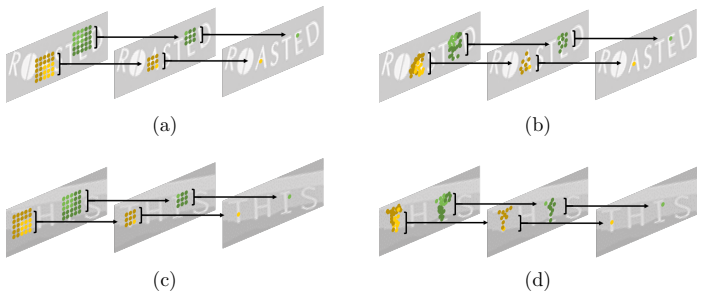
- [Figure 3] The caption for Figure 3 is difficult to follow. The phrase 'In each image triplet' is unclear because the figure appears to show pairs of panels; please revise the caption to describe the layout precisely.
Circularity Check
Mild circularity: deformable-layer placement is selected on the same test benchmarks later reported as final results; central DConv-vs-baseline comparison remains independent.
-
fitted input called prediction
[Section 3.3.2 (Table 2) and Section 3.4 (Table 3)]
"According to the results, finally we choose to apply deformable layers in the fourth and fifth convolution."
The configuration {4,5} is chosen by ranking Table 2's accuracies on the very same five test benchmarks (Total, IC13, IC15, SVT, IIIT5K) that later appear in Table 3. Table 3's 'Ours' row (70.3, 89.7, 72.2, 79.4, 92.2) is identical to Table 2's {4,5} row, and no separate validation set is described. Therefore the reported final performance is not an out-of-sample prediction of a fixed architecture; it is the test accuracy of the best-scoring configuration selected on those test sets. The claim that {4,5} is the right location is true by the selection criterion used to pick it, so this part of the validation is circular.
full rationale
No equation in the paper reduces a predicted quantity to an input by construction; the deformable-convolution formulation is standard and cited to Dai et al. [13]. There are no author self-citations and no imported uniqueness theorems. Training uses only synthetic data (MJSynth, SynthText), and testing is on public real benchmarks, so the baseline-versus-DConv comparison is genuine external evidence. The only circular element is the test-set-driven model selection: Table 2 is used to choose layer location {4,5}, and Table 3 then reports that same selected row as 'Ours'. This makes the location choice self-confirming and inflates the apparent strength of the final result. I do not count the missing parameter-matched standard-convolution control as circularity; that is a confounding/correctness concern about whether adaptive geometry or added capacity causes the gain, not a reduction of the result to its inputs. Overall the circularity is partial because the headline accuracy gain over CRNN is still an externally trained measurement on real benchmarks.
Assumptions & free parameters
free parameters (4)
- deformable layer location =
{4,5}
- input image size =
200x64
- learning rate =
0.00005
- training epochs =
8
assumptions (3)
- domain assumption Deformable convolution layers (Dai et al. 2017) are trainable via backpropagation and can learn sampling offsets that adapt to input content.
- standard math CTC loss is a valid objective for per-frame sequence recognition in this architecture.
- domain assumption Training on synthetic data (MJSynth and SynthText) transfers to real-world benchmarks.
Cite this review
Pith. "Pith review of Focus-Enhanced Scene Text Recognition with Deformable Convolutions." pith.science (2026). https://pith.science/paper/7MGE3JBV
@misc{pith2026190810998,
  author       = {Pith},
  title        = {Pith review of: Focus-Enhanced Scene Text Recognition with Deformable Convolutions},
  year         = {2026},
  howpublished = {\url{https://pith.science/paper/7MGE3JBV}},
  note         = {Machine review of arXiv:1908.10998}
}
read the original abstract
Recently, scene text recognition methods based on deep learning have sprung up in computer vision area. The existing methods achieved great performances, but the recognition of irregular text is still challenging due to the various shapes and distorted patterns. Consider that at the time of reading words in the real world, normally we will not rectify it in our mind but adjust our focus and visual fields. Similarly, through utilizing deformable convolutional layers whose geometric structures are adjustable, we present an enhanced recognition network without the steps of rectification to deal with irregular text in this work. A number of experiments have been applied, where the results on public benchmarks demonstrate the effectiveness of our proposed components and shows that our method has reached satisfactory performances. The code will be publicly available at https://github.com/Alpaca07/dtr soon.
Figures


Figures from the paper (2 more)


Reference graph
Works this paper leans on
-
[24]
B. Shi, X. Wang, P. Lyu, C. Yao, X. Bai, Robust scene text recognition with automatic rectification, in: Proceedings of the IEEE Conference on Computer Vision and Pattern Recognition, 2016, pp. 4168–4176
work page 2016
-
[1]
B. Shi, X. Bai, C. Yao, An end-to-end trainable neural network for image-based sequence recognition and its application to scene text recog- nition, IEEE transactions on pattern analysis and machine intelligence 39 (11) (2017) 2298–2304
work page 2017
-
[2]
M. Jaderberg, K. Simonyan, A. Vedaldi, A. Zisserman, Synthetic data and artificial neural networks for natural scene text recognition, arXiv preprint arXiv:1406.2227
-
[3]
M. Jaderberg, K. Simonyan, A. Vedaldi, A. Zisserman, Reading text in the wild with convolutional neural networks, arXiv preprint arXiv:1412.1842
- [4]
-
[5]
W. Liu, C. Chen, K.-Y. K. Wong, Z. Su, J. Han, Star-net: A spatial attention residue network for scene text recognition., in: BMVC, Vol. 2, 2016, p. 7
work page 2016
- [6]
-
[7]
Y. Sun, C. Zhang, Z. Huang, J. Liu, J. Han, E. Ding, Textnet: Irregular text reading from images with an end-to-end trainable network, arXiv preprint arXiv:1812.09900
Show all 31 references
-
[8]
C. Yao, X. Bai, W. Liu, A unified framework for multioriented text de- tection and recognition, IEEE Transactions on Image Processing 23 (11) (2014) 4737–4749
2014
-
[9]
C. Luo, L. Jin, Z. Sun, Moran: A multi-object rectified attention net- work for scene text recognition, Pattern Recognition 90 (2019) 109–118
2019
-
[11]
Jaderberg, K
M. Jaderberg, K. Simonyan, A. Zisserman, et al., Spatial transformer networks, in: Advances in neural information processing systems, 2015, pp. 2017–2025
2015
-
[12]
P. Lyu, M. Liao, C. Yao, W. Wu, X. Bai, Mask textspotter: An end-to- end trainable neural network for spotting text with arbitrary shapes, in: Proceedings of the European Conference on Computer Vision (ECCV), 2018, pp. 67–83
2018
-
[13]
J. Dai, H. Qi, Y. Xiong, Y. Li, G. Zhang, H. Hu, Y. Wei, Deformable convolutional networks, in: Proceedings of the IEEE international con- ference on computer vision, 2017, pp. 764–773
2017
-
[14]
Simonyan, A
K. Simonyan, A. Zisserman, Very deep convolutional networks for large- scale image recognition, arXiv preprint arXiv:1409.1556. 12
-
[15]
Hochreiter, J
S. Hochreiter, J. Schmidhuber, Long short-term memory, Neural com- putation 9 (8) (1997) 1735–1780
1997
-
[16]
S. M. Lucas, A. Panaretos, L. Sosa, A. Tang, S. Wong, R. Young, Icdar 2003 robust reading competitions, in: Seventh International Conference on Document Analysis and Recognition, 2003. Proceedings., Citeseer, 2003, pp. 682–687
2003
-
[17]
K. Wang, B. Babenko, S. Belongie, End-to-end scene text recognition, in: 2011 International Conference on Computer Vision, IEEE, 2011, pp. 1457–1464
2011
-
[18]
C. K. Ch’ng, C. S. Chan, Total-text: A comprehensive dataset for scene text detection and recognition, in: 14th IAPR International Confer- ence on Document Analysis and Recognition ICDAR, 2017, pp. 935–942. doi:10.1109/ICDAR.2017.157
2017 doi
-
[19]
Karatzas, F
D. Karatzas, F. Shafait, S. Uchida, M. Iwamura, L. G. i Bigorda, S. R. Mestre, J. Mas, D. F. Mota, J. A. Almazan, L. P. De Las Heras, Icdar 2013 robust reading competition, in: 2013 12th International Conference on Document Analysis and Recognition, IEEE, 2013, pp. 1484–1493
2013
-
[20]
Karatzas, L
D. Karatzas, L. Gomez-Bigorda, A. Nicolaou, S. Ghosh, A. Bagdanov, M. Iwamura, J. Matas, L. Neumann, V. R. Chandrasekhar, S. Lu, et al., Icdar 2015 competition on robust reading, in: 2015 13th International Conference on Document Analysis and Recognition (ICDAR), IEEE, 2015, p...
2015
-
[21]
Mishra, K
A. Mishra, K. Alahari, C. V. Jawahar, Scene text recognition using higher order language priors, in: BMVC, 2012
2012
-
[22]
Graves, S
A. Graves, S. Fern´ andez, F. Gomez, J. Schmidhuber, Connectionist tem- poral classification: labelling unsegmented sequence data with recurrent neural networks, in: Proceedings of the 23rd international conference on Machine learning, ACM, 2006, pp. 369–376
2006
-
[23]
Paszke, S
A. Paszke, S. Gross, S. Chintala, G. Chanan, Pytorch: Tensors and dynamic neural networks in python with strong gpu acceleration, Py- Torch: Tensors and dynamic neural networks in Python with strong GPU acceleration 6. 13
-
[25]
C.-Y. Lee, S. Osindero, Recursive recurrent nets with attention modeling for ocr in the wild, in: Proceedings of the IEEE Conference on Computer Vision and Pattern Recognition, 2016, pp. 2231–2239
2016
-
[26]
Cheng, Y
Z. Cheng, Y. Xu, F. Bai, Y. Niu, S. Pu, S. Zhou, Aon: Towards arbitrarily-oriented text recognition, in: Proceedings of the IEEE Con- ference on Computer Vision and Pattern Recognition, 2018, pp. 5571– 5579
2018
-
[27]
W. Liu, C. Chen, K.-Y. K. Wong, Char-net: A character-aware neural network for distorted scene text recognition, in: Thirty-Second AAAI Conference on Artificial Intelligence, 2018
2018
-
[28]
Y. Liu, Z. Wang, H. Jin, I. Wassell, Synthetically supervised feature learning for scene text recognition, in: Proceedings of the European Conference on Computer Vision (ECCV), 2018, pp. 435–451
2018
-
[29]
Bissacco, M
A. Bissacco, M. Cummins, Y. Netzer, H. Neven, Photoocr: Reading text in uncontrolled conditions, in: Proceedings of the IEEE International Conference on Computer Vision, 2013, pp. 785–792
2013
-
[30]
J. Wang, X. Hu, Gated recurrent convolution neural network for ocr, in: Advances in Neural Information Processing Systems, 2017, pp. 335–344
2017
-
[31]
Jaderberg, K
M. Jaderberg, K. Simonyan, A. Vedaldi, A. Zisserman, Deep struc- tured output learning for unconstrained text recognition, arXiv preprint arXiv:1412.5903
-
[32]
Z. R. Tan, S. Tian, C. L. Tan, Using pyramid of histogram of oriented gradients on natural scene text recognition, in: 2014 IEEE International Conference on Image Processing (ICIP), IEEE, 2014, pp. 2629–2633. 14
2014
Reviewed August 14, 2026 · model on record in the stance chip above.
Discussion (0). Continue with ORCID to comment.