REVIEW 4 major objections 7 minor 46 references
Discrete Laplace Operator Estimation for Dynamic 3D Reconstruction
T0 review · 4 major / 7 minor · reviewed 2026-08-14 · deepseek-v4-flash
Pith's one-line read This paper claims that the temporal order of unsynchronized photos can be recovered alongside 3D geometry by jointly estimating a discrete Laplace operator on the observations.
desk verdict A genuinely new formulation for synchronization-free dynamic 3D reconstruction, with an honest but simplified theory; the unordered-image variant leans hard on an assumption that can break, yet the paper deserves serious review. read the letter →
The pith
A machine-rendered reading of the paper's core claim, the machinery that carries it, and where it could break.
The reading
What carries the argument
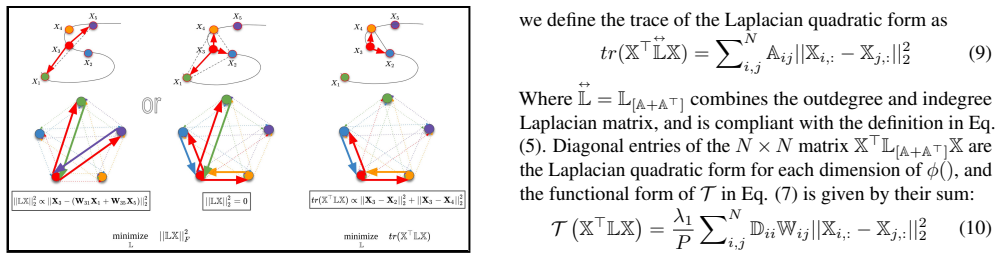
The load-bearing object is the discrete Laplace operator $L = D - A = D(I - W)$ on a fully connected graph whose vertices are the input images. The decomposition of the affinity matrix into a diagonal degree matrix $D$ and a row-stochastic weight matrix $W$ separates each node's local density from the relative weights of its neighbors, letting the graph's topology be learned rather than prescribed. The operator encodes three priors: the linear form $\|LX\|_F^2$ enforces anisotropic smoothness of the 3D motion, the quadratic form $\operatorname{tr}(X^\top L[A + A^\top]X)$ favors compact neighborhoods, and the spectral quadratic form $f^\top L f$ folds partial sequencing information into the graph. This single object converts dynamic reconstruction into a tri-convex program over $X$, $D$, and $W$ solved by alternating convex search.
What would settle it
Run the method on a synthetic motion-capture sequence whose trajectory is a figure-eight or back-and-forth path, render unsynchronized multi-view images with no timestamps, and compare the recovered ordering to ground truth by Kendall rank correlation; if the ordering collapses whenever the path revisits the same 3D location at widely separated times, the claim that temporal adjacency is recoverable from spatial adjacency is falsified.
Extended reading notes
Core claim
On its own terms, the paper's central discovery is that the unknown temporal order of observations is carried by the same discrete Laplace operator that enforces smoothness of the 3D motion, and can therefore be recovered jointly with geometry. The proposed optimization minimizes over $X$, $D$, and $W$ the cost $\frac{1}{P}\|D(I-W)X\|_F^2 + \frac{\lambda_1}{P}\sum_{i,j} D_{ii}W_{ij}\|X_{i,:}-X_{j,:}\|_2^2$, plus terms that penalize distance to viewing rays and favor camera ray convergence, subject to $W$ being row-stochastic and non-negative and $D$ positive with unit trace. Minimizing the first term drives each estimated shape toward a barycentric combination of its temporal neighbors, while the second forces those neighbors to be spatially compact, so the graph connectivity approximates the true temporal chain of a smooth motion. The reported experiments show the approach staying competitive with methods that use full ground-truth sequencing and outperforming them at lower frame rates, irregular sampling, and missing-data levels of 10-50%.
Load-bearing premise
The load-bearing premise is that moments close in time are close in 3D space, and not merely that moments at the same place are close in time; for repetitive, oscillating, or self-intersecting motion, spatial proximity creates false temporal links and corrupts the recovered ordering and geometry.
Editorial extensions
If this is right
- Dynamic reconstruction becomes possible from uncoordinated multi-view photo sets with no timestamps, at accuracy comparable to pipelines that require full ground-truth image order.
- Under decreasing temporal sampling density, non-uniform sampling, and missing 2D observations, the learned affinity graph degrades more gracefully than fixed trajectory-basis or self-expressive dictionary baselines.
- The spectral signature of the estimated Laplacian separates temporally disjoint events that are spatially co-located, so event segmentation falls out of the reconstruction without a separate clustering stage.
- The same graph machinery associates feature tracks across multiple subjects, providing a data-association mechanism for multi-target dynamic scenes.
Reading between the lines
- The paper leaves open whether the recovered Laplacian can be reused as a learned temporal prior to bootstrap reconstruction of new observations of the same scene; this is a natural next use of the estimated graph.
- A testable extension is to replace Euclidean 3D proximity with acceleration-aware or trajectory-arc affinities, which could preserve correct temporal links on repetitive or self-intersecting motions while staying inside the same tri-convex framework.
- The structure solve for $X$ is quoted as $O((NP)^3)$; scaling to video-length inputs would most likely require a faster linear solver for that block, a regime the paper does not explore.
Signed reviews
Editorial analysis
A structured set of objections, weighed in public.
Referee Report
Summary. The paper proposes a graph-theoretic framework for dynamic 3D reconstruction from unsynchronized multi-view images with unknown temporal sampling. Observations are represented as graph vertices, their 3D geometry as node attributes, and spatio-temporal affinities as edge weights. The method jointly estimates the 3D structure matrix X and a directed discrete Laplace operator parameterized as L = D(I - W) through the tri-convex objective in Eq. (7), with terms for anisotropic smoothness, neighborhood compactness, ray consistency, and multi-view reconstructability. Two variants are presented: one for unordered image sets (Sec. 4) and one for unsynchronized image streams with partial sequencing (Sec. 5). Experiments on motion capture data and multi-view image datasets show competitive or improved performance under decreasing frame rates, non-uniform sampling, missing data, and 2D noise, and the framework is extended to event segmentation and multi-target data association. A simplified reconstructability analysis in Sec. 7 derives error bounds for a fixed, ground-truth Laplacian.
Significance. If the results hold, the framework is a useful data-adaptive alternative to trajectory-basis and self-expressive dictionary methods, with the notable strength of learning temporal adjacency from geometry rather than assuming known sequencing. The problem formulation is clear, the optimization is specified in detail, and the synthetic experiments cover several practically relevant degradation conditions. The DTW arc-distance sequencing for image streams is a sensible way to mitigate the failure of Euclidean proximity for repetitive motion. However, the central claim of generality for asynchronous photography is not yet fully supported: the unordered-image variant inherits the failure modes of Assumption A3 without mitigation, and the theoretical analysis in Sec. 7 does not analyze joint topology estimation. With targeted additions (tests on repetitive motion in the unordered setting, reporting of all hyperparameters and error bars, and a clearer statement of the scope of Sec. 7), the contribution would be solid and likely of interest to the dynamic reconstruction community.
major comments (4)
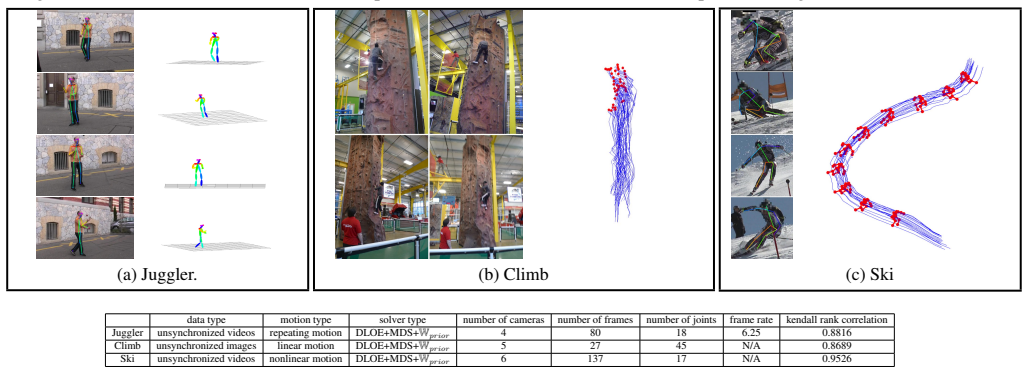
- [Sec. 4, Eq. (15)] The unordered-photography variant estimates W and D from 3D Euclidean distances and the ray term (Eqs. (8), (10), (12)) without any temporal prior or monotonicity constraint. For repetitive or self-intersecting motion, spatial proximity can therefore create spurious temporal adjacencies, and the manuscript's own Assumption A3 (Sec. 1) concedes that spatial proximity does not imply temporal proximity. The mitigation in Sec. 5 and Table 1 uses DTW arc distance Z from intra-stream ordering, which is unavailable in the Sec. 4 setting; the repeating-motion row in Table 1 is computed with Z, not with the Euclidean distance used in asynchronous photography. Since the asynchronous-photography claim is central, the authors should either add a constraint that enforces a 1D path/temporal ordering in the unordered variant, demonstrate empirically on a repetitive/self-intersecting motion in the Sec. 4 setting, or explicitly restrict the claim. Section 8.3's co-located temporally disjoint events also need an explanation of why cross-event spatial proximity does not produce spurious edges.
- [Sec. 7, Eqs. (17)-(21)] The reconstructability analysis assumes L is fixed, encodes ground-truth temporal adjacency, and uses noise-free 2D observations. This does not analyze the joint estimation of X and L, which is the paper's central contribution, and the bounds in Eq. (21) therefore do not address the failure mode induced by estimating graph topology from spatial proximity. The analysis is useful for studying the effect of camera geometry and motion-plane incidence, but it should be framed as a simplified first-order analysis. The authors should add experiments or analysis that quantify the effect of topology-estimation error on the reconstruction bounds, or clearly state that the joint estimation aspect is not covered by the theoretical results.
- [Sec. 8.1, Eq. (15)] The hyperparameter lambda_1 appears in the optimization (Eqs. (13), (15)) but is never reported; Sec. 8.1 gives only lambda_2 = 0.0015 and lambda_3 = 0.02. Without lambda_1 values and a sensitivity study, the empirical results are not fully reproducible and it is unclear how robust the method is to hyperparameter choice. The authors should report the setting used for all three lambda parameters and provide a sensitivity analysis over a reasonable range.
- [Sec. 8.1 and Fig. 5] The synthetic experiments report averages over 20 executions but no standard deviations or error bars, and the multi-view image experiments are single runs. Several comparisons in Fig. 5 are close (e.g., with TB and HPF at high frame rates), so variance information is needed to support the claimed advantages. The authors should include error bars or per-trial statistics and specify the number of trials for the multi-view datasets.
minor comments (7)
- [Sec. 3.3, Eq. (7)] The sentence 'Based on the geometric properties encoded by the discrete Laplace operator the formulate the optimization problem' contains a typo and should read 'we formulate the optimization problem'.
- [Sec. 4, Eq. (11)] The definition of the ray error uses dnp, but Eq. (11) writes the same symbol; please clarify the notation and ensure the ray-error term is defined consistently for each point p and observation n.
- [Sec. 6] The initialization of W is not specified. The paper states initial values for D and X, but not for the variable block W; please describe the initial W used in the alternating scheme.
- [Sec. 8.2] The statement 'We unsynchronized images by removing concurrent observations' indicates that timestamps are used only to eliminate concurrency; please clarify whether any other timestamp information leaks into the method, since the goal is to operate without temporal metadata.
- [Abstract] The phrase 'arbitrary temporal sampling density and distribution' is stronger than Assumption A2, which requires sampling dense enough for approximate local linear interpolation; consider softening the wording to 'unknown and possibly irregular temporal sampling under a local-linearity assumption'.
- [Fig. 5] The subplot labels are small and the captions do not state whether error bars are intentionally omitted; please enlarge the labels and add a note that the plotted curves are means without variance.
- [Sec. 7, Eq. (20)] Please check the dimensions in the definition of b_n: the term L^T_{:,n} L X* is a column vector scaled by L^T_{:,n}, while the term \overleftrightarrow{L}_{n,:} X* is a row-scaled object; the expression may require a transpose to define b_n consistently as a scalar.
Circularity Check
No significant circularity: the joint DLOE formulation is self-contained and validated against external benchmarks; only minor non-load-bearing self-citation exists.
full rationale
The paper's central claim is that jointly estimating 3D structure X and the discrete Laplace operator via the decomposition A=DW in the tri-convex objective of Eq. (7) enables dynamic 3D reconstruction without timestamps. This is a genuine joint-estimation framework, not a derivation of a prediction from a fitted input. The key modeling choice, using spatial proximity as a proxy for temporal proximity, is explicitly introduced as Assumption A3 ('temporal proximity implies spatial proximity, but not vice-versa') and is acknowledged in Sec. 1 as not universally true. This is an assumption about the scene and an admitted limitation, not a circular reduction: the recovered graph topology is evaluated against external ground-truth orderings (Table 1) and external mocap/image benchmarks, rather than being defined by them. The reconstructability analysis in Sec. 7 assumes L is fixed and encodes ground-truth temporal adjacency, but this is an analytic bound for a subproblem, not a circular reuse of the method's output as its own evidence. The only notable self-citation is the comparison with SEDL [43], a prior method from the same group, but the comparison is empirical on motion-capture data and multi-view datasets, and the new formulation adds the D-W decomposition, directed graph, ray-convergence term, and spectral sequencing priors not present in SEDL. No equation in the paper reduces to its own input by construction, and no load-bearing claim rests on an unverified self-citation. Therefore the paper receives a low score reflecting only the minor, non-load-bearing self-citation, not any substantive circularity.
Assumptions & free parameters
free parameters (3)
- lambda_1 =
unreported
- lambda_2 =
0.0015
- lambda_3 =
0.02
assumptions (4)
- domain assumption 2D observations are samples of the continuous motion of a 3D point set.
- domain assumption Unknown and arbitrary temporal sampling density allows approximate local linear interpolation of 3D geometry.
- domain assumption Temporal proximity implies spatial proximity, but not vice-versa.
- domain assumption Camera intrinsic and extrinsic parameters are known for every input image.
Cite this review
Pith. "Pith review of Discrete Laplace Operator Estimation for Dynamic 3D Reconstruction." pith.science (2026). https://pith.science/paper/GBHZHHNI
@misc{pith2026190811044,
  author       = {Pith},
  title        = {Pith review of: Discrete Laplace Operator Estimation for Dynamic 3D Reconstruction},
  year         = {2026},
  howpublished = {\url{https://pith.science/paper/GBHZHHNI}},
  note         = {Machine review of arXiv:1908.11044}
}
read the original abstract
We present a general paradigm for dynamic 3D reconstruction from multiple independent and uncontrolled image sources having arbitrary temporal sampling density and distribution. Our graph-theoretic formulation models the Spatio-temporal relationships among our observations in terms of the joint estimation of their 3D geometry and its discrete Laplace operator. Towards this end, we define a tri-convex optimization framework that leverages the geometric properties and dependencies found among a Euclideanshape-space and the discrete Laplace operator describing its local and global topology. We present a reconstructability analysis, experiments on motion capture data and multi-view image datasets, as well as explore applications to geometry-based event segmentation and data association.
Figures


Figures from the paper (5 more)




Reference graph
Works this paper leans on
-
[1]
Metric multidimensional scaling (mds): ana- lyzing distance matrices
Herv´e Abdi. Metric multidimensional scaling (mds): ana- lyzing distance matrices. Encyclopedia of measurement and statistics. Sage, Thousand Oaks, CA, pages 1–13, 2007
work page 2007
-
[2]
Deformable motion 3d reconstruction by union of regularized subspaces
Antonio Agudo and Francese Moreno-Noguer. Deformable motion 3d reconstruction by union of regularized subspaces. In 2018 25th IEEE International Conference on Image Pro- cessing (ICIP), pages 2930–2934. IEEE, 2018
work page 2018
-
[3]
A scalable, efficient, and accurate solution to non-rigid structure from motion
Antonio Agudo and Francesc Moreno-Noguer. A scalable, efficient, and accurate solution to non-rigid structure from motion. Computer Vision and Image Understanding, 167:121– 133, 2018
work page 2018
-
[4]
Robust spatio- temporal clustering and reconstruction of multiple deformable bodies
Antonio Agudo and Francesc Moreno-Noguer. Robust spatio- temporal clustering and reconstruction of multiple deformable bodies. IEEE Transactions on Pattern Analysis and Machine Intelligence, 41(4):971–984, 2019
work page 2019
-
[5]
Shai Avidan and Amnon Shashua. Trajectory triangulation of lines: Reconstruction of a 3d point moving along a line from a monocular image sequence. In Proceedings of the 1999 IEEE Computer Society Conference on Computer Vision and Pattern Recognition, volume 2, pages 62–66. IEEE, 1999
work page 1999
-
[6]
Trajectory triangulation: 3d reconstruction of moving points from a monocular image sequence
Shai Avidan and Amnon Shashua. Trajectory triangulation: 3d reconstruction of moving points from a monocular image sequence. IEEE Transactions on Pattern Analysis & Machine Intelligence, (4):348–357, 2000
work page 2000
-
[7]
Unstructured video-based rendering: Interactive explo- ration of casually captured videos
Luca Ballan, Gabriel J Brostow, Jens Puwein, and Marc Polle- feys. Unstructured video-based rendering: Interactive explo- ration of casually captured videos. ACM Transactions on Graphics, 29(4):Article–No, 2010
work page 2010
-
[8]
Tali Basha, Yael Moses, and Shai Avidan. Photo sequencing. In European Conference on Computer Vision, pages 654–667. Springer, 2012
work page 2012
Show all 46 references
-
[9]
Feature- based sequence-to-sequence matching
Yaron Caspi, Denis Simakov, and Michal Irani. Feature- based sequence-to-sequence matching. International Journal of Computer Vision, 68(1):53–64, 2006
2006
-
[10]
Directed graph embedding
Mo Chen, Qiong Yang, and Xiaoou Tang. Directed graph embedding. In IJCAI, pages 2707–2712, 2007
2007
-
[11]
Fast and robust archetypal analysis for representation learning
Yuansi Chen, Julien Mairal, and Zaid Harchaoui. Fast and robust archetypal analysis for representation learning. In Proceedings of the IEEE Conference on Computer Vision and Pattern Recognition, pages 1478–1485, 2014
2014
-
[12]
Laplacians and the cheeger inequality for directed graphs
Fan Chung. Laplacians and the cheeger inequality for directed graphs. Annals of Combinatorics, 9(1):1–19, 2005
2005
-
[13]
Spectral graph theory
Fan RK Chung. Spectral graph theory. Number 92. American Mathematical Soc., 1997
1997
-
[14]
Feature-based multi-video synchro- nization with subframe accuracy
Ahmed Elhayek, Carsten Stoll, Kwang In Kim, H-P Seidel, and Christian Theobalt. Feature-based multi-video synchro- nization with subframe accuracy. In Joint DAGM (German Association for Pattern Recognition) and OAGM Symposium, pages 266–275. Springer, 2012
2012
-
[15]
Serialrank: Spectral ranking using seriation
Fajwel Fogel, Alexandre d’Aspremont, and Milan V ojnovic. Serialrank: Spectral ranking using seriation. In Advances in Neural Information Processing Systems, pages 900–908, 2014
2014
-
[16]
Synchroniza- tion of two independently moving cameras without feature correspondences
Tiago Gaspar, Paulo Oliveira, and Paolo Favaro. Synchroniza- tion of two independently moving cameras without feature correspondences. In European Conference on Computer Vi- sion, pages 189–204. Springer, 2014
2014
-
[17]
Bicon- vex sets and optimization with biconvex functions: a survey and extensions
Jochen Gorski, Frank Pfeuffer, and Kathrin Klamroth. Bicon- vex sets and optimization with biconvex functions: a survey and extensions. Mathematical methods of operations research, 66(3):373–407, 2007
2007
-
[18]
Reconstruction of a scene with multiple linearly moving objects
Mei Han and Takeo Kanade. Reconstruction of a scene with multiple linearly moving objects. International Journal of Computer Vision, 59(3):285–300, 2004
2004
-
[19]
Spatio- temporally consistent correspondence for dense dynamic scene modeling
Dinghuang Ji, Enrique Dunn, and Jan-Michael Frahm. Spatio- temporally consistent correspondence for dense dynamic scene modeling. In European Conference on Computer Vision, pages 3–18. Springer, 2016
2016
-
[20]
Panoptic studio: A massively multiview system for social interaction capture
Hanbyul Joo, Tomas Simon, Xulong Li, Hao Liu, Lei Tan, Lin Gui, Sean Banerjee, Timothy Godisart, Bart Nabbe, Iain Matthews, et al. Panoptic studio: A massively multiview system for social interaction capture. IEEE Transactions on Pattern Analysis and Machine Intelligence, 41(1...
2017
-
[21]
Space-time tradeoffs in photo sequencing
Yael Moses, Shai Avidan, et al. Space-time tradeoffs in photo sequencing. In Proceedings of the IEEE International Conference on Computer Vision, pages 977–984, 2013
2013
-
[22]
Documentation mocap database hdm05
Meinard M ¨uller, Tido R ¨oder, Michael Clausen, Bernhard Eberhardt, Bj¨orn Kr¨uger, and Andreas Weber. Documentation mocap database hdm05. 2007
2007
-
[23]
Linear sequence-to-sequence alignment
Flavio Padua, Rodrigo Carceroni, Geraldo Santos, and Kiri- akos Kutulakos. Linear sequence-to-sequence alignment. IEEE Transactions on Pattern Analysis and Machine Intelli- gence, 32(2):304–320, 2010
2010
-
[24]
3d reconstruction of a smooth articulated trajectory from a monocular image se- quence
Hyun Soo Park and Yaser Sheikh. 3d reconstruction of a smooth articulated trajectory from a monocular image se- quence. In 2011 International Conference on Computer Vi- sion, pages 201–208. IEEE, 2011
2011
-
[25]
3d reconstruction of a moving point from a series of 2d projections
Hyun Soo Park, Takaaki Shiratori, Iain Matthews, and Yaser Sheikh. 3d reconstruction of a moving point from a series of 2d projections. In European Conference on Computer Vision, pages 158–171. Springer, 2010
2010
-
[26]
3d trajectory reconstruction under perspective projec- tion
Hyun Soo Park, Takaaki Shiratori, Iain Matthews, and Yaser Sheikh. 3d trajectory reconstruction under perspective projec- tion. International Journal of Computer Vision, 115(2):115– 135, 2015
2015
-
[27]
Learning monocular 3d human pose estimation from multi-view images
Helge Rhodin, J ¨org Sp¨orri, Isinsu Katircioglu, Victor Con- stantin, Fr´ed´eric Meyer, Erich M¨uller, Mathieu Salzmann, and Pascal Fua. Learning monocular 3d human pose estimation from multi-view images. In Proceedings of the IEEE Con- ference on Computer Vision and Pattern ...
2018
-
[28]
3d reconstruction from tangent-of-sight measurements of a moving object seen from a moving camera
Dana Segal and Amnon Shashua. 3d reconstruction from tangent-of-sight measurements of a moving object seen from a moving camera. In European Conference on Computer Vision, pages 621–631. Springer, 2000
2000
-
[29]
Trajec- tory triangulation over conic section
Amnon Shashua, Shai Avidan, and Michael Werman. Trajec- tory triangulation over conic section. In Proceedings of the Seventh IEEE International Conference on Computer Vision, volume 1, pages 330–336. IEEE, 1999
1999
-
[30]
Separable spatiotemporal priors for convex recon- struction of time-varying 3d point clouds
Tomas Simon, Jack Valmadre, Iain Matthews, and Yaser Sheikh. Separable spatiotemporal priors for convex recon- struction of time-varying 3d point clouds. In European Con- ference on Computer Vision, pages 204–219. Springer, 2014
2014
-
[31]
Kronecker-markov prior for dynamic 3d reconstruc- tion
Tomas Simon, Jack Valmadre, Iain Matthews, and Yaser Sheikh. Kronecker-markov prior for dynamic 3d reconstruc- tion. IEEE Transactions on Pattern Analysis and Machine Intelligence, 39(11):2201–2214, 2017
2017
-
[32]
Laplacian mesh processing
Olga Sorkine. Laplacian mesh processing. In Eurographics (STARs), pages 53–70, 2005
2005
-
[33]
Video synchronization from human motion using rank constraints
Philip A Tresadern and Ian D Reid. Video synchronization from human motion using rank constraints. Computer Vision and Image Understanding, 113(8):891–906, 2009
2009
-
[34]
Synchronizing video sequences
Tinne Tuytelaars and Luc Van Gool. Synchronizing video sequences. In Proceedings of the 2004 IEEE Conference on Computer Vision and Pattern Recognition, VOL 1 , vol- ume 1, pages 762–768. Institute of Electrical and Electronics Engineers, 2004
2004
-
[35]
General trajectory prior for non-rigid reconstruction
Jack Valmadre and Simon Lucey. General trajectory prior for non-rigid reconstruction. In Proceedings of 2012 IEEE Conference on Computer Vision and Pattern Recognition , pages 1394–1401. IEEE, 2012
2012
-
[36]
Spa- tiotemporal bundle adjustment for dynamic 3d reconstruction
Minh V o, Srinivasa G Narasimhan, and Yaser Sheikh. Spa- tiotemporal bundle adjustment for dynamic 3d reconstruction. In Proceedings of the IEEE Conference on Computer Vision and Pattern Recognition, pages 1710–1718, 2016
2016
-
[37]
Automatic adap- tation of person association for multiview tracking in group activities
Minh V o, Ersin Yumer, Kalyan Sunkavalli, Sunil Hadap, Yaser Sheikh, and Srinivasa Narasimhan. Automatic adap- tation of person association for multiview tracking in group activities. arXiv preprint arXiv:1805.08717, 2018
2018 arXiv
-
[38]
Grassmannian regularized structured multi-view embedding for image clas- sification
Xinchao Wang, Wei Bian, and Dacheng Tao. Grassmannian regularized structured multi-view embedding for image clas- sification. IEEE Trans. Image Processing, 22(7):2646–2660, 2013
2013
-
[39]
Motion guided video sequence synchronization
Daniel Wedge, Du Huynh, and Peter Kovesi. Motion guided video sequence synchronization. In Asian Conference on Computer Vision, pages 832–841. Springer, 2006
2006
-
[40]
Convolutional pose machines
Shih-En Wei, Varun Ramakrishna, Takeo Kanade, and Yaser Sheikh. Convolutional pose machines. In Proceedings of the IEEE Conference on Computer Vision and Pattern Recogni- tion, pages 4724–4732, 2016
2016
-
[41]
Deep graph laplacian regularization
Jin Zeng, Jiahao Pang, Wenxiu Sun, Gene Cheung, and Ruichao Xiao. Deep graph laplacian regularization. arXiv preprint arXiv:1807.11637, 2018
2018 arXiv
-
[42]
Sparse dynamic 3d reconstruction from unsynchronized videos
Enliang Zheng, Dinghuang Ji, Enrique Dunn, and Jan- Michael Frahm. Sparse dynamic 3d reconstruction from unsynchronized videos. In Proceedings of the IEEE Inter- national Conference on Computer Vision, pages 4435–4443, 2015
2015
-
[43]
Self-expressive dictionary learning for dy- namic 3d reconstruction
Enliang Zheng, Dinghuang Ji, Enrique Dunn, and Jan- Michael Frahm. Self-expressive dictionary learning for dy- namic 3d reconstruction. IEEE Transactions on Pattern Anal- ysis and Machine Intelligence, 40(9):2223–2237, 2017
2017
-
[44]
Spectral embedding of directed networks
Quan Zheng and David B Skillicorn. Spectral embedding of directed networks. Social Network Analysis and Mining, 6(1):76, 2016
2016
-
[45]
3d motion reconstruction for real-world camera motion
Yingying Zhu, M Cox, and S Lucey. 3d motion reconstruction for real-world camera motion. In Proceedings of the 2011 IEEE Conference on Computer Vision and Pattern Recogni- tion, pages 1–8. IEEE Computer Society, 2011
2011
-
[46]
Convolutional sparse coding for trajectory reconstruction
Yingying Zhu and Simon Lucey. Convolutional sparse coding for trajectory reconstruction. IEEE Transactions on Pattern Analysis and Machine Intelligence, 37(3):529–540, 2015
2015
Reviewed August 14, 2026 · model on record in the stance chip above.
Discussion (0). Continue with ORCID to comment.