REVIEW 4 major objections 6 minor 13 references
Improving Self-Supervised Single View Depth Estimation by Masking Occlusion
T0 review · 4 major / 6 minor · reviewed 2026-08-14 · deepseek-v4-flash
Pith's one-line read A mask that drops occluded pixels improves self-supervised depth prediction.
desk verdict A clean, honest thesis-style paper proposing a depth-based occlusion mask for self-supervised depth, but the headline gain rests on a single training run and is close to seed noise. read the letter →
The pith
A machine-rendered reading of the paper's core claim, the machinery that carries it, and where it could break.
The reading
What carries the argument
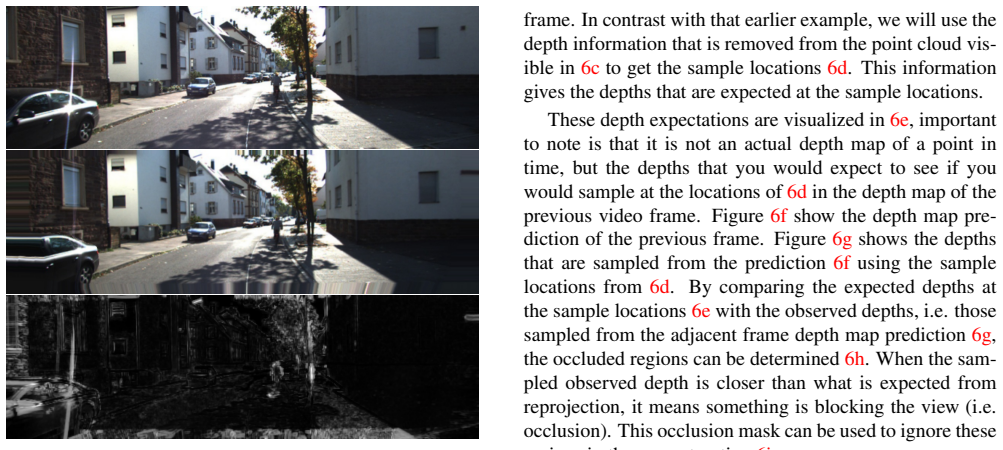
The occlusion mask (Equation 7) is the load-bearing object: for each pixel projected from the target frame into an adjacent frame, it takes the depth expected at the projected location (from the target's depth prediction and the pose network) and the depth actually sampled at that location from the adjacent frame's predicted depth map. The pixel is masked out if the observed depth is closer than the expected depth scaled by (1 - tolerance), or if the projected coordinate falls outside the image. This mask carries the argument because it removes from training exactly the pixels whose reconstruction is unreliable due to occlusion, without adding learnable parameters or requiring gradients through the adjacent-frame depth prediction. It is inserted into two photometric losses, one that averages non-occluded reconstructions and one that keeps the per-pixel minimum selection but adds the mask as an error penalty.
What would settle it
Train the identical baseline with an occlusion mask computed from ground-truth depth maps of the adjacent frames instead of predicted ones; if the accuracy gain disappears or reverses, the reported improvement comes from the depth-variability comparison rather than from removing true occlusions. Alternatively, label occluded regions on a KITTI subset and measure the mask's precision and recall during the first training epochs.
Extended reading notes
Core claim
The central claim is that explicitly masking occlusion effects during training improves single-view depth prediction, and that this can be done with a parameter-free mask derived from the depth network's own predictions. The mask compares the depth expected at a reprojected sample location with the depth observed there in the adjacent frame's predicted depth map; if the observed depth is closer by more than a tolerance, the pixel is treated as occluded and removed from the photometric loss. Incorporated into a minimum-reprojection loss, the mask raises accuracy on KITTI across all seven reported metrics, with Abs Rel going from 0.114 to 0.113 and RMSE from 4.874 to 4.789. A second, unexpected finding is that the per-pixel minimum reprojection baseline already ignores some reprojection error caused by object motion, not just occlusion, which explains why simply averaging non-occluded regions did not outperform it.
Load-bearing premise
The mask assumes the depth predictions of the adjacent frames are accurate enough that a closer-than-expected sampled depth really means occlusion; early in training, when those predictions are poor, the mask can drop valid pixels or keep occluded ones, and the tolerance parameter was chosen under an accidental training-mode setting that may have raised it too high.
Editorial extensions
If this is right
- Incorporating the occlusion mask into a per-pixel minimum reprojection loss improves all seven KITTI depth metrics relative to the baseline.
- For average-reprojection losses, the mask improves most accuracy metrics but leaves Abs Rel unchanged and makes Sq Rel and RMSE slightly worse, so its benefit is not uniform across loss families.
- The per-pixel minimum reprojection loss, not the mask, is what removes much of the object-motion error; a model that actually models motion might prefer the mask because it keeps motion error as a learning signal.
- The mask needs no extra learnable parameters and no backprop through the adjacent frames' depth predictions, so the extra training cost is limited to computing the mask itself.
Reading between the lines
- If the tolerance parameter were annealed from a high value early in training to near zero later, the mask might retain valid pixels during the fragile early phase and catch closer occluders once depth predictions sharpen.
- The method could be tested on a model that explicitly handles object motion; the paper's own discussion predicts the occlusion mask should then be more helpful than per-pixel minimum reprojection, because it preserves motion-related photometric error.
- A strong test of the mask itself is to compare masks built from predicted depths with masks built from ground-truth depths of adjacent frames; this would separate the value of occlusion masking from the accuracy of the depth predictions it relies on.
Signed reviews
Editorial analysis
A structured set of objections, weighed in public.
Referee Report
Summary. The paper addresses occlusion in self-supervised monocular depth estimation trained with view synthesis. It proposes an occlusion mask computed from predicted depth maps by comparing expected depth at reprojected sample locations with the sampled depth from adjacent frame depth predictions (Eq. 7). Two new photometric losses incorporate this mask: non-occluded average reprojection (Eq. 8) and non-occluded minimum reprojection (Eq. 9). Experiments on KITTI (Table 1) compare these against baselines from monodepth2. The paper claims that incorporating the mask improves performance and that per-pixel min reprojection additionally ignores object-motion errors. It also reports that its original hypothesis—that ignoring only occluded regions yields more useful training signal—is not confirmed.
Significance. If the central empirical claim were fully established, the occlusion mask would be a simple, parameter-efficient addition to self-supervised depth estimation pipelines, since it uses only predicted geometry and adds no learned parameters. The paper is also valuable for its clear visualization of what per-pixel minimum reprojection actually ignores (Figs. 7 and 8), and it openly discusses a failed hypothesis. However, the current evidence is not yet convincing: single-run training, small margins, and an accidentally chosen tolerance parameter mean the quantitative improvement could be within stochastic variation.
major comments (4)
- [Section 3.1.1, Table 1] The central claim (i) is supported only by a single training run per variant, and the key comparison (per-pixel min vs non-occluded min) shows a 0.001 Abs Rel and 0.085 RMSE difference. In this training regime, run-to-run variation from random seeds and checkpoint selection is typically of the same order, so without repeated runs, variance estimates, or a multiple-seed comparison, the reported improvement cannot be distinguished from noise.
- [Section 3.1.1, Table 1a] The average-reprojection baseline is taken directly from Table 2 of [6] rather than re-trained in the author's setup, which mixes implementations. Moreover, the non-occluded average reprojection is worse than this borrowed baseline on Sq Rel (0.936 vs 0.878) and RMSE (4.908 vs 4.846), so the statement in §3.1.1 that "Both types of loss functions (a, b) get improved result when occlusion mask is incorporated" is not supported by the table.
- [Appendix A, Eq. (7)] The tolerance parameter was set to 0.3 while the network was accidentally kept in training mode, which the authors state may have overestimated depth variability. No sensitivity analysis over this parameter is reported, so a reader cannot tell whether the improvements in Table 1 are robust to a different, defensible tolerance value or to a mask computed from a model in evaluation mode.
- [Section 2.3.1, Eq. (7)] The mask uses the same predicted depth maps that are being optimized, creating a bootstrap dependence; early in training, unreliable depth predictions may cause the mask to drop valid pixels or retain occluded ones. A concrete test would be to compare masks generated online against masks generated with a fixed, pretrained depth network or against ground-truth visibility maps, and to report how the training loss and final metrics respond.
minor comments (6)
- [Section 2.3.1, Eq. (7)] The text defines the sampled depth as z_{t'}^* but the equation uses z_{t->t'}^*; consistent notation should be used.
- [Section 2.3.3, Eq. (9)] Adding (1 - omega) to a photometric error already in [0,1] gives a loss in [0,2], which may change the effective behavior of the automask threshold in Eq. (4); this should be discussed or the normalization clarified.
- [Section 3.1.2, Fig. 8] Claim (ii) is based on a single randomly selected training example; a quantitative measure over many examples (e.g., fraction of pixels selected from the previous vs next frame on moving objects) would make the claim more robust.
- [Section 2.1.2, Eq. (1)] The projection notation uses z_t both as a homogeneous coordinate and as depth; consider clarifying the coordinate frame to avoid confusion.
- [Section 3.1] The manuscript never reports training hyperparameters such as image resolution, batch size, and number of epochs; these details are needed for reproducibility.
- [Sections 4 and Appendix A] The text frequently refers to "this thesis" and to informal details such as forgetting to switch the network to evaluation mode; while the transparency is appreciated, the phrasing should be adjusted for a journal venue.
Circularity Check
No significant circularity: the occlusion mask's dependence on the trained depth predictions is a bootstrap training signal, not a derivation of the evaluated result, and the KITTI evaluation is externally grounded.
full rationale
The paper's central claim—that adding the occlusion mask of Eq. (7) to the photometric loss improves KITTI depth metrics—is not derived from the mask itself. The mask is a binary weight computed by comparing the projected depth z_{t→t'} with the depth z_{t'*} sampled from the adjacent frame's predicted depth map; this is a geometric consistency check on the network's own predictions. That creates a bootstrap dependence during training, since poor depth maps can produce unreliable masks, but it does not make the reported improvement equivalent to an input by construction. The evaluation in Table 1 is against external KITTI ground truth, so the empirical claim stands or falls independently of the mask's formulation. The paper even reports that its original hypothesis was not confirmed: the non-occluded average reprojection loss fails to beat the per-pixel minimum reprojection baseline, which is the opposite of what a forced or self-validating construction would predict. The tolerance parameter (Appendix A) was hand-set, and the author candidly notes the network was accidentally left in training mode; this is a methodological weakness and a correctness risk, not a circular reduction. There are no load-bearing self-citations: the baseline [6] is an external, published implementation, and no uniqueness theorem or prior-work ansatz is imported to forbid alternatives. No equation in the paper reduces to its own input or renames a fitted parameter as a prediction. Under the stated criteria, no significant circularity is present.
Assumptions & free parameters
free parameters (1)
- tolerance =
0.3
assumptions (3)
- domain assumption Image reconstruction assumes a static scene, no occlusion/disocclusion, and Lambertian surfaces.
- domain assumption The camera intrinsics matrix K is known and fixed.
- domain assumption A sample in the adjacent frame whose predicted depth is closer than the projected expected depth indicates occlusion of the target pixel.
Cite this review
Pith. "Pith review of Improving Self-Supervised Single View Depth Estimation by Masking Occlusion." pith.science (2026). https://pith.science/paper/CDTIXJQ4
@misc{pith2026190811112,
  author       = {Pith},
  title        = {Pith review of: Improving Self-Supervised Single View Depth Estimation by Masking Occlusion},
  year         = {2026},
  howpublished = {\url{https://pith.science/paper/CDTIXJQ4}},
  note         = {Machine review of arXiv:1908.11112}
}
read the original abstract
Single view depth estimation models can be trained from video footage using a self-supervised end-to-end approach with view synthesis as the supervisory signal. This is achieved with a framework that predicts depth and camera motion, with a loss based on reconstructing a target video frame from temporally adjacent frames. In this context, occlusion relates to parts of a scene that can be observed in the target frame but not in a frame used for image reconstruction. Since the image reconstruction is based on sampling from the adjacent frame, and occluded areas by definition cannot be sampled, reconstructed occluded areas corrupt to the supervisory signal. In previous work arXiv:1806.01260 occlusion is handled based on reconstruction error; at each pixel location, only the reconstruction with the lowest error is included in the loss. The current study aims to determine whether performance improvements of depth estimation models can be gained by during training only ignoring those regions that are affected by occlusion. In this work we introduce occlusion mask, a mask that during training can be used to specifically ignore regions that cannot be reconstructed due to occlusions. Occlusion mask is based entirely on predicted depth information. We introduce two novel loss formulations which incorporate the occlusion mask. The method and implementation of arXiv:1806.01260 serves as the foundation for our modifications as well as the baseline in our experiments. We demonstrate that (i) incorporating occlusion mask in the loss function improves the performance of single image depth prediction models on the KITTI benchmark. (ii) loss functions that select from reconstructions based on error are able to ignore some of the reprojection error caused by object motion.
Figures


Figures from the paper (5 more)



Reference graph
Works this paper leans on
-
[6]
the surfaces appear uniformly bright from all directions of view so that the photo-consistency error is meaningful 11
- [1]
-
[2]
D. Eigen, C. Puhrsch, and R. Fergus. Depth Map Pre- diction from a Single Image using a Multi-Scale Deep Network. In Z. Ghahramani, M. Welling, C. Cortes, N. D. Lawrence, and K. Q. Weinberger, editors, Ad- vances in Neural Information Processing Systems 27 , pages 2366–2374. Curran Associates, Inc., 2014. 8
work page 2014
-
[3]
R. Garg, V . K. BG, G. Carneiro, and I. Reid. Unsuper- vised CNN for Single View Depth Estimation: Geom- etry to the Rescue. arXiv:1603.04992 [cs], Mar. 2016. arXiv: 1603.04992. 1
work page Pith review arXiv 2016
- [4]
- [5]
- [7]
-
[8]
K. He, G. Gkioxari, P. Doll ´ar, and R. Girshick. Mask R-CNN. arXiv:1703.06870 [cs], Mar. 2017. arXiv: 1703.06870. 2
arXiv 2017
Show all 13 references
-
[9]
Jaderberg, K
M. Jaderberg, K. Simonyan, A. Zisserman, and k. kavukcuoglu. Spatial Transformer Networks. In C. Cortes, N. D. Lawrence, D. D. Lee, M. Sugiyama, and R. Garnett, editors, Advances in Neural Informa- tion Processing Systems 28, pages 2017–2025. Curran Associates, Inc., 2015. 4
2017
-
[10]
Mahjourian, M
R. Mahjourian, M. Wicke, and A. Angelova. Un- supervised Learning of Depth and Ego-Motion from Monocular Video Using 3d Geometric Con- straints. arXiv:1802.05522 [cs] , Feb. 2018. arXiv: 1802.05522. 2, 6
2018 arXiv
-
[11]
C. Wang, J. M. Buenaposada, R. Zhu, and S. Lucey. Learning Depth from Monocular Videos Using Di- rect Methods. 2018 IEEE/CVF Conference on Com- puter Vision and Pattern Recognition , pages 2022– 2030, June 2018. 5
2018
-
[12]
T. Zhou, M. Brown, N. Snavely, and D. G. Lowe. Un- supervised Learning of Depth and Ego-Motion from Video. arXiv:1704.07813 [cs] , Apr. 2017. arXiv: 1704.07813. 1, 2, 3, 4, 5, 8
2017 arXiv
-
[13]
tolerance
Zhou Wang, A. C. Bovik, H. R. Sheikh, and E. P. Si- moncelli. Image quality assessment: from error vis- ibility to structural similarity. IEEE Transactions on Image Processing, 13(4):600–612, Apr. 2004. 5 12 Appendices A. Occlusion mask - parameter value In this work a “tolera...
2004
Reviewed August 14, 2026 · model on record in the stance chip above.
Discussion (0). Continue with ORCID to comment.