REVIEW 4 major objections 5 minor 63 references
Analytical Soft SUSY Spectrum in Supersymmetric Models in Light of $ S_{4} \times Z_{n} $ flavor symmetric SUSY SO(10) theory
T0 review · 4 major / 5 minor · reviewed 2026-08-14 · deepseek-v4-flash
Pith's one-line read In the $S_4 \times Z_n$ type-II seesaw SO(10) framework, the $\mu \to e \gamma$ rate is computed to sharply separate CMSSM, NUHM, and NUSM supersymmetry-breaking patterns, with MEG-II projected to probe nearly all of NUHM and much of NUSM…
desk verdict A useful but under-verified parameter scan: the qualitative CMSSM/NUHM/NUSM hierarchy under MEG-II is credible, but the paper's own leading-log caveat and an unphysical table entry keep the quantitative boundaries from being trusted. read the letter →
The pith
A machine-rendered reading of the paper's core claim, the machinery that carries it, and where it could break.
The reading
What carries the argument
The central machinery is the leading-log mass-insertion approximation for the off-diagonal left-handed slepton mass matrix. In the $S_4\times Z_n$ type-II seesaw SO(10) model, the Dirac neutrino Yukawa matrix $f_\nu$ is fixed by the flavor symmetry, and the entries $(\delta_{LL})_{ij}$ are proportional to $(f_\nu^\dagger)_{ik}(f_\nu)_{jk}\log(M_X/M_{R_k})$. For CMSSM the prefactor is $(-3m_0^2 + A_0^2)/(8\pi^2)$, while for NUHM it becomes $(-2m_0^2 + A_0^2 + m_{H_u}^2)/(8\pi^2)$, and the relative sign between $m_{H_u}^2$ and $m_0^2$ is what permits cancellations. The numerical scans use the paper's chosen spectrum and LFV computation code, with full two-loop RGE running of the Yukawa couplings.
What would settle it
Compute $\text{BR}(\mu\to e\gamma)$ by full two-loop RGE running of the $S_4\times Z_n$ Dirac neutrino Yukawa matrix at representative points (for instance $m_0 = 8$ TeV, $M_{1/2} = 3$ TeV, $\tan\beta = 5$) and compare with the leading-log formula; an order-of-magnitude discrepancy would shift the claimed allowed regions. Alternatively, a null result from MEG-II would exclude every predicted NUHM point whose central rate exceeds $6\times 10^{-14}$, directly contradicting the paper's claim that almost all of NUHM lies within MEG-II reach.
Extended reading notes
Core claim
Using the $S_4 \times Z_n$ constrained type-II seesaw framework, the paper computes the lepton-flavor-violating mass insertions $(\delta_{LL})_{ij}$ from the Dirac neutrino Yukawa couplings at the GUT scale and evaluates $\text{BR}(\mu\to e\gamma)$ under CMSSM, NUHM, and NUSM boundary conditions. The central finding is that the current bound of $4.2\times 10^{-13}$ and the future reach of $6\times 10^{-14}$ carve out qualitatively different allowed regions: CMSSM requires $m_0$ roughly 4.5--8 TeV with $M_{1/2}$ above about 3 TeV and a narrow $\tan\beta$ band; NUHM permits spectra as light as about 1 TeV in $M_{1/2}$ because negative $A_0$ and the Higgs soft mass $m_{H_u}$ partially cancel against $m_0^2$ in the off-diagonal slepton mass; and NUSM with multi-TeV first-two-generation scalars survives over $M_{1/2}$ from about 1 to 6 TeV and $m_0$ up to 16 TeV, with $\tan\beta$ restricted to 5--47 and, for $m_h \simeq 125.9$ GeV, to 15--30. The paper reads these differing fates as a way to distinguish the three supersymmetry-breaking patterns at MEG-II and the HE/HL-LHC.
Load-bearing premise
The load-bearing premise is that the leading-log mass-insertion formulas with the tabulated $\delta$ values give the right branching fractions, even though the paper concedes that for $M_{1/2}$ around 1 TeV the result may differ from a full RGE evaluation by up to a factor of 10.
Editorial extensions
If this is right
- MEG-II at $6\times 10^{-14}$ would probe essentially all of the NUHM parameter space that survives the 2016 MEG bound, because the cancellation mechanism keeps rates above the future sensitivity.
- In CMSSM, only very heavy spectra ($m_0 \sim 4.5$--$8$ TeV, $M_{1/2} \gtrsim 3$ TeV) remain, so a null MEG-II result would not further constrain CMSSM, while a positive signal would strongly disfavor it.
- In NUSM, MEG-II would restrict $\tan\beta$ to below about 20, and the surviving points predict low LFV rates, making MEG-II and HE/HL-LHC complementary probes.
- The model-by-model allowed regions listed in the summary tables provide direct target lists for HE/HL-LHC sparticle searches, since each model corresponds to a distinct $m_0$--$M_{1/2}$--$A_0$ pattern.
Reading between the lines
- If the paper's admitted factor-of-10 uncertainty in the leading-log formula propagates up to $M_{1/2}$ of several TeV, the true exclusion boundaries could shift by thousands of GeV; a dedicated full-RGE benchmark scan on the $S_4\times Z_n$ $f_\nu$ matrix would settle this.
- Because the $S_4\times Z_n$ model fixes the relative sizes of $\delta_{12}$, $\delta_{23}$, and $\delta_{31}$, a future measurement of $\tau\to\mu\gamma$ and $\tau\to e\gamma$ alongside $\mu\to e\gamma$ would test the flavor-symmetry structure itself, not just the individual rates.
- The paper does not derive the tabulated $\delta$ values from the model's vacuum alignments; deriving them would turn the phenomenological scan into a first-principles test of the flavor symmetry, and any inconsistency would point to corrections to the leading-log or type-II seesaw assumptions.
Editorial analysis
A structured set of objections, weighed in public.
Referee Report
Summary. This paper studies the charged-lepton-flavor-violating decay mu -> e gamma in supersymmetric SO(10) models with an S4 x Z_n flavor symmetry and type-II seesaw neutrino masses. Using the Dirac neutrino Yukawa texture of Ref. [28], the author scans the soft SUSY-breaking parameter space of CMSSM, NUHM, and NUSM with the public code SuSeFLAV and applies the MEG 2016 bound BR(mu -> e gamma) < 4.2 x 10^-13 and the projected MEG-II sensitivity 6 x 10^-14. The main results are allowed regions in (m0, M1/2, tan beta, A0) for each model: CMSSM survives only for heavy spectra, NUHM allows much lighter spectra because of cancellations involving m_Hu, and NUSM leaves a wide range of M1/2 up to about 6 TeV. The paper also comments on the reach of HE/HL-LHC for the surviving spectra.
Significance. If the numerical results were fully supported, the paper would provide a useful model-discrimination statement for MEG-II and HL-LHC: the three SUSY boundary conditions produce qualitatively different allowed regions, and the projected MEG-II sensitivity would probe essentially all of NUHM and much of NUSM while leaving CMSSM largely untouched. The use of the public SuSeFLAV package and of an externally published S4 x Z_n Yukawa texture are appropriate, and the comparison with the current MEG limit is concrete. However, the quantitative boundaries are not currently reproducible from the text: the key delta_ij inputs are not derived, one table entry is unphysical, and the relationship between the leading-log equations and the claimed full two-loop running is not resolved. The qualitative hierarchy is plausible and consistent with the earlier literature, but the specific mass limits should be treated with caution until the inputs are documented.
major comments (4)
- [Sec. III, Table I and Eqs. (5)-(7)] The numerical inputs that drive the LFV predictions are stated without derivation: the Dirac neutrino Yukawa matrix f_nu from [28] is not displayed, not even the (1,3), (2,3), and (3,3) combinations that enter Eqs. (5)-(7), and no intermediate calculation is shown that yields delta_12 = 0.6672 x 10^-4, delta_23 = 1.5634 x 10^-4, or delta_31 = 0.7377 x 10^43. The last value is impossible as a dimensionless mass insertion and indicates at least a typographical error. Because delta_ij is defined in Sec. II.A as Delta_ij / m_tilde_l^2, fixed table values also presuppose a fixed slepton scale that is not specified. Please provide f_nu or a step-by-step derivation, correct the table, and state how the table entries are used in the SuSeFLAV runs. This is load-bearing because the excluded/allowed boundaries in Figs. 3-8 ultimately rest on these numbers.
- [Sec. II.A (after Eq. (13)) and Sec. IV] The paper's own caveat after Eq. (13) states that for M1/2 around 1 TeV the branching fractions can differ by up to a factor of 10 from the full RGE running, while the abstract and Sec. IV claim that the numerical analysis includes full two-loop RGE running. Since the scans extend to M1/2 of 4.5-6 TeV and the NUSM lower boundary sits at M1/2 around 1 TeV, which is exactly where the stated factor-of-10 discrepancy applies, the text must state explicitly which figures are produced by SuSeFLAV's full running and which by the leading-log equations (3) and (13). Without this specification, a factor-of-10 uncertainty applies to the lower boundaries and the sharp quantitative limits quoted in Sec. IV are not supported as stated.
- [Sec. IV and Tables II-III] Several central quantitative statements are read from scatter plots without documented acceptance or rejection criteria or scan density; examples include Sec. IV.A's statement that m0 lies between 4.5 TeV and 8 TeV and the ranges compiled in Tables II and III. In addition, the column headers of Tables II and III are inconsistent, with Table III's first column labeled 'CMSSM' although the section and table title concern NUSM. Please provide the SuSeFLAV input files or benchmark points, and state the number of scan points and the criterion for 'allowed'. Without this, the printed boundaries are not reproducible and the reader cannot tell whether they reflect the S4 x Z_n texture or internal choices of the scan.
- [Abstract and Sec. IV] The abstract states that regions excluded by LHC searches are specified, but the results sections apply only the MEG bound, the Higgs-mass window, and projected sensitivities; no explicit LHC sparticle-search exclusion, such as gluino or squark mass limits, is referenced or overlaid in the figures. Either add the LHC constraints actually used, or soften the claim in the abstract and conclusion to match what is presented.
minor comments (5)
- [Title and Abstract] The title contains a typo, 'L ight' for 'Light', and the abstract has 'for the the above mentioned'; these should be corrected.
- [Throughout] There are repeated language and typographical errors, including 'Feynmann' for 'Feynman', 'paramater' for 'parameter', and inconsistent formatting such as 'SuSeFL A V'; a careful editorial pass is needed.
- [Sec. IV.A] The sentence 'the parameter space M1/2 >= 10 GeV is permitted by present MEG bounds' is clearly missing a factor of 10^3 and should read at least 1 TeV, consistent with the surrounding discussion and Table II.
- [Sec. II.B] After Eq. (9), the neutrino masses are listed as 'm_nu3 = 0.05 eV, m_nu3 = 0.01 eV, and m_nu1 = 0.005 eV'; the second occurrence of m_nu3 should be m_nu2.
- [References] References [29] and [39] appear to be the same paper and are redundant; please check and consolidate them.
Circularity Check
No circular reduction: the LFV rates are a scan of SUSY soft parameters using the external S4×Zn Yukawa texture [28] and external MEG bounds; the only self-citation ([31]) is contextual, not load-bearing.
full rationale
The paper's derivation chain is: (i) take the S4×Zn Dirac neutrino Yukawa matrix from [28] (Dutta et al., not the present author); (ii) use standard leading-log mass-insertion formulas, eqs. (3), (5)–(7), with the δij values in Table I stated as computed from that fν; (iii) feed these into the public code SuSeFLAV [50] while scanning the soft parameters of CMSSM, NUHM, and NUSM; (iv) compare the resulting BR(μ→eγ) with the MEG 2016 upper limit and the projected MEG-II sensitivity. No parameter is fitted to the MEG data: the δij are fixed model inputs and the MEG bound is an external constraint, so the exclusion contours are not forced by construction. The central qualitative result—CMSSM needs heavier spectra while NUHM can be lighter due to cancellations and NUSM admits a wide region—follows from the scan and the soft-mass dependence of the LFV amplitude, not from any definitional equivalence. The only self-citation, [31] (Bora–Ghosh), is used for the NUSM parameterization and for the A0=0 leading-log expression, but the NUSM setup is also attributed to [39] (Bhattacharya et al.) and the mass-insertion formulas are standard (cf. [51]), so this self-citation is not load-bearing. The apparent Table I entry δ31 = 0.7377×10^43 is unphysical as rendered, and the intermediate calculation of the δij from fν is not shown, but these are transparency/reproducibility issues rather than circularity; moreover, the μ→eγ channel of interest depends on δ12 through eq. (5), not δ31. The paper's own caveat after eq. (13)—that at M1/2 ~ 1 TeV the leading-log branching fraction can differ by up to a factor of 10 from full RGE running—is a numerical-accuracy limitation, not a circular step. Overall, there is no significant circularity; the score of 2 reflects only the minor, non-load-bearing self-citation to [31].
Assumptions & free parameters
free parameters (7)
- m0 (universal scalar mass) =
0-8 TeV (CMSSM), 30 GeV-8 TeV (NUHM), 0-16 TeV (NUSM)
- M1/2 (universal gaugino mass) =
0.3-4.5 TeV (CMSSM), 30 GeV-5 TeV (NUHM), 0-6 TeV (NUSM)
- A0 (universal trilinear coupling) =
-3m0 to +3m0 (CMSSM), -24 to +24 TeV (NUHM), 0 (NUSM)
- tan beta =
1-60
- mHu and mHd (NUHM Higgs soft masses) =
-9.5 to +9.5 TeV
- RH neutrino masses MR1, MR2, MR3 =
1e13 GeV, 1e14 GeV, 1e16 GeV
- delta12, delta23, delta31 (mass insertions from Table 1) =
0.6672e-4, 1.5634e-4, 0.7377e43 (as printed)
assumptions (5)
- domain assumption The Dirac neutrino Yukawa matrix f_nu from the S4 x Zn model [28] is correct and applicable at the GUT scale.
- domain assumption The leading-log mass-insertion approximation (eqs. (3),(5)-(7),(13)) accurately captures the LFV rates over the scanned parameter space.
- domain assumption The neutrino mass matrix in eq. (8) arises from a type-II seesaw mechanism within the S4 x Zn SO(10) model.
- domain assumption SuSeFLAV correctly implements the 2-loop RGEs and the LFV computation.
- domain assumption The SUSY breaking boundary conditions for CMSSM, NUHM and NUSM are as stated.
Cite this review
Pith. "Pith review of Analytical Soft SUSY Spectrum in Supersymmetric Models in Light of $ S_{4} \times Z_{n} $ flavor symmetric SUSY SO(10) theory." pith.science (2026). https://pith.science/paper/TWUL2NDN
@misc{pith2026190811160,
  author       = {Pith},
  title        = {Pith review of: Analytical Soft SUSY Spectrum in Supersymmetric Models in Light of $ S_4 \times Z_n $ flavor symmetric SUSY SO(10) theory},
  year         = {2026},
  howpublished = {\url{https://pith.science/paper/TWUL2NDN}},
  note         = {Machine review of arXiv:1908.11160}
}
abstract
The heavy right-handed neutrinos in supersymmetric models can act as the source of lepton flavor violation (LFV). LFV processes like $ \mu \rightarrow e \gamma $, $ \tau \rightarrow \mu \gamma $, $ \tau \rightarrow e \gamma $ is an effective way to explore new physics beyond the SM. Among the possible processes, $ \mu $ decays have the greatest discovery potential in most of the supersymmetric models. Experimental inference of lepton flavor-violating processes within a supersymmetric type-II seesaw framework in the non-universal Higgs model (NUHM) and non-universal Scalar Mass model for Yukawa mixing scenarios in the $ S_{4} $ theory with an additional discrete symmetry is presented. The numerical analysis includes full 2 loop renormalization group running effects for the the above mentioned Yukawa coupling matrices. The projected discovery reach of LFV experiments (MEG-II) is mentioned and those regions in mSUGRA, NUHM, NUSM models that have already been excluded by the LHC searches or that which is probed by MEG experiments is specified here. The results presented in this work can influence experimental challenges and physics motivations to construct various BSM theories and sensitivity to test these theories at next run of HE/HL LHC is also considered.
Figures


Figures from the paper (5 more)


Reference graph
Works this paper leans on
-
[28]
A. Baldini, F. Cei, C. Cerri, S. Dussoni, L. Galli, et al. , [physics.ins-det] (2013). arXiv:1301.7225
arXiv 2013
-
[1]
Fragile m0 susy space is allowed as contrasted to CMSSM
-
[2]
3.For Higgs mass around 125 GeV, favoured values of tan β are 12 ≤ tanβ ≤ 28 are allowed
A wider SUSY parameter space is favoured as compared to CMSSM and NUHM model. 3.For Higgs mass around 125 GeV, favoured values of tan β are 12 ≤ tanβ ≤ 28 are allowed. Tan β values less than 30 are allowed. 4.The expected sensitivity of the MEG-II experiment which is 6 × 10⁻¹⁴ for three years of data taking restricts values of tan β to be less than 20 and...
work page 2016
-
[3]
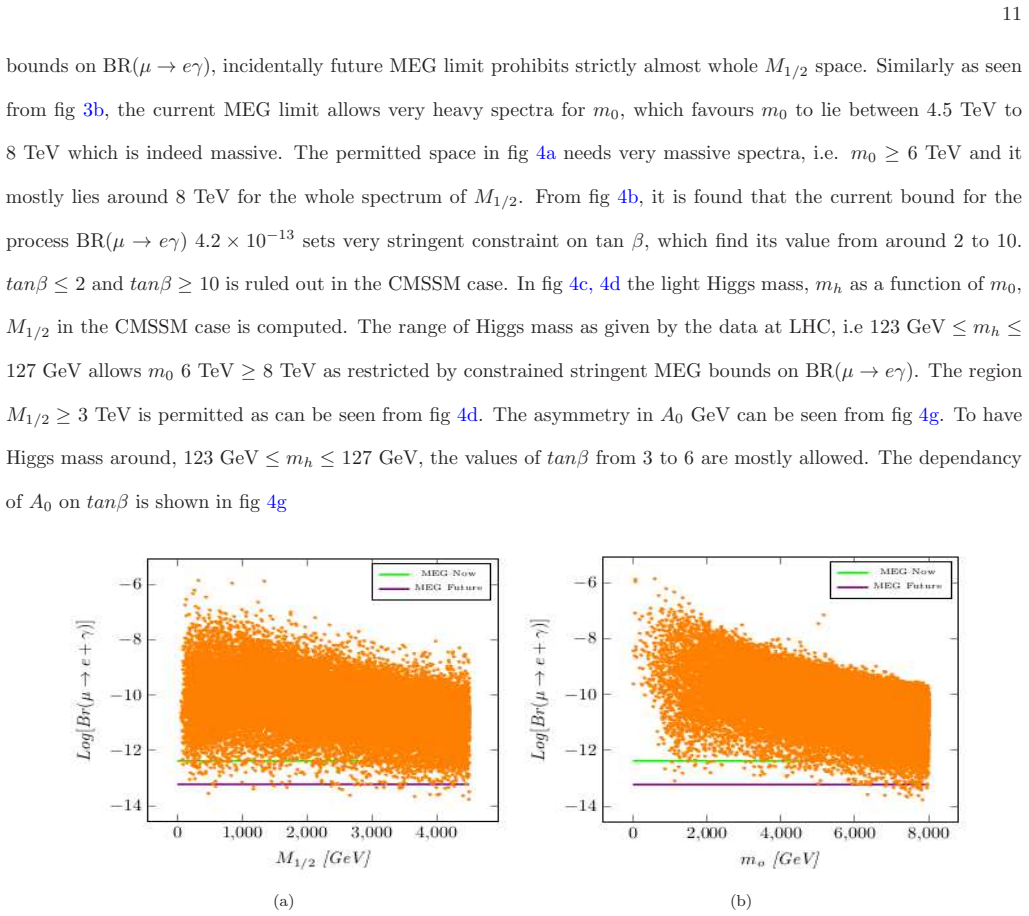
brings forth significant restrictions on SUSY parameter space in CM SSM. As depicted from fig 3a, few part of the paramater space is allowed for tan β = 5 − 60 in CMSSM as constrained by future MEG limit for BR( µ → eγ) which is 6 ×10⁻¹⁴. So to conclude it is seen that the parameter space M1/2 ≥ 10 GeV is permitted by present MEG 11 bounds on BR( µ → eγ), i...
-
[4]
J. A. Casas and A. Ibarra, Nucl. Phys. B 618 (2001) 171; F. D eppisch, H. Pas, A. Redelbach, R. Ruckl and Y. Shimizu, Nucl. Phys. Proc. Suppl. 116 (2003) 316
work page 2001
-
[5]
Fig. 5d represents m0 Vs M1/2. The SUSY parameter space M1/2 − mh and m0 − mh is presented, as allowed by present MEG bounds in figs. 6a,6c. For Higgs mass to be around 126 GeV, values of M1/2 from 4 TeV to 5 TeV are mostly allowed. Similarly for mh around 126 GeV, region 6 TeV ≤ m0 ≤ 8 TeV are mostly allowed. In δLL i⁄=j owing to the cancellations between...
-
[6]
S. Dimopoulos, S. Raby and F. Wilczek, Phys. Rev. D 24 (198 1) 1681; U. Amaldi, W. de Boer and H. Furstenau, Phys. Lett. B 260, 447 (1991); J. R. Ellis, S. Kelley and D. V. Nanopo ulos, Phys. Lett. B 260 (1991) 131; P. Langacker and M. x. Luo, Phys. Rev. D 44 (1991) 817
work page 1991
-
[7]
L. E. Ibanez and G. G. Ross, Phys. Lett. 110B (1982) 215; K. Inoue et al. Prog. Theor. Phys. 68, 927 (1982) and 71, 413 (1984); L. Ibanez, Phys. Lett. B118, 73 (1982); H. P. Nilles, M. Srednicki and D. Wyler, Phys. Lett. B 120 (1983) 346; J. Ellis, J. Hagelin, D. Nanopoulos and M. Tamvakis, Phys. Lett . B125, 275 (1983); L. Alvarez-Gaum e. J. Polchinski a...
work page 1982
Show all 63 references
-
[8]
H. E. Haber and R. Hempfling, Phys. Rev. Lett. 66 (1991) 181 5; J. R. Ellis, G. Ridolfi and F. Zwirner, Phys. Lett. B 257 (1991) 83; Y. Okada, M. Yamaguchi and T. Yanagida, Prog. Theo r. Phys. 85 (1991) 1; M. Carena, M. Quiros and C. E. M. Wagner, Nucl. Phys. B 461 (1996) 407; V...
1991
-
[9]
Sidori, F
G.I. Sidori, F. Mescia, P. Paradisi, D. Temes, Phys Rev. D75, 115019 (2007)
2007
-
[10]
Canepa, Rev
A. Canepa, Rev. Phys. 4 (2019) 100033. doi:10.1016/j.re vip.2019.100033
2019
-
[11]
Witten, Nucl
E. Witten, Nucl. Phys. B 188, 513 (1981); R. K. Kaul, Phys. Lett. B 109, 19 (1982)
1981
-
[12]
Goldberg, Phys
H. Goldberg, Phys. Rev. Lett. 50 (1983) 1419; J. R. Ellis, J. S. Hagelin, D. V. Nanopoulos, K. A. Olive and M. Srednicki, Nucl. Phys. B 238 (1984) 453
1983
-
[13]
Blanke, et al, Acta Phys
M. Blanke, et al, Acta Phys. Polon, B41, 657-683 (2010)
2010
-
[14]
Baer and X
H. Baer and X. Tata, Cambridge, UK: Univ. Pr. (2006) 537 p. ; M. Drees, R. Godbole and P. Roy, Hackensack, USA: World Scientific (2004) 555 p; S. P. Martin, Adv. Ser. Direct. High E nergy Phys. 21 (2010) 1, [hep-ph/9709356]; D. J. H. Chung, L. L. Everett, G. L. Kane, S. F. King...
2006 arXiv
-
[15]
For a review, see e.g. R. Arnowitt and P. Nath, In *Kane, G .L. (ed.): Perspectives on supersymmetry II 222-243 21 [arXiv:0912.2273 [hep-ph]] and references therein; V. D. B arger, M. S. Berger and P. Ohmann, Phys. Rev. D 47 (1993) 1093 and Phys. Rev. D 49 (1994) 4908; G. L. K...
1993 arXiv
-
[16]
A. M. Baldini et al. [MEG Collaboration], Eur. Phys. J. C 76, no. 8, 434 (2016) doi:10.1140/epjc/s10052 016-4271-x [arXiv:1605.05081 [hep-ex]]
2016 arXiv
-
[17]
A. M. Baldini et al. [MEG II Collaboration], Eur. Phys. J . C 78, no. 5, 380 (2018) doi:10.1140/epjc/s10052-018-5845 -6 [arXiv:1801.04688 [physics.ins-det]]
2018 arXiv
-
[18]
Adam et al
J. Adam et al . (MEG Collaboration), (2013), Phys. Rev. Lett. 110 20, 201801 (2013). arXiv:1303.0754 [hep-ex]
2013 arXiv
-
[19]
Antusch, E
S. Antusch, E. Arganda, M. J. Herrero, A. M. Teixeira, JH EP 0611, 090 (2006)
2006
-
[21]
Masiero, Sudhir K.Vempati, hep-ph/0407325, New J.P hys
A. Masiero, Sudhir K.Vempati, hep-ph/0407325, New J.P hys. 6, 202 (2004)
2004 arXiv
-
[22]
which requires a 125 GeV Higgs mass along with multi-TeV soft term s (as implied by LHC data) nevertheless at the same time it avoids the fine-tunings attached with the Little Hiera rchy problem. Here, the current and projected reaches of LFV search µ → e + γ in MEG II and MEG ...
2016
-
[23]
Agashe, A.E
K. Agashe, A.E. Blechman, F. Petriello, Phys Rev D74, 053011 (2006)
2006
-
[24]
Joaquim and A
F. Joaquim and A. Rossi, Phys. Rev. Lett. 97, 181801 (2006). arXiv:hep-ph/0604083 [hep-ph]; Nucl. Phys. B765, 71 (2007). arXiv:hep-ph/0607298 [hep-ph]; F. Joaquim, JHEP 1006, 079 (2010). arXiv:0912.3427 [hep-ph]
2006 arXiv
-
[25]
Arganda and M
E. Arganda and M. J. Herrero, Phys.Rev. D73, 055003 (2006). arXiv:hep-ph/0510405 [hep-ph]; M. Hirsch, S. Kaneko, and W. Porod, Phys.Rev. D78, 093004 (2008). arXiv:0806.3361[hep-ph]; J. Esteves, S. Kaneko, J. Romao, M. Hirsch, and W. Porod, Phys.Rev. D80, 095003 (2009). arXiv:0...
2006 arXiv
-
[26]
Thomas Hambye, Nucl. Phys. Proc. Suppl. 248-250, 13-19 (2014). arxiv-1312.5214
2014 arXiv
-
[27]
Schechter and J
J. Schechter and J. Valle, Phys. Rev. D22, 2227, (1980); R. N. Mohapatra and G. Senjanovic, Phys. Rev. D23, 165 (1981); G. Lazarides, Q. Shafi, and C. Wetterich, Nucl. Phys. B181, 287 (1981); T. Cheng and L. F. Li, Phys. Rev. D22, 2860 (1980)
1980
-
[29]
D98 (2018) no.1, 015009, arXiv: 1804.08642
Amin Aboubrahim, Pran Nath, Phys.Rev. D98 (2018) no.1, 015009, arXiv: 1804.08642
2018 arXiv
-
[30]
I. H. Lee, Phys. Lett. B138,121 (1984), Nucl.Phys B246, 120 (1984); F. Borzumati, A. Masiero, Phys. Rev. Lett. 57 (961), 1986; L. J. Hall, V. A. Kostelecky, S. Raby, Nucl. Phys B267, 415(1986), F.Gabbiani and A. Masiero, Nucl. Phys. B322, 235 (1989)
1984
-
[31]
J.Hisano, et al, Phys. Lett. B357, 579 (1995), J. Hisano et. al., Phys. Rev. D 53 , 2442 (1996)
1995
- [32]
-
[33]
In Table 1 the presiding values of δij that enter eq.(5,6,7) is presented
is employed. In Table 1 the presiding values of δij that enter eq.(5,6,7) is presented. IV. CALCULATIONS AND DISCUSSION ON RESULTS In this section, study on the computation of results presented in s ection 3 is discussed. A. Complete Universality - CMSSM At the high scale, the...
-
[34]
Takeshi Fukuyama, Tatsuru Kikuchi, Nobuchika Okada, P hys. Rev. D68, 033012 (2003). hep-ph/0304190
2003 arXiv
-
[35]
Takeshi Fukuyama, Amon llakovac, Tatsuru Kikuchi, Eur . Phys. J. C56, 125-146 (2008). arXiv:hep-ph/0506295
2008 arXiv
-
[36]
Chamseddine, R
A. Chamseddine, R. Arnowitt and P. Nath, Phys. Rev. Lett . 49, 970 (1982); R. Barbieri, S. Ferrara and C. Savoy, Phys. Lett . B119, 343 (1982); L.J. Hall, J. Lykken and S. Weinberg, Phys. R ev. D27, 2359 (1983); for a review, see H. P. Nilles, Phys. Rep. 110, 1 (1984); R. L. A...
1982 arXiv
-
[37]
Mohap atra (Maryland U.), 2009
Bhaskar Dutta (Texas A-M), Yukihiro Mimura, R.N. Mohap atra (Maryland U.), 2009. 12, JHEP 1005 (2010) 03; P.S. Bhupal Dev (Maryland U.), Bhaskar Dutta (Texas A-M), R.N. Mo hapatra, Matthew Severson (Maryland U.), Phys.Rev. D86 (2012) 035002; P.S. Bhupal Dev, R.N. Mohapatra, Ma...
2010
-
[39]
and the SUSY particle spectrum using the publicly available package SuSeFLA V [50] is created. tanβ ∈ [5, 60] m0 ∈ [0, 16] TeV M1/2 ∈ [0, 6] TeV A0 ∈ 0 TeV mHu = mHd ∈ 0 TeV (12) Massive right handed neutrinos used in our calculations are - MR1 = 10 13 GeV, MR2 = 10 14 GeV, an...
-
[40]
The leading log approximation for the slepton mass matrix element tha t induces the process µ → e + γ is 12 (a) (b) (c) (d) (e) (f) (g) Figure 4: In figs (4a-4e) allowed SUSY parameters region as constrained by MEG 2016 bo und is presented. 13 ( m2 ˜L ) i⁄=j = −2m2 o + A2 o + m...
2016
-
[41]
Stefano Profumo, Carlos E.Yaguna, Nucl. Phys. B681, 247-260 (2004). arXiv-0307225
2004
-
[42]
Kalpana Bora, Gayatri Ghosh, Eur. Phys. J. C75, 9, 428, (2015), arXiv:1410.1265 [hep-ph]
2015 arXiv
-
[43]
(MEG Collaboration) J. Adam et. al., Phys. Rev. Lett. 107, 171801 (2011), [ arXiv:1107.5547]. 22
2011 arXiv
-
[44]
Tanabashi et al
M. Tanabashi et al. [Particle Data Group], Phys. Rev. D 9 8, no. 3, 030001 (2018). doi:10.1103/PhysRevD.98.030001
2018 doi
- [45]
-
[46]
Tata, Lectures presented at the IX Jo rge Swieca Summer School, Campos do Jord o, Brazil, Feb
For reviews, see X. Tata, Lectures presented at the IX Jo rge Swieca Summer School, Campos do Jord o, Brazil, Feb. 1997 , UH-511-872-97, hep-ph/9706307; S. Dawason, Lectures at TASI 97, (1997), hep-ph/9712464
1997 arXiv
-
[47]
Cremmer, S
E. Cremmer, S. Ferrara, L. Girardello, A. Van Proeyen, P hys. Lett. B 116, 231 (1982); L. E. Ibanez, Phys. Lett. B 118, 73 (1982); P. Nath, R. L. Arnowitt and A. H. Chamseddine, Model Independent Analysis Of Low Energy Phenomena In Supergravity Unified Theories , NUB No: 2588, ...
1982
-
[48]
D81 075009 (2010)
Subhaditya Bhattacharya, Utpal Chattopadhya, Debajy oti Choudhury, Debottam Das, Biswarup Mukhopadhyaya, Phys.Rev. D81 075009 (2010). arXiv:0907.3428
2010 arXiv
-
[49]
Calibbi, D
L. Calibbi, D. Chowdhury, A. Masiero, K. M. Patel and S. K . Vempati, JHEP 1211, 040 (2012) doi:10.1007/JHEP11(2012)040 [arXiv:1207.7227 [hep-ph] ]
2012 arXiv
- [50]
-
[51]
Arvanitaki, M
A. Arvanitaki, M. Baryakhtar, X. Huang, K. Van Tilburg, G. Villadoro, JHEP 1403, 022 (2014). arXiv: 1309.3568
2014 arXiv
- [52]
-
[53]
J. L. Feng, Ann. Rev. Nucl. Part. Sci. 63; 351-382 (2013). arXiv: 1302.6587
2013 arXiv
-
[54]
Masiero, S
A. Masiero, S. K. Vempati and O. Vives, Nucl. Phys. B 649, 189 (2003) doi:10.1016/S0550-3213(02)01031- 3 [hep-ph/0209303]; L. Calibbi, A. Faccia, A. Masiero and S. K. Vempati, Phys. Rev. D 74, 116002 (2006) doi:10.1103/PhysRevD.74.116002 [hep-ph/0605139]; L. Ca libbi, D. Chowd...
2003 arXiv
- [55]
-
[56]
Villadoro, JHEP 1302, 126 (2013)
Asimina Arvanitaki, Nathaniel Craig, Savas Dimopoulo s, G. Villadoro, JHEP 1302, 126 (2013). hep-ph/ 1210.0555
2013 arXiv
-
[57]
Savas Dimopoulos, Kiel Howe, John March-Russell, Phys .Rev.Lett.113, 111802 (2014), hep-ph- 1404.7554
2014 arXiv
- [58]
-
[59]
Chowdhury, R
D. Chowdhury, R. Garani, and S. K. Vempati,SUSEFLA V:Pr ogram for supersymmetric mass spectra with seesaw mecha- nism and rare LFV decays, Comput. Phys. Commun. 184, 899-918 (2013). arXiv:1109.3551
2013 arXiv
-
[60]
Calibbi, A
L. Calibbi, A. Faccia, A. Masiero, and S. K. Vempati, Lep ton Flavour Violation from SUSYGUTs: Where do we stand for MEG, PRISM/PRIME and a Super Flavour factory, Phys. Rev. D74, 116002 (2006). aXiv:0605139v2. 23
2006
-
[61]
Gabbiani, A
F. Gabbiani, A. Masiero, Nucl. Phys. B 322, 235 (1989)
1989
-
[62]
Masina, C
I. Masina, C. Savoy, Nucl. Phys. B 661, 365-393 (2003). [ arXiv:hep-ph/0211283]
2003 arXiv
-
[64]
Hirsch, F
M. Hirsch, F. R. Joaquim and A. Vicente, JHEP 1211, 105 (2 012) doi:10.1007/JHEP11(2012)105 [arXiv:1207.6635 [hep - ph]]
2012 arXiv
-
[65]
Barger, D
V. Barger, D. Marfatia, A. Mustafayev and A. Soleimani, Phys. Rev. D 80 (2009) 076004 doi:10.1103/PhysRevD.80.076 004 [arXiv:0908.0941 [hep-ph]]
2009 arXiv
-
[2016]
Negative values of A0 are favoured in order to have Higgs mass around 126 GeV
Fig 6b shows A0 [GeV] Vs mh [GeV]. Negative values of A0 are favoured in order to have Higgs mass around 126 GeV. Fig 6d represents tan β Vs mh. The last row in the right panel depicts the constraintor restrictio n on tan β . Amost all values of tan β from around 5 to 40 are a...
2016
Reviewed August 14, 2026 · model on record in the stance chip above.
Discussion (0). Continue with ORCID to comment.