REVIEW 3 major objections 3 minor 11 references
InferPy: Probabilistic Modeling with Deep Neural Networks Made Easy
T0 review · 3 major / 3 minor · reviewed 2026-08-14 · deepseek-v4-flash
Pith's one-line read InferPy claims that a compact API for deep probabilistic modeling lets non-specialists define, fit, and sample from VAEs in about a dozen lines of code.
desk verdict A real, working usability layer over TFP for deep probabilistic models that likely does what it says, but the paper's 'easy' claim needs a measurement and the datamodel semantics need to be pinned down. read the letter →
The pith
A machine-rendered reading of the paper's core claim, the machinery that carries it, and where it could break.
The reading
What carries the argument
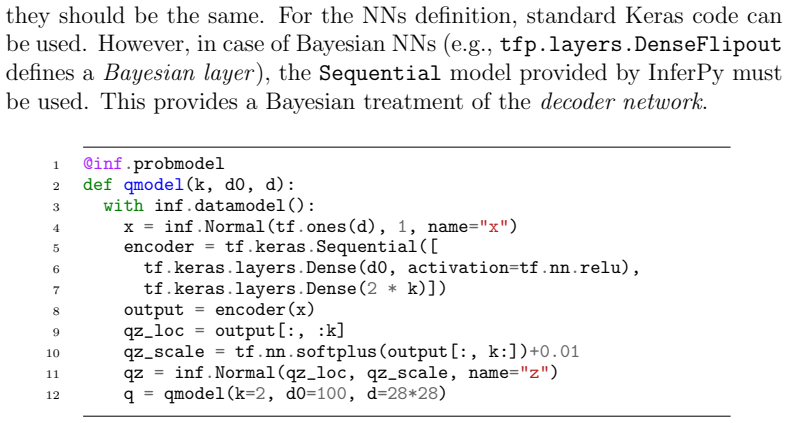
The central mechanism is the decorated model function combined with the datamodel context manager: @inf.probmodel marks a function whose executed random-variable instantiations define the model, and with inf.datamodel(): tells InferPy to replicate the enclosed variables once per data sample, making them conditionally independent given variables defined outside the block. Name matching between the p-model and q-model variables sets up amortized variational inference, and an SVI class wraps the optimization; standard Keras sequential layers can be used inside models, with Bayesian layers supported through an InferPy Sequential wrapper. This machinery is what lets the API replace explicit tensor shapes and inference code with a compact declarative specification.
What would settle it
Codify a simple two-level hierarchical model in both InferPy and an equivalent hand-written program on the same underlying backend with identical seeds; compare the joint densities or posterior draws. If the replicated variables are not conditionally independent given the outer variables, or if predictions differ systematically, the datamodel construct fails to preserve semantics.
Extended reading notes
Core claim
The paper's central claim is that the trade-off between model generality and ease of use can be moved decisively toward ease of use. Using the decorator @inf.probmodel to mark model-defining functions, the with inf.datamodel(): context manager to replicate random variables for each data sample, and name-based matching between variables in the generative (p) and variational (q) models, InferPy lets a user specify a variational autoencoder—decoder, encoder, and stochastic variational inference—in about twelve lines. The authors argue that this hides the tensor plumbing and inference details that make libraries aimed at general probabilistic models hard to approach, while remaining expressive enough for hierarchical models containing deep neural networks.
Load-bearing premise
The load-bearing assumption is that InferPy's automatic replication of variables inside with inf.datamodel():, together with name-based matching between the generative and variational models, reproduces exactly the conditional-independence structure of the model the user intends; if this replication is wrong or incomplete, the compact code defines a different probabilistic model than the one claimed.
Editorial extensions
If this is right
- If the API works as claimed, users without a strong probabilistic background can prototype VAEs and related deep generative models in a few lines, making the methods available to a wider group of practitioners.
- Because InferPy sits on top of an existing general-purpose backend, models definable in that backend remain expressible in InferPy, so the ease-of-use gain comes without leaving that ecosystem.
- Typical workflows—defining a generative model, fitting it with variational inference, sampling from posteriors, and generating new data—collapse into short method calls such as fit(), posterior(), and posterior_predictive().
- The compact API should lower the cost of experimenting with model architectures, since changing the decoder or encoder only requires editing small decorated functions.
Reading between the lines
- The name-matching convention between p and q models suggests a possible extension: the same specification could be automatically checked for consistency, such as verifying that every q-variable has a corresponding p-variable, rather than relying on the user to get names right.
- The datamodel replication pattern is likely generalizable beyond variational inference: because it only fixes conditional-independence semantics, the same compact specification could in principle drive other inference engines such as Monte Carlo methods, though the paper only demonstrates SVI.
- A natural stress test would be to measure how sensitive the API's hidden default configurations are to learning-rate choices; the paper does not report such a benchmark, so ease of use may come at the cost of less control for users who need custom inference schedules.
- One could compare code length and learning outcomes side by side with a general-purpose probabilistic programming language on a realistic dataset; the paper does not provide such an empirical comparison, so the practical size of the claimed ease-of-use gain remains to be quantified.
Signed reviews
Editorial analysis
A structured set of objections, weighed in public.
Referee Report
Summary. The paper describes InferPy, a Python package that provides a high-level API for defining, fitting, and evaluating probabilistic models containing deep neural networks, built on top of TensorFlow Probability and Keras. The authors motivate the package by the difficulty of specifying deep generative and Bayesian deep learning models in general-purpose probabilistic programming libraries, and they illustrate the API with a variational autoencoder in three short code listings: the generative model, the variational model, and the inference call. The paper also supplies software and code metadata (version 1.3.0, Apache-2.0, PyPI and GitHub links). The main claimed contribution is ease of use: a compact API that hides inference details and allows users without a strong probabilistic background to work with deep probabilistic models.
Significance. If the behavior of the central `datamodel` replication construct is faithful, InferPy offers a genuine practical simplification for a useful class of deep probabilistic models, and the VAE example shows that model and variational family can be expressed in a few lines of code. The paper's strengths are its versioned, open-source release with reproducible code metadata (Tables 1 and 2) and its concrete running example. The paper does not propose new inference algorithms or theoretical results; its contribution is a software usability claim. Consequently, the correctness of the abstraction and the evidence for 'ease of use' are the deciding factors for the paper's claims.
major comments (3)
- [Section 4, Figure 2] The q-model declares the observed variable x inside `with inf.datamodel()` exactly like the latent variable z: `x = inf.Normal(tf.ones(d), 1, name="x")`. The manuscript never specifies how InferPy distinguishes observed variables from latent variables inside the q-model, nor how the conditioning of q(z|x) is established before `fit()` is called. If x is treated as a variational random variable rather than as an observed/conditioning input, the optimized objective would target q(z,x) or another surrogate instead of q(z|x), and the fitted object would not implement the VAE described in the text. This fidelity question is load-bearing because the compact API is only useful if it encodes the intended probabilistic model; please clarify the mechanism or cite the exact part of the API documentation that defines it.
- [Section 4, footnote 1] The footnote states that 'the number of replications will be automatically calculated just before the inference,' but this is not sufficient to guarantee the conditional-independence semantics of the model. In the VAE example, the p-model's `datamodel` block defines a generative distribution over each data point, while the q-model's `datamodel` block must provide an encoder evaluated at each observed point; the paper does not say whether the replication count is derived from the data batch, from the declared tensor dimensions, or from name matching between the p-model and q-model. A precise definition, or a reference to a formal semantics section in the manual, is needed before users can trust that the concise code defines the intended probabilistic model across batches and epochs.
- [Section 4 and Conclusions] The central claim of ease of use is supported mainly by the sentence 'The analogous TFP code for this model is far more complex,' but no TFP or Pyro counterpart is shown, and no usability evidence such as code-length comparison, task-completion time, error rates, or a user study is reported. Since 'made easy' is the title's and abstract's main promise, the paper should include the complete alternative implementation in an appendix and at least a simple quantitative comparison (for example, lines of code and number of inference concepts a user must know) to make the claim testable.
minor comments (3)
- [Section 4] There are several language issues: 'syntaxis' should be 'syntax', 'multivarate' should be 'multivariate', 'This construct enormously simplify the code' should be 'This construct enormously simplifies the code', and 'A major released of the code' should be 'A major release of the code'.
- [Tables 1 and 2] The package name is spelled inconsistently: 'InferPy' in the text and 'Inferpy' in some metadata entries; please use one spelling throughout.
- [Section 4, last paragraph] The sentence about the TFP code being in the online documentation refers the reader to Tables 1 and 2, but those tables only contain the general documentation URL; a direct link or section pointer to the specific VAE comparison would be more useful.
Circularity Check
No circularity: InferPy is presented as a software layer over TensorFlow Probability, with no derivation that reduces to its own inputs.
full rationale
No circularity found. This is a software/API paper rather than a mathematical derivation: it illustrates how a VAE is expressed in InferPy (Figures 1-3) and states that inference is delegated to TensorFlow Probability and Keras. The only same-author references ([2] and [5]) are used for background and for contrasting with the previous InferPy version; no load-bearing claim is justified by those self-citations, and no fitted parameter is renamed as a prediction. The semantics of the `with inf.datamodel()` construct is a potential correctness risk, because the paper does not formally specify how variable replication or observed/latent distinction is resolved before inference; however, that is an implementation-validation concern, not circularity. The paper does not define the datamodel construct in terms of the ease-of-use claim, nor does it use the construct to derive itself. Since the paper is self-contained as a software presentation and its inference correctness is explicitly delegated to external TFP/Keras components, the appropriate circularity score is 0.
Assumptions & free parameters
assumptions (2)
- domain assumption TensorFlow Probability provides correct variational inference and Monte Carlo primitives.
- domain assumption The `inf.datamodel()` construct correctly replicates random variables per data sample according to conditional independence.
Cite this review
Pith. "Pith review of InferPy: Probabilistic Modeling with Deep Neural Networks Made Easy." pith.science (2026). https://pith.science/paper/FNQ6NMXV
@misc{pith2026190811161,
  author       = {Pith},
  title        = {Pith review of: InferPy: Probabilistic Modeling with Deep Neural Networks Made Easy},
  year         = {2026},
  howpublished = {\url{https://pith.science/paper/FNQ6NMXV}},
  note         = {Machine review of arXiv:1908.11161}
}
read the original abstract
InferPy is a Python package for probabilistic modeling with deep neural networks. It defines a user-friendly API that trades-off model complexity with ease of use, unlike other libraries whose focus is on dealing with very general probabilistic models at the cost of having a more complex API. In particular, this package allows to define, learn and evaluate general hierarchical probabilistic models containing deep neural networks in a compact and simple way. InferPy is built on top of Tensorflow Probability and Keras.
Figures


Reference graph
Works this paper leans on
-
[1]
write newline
" write newline "" before.all 'output.state := FUNCTION n.dashify 't := "" t empty not t #1 #1 substring "-" = t #1 #2 substring "--" = not "--" * t #2 global.max substring 't := t #1 #1 substring "-" = "-" * t #2 global.max substring 't := while if t #1 #1 substring * t #2 global.max substring 't := if while FUNCTION word.in bbl.in ":" * " " * FUNCTION f...
- [2]
-
[3]
Probabilistic Models with Deep Neural Networks
A. Masegosa, R. Caba\ n as, H. Langseth, T. Nielsen, A. Salmer\' o n, Probabilistic modeling with deep neural networks, arXiv preprint arXiv:... http://arxiv.org/abs/1908.03442 arXiv:1908.03442
work page Pith review arXiv 1908
-
[4]
D. Tran, M. W. Hoffman, D. Moore, C. Suter, S. Vasudevan, A. Radul, Simple, distributed, and accelerated probabilistic programming, in: Advances in Neural Information Processing Systems, 2018, pp. 7598--7609
work page 2018
-
[5]
E. Bingham, J. P. Chen, M. Jankowiak, F. Obermeyer, N. Pradhan, T. Karaletsos, R. Singh, P. Szerlip, P. Horsfall, N. D. Goodman, Pyro: Deep universal probabilistic programming, The Journal of Machine Learning Research 20 (1) (2019) 973--978
work page 2019
-
[6]
R. Caba \ n as, A. Salmer \'o n, A. R. Masegosa, Inferpy: Probabilistic modeling with Tensorflow made easy, Knowledge-Based Systems 168 (2019) 25--27
work page 2019
-
[7]
D. Tran, A. Kucukelbir, A. B. Dieng, M. Rudolph, D. Liang, D. M. Blei, Edward: A library for probabilistic modeling, inference, and criticism, arXiv preprint arXiv:1610.09787
-
[8]
R. Salakhutdinov, Learning deep generative models, Annual Review of Statistics and Its Application 2 (2015) 361--385
work page 2015
Show all 11 references
-
[9]
Ghahramani, Probabilistic machine learning and artificial intelligence, Nature 521 (7553) (2015) 452
Z. Ghahramani, Probabilistic machine learning and artificial intelligence, Nature 521 (7553) (2015) 452
2015
-
[10]
Brooks, A
S. Brooks, A. Gelman, G. Jones, X.-L. Meng, Handbook of markov chain monte carlo, CRC press, 2011
2011
-
[11]
Doersch, Tutorial on variational autoencoders, arXiv preprint arXiv:1606.05908
C. Doersch, Tutorial on variational autoencoders, arXiv preprint arXiv:1606.05908
Reviewed August 14, 2026 · model on record in the stance chip above.
Discussion (0). Continue with ORCID to comment.