REVIEW 4 major objections 5 minor 3 references
Threat determination for radiation detection from the Remote Sensing Laboratory
T0 review · 4 major / 5 minor · reviewed 2026-08-14 · deepseek-v4-flash
Pith's one-line read A neural network trained only on simulated gamma-ray spectra can classify real measured spectra, and a single hidden layer is needed to recognize a shielded industrial gauge that a linear model misses.
desk verdict A short proof-of-concept on GADRAS-to-measured gamma-ray spectral classification; the sim-to-real transfer and nonlinearity observation are worth refereeing, but the threat-filtering framing outruns the demonstrated capability. read the letter →
The pith
A machine-rendered reading of the paper's core claim, the machinery that carries it, and where it could break.
The reading
What carries the argument
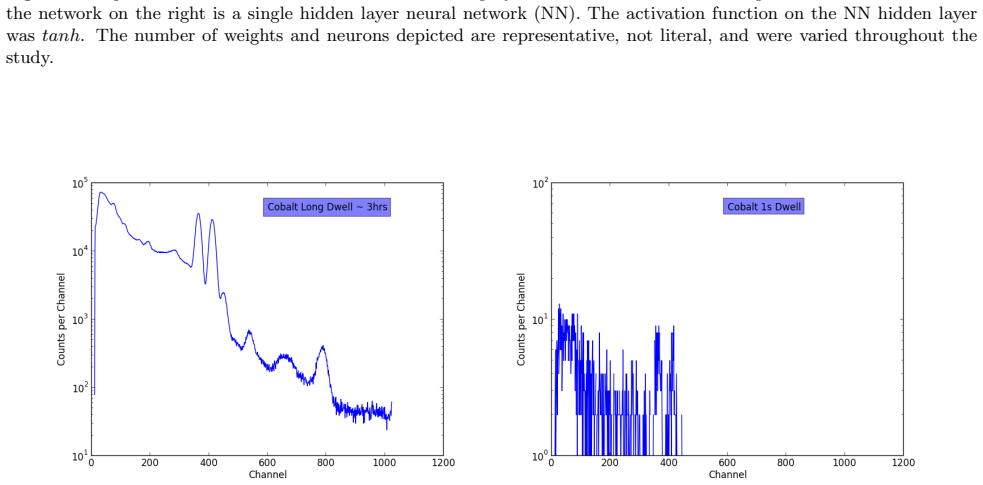
The central object is the gamma-ray spectrum, binned into 1024 or 256 channels and used as the input vector $\mathbf{x}$ to two classifiers: a linear model $\hat{\mathbf{y}} = \mathrm{softmax}(W\mathbf{x} + \mathbf{b})$ and a single-hidden-layer network $\hat{\mathbf{y}} = W_2 \tanh(W_1 \mathbf{x} + \mathbf{b}_1) + \mathbf{b}_2$. Training minimizes cross-entropy with a gradient-based optimizer. The bridging mechanism is the radiation transport code that generates 24-hour dwell spectra, which are then Poisson-sampled to 1-second spectra matching the detector's sampling frequency. The surrogate industrial gauge—cesium behind steel—is the probe used to show that the nonlinear model separates a confuser class the linear model cannot.
What would settle it
Take the same two architectures and the same simulated training data, but test on measured spectra from a different sodium iodide detector, from distances or shielding configurations outside the training range, or from a background environment unlike the laboratory; if accuracy drops to chance levels, the simulation-to-measurement transfer claim fails. A sharper test is to add a measured background spectrum into the simulated training set: if accuracy improves markedly, the no-background training choice is the limiting factor.
Extended reading notes
Core claim
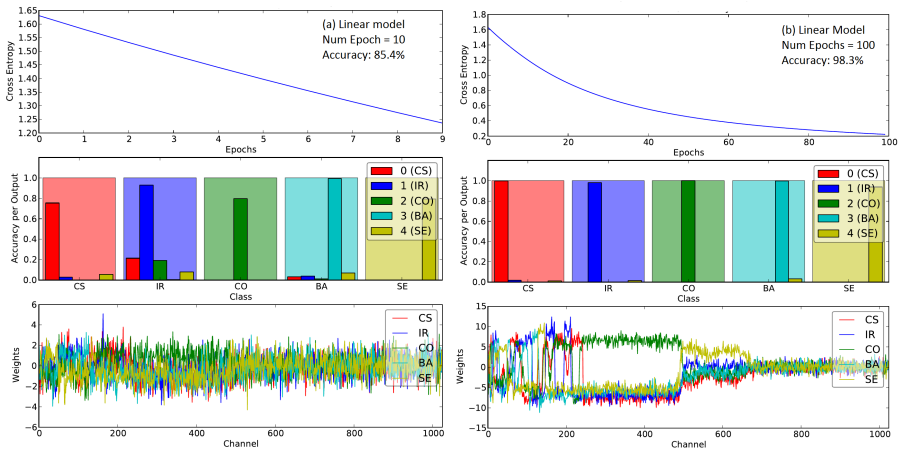
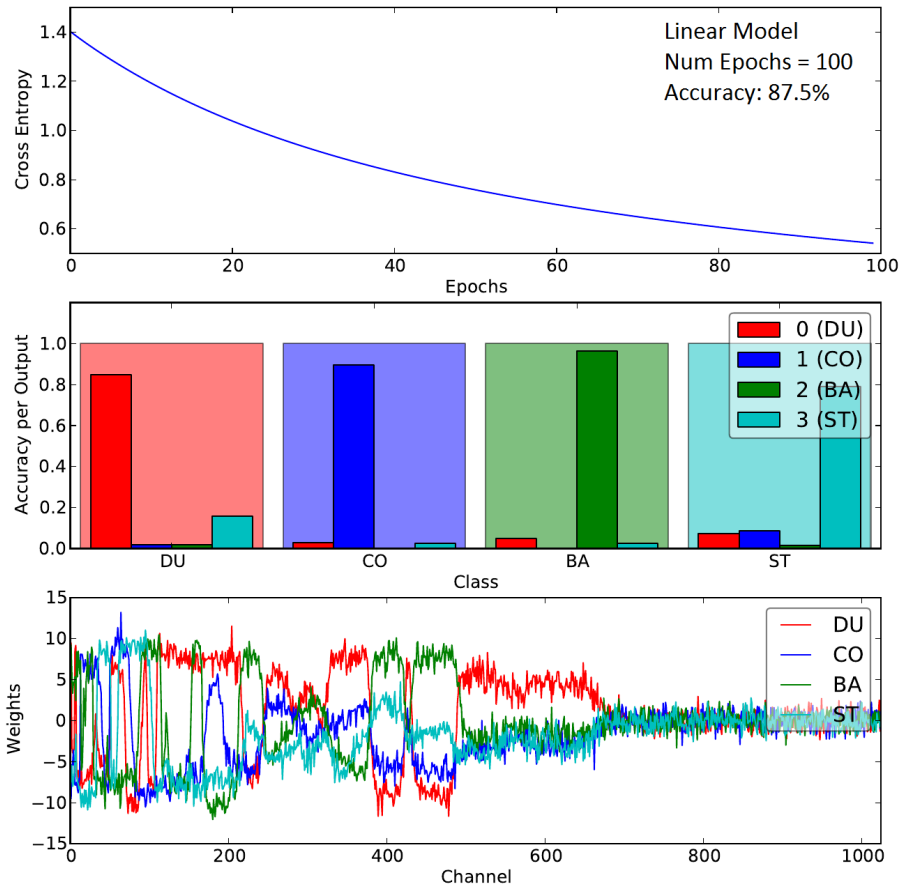
The central discovery is that a classifier trained exclusively on simulated gamma-ray spectra—produced at long dwell times and then randomly resampled to one-second counts, with no background radiation included—can still classify real one-second measurements from a 2-by-4-by-16-inch sodium iodide detector with high accuracy. The same training procedure also produces a classifier that identifies shielding type, with learned weights that show spectral features such as a double-hump pattern associated with depleted uranium. For the surrogate industrial gauge, defined in the paper as cesium shielded by steel, the single-hidden-layer network achieves almost 100 percent accuracy on that output while the linear model achieves less than 20 percent. The authors take this contrast as evidence that at least some spectral identification problems require the nonlinearity provided by a hidden layer.
Load-bearing premise
The load-bearing premise is that gamma-ray spectra simulated by a radiation transport code, randomly resampled from long exposures to one-second counts and containing no background radiation, faithfully represent real one-second measurements from the sodium iodide detector, including its actual background and detector response.
Editorial extensions
If this is right
- Simulated spectra can serve as the training set for classifiers over a fixed menu of isotopes, distances, and shieldings, reducing the need for large measured training collections.
- A single hidden layer is enough for at least one confuser-discrimination task: the surrogate industrial gauge is identified almost perfectly by the nonlinear model and missed by the linear model.
- The same architecture can be trained to report shielding type as well as isotope, and the converged weights appear to encode physical spectral features, such as the depleted-uranium double hump.
- Training to long-dwell simulated spectra works, with a preliminary hint that training to a subset of the Poisson-sampled ensemble may work even better.
- A classifier trained with no background radiation still performs well on measured data, suggesting that explicit background modeling may not be required for this detector and geometry range.
Reading between the lines
- It remains untested whether the simulation-to-measurement transfer survives changes in detector size, field background environments, or detector motion; the no-background training choice makes this the natural next experiment.
- The gauge result suggests that confuser discrimination can hinge on subtle spectral shape differences rather than gross photopeak presence; if so, larger confuser sets will push toward more expressive nonlinear architectures.
- Because Poisson-sampling long-dwell simulations is essentially free data augmentation, one could test the paper's preliminary hint that training on the ensemble improves measured-data accuracy over training on the asymptotic spectrum.
- The learned weight plots could be compared quantitatively against known photopeak positions to predict which isotope classifications are robust to simulation mismatch.
Signed reviews
Editorial analysis
A structured set of objections, weighed in public.
Referee Report
Summary. The paper proposes a machine-learning approach to gamma-ray isotope identification for preventative radiological/nuclear detection (PRND). Two architectures are compared: a single-layer softmax linear model and a single-hidden-layer network with tanh activation, trained with TensorFlow. Training data are simulated with GADRAS for a 2"x4"x16" NaI detector, generated as 24-hour spectra and Poisson-sampled to 1-second dwells; the source library consists of Cesium, Cobalt, Barium, Selenium, and Iridium at various distances and shielding configurations. The authors report three evaluations: a Poisson-sampled simulated test, a transfer test on measured laboratory spectra, and a surrogate 'industrial gauge' classification task (Cesium behind steel vs. everything else). The main claims are that a network trained only on simulated data transfers 'surprisingly good' to measured data, and that the hidden-layer network identifies the surrogate gauge with 'almost 100%' accuracy while the linear model achieves less than 20% accuracy on that output, implying that nonlinearity is needed for some spectrum-identification tasks.
Significance. If substantiated, the simulated-to-measured transfer result would be practically valuable for PRND: it would reduce the need for large measured training corpora and would support deploying many static sensors monitored by automated classifiers. The paper also identifies a concrete confuser-discrimination task where a linear model fails dramatically and a single hidden layer succeeds, which is a useful falsifiable observation about model capacity. The use of external measured data to validate the transfer is methodologically sound, and the surrogate-gauge design is a clear test. However, the evidence is presented only qualitatively, with no numeric accuracies, error bars, confusion matrices, or test-set sizes, and the evaluation lacks any background or rejection class. The significance is therefore conditional: the idea is promising, but the current manuscript does not quantitatively establish the central claims or the threat-filtering capability promised in the abstract.
major comments (4)
- [Section 3, Fig. 5] The central transfer claim is supported only by the phrase 'surprisingly good'; no numeric accuracy, confusion matrix, test-set size, class balance, or error bars are reported. Without these, the reader cannot assess whether the measured-data performance is above chance or stable across conditions, so the claim is not quantitatively established.
- [Sections 2 and 3, Table 1 and Fig. 5] The classifier has no background or 'none-of-the-above' output; both the training classes and the measured test spectra are drawn from only the five library isotopes (Cesium, Cobalt, Barium, Selenium, Iridium). Every measured spectrum is therefore force-assigned to one of those classes. The paper's stated goal is filtering non-threatening encounters, but background-only and unknown-isotope inputs were never part of training or evaluation, so the reported transfer says nothing about that capability. This is a load-bearing gap for the threat-determination framing.
- [Section 3, Fig. 6] The surrogate gauge experiment is also a forced-choice test: the 'Not Cesium Steel' class is defined only over the five simulated isotopes and shielding configurations in Table 1, with no background component. In addition, the two headline numbers ('less than 20%' and 'almost 100%') are not accompanied by test-set sizes, class counts, or error bars. The conclusion that some spectral identification problems demand nonlinearity is plausible, but the claimed performance difference is not statistically or quantitatively demonstrated.
- [Section 3] The hidden-layer network's measured-data results are reported only as 'similar results' with no figure or numeric summary. Because the paper argues that nonlinearity matters for at least one task and recommends more complex architectures for future work, the reader needs the nonlinear model's transfer accuracy on measured data to assess whether simulated training generalizes for both architectures.
minor comments (5)
- [Section 2, Eqs. (1)-(3)] The equations do not explicitly show the softmax operation on the output vector, although the text and Fig. 1 describe softmax normalization; please define the full forward pass, including the softmax, for both architectures.
- [Section 3, Figs. 3-6] The number of hidden units, learning rate, minibatch size, number of training epochs for the final results, and the choice of 1024- vs. 256-channel input are not stated, so the experiments are not reproducible from the text.
- [Figure 5 caption] The caption of Fig. 5 gives no information about what is plotted; the reader cannot tell whether the figure shows a confusion matrix, classification accuracy over time, or example classifications. A descriptive caption is needed.
- [Throughout] There are several typos and misspellings, including 'personel' (Section 1), 'shieding' and 'surragate' (Section 3), 'feasablity' (Section 3), and 'Shiedings' in the Table 1 header; these should be corrected.
- [Section 3, Fig. 3] The statement that training on a subset of the Poisson-sampled ensemble may be better than training on time-asymptotic spectra is presented without supporting data or uncertainty, and the final models use time-asymptotic training; this preliminary observation should either be quantified or clearly labeled as anecdotal.
Circularity Check
No significant circularity: the transfer and nonlinearity claims are independently tested, not defined into existence.
full rationale
The paper's chain is: train two small networks on GADRAS-simulated NaI spectra, check convergence on a Poisson-sampled ensemble, then evaluate on measured lab spectra, and finally compare linear vs. hidden-layer performance on a defined surrogate-gauge task. The Poisson-sampled ensemble is generated from the same simulations used for training, so it is not an independent validation of GADRAS fidelity; however, the paper presents it only as a convergence check ('These results illustrate convergence of the training'), not as the evidence for operational transfer. The actual transfer evidence is external: the authors state 'The results are surprisingly good considering that this machine was not trained to data having any background radiation' in connection with tests against measured data (Section 3, Fig. 5). That comparison can fail, depends on real instrument response, and is not forced by the training labels. The absence of a background/rejection class in the fixed isotope set limits the threat-filtering conclusion, but that is a scope/correctness concern, not circularity. The surrogate-gauge experiment explicitly defines 'Cesium Steel' vs. 'Not Cesium Steel', so the labels are constructional, but the finding that the hidden-layer network reaches almost 100% while the linear model is below 20% is an empirical comparison on the same data, not a fitted parameter disguised as a prediction. No load-bearing self-citation or uniqueness theorem is used; GADRAS and TensorFlow are external references. Therefore no step reduces to its own input by construction.
Assumptions & free parameters
free parameters (3)
- Learning rate (AdamOptimizer)
- Hidden layer width
- Number of training epochs =
10 and 100
assumptions (5)
- domain assumption GADRAS-simulated spectra for the 2x4x16 NaI detector faithfully represent the real detector response.
- domain assumption Poisson sampling of long-dwell simulated spectra to 1-second spectra reproduces real 1-second acquisitions.
- domain assumption Cesium shielded by steel is a representative surrogate for an industrial gauge.
- domain assumption Training without background radiation is acceptable for transfer to measured data.
- domain assumption Balanced-class training with softmax cross-entropy is appropriate despite heavily imbalanced operational encounter rates.
Cite this review
Pith. "Pith review of Threat determination for radiation detection from the Remote Sensing Laboratory." pith.science (2026). https://pith.science/paper/TRHIMKIT
@misc{pith2026190811207,
  author       = {Pith},
  title        = {Pith review of: Threat determination for radiation detection from the Remote Sensing Laboratory},
  year         = {2026},
  howpublished = {\url{https://pith.science/paper/TRHIMKIT}},
  note         = {Machine review of arXiv:1908.11207}
}
read the original abstract
The ability to search for radiation sources is of interest to the Homeland Security community. The hope is to find any radiation sources which may pose a reasonable chance for harm in a terrorist act. The best chance of success for search operations generally comes with fielding as many detection systems as possible. In doing this, the hoped for encounter with the threat source will inevitably be buried in an even larger number of encounters with non-threatening radiation sources commonly used for many medical and industrial use. The problem then becomes effectively filtering the non-threatening sources, and presenting the human-in-the-loop with a modest list of potential threats. Our approach is to field a collection of detection systems which utilize soft-sensing algorithms for the purpose of discriminating potential threat and non-threat objects, based on a variety of machine learning techniques.
Figures

Figures from the paper (3 more)


Reference graph
Works this paper leans on
-
[1]
TensorFlow: Large-scale machine learning on heterogeneous systems,
Abadi, M., Agarwal, A., Barham, P., Brevdo, E., Chen, Z., Citro, C., Corrado, G. S., Davis, A., Dean, J., Devin, M., Ghemawat, S., Goodfellow, I., Harp, A., Irving, G., Isard, M., Jia, Y., Jozefowicz, R., Kaiser, L., Kudlur, M., Levenberg, J., Man´ e, D., Monga, R., Moore, S., Murray, D., Olah, C., Schuster, M., Shlens, J., Steiner, B., Sutskever, I., Tal...
work page 2015
-
[2]
Gadras-drf 18.5 user’s manual.,
Horne, S. M., Thoreson, G. G., Theisen, L. A., Mitchell, D. J., Harding, L., and Amai, W. A., “Gadras-drf 18.5 user’s manual.,”
-
[3]
A framework for the solution of inverse radiation transport problems,
Mattingly, J. and Mitchell, D. J., “A framework for the solution of inverse radiation transport problems,” IEEE Transactions on Nuclear Science 57, 3734–3743 (Dec 2010). Figure 1. Representations of the network architectures employed. The network on the left represents a linear model and the network on the right is a single hidden layer neural network (NN...
work page 2010
Reviewed August 14, 2026 · model on record in the stance chip above.
Discussion (0). Continue with ORCID to comment.