REVIEW 6 minor 59 references
Sampling low-dimensional Markovian dynamics for pre-asymptotically recovering reduced models from data with operator inference
T0 review · 0 major / 6 minor · reviewed 2026-08-14 · deepseek-v4-flash
Pith's one-line read This paper introduces a data-sampling scheme with re-projection that makes data-driven operator inference recover, exactly and for finite data, the same reduced models that traditional intrusive projection-based model reduction constructs.
desk verdict Clean, narrow result: re-projection sampling provably recovers intrusive reduced models, but only when the simulator can be queried one step from arbitrary reconstructed states. read the letter →
The pith
A machine-rendered reading of the paper's core claim, the machinery that carries it, and where it could break.
The reading
What carries the argument
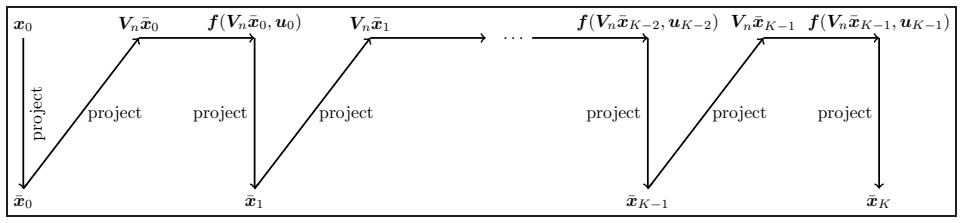
The key mechanism is the re-projection step in Algorithm 1: instead of recording $V_n^T x_k$ along an uninterrupted full-model trajectory, the algorithm alternates between lifting the current reduced state to $V_n \bar{x}_k$, querying the full system for one step from that lifted state, and projecting back as $\bar{x}_{k+1} = V_n^T f(V_n \bar{x}_k, u_k)$. This turn-by-turn re-projection removes the accumulated influence of the orthogonal complement that would otherwise make the projected dynamics non-Markovian. The proof identity is the mixed-product property of Kronecker products: $V_n^T A_i (V_n \otimes \cdots \otimes V_n)(\bar{x} \otimes \cdots \otimes \bar{x})$ equals the projected operator $\tilde{A}_i$ applied to the $i$-th power of $\bar{x}$, so the sampled pairs obey exactly the intrusive reduced equations. The least-squares problem (17) then recovers $\tilde{A}_1,\ldots,\tilde{A}_\ell,\tilde{B}$ uniquely when $\bar{D}$ has full row rank and $K$ is large enough.
What would settle it
Construct a linear system $x_{k+1} = A x_k$ with a chosen subspace $V_n$ for which the cross-coupling $A_{\parallel \perp}$ is nonzero, run Algorithm 1 with exactly $K = p + n_1$ samples, and solve (17); if the data matrix $\bar{D}$ has full rank but the recovered operator differs from $\tilde{A} = V_n^T A V_n$ beyond rounding error, Corollary 1 is false. A simpler direct test is to check whether any full-rank $\bar{D}$ with $K$ satisfying (15) admits two different zero-residual least-squares solutions.
Extended reading notes
Core claim
The central claim is Corollary 1: for a polynomial system of degree $\ell$, if re-projected trajectories are generated by Algorithm 1 from an initial condition in the reduced subspace, and if $K \geq p + \sum_{i=1}^{\ell} n_i$ with $n_i = \binom{n+i-1}{i}$, and the data matrix $\bar{D}$ in (16) has full rank, then the unique least-squares solution satisfies $\|\hat{A}_i - \tilde{A}_i\|_F = \|\hat{B} - \tilde{B}\|_F = 0$ for all $i$. The learned model is therefore not merely an approximation of the intrusive reduced model; it is the intrusive reduced model. The reason is Proposition 1: because each full-model query starts from the lifted re-projected state $V_n \bar{x}_k$, the projected next state equals the state produced by the projected reduced operators, so the closure error $\|\bar{X} - \tilde{X}\|_F$ is zero for the sampled data. Operator inference then recovers the reduced operators exactly as the unique zero-residual least-squares fit.
Load-bearing premise
The load-bearing premise is that the high-dimensional system can be queried for one time step starting from arbitrary lifted states $V_n \bar{x}_k$; if only pre-recorded trajectories are available and the system cannot be stepped from new states, the re-projected trajectories cannot be generated and the exact-recovery guarantee collapses.
Editorial extensions
If this is right
- Learned models are exactly the reduced models of traditional projection-based model reduction, so they inherit the well-studied properties of those models.
- Exact recovery is pre-asymptotic: it does not require the number of data points or the reduced dimension to approach the full dimension.
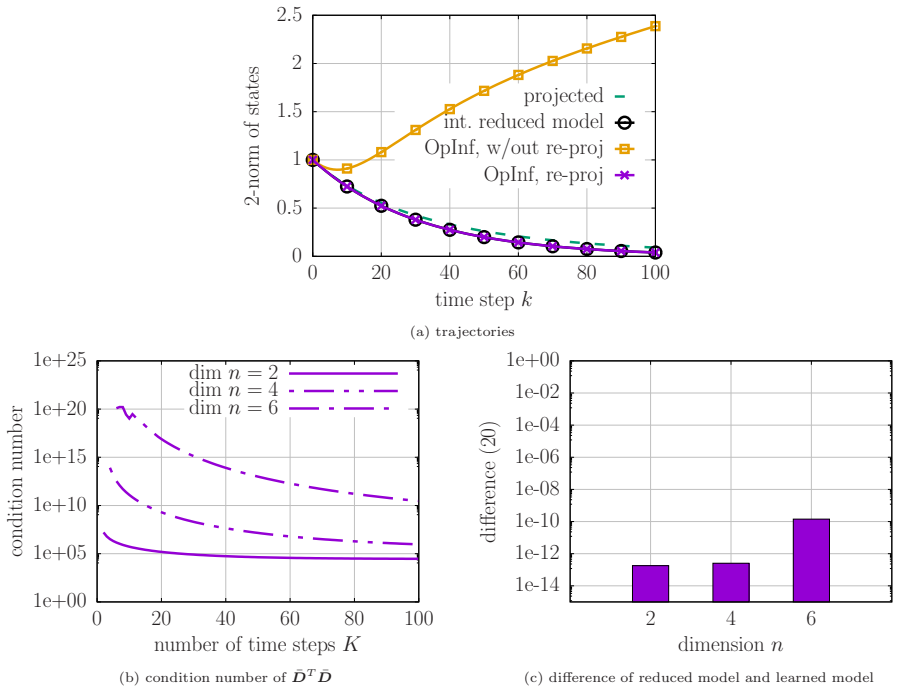
- The two conditions of Corollary 1—the trajectory-length bound (15) and full rank of the data matrix—can be checked numerically, giving a practical certificate that the intrusive model has been recovered.
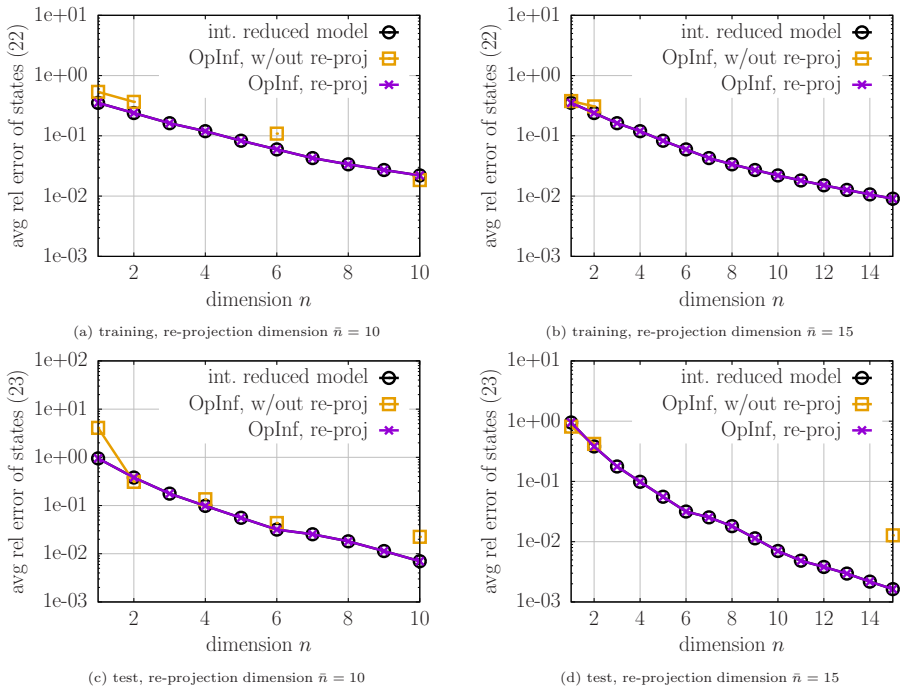
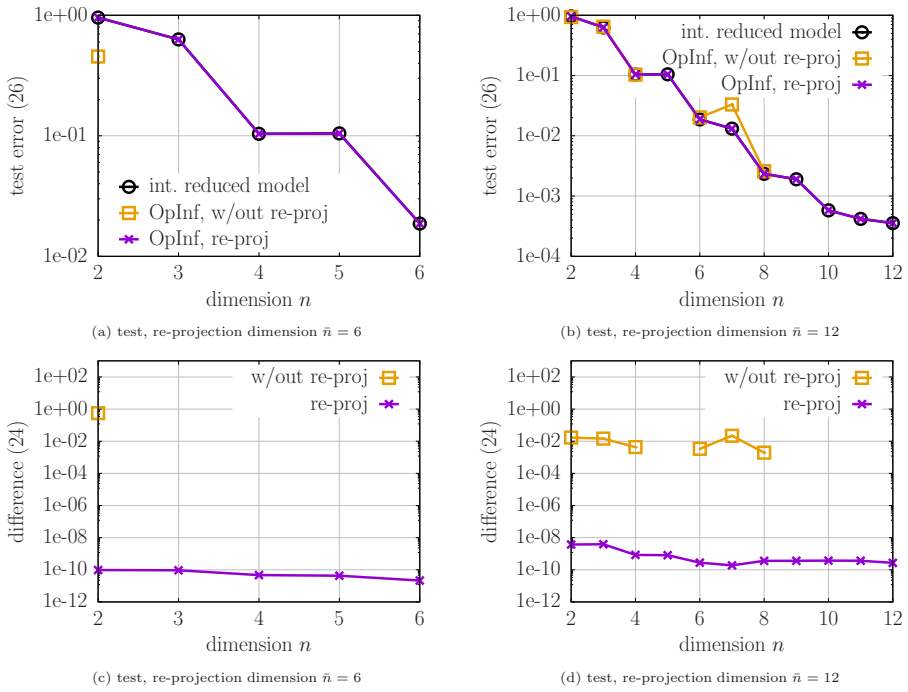
- In the numerical examples, models learned from re-projected trajectories match the intrusive reduced models to about $10^{-10}$ or better, whereas models learned without re-projection can become unstable and diverge.
- The sampling procedure costs roughly twice one full-model simulation: one trajectory set for the basis and one re-projected set for the fit.
Reading between the lines
- An extension the paper leaves implicit is that the same argument should apply wherever the full model can be queried one step from arbitrary lifted states, including implicit time steppers or stochastic forcing sampled per step; the essential requirement is that $f(V_n \bar{x}_k, u_k)$ is well defined.
- A testable practical extension is to use the two Corollary 1 conditions as an online certificate: when the data matrix has full rank and $K \geq p + \sum_i n_i$, one can declare the learned operators identical to the intrusive reduced operators without ever forming the full operators, thereby transferring traditional a posteriori error bounds to the data-driven model.
- For non-polynomial nonlinearities, re-projection could be combined with lifting approaches; whether exact recovery persists would depend on whether the lifted representation closes under the polynomial-degree assumption.
- The requirement to re-query the full model from new states is the price of exactness; in settings where only recorded trajectories exist, Corollary 1 would not apply, and some approximation of the re-projection would be needed.
Signed reviews
Editorial analysis
A structured set of objections, weighed in public.
Referee Report
Summary. This paper addresses the closure-error problem in data-driven model reduction via operator inference. For polynomial dynamical systems (1)-(2), standard operator inference fits reduced operators to projected trajectories, which are non-Markovian and therefore lead to operators that differ from the intrusive Galerkin reduced operators. The paper proposes Algorithm 1, which generates re-projected trajectories by alternately evaluating the high-dimensional system for one step from reconstructed states Vn * bar_x_k and projecting back to Vn. Proposition 1 proves that, when x0 is in Vn, these re-projected trajectories coincide exactly with trajectories of the intrusive reduced model. Corollary 1 shows that if the corresponding data matrix has full rank and the trajectory length satisfies K >= p + sum_i n_i, then least-squares operator inference recovers the intrusive operators exactly. Algorithm 2 integrates the procedure with POD across parameters. Numerical experiments on a linear toy problem, Burgers' equation, Chafee-Infante, and a 2D diffusion-reaction equation show that models learned from re-projected trajectories match intrusive reduced models and remain stable where models from plain projected trajectories diverge. The paper explicitly discusses limitations: the need to query the high-dimensional system, condition-number growth, and the checkable nature of the full-rank assumption.
Significance. The main contribution is a simple but effective idea: by re-projecting after every single high-dimensional step, the non-Markovian component of the projected dynamics is removed, making the sampled trajectories exactly those of the intrusive reduced model. The proofs of Proposition 1 and Corollary 1 are correct under the stated assumptions, and the paper is honest about the conditions (x0 in Vn, full-rank data matrix, active query access). If the result is taken together with these conditions, it provides a pre-asymptotic, finite-data guarantee that connects data-driven operator inference with classical projection-based model reduction, so that learned models inherit the well-studied properties of intrusive reduced models. The numerical study is convincing and includes cases where standard operator inference is unstable. The main caveat is that the guarantee depends on the ability to generate re-projected trajectories, which is an active sampling requirement rather than a passive-data setting.
minor comments (6)
- [Abstract and Section 4.2] The abstract and introduction describe the method as learning 'from data' without qualification, but Algorithm 1 line 4 requires active queries of the high-dimensional system from arbitrary reconstructed states Vn * bar_x_k; please state this active-data-generation requirement as a central condition so that the scope of Corollary 1 is not overstated.
- [Section 5.2.1 and Figures 4-5] The displayed results for n < bar_n are obtained by truncating operators learned at dimension bar_n; Corollary 1 guarantees exact recovery only at the re-projection dimension, so please state explicitly that the agreement at truncated dimensions is an empirical observation rather than a consequence of the theorem.
- [Section 2.4] In the toy example, the initial condition is said to be the first column of the identity matrix of dimension n x n; since x0 is in R^N with N = 10, this should be the N x N identity matrix.
- [Section 3.1] The block matrix A_perp_perp_1 is defined as (V_n^perp)^T A_1 (V_n^perp)^T; the second factor should be V_n^perp, not (V_n^perp)^T.
- [Corollary 1, Eq. (16)] The last block of bar_D is written as bar_X^j; it should be bar_X^ell to match the polynomial degree.
- [Section 5.3.1] The initial condition is written as x(xi, t) = 0 for xi in Omega union {0,1}; the time argument should be 0 rather than t.
Circularity Check
No significant circularity: the exact-recovery guarantee is a direct identifiability result for data generated by the re-projection sampler, with explicit assumptions.
full rationale
The derivation chain is self-contained and not circular. Algorithm 1 defines re-projected trajectories by single-step queries xtmp = f(Vn xbar_k, u_k) followed by projection xbar_{k+1} = Vn^T xtmp. Proposition 1 proves that these equal the intrusive reduced-model trajectories by induction, using the mixed-product property of Kronecker products; this is a direct algebraic identity, not a circular reuse of the conclusion. The intrusive operators in (3) are exactly the projected operators, so the equality is by construction, but that construction is the paper's stated method, not a hidden fitting loop. Corollary 1 then applies a standard full-rank least-squares identifiability argument: since the re-projected data matrix satisfies the intrusive reduced-model equations with objective zero and has full row rank, the unique least-squares solution equals the intrusive operators. This is a genuine identifiability result; the full-rank and trajectory-length conditions are explicit assumptions and are verified numerically in Sections 5.2 through 5.4. The method does require active queries of the high-dimensional system (Algorithm 1, line 4), which the paper explicitly acknowledges in Section 4.2; this limits the practical scope to settings where such queries are possible, but it is not a circularity. No load-bearing self-citations or imported uniqueness theorems are used; references to prior operator-inference work [38] provide background and notation, while the proof here is self-contained.
Assumptions & free parameters
assumptions (6)
- domain assumption The high-dimensional system has polynomial nonlinear terms of known degree ℓ.
- domain assumption The high-dimensional system can be queried for single time steps from arbitrary initial conditions.
- domain assumption The initial condition x0 lies in the reduced space Vn.
- domain assumption The data matrix bar_D has full rank.
- standard math The basis matrix Vn has orthonormal columns.
- standard math The duplicate-free power vector x^i is compatible with Kronecker products under the mixed-product property.
Cite this review
Pith. "Pith review of Sampling low-dimensional Markovian dynamics for pre-asymptotically recovering reduced models from data with operator inference." pith.science (2026). https://pith.science/paper/PXRWXZNA
@misc{pith2026190811233,
  author       = {Pith},
  title        = {Pith review of: Sampling low-dimensional Markovian dynamics for pre-asymptotically recovering reduced models from data with operator inference},
  year         = {2026},
  howpublished = {\url{https://pith.science/paper/PXRWXZNA}},
  note         = {Machine review of arXiv:1908.11233}
}
read the original abstract
This work introduces a method for learning low-dimensional models from data of high-dimensional black-box dynamical systems. The novelty is that the learned models are exactly the reduced models that are traditionally constructed with model reduction techniques that require full knowledge of governing equations and operators of the high-dimensional systems. Thus, the learned models are guaranteed to inherit the well-studied properties of reduced models from traditional model reduction. The key ingredient is a new data sampling scheme to obtain re-projected trajectories of high-dimensional systems that correspond to Markovian dynamics in low-dimensional subspaces. The exact recovery of reduced models from these re-projected trajectories is guaranteed pre-asymptotically under certain conditions for finite amounts of data and for a large class of systems with polynomial nonlinear terms. Numerical results demonstrate that the low-dimensional models learned with the proposed approach match reduced models from traditional model reduction up to numerical errors in practice. The numerical results further indicate that low-dimensional models fitted to re-projected trajectories are predictive even in situations where models fitted to trajectories without re-projection are inaccurate and unstable.
Figures

Figures from the paper (6 more)




Reference graph
Works this paper leans on
-
[1]
D. Amsallem, J. Cortial, K. Carlberg, and C. Farhat. A method for interpolating on manifolds struc- tural dynamics reduced-order models. International Journal for Numerical Methods in Engineerin g, 80(9):1241–1258, 2009
work page 2009
- [2]
-
[3]
A. Antoulas and B. D. Q. Anderson. On the scalar rational interp olation problem. IMA Journal of Mathematical Control & Information , 3(2-3):61–88, 1986
work page 1986
-
[4]
A. Antoulas, C. Beattie, and S. Gugercin. Interpolatory model reduction of large-scale dynamical systems. In J. Mohammadpour and K. Grigoriadis, editors, Efficient Modeling and Control of Large- Scale Systems . Springer-Verlag, 2010
work page 2010
-
[5]
A. Antoulas, C. A. Beattie, and S. Gugercin. Interpolatory mod el reduction of large-scale dynamical systems. In J. Mohammadpour and K. M. Grigoriadis, editors, Efficient Modeling and Control of Large-Scale Systems, pages 3–58, Boston, MA, 2010. Springer US
work page 2010
-
[6]
A. Antoulas, I. Gosea, and A. Ionita. Model reduction of bilinear systems in the Loewner framework. SIAM Journal on Scientific Computing , 38(5):B889–B916, 2016
work page 2016
-
[7]
C. Beattie and S. Gugercin. Realization-independent H2-approximation. In Proc. IEEE Conf. Decis. Control, pages 4953–4958, Maui, HI, USA, 2012
work page 2012
- [8]
Show all 59 references
-
[9]
Benner, S
P. Benner, S. Gugercin, and K. Willcox. A survey of projection-b ased model reduction methods for parametric dynamical systems. SIAM Review , 57(4):483–531, 2015
2015
-
[10]
S. L. Brunton, B. W. Brunton, J. L. Proctor, and J. N. Kutz. Koopman invariant subspaces and finite linear representations of nonlinear dynamical systems for contro l. PLOS ONE , 11(2):1–19, 02 2016
2016
-
[11]
S. L. Brunton, J. L. Proctor, and J. N. Kutz. Discovering gov erning equations from data by sparse identi- fication of nonlinear dynamical systems. Proceedings of the National Academy of Sciences, 113(15):3932– 3937, 2016
2016
-
[12]
Champion, S
K. Champion, S. Brunton, and J. Kutz. Discovery of nonlinear m ultiscale systems: Sampling strategies and embeddings. SIAM Journal on Applied Dynamical Systems , 18(1):312–333, 2019
2019
-
[13]
Chorin and P
A. Chorin and P. Stinis. Problem reduction, renormalization, and memory. Commun. Appl. Math. Comput. Sci. , 1(1):1–27, 2006
2006
-
[14]
A. J. Chorin, O. H. Hald, and R. Kupferman. Optimal prediction w ith memory. Physica D: Nonlinear Phenomena, 166(3):239 – 257, 2002
2002
-
[15]
Degroote, J
J. Degroote, J. Vierendeels, and K. Willcox. Interpolation amon g reduced-order matrices to obtain parameterized models for design, optimization and probabilistic analy sis. International Journal for Numerical Methods in Fluids , 63(2):207–230, 2010
2010
-
[16]
L. Fick, Y. Maday, A. T. Patera, and T. Taddei. A Reduced Basis Technique for Long-Time Unsteady Turbulent Flows. ArXiv e-prints , Oct. 2017
2017
-
[17]
Givon, R
D. Givon, R. Kupferman, and A. Stuart. Extracting macrosco pic dynamics: model problems and algorithms. Nonlinearity, 17(6):R55–R127, aug 2004
2004
-
[18]
I. V. Gosea and A. Antoulas. Data-driven model order reduct ion of quadratic-bilinear systems. Numer- ical Linear Algebra with Applications , 25(6):e2200, 2018
2018
-
[19]
Gouasmi, E
A. Gouasmi, E. J. Parish, and K. Duraisamy. A priori estimation o f memory effects in reduced-order models of nonlinear systems using the Mori-Zwanzig formalism. Proceedings of the Royal Society A: Mathematical, Physical and Engineering Sciences , 473(2205):20170385, 2017. 21
2017
-
[20]
Goyal, M
P. Goyal, M. I. Ahmad, and P. Benner. Model reduction of quad ratic-bilinear descriptor systems via Carleman bilinearization. In 2015 European Control Conference (ECC) , pages 1177–1182, 2015
2015
-
[21]
M. A. Grepl and A. T. Patera. A posteriori error bounds for r educed-basis approximations of parametrized parabolic partial differential equations. ESAIM: M2AN , 39(1):157–181, 2005
2005
-
[22]
C. Gu. QLMOR: A projection-based nonlinear model order redu ction approach using quadratic-linear representation of nonlinear systems. IEEE Transactions on Computer-Aided Design of Integrated C ir- cuits and Systems , 30(9):1307–1320, 2011
2011
-
[23]
Gugercin, A
S. Gugercin, A. Antoulas, and C. Beattie. H2 Model Reduction for Large-Scale Linear Dynamical Systems. SIAM Journal on Matrix Analysis and Applications , 30(2):609–638, Jan. 2008
2008
-
[24]
Haasdonk and M
B. Haasdonk and M. Ohlberger. Efficient reduced models and a po steriori error estimation for parametrized dynamical systems by offline/online decomposition. Mathematical and Computer Mod- elling of Dynamical Systems , 17(2):145–161, 2011
2011
-
[25]
Ionita and A
A. Ionita and A. Antoulas. Data-driven parametrized model re duction in the Loewner framework. SIAM Journal on Scientific Computing , 36(3):A984–A1007, 2014
2014
-
[26]
Kramer and K
B. Kramer and K. E. Willcox. Nonlinear model order reduction via lif ting transformations and proper orthogonal decomposition. AIAA Journal , 57(6):2297–2307, 2019
2019
-
[27]
J. N. Kutz, S. L. Brunton, B. W. Brunton, and J. L. Proctor. Dynamic mode decomposition: Data-driven modeling of complex systems . SIAM, 2016
2016
-
[28]
Le Clainche and J
S. Le Clainche and J. Vega. Higher order dynamic mode decompos ition. SIAM Journal on Applied Dynamical Systems , 16(2):882–925, 2017
2017
-
[29]
Lefteriu and A
S. Lefteriu and A. Antoulas. A new approach to modeling multipor t systems from frequency-domain data. Computer-Aided Design of Integrated Circuits and Systems, IEEE Transactions on , 29(1):14–27, Jan 2010
2010
-
[30]
L. Ljung. System identification . Prentice Hall, 1987
1987
-
[31]
Mayo and A
A. Mayo and A. Antoulas. A framework for the solution of the ge neralized realization problem. Linear Algebra and its Applications , 425(2–3):634 – 662, 2007
2007
-
[32]
I. Mezi´ c. Spectral properties of dynamical systems, mode l reduction and decompositions. Nonlinear Dynamics, 41(1):309–325, Aug 2005
2005
-
[33]
Pan and K
S. Pan and K. Duraisamy. Data-driven discovery of closure mod els. SIAM Journal on Applied Dynamical Systems, 17(4):2381–2413, 2018
2018
-
[34]
Panzer, J
H. Panzer, J. Mohring, R. Eid, and B. Lohmann. Parametric mod el order reduction by matrix interpo- lation. at – Automatisierungstechnik , 58(8):475–484, 2010
2010
-
[35]
Peherstorfer, S
B. Peherstorfer, S. Gugercin, and K. Willcox. Data-driven red uced model construction with time-domain Loewner models. SIAM Journal on Scientific Computing , 39(5):A2152–A2178, 2017
2017
-
[36]
Peherstorfer and Y
B. Peherstorfer and Y. Marzouk. A transport-based multifid elity preconditioner for Markov chain monte carlo. Advances in Computational Mathematics , 2019
2019
-
[37]
Peherstorfer and K
B. Peherstorfer and K. Willcox. Dynamic data-driven reduced- order models. Computer Methods in Applied Mechanics and Engineering , 291:21–41, 2015. 22
2015
-
[38]
Peherstorfer and K
B. Peherstorfer and K. Willcox. Data-driven operator inferen ce for nonintrusive projection-based model reduction. Computer Methods in Applied Mechanics and Engineering , 306:196–215, 2016
2016
-
[39]
Peherstorfer, K
B. Peherstorfer, K. Willcox, and M. Gunzburger. Survey of mu ltifidelity methods in uncertainty prop- agation, inference, and optimization. SIAM Review , 60(3):550–591, 2018
2018
-
[40]
Prud’homme, Y
C. Prud’homme, Y. Maday, A. T. Patera, G. Turinici, D. V. Rovas , K. Veroy, and L. Machiels. Reli- able Real-Time Solution of Parametrized Partial Differential Equation s: Reduced-Basis Output Bound Methods. Journal of Fluids Engineering , 124(1):70–80, Nov. 2001
2001
-
[41]
E. Qian, B. Kramer, A. N. Marques, and K. E. Willcox. Transform & learn: A data-driven approach to nonlinear model reduction. In AIAA Aviation 2019 Forum , 2019
2019
-
[42]
Rowley, I
C. Rowley, I. Mezi´ c, S. Bagheri, P. Schlatter, and D. Henning son. Spectral analysis of nonlinear flows. Journal of Fluid Mechanics , 641:115–127, 12 2009
2009
-
[43]
Rozza, D
G. Rozza, D. Huynh, and A. Patera. Reduced basis approximat ion and a posteriori error estimation for affinely parametrized elliptic coercive partial differential equations. Archives of Computational Methods in Engineering, 15(3):1–47, 2007
2007
-
[44]
S. H. Rudy, S. L. Brunton, J. L. Proctor, and J. N. Kutz. Dat a-driven discovery of partial differential equations. Science Advances, 3(4), 2017
2017
-
[45]
Schaeffer, R
H. Schaeffer, R. Caflisch, C. D. Hauck, and S. Osher. Sparse d ynamics for partial differential equations. Proceedings of the National Academy of Sciences , 110(17):6634–6639, 2013
2013
-
[46]
Schaeffer, G
H. Schaeffer, G. Tran, and R. Ward. Extracting sparse high-d imensional dynamics from limited data. SIAM Journal on Applied Mathematics , 78(6):3279–3295, 2018
2018
-
[47]
P. Schmid. Dynamic mode decomposition of numerical and experim ental data. Journal of Fluid Me- chanics, 656:5–28, 8 2010
2010
-
[48]
Schmid and J
P. Schmid and J. Sesterhenn. Dynamic mode decomposition of nu merical and experimental data. In Bull. Amer. Phys. Soc., 61st APS meeting , page 208. American Physical Society, 2008
2008
-
[49]
Schmidt and B
A. Schmidt and B. Haasdonk. Reduced basis approximation of lar ge scale parametric algebraic Riccati equations. ESAIM: COCV , 24(1):129–151, 2018
2018
-
[50]
Sirovich
L. Sirovich. Turbulence and the dynamics of coherent structu res. Quarterly of Applied Mathematics , pages 561–571, 1987
1987
-
[51]
P. Stinis. Renormalized Mori-Zwanzig-reduced models for syste ms without scale separation. Proceedings of the Royal Society A: Mathematical, Physical and Engineer ing Sciences , 471(2176):20140446, 2015
2015
-
[52]
Swischuk, B
R. Swischuk, B. Kramer, C. Huang, and K. Willcox. Learning phys ics-based reduced-order models for a single-injector combustion process. arXiv e-prints , page arXiv:1908.03620, Aug 2019
1908 arXiv
-
[53]
E. H. Thiede, D. Giannakis, A. R. Dinner, and J. Weare. Galerkin a pproximation of dynamical quantities using trajectory data. The Journal of Chemical Physics , 150(24):244111, 2019
2019
-
[54]
J. H. Tu, C. W. Rowley, D. M. Luchtenburg, S. L. Brunton, and J. N. Kutz. On dynamic mode decomposition: Theory and applications. Journal of Computational Dynamics , 1(2):391–421, 2014
2014
-
[55]
Veroy and A
K. Veroy and A. T. Patera. Certified real-time solution of the pa rametrized steady incompressible Navier-Stokes equations: rigorous reduced-basis a posteriori e rror bounds. International Journal for Numerical Methods in Fluids , 47(8-9):773–788, 2005. 23
2005
-
[56]
Veroy, C
K. Veroy, C. Prud’homme, D. Rovas, and A. Patera. A Posterio ri Error Bounds for Reduced-Basis Approximation of Parametrized Noncoercive and Nonlinear Elliptic Par tial Differential Equations. In 16th AIAA Computational Fluid Dynamics Conference , Fluid Dynamics and Co-located ...
2003
-
[57]
Z. Wang, I. Akhtar, J. Borggaard, and T. Iliescu. Proper ort hogonal decomposition closure models for turbulent flows: A numerical comparison. Computer Methods in Applied Mechanics and Engineering , 237-240:10–26, 2012
2012
-
[58]
M. O. Williams, I. G. Kevrekidis, and C. W. Rowley. A data-driven ap proximation of the Koopman operator: Extending dynamic mode decomposition. Journal of Nonlinear Science , 25(6):1307–1346, Dec 2015
2015
-
[59]
Y. Zhu, J. M. Dominy, and D. Venturi. On the estimation of the Mo ri-Zwanzig memory integral. Journal of Mathematical Physics , 59(10):103501, 2018. 24
2018
Reviewed August 14, 2026 · model on record in the stance chip above.
Discussion (0). Continue with ORCID to comment.