REVIEW 1 major objections 6 minor 86 references
Rotating neutron stars with non-barotropic thermal profile
T0 review · 1 major / 6 minor · reviewed 2026-08-14 · deepseek-v4-flash
Pith's one-line read The relativistic Euler equation can be cast in potential form for non-barotropic fluids, giving stationary, differentially rotating neutron star models.
desk verdict First GR non-barotropic rotating star models with solid numerical validation, but the advertised potential-formulation extension is narrower than the abstract suggests. read the letter →
The pith
A machine-rendered reading of the paper's core claim, the machinery that carries it, and where it could break.
The reading
What carries the argument
The central object is the potential $Q(p,\Omega)$ defined as $-\ln(\alpha/\gamma)$, with pressure $p$ and angular velocity $\Omega$ as independent variables, in exact analogy to a thermodynamic potential. Its partial derivatives give the specific volume $1/h$ and the angular-momentum function $F$, and at each grid point the construction enforces the three equations $Q(p,\Omega)=-\ln(\alpha/\gamma)$, $\partial_\Omega Q=F$, and $\partial_p Q=1/h$. The cross term $bH(p)\mathcal{F}(\Omega)$ in the model potential is what breaks barotropicity, because it makes $\partial_p\partial_\Omega Q$ nonzero; the Maxwell-like relation then forces the entropy to depend on $\Omega$ and the specific angular momentum to depend on $p$. This machinery converts the Euler equation from a differential relation into an algebraic system for $(p,\Omega)$, with the entropy obtained afterward from the equation of state.
What would settle it
Take one of the constructed non-barotropic equilibrium models and evolve it with a fully general-relativistic hydrodynamics code that does not rely on the conformal-flatness approximation for several tens of dynamical timescales; if the central density, entropy map, and angular-velocity profile drift systematically away from their initial values beyond the small oscillations seen in the paper, the configurations are not true stationary solutions. A cheaper check is to evaluate the Euler-equation residual $\delta_i=\partial_i Q-\partial_i p/h-F\,\partial_i\Omega$ at increasing resolution and require it to converge to zero.
Extended reading notes
Core claim
The central claim is that the Euler equation $\partial_i p/h+\partial_i\ln(\alpha/\gamma)+F\partial_i\Omega=0$ can be integrated through a potential $Q(p,\Omega)=-\ln(\alpha/\gamma)$ provided $1/h=\partial Q/\partial p|_\Omega$ and $F=\partial Q/\partial\Omega|_p$, which requires the Maxwell-like relation $\partial_\Omega(1/h)|_p=\partial_p F|_\Omega$. Choosing a potential such as $Q=Q_0+H(p)+\mathcal{F}(\Omega)+bH(p)\mathcal{F}(\Omega)$, the paper solves for pressure and angular velocity at every point and then derives the entropy profile that makes the one-form $\mathrm{d}p/h+F\,\mathrm{d}\Omega$ integrable. The resulting stars have $s=s(p,\Omega)$ and $l=l(p,\Omega)$, so they are genuinely non-barotropic, and the same potential construction is stated to be new even in the Newtonian limit.
Load-bearing premise
The load-bearing premise is that a potential $Q(p,\Omega)$ can be found whose mixed partial derivatives satisfy the Maxwell-like relation $\partial_\Omega(1/h)|_p=\partial_p F|_\Omega$; for a generic non-barotropic equation of state and a prescribed thermal profile this integrability condition will fail, and then the method cannot reproduce that profile—it can only produce the entropy profile that makes the potential integrable.
Editorial extensions
If this is right
- A stationary non-barotropic star must be differentially rotating; uniform rotation forces the star to be barotropic, a relativistic version of the von Zeipel theorem.
- If the angular-momentum function depends only on $\Omega$, then the entropy is a function of pressure alone and the star is an effective barotrope; the converse also holds, so non-barotropic thermal structure and a genuinely two-dimensional rotation law are inseparable.
- The Euler equation fixes only pressure and enthalpy density directly; every other thermodynamic quantity must come from inverting the equation of state, which the paper demonstrates for a two-dimensional equation of state and outlines for one with an additional variable such as electron fraction.
- The potential construction is independent of the conformal-flatness approximation and can be adapted to the full stationary metric or to Newtonian gravity, and the second independent variable could in principle be something other than $\Omega$, such as a magnetic-field-related coordinate.
- The method can produce equilibrium configurations that are convectively unstable, so stability is a separate question to be checked for each model.
Reading between the lines
- A practical fitting algorithm is the natural next step: expand $Q(p,\Omega)$ in a series of separable terms and adjust coefficients to match a target entropy at selected grid points; the paper only sketches this as a proof of principle.
- Because the Maxwell-like relation is a solvability condition, it could be used as a diagnostic on dynamical data: compute $\partial_\Omega(1/h)|_p-\partial_p F|_\Omega$ on a merger remnant to test whether a stationary non-barotropic equilibrium is a good local approximation, a check the paper does not perform.
- The non-barotropicity parameter $b$ need not be constant; promoting it to a function of $p$ and $\Omega$ would give extra freedom to fit realistic entropy gradients, an extension left implicit.
- Since only $(p,h)$ are needed from the Euler equation, the method should combine with tabulated finite-temperature equations of state by inverting $(p,h)$ to temperature and composition, provided the inversion is unique; the paper demonstrates the inversion only for a simple analytic equation of state.
Editorial analysis
A structured set of objections, weighed in public.
Referee Report
Summary. The paper presents a new method for constructing stationary, axisymmetric, differentially rotating relativistic neutron stars with non-barotropic equations of state. The key idea is to write the relativistic Euler equation as the differential of a potential Q(p,Omega), with partial derivatives equal to 1/h and F, generalizing the barotropic first-integral method. After defining the potential Q in Sec. III A and a simple non-separable model Q = Q0 + H(p) + F(Omega) + b H(p) F(Omega) in Sec. III B, the authors implement the scheme in the XNS code and construct seven models with an analytic two-parameter EOS. They validate the models in two ways: the Euler-equation residuals of the consistent models are about 1e-7, two to three orders of magnitude smaller than in the inconsistent 'control' models, and BAM dynamical evolutions show that non-convective consistent models oscillate at a level comparable to a cold rigidly rotating star. The paper also derives consequences such as the relativistic von Zeipel theorem (non-barotropic stars must be differentially rotating) and discusses extensions to more general equations of state, Legendre-transformed potentials, and Newtonian gravity.
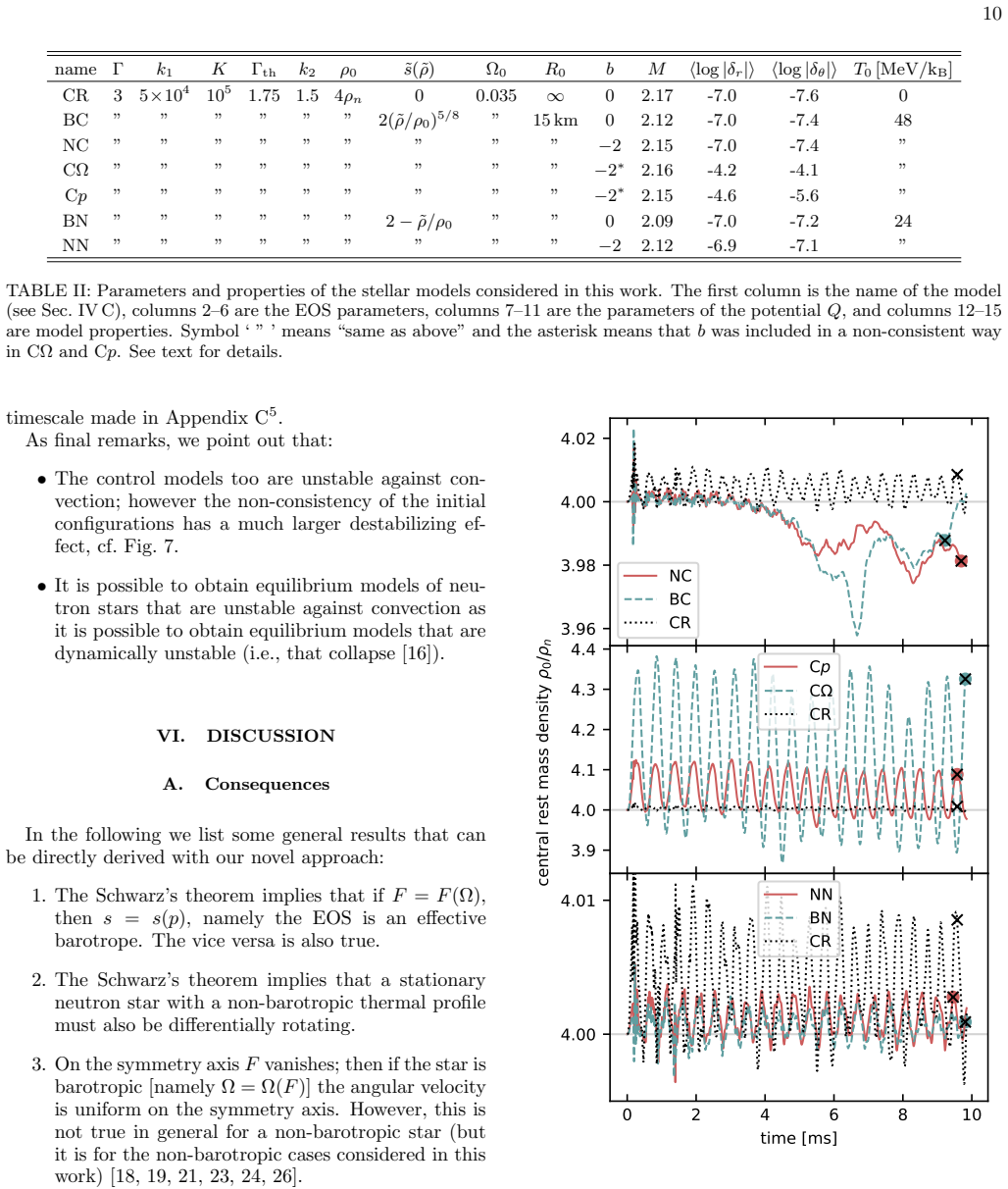
Significance. This is a genuinely useful contribution to relativistic stellar structure. The potential formulation Q(p,Omega) is elegant and, to my knowledge, new in the GR context, and the numerical implementation with careful controls provides strong evidence that the constructed configurations are stationary. The paper is unusually honest about limitations: Sec. III B states that the system (35)-(37) is overdetermined for a prescribed entropy profile and that s(r,theta) is derived after the fact, and Sec. VI B presents entropy fitting only as a proof of principle. The Euler-residual test and the BAM stationarity test are well designed: the consistent models give residuals around 1e-7 while the inconsistent C_Omega and C_p controls are two to three orders worse, and the non-convective NN model behaves like the cold rigid rotator in evolution. The paper is a solid proof of concept rather than a tool for arbitrary prescribed thermal profiles.
major comments (1)
- [Abstract and Sec. III B] The abstract claims that the potential formulation 'can be extended to the non-barotropic case' without stating the inverse nature of the construction. As the authors themselves note in Sec. III B, for a prescribed pointwise entropy the system (35)-(37) is three equations in two unknowns and in general has no solution; the entropy profile is an output of the chosen Q, not an input. For a generic tabulated EOS and a desired thermal profile, the Maxwell relation (34) will generally fail, so no Q exists. I recommend rewording the abstract and introduction to say that the method constructs the unique thermal profile consistent with a chosen potential Q, and to state explicitly that matching a prescribed s(r,theta) is not possible in general. The current wording overstates the scope of the extension.
minor comments (6)
- [Sec. II and Sec. IV A] The symbol h is used both for the specific enthalpy (e.g., Eq. (10)) and for the enthalpy density (e.g., Eq. (4) and Eq. (42)); this is confusing, and the footnote in Sec. II does not cover this distinction. Please use separate symbols or state clearly which quantity is meant in each equation.
- [Sec. III A] Below Eq. (32), the statement that 'given the pair p and Omega, we must be able to determine the pair r and theta' should be qualified as a local condition. The paper mentions the two-hemisphere degeneracy but does not discuss points where grad p and grad Omega are parallel or where Omega is constant on the symmetry axis; please state the assumption that the Jacobian of the map (r,theta) to (p,Omega) is nonzero except on a set of measure zero and explain how the construction behaves near such points.
- [Fig. 3] The caption contains what appears to be a typo: 'p, r,'. Please fix the caption.
- [Table II] The asterisk footnote says that b was included in a non-consistent way in C_Omega and C_p. This is explained in Sec. IV C, but a parenthetical reference to Eq. (40) versus Eq. (42) would make the construction of the control models clearer.
- [Sec. V B] In Eq. (47), the index i in delta_i denotes the direction of differentiation while the average is taken over points j. This is fine, but writing the two explicit averages <log|delta_r|> and <log|delta_theta|> in the text would avoid possible confusion.
- [General] There are several minor grammatical slips, for example 'the remaining density oscillations is likely' in Sec. IV B, and the phrase 'We have first defined' in Sec. III B. A careful proofread is recommended.
Circularity Check
No significant circularity: the potential Q is a reformulation of the Euler equation, but the model construction and the independent BAM evolution give the central claim real content.
full rationale
The paper's central derivation is self-contained. Eq. (29) defines Q = -ln(alpha/gamma), and Eq. (30) is explicitly the Euler equation (4); this is a change of variables, not a fitted prediction. The construction in Sec. III B chooses a Q ansatz, solves Eqs. (35)-(36) for p and Omega, and then obtains s from Eq. (37); the paper states plainly that for fixed s the system 'in general has no solution', so it makes no claim to predict an arbitrary prescribed thermal profile. The entropy profile is an output, and this scope limitation is acknowledged in Sec. VI B, which offers only a proof-of-principle fitting procedure restricted to planar configurations. Validation is not circular: Test 2 residuals measure consistency of the numerical solution with the equations it solves, and Control models C_Omega and C_p are deliberately inconsistent; the decisive check is the independent BAM evolution, an external dynamical code not used to construct the models. The self-citations to Camelio et al. (2018) for XNS provenance are validated against the external RNS code and are not load-bearing for the theoretical potential-formulation result, which is derived in the text. Section VI conclusions follow from the Q representation and are explicitly attributed to von Zeipel [56,57]. Thus no load-bearing step reduces to its own input.
Assumptions & free parameters
free parameters (6)
- b (barotropic coupling parameter) =
-2 for NC/NN models; 0 for barotropic and control models
- R0 (differential-rotation scale) =
15 km
- Omega0 (central angular velocity) =
0.035 (code units)
- k1 (cold polytrope constant) =
5e4 code units (K = 1e5)
- k2 (thermal EOS constant) =
1.5
- rho0 (central rest-mass density) =
4 rho_n for all models
assumptions (5)
- domain assumption The spacetime is stationary, axisymmetric, and circular, with negligible meridional currents and convection.
- domain assumption The matter is a perfect fluid with stress-energy tensor of Eq. (3).
- ad hoc to paper The one-form dp/h + F dOmega is exact, so there exists a potential Q(p,Omega) satisfying the Maxwell relation of Eq. (34).
- domain assumption The map (r,theta) to (p,Omega) is a local coordinate system away from the axis and equator; only the hemisphere degeneracy Q+ and Q- is considered.
- domain assumption The XCFC metric approximation is accurate enough for the configurations studied, with local-quantity errors estimated within about 2%.
Cite this review
Pith. "Pith review of Rotating neutron stars with non-barotropic thermal profile." pith.science (2026). https://pith.science/paper/5UUTDJCZ
@misc{pith2026190811258,
  author       = {Pith},
  title        = {Pith review of: Rotating neutron stars with non-barotropic thermal profile},
  year         = {2026},
  howpublished = {\url{https://pith.science/paper/5UUTDJCZ}},
  note         = {Machine review of arXiv:1908.11258}
}
read the original abstract
Neutron stars provide an excellent laboratory for physics under the most extreme conditions. Up to now, models of axisymmetric, stationary, differentially rotating neutron stars were constructed under the strong assumption of barotropicity, where a one-to-one relation between all thermodynamic quantities exists. This implies that the specific angular momentum of a matter element depends only on its angular velocity. The physical conditions in the early stages of neutron stars, however, are determined by their violent birth processes, typically a supernova or in some cases the merger of two neutron stars, and detailed numerical models show that the resulting stars are by no means barotropic. Here, we construct models for stationary, differentially rotating, non-barotropic neutron stars, where the equation of state and the specific angular momentum depend on more than one independent variable. We show that the potential formulation of the relativistic Euler equation can be extended to the non-barotropic case, which, to the best of our knowledge, is a new result even for the Newtonian case. We implement the new method into the XNS code and construct equilibrium configurations for non-barotropic equations of state. We scrutinize the resulting configurations by evolving them dynamically with the numerical relativity code BAM, thereby demonstrating that the new method indeed produces stationary, differentially rotating, non-barotropic neutron star configurations.
Figures


Figures from the paper (5 more)




Reference graph
Works this paper leans on
-
[1]
Otherwise, determine Ω from Eq
If the star is rigidly rotating, set Ω = Ω 0. Otherwise, determine Ω from Eq. (40)
-
[2]
barotropic
However, dynamical core-collapse supernova and bi- nary neutron star merger simulations show that realistic newly-born neutron stars are non-barotropic [e.g., 4, 5]. In this section we show how it is possible to overcome these limitations in a rigorous way. A. The generalization Eq. (4) can be written as dp h +F dΩ + d lnα γ = 0, (25) to stress that when ...
-
[3]
Find H(p) from Eq. (41)
-
[4]
Find p invertingH(p)
-
[5]
If p < ps (ps being a fixed value of the surface pressure), go to step 8
-
[6]
If the star is non-barotropic: (a) Find h from Eq. (42). (b) If the pair h ,p is not physical (e.g., h ≤ p), go to step 8
-
[7]
Solve the EOS from p (if barotropic) or p, h (if non barotropic)
All independent quantities have been computed. Solve the EOS from p (if barotropic) or p, h (if non barotropic). Determine vφ from Ω
-
[8]
Go to step 1 with the next ri
Show all 86 references
-
[9]
same as above
The point is outside the surface. Set to zero all matter quantities in r≥ ri and go to step 1 with ri =r1 and the next θj. We adopt a rectangular non-evenly spaced grid in r,θ [16]. Our radial grid is divided in two regions: the in- ner part has 2000 evenly spaced points from ...
2000
-
[10]
The vice versa is also true
The Schwarz’s theorem implies that if F = F (Ω), then s = s(p), namely the EOS is an effective barotrope. The vice versa is also true
-
[11]
The Schwarz’s theorem implies that a stationary neutron star with a non-barotropic thermal profile must also be differentially rotating
-
[12]
However, this is not true in general for a non-barotropic star (but it is for the non-barotropic cases considered in this work) [18, 19, 21, 23, 24, 26]
On the symmetry axisF vanishes; then if the star is barotropic [namely Ω = Ω(F )] the angular velocity is uniform on the symmetry axis. However, this is not true in general for a non-barotropic star (but it is for the non-barotropic cases considered in this work) [18, 19, 21, ...
-
[13]
III is that there are only two EOS quantities that can be directly determined from the Euler equation with- out solving the EOS, namely p and h
An interesting point that emerges from Sec. III is that there are only two EOS quantities that can be directly determined from the Euler equation with- out solving the EOS, namely p and h . This should not be a surprise because p and h are the only EOS quantities that appear i...
-
[14]
As already pointed out, the method we developed to obtain non-barotropic configurations does not depend on the XCFC approximation and can be easily adapted to the full stationary metric (even without the circularity assumption) or to Newto- nian gravity (see Appendix A). All th...
-
[15]
including viscosity [24]
It is known that the numerical solution of the Eu- ler equation for a Newtonian non-barotropic star shows a degeneracy in the profile of Ω that can be lift by e.g. including viscosity [24]. This degeneracy does not arise in our method because we fix the po- tential Q(p, Ω) and t...
2020
-
[16]
J. M. Lattimer, Ann. Rev. Nucl. Part. Sci.62, 485 (2012), 1305.3510
2012 arXiv
-
[17]
J. M. Lattimer and M. Prakash, Phys. Rept. 621, 127 (2016), 1512.07820
2016 arXiv
-
[18]
B. P. Abbott et al. (LIGO Scientific, Virgo), Phys. Rev. Lett. 121, 161101 (2018), 1805.11581
2018 arXiv
-
[19]
Perego, S
A. Perego, S. Bernuzzi, and D. Radice, Eur. Phys. J. A55, 124 (2019), 1903.07898
2019 arXiv
-
[20]
Fischer, I
T. Fischer, I. Sagert, G. Pagliara, M. Hempel, J. Schaffner-Bielich, T. Rauscher, F. K. Thielemann, R. K¨ appeli, G. Mart´ ınez-Pinedo, and M. Liebend¨ orfer, The Astrophysical Journal Supplement Series 194, 39 (2011), 1011.3409
2011 arXiv
-
[21]
Punturo et al., Class
M. Punturo et al., Class. Quant. Grav.27, 194002 (2010)
2010
-
[22]
B. S. Sathyaprakash et al. (2019), 1903.09221
2019
-
[23]
B. P. Abbott, R. Abbott, T. D. Abbott, F. Acernese, K. Ackley, C. Adams, T. Adams, P. Addesso, R. X. Ad- hikari, V. B. Adya, et al., Physical Review Letters 119, 161101 (2017), 1710.05832
2017 arXiv
-
[24]
B. P. Abbott, R. Abbott, T. D. Abbott, F. Acernese, K. Ackley, C. Adams, T. Adams, P. Addesso, R. X. Ad- hikari, V. B. Adya, et al., Astrophys. J. Lett. 848, L12 (2017), 1710.05833
2017 arXiv
-
[25]
D. A. Coulter, R. J. Foley, C. D. Kilpatrick, M. R. Drout, A. L. Piro, B. J. Shappee, M. R. Siebert, J. D. Simon, N. Ulloa, D. Kasen, et al., Science 358, 1556 (2017), 1710.05452
2017 arXiv
-
[26]
Burrows, Astrophys
A. Burrows, Astrophys. J. 334, 891 (1988)
1988
-
[27]
Bonazzola, E
S. Bonazzola, E. Gourgoulhon, M. Salgado, and J. A. Marck, Astron. Astrophys. 278, 421 (1993)
1993
-
[28]
J. O. Goussard, P. Haensel, and J. L. Zdunik, Astron. Astrophys. 321, 822 (1997), astro-ph/9610265
1997 arXiv
-
[29]
Bucciantini and L
N. Bucciantini and L. Del Zanna, Astron. Astrophys. 528, A101 (2011), 1010.3532
2011 arXiv
-
[30]
A. G. Pili, N. Bucciantini, and L. Del Zanna, Mon. Not. R. Astron. Soc. 439, 3541 (2014), 1401.4308
2014 arXiv
-
[31]
Camelio, T
G. Camelio, T. Dietrich, and S. Rosswog, Mon. Not. R. Astron. Soc. 480, 5272 (2018), 1806.07775
2018 arXiv
-
[32]
I. W. Roxburgh and P. A. Strittmatter, Mon. Not. R. Astron. Soc. 133, 345 (1966)
1966
-
[33]
M. J. Clement, Astrophys. J. 156, 1051 (1969)
1969
-
[34]
J. J. Monaghan, Mon. Not. R. Astron. Soc. 154, 47 (1971)
1971
-
[35]
C. M. Sharp, R. C. Smith, and D. L. Moss, Mon. Not. R. Astron. Soc. 179, 699 (1977)
1977
-
[36]
Uryu and Y
K. Uryu and Y. Eriguchi, Mon. Not. R. Astron. Soc. 269, 24 (1994)
1994
-
[37]
I. W. Roxburgh, Astron. Astrophys. 454, 883 (2006)
2006
-
[38]
Espinosa Lara and M
F. Espinosa Lara and M. Rieutord, Astron. Astrophys. 470, 1013 (2007)
2007
-
[39]
Espinosa Lara and M
F. Espinosa Lara and M. Rieutord, Astron. Astrophys. 552, A35 (2013), 1212.0778
2013 arXiv
-
[40]
Yasutake, K
N. Yasutake, K. Fujisawa, and S. Yamada, Mon. Not. R. Astron. Soc. 446, L56 (2015), 1402.4567
2015 arXiv
- [41]
-
[42]
Amendt, A
P. Amendt, A. Lanza, and M. A. Abramowicz, The As- trophysical Journal 343, 437 (1989)
1989
-
[43]
D. N. Razdoburdin, Astronomische Nachrichten 338, 799 (2017), 1708.08716
2017 arXiv
-
[44]
J. M. Bardeen, The Astrophysical Journal 162, 71 (1970)
1970
-
[45]
Stergioulas, Living Reviews in Relativity 6, 3 (2003), ISSN 1433-8351, URL https://doi.org/10
N. Stergioulas, Living Reviews in Relativity 6, 3 (2003), ISSN 1433-8351, URL https://doi.org/10. 12942/lrr-2003-3
2003
-
[46]
Komatsu, Y
H. Komatsu, Y. Eriguchi, and I. Hachisu, Mon. Not. R. Astron. Soc. 237, 355 (1989)
1989
-
[47]
Ury¯ u, A
K. Ury¯ u, A. Tsokaros, L. Baiotti, F. Galeazzi, K. Taniguchi, and S. Yoshida, Phys. Rev. D 96, 103011 (2017), 1709.02643
2017 arXiv
-
[48]
Witzany and P
V. Witzany and P. Jefremov, 614, A75 (2019), ISSN 0004-6361, 1432-0746, URL https://www.aanda.org/ articles/aa/abs/2018/06/aa32361-17/aa32361-17. html
2019
-
[49]
Villain, J
L. Villain, J. A. Pons, P. Cerd´ a-Dur´ an, and E. Gour- goulhon, Astron. Astrophys. 418, 283 (2004), astro- ph/0310875
2004
-
[50]
Cordero-Carri´ on, P
I. Cordero-Carri´ on, P. Cerd´ a-Dur´ an, H. Dimmelmeier, J. L. Jaramillo, J. Novak, and E. Gourgoulhon, Phys. Rev. D 79, 024017 (2009), 0809.2325
2009 arXiv
-
[51]
Gourgoulhon, arXiv e-prints arXiv:1003.5015 (2010), 1003.5015
E. Gourgoulhon, arXiv e-prints arXiv:1003.5015 (2010), 1003.5015
2010 arXiv
-
[52]
Iosif and N
P. Iosif and N. Stergioulas, General Relativity and Grav- itation 46, 1800 (2014), 1406.7375
2014 arXiv
-
[53]
Stergioulas and J
N. Stergioulas and J. L. Friedman, Astrophys. J. 444, 306 (1995), astro-ph/9411032
1995 arXiv
-
[54]
Br¨ ugmann, W
B. Br¨ ugmann, W. Tichy, and N. Jansen, Phys. Rev. Lett. 92, 211101 (2004), gr-qc/0312112
2004 arXiv
-
[55]
Br¨ ugmann, J
B. Br¨ ugmann, J. A. Gonzalez, M. Hannam, S. Husa, U. Sperhake, et al., Phys.Rev. D77, 024027 (2008), gr- qc/0610128
2008
-
[56]
Thierfelder, S
M. Thierfelder, S. Bernuzzi, and B. Br¨ ugmann, Phys.Rev. D84, 044012 (2011), 1104.4751
2011 arXiv
-
[57]
Dietrich, S
T. Dietrich, S. Bernuzzi, M. Ujevic, and B. Br¨ ugmann, Phys. Rev. D91, 124041 (2015), 1504.01266
2015 arXiv
- [58]
-
[59]
Dietrich, S
T. Dietrich, S. Ossokine, and K. Clough, Class. Quant. Grav. 36, 025002 (2019), 1807.06959
2019 arXiv
- [60]
-
[61]
Weyhausen, S
A. Weyhausen, S. Bernuzzi, and D. Hilditch, Phys. Rev. D85, 024038 (2012), 1107.5539
2012 arXiv
-
[62]
Hilditch, S
D. Hilditch, S. Bernuzzi, M. Thierfelder, Z. Cao, 18 W. Tichy, et al., Phys. Rev. D88, 084057 (2013), 1212.2901
2013 arXiv
-
[63]
Borges, M
R. Borges, M. Carmona, B. Costa, and W. S. Don, Journal of Computational Physics 227, 3191 (2008), ISSN 0021-9991, URL http://www.sciencedirect.com/ science/article/pii/S0021999107005232
2008
-
[64]
Bernuzzi, M
S. Bernuzzi, M. Thierfelder, and B. Bruegmann, Phys. Rev. D85, 104030 (2012), 1109.3611
2012 arXiv
-
[65]
Dietrich, S
T. Dietrich, S. Bernuzzi, B. Bruegmann, and W. Tichy, in Proceedings, 26th Euromicro International Conference on Parallel, Distributed and Network-based Processing (PDP 2018): Cambridge, UK, March 21-23, 2018 (2018), pp. 682–689, 1803.07965
2018 arXiv
-
[66]
Dietrich, D
T. Dietrich, D. Radice, S. Bernuzzi, F. Zappa, A. Perego, B. Brgmann, S. V. Chaurasia, R. Dudi, W. Tichy, and M. Ujevic, Class. Quant. Grav. 35, 24LT01 (2018), 1806.01625
2018 arXiv
-
[67]
Dietrich, A
T. Dietrich, A. Samajdar, S. Khan, N. K. Johnson- McDaniel, R. Dudi, and W. Tichy (2019), 1905.06011
2019 arXiv
-
[68]
Kiuchi, K
K. Kiuchi, K. Kawaguchi, K. Kyutoku, Y. Sekiguchi, M. Shibata, and K. Taniguchi, Phys. Rev. D96, 084060 (2017), 1708.08926
2017 arXiv
-
[69]
Guercilena, D
F. Guercilena, D. Radice, and L. Rezzolla, Comput. As- trophys. Cosmol. 4, 3 (2017), 1612.06251
2017 arXiv
-
[70]
Birkl, N
R. Birkl, N. Stergioulas, and E. M¨ uller, Phys. Rev. D 84, 023003 (2011), 1011.5475
2011 arXiv
-
[71]
H. v. Zeipel, Monthly Notices of the Royal Astronomical Society 84, 665 (1924), ISSN 0035-8711, http://oup.prod.sis.lan/mnras/article- pdf/84/9/665/2793230/mnras84-0665.pdf, URL https://doi.org/10.1093/mnras/84.9.665
1924 doi
-
[72]
M. A. Abramowicz, Acta Astron. 21, 81 (1971)
1971
-
[73]
Burrows and J
A. Burrows and J. M. Lattimer, Astrophys. J. 307, 178 (1986)
1986
-
[74]
Keil and H
W. Keil and H. T. Janka, Astron. Astrophys. 296, 145 (1995)
1995
-
[75]
J. A. Pons, S. Reddy, M. Prakash, J. M. Lattimer, and J. A. Miralles, Astrophys. J. 513, 780 (1999), astro- ph/9807040
1999
-
[76]
L. F. Roberts, The Astrophysical Journal 755, 126 (2012), URL https://doi.org/10.1088%2F0004-637x% 2F755%2F2%2F126
2012
-
[77]
Camelio, L
G. Camelio, L. Gualtieri, J. A. Pons, and V. Ferrari, Phys. Rev. D 94, 024008 (2016), 1601.02945
2016 arXiv
-
[78]
Ferrari, G
V. Ferrari, G. Miniutti, and J. A. Pons, Monthly No- tices of the Royal Astronomical Society 342, 629 (2003), ISSN 0035-8711, http://oup.prod.sis.lan/mnras/article- pdf/342/2/629/3433686/342-2-629.pdf, URL https:// doi.org/10.1046/j.1365-8711.2003.06580.x
2003
-
[79]
Camelio, A
G. Camelio, A. Lovato, L. Gualtieri, O. Benhar, J. A. Pons, and V. Ferrari, Phys. Rev. D 96, 043015 (2017), 1704.01923
2017 arXiv
-
[80]
Chatterjee, T
D. Chatterjee, T. Elghozi, J. Novak, and M. Oertel, Monthly Notices of the Royal As- tronomical Society 447, 3785 (2015), ISSN 0035-8711, http://oup.prod.sis.lan/mnras/article- pdf/447/4/3785/5792844/stu2706.pdf, URL https://doi.org/10.1093/mnras/stu2706
2015 doi
-
[81]
Rosswog and M
S. Rosswog and M. B. Davies, Monthly Notices of the Royal Astronomical Society 334, 481 (2002), astro- ph/0110180
2002
-
[82]
Bauswein, H.-T
A. Bauswein, H.-T. Janka, and R. Oechslin, Phys. Rev. D 82, 084043 (2010), URL https://link.aps.org/doi/ 10.1103/PhysRevD.82.084043
2010 doi
-
[83]
Yasin, S
H. Yasin, S. Sch¨ afer, A. Arcones, and A. Schwenk, arXiv e-prints arXiv:1812.02002 (2018), 1812.02002
2018 arXiv
-
[84]
K. S. Thorne, Astrophys. J. 144, 201 (1966)
1966
-
[85]
De Pietri, A
R. De Pietri, A. Feo, J. A. Font, F. L¨ offler, F. Maione, M. Pasquali, and N. Stergioulas, Phys. Rev. Lett. 120, 221101 (2018), URL https://link.aps.org/doi/10. 1103/PhysRevLett.120.221101
2018
-
[86]
De Pietri, A
R. De Pietri, A. Feo, J. A. Font, F. L¨ offler, M. Pasquali, and N. Stergioulas, arXiv e-prints arXiv:1910.04036 (2019), 1910.04036
2019 arXiv
Reviewed August 14, 2026 · model on record in the stance chip above.
Discussion (0). Continue with ORCID to comment.