REVIEW 2 major objections 5 minor 27 references
Three-loop soft anomalous dimensions for top-quark production
T0 review · 2 major / 5 minor · reviewed 2026-08-14 · deepseek-v4-flash
Pith's one-line read The paper derives explicit three-loop soft anomalous dimensions for t-channel, s-channel, and tW single-top production, giving the key ingredients for N$^3$LL resummation and N$^3$LO soft-gluon corrections in these processes.
desk verdict Useful conference summary of already-published three-loop soft anomalous dimensions, but the abstract overclaims the top-pair results. read the letter →
The pith
A machine-rendered reading of the paper's core claim, the machinery that carries it, and where it could break.
The reading
What carries the argument
The central object is the soft anomalous dimension matrix $\Gamma_S$, a color-space matrix whose renormalization-group equation controls the exponentiation of soft-gluon logarithms in moment space. For the single-top channels only one element of this matrix is needed, and the three-loop result is built from the one-loop matrix element multiplied by the three-loop cusp coefficient $K'^{(3)}$, plus a universal constant term involving $K^{(2)}$, $C_A$, $C_F$, and zeta values. The massive cusp anomalous dimension $\Gamma_{\rm cusp}$ enters the diagonal elements of the top-pair matrices, and the paper uses its three-loop form from earlier work. The structural assumption that three-loop matrices match two-loop matrices with updated coefficients is what would carry the argument for top-antitop pair production.
What would settle it
An independent calculation of the off-diagonal three-loop elements of the s-channel soft anomalous dimension matrix, or of the four-parton correlations in quark-antiquark top-pair production, would settle the structural assumption; if the off-diagonal elements deviate from the two-loop replacement pattern, the pair-production conjecture is falsified.
Extended reading notes
Core claim
The central claim is an explicit three-loop formula for the soft anomalous dimension, stated as Eq. (3.3) for the t-channel, Eq. (3.6) for the s-channel, and Eq. (3.10) for tW production: $$\Gamma_{S11}^{(3)} = K'^{(3)} \Gamma_{S11}^{(1)} + \frac{1}{2} $K^{{(2)}}$ C_A (1-\zeta_3) + C_F $C_A^{2}$ \left[-\frac14 + \frac38 \zeta_2 - \frac18 \zeta_3 - \frac38 \zeta_2 \zeta_3 + \frac{9}{16} \zeta_5\right],$$ where the $K^{(n)}$ are the cusp coefficients of the massless limit and $\zeta_n$ are Riemann zeta values. The same combination appears for all three channels because their leading color structure is the same. The paper states explicitly that only the (1,1) element enters the N$^3$LO corrections for single-top production, so the other matrix elements need not be fully determined for those applications. For top-antitop pair production, the paper says complete three-loop results are not yet available, and it assumes the three-loop matrices have the same structure as the two-loop ones, with three-loop coefficients replacing two-loop ones, up to four-parton correlations.
Load-bearing premise
The load-bearing premise is that the previously derived three-loop formula in ref. [7] is correct for the single-top channels, and that for top-antitop pair production the three-loop soft anomalous dimension matrices mirror the two-loop structure with three-loop coefficients, up to four-parton correlations.
Editorial extensions
If this is right
- The explicit formula can be inserted into the resummation exponent to produce N$^3$LL resummed cross sections for t-channel, s-channel, and tW single-top production.
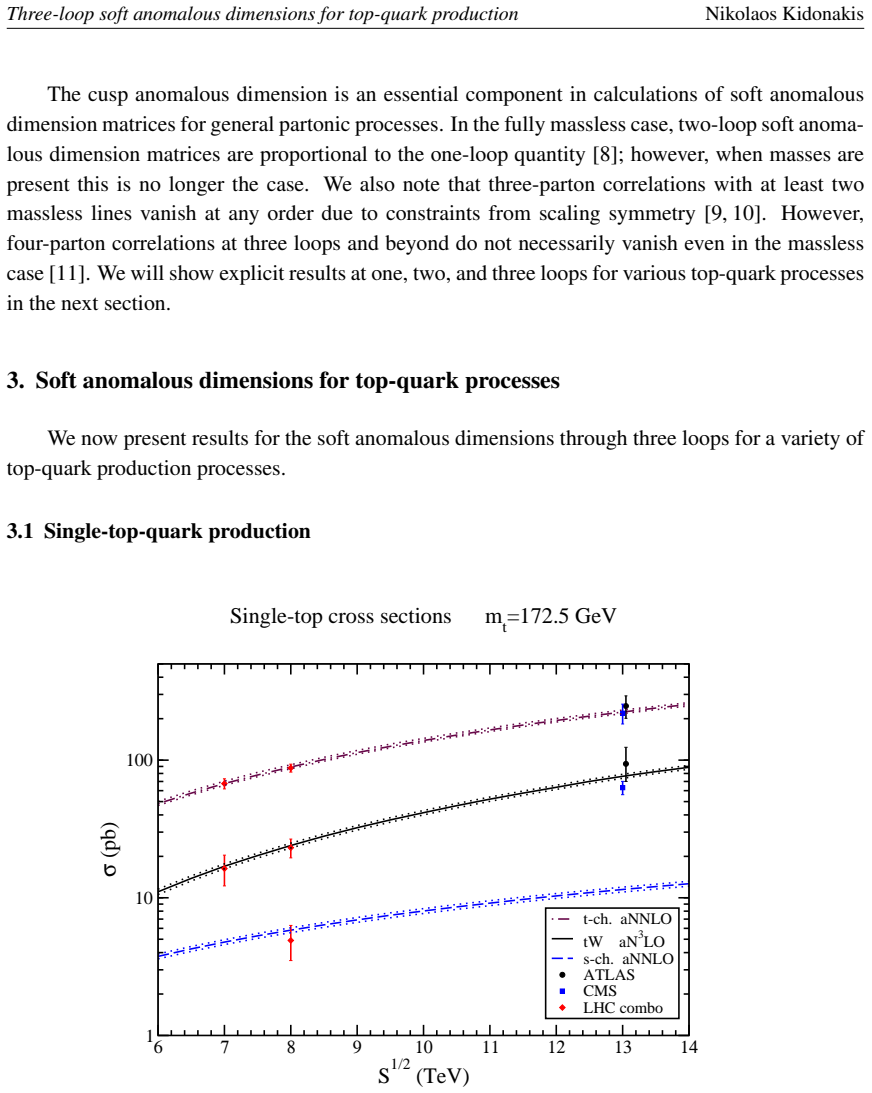
- Inverting the resummed moments gives approximate N$^3$LO soft-gluon corrections, updating the aNNLO and aN$^3$LO predictions shown for the LHC.
- Because the soft anomalous dimension for tZ, tZ$'$, t$\gamma$, and tH$^-$ production is identical to the one for tW, the same three-loop formula covers all those new-physics channels.
- If the structural analogy holds, the diagonal elements of the quark-antiquark and gluon-gluon top-pair matrices at three loops receive contributions from the three-loop massive cusp anomalous dimension, with off-diagonal elements following the two-loop replacement pattern up to four-parton correlations.
Reading between the lines
- If the pattern in Eq. (3.3) is universal, an independent three-loop calculation in a different color basis should reproduce the same constant term, which would point to a deeper cusp-like origin for the single-top soft anomalous dimension.
- The assumed two-loop-to-three-loop dictionary for top-pair production can be tested against a future complete N$^3$LO calculation; any residual difference would isolate the four-parton correlation contribution.
- The same color-flow and mass pattern suggests the formula should also cover associated production of a top quark with other colorless final states, such as a Standard-Model Higgs boson, extending the reach beyond the channels listed in the paper.
Editorial analysis
A structured set of objections, weighed in public.
Referee Report
Summary. This conference proceedings paper presents soft anomalous dimensions for top-quark production processes, with emphasis on three-loop results needed for N3LL resummation and N3LO soft-gluon corrections. The paper gives the two- and three-loop massive and massive-massless cusp anomalous dimensions, then presents one-, two-, and three-loop soft anomalous dimension matrices for single-top t-channel and s-channel production, for tW production, and for related new-physics processes (tZ, tZ', tgamma, tH-), and finally discusses top-antitop pair production in both q qbar and gg channels. The single-top and tW three-loop results are quoted from earlier work, while the top-pair section explicitly states that complete three-loop results are not available and instead conjectures a formal analogy with the two-loop results.
Significance. If the quoted formulas are correct, they are useful ingredients for extending soft-gluon resummation and approximate N3LO predictions to several top-quark production channels, and the paper helps consolidate results from a series of prior publications. The concrete analytic expressions for the massive-massless cusp and for single-top/tW soft anomalous dimensions are valuable reference material. The strengths are the explicit formulas, the connection to resummation applications, and the clear identification of which results are complete. However, the paper does not derive any of the three-loop results here; it relies entirely on cited references, and for top-pair production it provides only a conjectured two-loop analogy. The central claim in the abstract that the paper presents three-loop results for top-pair production is therefore stronger than what the body establishes.
major comments (2)
- [Abstract and Section 3.3] The abstract states that the paper presents results through three loops for top-quark production, including top-pair production, but Section 3.3 explicitly says for both q qbar -> t tbar and gg -> t tbar that 'we do not yet have complete three-loop results.' The only three-loop content for these channels is the conjecture that all superscript-(2) terms in Eqs. (3.12) and (3.15) be replaced by superscript-(3) terms 'up to four-parton correlations.' No three-loop analogue of the function N_S^(2) in Eq. (3.13) is provided, and no argument is given that the only new contributions at three loops are cusp iterations and four-parton correlations. Because the abstract's central claim includes top-pair production, this is a load-bearing gap. The paper should either present actual three-loop results for these matrices or explicitly and consistently state that only two-loop results, plus a conjectured structural ansatz, are available for top-pair production.
- [Section 2, Eq. (2.5)] The three-loop massive cusp anomalous dimension is represented by the numerical approximation Gamma_cusp^(3,approx)(beta) = 0.09221 beta^2 + 2.80322 Gamma_cusp^(1)(beta), described only as 'a simple numerical expression.' This is a two-parameter fit, and the paper does not state its accuracy, the range of beta over which it is valid, or how it compares with the exact expression from Ref. [6]. Since this approximation is later invoked for the diagonal entries of the top-pair soft anomalous dimension matrices in Section 3.3, the numerical reliability of the three-loop claims depends on these unspecified coefficients. The paper should quantify the error or present the exact expression, and should make clear whenever a numerical fit, rather than the exact result, is being used.
minor comments (5)
- [Section 3.1.1 and 3.1.2] The phrases 'up to four-parton correlations' are used repeatedly, but the paper never specifies which color and kinematic configurations of four-parton correlations are expected to enter, nor whether they are expected to vanish in the chosen color bases. A precise statement or a reference to the relevant calculation would make the conjecture more useful and testable.
- [Section 3.1.1] The sentence 'At three loops, we only need the first element of the matrix for N^3LL resummation, and to calculate the N^3LO soft-gluon corrections' is asserted without showing why the other elements do not contribute. A one-sentence explanation in terms of the leading-order hard-scattering structure would help the reader assess the claim.
- [Section 2, Eqs. (2.3)-(2.8)] The notation K^(n) versus K'^(n) is potentially confusing: Eq. (2.3) defines K'^(2)=K^(2)/C_F, but Eqs. (2.7) and (2.8) use K^(2) without a prime in expressions that also contain explicit color factors. The paper would benefit from a consistent convention, for example by defining all K coefficients once and using that notation throughout.
- [Section 3.2] The statement that the soft anomalous dimensions for tZ, tZ', tgamma, and tH- production are 'identical' to the tW result is presented without derivation or discussion of possible color-structure differences. Since the processes differ in initial and final states, a brief explanation of why the color and kinematic structure is the same would be helpful.
- [Figure 2] The figure caption does not indicate whether error bands include PDF and scale uncertainties; specifying the source of the bands and the treatment of theoretical uncertainties would improve reproducibility of the comparison with data.
Circularity Check
No circular derivation: the three-loop formulas are quoted from published prior work, and the only admitted gap is a conjectural three-loop analogy for top-pair production, which is an overclaim rather than a circular reduction.
full rationale
Walking the claimed derivation chain, the single-top three-loop results in Eqs. (3.3), (3.6), and (3.10) are structurally identical to the massive-massless cusp result in Eq. (2.8), with the one-loop soft anomalous dimension substituted for the kinematic logarithm. That substitution is fixed by the color-dipole structure at one loop, not by any fitted parameter. Eq. (2.8) is not an input of this paper; it is cited to refs. [6] and [7], with [7] being a peer-reviewed PRD article containing its own calculation, so the self-citation points to independent, externally checkable content. No observable is fitted and then renamed a prediction: the only numerical coefficients appear in Eq. (2.5), which the text explicitly labels 'approx' and which is an approximation to the known three-loop cusp expression, not to a target cross section. The paper does contain an explicit limitation in Sec. 3.3: it states 'we do not yet have complete three-loop results' for q qbar -> t tbar and gg -> t tbar, and then conjectures the three-loop structure by replacing superscript-(2) terms with superscript-(3) terms 'up to four-parton correlations'. This is an unproved analogy, and it makes the abstract's 'results through three loops' claim for top-pair production stronger than what Sec. 3.3 actually establishes. That is a correctness/overclaim concern, not circularity: the conjectured replacement rule is not forced by a definitional equivalence, by a fitted input, or by a self-referential uniqueness theorem. The central formulas therefore do not reduce by construction to their inputs, and the frequent self-citations do not form a circular loop because they refer to independently published derivations. Score 0.
Assumptions & free parameters
free parameters (2)
- cusp approximation coefficient a =
0.09221
- cusp approximation coefficient b =
2.80322
assumptions (4)
- domain assumption The soft function S satisfies the renormalization group equation Eq. (1.1) with soft anomalous dimension Gamma_S.
- domain assumption Three-parton correlations with at least two massless lines vanish at any order; four-parton correlations can contribute at three loops.
- ad hoc to paper The numerical approximation Eq. (2.5) is used as a stand-in for the exact three-loop massive cusp anomalous dimension.
- ad hoc to paper For top-pair production, the three-loop soft anomalous dimension structure is analogous to the two-loop structure, with superscripts (2) replaced by (3), up to four-parton correlations.
Cite this review
Pith. "Pith review of Three-loop soft anomalous dimensions for top-quark production." pith.science (2026). https://pith.science/paper/WQI2RTBM
@misc{pith2026190811333,
  author       = {Pith},
  title        = {Pith review of: Three-loop soft anomalous dimensions for top-quark production},
  year         = {2026},
  howpublished = {\url{https://pith.science/paper/WQI2RTBM}},
  note         = {Machine review of arXiv:1908.11333}
}
abstract
I present results through three loops for soft anomalous dimensions that control soft-gluon emission in processes involving the top quark. In particular I present results for channels in single-top production and top-pair production as well as for processes with new physics, including $tZ$, $tZ'$, $t \gamma$, and $tH^-$ production. These calculations are ingredients to resummations at N$^3$LL accuracy and to derivations of N$^3$LO soft-gluon corrections.
Figures

Reference graph
Works this paper leans on
- [7]
-
[6]
Three-loop cusp anomalous dimension and a conjecture for $n$ loops
N. Kidonakis, Int. J. Mod. Phys. A 31, 1650076 (2016) [arXiv:1601.01666 [hep-ph]]
work page Pith review arXiv 2016
-
[1]
N. Kidonakis, Int. J. Mod. Phys. A 33, 1830021 (2018) [arXiv:1806.03336 [hep-ph]]
arXiv 2018
-
[2]
N. Kidonakis and G. Sterman, Nucl. Phys. B 505, 321 (1997) [hep-ph/9705234]
arXiv 1997
-
[3]
G.P. Korchemsky and A.V . Radyushkin, Phys. Lett. B171, 459 (1986); Nucl. Phys. B 283, 342 (1987)
work page 1986
-
[4]
N. Kidonakis, Phys. Rev. Lett. 102, 232003 (2009) [arXiv:0903.2561 [hep-ph]]
arXiv 2009
-
[5]
A. Grozin, J.M. Henn, G.P. Korchemsky, and P. Marquard, Phys. Rev. Lett. 114, 062006 (2015) [arXiv:1409.0023 [hep-ph]]
arXiv 2015
-
[8]
S.M. Aybat, L.J. Dixon, and G. Sterman, Phys. Rev. D 74, 074004 (2006) [hep-ph/0607309]
arXiv 2006
Show all 27 references
-
[9]
Becher and M
T. Becher and M. Neubert, Phys. Rev. Lett. 102, 162001 (2009) [arXiv:0901.0722 [hep-ph]]
2009 arXiv
- [10]
-
[11]
Almelid, C
O. Almelid, C. Duhr, and E. Gardi, Phys. Rev. Lett. 117, 172002 (2016) [arXiv:1507.00047 [hep-ph]]
2016 arXiv
- [12]
-
[13]
Kidonakis, Phys
N. Kidonakis, Phys. Rev. D 81, 054028 (2010) [arXiv:1001.5034 [hep-ph]]; 82, 054018 (2010) [arXiv:1005.4451 [hep-ph]]; 83, 091503 (2011) [arXiv:1103.2792 [hep-ph]]
2010 arXiv
- [14]
-
[15]
Harland-Lang, A.D
L.A. Harland-Lang, A.D. Martin, P. Molytinski, and R.S. Thorne, Eur. Phys. J. C 75, 204 (2015) [arXiv:1412.3989 [hep-ph]]
2015 arXiv
-
[16]
ATLAS Collaboration, JHEP 1704 (2017) 086 [arXiv:1609.03920 [hep-ex]]
2017 arXiv
-
[17]
CMS Collaboration, arXiv:1812.10514 [hep-ex]
-
[18]
ATLAS and CMS Collaborations, JHEP 1905 (2019) 088 [arXiv:1902.07158 [hep-ex]]
2019 arXiv
-
[19]
ATLAS Collaboration, JHEP 1801 (2018) 063 [arXiv:1612.07231 [hep-ex]]
2018 arXiv
-
[20]
CMS Collaboration, JHEP 1810 (2018) 117 [arXiv:1805.07399 [hep-ex]]
2018 arXiv
- [21]
- [22]
-
[23]
Forslund and N
M. Forslund and N. Kidonakis, Phys. Rev. D 98, 074017 (2018) [arXiv:1808.09014 [hep-ph]]
2018 arXiv
- [24]
- [25]
-
[26]
Kidonakis, Phys
N. Kidonakis, Phys. Rev. D 90, 014006 (2014) [arXiv:1405.7046 [hep-ph]]; 91, 031501 (2015) [arXiv:1411.2633 [hep-ph]]; 91, 071502 (2015) [arXiv:1501.01581 [hep-ph]]
2014 arXiv
-
[27]
Ferroglia, M
A. Ferroglia, M. Neubert, B.D. Pecjak, and L.L. Yang, Phys. Rev. Lett. 103, 201601 (2009) [arXiv:0907.4791 [hep-ph]]; JHEP 0911 (2009) 062 [arXiv:0908.3676 [hep-ph]]. 7
2009 arXiv
Reviewed August 14, 2026 · model on record in the stance chip above.
Discussion (0). Continue with ORCID to comment.