REVIEW 3 major objections 4 minor 37 references
Odd-frequency Berezinskii superconductivity in Dirac semimetals
T0 review · 3 major / 4 minor · reviewed 2026-08-14 · deepseek-v4-flash
Pith's one-line read Repulsive interactions can drive odd-frequency superconductivity in Dirac semimetals.
desk verdict A useful inverse-gap framework for odd-frequency pairing in Dirac semimetals, undermined by an unchecked Taylor approximation; referee it, but don't take the existence claim as established. read the letter →
The pith
A machine-rendered reading of the paper's core claim, the machinery that carries it, and where it could break.
The reading
What carries the argument
The load-bearing object is the frequency-resolved mean-field gap equation, converted from an integral equation into a differential equation with boundary conditions. For the odd-frequency gap $\Delta_{\rm odd}(\omega)$, the equation takes the form $\omega V''(\omega)-V'(\omega) = [\omega \Delta'_{\rm odd}(\omega)-\Delta_{\rm odd}(\omega)]/(-2\int_0^\omega d\omega' \omega' f_{\rm odd}(\omega'))$, so only the derivative $V'(\omega)$ of the pairing potential enters; together with the boundary condition $V(\omega)\to 0$ at large $\omega$, this determines the potential from a chosen gap ansatz. For the ansatz $\Delta_{\rm odd}=\alpha\Lambda_k/\omega$, the recovered potential is repulsive and roughly $1/\omega^2$, which is the concrete mechanism claimed to favor Berezinskii pairing. The chirality label $\chi$ plays the role that orbital parity plays in multiorbital systems, making the odd-frequency spin-singlet s-wave gap symmetry-allowed.
What would settle it
A first-principles calculation of the effective frequency-dependent electron-electron interaction in a candidate Dirac semimetal would settle the mechanism: if the resulting $V(\omega)$ is not repulsive with the derivative profile required by the differential gap equation, then odd-frequency pairing cannot naturally appear by this route.
Extended reading notes
Core claim
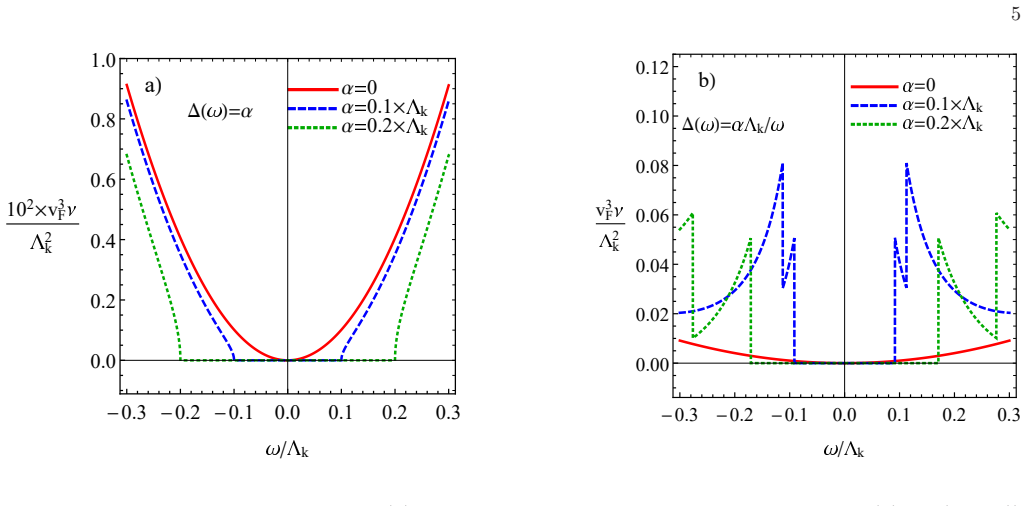
In a Dirac semimetal at zero chemical potential, with a single Dirac node and spin-singlet s-wave pairing, the paper solves the mean-field gap equation for two gap symmetries: the conventional even-frequency gap $\Delta_{\rm even}(\omega)=\alpha$ and the odd-frequency Berezinskii gap $\Delta_{\rm odd}(\omega)=\alpha\Lambda_k/\omega$. For the odd-frequency case the integral gap equation can be rewritten so that only $V'(\omega)$, the frequency derivative of the pairing potential, appears; solving the inverse problem for the potential yields a repulsive potential, $V(\omega)>0$, falling approximately as $1/\omega^2$ at large frequency. The paper concludes that odd-frequency pairing is not only possible but natural in Dirac semimetals because the chirality degree of freedom makes the inter-chirality, spin-singlet s-wave channel odd under time exchange, satisfying a generalized $SP^*\chi T^*=-1$ rule. Both gaps need coupling above a critical value because the density of states vanishes at the Dirac point, and the calculated density of states for the odd-frequency gap shows double-cusp features at low frequency, a signature absent for the even-frequency gap.
Load-bearing premise
The central result depends on real Dirac semimetals actually having a repulsive interaction that changes strongly with frequency in the required way; the paper derives what that interaction must look like but does not prove one exists.
Editorial extensions
If this is right
- In compensated Dirac and Weyl semimetals at charge neutrality, both even- and odd-frequency gaps require coupling strengths above a critical value, so the usual BCS no-threshold intuition does not apply.
- A repulsive frequency-dependent interaction can be a source of superconductivity, giving experimental search a new target: materials with strong repulsive frequency-dependent scattering, not just attractive BCS channels.
- The density of states of a Dirac semimetal with an odd-frequency gap exhibits cusp-like features at low frequencies and generically no coherence peaks even away from charge neutrality, providing a spectroscopic fingerprint.
- The same qualitative behavior holds in two-dimensional Dirac semimetals, so graphene-like systems are also candidate platforms.
- Chirality provides a symmetry-allowed odd-frequency channel in spin-singlet s-wave pairing, extending Berezinskii pairing beyond systems that require orbital multiplicity.
Reading between the lines
- If confirmed, the mechanism predicts that tuning the frequency dependence of the interaction, for example by coupling to a soft bosonic mode that changes the sign of $V'(\omega)$, could switch between BCS and Berezinskii states, since the two channels couple to different functionals of $V$.
- The cusp-like DOS signature could be tested in existing Dirac semimetal candidates with scanning tunneling spectroscopy; absence of the low-frequency double-cusp at charge neutrality would count against the specific odd-frequency ansatz.
- The paper's inverse-problem method, recovering the potential from an assumed gap, could be applied to other odd-frequency proposals to check whether their assumed gaps imply physically reasonable repulsive potentials.
- Because the required potential is repulsive, competing charge or insulating instabilities may preempt the superconducting state; the paper notes this possibility but does not analyze it.
Signed reviews
Editorial analysis
A structured set of objections, weighed in public.
Referee Report
Summary. The paper formulates a mean-field effective-action description of even- and odd-frequency superconducting pairing in three-dimensional (and two-dimensional) Dirac semimetals. The authors derive an integral gap equation, approximate it by differential gap equations that involve only the frequency derivative of the pairing potential for the odd-frequency case, and then solve these equations in inverse form: for a chosen gap ansatz, they reconstruct the pairing potential. For the odd-frequency ansatz Δ_odd(ω)=αΛ_k/ω, the reconstructed potential is found to be repulsive and to decay approximately as 1/ω² at large frequency. The paper further shows that both even- and odd-frequency pairings require a critical coupling at charge neutrality, and it computes the density of states, identifying cusp-like features as a proposed experimental signature of odd-frequency pairing. The central conclusion is that repulsive, strongly frequency-dependent interactions can generate Berezinskii pairing in Dirac semimetals.
Significance. If the central claim is correct, the paper offers a conceptually new route to odd-frequency superconductivity: repulsive interactions, rather than the attractive BCS interaction, could stabilize the Berezinskii state in Dirac and Weyl semimetals. The symmetry classification using the chirality degree of freedom (SP*χT* = −1) is a clean and useful extension of the standard SP*OT* rule, and the effective-action framework for frequency-dependent pairing is a valuable contribution. The authors are also commendably explicit that their construction is an inverse problem: the pairing potential is derived from a chosen gap ansatz, and the physical origin of the repulsive frequency-dependent interaction is left open. However, the load-bearing results—the repulsive character of the potential, the critical-coupling statement, and the DOS signature—are all obtained from the same ansatz through an approximate differential gap equation, and their robustness is not established. The significance is therefore conditional on additional consistency checks.
major comments (3)
- [SM Eq. (S35) and main-text Eq. (10)] The central reduction from the exact integral gap equation, SM Eq. (S33), to the differential form used throughout, SM Eq. (S36) and main-text Eq. (10), relies on the approximation V(ω−ω′)−V(ω+ω′) ≈ −2[θ(ω−ω′)ω′V′(ω)+θ(ω′−ω)ωV′(ω′)]. This is not an exact identity for a general potential, and no validity condition or error estimate is given. Because the reconstructed potential V(ω) for the ansatz Δ_odd=αΛ_k/ω diverges at small ω and decays only as 1/ω², the derivative approximation is not obviously accurate in the region that matters. The authors never substitute the derived V back into the exact integral equation (S33) and never report a residual. Without such a check, the conclusion that a repulsive frequency-dependent potential supports the assumed odd-frequency gap could be an artifact of the approximation. I ask the authors either to justify Eq. (S35) quantitatively for the reconstructed potential or to verify the solution directly against Eq. (S33).
- [Main-text Eq. (18) and Conclusions, fourth paragraph] The claim that odd-frequency pairing 'can naturally appear' in Dirac semimetals is built on an inverse construction: the potential V(ω) is solved from the chosen ansatz Δ_odd=αΛ_k/ω, and the paper explicitly states in the Conclusions that 'the physical nature of repulsive frequency-dependent potential should be also clarified.' This is an acknowledged limitation, but it is load-bearing for the main message. The paper demonstrates that a particular gap ansatz corresponds, within the approximate equation, to a repulsive potential with a certain derivative profile; it does not show that any known or plausible microscopic interaction produces such a potential. The authors should either identify a microscopic mechanism that yields the required V(ω) or restrict the claims accordingly, for example by presenting the result as a conditional possibility rather than as a natural realization.
- [SM Sec. V and main-text Fig. 3] The proposed experimental signature—cusp-like features in the density of states—is computed from the same ansatz Δ_odd=αΛ_k/ω, and the SM itself notes that the appearance of the cusps is directly related to the finite momentum cutoff Λ_k and that for Λ_k→∞ the odd-frequency DOS shows only a single peak at ω→0. This makes the cusp signature a cutoff-dependent feature of the ansatz rather than a robust prediction of the pairing state. The authors also show that other odd-frequency gap ansätze give different spectral details. To support the experimental claim, the DOS should be computed either from a self-consistent gap or at least with an explicit demonstration that the cusp structure survives for physical, finite screening scales and is not an artifact of the ansatz.
minor comments (4)
- [Title] The title contains an obvious typo: 'sem imetals' should be 'semimetals'.
- [Introduction, third paragraph] The sentence 'the OF gap is determined by the derivative of the with respect to frequency' is missing a noun; it should read 'the derivative of the potential with respect to frequency.'
- [SM Eq. (S43)] The notation V′_odd(ω) in the boundary condition for the odd-frequency potential is confusing because the potential itself is not odd in frequency; it should be simply V′(ω).
- [Main-text Eq. (17)] The even-frequency ansatz is written as Δ_even(ω)=α, but the following discussion would benefit from explicitly stating that α is a constant amplitude; this is clear from context but is not stated before the equation.
Circularity Check
Repulsive-potential 'prediction' is an inverse solution for V from the assumed gap ansatz; the central claim reduces by construction to the defining equation of V.
-
fitted input called prediction
[Gap equation, Eq. (11); ansatz Eq. (18); Conclusions, penultimate paragraph]
"In the case of the OF superconductivity, we find it convenient to reformulate the gap equation as an equation for the pairing potential itself. ... As for the OF gap, let us consider only the ansatz that produces a vanishing at ω → ∞ potential, Δ_odd(ω) = α Λ_k/ω. ... The equation for the pairing potential V(ω) that allows for the OF pairing reads ωV''(ω) − V'(ω) = ..."
The pairing potential V is not independently specified or fitted to data; it is obtained by solving Eq. (11), whose right-hand side is fixed by the chosen ansatz Δ_odd = αΛ_k/ω. Eq. (11) is the differential form of the approximate gap equation derived from the exact integral equation (S33) using the uncontrolled replacement (S35). Therefore the repulsive sign and 1/ω^2 tail of V are consequences of the ansatz, not evidence that a physical repulsive frequency-dependent interaction generates the Berezinskii state. The conclusion that 'the OF pairing can be generated even by a repulsive potential with an appropriate derivative' is true by construction because V was constructed to satisfy the approximate gap equation for this Δ.
full rationale
The paper is transparent that it solves an inverse problem: Eq. (11) determines V from a prescribed Δ. Inserting the OF ansatz Δ = αΛ_k/ω yields a repulsive V ∼ 1/ω^2. This makes the statement that a repulsive V with the appropriate derivative supports odd-frequency pairing true by construction within the approximate differential gap equation, rather than an independently established result. The DOS cusps are computed from the same assumed Δ and are conditional model outputs, not independent confirmation of the inverse-derived V. The paper's own caveat that the physical origin of the repulsive frequency-dependent potential remains to be clarified confirms that the microscopic-support link is not established. No other significant circularity is present: the symmetry classification and critical-coupling statements are either derived in the text or cited as agreement rather than as the sole basis, and self-citations such as Ref. [38] are not load-bearing. However, the central physical claim rests on an uncontrolled approximation, Eq. (S35), and the constructed V is never checked in the exact integral equation (S33); that is primarily a correctness risk, but it compounds the inverse-construction issue. Overall score 6: one central 'prediction' reduces by construction.
Assumptions & free parameters
free parameters (4)
- gap amplitude alpha =
alpha = 10^-2 Lambda_k in main-text figures; arbitrary scale
- momentum cutoff Lambda_k =
no numerical value given; used as the UV scale
- frequency cutoff Lambda_omega =
Lambda_omega = 2 Lambda_k in numerical calculations
- parameter beta =
beta = 1 for alternative ansatze in SM
assumptions (5)
- standard math SP*chiT* = -1 symmetry rule for two-fermion correlation functions
- domain assumption Mean-field decoupling of the interaction via Hubbard-Stratonovich transformation and neglect of fluctuation corrections
- domain assumption Low-energy effective Hamiltonian with a single Dirac point, chirality gamma5, and spin-singlet s-wave pairing
- ad hoc to paper Existence of a repulsive, strongly frequency-dependent pairing potential V(omega) with vanishing boundary condition at large omega
- ad hoc to paper Approximation (Eq. S35) replacing V(omega - omega') - V(omega + omega') by local derivative terms
Cite this review
Pith. "Pith review of Odd-frequency Berezinskii superconductivity in Dirac semimetals." pith.science (2026). https://pith.science/paper/DLIZE53Q
@misc{pith2026190811385,
  author       = {Pith},
  title        = {Pith review of: Odd-frequency Berezinskii superconductivity in Dirac semimetals},
  year         = {2026},
  howpublished = {\url{https://pith.science/paper/DLIZE53Q}},
  note         = {Machine review of arXiv:1908.11385}
}
read the original abstract
We formulate a general framework for addressing both odd- and even-frequency superconductivity in Dirac semimetals and demonstrate that the odd-frequency or the Berezinskii pairing can naturally appear in these materials because of the chirality degree of freedom. We show that repulsive frequency-dependent interactions favor the Berezinskii pairing while an attractive electron-electron interaction allows for the BCS pairing. In the case of compensated Dirac and Weyl semimetals, both the conventional BCS and odd-frequency Berezinskii pairings require critical coupling. Since these pairings could originate from physically different mechanisms, our findings pave the way for controlling the realization of the Berezinskii superconductivity in topological semimetals. We also present the density of states with several cusp-like features that can serve as an experimentally verifiable signature of the odd-frequency gap.
Figures


Reference graph
Works this paper leans on
-
[1]
V. L. Berezinskii, Pis’ma Zh. Eksp. Teor. Fiz 20, 628 (1974)
work page 1974
- [2]
-
[4]
The Role of Odd-Frequency Pairing in Multiband Superconductors
C. Triola, J. Cayao, and A. M. Black-Schaffer, arXiv:1907.12552
work page Pith review arXiv 1907
- [5]
-
[6]
E. Abrahams, A. Balatsky, J. R. Schrieffer, and P. B. Allen, Phys. Rev. B 47, 513 (1993); Erratum Phys. Rev. B 52, 15649 (1995)
work page 1993
- [7]
-
[8]
K. Shigeta, S. Onari, K. Yada, and Y. Tanaka, Phys. Rev. B 79, 174507 (2009)
work page 2009
-
[9]
H. Kusunose, Y. Fuseya, and K. Miyake, J. Phys. Soc. Jpn. 80, 044711 (2011)
work page 2011
Show all 37 references
-
[10]
Shigeta, S
K. Shigeta, S. Onari, and Y. Tanaka, Phys. Rev. B 85, 224509 (2012)
2012
-
[11]
Tanaka, Y
Y. Tanaka, Y. Tanuma, and A. A. Golubov, Phys. Rev. B 76, 054522 (2007)
2007
-
[12]
Tanaka, A
Y. Tanaka, A. A. Golubov, S. Kashiwaya, and M. Ueda, Phys. Rev. Lett. 99, 037005 (2007)
2007
-
[13]
Eschrig, T
M. Eschrig, T. L¨ ofwander, T. Champel, J. C. Cuevas, and J. Kopu, G. Sch¨ on, J. Low Temp. Phys. 147, 457 (2007)
2007
-
[14]
A. M. Black-Schaffer and A. V. Balatsky, Phys. Rev. B 88, 104514 (2013)
2013
-
[15]
Triola and A
C. Triola and A. V. Balatsky, Phys. Rev. B 95, 224518 (2017)
2017
-
[16]
Triola and A
C. Triola and A. V. Balatsky, Phys. Rev. B 94, 094518 6 BCS, even-frequency Odd-frequency Metal: ǫk = k2/(2m) − µ no critical coupling gcrit → 0 critical coupling |g|> |gcrit| Dirac semimetal: ǫk = vF k critical coupling g < g even crit < 0 critical coupling g > g odd crit > 0...
2016
-
[17]
Yokoyama, Y
T. Yokoyama, Y. Tanaka, and A. A. Golubov, Phys. Rev. B 78, 012508 (2008)
2008
-
[18]
Solenov, I
D. Solenov, I. Martin, and D. Mozyrsky, Phys. Rev. B 79, 132502 (2009)
2009
-
[19]
Kusunose, Y
H. Kusunose, Y. Fuseya, and K. Miyake, J. Phys. Soc. Jpn. 80, 054702 (2011)
2011
-
[20]
T. O. Wehling, A. M. Black-Schaffer, and A. V. Balatsky, Adv. Phys. 63, 1 (2014)
2014
-
[21]
Yan and C
B. Yan and C. Felser, Ann. Rev. Cond. Mat. Phys. 8, 337 (2017)
2017
-
[22]
M. Z. Hasan, S.-Y. Xu, I. Belopolski, and C.-M. Huang, Ann. Rev. Cond. Mat. Phys. 8, 289 (2017)
2017
-
[23]
N. P. Armitage, E. J. Mele, and A. Vishwanath, Rev. Mod. Phys. 90, 015001 (2018)
2018
-
[24]
B. A. Bernevig and T. L. Hughes, Topological Insulators and Topological Superconductors (Princeton University Press, Princeton, 2013)
2013
-
[25]
A. P. Schnyder and P. M. R. Brydon, J. Phys.: Condens. Matter 27, 243201 (2015)
2015
-
[26]
Sato and Y
M. Sato and Y. Ando, Rept. Prog. Phys. 80, 076501 (2017)
2017
-
[27]
Hirata, K
M. Hirata, K. Ishikawa, G. Matsuno, A. Kobayashi, K. Miyagawa, M. Tamura, C. Berthier, and K. Kanoda, Science 358, 1403 (2017)
2017
-
[28]
Y. Cao, V. Fatemi, S. Fang, K. Watanabe, T. Taniguchi, E. Kaxiras, and P. Jarillo-Herrero Nature 556, 43 (2018)
2018
-
[29]
Ya. V. Fominov, Y. Tanaka, Y. Asano, and M. Eschrig, Phys. Rev. B 91, 144514 (2015)
2015
-
[30]
Meng and L
T. Meng and L. Balents, Phys. Rev. B 86, 054504 (2012)
2012
-
[31]
G. Y. Cho, J. H. Bardarson, Y.-M. Lu, and J. E. Moore, Phys. Rev. B 86, 214514 (2012)
2012
-
[32]
H. Wei, S. P. Chao, and V. Aji, Phys. Rev. B 89, 014506 (2014)
2014
-
[33]
Hosur, X
P. Hosur, X. Dai, Z. Fang, and X. L. Qi, Phys. Rev. B 90, 045130 (2014)
2014
-
[34]
Bednik, A
G. Bednik, A. A. Zyuzin, and A. A. Burkov, Phys. Rev. B 92, 035153 (2015)
2015
-
[35]
Kobayashi and M
S. Kobayashi and M. Sato, Phys. Rev. Lett. 115, 187001 (2015)
2015
-
[36]
Y. Kim, M. J. Park, and M. J. Gilbert, Phys. Rev. B 93, 214511 (2016)
2016
-
[37]
Hashimoto, S
T. Hashimoto, S. Kobayashi, Y. Tanaka, and M. Sato, Phys. Rev. B 94, 014510 (2016)
2016
-
[38]
Huang, P
Z. Huang, P. W¨ olfle, and A. V. Balatsky, Phys. Rev. B 92, 121404(R) (2015). 1 Odd-frequency Berezinskii superconductivity in Dirac sem imetals — Supplemental Material P. O. Sukhachov, 1 Vladimir Juriˇ ci´ c,1 and A. V. Balatsky 1, 2 1Nordita, KTH Royal Institute of Technology...
2015 arXiv
Reviewed August 14, 2026 · model on record in the stance chip above.
Discussion (0). Continue with ORCID to comment.