REVIEW 4 major objections 4 minor 30 references
Small Obstacle Avoidance Based on RGB-D Semantic Segmentation
T0 review · 4 major / 4 minor · reviewed 2026-08-14 · deepseek-v4-flash
Pith's one-line read A two-stage RGB-D segmentation cascade—first the road, then obstacles inside it—lets robots detect and route around 5 cm hazards on indoor and outdoor roads.
desk verdict A credible two-stage RGB-D obstacle-avoidance pipeline with consistent ablation gains, but the 'arbitrary obstacle' claim outruns a closed-set evaluation and the paper needs reproducibility and open-set testing before the system-level numbers convince me. read the letter →
The pith
A machine-rendered reading of the paper's core claim, the machinery that carries it, and where it could break.
The reading
What carries the argument
The load-bearing mechanism is the ROI cascade: stage one's road contour $\mathrm{Mask}_{seg\to RGB-D}$ (Eq. 3) cuts the RGB-D input, so stage two's output $\mathrm{Obstacle}_{seg}$ (Eq. 4) sees only the road region, making obstacle a local concept relative to the road. Temporal consistency is carried by optical-flow feature propagation $f_c(x)=\sum_i B(i,x+F_{c\to p}(x)) f_p(i)$ (Eq. 1), which warps the previous frame's features into current-frame coordinates before skip connections reach the decoder. Motion-blur augmentation uses a linear point-spread-function model (Eqs. 5-6) to make the network robust to camera shake.
What would settle it
Measure the obstacle detection rate (ODR) and non-obstacle false positives per frame (NOFP) for stage two while artificially eroding, dilating, or locally removing parts of the stage-one road mask. If small-obstacle detection collapses when the mask is locally wrong, the cascade's core claim—that defining the ROI from stage one is what enables small-obstacle accuracy—is falsified; if detection survives moderate mask errors, the claim is strengthened.
Extended reading notes
Core claim
The central claim is that obstacle detection becomes accurate for small objects when the segmentation problem is split in two. The first stage produces a road mask from the RGB-D image; the second stage classifies every pixel inside that mask as road, obstacle, or other, and during training the ground-truth non-road objects inside the road contour are mapped to the obstacle class. Because the second stage works on the road region only, a small obstacle is defined relative to the road rather than against the whole scene, which the authors argue is why objects missed by one-stage baselines are found. Temporal stability comes from propagating the previous frame's feature maps into the current frame through an estimated optical-flow field, so neighboring frames produce consistent segmentation, and motion-blur augmentation during training is added to survive camera shake. The resulting road/obstacle map is cleaned by morphological closing, erosion, and dilation, then fed to an artificial potential field planner that selects the farthest sufficiently wide road row as a destination and steers a collision-free path.
Load-bearing premise
The load-bearing premise is that the stage-one road contour is reliable enough to define the search region: any small obstacle lying outside the detected road mask is never considered by stage two, and the paper does not analyze how road-mask errors degrade obstacle detection.
Editorial extensions
If this is right
- A robot using this scheme can plan collision-free paths around objects between 5 cm and 50 cm in size on both indoor floors and outdoor streets, because the obstacle detector searches only the road region.
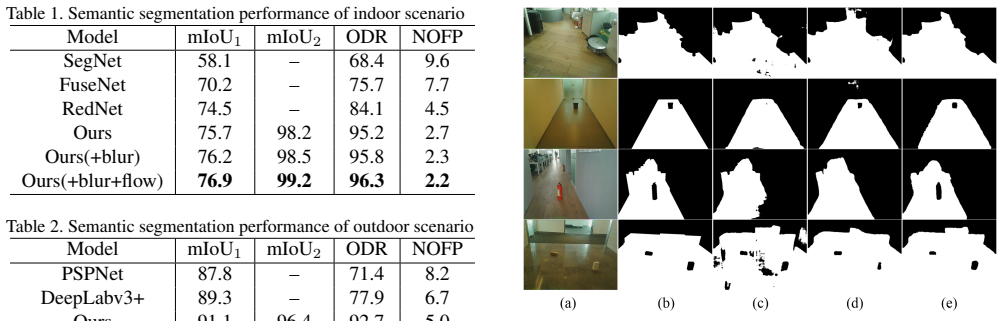
- Adding random motion blur to training raises segmentation accuracy and lowers false positives: indoor mIoU goes from 75.7 to 76.9 and non-obstacle false positives per frame (NOFP) from 2.7 to 2.2; outdoor mIoU goes from 91.1 to 92.1 and NOFP from 5.0 to 4.2.
- Optical-flow supervision is what removes temporal flicker: the paper shows consecutive-frame segmentation is stable with it and unstable without it.
- Morphological grouping of nearby obstacles reduces the number of objects the planner must handle and avoids collisions in narrow gaps between obstacles.
- The planned paths stay close to human-labeled routes, with Hausdorff distances of 0.15 m indoor and 0.27 m outdoor, compared with about 0.6 m for a stereo-vision baseline indoors.
Reading between the lines
- A natural transfer is to other ground-plane settings such as runway debris detection or warehouse floor inspection, where obstacle is defined relative to a drivable surface; the same two-stage decomposition should reduce false positives from scene context.
- Because the cascade inherits stage-one errors, a testable extension is feeding road-mask uncertainty or a second ROI refinement pass back into stage two to recover obstacles in regions the contour missed.
- The optical-flow feature-propagation trick, borrowed from video recognition, could be evaluated on other moving-camera dense prediction tasks such as depth completion or panoptic segmentation where temporal stability matters.
- The newly collected dataset of 2200 indoor and 2000 outdoor images with small obstacles and human-labeled walking routes could serve as a benchmark for small-obstacle avoidance, since existing public segmentation datasets lack explicit obstacle and path labels.
Signed reviews
Editorial analysis
A structured set of objections, weighed in public.
Referee Report
Summary. The paper proposes a complete obstacle-avoidance system for wheeled robots using RGB-D input. The main technical contribution is a two-stage semantic segmentation network: stage one extracts a road mask from the RGB-D image, and stage two classifies pixels inside the road contour as road, obstacle, or others, with all non-road pixels mapped to obstacle during training. Temporal consistency is addressed by optical-flow-based feature propagation between adjacent frames, and robustness to camera shake is addressed by motion-blur data augmentation. The segmented binary map is post-processed with morphological operations and fed into an artificial-potential-field local path planner. The method is evaluated on SUN RGB-D and Cityscapes for segmentation and on a privately collected small-obstacle dataset for obstacle detection and path planning, reporting mIoU, obstacle detection rate (ODR), non-obstacle false positives (NOFP), and path Hausdorff distance. The authors report improvements over one-stage baselines and over a stereo-based obstacle-avoidance method.
Significance. If the results hold, the paper would make a useful applied contribution by integrating two-stage RGB-D segmentation, temporal-consistency supervision, and path planning into a single system, and it demonstrates consistent incremental gains from the proposed blur and optical-flow components on external benchmarks. The use of SUN RGB-D and Cityscapes for stage-one evaluation and the comparison with standard segmentation baselines are appropriate and show no derivational circularity. The main limitation on significance is that the headline small-obstacle results come from a private dataset that is not available, the ablations are reported without variance estimates, and the claimed ability to detect arbitrary obstacles is not supported by the closed-set training paradigm.
major comments (4)
- [Section 3.1, Eq. (4); Section 4.1] The stage-two model is trained as a closed-set classifier over classes {road, obstacle, others} using the mapped label sets of SUN RGB-D and Cityscapes, with the private small-obstacle dataset used only at inference. A softmax network trained this way has no mechanism to label a genuinely unseen object type as obstacle; an unknown object will simply receive the highest-probability seen class, which may be road or background. This directly undercuts the paper's claim, in the abstract and in Section 2.1, that the method can handle arbitrary obstacles or obstacles that are often missed by predefined-category systems. The reported ODR values of 96.3 (indoor) and 93.8 (outdoor) on the private dataset may reflect overlap between the chosen test objects (trash cans, cartons, bricks) and the furniture/object classes in the training label sets. The authors should either add an open-set or anomaly-detection component, provide a held-out-object-category experiment showing detection of objects whose semantic classes are absent from training, or substantially soften the arbitrary-obstacle claim.
- [Section 4.2, Tables 1-3] All reported metrics appear to come from single training runs and single test passes, with no error bars, confidence intervals, or significance tests. Several of the claimed improvements are numerically small (e.g., indoor mIoU increasing from 75.7 to 76.2 to 76.9, and ODR from 95.2 to 95.8 to 96.3 in Table 1), and it is not established that these differences are outside run-to-run variance. Because the private dataset and code are not available, the reader cannot assess this risk. The authors should report means and standard deviations over multiple seeds (or otherwise provide statistical evidence), and they should make the evaluation protocol and, ideally, the dataset available for independent verification.
- [Section 3.1, Eqs. (3)-(4)] Stage two operates only inside the stage-one road contour, so any road-segmentation error in stage one directly removes small obstacles in the missed region from consideration. The paper provides no analysis of how stage-one contour errors affect obstacle detection, and no experiment varies or degrades road-mask quality to quantify this failure mode. A concrete test would be to perturb the predicted road mask (e.g., by morphological dilation/erosion or by using a known-imperfect one-stage model) and measure the resulting ODR and path-planning quality; alternatively, the authors could report road-contour recall on the private dataset. Without such an analysis, the claimed robustness of the two-stage design is not fully supported.
- [Section 4.4, Table 3] The path-planning comparison is against a stereo-vision method [7] with a different sensor and a different perception/planning pipeline, so the reported Hausdorff-distance improvement (0.15 m indoor, 0.27 m outdoor versus about 0.6 m) is not an apples-to-apples comparison. Moreover, only the Hausdorff distance to the mean of five human-annotated routes is reported; there is no path success rate, collision metric, or comparison against paths planned from the same RGB-D data using a one-stage segmentation baseline. The authors should add fair comparisons and additional quantitative metrics to support the claim that the proposed system produces superior collision-free paths.
minor comments (4)
- [Section 4.2, Eqs. (16)-(17)] The definitions of ODR and NOFP do not specify how instances with partial overlap between 0% and 50% are treated; these instances appear to be neither success predictions nor false predictions. The authors should state explicitly whether such instances are ignored, counted as false negatives, or otherwise handled.
- [Sections 3.3 and 3.4] Several free parameters are introduced with manual values and no sensitivity analysis: k1, k2, k3 in Eq. (7), alpha in the destination-setting threshold, and mu_r and mu_a in the APF path planner. A small sensitivity study would strengthen the claim that the reported results are not overly dependent on these choices.
- [Section 4.1] The statement that the small-obstacle dataset is 'only used during inference' is important but underspecified. The authors should clarify how the road/obstacle ground truth for that dataset is generated, how its classes relate to the SUN RGB-D and Cityscapes mappings, and whether any manual rules or additional supervision are used when evaluating stage two on it.
- [General] There are several typographical and formatting issues, including the title 'Small Obstacle A voidance', inconsistent spacing in 'pre-defined', and a missing equation number for the optical-flow propagation formula in Section 3.1; these should be corrected in revision.
Circularity Check
No significant circularity: the claimed gains are benchmarked against external datasets and standard baselines, and no load-bearing step reduces to its own input.
full rationale
The paper's central architecture is a two-stage RGB-D segmentation network with optical-flow supervision and motion-blur augmentation. Its main reported results (mIoU, ODR, NOFP, path Hausdorff distance) are measured on external public benchmarks (SUN RGB-D, Cityscapes) and on a separately collected small-obstacle dataset that is used only for inference, not for training the segmentation models. The design components are adopted from cited prior work: RedNet [13], FlowNet [6], and deep feature flow [30], none of which is authored by the present paper's authors. No parameter is fitted to the evaluation metric and then reported as a prediction; the hand-tuned morphological coefficients and APF scaling factors affect performance but are not presented as derived results. The only conceptual concern, that stage two is trained on a closed label set and therefore may not generalize to truly unseen obstacle categories, is a correctness and generalization risk, not a circularity: the training labels are not defined in terms of the reported predictions, and the evaluation uses independent ground-truth annotations. No self-citation chain is load-bearing, and no equation reduces to its own input. The paper therefore receives a circularity score of 0.
Assumptions & free parameters
free parameters (5)
- k1 =
1/80
- k2 =
1/48
- k3 =
1/64
- alpha =
1/24
- mu_r and mu_a =
not reported
assumptions (5)
- domain assumption Motion blur caused by robot movement can be modeled as uniform linear motion with a rectangular point spread function.
- ad hoc to paper Every non-road pixel inside the stage-one road contour is an obstacle during stage-two training and inference.
- domain assumption The semantic class mappings from SUN RGB-D and Cityscapes to a small road/obstacle/other label set are valid supervision for general small-obstacle avoidance.
- domain assumption Optical flow fields align pre-frame feature maps to current-frame features accurately enough to improve temporal consistency.
- domain assumption The mean of five human-labeled walking routes is a valid ground truth for path planning evaluation.
Cite this review
Pith. "Pith review of Small Obstacle Avoidance Based on RGB-D Semantic Segmentation." pith.science (2026). https://pith.science/paper/6MJNF4NQ
@misc{pith2026190811675,
  author       = {Pith},
  title        = {Pith review of: Small Obstacle Avoidance Based on RGB-D Semantic Segmentation},
  year         = {2026},
  howpublished = {\url{https://pith.science/paper/6MJNF4NQ}},
  note         = {Machine review of arXiv:1908.11675}
}
read the original abstract
This paper presents a novel obstacle avoidance system for road robots equipped with RGB-D sensor that captures scenes of its way forward. The purpose of the system is to have road robots move around autonomously and constantly without any collision even with small obstacles, which are often missed by existing solutions. For each input RGB-D image, the system uses a new two-stage semantic segmentation network followed by the morphological processing to generate the accurate semantic map containing road and obstacles. Based on the map, the local path planning is applied to avoid possible collision. Additionally, optical flow supervision and motion blurring augmented training scheme is applied to improve temporal consistency between adjacent frames and overcome the disturbance caused by camera shake. Various experiments are conducted to show that the proposed architecture obtains high performance both in indoor and outdoor scenarios.
Figures


Figures from the paper (7 more)




Reference graph
Works this paper leans on
-
[7]
S. Ghosh and J. Biswas. Joint perception and planning for efficient obstacle avoidance using stereo vision. InIEEE/RSJ International Conference on Intelligent Robots and Systems (IROS), pages 1026–1031, 2017
work page 2017
-
[1]
V . Badrinarayanan, A. Kendall, and R. Cipolla. Segnet: A deep convolutional encoder-decoder architecture for image segmentation. IEEE transactions on pattern analysis and machine intelligence, 39(12):2481–2495, 2017
work page 2017
-
[2]
L. C. Chen, G. Papandreou, I. Kokkinos, K. Murphy, and A. L. Yuille. Deeplab: Semantic image segmentation with deep convolutional nets, atrous convolution, and fully con- nected crfs. IEEE transactions on pattern analysis and ma- chine intelligence, 40(4):834–848, 2018
work page 2018
-
[3]
L. C. Chen, G. Papandreou, F. Schroff, and H. Adam. Re- thinking atrous convolution for semantic image segmenta- tion. In arXiv preprint arXiv:1706.05587, 2017
arXiv 2017
-
[4]
L. C. Chen, Y . Zhu, G. Papandreou, F. Schroff, and H. Adam. Encoder-decoder with atrous separable convolution for se- mantic image segmentation. In European Conference on Computer Vision (ECCV), pages 801–818, 2018
work page 2018
-
[5]
M. Cordts et al. The cityscapes dataset for semantic ur- ban scene understanding. In IEEE Conference on Computer Vision and Pattern Recognition (CVPR) , pages 3213–3223, 2016
work page 2016
-
[6]
A. Dosovitskiy et al. Flownet: Learning optical flow with convolutional networks. In IEEE International Conference on Computer Vision (ICCV), pages 2758–2766, 2015
work page 2015
- [8]
Show all 30 references
-
[9]
Hazirbas, L
C. Hazirbas, L. Ma, C. Domokos, and D. Cremers. Fusenet: Incorporating depth into semantic segmentation via fusion- based cnn architecture. In Asian Conference on Computer Vision (ACCV), pages 213–228, 2016
2016
-
[10]
Horswill
I. Horswill. Visual collision avoidance by segmentation. In IEEE/RSJ International Conference on Intelligent Robots and Systems (IROS), pages 87–99, 1995
1995
-
[11]
J. Jia. Single image motion deblurring using transparency. In IEEE Conference on Computer Vision and Pattern Recogni- tion (CVPR), pages 1–8, 2007
2007
-
[12]
Jiang, Z
J. Jiang, Z. Zhang, Y . Huang, and L. Zheng. Incorporat- ing depth into both cnn and crf for indoor semantic seg- mentation. In IEEE International Conference on Software Engineering and Service Science (ICSESS), pages 525–530, 2017
2017
-
[13]
Jiang, L
J. Jiang, L. Zheng, F. Luo, and Z. Zhang. Rednet: Residual encoder-decoder network for indoor rgb-d semantic segmen- tation. In arXiv preprint arXiv:1806.01054, 2018
2018 arXiv
-
[14]
O. Khatib. Real-time obstacle avoidance for manipulators and mobile robots. In Autonomous Robot Vehicles , pages 396–404. 1986
1986
-
[15]
Kristan, V
M. Kristan, V . S. Kenk, S. Kovaˇciˇc, and J. Perˇs. Fast image- based obstacle detection from unmanned surface vehicles. IEEE Transactions on Cybernetics, 46(3):641–654, 2016
2016
-
[16]
J. Long, E. Shelhamer, and T. Darrell. Fully convolutional networks for semantic segmentation. In IEEE Conference on Computer Vision and Pattern Recognition (CVPR), pages 3431–3440, 2015
2015
-
[17]
L. M. Lorigo, R. A. Brooks, and W. E. L. Grimsou. Visually- guided obstacle avoidance in unstructured environments. In IEEE/RSJ International Conference on Intelligent Robots and Systems (IROS), pages 373–379, 1997
1997
-
[18]
L. Ma, J. St ¨uckler, C. Kerl, and D. Cremers. Multi-view deep learning for consistent semantic mapping with rgb-d cam- eras. In IEEE/RSJ International Conference on Intelligent Robots and Systems (IROS), pages 598–605, 2017
2017
-
[19]
N. J. Nilsson. Shakey the robot. Technical report, SRI IN- TERNATIONAL MENLO PARK CA, 1984
1984
-
[20]
Ramos, S
S. Ramos, S. Gehrig, P. Pinggera, U. Franke, and C. Rother. Detecting unexpected obstacles for self-driving cars: Fusing deep learning and geometric modeling. In IEEE Intelligent Vehicles Symposium (IV), pages 1025–1032, 2017
2017
-
[21]
Silberman, D
N. Silberman, D. Hoiem, P. Kohli, and R. Fergus. Indoor segmentation and support inference from rgbd images. In European Conference on Computer Vision (ECCV) , pages 746–760, 2012
2012
-
[22]
S. Song, S. P. Lichtenberg, and J. Xiao. Sun rgb-d: A rgb-d scene understanding benchmark suite. In IEEE Conference on Computer Vision and Pattern Recognition (CVPR), pages 567–576, 2015
2015
-
[23]
M. A. Turk and M. Marra. Color road segmentation and video obstacle detection. In Mobile Robots I , volume 727, pages 136–143, 1987
1987
-
[24]
Ulrich and I
I. Ulrich and I. Nourbakhsh. Appearance-based obstacle de- tection with monocular color vision. In Association for the Advancement of Artificial Intelligence (AAAI) , pages 866– 871, 2000
2000
-
[25]
Valada, R
A. Valada, R. Mohan, and W. Burgard. Self-supervised model adaptation for multimodal semantic segmentation. In arXiv preprint arXiv:1808.03833, 2018
2018 arXiv
-
[26]
C. Wei, Q. Ge, S. Chattopadhyay, and E. Lobaton. Robust obstacle segmentation based on topological persistence in outdoor traffic scenes. In IEEE Symposium on Computa- tional Intelligence in Vehicles and Transportation Systems (CIVTS), pages 92–99, 2014
2014
-
[27]
Yang et al
K. Yang et al. Unifying terrain awareness for the visually impaired through real-time semantic segmentation. Sensors, 18(5):1506, 2018
2018
-
[28]
H. Zhao, X. Qi, X. Shen, J. Shi, and J. Jia. Icnet for real-time semantic segmentation on high-resolution images. In Euro- pean Conference on Computer Vision (ECCV) , pages 405– 420, 2018
2018
-
[29]
H. Zhao, J. Shi, X. Qi, X. Wang, and J. Jia. Pyramid scene parsing network. In IEEE Conference on Computer Vision and Pattern Recognition (CVPR), pages 2881–2890, 2017
2017
-
[30]
X. Zhu, Y . Xiong, J. Dai, L. Yuan, and Y . Wei. Deep feature flow for video recognition. InIEEE Conference on Computer Vision and Pattern Recognition (CVPR) , pages 2349–2358, 2017. 9
2017
Reviewed August 14, 2026 · model on record in the stance chip above.
Discussion (0). Continue with ORCID to comment.