REVIEW 4 major objections 4 minor 66 references
Transport signatures of a Floquet topological transition at the helical edge
T0 review · 4 major / 4 minor · reviewed 2026-08-14 · deepseek-v4-flash
Pith's one-line read A periodically driven quantum point contact between helical edge states undergoes a topological phase transition when the drive amplitude crosses the Zeeman field, and the transition is visible in the conductance.
desk verdict A concrete proposal for a Floquet topological transition in a driven helical-edge QPC, with a transport signature that is well worked out; the missing topological invariant leaves the central claim underdetermined. read the letter →
The pith
A machine-rendered reading of the paper's core claim, the machinery that carries it, and where it could break.
The reading
What carries the argument
The central object is the quasi-energy operator $Q = H(t) - i\partial_t$ acting on the extended Floquet-Hilbert space. Projecting $Q$ onto the zero- and one-photon sectors (Shirley-Floquet theory to lowest order in the drive) yields a four-by-four effective Hamiltonian $\mathcal{H}_{\mathrm{eff}}$ whose eigenvalues are quasi-energies. The drive enters through matrix elements $\Delta_0(k) \propto eA$, while the Zeeman field enters through $B_0(k) \propto B_z$; the transition occurs where these two couplings balance. For resonant frequency $\omega = 2\sqrt{\gamma_c^2+\gamma_0^2}$, the gap closes at $k=0$ and at quasi-energy $\omega/2$ when $eA = B_z$, reopening with a different character on each side. For off-resonant driving with imbalance $\delta\omega$, the phase boundary shifts to $B_z = \sqrt{(eA)^2 + (\delta\omega)^2(1+(\gamma_c/\gamma_0)^2)}$.
What would settle it
Evaluate a Floquet topological invariant, such as a winding number of the effective quasi-energy Hamiltonian, as a function of $eA/B_z$; if the invariant does not change at $eA = B_z$, the claimed topological transition is refuted, while the conductance features would remain as ordinary spectral effects.
Extended reading notes
Core claim
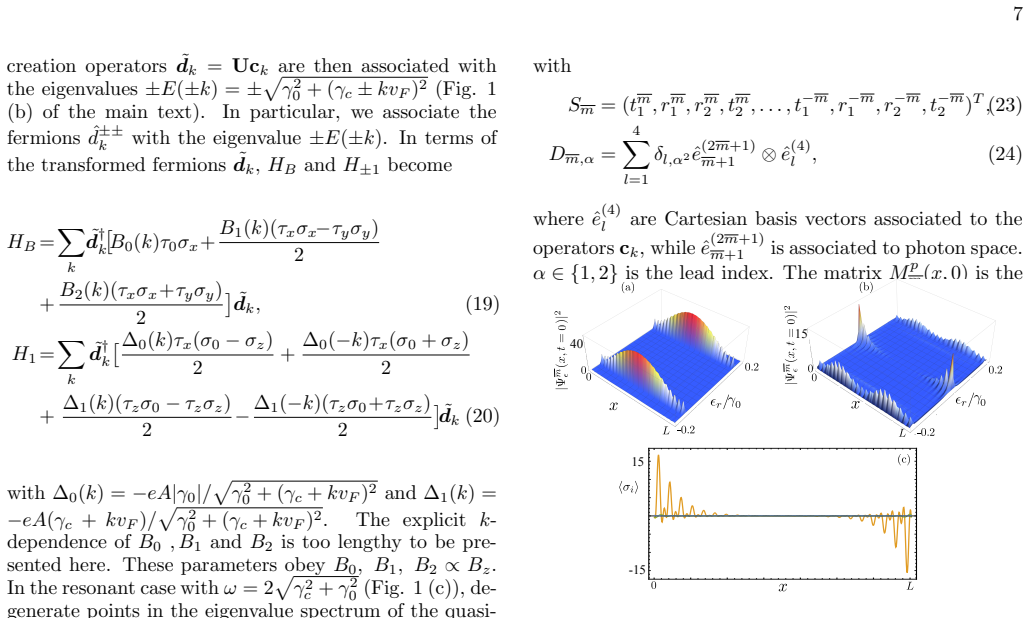
The central claim is that a periodically driven QPC between helical edges exhibits a Floquet topological phase transition as the dimensionless ratio $eA/B_z$ crosses unity. At resonant driving, $\omega = 2\sqrt{\gamma_c^2+\gamma_0^2}$, the effective quasi-energy operator projects onto zero- and one-photon sectors and its spectrum shows a gap-closing and reopening at quasi-energy $\epsilon = \omega/2$ exactly at $eA = B_z$. In the topological phase, $0 < eA/B_z < 1$, bound states localized at the ends of the QPC appear at $\omega/2$, with a dominant spin component perpendicular to the helical spin axis. These bound states act as a ferromagnetic barrier, enabling backscattering into the same channel, which breaks the perfect $e^2/h$ quantization of the four-terminal conductance and leaves distinctive resonances in the two-terminal conductance of a weakly coupled QPC. The paper thus establishes the QPC as a feasible platform for detecting a Floquet topological transition via transport alone.
Load-bearing premise
The paper's identification of the transition as topological rests on observing gap closing and reopening at a symmetric quasi-energy together with localized boundary states, without computing a full topological invariant; if the two sides were found to be topologically equivalent, the central claim would fail.
Editorial extensions
If this is right
- At resonance, the QPC is in a topological Floquet phase for $0 < eA/B_z < 1$ and a trivial phase for $eA/B_z > 1$, with the phase boundary at $eA = B_z$.
- The topological phase hosts bound states at quasi-energy $\omega/2$ localized at the QPC ends, with spin polarization perpendicular to the helical quantization axis.
- In a four-terminal measurement, the trivial phase has conductance quantized at $e^2/h$ per channel; this quantization is lost in the topological phase because the bound state backscatters same-channel electrons.
- In a two-terminal measurement with weak coupling to the leads, the topological bound states appear as sharp resonances at $\omega/2$ in the conductance.
- Off-resonant driving shifts the transition but leaves the same qualitative transport signatures, with the boundary given by the generalized condition $B_z = \sqrt{(eA)^2 + (\delta\omega)^2(1+(\gamma_c/\gamma_0)^2)}$.
Reading between the lines
- The mechanism is generic: any one-dimensional junction with a charge-conjugation symmetry and a Zeeman gap could show the same Floquet transition, so similar signatures may be sought in other helical or spin-orbit coupled systems.
- The spin-polarized bound state could be used as an electrically controlled spin flipper or spin filter, since tunneling into it flips the spin and produces same-channel reflection.
- The paper never computes a bulk topological invariant for the Floquet bands; if a future calculation showed the two phases have the same invariant, the 'topological' designation would be wrong, though the conductance features would remain as spectral signatures.
- A direct extension would be to study the interacting case: with electron-electron interactions along the helical edges, the bound-state spin texture might give rise to correlation effects detectable in noise measurements.
Signed reviews
Editorial analysis
A structured set of objections, weighed in public.
Referee Report
Summary. The paper proposes a quantum point contact (QPC) between helical edge states of a two-dimensional topological insulator, subjected to a static Zeeman field B_z and a periodic drive of amplitude eA and frequency ω. Using Shirley-Floquet theory in a one-photon rotating-wave approximation, the authors derive an effective quasi-energy Hamiltonian (Eq. (6)) and identify a gap closing and reopening at quasi-energy ω/2 when eA = B_z; they interpret this as a Floquet topological phase transition. They then solve a Floquet scattering problem with a transfer matrix and compute two-terminal and four-terminal conductances, showing that the four-terminal conductance changes across the transition and that a localized bound state appears at the QPC ends. The central claim is that this transition and its bound states can be detected unambiguously by photon-assisted transport.
Significance. If established, the result would provide a solid-state, experimentally accessible platform for a Floquet topological phase transition with transport signatures in a device whose undriven version has already been realized in the lab. The main strengths are that the effective Hamiltonian is derived from a microscopic model, the transport calculation is performed from first principles without fitting experimental data, and the predicted transition condition eA = B_z is falsifiable within the model. The main weaknesses are that no topological invariant is computed and the bound-state criterion is not a topological diagnostic; these issues undermine the central 'topological' classification as stated, although they do not invalidate the transport calculation itself.
major comments (4)
- [Model and Bound state (Eq. (6), Fig. 1(d)-(f))] The paper identifies the transition by a gap closing and reopening at quasi-energy ϵ = ω/2 together with localized states at the QPC ends, but it never computes a bulk Floquet topological invariant for H_eff(k) in Eq. (6), nor a scattering-matrix invariant from the Floquet scattering amplitudes in the Transport section. In a one-dimensional Floquet system with charge-conjugation symmetry, a gap closing at a particle-hole symmetric point is necessary but not sufficient for a topological transition: a trivial band inversion can close and reopen the gap without changing any invariant. Since the central claim is that the system undergoes a Floquet topological phase transition, the presented evidence does not rule out a non-topological band inversion. I request an invariant calculation (for example, a winding number of the effective Hamiltonian or the Floquet scattering matrix invariant) or an explicit restriction of the claims to a gap-closing transition with boundary states.
- [Bound state, Eq. (13) and Fig. 5(a)] The criterion used to identify a topological bound state is that a local maximum in the probability density grows as the gap-inducing parameters are increased. This is a resonance criterion, not a topological criterion. A non-topological interface state in an open system would behave in the same way, so the existence of such a local maximum does not establish that the state is protected. Please add a diagnostic that ties the state to the claimed topology, such as pinning at quasi-energy ϵ = ω/2, exponential localization controlled by |eA − B_z|, appearance in pairs at the two QPC ends, or robustness against symmetry-preserving disorder.
- [Supplementary Material A, Eqs. (19)-(20)] The effective Hamiltonian in Eq. (6) is not fully specified: B_0(k) is left implicit in the main text, and B_0(k), B_1(k), B_2(k) in Eq. (19) of the Supplementary Material are declared 'too lengthy to be presented'. Because Eq. (6) is the basis of the transition condition in Eq. (14) and of all subsequent transport predictions, the omitted matrix elements are load-bearing for the central derivation. They should be supplied explicitly, or at least in a systematically defined form, so that the gap-closing condition and the conductance curves can be independently verified.
- [Model and Supplementary Material A] The rotating-wave/one-photon approximation is introduced with the condition eA, B_z ≪ ω, but the manuscript does not estimate the error from neglected multi-photon processes. Since the transition occurs at eA = B_z and transport is computed with a photon cutoff m, the one-photon effective Hamiltonian could receive quantitative corrections near the transition. Please provide a perturbative estimate of the leading neglected terms or a convergence check in the photon cutoff that demonstrates the transition condition in Eq. (14) is stable.
minor comments (4)
- [Transport, Eqs. (10) and (13)] In Eqs. (10) and (13), the symbol m is used both as the truncation order and as the summation/running photon index; please use different letters (for example, n for the running index and M for the cutoff).
- [Fig. 2 caption] The red line in Fig. 2 is referenced as Eq. (14), but that equation appears only in footnote 57; it should be promoted to a numbered equation in the main text.
- [Abstract and Introduction] The abstract and introduction claim that the transition can be 'unambiguously detected' by transport, but the two-terminal conductance in Fig. 2(a) is stated not to distinguish the topological and trivial regimes; please qualify the claim to the four-terminal measurement or provide a quantitative criterion.
- [Fig. 4 caption] The caption says 'driven electro-magnetic vector field eA', but Eq. (5) describes a periodic scalar-type coupling eA cos(ωt) τ_z σ_z; please unify the terminology.
Circularity Check
No significant circularity: the predicted transition and conductance signatures are derived from the stated Hamiltonian, with no fitted inputs and no load-bearing self-citation.
full rationale
The paper's central claim is that a driven QPC between helical edges undergoes a Floquet topological phase transition as eA crosses B_z. The effective quasi-energy operator in Eq. (6) is derived directly from the model Hamiltonian, Eqs. (1)-(5), using Shirley-Floquet theory in the supplementary material, and the transition condition eA = B_z follows from the explicit Hamiltonian parameters rather than from data fitting or from a pre-assigned prediction. The conductance curves in Figs. 2 and 4 are obtained by solving the Floquet scattering problem defined by Eqs. (7)-(11), with no experimental data and no parameter tuned to force the claimed signatures. The bound-state evidence is likewise presented as explicit probability densities and spin densities computed from the same scattering formalism. Self-citations appear in the paper (e.g., the QPC model and the prior work defining a bound-state diagnostic), but they serve as background or as a naming convention; the load-bearing derivations do not reduce to an assertion from these citations. The reader's concern that no bulk Floquet topological invariant is computed is a completeness and correctness issue, not a circularity issue: the absence of an invariant does not mean the prediction is equivalent to an input. Overall, the derivation is self-contained and the predicted transport signatures are consequences of the stated model.
Assumptions & free parameters
free parameters (6)
- Driving amplitude eA =
Control parameter; transition predicted at eA = B_z
- Zeeman field B_z =
Control parameter; sets transition scale
- Static coupling strengths gamma_0 and gamma_c =
Chosen equal in numerics (gamma_0 = gamma_c)
- Drive frequency omega =
Resonant value omega = 2 sqrt(gamma_0^2 + gamma_c^2), with detuning delta_omega
- QPC length L =
Examples: L = 27 v_F/gamma_0 and L = 120 v_F/gamma_0
- Photon cutoff m =
m = 10 or m = 5
assumptions (6)
- domain assumption Low-energy helical edge theory with four Fermi fields and linear dispersion is valid when all energy scales are below the bulk gap.
- domain assumption Electron-electron interactions and other symmetry-breaking perturbations are neglected in the QPC and leads.
- ad hoc to paper Rotating-wave or one-photon Floquet approximation with eA, B_z much smaller than omega is sufficient to capture the topological transition.
- domain assumption Gap closing and reopening at charge-conjugation-symmetric quasi-energies, plus localized bound states, identifies a topological phase transition.
- ad hoc to paper Step-function QPC potentials with lambda_F much smaller than L_s much smaller than L describe the device.
- standard math Floquet scattering theory with independent Fermi distributions in each lead applies to the driven open system.
Cite this review
Pith. "Pith review of Transport signatures of a Floquet topological transition at the helical edge." pith.science (2026). https://pith.science/paper/QEAPIUAF
@misc{pith2026190811719,
  author       = {Pith},
  title        = {Pith review of: Transport signatures of a Floquet topological transition at the helical edge},
  year         = {2026},
  howpublished = {\url{https://pith.science/paper/QEAPIUAF}},
  note         = {Machine review of arXiv:1908.11719}
}
read the original abstract
The manipulation of the helical edge states of two-dimensional topological insulators is crucial for the development of technological applications. Recently, an important step forward, namely, the experimental realization of a quantum point contact between helical edges, has been accomplished. We theoretically predict that such a quantum point contact, in the presence of a time periodic applied electric field, is characterized by a topological quantum phase transition in the Floquet spectrum. Moreover, we show that it is possible to detect this dynamical topological quantum phase transition by a bare conductance measurements.
Figures


Figures from the paper (3 more)


Reference graph
Works this paper leans on
-
[1]
author author C. L. \ Kane \ and\ author E. J. \ Mele ,\ 10.1103/PhysRevLett.95.146802 journal journal Phys. Rev. Lett. \ volume 95 ,\ pages 146802 ( year 2005 ) NoStop
-
[2]
author author B. A. \ Bernevig , author T. L. \ Hughes , \ and\ author S.-C. \ Zhang ,\ @noop journal journal Science \ volume 314 ,\ pages 1757 ( year 2006 ) NoStop
work page 2006
-
[3]
o nig , author S. Wiedmann , author C. Br \
author author M. K \"o nig , author S. Wiedmann , author C. Br \"u ne , author A. Roth , author H. Buhmann , author L. W. \ Molenkamp , author X.-L. \ Qi , \ and\ author S.-C. \ Zhang ,\ @noop journal journal Science \ volume 318 ,\ pages 766 ( year 2007 ) NoStop
work page 2007
-
[4]
author author S. Nadj-Perge , author I. K. \ Drozdov , author J. Li , author H. Chen , author S. Jeon , author J. Seo , author A. H. \ MacDonald , author B. A. \ Bernevig , \ and\ author A. Yazdani ,\ 10.1126/science.1259327 journal journal Science \ volume 346 ,\ pages 602 ( year 2014 ) NoStop
-
[5]
author author P. Michetti \ and\ author B. Trauzettel ,\ 10.1063/1.4792275 journal journal Appl. Phys. Lett. \ volume 102 ,\ pages 063503 ( year 2013 ) NoStop
-
[6]
author author J. Linder \ and\ author J. W. A. \ Robinson ,\ https://doi.org/10.1038/nphys3242 journal journal Nat. Phys. \ volume 11 ,\ pages 307 ( year 2015 ) NoStop
-
[7]
author author D. Breunig , author P. Burset , \ and\ author B. Trauzettel ,\ 10.1103/PhysRevLett.120.037701 journal journal Phys. Rev. Lett. \ volume 120 ,\ pages 037701 ( year 2018 ) NoStop
-
[8]
author author R. S. K. \ Mong , author D. J. \ Clarke , author J. Alicea , author N. H. \ Lindner , author P. Fendley , author C. Nayak , author Y. Oreg , author A. Stern , author E. Berg , author K. Shtengel , \ and\ author M. P. A. \ Fisher ,\ 10.1103/PhysRevX.4.011036 journal journal Phys. Rev. X \ volume 4 ,\ pages 011036 ( year 2014 ) NoStop
Show all 66 references
-
[9]
Klinovaja \ and\ author D
author author J. Klinovaja \ and\ author D. Loss ,\ 10.1103/PhysRevLett.112.246403 journal journal Phys. Rev. Lett. \ volume 112 ,\ pages 246403 ( year 2014 ) NoStop
2014 doi
-
[10]
Wiedenmann , author E
author author J. Wiedenmann , author E. Bocquillon , author R. S. \ Deacon , author S. Hartinger , author O. Herrmann , author T. M. \ Klapwijk , author L. Maier , author C. Ames , author C. Bruene , author C. Gould , author A. Oiwa , author K. Ishibashi , author S. Tarucha , ...
2016 doi
-
[11]
Maciejko , author C
author author J. Maciejko , author C. Liu , author Y. Oreg , author X.-L. \ Qi , author C. Wu , \ and\ author S.-C. \ Zhang ,\ 10.1103/PhysRevLett.102.256803 journal journal Phys. Rev. Lett. \ volume 102 ,\ pages 256803 ( year 2009 ) NoStop
-
[12]
Traverso Ziani , author F
author author N. Traverso Ziani , author F. Cr\'epin , \ and\ author B. Trauzettel ,\ 10.1103/PhysRevLett.115.206402 journal journal Phys. Rev. Lett. \ volume 115 ,\ pages 206402 ( year 2015 ) NoStop
2015 doi
-
[13]
Zhang \ and\ author C
author author F. Zhang \ and\ author C. L. \ Kane ,\ 10.1103/PhysRevLett.113.036401 journal journal Phys. Rev. Lett. \ volume 113 ,\ pages 036401 ( year 2014 ) NoStop
2014 doi
-
[14]
author author C. P. \ Orth , author R. P. \ Tiwari , author T. Meng , \ and\ author T. L. \ Schmidt ,\ 10.1103/PhysRevB.91.081406 journal journal Phys. Rev. B \ volume 91 ,\ pages 081406 ( year 2015 ) NoStop
2015 doi
-
[15]
C. Y. J. Teo and C. L. Kane, https://doi.org/10.1103/PhysRevB.79.235321 Phys. Rev. B 79, 235321(2009)
2009 doi
-
[16]
Asano, Y
Y. Asano, Y. Tanaka, and N. Nagaosa, https://doi.org/10.1103/PhysRevLett.105.056402 Phys. Rev. Lett. 105, 056402 (2010)
2010 doi
-
[17]
Strunz, J
J. Strunz, J. Wiedenmann, C. Fleckenstein, L. Lunczer, W. Beugeling, V. L M\"uller, P. Shekhar, N. Traverso Ziani, S. Shamim, J. Kleinlein, H. Buhmann, B. Trauzettel, L. W. Molenkamp, Nat. Phys. 16, 83 (2020)
2020
-
[18]
\ Liu , author J
journal author author C.-X. \ Liu , author J. C. \ Budich , author P. Recher , \ and\ author B. Trauzettel ,\ 10.1103/PhysRevB.83.035407 journal journal Phys. Rev. B \ volume 83 ,\ pages 035407 ( year 2011 ) NoStop
2011 doi
-
[19]
Dolcini ,\ 10.1103/PhysRevB.83.165304 journal journal Phys
author author F. Dolcini ,\ 10.1103/PhysRevB.83.165304 journal journal Phys. Rev. B \ volume 83 ,\ pages 165304 ( year 2011 ) NoStop
2011 doi
-
[20]
Ferraro , author G
author author D. Ferraro , author G. Dolcetto , author R. Citro , author F. Romeo , \ and\ author M. Sassetti ,\ 10.1103/PhysRevB.87.245419 journal journal Phys. Rev. B \ volume 87 ,\ pages 245419 ( year 2013 ) NoStop
2013 doi
-
[21]
Klinovaja , author A
author author J. Klinovaja , author A. Yacoby , \ and\ author D. Loss ,\ 10.1103/PhysRevB.90.155447 journal journal Phys. Rev. B \ volume 90 ,\ pages 155447 ( year 2014 ) NoStop
2014 doi
-
[22]
Fleckenstein , author N
author author C. Fleckenstein , author N. Traverso Ziani , \ and\ author B. Trauzettel ,\ 10.1103/PhysRevB.97.134523 journal journal Phys. Rev. B \ volume 97 ,\ pages 134523 ( year 2018 a ) NoStop
2018 doi
-
[23]
Li , author W
author author J. Li , author W. Pan , author B. A. \ Bernevig , \ and\ author R. M. \ Lutchyn ,\ 10.1103/PhysRevLett.117.046804 journal journal Phys. Rev. Lett. \ volume 117 ,\ pages 046804 ( year 2016 ) NoStop
2016 doi
-
[24]
Fleckenstein , author N
author author C. Fleckenstein , author N. Traverso Ziani , \ and\ author B. Trauzettel ,\ 10.1103/PhysRevLett.122.066801 journal journal Phys. Rev. Lett. \ volume 122 ,\ pages 066801 ( year 2019 ) NoStop
2019 doi
-
[25]
Yao , author A
author author W. Yao , author A. H. \ MacDonald , \ and\ author Q. Niu ,\ 10.1103/PhysRevLett.99.047401 journal journal Phys. Rev. Lett. \ volume 99 ,\ pages 047401 ( year 2007 ) NoStop
2007 doi
-
[26]
Liu , author H
author author M. Liu , author H. Y. \ Hwang , author H. Tao , author A. C. \ Strikwerda , author K. Fan , author G. R. \ Keiser , author A. J. \ Sternbach , author K. G. \ West , author S. Kittiwatanakul , author J. Lu , author S. A. \ Wolf , author F. G. \ Omenetto , author X...
-
[27]
author author E. J. \ Sie , author J. W. \ McIver , author Y.-H. \ Lee , author L. Fu , author J. Kong , \ and\ author N. Gedik ,\ https://doi.org/10.1038/nmat4156 journal journal Nat. Mater. \ volume 14 ,\ pages 290 ( year 2014 ) NoStop
-
[28]
Klinovaja and D
J. Klinovaja and D. Loss, http://journals.aps.org/prb/abstract/10.1103/PhysRevB.92.121410 Phys. Rev. B 92 121410(R) (2015)
2015 doi
-
[29]
Thakurathi , author D
author author M. Thakurathi , author D. Loss , \ and\ author J. Klinovaja ,\ 10.1103/PhysRevB.95.155407 journal journal Phys. Rev. B \ volume 95 ,\ pages 155407 ( year 2017 ) NoStop
2017 doi
-
[30]
Cavalleri ,\ 10.1080/00107514.2017.1406623 journal journal Contemporary Physics \ volume 59 ,\ pages 31 ( year 2018 ) NoStop
author author A. Cavalleri ,\ 10.1080/00107514.2017.1406623 journal journal Contemporary Physics \ volume 59 ,\ pages 31 ( year 2018 ) NoStop
2017
-
[31]
Oka \ and\ author S
author author T. Oka \ and\ author S. Kitamura ,\ 10.1146/annurev-conmatphys-031218-013423 journal journal Annual Review of Condensed Matter Physics \ volume 10 ,\ pages 387 ( year 2019 ) NoStop
2019 doi
-
[32]
Rudner and J
M. Rudner and J. C. Song, Nat. Phys. 15, 1017 (2019)
2019
-
[33]
McIver , author B
author author J. McIver , author B. Schulte , author F.-U. \ Stein , author T. Matsuyama , author G. Jotzu , author G. Meier , \ and\ author A. Cavalleri ,\ @noop journal journal preprint arXiv:1811.03522 \ ( year 2018 ) NoStop
2018 arXiv
-
[34]
Oka \ and\ author H
author author T. Oka \ and\ author H. Aoki ,\ @noop journal journal Phys. Rev. B \ volume 79 ,\ pages 081406 ( year 2009 ) NoStop
2009
-
[35]
Kitagawa , author E
author author T. Kitagawa , author E. Berg , author M. Rudner , \ and\ author E. Demler ,\ @noop journal journal Phys. Rev. B \ volume 82 ,\ pages 235114 ( year 2010 ) NoStop
2010
-
[36]
author author N. H. \ Lindner , author G. Refael , \ and\ author V. Galitski ,\ @noop journal journal Nat. Phys. \ volume 7 ,\ pages 490 ( year 2011 ) NoStop
2011
-
[37]
Kitagawa , author T
author author T. Kitagawa , author T. Oka , author A. Brataas , author L. Fu , \ and\ author E. Demler ,\ @noop journal journal Phys. Rev. B \ volume 84 ,\ pages 235108 ( year 2011 ) NoStop
2011
-
[38]
Gu , author H
author author Z. Gu , author H. Fertig , author D. P. \ Arovas , \ and\ author A. Auerbach ,\ @noop journal journal Phys. Rev. Lett. \ volume 107 ,\ pages 216601 ( year 2011 ) NoStop
2011
-
[39]
author author D. E. \ Liu , author A. Levchenko , \ and\ author H. U. \ Baranger ,\ @noop journal journal Phys. Rev. Lett. \ volume 111 ,\ pages 047002 ( year 2013 ) NoStop
2013
-
[40]
Kundu and B
A. Kundu and B. Seradjeh Phys. Rev. Lett. 111, 136402 (2013)
2013
-
[41]
Ezawa ,\ 10.1103/PhysRevLett.110.026603 journal journal Phys
author author M. Ezawa ,\ 10.1103/PhysRevLett.110.026603 journal journal Phys. Rev. Lett. \ volume 110 ,\ pages 026603 ( year 2013 ) NoStop
2013 doi
-
[42]
Wang , author B
author author R. Wang , author B. Wang , author R. Shen , author L. Sheng , \ and\ author D. Y. \ Xing ,\ http://stacks.iop.org/0295-5075/105/i=1/a=17004 journal journal EPL (Europhysics Letters) \ volume 105 ,\ pages 17004 ( year 2014 ) NoStop
2014
-
[43]
author author L. E. F. Foa Torres , author P. M. Perez-Piskunow , author C. A. Balseiro , \ and\ author G. Usaj ,\ https://link.aps.org/doi/10.1103/PhysRevLett.113.266801 journal journal Phys. Rev. Lett. \ volume 113 ,\ pages 266801 ( year 2014 ) NoStop
-
[44]
L. E. F. Foa Torres, P. M. Perez-Piskunow, C. A. Balseiro, and Gonzalo Usaj, Phys
-
[45]
Sentef , author M
author author M. Sentef , author M. Claassen , author A. Kemper , author B. Moritz , author T. Oka , author J. Freericks , \ and\ author T. Devereaux ,\ @noop journal journal Nature Communications \ volume 6 ( year 2015 ) NoStop
2015
-
[46]
Farrell and T
A. Farrell and T. Pereg-Barnea, Phys. Rev. Lett. 115, 106403 (2015)
2015
-
[47]
Farrell and T
A. Farrell and T. Pereg-Barnea, Phys. Rev. B 93, 045121 (2016)
2016
-
[48]
Privitera \ and\ author G
author author L. Privitera \ and\ author G. E. \ Santoro ,\ 10.1103/PhysRevB.93.241406 journal journal Phys. Rev. B \ volume 93 ,\ pages 241406 ( year 2016 ) NoStop
2016 doi
-
[49]
Yan \ and\ author Z
author author Z. Yan \ and\ author Z. Wang ,\ 10.1103/PhysRevLett.117.087402 journal journal Phys. Rev. Lett. \ volume 117 ,\ pages 087402 ( year 2016 ) NoStop
2016 doi
-
[50]
H \"u bener , author M
author author H. H \"u bener , author M. A. \ Sentef , author U. De Giovannini , author A. F. \ Kemper , \ and\ author A. Rubio ,\ https://doi.org/10.1038/ncomms13940 journal journal Nature Communications \ volume 8 ,\ pages 13940 ( year 2017 ) NoStop
-
[51]
Ezawa ,\ @noop journal journal Physical Review B \ volume 96 ,\ pages 041205 ( year 2017 ) NoStop
author author M. Ezawa ,\ @noop journal journal Physical Review B \ volume 96 ,\ pages 041205 ( year 2017 ) NoStop
2017
-
[52]
Rodriguez-Vega, H
M. Rodriguez-Vega, H. A. Fertig, and B. Seradjeh, Phys. Rev. B 98, 041113(R) (2018)
2018
-
[53]
Rodriguez-Vega , author A
author author M. Rodriguez-Vega , author A. Kumar , \ and\ author B. Seradjeh ,\ 10.1103/PhysRevB.100.085138 journal journal Phys. Rev. B \ volume 100 ,\ pages 085138 ( year 2019 ) NoStop
2019 doi
-
[54]
D. M. Kennes, N. Muller, M. Pletyukhov, C. Weber, C. Bruder, F. Hassler, J. Klinovaja, D. Loss, and H. Schoeller, https://journals.aps.org/prb/abstract/10.1103/PhysRevB.100.041103 Phys. Rev. B 100, 041103(R) (2019)
2019 doi
-
[55]
Jotzu , author M
author author G. Jotzu , author M. Messer , author R. Desbuquois , author M. Lebrat , author T. Uehlinger , author D. Greif , \ and\ author T. Esslinger ,\ @noop journal journal Nature \ volume 515 ,\ pages 237 ( year 2014 ) NoStop
2014
-
[56]
Asteria , author D
author author L. Asteria , author D. T. \ Tran , author T. Ozawa , author M. Tarnowski , author B. S. \ Rem , author N. Fl \"a schner , author K. Sengstock , author N. Goldman , \ and\ author C. Weitenberg ,\ 10.1038/s41567-019-0417-8 journal journal Nat. Phys. \ volume 15 ,\ ...
-
[57]
U nal , author N. Fl \
author author M. Tarnowski , author F. N. \ \"U nal , author N. Fl \"a schner , author B. S. \ Rem , author A. Eckardt , author K. Sengstock , \ and\ author C. Weitenberg ,\ 10.1038/s41467-019-09668-y journal journal Nat. Commun. \ volume 10 ,\ pages 1728 ( year 2019 ) NoStop
-
[58]
( Eq:Heff ), we obtain a gap closing-reopening transition at k=0 for eqnarray Eq:GapClosing B_z= (eA)^2+( )^2(1+( _c/ _0)^2)
Generalizing the above discussion to a driving frequency =2( _0^2+ _c^2 - ) , with an imbalance , from Eq. ( Eq:Heff ), we obtain a gap closing-reopening transition at k=0 for eqnarray Eq:GapClosing B_z= (eA)^2+( )^2(1+( _c/ _0)^2) . eqnarray
-
[59]
Hence, we require _F L_s L
This assumption is valid, provided the Fermi wave length _F is much smaller than the smoothening length L_s that describes the build-up of the QPC potentials which itself should be smaller than L . Hence, we require _F L_s L
-
[60]
P. K. Tien and J. P. Gordon Phys. Rev. 129, 647 (1963)
1963
-
[61]
author author M. V. \ Moskalets ,\ @noop title Scattering matrix approach to non - stationary quantum transport \ ( publisher World Scientific ,\ year 2012 ) NoStop
2012
-
[62]
Moskalets \ and\ author M
author author M. Moskalets \ and\ author M. B\"uttiker ,\ 10.1103/PhysRevB.66.205320 journal journal Phys. Rev. B \ volume 66 ,\ pages 205320 ( year 2002 ) NoStop
2002 doi
-
[63]
Atteia , author J
author author J. Atteia , author J. H. Bardarson ,\ and\ author J. Cayssol ,\ 10.1103/PhysRevB.96.245404 journal journal Phys. Rev. B \ volume 96 ,\ pages 245404 ( year 2017 b ) NoStop
2017 doi
-
[64]
The sum is due to the fact that an incoming electron can be reflected with the absorption of, generically, m photons
-
[65]
Fleckenstein , author F
author author C. Fleckenstein , author F. Keidel , author B. Trauzettel , \ and\ author N. Traverso Ziani ,\ 10.1140/epjst/e2018-800093-5 journal journal Eur. Phys. J. Special Topics \ volume 227 ,\ pages 1377 ( year 2018 b ) NoStop
2018 doi
-
[66]
Klinovaja , \ and\ author D
author author J. Klinovaja , \ and\ author D. Loss ,\ https://doi.org/10.1103/PhysRevB.86.085408 journal journal Phys. Rev. B \ volume 86 ,\ pages 085408 ( year 2012 b ) NoStop
2012 doi
Reviewed August 14, 2026 · model on record in the stance chip above.
Discussion (0). Continue with ORCID to comment.