REVIEW 4 major objections 4 minor 45 references
A Decentralized Primal-dual Method for Constrained Minimization of a Strongly Convex Function
T0 review · 4 major / 4 minor · reviewed 2026-08-14 · deepseek-v4-flash
Pith's one-line read A decentralized primal-dual method achieves optimal $O(1/k^2)$ rates for constrained consensus over static and time-varying networks.
desk verdict A genuinely useful O(1/k^2) result for decentralized conic consensus, but the time-varying theorem is narrower than advertised and the static proof is mostly a sketch. read the letter →
The pith
A machine-rendered reading of the paper's core claim, the machinery that carries it, and where it could break.
The reading
What carries the argument
The central object is a convex-concave saddle-point reformulation of (2), where dual variables $\theta_i$ enforce each conic constraint $g_i(x) \in -K_i$ via projection onto the polar cone $K_i^*$, and a consensus dual variable ($\lambda$ for static, $\nu$ for time-varying) enforces agreement. The paper's APD-based recursion alternates primal and dual updates with step sizes $\tau_k = \Theta(1/k)$ and $\gamma_k = \Theta(k)$, which yields the weight factor $W_K = \Theta(K^2)$. Two detailed mechanisms carry the argument: an x-update-before-y-update ordering that produces an inductive bound on the dual iterates (breaking the circular dependence between the coupling Lipschitz constant and the dual bound), and for DPDA-TV an approximate averaging operator $R^k$ (the push-sum protocol) whose error $\|R^k(\omega) - P_{\Xi}(\omega)\| \le N \Gamma \beta^{q_k} \|\omega\|$ is controlled by choosing $q_k = (5+c)\log_{1/\varsigma}(k+1)$ communication rounds per iteration.
What would settle it
Run DPDA on a two-agent static network for problem (2) with $n=2$, $f_i(x)=\tfrac12\|x-a_i\|^2$ for distinct $a_i$, and constraint sets $\{x : \|x\|^2 \le 1\}$ for both agents (a Slater point exists), measuring $\phi(\bar{x}^K)-\phi(x^*)$ and the infeasibility of $\bar{x}^K$. Theorem 2.2 predicts both decay as $O(1/K^2)$ with $W_K=\Theta(K^2)$; if the experimental decay is provably slower (e.g., $O(1/K)$) for a correctly tuned implementation, the theorem's claim would be contradicted.
Extended reading notes
Core claim
On the paper's own terms, the central discovery is that strong convexity can be fully exploited in a decentralized primal-dual framework: DPDA (static networks) and DPDA-TV (time-varying networks) generate ergodic averages $\bar{x}^K$ that satisfy $\max\{|\phi(\bar{x}^K)-\phi(x^*)|,\ d_{\Xi}(\bar{x}^K)+\sum_i \|\theta_i^*\|\, d_{-K_i}(g_i(\bar{x}^K_i))\}=O(1/K^2)$, and last iterates with $\|\bar{x}^K - x^*\|^2 = O(1/K^2)$, provided the dual sequences stay bounded and, for DPDA-TV, the approximate averaging errors decay fast enough. The key is a step-size scheduling that grows the consensus weights as $W_K = \Theta(K^2)$ while damping primal step sizes as $\Theta(1/k)$. When the constraint functions are affine, no dual bound is needed; when they are nonlinear, a Slater point yields the bound $B$ in (17). The paper also shows the $O(1/k^2)$ rate persists under time-varying directed topologies, where the consensus projection is replaced by an inexact push-sum average.
Load-bearing premise
The guarantees rest on strong convexity of the aggregate objective and, for time-varying networks, on bounded search domains and known contraction parameters for the approximate consensus averaging; if any of these fail, the stated $O(1/k^2)$ rate is not proven.
Editorial extensions
If this is right
- For strongly convex agents with nonlinear conic constraints, achieving $\epsilon$-suboptimality and $\epsilon$-infeasibility requires $O(1/\sqrt{\epsilon})$ iterations on static networks and $\tilde{O}(N^4/\sqrt{\epsilon})$ total communication rounds on time-varying networks.
- When the constraint functions are affine, the primal step size no longer depends on the dual bound, and the communication complexity improves to $\tilde{O}(N^{3.5}/\sqrt{\epsilon})$.
- The $O(1/k^2)$ rate matches the centralized lower bound $\Omega(1/k^2)$ for first-order primal-dual methods, so decentralization does not slow down convergence in this setting.
- A corollary of the analysis gives an $O(1/k)$ rate when strong convexity is relaxed, extending the authors' earlier result from affine to nonlinearly conic-constrained problems.
Reading between the lines
- The compact-domain assumption in Theorem 3.1 is not a proof artifact only: the numerical tests on C-LASSO in Section 6 use unbounded $\mathbb{R}^n$ domains, so the stated $O(1/k^2)$ guarantee does not formally cover those experiments. A localization argument (e.g., a projected step that keeps iterates in a bounded set) would be a natural extension.
- The dual bound $B$ in (17) requires a Slater point; the framework leaves open the case where the duality gap is zero but no Slater point exists, which would need a different mechanism to control dual iterates.
- If the averaging contraction parameters $\Gamma$ and $\beta$ are unknown, the paper's own Remark 3.4 shows that choosing $q_k = (k+1)^{1/p}$ keeps convergence but inflates the communication count to $O(K^{1+1/p})$; one could test whether the asymptotic rate still holds with such a choice in practice.
- The summability condition $\sum_k \beta^{q_k} k^4 < \infty$ quantifies how much inexactness an accelerated primal-dual method can tolerate; it suggests that any consensus subroutine with geometrically decreasing error can be plugged into the framework without destroying the $O(1/k^2)$ rate.
Signed reviews
Editorial analysis
A structured set of objections, weighed in public.
Referee Report
Summary. The paper proposes two decentralized primal-dual algorithms for consensus optimization with agent-specific nonlinear conic constraints: DPDA for static networks and DPDA-TV for time-varying networks. For strongly convex objectives it claims O(1/k^2) ergodic rates on suboptimality, infeasibility, and consensus violation, plus O(1/k^2) convergence of the iterates, in terms of communication rounds. The analysis is based on an accelerated primal-dual inequality from the authors' prior work [11], with new bounds for the dual iterates and for the error caused by approximating the averaging operator via finite communication rounds.
Significance. If the results are correct, this is a meaningful advance: it provides the first O(1/k^2) decentralized rates for nonlinearly conic-constrained consensus problems, matching the centralized lower bound up to communication overhead. The paper gives explicit step-size rules and a detailed time-varying analysis via push-sum and Metropolis averaging, with quantified error accumulation. The authors also provide numerical evidence on static and time-varying networks for ellipsoid intersection and C-LASSO problems. The central parameter-free APD inequality and the telescoping structure of the appendix are substantial strengths. However, the time-varying guarantee is conditional on a compact-domain assumption and on knowledge of the averaging contraction parameters, and the static guarantee requires a Slater point and a computable dual bound; these restrictions are not reflected in the abstract.
major comments (4)
- [Section 3, Theorem 3.1] The compact-domain assumption Δ = max_i sup_{x∈dom φ_i} ||x|| < ∞, introduced just before Definition 5, is load-bearing. The bound (57) on Λ(K) relies on ||x^{k+1}|| ≤ √N Δ and on the estimate (39) for ||ν^k||; without compactness neither is available, and the summability condition on β^{q_k}k^4 no longer controls the error term. Since the abstract and introduction advertise problem (2) without compactness, the time-varying O(1/k^2) claim is narrower than stated. Please either extend the proof to unbounded domains with an alternative boundedness argument, or prominently restrict the claims in the abstract and introduction to the compact-domain setting.
- [Section 6, C-LASSO experiments] The supplementary C-LASSO experiments solve (70) with local variables x_i ∈ R^n and no bound on the domain, so Δ = ∞. These experiments therefore lie outside the hypotheses of Theorem 3.1. The experimental section should explicitly state this limitation, or the experiments should be modified to use a bounded feasible set that satisfies the theorem's assumptions.
- [Section 2, Lemma 2.1 and Theorem 2.2] The proof of the uniform dual bound required for the static case is only sketched (the text says 'Due to the limited space we briefly give the proof sketch'), and Theorem 2.2 states that the rate 'follows from (7)' without a full derivation. Because the step-size selection of DPDA depends on the bound B, which is computable only when a Slater point is available, the static O(1/k^2) guarantee is not fully justified as written. Please provide a complete proof of the dual bound and of Theorem 2.2 in an appendix.
- [Lemma 3.2 and Remark 3.4] Lemma 3.2 is stated without proof, and its statement only covers exponents of the form p√k. Remark 3.4 uses q_k = (k+1)^{1/p}, which is not of that form for general p ≥ 1. Since this lemma is used to justify the summability of the error terms and the alternative communication schedule, either the lemma should be proved and generalized to match the claimed use, or the remark should be reworded to rely on a direct super-polynomial decay argument.
minor comments (4)
- [Section 1.1] The description of the 'slightly extended version of APD' would benefit from an explicit statement of which assumptions in [11] are relaxed and how the step-size conditions in (6) relate to the original APD conditions.
- [Section 5.1 (Proof of Lemma 2.3)] The proof refers to 'the same arguments to obtain (37)', but (37) appears later in the proof of Lemma 3.3; please reorder or add a cross-reference to Equation (37) within the current proof.
- [Theorem 3.1, statement] The notation Λ(K) appears in the theorem statement but is only defined later in the proof (after (67)); please define it in the statement or right after the display, and check that it is compatible with Λ0 in Theorem 2.2.
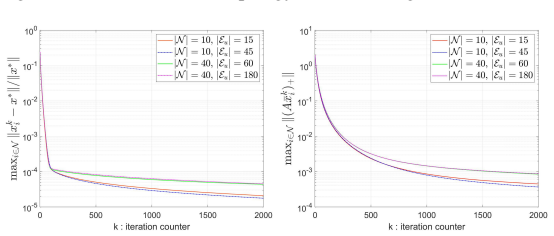
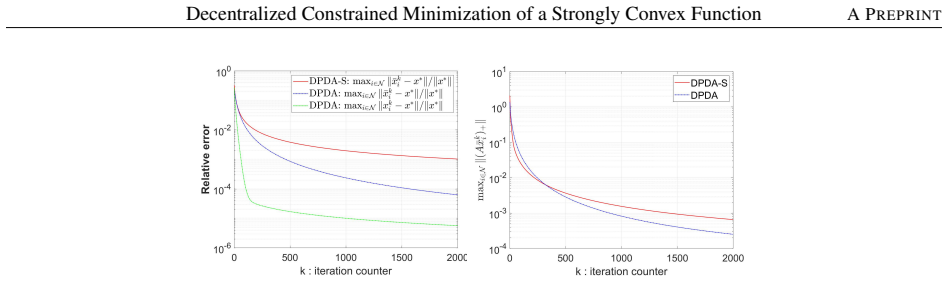
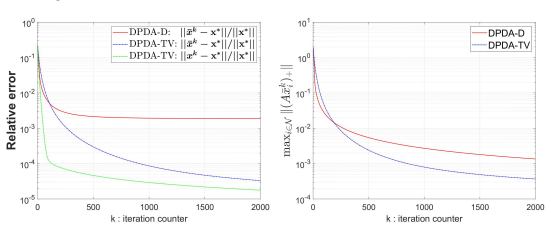
- [Section 6.2] The plots in Figures 10-12 would be easier to read if the legend entries were consistent across panels and the y-axis labels matched the statistics described in the text.
Circularity Check
No circularity: the O(1/k^2) rates are derived from the general APD inequality (7) with explicit step-size and boundedness arguments, not from fitted inputs or self-referential definitions.
full rationale
The paper's derivation chain is self-contained relative to its stated assumptions. The O(1/K^2) guarantees in Theorem 2.2 and Theorem 3.1 follow from the general accelerated primal-dual inequality (7), which is imported from the authors' prior work [11] but is an independent saddle-point bound with explicit step-size conditions and no reference to the decentralized consensus rates claimed here. The static result applies (7) to the saddle reformulation (9), with the dual bound B obtained from the quadratic inequality (16)-(17); although computing B requires a Slater point and knowledge of ||theta*||, that is a standard a priori bound, not a fitted parameter renamed as a prediction. The time-varying result is obtained by treating DPDA-TV as an inexact APD, bounding the averaging error e^{k+1} via the compact-domain assumption Delta < infinity and the approximation condition (23), and then controlling the accumulated error Lambda(K) through the summability condition on q_k. The compact-domain and known-(Gamma,beta) requirements restrict the applicability of Theorem 3.1, and the Section 6 C-LASSO experiments on unbounded domains lie outside that theorem, but this is a scope mismatch rather than a circularity. The paper even explicitly identifies a potential circularity in a naive dual-boundedness induction and breaks the cycle by reordering the x- and y-updates; that passage concerns algorithmic design, not a circular derivation. No step was found where an output quantity is defined in terms of itself, a fitted parameter is relabeled as a prediction, or a load-bearing conclusion rests solely on an unverified self-citation.
Assumptions & free parameters
free parameters (5)
- mu
- gamma_0 =
1/4 in Section 4 experiments
- delta =
C_min in Section 4, 1 in Section 6
- B =
computed from Slater point in experiments, e.g., B=||x0||^2/(2 min_i c_i)
- q_k =
5 ln(k+1) in Section 4, 10 ln(k+1) in Section 6
assumptions (8)
- standard math Standard convex analysis: Fenchel duality, Moreau decomposition, support functions, conjugate functions, Jensen inequality.
- domain assumption Assumption 1.1: f_i is differentiable with L_fi-Lipschitz gradient and prox of rho_i is efficiently computable.
- domain assumption Assumption 1.2: zero duality gap and existence of a primal-dual solution; a Slater point is sufficient.
- domain assumption Assumption 1.3: g_i is K_i-convex, differentiable with L_g_i-Lipschitz Jacobian and bounded Jacobian norm C_g_i.
- domain assumption Assumption 1.4: each f_i is strongly convex with modulus mu_i > 0.
- domain assumption Compact local domains for the time-varying variant, Delta = max_i sup_{x in dom phi_i} ||x|| < infinity (Section 3, before Definition 5).
- domain assumption Assumption 3.2: approximate averaging operator R^k satisfies the geometric error bound ||R^k(omega)-P_Xi(omega)|| <= N Gamma beta^{q_k} ||omega|| with known Gamma and beta in (0,1).
- domain assumption Assumption 3.1: synchronous operation with a global clock, one communication round per tick, and the specified directed or undirected message-passing rules.
Cite this review
Pith. "Pith review of A Decentralized Primal-dual Method for Constrained Minimization of a Strongly Convex Function." pith.science (2026). https://pith.science/paper/65DIIEVH
@misc{pith2026190811835,
  author       = {Pith},
  title        = {Pith review of: A Decentralized Primal-dual Method for Constrained Minimization of a Strongly Convex Function},
  year         = {2026},
  howpublished = {\url{https://pith.science/paper/65DIIEVH}},
  note         = {Machine review of arXiv:1908.11835}
}
read the original abstract
We propose decentralized primal-dual methods for cooperative multi-agent consensus optimization problems over both static and time-varying communication networks, where only local communications are allowed. The objective is to minimize the sum of agent-specific convex functions over conic constraint sets defined by agent-specific nonlinear functions; hence, the optimal consensus decision should lie in the intersection of these private sets. Under the strong convexity assumption, we provide convergence rates for sub-optimality, infeasibility, and consensus violation in terms of the number of communications required; examine the effect of underlying network topology on the convergence rates.
Figures


Figures from the paper (9 more)



Reference graph
Works this paper leans on
-
[30]
A primal-dual method for conic constrained distributed optimization problems,
N. S. Aybat and E. Y . Hamedani, “A primal-dual method for conic constrained distributed optimization problems,” in Advances in Neural Information Processing Systems, 2016, pp. 5050–5058
work page 2016
-
[26]
Distributed constrained optimization by consensus-based primal-dual perturbation method,
T.-H. Chang, A. Nedic, and A. Scaglione, “Distributed constrained optimization by consensus-based primal-dual perturbation method,”Automatic Control, IEEE Transactions on, vol. 59, no. 6, pp. 1524–1538, 2014
work page 2014
-
[29]
Regularized primal-dual subgradient method for distributed constrained optimiza- tion,
D. Yuan, D. W. Ho, and S. Xu, “Regularized primal-dual subgradient method for distributed constrained optimiza- tion,”IEEE Transactions on Cybernetics, vol. PP, no. 99, pp. 1–1, 2015
work page 2015
-
[11]
A primal-dual algorithm with line search for general convex-concave saddle point problems,
E. Y . Hamedani and N. S. Aybat, “A primal-dual algorithm with line search for general convex-concave saddle point problems,”SIAM Journal on Optimization, vol. 31, no. 2, pp. 1299–1329, 2021
2021
-
[1]
Consensus in ad hoc WSNs with noisy links - Part I: Distributed estimation of deterministic signals,
I. D. Schizas, A. Ribeiro, and G. B. Giannakis, “Consensus in ad hoc WSNs with noisy links - Part I: Distributed estimation of deterministic signals,” Signal Processing, IEEE Transactions on, vol. 56, no. 1, pp. 350–364, 2008. 14 Decentralized Constrained Minimization of a Strongly Convex Function A PREPRINT 10 6 1 8 3 11 5 9 4 12 27 Figure 7:Gd = (N,Ed) ...
work page 2008
-
[2]
Multirobot active target tracking with combinations of relative observations,
K. Zhou and S. I. Roumeliotis, “Multirobot active target tracking with combinations of relative observations,” IEEE Transactions on Robotics, vol. 27, no. 4, pp. 678–695, 2011
work page 2011
-
[3]
K. I. Tsianos, S. Lawlor, and M. G. Rabbat, “Consensus-based distributed optimization: Practical issues and applications in large-scale machine learning,” inCommunication, Control, and Computing (Allerton), 2012 50th Annual Allerton Conference on. IEEE, 2012, pp. 1543–1550
work page 2012
-
[4]
Dual averaging for distributed optimization: Convergence analysis and network scaling,
J. C. Duchi, A. Agarwal, and M. J. Wainwright, “Dual averaging for distributed optimization: Convergence analysis and network scaling,”IEEE Transactions on Automatic control, vol. 57, no. 3, pp. 592–606, 2012
work page 2012
Show all 45 references
-
[5]
Distributed non-autonomous power control through distributed convex optimization,
S. S. Ram, V . V . Veeravalli, and A. Nedic, “Distributed non-autonomous power control through distributed convex optimization,” inINFOCOM 2009, IEEE. IEEE, 2009, pp. 3001–3005
2009
-
[6]
Probabilistically constrained linear programs and risk-adjusted controller design,
C. M. Lagoa, X. Li, and M. Sznaier, “Probabilistically constrained linear programs and risk-adjusted controller design,”SIAM Journal on Optimization, vol. 15, no. 3, pp. 938–951, 2005
2005
-
[7]
Cooperative distributed model predictive control,
B. T. Stewart, A. N. Venkat, J. B. Rawlings, S. J. Wright, and G. Pannocchia, “Cooperative distributed model predictive control,”Systems & Control Letters, vol. 59, no. 8, pp. 460–469, 2010
2010
-
[8]
Distributed algorithms for robust convex optimization via the scenario approach,
K. You, R. Tempo, and P. Xie, “Distributed algorithms for robust convex optimization via the scenario approach,” IEEE Transactions on Automatic Control, vol. 64, no. 3, pp. 880–895, 2018
2018
-
[9]
Theory and applications of robust optimization,
D. Bertsimas, D. B. Brown, and C. Caramanis, “Theory and applications of robust optimization,”SIAM review, vol. 53, no. 3, pp. 464–501, 2011
2011
-
[10]
Ben-Tal, L
A. Ben-Tal, L. El Ghaoui, and A. Nemirovski, Robust optimization. Princeton University Press, 2009, vol. 28
2009
-
[12]
Boyd and L
S. Boyd and L. Vandenberghe, Convex optimization. Cambridge university press, 2004
2004
-
[13]
Convergence rate of distributed ADMM over networks,
A. Makhdoumi and A. Ozdaglar, “Convergence rate of distributed ADMM over networks,”IEEE Transactions on Automatic Control, vol. PP, no. 99, 2017
2017
-
[14]
Multi-agent distributed optimization via inexact consensus ADMM,
T. H. Chang, M. Hong, and X. Wang, “Multi-agent distributed optimization via inexact consensus ADMM,”IEEE Transactions on Signal Processing, vol. 63, no. 2, pp. 482–497, Jan 2015
2015
-
[15]
Extra: An exact first-order algorithm for decentralized consensus optimization,
W. Shi, Q. Ling, G. Wu, and W. Yin, “Extra: An exact first-order algorithm for decentralized consensus optimization,”SIAM Journal on Optimization, vol. 25, no. 2, pp. 944–966, 2015
2015
-
[16]
Extrapush for convex smooth decentralized optimization over directed networks,
J. Zeng and W. Yin, “Extrapush for convex smooth decentralized optimization over directed networks,”Journal of Computational Mathematics, vol. 35, no. 4, p. 381–394, 2017
2017
-
[17]
Fast distributed optimization over directed graphs,
C. Xi, Q. Wu, and U. A. Khany, “Fast distributed optimization over directed graphs,” in2016 American Control Conference (ACC), July 2016, pp. 6507–6512
2016
-
[18]
ADD-OPT: Accelerated distributed directed optimization,
C. Xi, R. Xin, and U. A. Khan, “ADD-OPT: Accelerated distributed directed optimization,”IEEE Transactions on Automatic Control, vol. 63, no. 5, pp. 1329–1339, 2017
2017
-
[19]
Nedic and A
A. Nedic and A. Ozdaglar, Convex Optimization in Signal Processing and Communications . Cambridge University Press, 2010, ch. Cooperative Distributed Multi-agent Optimization, pp. 340–385
2010
-
[20]
Distributed optimization,
A. Nedi ´c, “Distributed optimization,” inEncyclopedia of Systems and Control. Springer, 2014, pp. 1–12
2014
-
[21]
Achieving geometric convergence for distributed optimization over time- varying graphs,
A. Nedic, A. Olshevsky, and W. Shi, “Achieving geometric convergence for distributed optimization over time- varying graphs,”SIAM Journal on Optimization, vol. 27, no. 4, pp. 2597–2633, 2017
2017
-
[22]
Constrained consensus and optimization in multi-agent networks,
A. Nedi´c, A. Ozdaglar, and P. A. Parrilo, “Constrained consensus and optimization in multi-agent networks,” Automatic Control, IEEE Transactions on, vol. 55, no. 4, pp. 922–938, 2010. 15 Decentralized Constrained Minimization of a Strongly Convex Function A PREPRINT
2010
-
[23]
Distributed constrained optimization over noisy networks,
K. Srivastava, A. Nedi´c, and D. M. Stipanovi´c, “Distributed constrained optimization over noisy networks,” in Decision and Control (CDC), 2010 49th IEEE Conference on. IEEE, 2010, pp. 1945–1950
2010
-
[24]
On distributed convex optimization under inequality and equality constraints,
M. Zhu and S. Martínez, “On distributed convex optimization under inequality and equality constraints,”Automatic Control, IEEE Transactions on, vol. 57, no. 1, pp. 151–164, 2012
2012
-
[25]
Distributed primal–dual subgradient method for multiagent optimization via consensus algorithms,
D. Yuan, S. Xu, and H. Zhao, “Distributed primal–dual subgradient method for multiagent optimization via consensus algorithms,” Systems, Man, and Cybernetics, Part B: Cybernetics, IEEE Transactions on, vol. 41, no. 6, pp. 1715–1724, 2011
2011
-
[27]
Distributed subgradient methods for saddle-point problems,
D. Mateos-Núñez and J. Cortés, “Distributed subgradient methods for saddle-point problems,” in2015 54th IEEE Conference on Decision and Control (CDC), Dec 2015, pp. 5462–5467
2015
-
[28]
A proximal dual consensus ADMM method for multi-agent constrained optimization,
T. H. Chang, “A proximal dual consensus ADMM method for multi-agent constrained optimization,” IEEE Transactions on Signal Processing, vol. 64, no. 14, pp. 3719–3734, July 2016
2016
-
[31]
Multi-agent constrained optimization of a strongly convex function,
E. Y . Hamedani and N. S. Aybat, “Multi-agent constrained optimization of a strongly convex function,” in2017 IEEE Global Conference on Signal and Information Processing. IEEE, 2017, pp. 558–562
2017
-
[32]
Lower complexity bounds of first-order methods for convex-concave bilinear saddle-point problems,
Y . Ouyang and Y . Xu, “Lower complexity bounds of first-order methods for convex-concave bilinear saddle-point problems,”Mathematical Programming, vol. 185, no. 1, pp. 1–35, 2021
2021
-
[33]
Dykstra’s splitting and an approximate proximal point algorithm for minimizing the sum of convex functions,
C. H. J. Pang, “Dykstra’s splitting and an approximate proximal point algorithm for minimizing the sum of convex functions,”Journal of Optimization Theory and Applications, vol. 182, no. 3, pp. 1019–1049, 2019
2019
-
[34]
On the ergodic convergence rates of a first-order primal–dual algorithm,
A. Chambolle and T. Pock, “On the ergodic convergence rates of a first-order primal–dual algorithm,” Math. Programming, vol. 159, no. 1, pp. 253–287, 2016
2016
-
[35]
A first-order primal-dual algorithm for convex problems with applications to imaging,
——, “A first-order primal-dual algorithm for convex problems with applications to imaging,” Journal of Mathe- matical Imaging and Vision, vol. 40, no. 1, pp. 120–145, 2011
2011
-
[36]
A distributed ADMM-like method for resource sharing over time-varying networks,
N. S. Aybat and E. Y . Hamedani, “A distributed ADMM-like method for resource sharing over time-varying networks,”SIAM Journal on Optimization, vol. 29, no. 4, pp. 3036–3068, 2019
2019
-
[37]
Decentralized computation of effective resistances and acceleration of consensus algorithms,
N. S. Aybat and M. Gürbüzbalaban, “Decentralized computation of effective resistances and acceleration of consensus algorithms,” in 2017 IEEE Global Conference on Signal and Information Processing (GlobalSIP) , 2017, pp. 538–542
2017
-
[38]
Randomized gossiping with effective resistance weights: Performance guarantees and applications,
B. Can, S. Soori, N. S. Aybat, M. M. Dehnavi, and M. Gurbuzbalaban, “Randomized gossiping with effective resistance weights: Performance guarantees and applications,” arXiv preprint arXiv:1907.13110, 2019
1907 arXiv
-
[39]
R. T. Rockafellar, Convex analysis. Princeton university press, 2015
2015
-
[40]
Gossip-based computation of aggregate information,
D. Kempe, A. Dobra, and J. Gehrke, “Gossip-based computation of aggregate information,” inFoundations of Computer Science. Proceedings. 44th Annual IEEE Symposium on. IEEE, 2003, pp. 482–491
2003
-
[41]
Distributed optimization over time-varying directed graphs,
A. Nedi´c and A. Olshevsky, “Distributed optimization over time-varying directed graphs,”IEEE Transactions on Automatic Control, vol. 60, no. 3, pp. 601–615, 2015
2015
-
[42]
On distributed averaging algorithms and quantization effects,
A. Nedic, A. Olshevsky, A. Ozdaglar, and J. N. Tsitsiklis, “On distributed averaging algorithms and quantization effects,”IEEE Transactions on Automatic Control, vol. 54, no. 11, pp. 2506–2517, 2009
2009
-
[43]
A fast distributed proximal-gradient method,
A. I. Chen and A. Ozdaglar, “A fast distributed proximal-gradient method,” in Communication, Control, and Computing (Allerton), 2012 50th Annual Allerton Conference on. IEEE, 2012, pp. 601–608
2012
-
[44]
Convergence rates of inexact proximal-gradient methods for convex optimization,
M. Schmidt, N. L. Roux, and F. R. Bach, “Convergence rates of inexact proximal-gradient methods for convex optimization,” inAdvances in neural information processing systems, 2011, pp. 1458–1466
2011
-
[45]
Mirror prox algorithm for multi-term composite minimization and semi-separable problems,
N. He, A. Juditsky, and A. Nemirovski, “Mirror prox algorithm for multi-term composite minimization and semi-separable problems,”Computational Optimization and Applications, vol. 61, no. 2, pp. 275–319, 2015. 16 Decentralized Constrained Minimization of a Strongly Convex Funct...
2015
Reviewed August 14, 2026 · model on record in the stance chip above.
Discussion (0). Continue with ORCID to comment.