REVIEW 4 major objections 5 minor 35 references
Handling Syntactic Divergence in Low-resource Machine Translation
T0 review · 4 major / 5 minor · reviewed 2026-08-14 · deepseek-v4-flash
Pith's one-line read Reordering beats supervised training in low-resource NMT
desk verdict A simple, plausible data-augmentation recipe for low-resource NMT with a clean ablation, but the 'significant' claim rests on single-run BLEU and needs variance reporting. read the letter →
The pith
A machine-rendered reading of the paper's core claim, the machinery that carries it, and where it could break.
The reading
What carries the argument
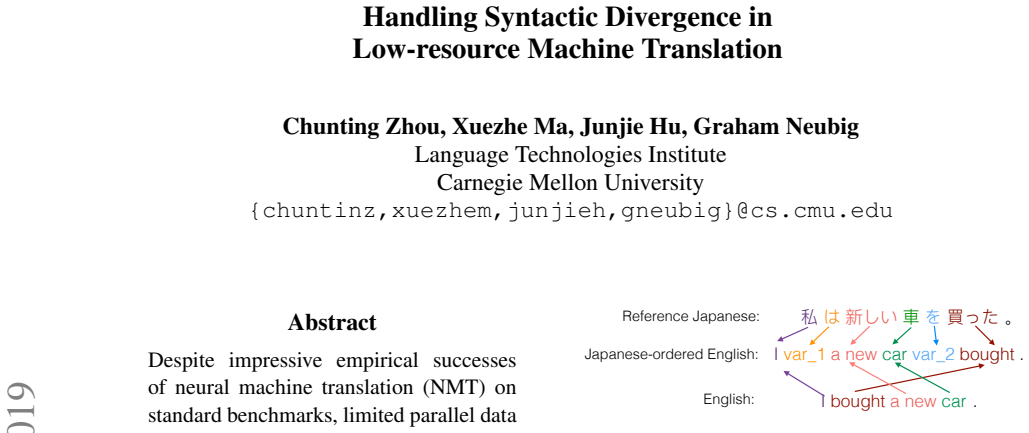
The load-bearing mechanism is a two-step pseudo-corpus construction. First, head finalization reorders each English-side target sentence into SOV order by moving phrase heads to phrase-final position and inserting tokens that mimic Japanese case markers. Second, a bilingual dictionary, built from the intersection of statistical word alignments plus translations induced from bilingual word embeddings, replaces each word in the reordered sentence with a source-language word, yielding a pseudo-source paired with the original target sentence. These pairs are added to the small real parallel corpus (with the real data duplicated five times) as extra training signal, teaching the model the source-target ordering regularities it cannot learn from a few thousand parallel pairs alone.
What would settle it
Run the identical augmentation on a language pair whose target order is not SOV, such as Welsh-to-English, using the unmodified English-to-Japanese head-finalization rules. If BLEU still improves, the gains cannot be credited to matching syntactic order; if it does not improve or drops, the syntactic-matching explanation is confirmed.
Extended reading notes
Core claim
The paper's central claim is that pseudo-parallel sentences created by reordering target-language text into source word order and translating it word-by-word provide supervision that lets NMT learn source-target order in data-poor settings. With 3,000 ja-en sentence pairs, the Reorder method scores BLEU 9.94 against 2.17 for supervised NMT and 2.27 for back-translation; with the in-domain ug-en set it scores 4.17 against 0.58 and 0.42 respectively. The reordering step itself carries most of the benefit: translating the original, unreordered English sentences (No-Reorder) trails Reorder on every setting, and RIBES, a word-order-sensitive metric, also favors Reorder. The paper shows the gains hold for longer sentences and increase as parallel data decreases, and that SMT systems do not gain the same way, pointing to an interaction specific to NMT.
Load-bearing premise
The method assumes that the head-finalization rules written for English-to-Japanese also match Uyghur's sentence structure, and that the bilingual dictionary from a tiny parallel corpus is accurate and broad enough that word-by-word translation noise does not erase the reordering signal.
Editorial extensions
If this is right
- At 3k ja-en parallel pairs the method raises BLEU from 2.17 to 9.94, so it is most useful exactly where standard NMT is barely functional.
- The reordering step is the source of the gain: No-Reorder trails Reorder consistently, and the gap widens for longer sentences.
- With no in-domain parallel data at all, the ug-en system still produces BLEU 4.17, indicating the method can bootstrap translation from monolingual target text plus a dictionary.
- The improvement shows up in RIBES as well as BLEU, meaning the augmented model is not just picking better words but producing better-ordered output.
- Back-translation is not merely weak but sometimes harmful in this regime (e.g., 6k ja-en: 5.40 vs. 7.86 supervised), so reordering-style augmentation occupies a distinct niche.
Reading between the lines
- The recipe should transfer to any SOV-to-SVO pair for which a simple head-finalization rule can be written, and the same logic could be applied to other divergent orders (VSO, VOS) with rules chosen to match.
- Because the dictionary is the main source of lexical noise, injecting controlled corruption into the dictionary in an ablation would map how robust the method is to dictionary errors, which the paper does not test.
- Reordering-based augmentation and back-translation could plausibly be complementary, with reordering teaching word order and back-translation supplying fluent target surfaces, but the paper does not test their combination.
- The fivefold duplication of the real parallel data affects the comparison; ablating the duplication factor would separate the benefit of extra exposure to the real pairs from the benefit of the new pseudo-parallel information.
Signed reviews
Editorial analysis
A structured set of objections, weighed in public.
Referee Report
Summary. This paper proposes a data-augmentation method for low-resource NMT with syntactically divergent language pairs. Given a small parallel corpus and a large target-side monolingual corpus, the method (1) reorders target sentences into source word order using a rule-based head-finalization procedure from Isozaki et al. (2010b), and (2) replaces each word with a source-language word using a bilingual dictionary, producing pseudo-parallel sentence pairs. The pseudo-pairs are added to the supervised training data. Experiments cover a simulated Japanese–English setting (subsampled ASPEC) and a real Uyghur–English setting (LORELEI test data, Bible/Wikipedia parallel data), and compare against supervised NMT/SMT, back-translation, and a No-Reorder control. The main empirical claim is that the method yields large BLEU and RIBES improvements that grow as parallel data shrinks.
Significance. The proposed idea is simple, well motivated, and potentially valuable for low-resource MT: it gives a concrete way to use monolingual data to teach word order in the absence of parallel data. The No-Reorder control is a strong experimental design choice, and the RIBES analysis provides supporting evidence that the gains are related to word order. The use of a genuinely low-resource Uyghur–English pair, rather than only a simulated setting, is a further strength. However, the empirical evidence as presented is not yet sufficient to support the strength of the claims: all BLEU scores are single runs with no significance testing, the key Uyghur reordering gap is small, and the simulated setup is unusually favorable. If the statistical concerns are addressed, the result would be a solid contribution to semi-supervised low-resource MT.
major comments (4)
- [Table 1, Sec. 3.2] The abstract and conclusion describe the gains as 'significant', but the paper reports no significance test, no confidence interval, and no multiple-seed variance for any condition. The most exposed comparison is Uyghur–English: the test set has about 1,975 sentences (Sec. 3.1), and Reorder (4.17) beats No-Reorder (3.24) by only 0.93 BLEU. With single runs, that gap is within the range of ordinary BLEU sampling noise on a test set of this size. Please add paired bootstrap tests on the test outputs or multi-seed runs with standard deviations for at least the ug-en condition and the 3k/6k ja-en conditions, and adjust the wording in the abstract accordingly. This is load-bearing because the ug-en experiment is the only real low-resource evidence that reordering itself, rather than the word-by-word augmentation, is responsible for the improvement.
- [Sec. 2, Fig. 1, Sec. 3.2] The Reorder condition differs from the No-Reorder control in two ways: the word order and the insertion of special tokens (e.g., 'var_1' and 'var_2' in Fig. 1) that mimic Japanese case markers. The No-Reorder control apparently translates the original English sentences and does not include these tokens. The gains attributed to reordering could therefore partly be due to the model receiving additional structural markers. Please run the No-Reorder condition with the same special tokens inserted in their original positions, or add an ablation that inserts the tokens without reordering, so the reordering effect is isolated.
- [Sec. 3.1] In the simulated ja-en experiments, the monolingual English corpus is the English side of the same 400k ASPEC parallel corpus from which the supervised pairs are subsampled. The pseudo-parallel training data is therefore perfectly in-domain with respect to both the supervised data and the test set. This is a favorable condition that is rarely met in actual low-resource settings. Please state this limitation explicitly and, ideally, add an out-of-domain monolingual condition to the simulation. The ug-en experiment partially addresses this concern, but its headline comparison is the statistically weakest one, as noted above.
- [Sec. 2, Sec. 3.1] The word-by-word translation step is central to the method, but the paper never reports the size, coverage, or precision of the bilingual dictionary, nor the proportion of English words that fall back to being copied as-is. Because the pseudo-source sentences are code-mixed whenever the dictionary misses a word, the model is trained on input that differs systematically from the real source language at test time. Please report dictionary statistics for both language pairs and an estimate of the fallback rate; this is necessary to assess how much lexical noise is introduced and whether the gains would survive with a smaller or noisier dictionary.
minor comments (5)
- [Footnote 1] The code URL 'https://github.com/violet-zct/pytorch-.reorder-nmt' is malformed; 'pytorch-.reorder' cannot be a valid repository name. Please provide a working link.
- [Table 2] The Uyghur source and reference lines render with garbled characters (e.g., 'à 8000', 'A3 . 3 A'); please check the font/encoding so the examples are readable.
- [Figure 1] The special tokens 'var_1' and 'var_2' are not defined in the caption; a one-line explanation would help readers understand the reordering output.
- [Appendix A] The sentence 'For SMT, reordering has much better performance than no-reorder' is contradicted by the Uyghur column of Table 3 (No-Reorder 1.67, Reorder 1.07). Please qualify the claim to the ja-en results.
- [Sec. 3.1] Applying the English-to-Japanese head-finalization rules to Uyghur 'as-is' is asserted to demonstrate generalization, but no direct evidence of reordering quality for Uyghur is given. A small sample or automatic measure of reordering accuracy would strengthen this claim.
Circularity Check
No significant circularity: the reordering rules and dictionary induction are external or training-split-based, and all claims are evaluated on held-out test sets.
full rationale
The derivation chain is self-contained and empirically grounded. Reordering uses head-finalization rules from Isozaki et al. (2010b), an external SMT method, applied to monolingual target sentences; word-by-word translation uses a bilingual dictionary built with GIZA++ alignments on the training parallel split and DemaBWE or geometric bilingual embeddings, and the resulting pseudo-parallel corpus is used only as augmented training data. Evaluation is on held-out test sets (ASPEC ja-en held-out split and Uyghur LORELEI test set), with baselines trained under the same data conditions. The central comparison Reorder versus No-Reorder changes only the reordering step while holding the dictionary-translation pipeline fixed, so the measured BLEU and RIBES differences are empirical effects rather than identities imposed by construction. The same-author self-citation, DemaBWE (Zhou et al., 2019), is used as a dictionary-induction component rather than as a load-bearing theorem or as justification of the paper's conclusion; replacing it with an external embedding method (Jawanpuria et al., 2019) in the Uyghur experiments further shows the result does not stand on that self-citation. No fitted parameter is relabeled as a prediction, and no uniqueness argument is imported from the authors' prior work. Accordingly the paper is not circular; any concerns about statistical significance or single-run BLEU tables are correctness and evidence concerns, not circularity.
Assumptions & free parameters
assumptions (4)
- domain assumption Head-finalization reordering rules from Isozaki et al. (2010b) produce English sentences in Japanese word order and are applicable to Uyghur with no modification.
- domain assumption A bilingual dictionary sufficient for word-by-word translation can be induced from the small parallel corpus, either by GIZA++ alignment intersection or embedding-based lexicon induction.
- domain assumption Monolingual target sentences are available in large quantity and can be filtered to match the test domain.
- domain assumption Standard NMT training on duplicated parallel data plus pseudo-parallel data does not overfit in a way that harms held-out test translation.
Cite this review
Pith. "Pith review of Handling Syntactic Divergence in Low-resource Machine Translation." pith.science (2026). https://pith.science/paper/N3JNCNG4
@misc{pith2026190900040,
  author       = {Pith},
  title        = {Pith review of: Handling Syntactic Divergence in Low-resource Machine Translation},
  year         = {2026},
  howpublished = {\url{https://pith.science/paper/N3JNCNG4}},
  note         = {Machine review of arXiv:1909.00040}
}
read the original abstract
Despite impressive empirical successes of neural machine translation (NMT) on standard benchmarks, limited parallel data impedes the application of NMT models to many language pairs. Data augmentation methods such as back-translation make it possible to use monolingual data to help alleviate these issues, but back-translation itself fails in extreme low-resource scenarios, especially for syntactically divergent languages. In this paper, we propose a simple yet effective solution, whereby target-language sentences are re-ordered to match the order of the source and used as an additional source of training-time supervision. Experiments with simulated low-resource Japanese-to-English, and real low-resource Uyghur-to-English scenarios find significant improvements over other semi-supervised alternatives.
Figures


Reference graph
Works this paper leans on
-
[1]
URL: " 'urlintro :=
ENTRY address author booktitle chapter edition editor howpublished institution journal key month note number organization pages publisher school series title type volume year eprint doi pubmed url lastchecked label extra.label sort.label short.list INTEGERS output.state before.all mid.sentence after.sentence after.block STRINGS urlintro eprinturl eprintpr...
-
[2]
write newline
" write newline "" before.all 'output.state := FUNCTION n.dashify 't := "" t empty not t #1 #1 substring "-" = t #1 #2 substring "--" = not "--" * t #2 global.max substring 't := t #1 #1 substring "-" = "-" * t #2 global.max substring 't := while if t #1 #1 substring * t #2 global.max substring 't := if while FUNCTION word.in bbl.in capitalize " " * FUNCT...
-
[3]
Mikel Artetxe, Gorka Labaka, and Eneko Agirre. 2018 a . Unsupervised statistical machine translation. In Proceedings of the 2018 Conference on Empirical Methods in Natural Language Processing, Brussels, Belgium. Association for Computational Linguistics
work page 2018
-
[4]
Mikel Artetxe, Gorka Labaka, Eneko Agirre, and Kyunghyun Cho. 2018 b . Unsupervised neural machine translation. In International Conference on Learning Representations (ICLR)
work page 2018
-
[5]
Ibrahim Badr, Rabih Zbib, and James Glass. 2009. Syntactic phrase reordering for English-to-Arabic statistical machine translation . In Proceedings of the 12th Conference of the European Chapter of the Association for Computational Linguistics, pages 86--93. Association for Computational Linguistics
work page 2009
-
[6]
Dzmitry Bahdanau, Kyunghyun Cho, and Yoshua Bengio. 2015. Neural machine translation by jointly learning to align and translate. In International Conference on Learning Representations (ICLR)
2015
-
[7]
Luisa Bentivogli, Arianna Bisazza, Mauro Cettolo, and Marcello Federico. 2016. Neural versus phrase-based machine translation quality: a case study. In Proceedings of the 2016 Conference on Empirical Methods in Natural Language Processing, pages 257--267, Austin, Texas. Association for Computational Linguistics
work page 2016
-
[8]
Arianna Bisazza and Marcello Federico. 2016. A survey of word reordering in statistical machine translation: Computational models and language phenomena . Computational linguistics, 42(2):163--205
work page 2016
Show all 35 references
-
[9]
Ond r ej Bojar, Rajen Chatterjee, Christian Federmann, Yvette Graham, Barry Haddow, Shujian Huang, Matthias Huck, Philipp Koehn, Qun Liu, Varvara Logacheva, et al. 2017. Findings of the 2017 conference on machine translation (WMT17) . In Proceedings of the Second Conference on...
2017
-
[10]
Yong Cheng, Wei Xu, Zhongjun He, Wei He, Hua Wu, Maosong Sun, and Yang Liu. 2016. Semi-supervised learning for neural machine translation. The 54th Annual Meeting of the Association for Computational Linguistics (ACL)
2016
-
[11]
Caitlin Christianson, Jason Duncan, and Boyan Onyshkevych. 2018. https://doi.org/10.1007/s10590-017-9212-4 Overview of the DARPA LORELEI Program . Machine Translation, 32(1-2):3--9
2018 doi
-
[12]
Michael Collins, Philipp Koehn, and Ivona Ku c erov \'a . 2005. Clause restructuring for statistical machine translation . In Proceedings of the 43rd annual meeting on association for computational linguistics, pages 531--540. Association for Computational Linguistics
2005
-
[13]
Anna Currey, Antonio Valerio Miceli Barone, and Kenneth Heafield. 2017. Copied monolingual data improves low-resource neural machine translation. In Proceedings of the Second Conference on Machine Translation, pages 148--156
2017
-
[14]
Jinhua Du and Andy Way. 2017. Pre-Reordering for Neural Machine Translation: Helpful or Harmful? The Prague Bulletin of Mathematical Linguistics, 108(1):171--182
2017
-
[15]
Chris Dyer, Jonathan Weese, Hendra Setiawan, Adam Lopez, Ferhan Ture, Vladimir Eidelman, Juri Ganitkevitch, Phil Blunsom, and Philip Resnik. 2010. cdec: A decoder, alignment, and learning framework for finite-state and context-free translation models . In Proceedings of the AC...
2010
-
[16]
Edouard Grave, Piotr Bojanowski, Prakhar Gupta, Armand Joulin, and Tomas Mikolov. 2018. https://fasttext.cc/docs/en/crawl-vectors.html Learning word vectors for 157 languages . In Proceedings of the Eleventh International Conference on Language Resources and Evaluation (LREC-2018)
2018
-
[17]
Francisco Guzm \'a n, Peng-Jen Chen, Myle Ott, Juan Pino, Guillaume Lample, Philipp Koehn, Vishrav Chaudhary, and Marc'Aurelio Ranzato. 2019. Two New Evaluation Datasets for Low-Resource Machine Translation: Nepali-English and Sinhala-English . arXiv preprint arXiv:1902.01382
2019 arXiv
-
[18]
Nizar Habash. 2007. Syntactic preprocessing for statistical machine translation . Proceedings of the 11th MT Summit, 10
2007
-
[19]
Di He, Yingce Xia, Tao Qin, Liwei Wang, Nenghai Yu, Tieyan Liu, and Wei-Ying Ma. 2016. Dual learning for machine translation. In Advances in Neural Information Processing Systems (NIPs), pages 820--828
2016
-
[20]
Ann Irvine and Chris Callison-Burch. 2013. Combining bilingual and comparable corpora for low resource machine translation. In Proceedings of the eighth workshop on statistical machine translation, pages 262--270
2013
-
[21]
Hideki Isozaki, Tsutomu Hirao, Kevin Duh, Katsuhito Sudoh, and Hajime Tsukada. 2010 a . Automatic evaluation of translation quality for distant language pairs. In Proceedings of the 2010 Conference on Empirical Methods in Natural Language Processing, pages 944--952. Associatio...
2010
-
[22]
Hideki Isozaki, Katsuhito Sudoh, Hajime Tsukada, and Kevin Duh. 2010 b . Head finalization: A simple reordering rule for SOV languages . In Proceedings of the Joint Fifth Workshop on Statistical Machine Translation and MetricsMATR, pages 244--251. Association for Computational...
2010
-
[23]
Pratik Jawanpuria, Arjun Balgovind, Anoop Kunchukuttan, and Bamdev Mishra. 2019. Learning multilingual word embeddings in latent metric space: a geometric approach. Transactions of the Association for Computational Linguistics (TACL)
2019
-
[24]
Philipp Koehn and Rebecca Knowles. 2017. Six challenges for neural machine translation. In Proceedings of the First Workshop on Neural Machine Translation, pages 28--39, Vancouver. Association for Computational Linguistics
2017
-
[25]
Robert C Moore and William Lewis. 2010. Intelligent selection of language model training data. In Proceedings of the ACL 2010 conference short papers, pages 220--224. Association for Computational Linguistics
2010
-
[26]
Toshiaki Nakazawa, Manabu Yaguchi, Kiyotaka Uchimoto, Masao Utiyama, Eiichiro Sumita, Sadao Kurohashi, and Hitoshi Isahara. 2016. ASPEC: Asian Scientific Paper Excerpt Corpus . In Proceedings of the Ninth International Conference on Language Resources and Evaluation (LREC 2016...
2016
-
[27]
Jiri Navratil, Karthik Visweswariah, and Ananthakrishnan Ramanathan. 2012. A comparison of syntactic reordering methods for English-German machine translation . Proceedings of COLING 2012, pages 2043--2058
2012
-
[28]
Graham Neubig and Junjie Hu. 2018. Rapid adaptation of neural machine translation to new languages. In Proceedings of the 2018 Conference on Empirical Methods in Natural Language Processing, pages 875--880. Association for Computational Linguistics
2018
-
[29]
Franz Josef Och and Hermann Ney. 2003. A systematic comparison of various statistical alignment models. Computational Linguistics, 29(1):19--51
2003
-
[30]
Rico Sennrich, Barry Haddow, and Alexandra Birch. 2016. Improving Neural Machine Translation Models with Monolingual Data . In Proceedings of the 54th Annual Meeting of the Association for Computational Linguistics (Volume 1: Long Papers), volume 1, pages 86--96
2016
-
[31]
Yoshimasa Tsuruoka, Yusuke Miyao, and Jun’ichi Tsujii. 2004. Towards efficient probabilistic HPSG parsing: integrating semantic and syntactic preference to guide the parsing . In Proceedings of the IJCNLP-04 Workshop on Beyond Shallow Analyses. ACL
2004
-
[32]
Ashish Vaswani, Noam Shazeer, Niki Parmar, Jakob Uszkoreit, Llion Jones, Aidan N Gomez, ukasz Kaiser, and Illia Polosukhin. 2017. Attention is all you need. In Advances in neural information processing systems, pages 5998--6008
2017
-
[33]
Fei Xia and Michael McCord. 2004. Improving a Statistical MT System with Automatically Learned Rewrite Patterns . In Proceedings of Coling 2004, pages 508--514, Geneva, Switzerland. COLING
2004
-
[34]
Jiateng Xie, Zhilin Yang, Graham Neubig, Noah A Smith, and Jaime Carbonell. 2018. Neural cross-lingual named entity recognition with minimal resources. In Proceedings of the 2018 Conference on Empirical Methods in Natural Language Processing, pages 369--379
2018
-
[35]
Chunting Zhou, Xuezhe Ma, Di Wang, and Graham Neubig. 2019. Density Matching for Bilingual Word Embedding . In Meeting of the North American Chapter of the Association for Computational Linguistics (NAACL), Minneapolis, USA
2019
Reviewed August 14, 2026 · model on record in the stance chip above.
Discussion (0). Continue with ORCID to comment.