REVIEW 4 major objections 5 minor 72 references
Open Named Entity Modeling from Embedding Distribution
T0 review · 4 major / 5 minor · reviewed 2026-08-14 · deepseek-v4-flash
Pith's one-line read Common named entity types — persons, locations, and organizations — cluster into dense hyperspheres in word-embedding space, which enables a dictionary-free, cross-lingual definition of named entities.
desk verdict A modest NER feature idea wrapped in an overstated discovery claim; the monolingual part is worth a look, but the cross-lingual mapping rests on a derivation error that undercuts the main low-resource contribution. read the letter →
The pith
A machine-rendered reading of the paper's core claim, the machinery that carries it, and where it could break.
The reading
What carries the argument
The named-entity hypersphere is a two-parameter geometric model: for each entity type, a center vector O and a radius r such that a word X is a candidate entity of that type if its Euclidean distance E(X,O) is no greater than r. It carries the argument as an open replacement for entity dictionaries: instead of consulting a finite list, any embedding inside the sphere is treated as a member of the type, and newly emerging entities are covered automatically as long as their embeddings lie inside. For cross-lingual transfer, the paper relies on the affine-invariance of relative distances, expressed as E(O1,X)/r1 = E(O2,Z)/r2, with the scale ratio K = r2/r1 solved from a small set of seed pairs; this makes the mapping require only a handful of annotated pairs. In the NER enhancement experiments, the same object appears as a 3-D feature vector: the z-scored distances from each word to the PER, LOC, and ORG hypersphere centers.
What would settle it
Compute the ratio E(O2, Z(i)) / E(O1, X(i)) on a held-out set of seed pairs between two languages with known entity dictionaries. If the variance of this ratio across pairs is large (i.e., K is not nearly constant) or if the predicted target hypersphere contains a low fraction of true target-language entities, the affine-ratio mapping fails. A monolingual check is equally concrete: for a language with a large gold NE dictionary, if the fitted hypersphere's F1 against that dictionary is no better than a baseline that picks the same number of random words, or if most dictionary entities fall outside the best-radius sphere, then the dense-hypersphere claim is not supported.
Extended reading notes
Core claim
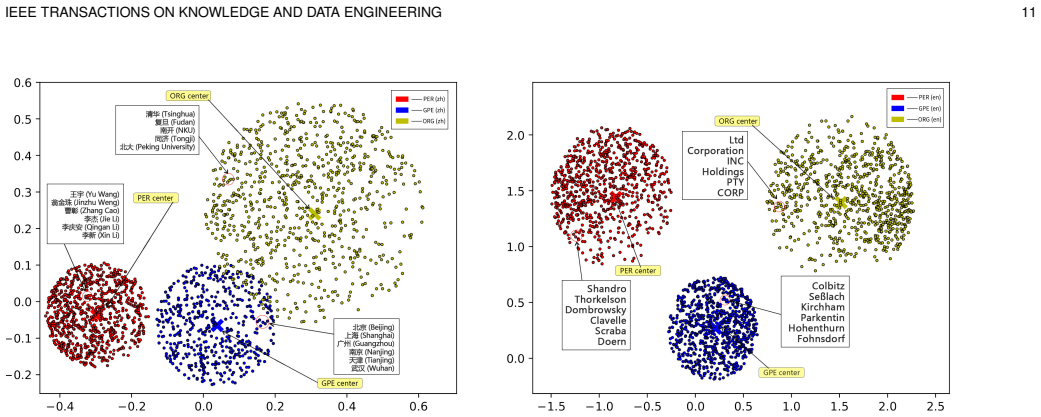
The central discovery is that common named entity types (PER, LOC, ORG) tend to be densely distributed inside a hypersphere in a general word-embedding space, and this geometric regularity can serve as an open definition of named entities. The paper proposes a named-entity hypersphere model with two parameters per type — a center vector O and a radius r — and treats membership as E(X, O) <= r for a word embedding X. The authors support the claim by t-SNE visualizations of English and Chinese embeddings, by inspecting nearest neighbors of known entities, and by experiments in which a fitted hypersphere separates dictionary entities from the rest of the vocabulary with F1 scores near 0.5 for PER, LOC, and ORG. They then claim that because embedding spaces are approximately isomorphic across languages, the hypersphere can be mapped from one language to another using either an Earth-Mover's-Distance/WGAN transformation or a seed-pair affine mapping that preserves relative distances to the center. The final component of the discovery is that z-scored Euclidean distances to the three hypersphere centers act as useful soft features that consistently improve several BiLSTM-CRF based NER baselines on English and Chinese benchmarks, with the largest gains at small training-data sizes.
Load-bearing premise
The load-bearing assumption is that two embedding spaces are related closely enough by a simple affine map that relative distances to the hypersphere centers are preserved, so the radius measured in one language can be transferred to the other as a scaled radius.
Editorial extensions
If this is right
- Monolingual entity detection can be done by geometry alone: any word whose embedding falls inside the fitted hypersphere of a type is treated as a member, so the model covers unregistered and newly created entities without dictionary updates.
- Cross-lingual entity resources become transferable: a source-language hypersphere plus an affine mapping between embedding spaces yields a candidate entity detector for a target language, demonstrated by building an Indonesian NE candidate list from English with seed pairs.
- The hypersphere feature improves strong neural NER systems: z-scored distances to the three centers deliver consistent F1 gains on CoNLL-2003 and Ontonotes 5.0 (English) and CityU and MSRA (Chinese), including a reported state-of-the-art 89.75 F1 on Ontonotes 5.0.
- Low-resource NER training benefits: the hypersphere feature gives larger relative improvements when the training set is small, suggesting the geometric clue substitutes for some annotation.
- The mapped hypersphere already captures enough structure to serve as a candidate NE dictionary for a truly low-resource language, with top-100 precision between 0.31 and 0.44 for the three types in Indonesian.
Reading between the lines
- Implicitly, the hypersphere model suggests a continuous confidence score for entity types rather than a hard membership; a word that lies between two spheres (like a polysemous name) could be assigned a soft probability, which might be exploited in entity linking and ambiguity resolution.
- One can test whether the spherical regularity is specific to static word2vec-style embeddings: in contextual embeddings, each word has multiple vectors, and the same two-parameter sphere may not hold; if it does not, a contextual variant of the model would require a different geometric object.
- The affine-ratio mapping could in principle be applied to any open-class category, not just PER/LOC/ORG; measuring how well the ratio K stays constant across held-out seed pairs would provide a cheap diagnostic for whether two embedding spaces are compatible enough for the method to work.
- The paper's low-resource experiment uses manual inspection rather than gold labels; a natural extension is to score the predicted Indonesian candidates against a human-created gold set or to run the mapped hypersphere as a weak annotator in a distant-supervision pipeline.
Signed reviews
Editorial analysis
A structured set of objections, weighed in public.
Referee Report
Summary. The paper proposes that named entity words of types PER, LOC, and ORG form a hypersphere in word embedding space, defines an open NE model via a center and a radius per type, maps the model across languages using learned embedding transformations, and uses the distance to hypersphere centers as an additional feature for NER systems. The authors report monolingual F1 scores around 0.46-0.58 for hypersphere-based NE detection, cross-lingual mapping experiments between English and Chinese and from English to Indonesian, and consistent improvements when the hypersphere feature is added to several BiLSTM-CRF baselines.
Significance. If the empirical claims held, the hypersphere model would provide a simple, dictionary-free description of NE distribution with potential utility for low-resource languages and as a feature for NER. The NER enhancement experiments in Tables 10-12 are a genuine strength: the 3-D hypersphere feature yields small but consistent F1 gains across multiple strong baselines, and the authors are transparent about reproduction difficulties and about t-SNE parameter sensitivity. The cross-lingual mapping idea is attractive but, as presented, is not supported by the derivations and quantitative results. The main contributions are therefore only partially established.
major comments (4)
- [Section 4.2, Eqs. (8)-(10)] The derivation of the cross-lingual hypersphere mapping is mathematically unsound. Equation (8) asserts that an affine transformation preserves the ratio E(O1,X)/r1 = E(O2,Z)/r2, but a general affine map f(x)=W^T x+b does not preserve ratios of Euclidean distances from arbitrary points to a center; it does so only when W is a scalar multiple of an orthogonal matrix. The collinear-ratio argument surrounding Eq. (7) shows only that ratios along a line are preserved, which does not transfer to distances in the ambient space. In addition, Eq. (10) is described as a linear equation group, but after squaring it contains quadratic terms in O2, so solving for O2 is not the linear problem the text claims. Since the predicted target hyperspheres in Tables 6-8 depend on this mapping, the cross-lingual results are not established by the derivation.
- [Section 4.1 and Tables 4-5] The monolingual evidence for the hypersphere hypothesis is weak and partly circular. The center and radius are optimized on the NE dictionary by maximizing F1, and the embedding dimension per type is also selected by maximum F1, so the resulting F1 scores measure how well the fitting procedure can adapt to the data rather than providing an independent confirmation of a spherical shape. The reported values (F1 between 0.46 and 0.58) are modest, and no comparison is made with alternative geometric models such as an ellipsoid, a Gaussian, or a mixture model, nor with a random baseline. The conclusion in Section 6 that common NE types 'tend to be densely distributed in a hypersphere' therefore overstates what Tables 4 and 5 demonstrate.
- [Section 5.3, Tables 6-7] The cross-lingual mapping results do not support the claim of considerable performance. The affine mapping F1 scores are mostly low (for example, 0.151 for en-zh ORG and 0.162 for zh-en ORG), and several k-NN baselines outperform the mapping (for example, k-NN2500 reaches 0.718 for en-zh ORG). The volume-based metric in Eq. (11) measures overlap of hyperspheres in the embedding space, not NE identification accuracy in the target language, and no statistical significance or variance information is reported. The target-language NE detection benefit of the proposed mapping is therefore not demonstrated.
- [Section 5.3, Table 8] The Indonesian evaluation is insufficient to support the claim that a useful NE dictionary is built. Table 8 reports only precision on the top-100 nearest words to the predicted center, with values from 0.31 to 0.60, and the manual examination protocol is not described. There is no F1 score, no comparison to a random or dictionary-based baseline, and no measure of inter-annotator agreement. At face value, a precision of 0.35 for top-100 LOC words means the majority of predicted entities are not correct, which is not satisfactory precision as stated in Section 6.
minor comments (5)
- [Section 5.3] The text contains a typo: 'we fist utilize' should be 'we first utilize'.
- [Section 5.6] The sentence 'especially when the it is less than 60% of the training set' contains a grammatical error and should be rephrased.
- [Section 5.5] The footnote marker '18' is used twice in the text, which makes the footnotes confusing; the numbering should be corrected.
- [Section 4.2] The reference to 'the initialized center O2 in Equation (3)' appears to be a citation error; Equation (3) defines the Wasserstein distance, while the center O2 is introduced in Eq. (6).
- [Abstract] The phrase 'replies on schedule update' should be 'relies on scheduled updates'.
Circularity Check
Cross-lingual hypersphere mapping is built from an assumed ratio invariance that is used to solve the very parameters it claims to predict.
-
ansatz smuggled in via citation
[Section 4.2 (Affine Mapping), Eqs. (7)-(10)]
"Based on the above characteristic, for any point X(i) in the source space and its mapping point Z(i), X(i) and Z(i) cut off radiuses with the same ratio, namely, the ratio of the distance of these two points to their centers and their radiuses remains unchanged. E(O1,X(i))/r1 = E(O2,Z(i))/r2 (8)"
The property proved in Eq. (7) is that affine maps preserve ratios of collinear segments. Eq. (8) extends this to Euclidean distance ratios from arbitrary points to sphere centers, which affine maps do not preserve; it is an additional ansatz, not a consequence of the cited affine-geometry invariance. The paper then solves K, O2, and r2 by enforcing this same equation on seed pairs (Eqs. (9)-(10)), so the target hypersphere is constructed to satisfy the assumed ratio rather than derived from the learned affine map. The cross-lingual experiments in Tables 6-8 evaluate spheres generated from this self-imposed constraint, making the mapping prediction equivalent to the initial assumption by construction.
full rationale
The monolingual hypersphere model is fitted to an NE dictionary by F1 maximization on a 9:1 train/test split, so its held-out F1 and the NER improvements on external benchmarks (CoNLL-2003, OntoNotes 5.0, MSRA, CityU) provide independent checks; the self-citations in the introduction are background references and are not load-bearing. The significant circularity is in the cross-lingual affine mapping: Eq. (8) is asserted as an affine invariant, but it is only the collinear ratio property that is affine-invariant, and Eq. (8) is exactly the relation used to solve the target center, ratio K, and radius. Thus the predicted target hypersphere is a solution to the assumed equation rather than a consequence of the embedding mapping, making the cross-lingual NE-distribution transfer claim partially circular by construction. The rest of the paper, especially the NER feature evaluation, remains self-contained.
Assumptions & free parameters
free parameters (6)
- Hypersphere center O per NE type =
Mean of NE embeddings after iterative filtering (not reported numerically)
- Hypersphere radius r per NE type =
Searched in [minDist, maxDist] to maximize F1 (not reported)
- Embedding dimension per NE type =
16-D for PER and ORG, 24-D for LOC
- Threshold q for discarding distant NEs =
Not specified
- Affine mapping ratio K =
Solved from seed pairs; not reported
- Number of seed pairs s =
About two dozen per entity type
assumptions (5)
- domain assumption Word embeddings place similar words close together in Euclidean space, so NE words share a region.
- domain assumption Cross-lingual embedding spaces are affinely isomorphic, and Euclidean distance ratios to hypersphere centers are preserved under this map.
- ad hoc to paper The NE distribution per type is unimodal and spherically symmetric, so one center and one radius suffice.
- domain assumption t-SNE visualizations represent the true geometric structure of high-dimensional embeddings.
- domain assumption The hand-built NE dictionaries are sufficiently complete and accurate to serve as ground truth for fitting and evaluating the hypersphere.
invented entities (1)
-
Named entity hypersphere
Cite this review
Pith. "Pith review of Open Named Entity Modeling from Embedding Distribution." pith.science (2026). https://pith.science/paper/RKK2MHA4
@misc{pith2026190900170,
  author       = {Pith},
  title        = {Pith review of: Open Named Entity Modeling from Embedding Distribution},
  year         = {2026},
  howpublished = {\url{https://pith.science/paper/RKK2MHA4}},
  note         = {Machine review of arXiv:1909.00170}
}
read the original abstract
In this paper, we report our discovery on named entity distribution in a general word embedding space, which helps an open definition on multilingual named entity definition rather than previous closed and constraint definition on named entities through a named entity dictionary, which is usually derived from human labor and replies on schedule update. Our initial visualization of monolingual word embeddings indicates named entities tend to gather together despite of named entity types and language difference, which enable us to model all named entities using a specific geometric structure inside embedding space, namely, the named entity hypersphere. For monolingual cases, the proposed named entity model gives an open description of diverse named entity types and different languages. For cross-lingual cases, mapping the proposed named entity model provides a novel way to build a named entity dataset for resource-poor languages. At last, the proposed named entity model may be shown as a handy clue to enhance state-of-the-art named entity recognition systems generally.
Figures


Figures from the paper (5 more)


Reference graph
Works this paper leans on
-
[1]
Neural architectures for named entity recognition,
G. Lample, M. Ballesteros, S. Subramanian, K. Kawakami, and C. Dyer, “Neural architectures for named entity recognition,” in Proceedings of the 2016 Conference of the North American Chapter of the Association for Computational Linguistics: Human Language Technologies, 2016
work page 2016
-
[2]
Bipartite flat-graph network for nested named entity recognition,
Y . Luo and H. Zhao, “Bipartite flat-graph network for nested named entity recognition,” in Proceedings of the 58th Annual Meeting of the Association for Computational Linguistics, 2020, pp. 6408–6418
work page 2020
-
[3]
Named entity recognition only from word embeddings,
Y . Luo, H. Zhao, and J. Zhan, “Named entity recognition only from word embeddings,” in Proceedings of the 2020 conference on empirical methods in natural language processing (EMNLP 2020), 2020
work page 2020
-
[4]
Linguistic regularities in continu- ous space word representations,
T. Mikolov, W. T. Yih, and G. Zweig, “Linguistic regularities in continu- ous space word representations,” in NAACL-HLT, 2013
work page 2013
-
[5]
Adapting word2vec to named entity recognition,
S. K. Sien ˇcnik, “Adapting word2vec to named entity recognition,” in Proceedings of the 20th Nordic Conference of Computational Linguistics (NODALIDA 2015), 2015, pp. 239–243
work page 2015
-
[6]
Named entity recognition using word embedding as a feature,
M. Seok, H.-J. Song, C.-Y . Park, J.-D. Kim, and Y .-s. Kim, “Named entity recognition using word embedding as a feature,”International Journal of Software Engineering and Its Applications, vol. 10, no. 2, 2016
work page 2016
-
[7]
Exploiting similarities among languages for machine translation,
T. Mikolov, Q. V . Le, and I. Sutskever, “Exploiting similarities among languages for machine translation,” arXiv:1309.4168 [cs], 2013
arXiv 2013
-
[8]
Cheap translation for cross-lingual named entity recognition,
S. Mayhew, C.-T. Tsai, and D. Roth, “Cheap translation for cross-lingual named entity recognition,” in Proceedings of the 2017 Conference on Empirical Methods in Natural Language Processing, 2017
work page 2017
Show all 72 references
-
[9]
Weakly supervised cross-lingual named entity recognition via effective annotation and representation projection,
J. Ni, G. Dinu, and R. Florian, “Weakly supervised cross-lingual named entity recognition via effective annotation and representation projection,” in Proceedings of the 55th Annual Meeting of the Association for Computational Linguistics (Volume 1: Long Papers) , 2017, pp. 1470– 1480
2017
-
[10]
Phonolog- ically aware neural model for named entity recognition in low resource transfer settings,
A. Bharadwaj, D. Mortensen, C. Dyer, and J. G. Carbonell, “Phonolog- ically aware neural model for named entity recognition in low resource transfer settings,” in Proceedings of the 2016 Conference on Empirical Methods in Natural Language Processing, 2016
2016
-
[11]
Rolston and K
L. Rolston and K. Kirchhoff, Collection of bilingual data for lexicon transfer learning, Technical report, 2016
2016
-
[12]
Multilingual named entity recognition using parallel data and metadata from wikipedia,
S. Kim, K. Toutanova, and H. Yu, “Multilingual named entity recognition using parallel data and metadata from wikipedia,” in Proceedings of the 50th Annual Meeting of the Association for Computational Linguistics , 2012. IEEE TRANSACTIONS ON KNOWLEDGE AND DATA ENGINEERING 11 F...
2012
-
[13]
Improving multilingual named entity recognition with Wikipedia entity type mapping,
J. Ni and R. Florian, “Improving multilingual named entity recognition with Wikipedia entity type mapping,” in Proceedings of the 2016 Con- ference on Empirical Methods in Natural Language Processing , 2016, pp. 1275–1284
2016
-
[14]
Named entity recognition using cross-lingual resources: Arabic as an example,
K. Darwish, “Named entity recognition using cross-lingual resources: Arabic as an example,” in Proceedings of the 51st Annual Meeting of the Association for Computational Linguistics, 2013
2013
-
[15]
Cross- lingual name tagging and linking for 282 languages,
X. Pan, B. Zhang, J. May, J. Nothman, K. Knight, and H. Ji, “Cross- lingual name tagging and linking for 282 languages,” in Proceedings of the 55th Annual Meeting of the Association for Computational Linguis- tics, 2017, pp. 1946–1958
2017
-
[16]
End-to-end sequence labeling via bi-directional LSTM-CNNs-CRF,
X. Ma and E. Hovy, “End-to-end sequence labeling via bi-directional LSTM-CNNs-CRF,” in Proceedings of the 54th Annual Meeting of the Association for Computational Linguistics, 2016, pp. 1064–1074
2016
-
[17]
Empower sequence labeling with task-aware neural language model,
L. Liu, J. Shang, X. Ren, F. Xu, H. Gui, J. Peng, and J. Han, “Empower sequence labeling with task-aware neural language model,” in Proceed- ings of the AAAI Conference on Artificial Intelligence , vol. 32, no. 1, 2018
2018
-
[18]
NCRF++: An open-source neural sequence labeling toolkit,
J. Yang and Y . Zhang, “NCRF++: An open-source neural sequence labeling toolkit,” in Proceedings of ACL 2018, System Demonstrations , 2018, pp. 74–79
2018
-
[19]
Experiments in graph-based semi- supervised learning methods for class-instance acquisition,
P. P. Talukdar and F. Pereira, “Experiments in graph-based semi- supervised learning methods for class-instance acquisition,” in Proceed- ings of the 48th annual meeting of the association for computational linguistics, 2010, pp. 1473–1481
2010
-
[20]
Deep active learning for named entity recognition,
Y . Shen, H. Yun, Z. C. Lipton, Y . Kronrod, and A. Anandkumar, “Deep active learning for named entity recognition,” in Proceedings of the International Conference on Learning Representations, 2018
2018
-
[21]
Clustype: Effective entity recognition and typing by relation phrase-based cluster- ing,
X. Ren, A. El-Kishky, C. Wang, F. Tao, C. R. V oss, and J. Han, “Clustype: Effective entity recognition and typing by relation phrase-based cluster- ing,” inProceedings of the 21th ACM SIGKDD International Conference on Knowledge Discovery and Data Mining , 2015, pp. 995–1004
2015
-
[22]
Learning named entity tagger using domain-specific dictionary,
J. Shang, L. Liu, X. Gu, X. Ren, T. Ren, and J. Han, “Learning named entity tagger using domain-specific dictionary,” in EMNLP, 2018
2018
-
[23]
Swellshark: A generative model for biomedical named entity recognition without labeled data,
J. Fries, S. Wu, A. Ratner, and C. R ´e, “Swellshark: A generative model for biomedical named entity recognition without labeled data,” arXiv preprint arXiv:1704.06360, 2017
2017 arXiv
-
[24]
Distantly supervised ner with partial annotation learning and reinforcement learning,
Y . Yang, W. Chen, Z. Li, Z. He, and M. Zhang, “Distantly supervised ner with partial annotation learning and reinforcement learning,” in Proceedings of the 27th International Conference on Computational Linguistics, 2018, pp. 2159–2169
2018
-
[25]
Better modeling of incomplete annotations for named entity recognition,
Z. Jie, P. Xie, W. Lu, R. Ding, and L. Li, “Better modeling of incomplete annotations for named entity recognition,” in Proceedings of the 2019 Annual Conference of the North American Chapter of the Association for Computational Linguistoics, 2019, pp. 729–734
2019
-
[26]
Inducing multilingual text analysis tools via robust projection across aligned corpora,
D. Yarowsky, G. Ngai, and R. Wicentowski, “Inducing multilingual text analysis tools via robust projection across aligned corpora,” in Proceedings of the first international conference on Human language technology research, 2001, pp. 1–8
2001
-
[27]
Mention detection crossing the language barrier,
I. Zitouni and R. Florian, “Mention detection crossing the language barrier,” in Proceedings of the 2008 Conference on Empirical Methods in Natural Language Processing (EMNLP 2008), 2008, pp. 600–609
2008
-
[28]
Cheap translation for cross-lingual named entity recognition,
S. Mayhew, C.-T. Tsai, and D. Roth, “Cheap translation for cross-lingual named entity recognition,” in Proceedings of the 2017 Conference on Empirical Methods in Natural Language Processing (EMNLP 2017) , 2017, pp. 2536–2545
2017
-
[29]
Cross-lingual pseudo-projected expec- tation regularization for weakly supervised learning,
M. Wang and C. D. Manning, “Cross-lingual pseudo-projected expec- tation regularization for weakly supervised learning,” arXiv preprint arXiv:1310.1597, 2013
2013 arXiv
-
[30]
An unsupervised method for word sense tagging using parallel corpora,
M. Diab and P. Resnik, “An unsupervised method for word sense tagging using parallel corpora,” in Proceedings of the 40th Annual Meeting of the Association for Computational Linguistics (ACL 2002) , 2002, pp. 255–262
2002
-
[31]
Cross-lingual syntactic transfer with limited resources,
M. S. Rasooli and M. Collins, “Cross-lingual syntactic transfer with limited resources,” arXiv preprint arXiv:1610.06227, 2016
2016 arXiv
-
[32]
Nudging the envelope of direct transfer methods for multilingual named entity recognition,
O. T ¨ackstr¨om, “Nudging the envelope of direct transfer methods for multilingual named entity recognition,” inNAACL-HLT, 2012, pp. 55–63
2012
-
[33]
Cross-lingual named entity recog- nition via wikification,
C.-T. Tsai, S. Mayhew, and D. Roth, “Cross-lingual named entity recog- nition via wikification,” in Proceedings of The 20th SIGNLL Conference on CoNLL, 2016, pp. 219–228
2016
-
[34]
Cross-lingual wikification using multilingual embeddings,
C.-T. Tsai and D. Roth, “Cross-lingual wikification using multilingual embeddings,” in Proceedings of the 2016 Conference of the North American Chapter of the Association for Computational Linguistics: Human Language Technologies (NAACL-HLT 2016), 2016, pp. 589–598
2016
-
[35]
Lexicon infused phrase em- beddings for named entity resolution,
A. Passos, V . Kumar, and A. McCallum, “Lexicon infused phrase em- beddings for named entity resolution,” in Proceedings of the Eighteenth Conference on Computational Natural Language Learning , Jun. 2014, pp. 78–86
2014
-
[36]
Joint entity recognition and disambiguation,
G. Luo, X. Huang, C.-Y . Lin, and Z. Nie, “Joint entity recognition and disambiguation,” in Proceedings of the 2015 Conference on Empirical Methods in Natural Language Processing (EMNLP 2015) , 2015, pp. 879–888
2015
-
[37]
Chinese named entity recognition with conditional random fields,
W. Chen, Y . Zhang, and H. Isahara, “Chinese named entity recognition with conditional random fields,” in Proceedings of the Fifth SIGHAN Workshop, 2006, pp. 118–121
2006
-
[38]
Deep learning for nlp (without magic),
R. Socher, Y . Bengio, and C. D. Manning, “Deep learning for nlp (without magic),” in Tutorial Abstracts of ACL 2012, 2012, pp. 5–5
2012
-
[39]
Modeling multi-turn conversation with deep utterance aggregation,
Z. Zhang, J. Li, P. Zhu, and H. Zhao, “Modeling multi-turn conversation with deep utterance aggregation,” in Proceedings of the 27th Interna- tional Conference on Computational Linguistics (COLING 2018) , 2018, pp. 3740—-3752
2018
-
[40]
Deep contextualized word representations,
M. Peters, M. Neumann, M. Iyyer, M. Gardner, C. Clark, K. Lee, and L. Zettlemoyer, “Deep contextualized word representations,” in NAACL- NLT, 2018
2018
-
[41]
BERT: Pre- training of deep bidirectional transformers for language understanding,
J. Devlin, M.-W. Chang, K. Lee, and K. Toutanova, “BERT: Pre- training of deep bidirectional transformers for language understanding,” in Proceedings of the 2019 Conference of the North American Chapter IEEE TRANSACTIONS ON KNOWLEDGE AND DATA ENGINEERING 12 of the Association ...
2019
-
[42]
Semantics-aware BERT for language understanding,
Z. Zhang, Y . Wu, H. Zhao, Z. Li, S. Zhang, X. Zhou, and X. Zhou, “Semantics-aware BERT for language understanding,” in the Thirty- Fourth AAAI Conference on Artificial Intelligence (AAAI-2020), 2020
2020
-
[43]
SG- Net: Syntax-guided machine reading comprehension,
Z. Zhang, Y . Wu, J. Zhou, S. Duan, H. Zhao, and R. Wang, “SG- Net: Syntax-guided machine reading comprehension,” in Proceedings of the Thirty-Fourth AAAI Conference on Artificial Intelligence , 2020, pp. 9636–9643
2020
-
[44]
Contextual string embeddings for sequence labeling,
A. Akbik, D. Blythe, and R. V ollgraf, “Contextual string embeddings for sequence labeling,” in Proceedings of the 27th International Conference on Computational Linguistics, 2018
2018
-
[45]
Visualizing data using t-SNE,
L. v. d. Maaten and G. Hinton, “Visualizing data using t-SNE,” Journal of machine learning research, vol. 9, no. 85, pp. 2579–2605, 2008
2008
-
[46]
Dis- tributed representations of words and phrases and their compositionality,
T. Mikolov, I. Sutskever, K. Chen, G. S. Corrado, and J. Dean, “Dis- tributed representations of words and phrases and their compositionality,” in Advances in neural information processing systems (NIPS 2013), 2013
2013
-
[47]
Maximum entropy models for named entity recognition,
O. Bender, F. J. Och, and H. Ney, “Maximum entropy models for named entity recognition,” in Proceedings of the Seventh Conference on Natural Language Learning, CoNLL 2003, Held in cooperation with HLT-NAACL 2003, Edmonton, Canada, May 31 - June 1, 2003 , W. Daelemans and M. Os...
2003
-
[48]
Least squares support vector machine classifiers,
J. A. Suykens and J. Vandewalle, “Least squares support vector machine classifiers,” Neural processing letters, vol. 9, no. 3, pp. 293–300, 1999
1999
-
[49]
Support vector data description,
D. M. Tax and R. P. Duin, “Support vector data description,” Machine learning, vol. 54, no. 1, pp. 45–66, 2004
2004
-
[50]
H. G. Gauch Jr and H. G. Gauch, Scientific method in practice . Cam- bridge University Press, 2003
2003
-
[51]
The earth mover’s distance under trans- formation sets,
S. Cohen and L. Guibasm, “The earth mover’s distance under trans- formation sets,” in The proceedings of the seventh IEEE international conference on Computer Vision (ICCV 1999) , vol. 2, 1999, pp. 1076– 1083
1999
-
[52]
FPTAS for minimizing the earth mover’s distance under rigid transformations and related problems,
H. Ding and J. Xu, “FPTAS for minimizing the earth mover’s distance under rigid transformations and related problems,”Algorithmica, vol. 78, no. 3, pp. 741–770, 2017
2017
-
[53]
Earth mover’s distance mini- mization for unsupervised bilingual lexicon induction,
M. Zhang, Y . Liu, H. Luan, and M. Sun, “Earth mover’s distance mini- mization for unsupervised bilingual lexicon induction,” in Proceedings of the 2017 Conference on Empirical Methods in Natural Language Processing (EMNLP 2017), 2017, pp. 1934–1945
2017
-
[54]
A robust self-learning method for fully unsupervised cross-lingual mappings of word embeddings,
M. Artetxe, G. Labaka, and E. Agirre, “A robust self-learning method for fully unsupervised cross-lingual mappings of word embeddings,” in Proceedings of the 56th Annual Meeting of the Association for Computational Linguistics (ACL 2018), 2018, pp. 789–798
2018
-
[55]
Wasserstein gan,
M. Arjovsky, S. Chintala, and L. Bottou, “Wasserstein gan,” arXiv preprint arXiv:1701.07875, 2017
2017 arXiv
-
[56]
Word translation without parallel data,
A. Conneau, G. Lample, M. Ranzato, L. Denoyer, and H. J ´egou, “Word translation without parallel data,” in Proceedings of the International Conference on Learning Representations, 2018
2018
-
[57]
Geometric tools for computer graphics,
P. J. Schneider and D. Eberly, “Geometric tools for computer graphics,” Computers & Graphics, 2003
2003
-
[58]
Berger, Geometry I[M]
M. Berger, Geometry I[M]. Springer Berlin Heidelberg, 1987
1987
-
[59]
Simon, Affine differential geometry
U. Simon, Affine differential geometry. Cambridge University Pre, 1994
1994
-
[60]
New York: Springer, 1997
R.W.Sharpe, Differential Geometry: Cartan’s Generalization of Klein’s Erlangen Program. New York: Springer, 1997
1997
-
[61]
Why the Monte Carlo method is so important today,
D. P. Kroese, T. Brereton, T. Taimre, and Z. I. Botev, “Why the Monte Carlo method is so important today,” Computational Statistics, 2014
2014
-
[62]
Robust lexical features for improved neural network named-entity recognition,
A. Ghaddar and P. Langlais, “Robust lexical features for improved neural network named-entity recognition,” in Proceedings of the 27th International Conference on Computational Linguistics, 2018
2018
-
[63]
Bidirectional lstm-crf models for sequence tagging,
Z. Huang, W. Xu, and K. Yu, “Bidirectional lstm-crf models for sequence tagging,” arXiv preprint arXiv:1508.01991, 2015
2015 arXiv
-
[64]
Conditional random fields: Probabilistic models for segmenting and labeling sequence data,
J. Lafferty, A. McCallum, and F. C. Pereira, “Conditional random fields: Probabilistic models for segmenting and labeling sequence data,” Proceedings of the Eighteenth International Conference on Machine Learning (ICML 2001), pp. 282–289, 2001
2001
-
[65]
Unsupervised segmentation helps supervised learning of character tagging for word segmentation and named entity recognition,
H. Zhao and C. Kit, “Unsupervised segmentation helps supervised learning of character tagging for word segmentation and named entity recognition,” in Proceedings of the Sixth SIGHAN Workshop on Chinese Language Processing, 2008, pp. 106–111
2008
-
[66]
Chinese named entity recognition via joint identification and categorization,
J. Zhou, W. Qu, and F. Zhang, “Chinese named entity recognition via joint identification and categorization,” Chinese journal of electronics , vol. 22, no. 2, pp. 225–230, 2013
2013
-
[67]
Character-based LSTM-CRF with radical-level features for chinese named entity recogni- tion,
C. Dong, J. Zhang, C. Zong, M. Hattori, and H. Di, “Character-based LSTM-CRF with radical-level features for chinese named entity recogni- tion,” in Natural Language Understanding and Intelligent Applications . Springer, 2016, pp. 239–250
2016
-
[68]
One billion word benchmark for measuring progress in statistical language modeling,
C. Chelba, T. Mikolov, M. Schuster, Q. Ge, T. Brants, P. Koehn, and T. Robinson, “One billion word benchmark for measuring progress in statistical language modeling,” in Fifteenth Annual Conference of the International Speech Communication Association, 2014
2014
-
[69]
Towards improving neural named entity recognition with gazetteers,
T. Liu, J.-G. Yao, and C.-Y . Lin, “Towards improving neural named entity recognition with gazetteers,” in Proceedings of the 57th Annual Meeting of the Association for Computational Linguistics , 2019, pp. 5301–5307
2019
-
[70]
Introduction to the conll-2003 shared task: Language-independent named entity recognition,
E. F. T. K. Sang and F. D. Meulder, “Introduction to the conll-2003 shared task: Language-independent named entity recognition,” in Proceedings of the seventh conference on Natural language learning at HLT-NAACL (HLT-NAACL 2003), 2003, pp. 1–6
2003
-
[71]
Named entity recognition with bidirectional LSTM-CNNs,
J. P. Chiu and E. Nichols, “Named entity recognition with bidirectional LSTM-CNNs,” TACL, 2016
2016
-
[72]
GRN: Gated relation network to enhance convolutional neural network for named entity recognition,
H. Chen, Z. Lin, G. Ding, J. Lou, Y . Zhang, and B. Karlsson, “GRN: Gated relation network to enhance convolutional neural network for named entity recognition,” in AAAI, 2019, pp. 6236–6243. Ying Luo received her Bachelor’s degree in computer science and technology from South...
2019
Reviewed August 14, 2026 · model on record in the stance chip above.
Discussion (0). Continue with ORCID to comment.