REVIEW 3 major objections 5 minor 22 references
Model-free Visual Control for Continuum Robot Manipulators via Orientation Adaptation
T0 review · 3 major / 5 minor · reviewed 2026-08-14 · deepseek-v4-flash
Pith's one-line read The paper argues that a single rotation matrix, estimated online from optical flow, can be composed with any Jacobian or kinematic model to align commanded and observed motion of a continuum manipulator in constrained environments, and…
desk verdict A clean single-angle rotation correction for continuum-manipulator visual servoing, with promising hardware results; the stability proof is conditional on an untested equal-singular-values assumption and leaves the adaptation dynamics out of the Lyapunov analysis. read the letter →
The pith
A machine-rendered reading of the paper's core claim, the machinery that carries it, and where it could break.
The reading
What carries the argument
The load-bearing object is the $2\times2$ rotation matrix $R(\theta)=\begin{bmatrix}\cos\theta & -\sin\theta\\ \sin\theta & \cos\theta\end{bmatrix}$, inserted so that $J^*J^\dagger R(\theta)$ maps commanded pixel directions onto observed camera motion. The argument for this structure is the singular-value decomposition of an arbitrary linear correction: when the two singular values $\sigma_1,\sigma_2$ are equal, the correction is a scalar times a rotation, and setting the scalar to 1 leaves one unknown angle. The angle is measured from optical flow as the angle between the intended pixel displacement and the observed flow direction, then filtered through a recursive estimator that converges to a single-parameter exponentially weighted update with angle wrap-around. A quadratic energy argument uses the alignment identity to show that every nonzero error shrinks; the remaining condition is that the commanded motion must overcome frictional and viscoelastic losses, otherwise the effective Jacobian is not full rank.
What would settle it
Measure the real $2\times2$ linear map from commanded pixel displacements to observed optical-flow motion over at least three non-collinear command directions. If the two stretch factors (singular values) of that map differ by more than the measurement noise, no single rotation angle can satisfy the paper's alignment identity, and the stability argument loses its basis. A direct experimental check is to run the controller in an environment whose contact produces visible shear and watch whether the tip keeps orbiting the target instead of converging.
Extended reading notes
Core claim
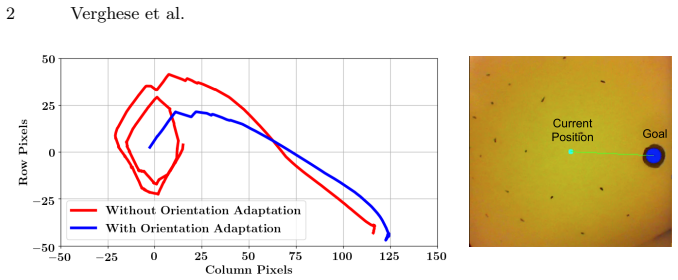
Under the assumption that the mismatch in the camera frame has equal singular values, the unknown correction $J^*J^\dagger$ reduces to a scalar times a rotation matrix $R(\theta)$. Setting the scalar to 1 and estimating only $\theta$ from the angle between commanded pixel displacement and optical-flow-measured motion makes corrected commands point along the direction the robot actually moves. With this alignment, the quadratic error $V = \tfrac{1}{2} e^{\top} e$ has derivative $\dot V = -\|J^*J^\dagger R(\theta)e\| \, \|e\|$, which is negative until the error reaches zero, giving asymptotic stability under ideal conditions. Experiments on a 2.2 mm catheter in three increasingly tortuous environments show rapid convergence for filter parameters $\alpha = 0.95$ and $0.75$, while the uncorrected case ($\alpha = 1$) does not converge even in the no-bend environment.
Load-bearing premise
The load-bearing premise is that the correction is a pure rotation: the environment twists the direction of actuation but does not stretch it differently along different axes or shear it, and the magnitude loss can be ignored.
Editorial extensions
If this is right
- The rotation correction can be composed with any base kinematic model or Jacobian estimator, so it is an add-on layer rather than a replacement controller.
- For teleoperators, steering commands would align with the camera image, so pushing 'up' moves the view up even when the catheter is pressed against anatomy.
- With a tuned filter parameter (0.95 or 0.75), convergence to a visual target is rapid in paths with up to two bends; with too much filtering (0.5), optical-flow noise prevents the angle estimate from settling.
- The stability guarantee is asymptotic under ideal conditions and requires that applied commands be strong enough to overcome actuation losses; otherwise the correction cannot observe a direction to correct.
- Because only one parameter is estimated online, the controller avoids the drift and artificial singularities that can plague full online Jacobian estimation.
Reading between the lines
- The same singular-value logic suggests a natural extension: estimating the two singular values as well as the angle would cover shear and direction-dependent losses, at the cost of needing richer measurements than a single optical-flow direction.
- For small commands that do not overcome static friction, optical flow gives little directional information; adding a small dither or a dead-zone-then-ramp command could maintain observability where this controller currently stalls.
- In surgical video, natural tissue texture could replace the manually added markers used in the experiments, provided enough trackable features remain visible; this is a testable engineering step toward clinical use.
- The one-angle correction could be combined with a slower separate estimate of control magnitude, splitting the correction into a stable direction part and a magnitude part that handles creep and hysteresis.
Signed reviews
Editorial analysis
A structured set of objections, weighed in public.
Referee Report
Summary. The paper proposes a model-free visual servoing controller for continuum robot manipulators operating in constrained environments. The key idea is to estimate online a single rotation parameter θ from optical flow measured by a distal endoscopic camera, and to compose the resulting rotation matrix R(θ) with the model-based Jacobian pseudo-inverse to compensate for actuation mismatch caused by unknown contact forces. A Kalman-filter-derived IIR filter with parameter α is used to estimate θ, and a Lyapunov argument is given to claim asymptotic stability. Experiments on a custom 2.2 mm robotic catheter in three environments (no bend, one bend, two bends) show that the controller converges for α = 0.95 and 0.75, while α = 0.5 leads to instability.
Significance. If the results hold, the approach is practically appealing: a single scalar parameter is estimated rather than a full Jacobian, the correction can be composed with existing kinematic or Jacobian estimators, and the structured form avoids the drift and singularities typical of fully model-free Jacobian estimation. The paper is clearly written, the problem is well motivated by surgical applications, and the hardware experiments on a real catheter strengthen the empirical part. The SVD-based motivation for the rotation structure is intuitive. However, the main theoretical claim of a guaranteed stable controller is not established by the analysis as written, and the empirical evidence, while suggestive, lacks statistical support. The value of the paper therefore depends on whether the structural assumptions can be validated and the convergence of the estimator proved.
major comments (3)
- [Section 2.4, Eqs. (18)-(21)] The Lyapunov argument assumes the very condition it needs to establish. The negative definiteness of Vdot in Eq. (21) follows only after substituting Eq. (2), which states that J*J†R(θ) aligns the control input with the observed motion. However, the adaptation law (Eq. (16) or (17)) is not part of the Lyapunov function, and no proof is given that θ converges to a value satisfying Eq. (2). The estimator dynamics, the optical-flow measurement noise, and the magnitude threshold are all outside V, so the analysis does not cover the closed-loop system actually implemented. The experimental instability at α = 0.5 shows that the filter dynamics can indeed break the claimed stability, so this gap is not merely cosmetic.
- [Section 2.1, Eqs. (2)-(4)] The central guarantee depends on the untested assumption that the actuation mismatch J*J† is a scalar multiple of a rotation, i.e., σ1 = σ2 in Eq. (3). If the mismatch includes shear or nonuniform scaling, no single θ can make Eq. (2) hold for all error directions, and the expression in Eq. (21) is not necessarily negative definite: e^T J*J†R(θ)e can be positive for some e. The paper explicitly defers shear to future work, but the abstract and Section 1.2 claim an unconditional guarantee ('a stable controller can be guaranteed') and composition with 'any Jacobian estimation or kinematic model'. The experiments do not measure the singular values of J*J† or otherwise test the rotation-only assumption, so the theoretical claim rests on an unvalidated structural condition. Please either prove convergence under weaker conditions, or clearly state the guarantee as conditional on σ1 = σ2 and validate that condition experimentally.
- [Section 4, Fig. 5] The empirical convergence claim is not supported with statistical evidence. The plots show individual traces without error bars, repeated runs, or quantitative success/failure criteria, and no comparison of final pixel error across environments. Given the variability expected in continuum manipulator behavior and the observed instability at α = 0.5, single traces are insufficient to establish that 'in all tested environments' the controller 'rapidly converge[s]' as a reproducible result. Please report multiple trials, error bars or distributions, and a defined convergence criterion.
minor comments (5)
- [Section 2.3] There are typos: 'Kalman Fitler' should be 'Kalman Filter' and 'Infinite Impulse Reponse' should be 'Infinite Impulse Response'.
- [Section 5] The phrase 'slightly nosier values' contains a typo; it should be 'noisier'.
- [Section 2.2, Eq. (10)] The sign convention for θ should be clarified: the angle between the intended motion and the observed optical flow determines θ only up to sign, and the rotation direction in Eq. (4) must be consistent with Eq. (7). A short explanation of how the sign is resolved would avoid ambiguity.
- [Section 2.3 and Section 3] The optical-flow magnitude threshold and the filter gain α are introduced as tunable parameters, but the experiments do not state how the threshold was chosen or how sensitive the results are to it. A brief discussion would help reproducibility.
- [References] Reference 10 contains a raw LaTeX command '\textit' in the title, which should be fixed in the final formatting.
Circularity Check
No significant circularity; the orientation adaptation is an online feedback estimate and the Lyapunov argument is conditional on the stated rotation-only/full-rank assumptions rather than reducible to its inputs.
full rationale
The paper's theta-estimation chain is a standard online parameter-identification loop: optical flow measures the actual motion (Eq. 6), Eq. (10) computes the angle that aligns observed motion with the commanded direction, and the IIR/Kalman filter smooths that measured angle. The Lyapunov argument in Eqs. (18)-(21) starts from the premise that theta has been set so that Eq. (2) holds; this is an explicit conditional ('Through the adaptive controller, the values of theta are set such that (2) is satisfied'), not a derivation of Eq. (2) from the stability objective. Eq. (21) follows from Eq. (20) by substituting the alignment condition Eq. (2), but Eq. (2) is the design target of the estimator, not an input fitted to the stability conclusion. The proof is therefore a conditional stability lemma: if the rotation-only structural assumption (sigma1=sigma2) is valid, if J*J-dagger is full rank, and if the estimate has converged to the true rotation, then the candidate Lyapunov function decreases. Those conditions are assumptions or gaps in the theoretical guarantee, and the theta-adaptation dynamics and optical-flow noise are not incorporated into V, but they are not circular: they are unproven premises, and the empirical evaluation is independent of the proof. Self-citations [8,9,10] frame prior model-less control work and are not load-bearing for the new R(theta) construction; no uniqueness theorem or author-only result is invoked to force the derivation. No prediction is fitted-then-renamed: the reported convergence is measured against a real catheter in three environments with different alpha values, and the theoretical claim is explicitly conditional on the assumptions stated in Section 2.1. Hence no circular step satisfying the quoted-reduction standard is exhibited.
Assumptions & free parameters
free parameters (2)
- filter gain α =
0.5, 0.75, 0.95 (tested); 0.75 and 0.95 converge
- optical flow magnitude threshold =
not reported
assumptions (4)
- ad hoc to paper The actuation mismatch J*J† can be represented as a pure rotation with unit singular values (σ1 = σ2, scalar = 1).
- domain assumption J*J† is full rank, meaning the control input overcomes frictional and viscoelastic losses.
- standard math Brightness constancy holds, so optical flow is proportional to the observed camera motion.
- standard math The Kalman filter converges to an IIR filter with single parameter α.
Cite this review
Pith. "Pith review of Model-free Visual Control for Continuum Robot Manipulators via Orientation Adaptation." pith.science (2026). https://pith.science/paper/AN6Z53E5
@misc{pith2026190900450,
  author       = {Pith},
  title        = {Pith review of: Model-free Visual Control for Continuum Robot Manipulators via Orientation Adaptation},
  year         = {2026},
  howpublished = {\url{https://pith.science/paper/AN6Z53E5}},
  note         = {Machine review of arXiv:1909.00450}
}
read the original abstract
We present an orientation adaptive controller to compensate for the effects of highly constrained environments on continuum manipulator actuation. A transformation matrix updated using optimal estimation techniques from optical flow measurements captured by the distal camera is composed with any Jacobian estimation or kinematic model to compensate for these effects. By utilizing domain knowledge to define the structure of this matrix, fewer parameters need to be estimated and a stable controller can be guaranteed. The algorithm is tested on a custom robotic catheter and convergence is shown both empirically and theoretically.
Figures


Figures from the paper (3 more)


Reference graph
Works this paper leans on
-
[1]
J. Burgner-Kahrs, D. C. Rucker and H. Choset, Continuum robots for medical applications: A survey,IEEE Transactions on Robotics, vol. 31, no. 6, pp. 1261–1280, Dec. 2015
work page 2015
-
[2]
V. Vitiello, S. Lee, T. P. Cundy and G. Yang, Emerging robotic platforms for minimally invasive surgery, IEEE Reviews in Biomedical Engineering , vol. 6, pp. 111–126, 2013
work page 2013
-
[3]
R. S. Penning, J. Jung, J. A. Borgstadt, N. J. Ferrier and M. R. Zinn, Towards closed loop control of a continuum robotic manipulator for medical applications, IEEE International Conference on Robotics and Automation , pp. 4822–4827, May 2011
work page 2011
-
[4]
R. S. Penning, J. Jung, N. J. Ferrier and M. R. Zinnet al., An evaluation of closed- loop control options for continuum manipulators, IEEE International Conference on Robotics and Automation, pp. 5392–5397, May 2012
work page 2012
-
[5]
A. Kapadia and I. D. Walker, ”Task-space control of extensible continuum manip- ulators,” IEEE/RSJ International Conference on Intelligent Robots and Systems , pp. 1087–1092, 2011
work page 2011
-
[6]
David B. Camarillo, Christopher R. CarlsonJ. Kenneth Salisbury, ”Task-Space con- trol of continuum manipulators with coupled tendon drive,Experimental Robotics, vol. 54, pp. 271–280, 2009
work page 2009
-
[7]
V. K. Chitrakaran, A. Behal, D. M. Dawson and I. D. Walker, ”Setpoint regulation of continuum robots using a fixed camera,” Robotica,vol. 25, pp. 581–586, 2007
work page 2007
-
[8]
M. C. Yip and D. B. Camarillo, ”Model-Less Feedback Control of Continuum Ma- nipulators in Constrained Environments,”IEEE Transactions on Robotics, vol. 30, no. 4, pp. 880–889, Aug. 2014
work page 2014
Show all 22 references
-
[9]
M. C. Yip and D. B. Camarillo, ”Model-Less Hybrid Position/Force Control: A Minimalist Approach for Continuum Manipulators in Unknown, Constrained Envi- ronments,” IEEE Robotics and Automation Letters, vol. 1, no. 2, pp. 844–851, July 2016
2016
-
[10]
M. C. Yip, J. S. Sganga, D. B. Camarillo, ”Autonomous control of continuum robot manipulators for complex cardiac ablation tasks.” {textitJournal of Medical Robotics Research, vol. 2, no. 1, pp. 1750002, 2017
2017
-
[11]
J., and Jones, B
Webster, R. J., and Jones, B. A., ”Design and Kinematic Modeling of Constant Curvature Continuum Robots: A Review,” The International Journal of Robotics Research vol. 29, no. 13, pp. 1661–1683, 2010
2010
-
[12]
H. Wang, W. Chen, X. Yu, T. Deng, X. Wang and R. Pfeifer, ”Visual servo control of cable-driven soft robotic manipulator,” IEEE/RSJ International Conference on Intelligent Robots and Systems , pp. 57–62. 2013
2013
-
[13]
H. Wang, B. Yang, Y. Liu, W. Chen, X. Liang and R. Pfeifer, ”Visual Servoing of Soft Robot Manipulator in Constrained Environments With an Adaptive Con- troller,” IEEE/ASME Transactions on Mechatronics, vol. 22, no. 1, pp. 41–50, Feb. 2017
2017
-
[14]
Yuen SG, Kesner SB, Vasilyev NV, Del Nido PJ, Robert D, Howe RD, ”3D ultrasound-guided motion compensation system for beating heart mitral valve re- pair.” Med Image Comput Comput Assist Interv. vol. 11, pt. 1, 2008
2008
-
[15]
S. B. Kesner and R. D. Howe, ”Force control of flexible catheter robots for beating heart surgery,” IEEE International Conference on Robotics and Automation , pp. 1589-1594, 2011. 12 Verghese et al
2011
-
[16]
Tully, G
S. Tully, G. Kantor, M. A. Zenati and H. Choset, ”Shape estimation for image- guided surgery with a highly articulated snake robot,” 2011 IEEE/RSJ Interna- tional Conference on Intelligent Robots and Systems , pp. 1353-1358, 2011
2011
-
[17]
Melingui, J
A. Melingui, J. J. Mvogo Ahanda, O. Lakhal, J. B. Mbede and R. Merzouki, ”Adaptive Algorithms for Performance Improvement of a Class of Continuum Ma- nipulators,” IEEE Transactions on Systems, Man, and Cybernetics: Systems , vol. 48, no. 9, pp. 1531-1541, Sept. 2018
2018
-
[18]
Giorelli, F
M. Giorelli, F. Renda, G. Ferri and C. Laschi, ”A feed-forward neural network learning the inverse kinetics of a soft cable-driven manipulator moving in three- dimensional space,” IEEE/RSJ International Conference on Intelligent Robots and Systems, pp. 5033-5039, 2013
2013
-
[19]
B. D. Lucas, T. Kanade, ”An Iterative Image Registration Technique with an Application to Stereo Vision.” Proceedings of Imaging Understanding Workshop , pages 121–130, 1981
1981
-
[20]
593-600 1994
Jianbo Shi, Tomasi, ”Good features to track,” ( IEEE Conference on Computer Vision and Pattern Recognition), pp. 593-600 1994
1994
-
[21]
Walrand, A
J. Walrand, A. Dimakis, ”Random Processes in Systems – Lecture Notes” https: //people.eecs.berkeley.edu/∼wlr/226F06/226a.pdf, August 2006
2006
-
[22]
Schreiber, D
D. Schreiber, D. Shak, A. Norbash, M. Yip, ”An Open-Source 7-Axis, Robotic Platform to Enable Dexterous Procedures within CT Scanners” IEEE/RSJ Inter- national Conference on Intelligent Robots and Systems arXiv:1903.04646, 2019
1903 arXiv
Reviewed August 14, 2026 · model on record in the stance chip above.
Discussion (0). Continue with ORCID to comment.