REVIEW 4 major objections 4 minor 85 references
Randomized methods to characterize large-scale vortical flow network
T0 review · 4 major / 4 minor · reviewed 2026-08-14 · deepseek-v4-flash
Pith's one-line read Randomized Nyström sampling with Halton points recovers the leading mode of a vortical flow network from roughly 5% of its adjacency matrix, dropping memory from about 215 GB to about 10.5 GB.
desk verdict Useful empirical demonstration of randomized low-rank methods for vortical flow networks, but the Nyström section rests on an SPSD assumption the adjacency matrix does not satisfy. read the letter →
The pith
A machine-rendered reading of the paper's core claim, the machinery that carries it, and where it could break.
The reading
What carries the argument
Two objects carry the argument. The first is the vortical adjacency matrix $A_{ij}=\frac12(|u_{i\to j}|+|u_{j\to i}|)$ for $i\ne j$, with zero diagonal, where $u_{i\to j}$ is the Biot–Savart induced velocity from vortex element $i$ to $j$; its leading eigenvector defines eigenvector centrality and seeds spectral clustering. The second is the Nyström method, a low-rank approximation scheme in which $l$ columns and the matching rows are sampled from $A$ to form $C=A(:,J)$ and $W=A(J,J)$; after eigendecomposing $W=U_W D_W U_W^\top$, the approximate eigenvalues and eigenvectors are rescaled as $\tilde D_k=\frac{n}{l}D_W$ and $\tilde U_k=\sqrt{\frac{l}{n}}\,C\,U_W D_W^{-1}$. Halton sampling, a quasi-random low-discrepancy sequence, selects the columns with more even spatial coverage than uniform random sampling, cutting both error and variance. Because only $l$ columns are touched, the cost is $O(nl)$ to sketch plus $O(l^3)$ for the small eigendecomposition, and the full dense $O(n^2)$ adjacency matrix never needs to be stored.
What would settle it
In the 421² airfoil case, recompute the leading eigenvector with the deterministic power method and compare it, with the same acute-angle error metric, against the Nyström approximation using 5% Halton-sampled columns; if the mismatch is well above the reported roughly 5%, the central scaling claim fails. A quick eigenvalue check on the same matrix can also settle whether the matrix has negative eigenvalues, which would show that the positive-semidefinite premise invoked by the Nyström guarantees does not hold.
Extended reading notes
Core claim
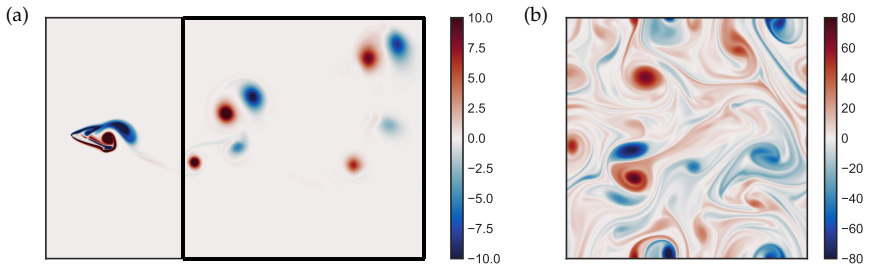
The central claim is that a vortical interaction network, whose adjacency matrix $A$ is built from the symmetrized Biot–Savart induced velocity between every pair of grid elements, has low-rank spectral structure that can be captured by sampling. Using the Nyström method, computing the eigendecomposition of a small sampled submatrix $W = A(J,J)$ and rescaling the result, the paper obtains approximations of the leading $k$ eigenvectors and eigenvalues without ever forming the full $A$. The paper demonstrates on flow past a NACA 0012 airfoil with Gurney flap and on two-dimensional isotropic turbulence that these approximations reproduce the deterministic leading eigenvector and the resulting spectral clusters. With Halton (quasi-uniform) column sampling, about 5% of columns gives about 5% error for the 421² airfoil case, and 10% of columns gives visually indistinguishable dominant eigenvectors for a 1024² turbulence grid, at a fraction of the memory and time of the deterministic power method. The intended use is not exact linear algebra but qualitatively correct graph structure for community detection, sensor and actuator placement, and control.
Load-bearing premise
All the quantitative accuracy claims rest on the unstated premise that the Nyström reconstruction formulas, whose guarantees are derived for symmetric positive-semidefinite matrices, still describe this adjacency matrix even though the matrix has zero diagonal, positive off-diagonals, and is not generally positive semidefinite.
Editorial extensions
If this is right
- Spectral network analysis of two-dimensional turbulent flows at 1024×1024 resolution becomes tractable without building the roughly 8 TB adjacency matrix, since only about 10% of the columns are sampled.
- The leading approximate eigenvectors recover the same seven spectral clusters as the exact eigenvectors in the airfoil wake, so downstream community detection can run on randomized output.
- Halton column sampling should be preferred over uniform random sampling for dense vortical matrices: it gives lower approximation error and lower variance at the same computational complexity.
- Eigenvector centrality computed from the approximate leading eigenvector identifies the dominant vortex cores and shear-layer structures in both tested flows, matching the deterministic result by visual inspection.
- Network measures derived from the adjacency spectrum, such as Katz centrality, PageRank, and spectral partitioning, can be applied to flows whose full matrices cannot be stored.
Reading between the lines
- By analogy, the same column-sampling Nyström pipeline could apply to any dense pairwise-interaction matrix arising from an inverse-distance or Green's-function kernel, not just Biot–Savart vorticity, since those matrices share a similar low-rank off-diagonal structure.
- A sharper test than the paper provides would relate the required column fraction to the eigengap of the adjacency matrix; the observed 5–10% sampling suggests the effective spectral rank is small, but the paper does not quantify that connection.
- Because the vortical adjacency matrix is likely indefinite, the Nyström error bounds that assume positive semidefiniteness do not formally justify the observed accuracy; a viable extension would apply Nyström to $A+\sigma I$ or to the graph Laplacian to obtain a guaranteed positive-semidefinite input.
- Preferential sampling weighted by vorticity magnitude or by the community structure found in a first pass could reduce the required column fraction further, since high-vorticity nodes dominate the network interactions.
Signed reviews
Editorial analysis
A structured set of objections, weighed in public.
Referee Report
Summary. The paper applies randomized column-sampling low-rank approximation methods, specifically a sketched SVD and the Nyström method, to the adjacency matrix of vortical interaction networks constructed from Biot-Savart induced velocities. It compares uniform random sampling with Halton (quasi-uniform) sampling, evaluates the approximation error of the leading eigenvector against a deterministic power method on two flows (an airfoil wake and two-dimensional decaying turbulence), and demonstrates large memory and time savings. The central claim is that sampling roughly 5-10% of the columns yields qualitatively accurate dominant eigenvectors, eigenvector centrality, and spectral clusters at a fraction of the cost of constructing and processing the full dense adjacency matrix.
Significance. If the mathematical foundations were sound, this would be a practically useful contribution: dense vortical adjacency matrices scale as O(n^2) and quickly become intractable, so a sampling-based route to dominant spectral information has clear value for network-based flow analysis. The paper has genuine strengths: the empirical evaluation is honest in comparing against a deterministic power method, results are averaged over 20 random seeds with reported distributions, concrete memory and time numbers are given, and the downstream tasks of eigenvector centrality and spectral clustering are validated visually. The quasi-uniform Halton sampling comparison is also a useful practical finding. However, the significance is conditional on correcting the mathematical derivation of the Nyström and sketched-SVD reconstructions for the specific adjacency matrix used, which is indefinite rather than positive semidefinite.
major comments (4)
- [Section 3.2, Eqs. (10)-(12)] The Nyström reconstruction as stated is not valid for the vortical adjacency matrix of Eq. (2). That matrix has zero diagonal and positive off-diagonal entries; any nonzero symmetric zero-diagonal matrix has trace zero and therefore cannot be positive semidefinite, so A is indefinite. Consequently the sampled submatrix W = A(J,J) is also indefinite whenever it contains at least one positive off-diagonal entry, D_W in Eq. (10) has negative eigenvalues, and the quantity D_W^{-1/2} in Eq. (12) is undefined over the reals. The paper's statement that W is SPSD when A is SPSD is conditional, and the condition is never established; in fact it fails for this construction. The authors must either use a reconstruction valid for indefinite symmetric matrices and state exactly what computation is performed, or apply the Nyström method to an explicitly shifted PSD matrix such as A + αI with a careful treatment of the shift. This is load-bearing because the Nyström results in Section 4 depend on Eq. (12).
- [Section 3.1, Eq. (8)] The sketched SVD path claims that scaled singular values of the sampled column matrix C approximate eigenvalues of A. For a symmetric indefinite matrix, singular values correspond to the eigenvalues of |A|, not of A, and left singular vectors approximate eigenvectors of |A|. Since the adjacency matrix is nonnegative, the Perron-Frobenius theorem guarantees that the dominant eigenvector is nonnegative and simple, but the paper does not invoke this theorem. Without such an argument, Eq. (8) is unjustified for the target matrix class, and the paper should state clearly whether the computed quantities are eigenvalues or singular values of A.
- [Section 4.2, Figures 4-5] The error metric is the acute angle between the true leading eigenvector and the approximate eigenvector. For an indefinite matrix with both positive and negative eigenvalues, the paper must specify which eigenvector is considered 'leading' and how the sign convention of the approximate eigenvector is fixed. More importantly, if the implementation silently replaces D_W^{-1/2} in Eq. (12) by a pseudoinverse, an absolute-value correction, or an SVD-based reconstruction, then the reported error curves do not test the algorithm described in the text. The actual reconstruction used in the code must be documented.
- [Section 4.3, Figure 8] Spectral clustering is based on the 'three leading eigenvectors' of A, but for an indefinite adjacency matrix the notion of leading is ambiguous: it could mean the largest eigenvalues in signed order or the largest eigenvalues in magnitude. Since the Nyström reconstruction in Eq. (11) can produce negative approximate eigenvalues, the paper should define how the top three eigenvectors are selected; otherwise the comparison between exact and approximate clusters in Figure 8 is not well-defined.
minor comments (4)
- [Section 1.2] The text says 'we propose efficient methods,' but the underlying randomized linear algebra tools are existing methods from the literature; 'we apply and evaluate' would be more accurate.
- [Section 3.1] There is a typo in the sentence 'with a an arbitrary sketching matrix'; delete the first 'a'.
- [Section 4.2, Table 1] Please clarify how the 'time to compute deterministic eigenvector' is obtained: the text says the power method need not construct the full adjacency matrix explicitly, yet Table 1 lists the storage required for the full adjacency matrix. The relationship between the reported construction time, storage, and power-method time should be stated precisely.
- [Section 5] The Discussion states that 'combining importance sampling, based on the probability distribution of detected communities, and the Nyström method' allows accurate eigenvector computation, but the paper does not implement community-based importance sampling; this appears to describe future work and should be labeled as such.
Circularity Check
No circularity: the randomized eigenvector approximations are benchmarked against independently computed deterministic power-method eigenvectors, and all algorithmic formulas come from external randomized linear algebra literature.
full rationale
The paper's central claim is that Nyström and sketched-SVD approximations of the leading eigenvectors of the vortical adjacency matrix are accurate enough for qualitative network analysis at reduced memory cost. This claim is not constructed from its own outputs. The adjacency matrix in Eq. (2) is defined independently from the Biot-Savart velocity field; the Nyström reconstruction (Eqs. 10-12) and sketched-SVD scaling (Eq. 8) are cited from external sources, including Kumar, Mohri, and Talwalkar [73], Frieze et al. [62], and Halko et al. [36]. The empirical error measure compares the randomized approximations against eigenvectors computed by a deterministic power method, which is an external benchmark independent of the proposed sampling procedure. The comparison of Halton versus uniform sampling is an empirical finding, not a fit used to define the method. No parameter is fitted to a subset of data and then reported as a prediction, and no central premise is justified only by a self-citation. The only substantive caveat is mathematical rather than circular: the adjacency matrix in Eq. (2) has zero diagonal and positive off-diagonal entries, so it is indefinite, and the SPSD assumption stated for the Nyström method in Section 3.2 is not verified. This is a correctness and applicability concern, not a circularity concern, because it does not involve the paper deriving its conclusion from its inputs.
Assumptions & free parameters
assumptions (4)
- domain assumption The Biot-Savart induced velocity adjacency matrix (Eqs. 1 and 2) is a meaningful representation of vortical interactions.
- ad hoc to paper The Nyström reconstruction formulas (Eqs. 10 to 12) are valid for the adjacency matrix A, which requires A to be symmetric positive semidefinite.
- domain assumption Dominant eigenvectors of the adjacency matrix provide physically meaningful centrality and clustering information (Eq. 3 and Section 2.1).
- standard math Sampling theory for Nyström and column sampling gives accurate low-rank approximations for this dense matrix with the stated scalings (Eqs. 8 and 11).
Cite this review
Pith. "Pith review of Randomized methods to characterize large-scale vortical flow network." pith.science (2026). https://pith.science/paper/7ZMTVPTB
@misc{pith2026190900535,
  author       = {Pith},
  title        = {Pith review of: Randomized methods to characterize large-scale vortical flow network},
  year         = {2026},
  howpublished = {\url{https://pith.science/paper/7ZMTVPTB}},
  note         = {Machine review of arXiv:1909.00535}
}
read the original abstract
We demonstrate the effective use of randomized methods for linear algebra to perform network-based analysis of complex vortical flows. Network theoretic approaches can reveal the connectivity structures among a set of vortical elements and analyze their collective dynamics. These approaches have recently been generalized to analyze high-dimensional turbulent flows, for which network computations can become prohibitively expensive. In this work, we propose efficient methods to approximate network quantities, such as the leading eigendecomposition of the adjacency matrix, using randomized methods. Specifically, we use the Nystr\"om method to approximate the leading eigenvalues and eigenvectors, achieving significant computational savings and reduced memory requirements. The effectiveness of the proposed technique is demonstrated on two high-dimensional flow fields: two-dimensional flow past an airfoil and two-dimensional turbulence. We find that quasi-uniform column sampling outperforms uniform column sampling, while both feature the same computational complexity.
Figures


Figures from the paper (5 more)


Reference graph
Works this paper leans on
-
[1]
P . J. Holmes, J. L. Lumley , G. Berkooz, and C. W. Rowley ,T urbulence, coherent structures, dynamical systems and symmetry. Cambridge Monographs in Mechanics, Cambridge, England: Cambridge University Press, 2nd ed., 2012
2012
-
[2]
Modal analysis of fluid flows: An overview,
K. Taira, S. L. Brunton, S. Dawson, C. W. Rowley , T. Colonius, B. J. McKeon, O. T. Schmidt, S. Gordeyev , V . Theofilis, and L. S. Ukeiley , “Modal analysis of fluid flows: An overview,” AIAA Journal, vol. 55, no. 12, pp. 4013–4041, 2017
2017
-
[3]
Modal analysis of fluid flows: Applications and outlook,
K. Taira, M. S. Hemati, S. L. Brunton, Y . Sun, K. Duraisamy , S. Bagheri, S. Dawson, and C.-A. Yeh, “Modal analysis of fluid flows: Applications and outlook,” accepted, AIAA Journal, 2019
2019
-
[4]
A hierarchy of low-dimensional models for the transient and post-transient cylinder wake,
B. R. Noack, K. Afanasiev , M. Morzynski, G. Tadmor, and F. Thiele, “A hierarchy of low-dimensional models for the transient and post-transient cylinder wake,” Journal of Fluid Mechanics , vol. 497, pp. 335– 363, 2003
2003
-
[5]
Dynamic mode decomposition of numerical and experimental data,
P . J. Schmid, “Dynamic mode decomposition of numerical and experimental data,” Journal of Fluid Mechanics, vol. 656, pp. 5–28, Aug. 2010
2010
-
[6]
Spectral analysis of nonlinear flows,
C. W. Rowley , I. Mezi´c, S. Bagheri, P . Schlatter, and D. Henningson, “Spectral analysis of nonlinear flows,” Journal of Fluid Mechanics , vol. 645, pp. 115–127, 2009
work page 2009
-
[7]
J. N. Kutz, S. L. Brunton, B. W. Brunton, and J. L. Proctor, Dynamic Mode Decomposition: Data-Driven Modeling of Complex Systems . SIAM, 2016
work page 2016
-
[8]
G. E. Dullerud and F. Paganini, A course in robust control theory: A convex approach . Texts in Applied Mathematics, Berlin, Heidelberg: Springer, 2000
work page 2000
Show all 85 references
-
[9]
Input-output analysis and control design applied to a linear model of spatially developing flows,
S. Bagheri, J. Hoepffner, P . J. Schmid, and D. S. Henningson, “Input-output analysis and control design applied to a linear model of spatially developing flows,” Applied Mechanics Reviews , vol. 62, no. 2, pp. 020803–1–020803–27, 2009. 14
2009
-
[10]
Closed-loop turbulence control: Progress and challenges,
S. L. Brunton and B. R. Noack, “Closed-loop turbulence control: Progress and challenges,” Applied Mechanics Reviews, vol. 67, pp. 050801–1–050801–48, 2015
2015
-
[11]
Linear closed-loop control of fluid instabilities and noise-induced per- turbations: A review of approaches and tools,
D. Sipp and P . J. Schmid, “Linear closed-loop control of fluid instabilities and noise-induced per- turbations: A review of approaches and tools,” Applied Mechanics Reviews , vol. 68, no. 2, p. 020801, 2016
2016
-
[12]
Galerkin v . least-squares petrov–galerkin projection in nonlinear model reduction,
K. Carlberg, M. Barone, and H. Antil, “Galerkin v . least-squares petrov–galerkin projection in nonlinear model reduction,” Journal of Computational Physics , vol. 330, pp. 693–734, 2017
2017
-
[13]
Constrained sparse Galerkin regression,
J.-C. Loiseau and S. L. Brunton, “Constrained sparse Galerkin regression,” Journal of Fluid Mechanics , vol. 838, pp. 42–67, 2018
2018
-
[14]
Sparse reduced-order modeling: sensor-based dynamics to full-state estimation,
J.-C. Loiseau, B. R. Noack, and S. L. Brunton, “Sparse reduced-order modeling: sensor-based dynamics to full-state estimation,” Journal of Fluid Mechanics , vol. 844, pp. 459–490, 2018
2018
-
[15]
Network-theoretic approach to sparsified discrete vortex dynamics,
A. G. Nair and K. Taira, “Network-theoretic approach to sparsified discrete vortex dynamics,” Journal of Fluid Mechanics, vol. 768, pp. 549–571, 2015
2015
-
[16]
Combustion noise is scale-free: transition from scale-free to order at the onset of thermoacoustic instability ,
M. Murugesan and R. Sujith, “Combustion noise is scale-free: transition from scale-free to order at the onset of thermoacoustic instability ,”Journal of Fluid Mechanics , vol. 772, pp. 225–245, 2015
2015
-
[17]
Network structure of two-dimensional decaying isotropic turbulence,
K. Taira, A. G. Nair, and S. L. Brunton, “Network structure of two-dimensional decaying isotropic turbulence,” Journal of Fluid Mechanics , vol. 795, 2016
2016
-
[18]
Coherent structure colouring: identification of coherent structures from sparse data using graph theory ,
K. L. Schlueter-Kuck and J. O. Dabiri, “Coherent structure colouring: identification of coherent structures from sparse data using graph theory ,” Journal of Fluid Mechanics , vol. 811, pp. 468–486, 2017
2017
-
[19]
Network community-based model reduction for vortical flows,
M. Gopalakrishnan Meena, A. G. Nair, and K. Taira, “Network community-based model reduction for vortical flows,” Physical Review E, vol. 97, no. 6, p. 063103, 2018
2018
-
[20]
Characterization and detection of thermoa- coustic combustion oscillations based on statistical complexity and complex-network theory ,
S. Murayama, H. Kinugawa, I. T. Tokuda, and H. Gotoda, “Characterization and detection of thermoa- coustic combustion oscillations based on statistical complexity and complex-network theory ,” Physical Review E, vol. 97, no. 2, p. 022223, 2018
2018
-
[21]
Lagrangian network analysis of turbulent mixing,
G. Iacobello, S. Scarsoglio, J. Kuerten, and L. Ridolfi, “Lagrangian network analysis of turbulent mixing,” Journal of Fluid Mechanics , vol. 865, pp. 546–562, 2019
2019
-
[22]
M. E. J. Newman, Networks: an introduction . Oxford Univ . Press, 2010
2010
-
[23]
Mesbahi and M
M. Mesbahi and M. Egerstedt, Graph theoretic methods in multiagent networks . Princeton University Press, 2010
2010
-
[24]
Controllability of multi-agent systems from a graph-theoretic perspective,
A. Rahmani, M. Ji, M. Mesbahi, and M. Egerstedt, “Controllability of multi-agent systems from a graph-theoretic perspective,” SIAM J. Control and Optimization , vol. 48, no. 1, pp. 162–186, 2009
2009
-
[25]
Internet congestion control,
S. H. Low, F. Paganini, and J. C. Doyle, “Internet congestion control,” Control Systems, IEEE , vol. 22, no. 1, pp. 28–43, 2002
2002
-
[26]
The “robust yet fragile
J. C. Doyle, D. L. Alderson, L. Li, S. Low, M. Roughan, S. Shalunov , R. Tanaka, and W. Willinger, “The “robust yet fragile” nature of the internet,” Proceedings of the National Academy of Sciences of the United States of America, vol. 102, no. 41, pp. 14497–14502, 2005
2005
-
[27]
Coherent swing instability of power grids,
Y . Susuki, I. Mezi´c, and T. Hikihara, “Coherent swing instability of power grids,” Journal of nonlinear science, vol. 21, no. 3, pp. 403–439, 2011
2011
-
[28]
Virtual leaders, artificial potentials and coordinated control of groups,
N. E. Leonard and E. Fiorelli, “Virtual leaders, artificial potentials and coordinated control of groups,” in Decision and Control, 2001. Proceedings of the 40th IEEE Conference on , vol. 3, pp. 2968–2973, IEEE, 2001
2001
-
[29]
Flocking for multi-agent dynamic systems: Algorithms and theory ,
R. Olfati-Saber, “Flocking for multi-agent dynamic systems: Algorithms and theory ,” Automatic Control, IEEE T ransactions on, vol. 51, no. 3, pp. 401–420, 2006
2006
-
[30]
Behavior-based formation control for multirobot teams,
T. Balch and R. C. Arkin, “Behavior-based formation control for multirobot teams,” Robotics and Automation, IEEE T ransactions on, vol. 14, no. 6, pp. 926–939, 1998
1998
-
[31]
Coverage control for mobile sensing networks,
J. Cortes, S. Martinez, T. Karatas, and F. Bullo, “Coverage control for mobile sensing networks,” in IEEE International Conference on Robotics and Automation (ICRA) , vol. 2, pp. 1327–1332, IEEE, 2002. 15
2002
-
[32]
Collective motion, sensor networks, and ocean sampling,
N. E. Leonard, D. A. Paley , F. Lekien, R. Sepulchre, D. M. Fratantoni, and R. E. Davis, “Collective motion, sensor networks, and ocean sampling,” Proceedings of the IEEE , vol. 95, no. 1, pp. 48–74, 2007
2007
-
[33]
Network motifs: simple building blocks of complex networks,
R. Milo, S. Shen-Orr, S. Itzkovitz, N. Kashtan, D. Chklovskii, and U. Alon, “Network motifs: simple building blocks of complex networks,” Science, vol. 298, no. 5594, pp. 824–827, 2002
2002
-
[34]
Genomic analysis of regulatory network dynamics reveals large topological changes,
N. M. Luscombe, M. M. Babu, H. Yu, M. Snyder, S. A. Teichmann, and M. Gerstein, “Genomic analysis of regulatory network dynamics reveals large topological changes,” Nature, vol. 431, no. 7006, pp. 308–312, 2004
2004
-
[35]
Networked oscillator based modeling and control of unsteady wake flows,
A. G. Nair, K. Taira, and S. L. Brunton, “Networked oscillator based modeling and control of unsteady wake flows,” Physical Review E , vol. 97, no. 063107, 2018
2018
-
[36]
Finding structure with randomness: Probabilistic algo- rithms for constructing approximate matrix decompositions,
N. Halko, P .-G. Martinsson, and J. A. Tropp, “Finding structure with randomness: Probabilistic algo- rithms for constructing approximate matrix decompositions,” SIAM Review, vol. 53, no. 2, pp. 217–288, 2011
2011
-
[38]
Randomized algorithms in numerical linear algebra,
R. Kannan and S. V empala, “Randomized algorithms in numerical linear algebra,” Acta Numerica , vol. 26, pp. 95–135, 2017
2017
-
[39]
Sketching as a tool for numerical linear algebra,
D. P . Woodruffet al., “Sketching as a tool for numerical linear algebra,” Foundations and T rends R© in Theoretical Computer Science, vol. 10, no. 1–2, pp. 1–157, 2014
2014
-
[40]
Randomized matrix decompositions using R,
N. B. Erichson, S. V oronin, S. L. Brunton, and J. N. Kutz, “Randomized matrix decompositions using R,” Journal of Statistical Software , vol. 89, no. 11, pp. 1–48, 2019
2019
-
[41]
Cluster-based feedback control of turbulent post-stall separated flows,
A. G. Nair, C.-A. Yeh, E. Kaiser, B. R. Noack, S. L. Brunton, and K. Taira, “Cluster-based feedback control of turbulent post-stall separated flows,” Journal of Fluid Mechanics, accepted , 2019
2019
-
[42]
The pagerank citation ranking: Bringing order to the web.,
L. Page, S. Brin, R. Motwani, and T. Winograd, “The pagerank citation ranking: Bringing order to the web.,” tech. rep., Stanford InfoLab, 1999
1999
-
[43]
E. D. Kolaczyk and G. Cs ´ardi, Statistical analysis of network data with R , vol. 65. Springer, 2014
2014
-
[44]
Finding community structure in very large networks,
A. Clauset, M. E. Newman, and C. Moore, “Finding community structure in very large networks,” Physical review E, vol. 70, no. 6, p. 066111, 2004
2004
-
[45]
Community structure in directed networks,
E. A. Leicht and M. E. Newman, “Community structure in directed networks,” Physical review letters, vol. 100, no. 11, p. 118703, 2008
2008
-
[46]
L. N. Trefethen and D. Bau III, Numerical Linear Algebra, vol. 50. SIAM, 1997
1997
-
[47]
The $25,000,000,000 eigenvector: The linear algebra behind Google,
K. Bryan and T. Leise, “The $25,000,000,000 eigenvector: The linear algebra behind Google,” SIAM Review, vol. 48, no. 3, pp. 569–581, 2006
2006
-
[48]
Randomized algorithms for matrices and data,
M. W. Mahoney , “Randomized algorithms for matrices and data,” Foundations and T rends in Machine Learning, vol. 3, pp. 123–224, 2011
2011
-
[49]
Randnla: Randomized numerical linear algebra,
P . Drineas and M. W. Mahoney , “Randnla: Randomized numerical linear algebra,” Commun. ACM, vol. 59, pp. 80–90, May 2016
2016
-
[50]
Randomized algorithms for the low-rank approximation of matrices,
E. Liberty , F. Woolfe, P .-G. Martinsson, V . Rokhlin, and M. Tygert, “Randomized algorithms for the low-rank approximation of matrices,” Proceedings of the National Academy of Sciences , vol. 104, no. 51, pp. 20167–20172, 2007
2007
-
[51]
Improved approximation algorithms for large matrices via random projections,
T. Sarlos, “Improved approximation algorithms for large matrices via random projections,” in Founda- tions of Computer Science. 47th Annual IEEE Symposium on , pp. 143–152, 2006
2006
-
[52]
A randomized algorithm for the decomposition of matrices,
P .-G. Martinsson, V . Rokhlin, and M. Tygert, “A randomized algorithm for the decomposition of matrices,” Applied and Computational Harmonic Analysis , vol. 30, pp. 47–68, 2011
2011
-
[53]
Compressed singular value decomposition for image and video processing,
N. B. Erichson, S. L. Brunton, and J. N. Kutz, “Compressed singular value decomposition for image and video processing,” in Proceedings of the IEEE International Conference on Computer Vision , pp. 1880–1888, 2017. 16
2017
-
[54]
A fast randomized algorithm for the approximation of matrices,
F. Woolfe, E. Liberty , V . Rokhlin, and M. Tygert, “A fast randomized algorithm for the approximation of matrices,” Journal of Applied and Computational Harmonic Analysis , vol. 25, pp. 335–366, 2008
2008
-
[55]
Simple and deterministic matrix sketching,
E. Liberty , “Simple and deterministic matrix sketching,” in Proceedings of the 19th ACM SIGKDD International Conference on Knowledge Discovery and Data Mining , pp. 581–588, ACM, 2013
2013
-
[56]
Randomized low-rank dynamic mode decomposition for motion detection,
N. B. Erichson and C. Donovan, “Randomized low-rank dynamic mode decomposition for motion detection,” Computer Vision and Image Understanding , vol. 146, pp. 40–50, 2016
2016
-
[57]
Randomized cp tensor decomposition,
N. B. Erichson, K. Manohar, S. L. Brunton, and J. N. Kutz, “Randomized cp tensor decomposition,” arXiv preprint arXiv:1703.09074, 2017
2017 arXiv
-
[58]
Randomized nonnegative matrix factoriza- tion,
N. B. Erichson, A. Mendible, S. Wihlborn, and J. N. Kutz, “Randomized nonnegative matrix factoriza- tion,” Pattern Recognition Letters, vol. 104, pp. 1–7, 2018
2018
-
[59]
Compressed dynamic mode decomposition for back- ground modeling,
N. B. Erichson, S. L. Brunton, and J. N. Kutz, “Compressed dynamic mode decomposition for back- ground modeling,” Journal of Real-Time Image Processing , pp. 1–14, 2016
2016
-
[60]
Randomized LU decomposition,
G. Shabat, Y . Shmueli, Y . Aizenbud, and A. Averbuch, “Randomized LU decomposition,”Applied and Computational Harmonic Analysis, vol. 44, no. 2, pp. 246–272, 2018
2018
-
[61]
A randomized algorithm for principal component analysis,
V . Rokhlin, A. Szlam, and M. Tygert, “A randomized algorithm for principal component analysis,” SIAM Journal on Matrix Analysis and Applications , vol. 31, pp. 1100–1124, 2009
2009
-
[62]
Fast Monte-Carlo algorithms for finding low-rank approxima- tions,
A. Frieze, R. Kannan, and S. V empala, “Fast Monte-Carlo algorithms for finding low-rank approxima- tions,” Journal of the ACM , vol. 51, no. 6, pp. 1025–1041, 2004
2004
-
[63]
A statistical perspective on algorithmic leveraging,
P . Ma, M. W. Mahoney , and B. Yu, “A statistical perspective on algorithmic leveraging,” Journal of Machine Learning Research, vol. 16, no. 1, pp. 861–911, 2015
2015
-
[64]
Sampling algorithms for l 2 regression and applications,
P . Drineas, M. W. Mahoney , and S. Muthukrishnan, “Sampling algorithms for l 2 regression and applications,” in Proceedings of the seventeenth annual ACM-SIAM symposium on Discrete algorithm , pp. 1127–1136, Society for Industrial and Applied Mathematics, 2006
2006
-
[65]
Fast approximation of matrix coherence and statistical leverage,
P . Drineas, M. Magdon-Ismail, M. W. Mahoney , and D. P . Woodruff, “Fast approximation of matrix coherence and statistical leverage,” Journal of Machine Learning Research , vol. 13, no. Dec, pp. 3475–3506, 2012
2012
-
[66]
Large-scale SVD and manifold learning,
A. Talwalkar, S. Kumar, M. Mohri, and H. Rowley , “Large-scale SVD and manifold learning,” Journal of Machine Learning Research, vol. 14, no. 1, pp. 3129–3152, 2013
2013
-
[67]
Niederreiter, Random number generation and quasi-Monte Carlo methods
H. Niederreiter, Random number generation and quasi-Monte Carlo methods . SIAM, 1992
1992
-
[68]
Algorithm 247: Radical-inverse quasi-random point sequence,
J. H. Halton, “Algorithm 247: Radical-inverse quasi-random point sequence,” Commun. ACM, vol. 7, pp. 701–702, Dec. 1964
1964
-
[69]
Using the nystr ¨om method to speed up kernel machines,
C. K. Williams and M. Seeger, “Using the nystr ¨om method to speed up kernel machines,” in Advances in neural information processing systems , pp. 682–688, 2001
2001
-
[70]
On the Nystr ¨om method for approximating a Gram matrix for improved kernel-based learning,
P . Drineas and M. W. Mahoney , “On the Nystr ¨om method for approximating a Gram matrix for improved kernel-based learning,” journal of machine learning research , vol. 6, no. Dec, pp. 2153–2175, 2005
2005
-
[71]
Improved Nystr ¨om low-rank approximation and error analysis,
K. Zhang, I. W. Tsang, and J. T. Kwok, “Improved Nystr ¨om low-rank approximation and error analysis,” in Proceedings of the 25th international conference on Machine learning , pp. 1232–1239, ACM, 2008
2008
-
[72]
Revisiting the nystr ¨om method for improved large-scale machine learning,
A. Gittens and M. W. Mahoney , “Revisiting the nystr ¨om method for improved large-scale machine learning,” The Journal of Machine Learning Research , vol. 17, no. 1, pp. 3977–4041, 2016
2016
-
[73]
Sampling methods for the Nystr ¨om method,
S. Kumar, M. Mohri, and A. Talwalkar, “Sampling methods for the Nystr ¨om method,” Journal of Machine Learning Research, vol. 13, no. Apr, pp. 981–1006, 2012
2012
-
[74]
Airfoil-wake modification with gurney flap at low reynolds number,
M. Gopalakrishnan Meena, K. Taira, and K. Asai, “Airfoil-wake modification with gurney flap at low reynolds number,” AIAA Journal, vol. 56, no. 4, pp. 1348–1359, 2017
2017
-
[75]
V ortex formation in the wake of an oscillating cylinder,
C. H. Williamson and A. Roshko, “V ortex formation in the wake of an oscillating cylinder,” Journal of Fluids and Structures, vol. 2, no. 4, pp. 355–381, 1988. 17
1988
-
[76]
The immersed boundary method: a projection approach.,
K. Taira and T. Colonius, “The immersed boundary method: a projection approach.,” Journal of Compu- tational Physics, vol. 225, no. 2, pp. 2118–2137, 2007
2007
-
[77]
A fast immersed boundary method using a nullspace approach and multi- domain far-field boundary conditions,
T. Colonius and K. Taira, “A fast immersed boundary method using a nullspace approach and multi- domain far-field boundary conditions,” Computer Methods in Applied Mechanics and Engineering , vol. 197, pp. 2131–2146, 2008
2008
-
[78]
Two-dimensional turbulence,
G. Boffetta and R. E. Ecke, “Two-dimensional turbulence,” Annual Review of Fluid Mechanics , vol. 44, pp. 427–451, 2012
2012
-
[79]
Numerical simulation of two-dimensional turbulence with high-symmetry ,
S. Kida, “Numerical simulation of two-dimensional turbulence with high-symmetry ,” Journal of the Physical Society of Japan , vol. 54, no. 8, pp. 2840–2854, 1985
1985
-
[80]
The algorithms behind gaio—set oriented numerical methods for dynamical systems,
M. Dellnitz, G. Froyland, and O. Junge, “The algorithms behind gaio—set oriented numerical methods for dynamical systems,” in Ergodic theory, analysis, and efficient simulation of dynamical systems , pp. 145– 174, Springer, 2001
2001
-
[81]
Set oriented numerical methods for dynamical systems,
M. Dellnitz and O. Junge, “Set oriented numerical methods for dynamical systems,” Handbook of dynamical systems, vol. 2, pp. 221–264, 2002
2002
-
[82]
Almost-invariant sets and invariant manifolds – connecting probabilistic and geometric descriptions of coherent structures in flows,
G. Froyland and K. Padberg, “Almost-invariant sets and invariant manifolds – connecting probabilistic and geometric descriptions of coherent structures in flows,” Physica D, vol. 238, pp. 1507–1523, 2009
2009
-
[83]
Transport in time-dependent dynamical systems: Finite-time coherent sets,
G. Froyland, N. Santitissadeekorn, and A. Monahan, “Transport in time-dependent dynamical systems: Finite-time coherent sets,” Chaos, vol. 20, no. 4, pp. 043116–1–043116–16, 2010
2010
-
[84]
A set oriented definition of finite-time Lyapunov exponents and coherent sets,
P . Tallapragada and S. D. Ross, “A set oriented definition of finite-time Lyapunov exponents and coherent sets,” Communications in Nonlinear Science and Numerical Simulation , vol. 18, pp. 1106–1126, May 2013
2013
-
[85]
Cluster-based reduced-order modelling of a mixing layer,
E. Kaiser, B. R. Noack, L. Cordier, A. Spohn, M. Segond, M. Abel, G. Daviller, J. Osth, S. Krajnovic, and R. K. Niven, “Cluster-based reduced-order modelling of a mixing layer,” J. Fluid Mech., vol. 754, pp. 365–414, 2014
2014
-
[86]
Nonlinear model order reduction based on local reduced-order bases,
D. Amsallem, M. J. Zahr, and C. Farhat, “Nonlinear model order reduction based on local reduced-order bases,” International Journal for Numerical Methods in Engineering , vol. 92, no. 10, pp. 891–916, 2012. 18
2012
Reviewed August 14, 2026 · model on record in the stance chip above.
Discussion (0). Continue with ORCID to comment.