REVIEW 3 major objections 4 minor 67 references
Macroscopic and edge behavior of a planar jellium
T0 review · 3 major / 4 minor · reviewed 2026-08-14 · deepseek-v4-flash
Pith's one-line read A planar jellium with a uniform opposite-sign disc has a uniform disc equilibrium, and its farthest particle switches from heavy-tailed to Gumbel as background charge crosses a threshold.
desk verdict Solid, well-written paper with concrete edge results and plausible macroscopic theorems, but the global asymptotic proofs have a real gap at λ=1 and a typo; worth refereeing with requests for a proper LDP justification. read the letter →
The pith
A machine-rendered reading of the paper's core claim, the machinery that carries it, and where it could break.
The reading
What carries the argument
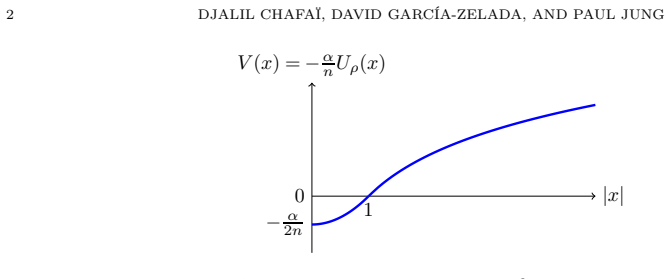
The central object is the logarithmic potential U_ρ of the uniform disc background, written explicitly as quadratic on the disc and logarithmic outside. The proofs rewrite the Gibbs weight using G(x,y)=g(x−y)+W_ρ(x)+W_ρ(y) with W_ρ=−U_ρ, which separates the n-dependent confining potential from the singular pair interaction and makes the large-deviation transfer possible. In the determinantal radially symmetric case, the key mechanism is the representation of the moduli of the particles as independent random variables with densities $t^{{2k−1}}$$e^{{-2nQ(t)}}$, which turns the farthest-particle distribution into a product of explicit one-dimensional integrals and leads directly to the infinite-product limit law and to the Ginibre comparison in the λ>1 regime.
What would settle it
Run the determinantal simulation with β=2 and α_n=n+κ for a fixed positive κ and record the largest radius over many n: the claimed law L predicts that the survival function 1−L(t) behaves like (R/t)^{2κ} for large t, so a log-log plot of the empirical tail against t/R should become a straight line of slope −2κ. A slope different from −2κ, or a finite-n sequence that fails to approach the infinite product, would refute Theorem 1.4. Separately, checking the hypotheses of the cited large-deviation theorem for V_n at λ=1 would settle whether Theorem 1.2's proof transfers.
Extended reading notes
Core claim
The central discovery is that this jellium, despite being non-neutral and unconfined, is exactly solvable enough to exhibit both macroscopic and edge phase transitions controlled by the charge ratio λ and the temperature parameter κ=lim nβ_n. Lemma 1.1 identifies the exact integrability boundary: the Gibbs measure is well defined if and only if β_n(α_n−n+1)>2, which in the determinantal case β=2 means α_n>n, so the system cannot be simultaneously charge-neutral and determinantal. Theorems 1.2 and 1.3 give the almost-sure limit of the empirical measure in the low-temperature and crossover regimes. Theorems 1.4 and 1.5 give the distribution of the modulus of the farthest particle in the determinantal case: when α_n=n+κ_n with κ_n→κ>0, the limit is the heavy-tailed law L(t)=∏_{k=0}^∞(1−(R/t)^{2(k+κ)}) on [R,∞), and when λ>1, an affine rescaling with explicit constants produces a Gumbel limit.
Load-bearing premise
The whole proof leans on a borrowed large-deviations result being valid for these n-dependent potentials, but the paper never checks the result's hypotheses, and one displayed inequality in the proof of Theorem 1.3 asks for a δ with 2<δ<β_n(λ−1), which is impossible for large n since β_n→0, so the high-temperature theorem's derivation is not complete as written.
Editorial extensions
If this is right
- For λ>1, the macroscopic support R/√λ lies strictly inside the background disc, so the limiting gas never occupies an outer ring of the disc: the outer edge of the background is a hard edge in the limit.
- For β=2 and α_n−n→κ>0, the farthest-particle radius has a one-sided heavy-tailed limit on [R,∞), with survival probability decaying like (R/t)^{2κ} for large t.
- For β=2 and λ>1, the rescaled farthest radius converges to the Gumbel law, matching the complex Ginibre ensemble edge, as expected because the particles only feel the quadratic part of the potential.
- In the high-temperature crossover nβ_n→κ with κ(λ−1)>2, the limiting density is neither uniform nor the free Boltzmann density but solves a nonlinear elliptic equation with the background term λ/(πR²)1_{|·|≤R}.
- The critical case κ(λ−1)=2 and the recovery of the uniform disc as κ→∞ are left open in the paper.
Reading between the lines
- One could test Theorem 1.4 directly by simulating the β=2 jellium with α_n=n+κ for a fixed κ and checking that the empirical survival function of the largest radius follows a straight line of slope −2κ in a log-log plot against t/R.
- The same G(x,y) rewriting should apply to other radially symmetric background charges whose potential is quadratic inside and logarithmic outside, suggesting analogues of Theorems 1.4 and 1.5 for a family of generalized jelliums.
- The crossover equation Δlogφ=2πκ(φ−λ/(πR²)1_{|·|≤R}) may define a one-parameter family of random normal matrix models interpolating between the Ginibre disc and a free-field regime, which could be explored by studying the κ→∞ limit equation explicitly.
- The heavy-tail-to-Gumbel transition at λ=1 might be a general mechanism for two-dimensional Coulomb gases with a background boundary: whenever the background potential outside the support is logarithmic, the farthest particle will have polynomial tail, and whenever the particles are strictly inside the smooth background, the tail becomes exponential. This is an inference beyond the paper's stateme
Editorial analysis
A structured set of objections, weighed in public.
Referee Report
Summary. The paper studies a planar Coulomb gas (jellium) with external potential generated by a uniform disc background, allowing particles outside the disc and non-neutral total charge. The main results are: (i) an integrability condition (Lemma 1.1) determining when the Gibbs measure is well-defined; (ii) low-temperature macroscopic convergence of the empirical measure to a uniform disc (Theorem 1.2) for α_n/n → λ ≥ 1; (iii) high-temperature crossover convergence to a density solving a nonlinear equation (Theorem 1.3) for nβ_n → κ and κ(λ−1)>2; and (iv) edge fluctuations in the determinantal case β=2: a heavy-tailed product law when λ=1 (Theorem 1.4) and Gumbel fluctuations when λ>1 (Theorem 1.5). The proofs of Theorems 1.4 and 1.5 rely on determinantal structure and partition-function comparisons with Ginibre ensembles, while Theorems 1.2 and 1.3 are proved via a large-deviation transfer to a known result for fixed potentials.
Significance. If fully established, the results provide a unified picture of a planar jellium interpolating between Ginibre-type (uniform equilibrium, Gumbel edge) and spherical-ensemble-type (heavy-tailed edge) behavior, with a crossover regime and a phase transition at λ=1. The explicit integrability condition and the exact heavy-tailed edge distribution are concrete and falsifiable predictions. The paper is clearly written and situates the model well in the literature. The edge theorems (1.4 and 1.5) are supported by essentially complete arguments: Theorem 1.4 uses a careful dominated-convergence argument on the determinantal radial product, and Theorem 1.5 reduces to Ginibre via a partition-function ratio with a localization lemma. The macroscopic theorems (1.2 and 1.3) are the weak part: their proofs delegate the load-bearing large-deviation step to [32] without verifying the hypotheses for the n-dependent potentials, and one displayed claim in the λ=1 case is demonstrably false. The significance of the paper remains high, but the central asymptotic results require substantial proof repair.
major comments (3)
- [Section 3.2 (Proof of Theorem 1.2, λ=1 case)] The claim that (1/(nβ_n)) D(µ | σ_n^{⊗n}) → 0 for bounded compactly supported smooth densities ρ is false. For the admissible sequence β_n=1, α_n = n+1+e^{-n}, we have γ_n = β_n(α_n−n+1) = 2+e^{-n} > 2, so Lemma 1.1 applies and nβ_n → ∞, α_n/n → 1. The displayed decomposition contains the term (1/(nβ_n)) log Z_{σ_n}, where Z_{σ_n} = ∫ e^{-γ_n Wρ} dℓ. Since Wρ ~ log|z| at infinity, Z_{σ_n} ~ C/(γ_n−2) = C e^n, so (1/(nβ_n)) log Z_{σ_n} → 1, not 0. Thus the relative-entropy term is not negligible for allowed parameter sequences, and the subsequent transfer of the large-deviation principle from [32] is not justified. This leaves the λ=1 case of Theorem 1.2, which is a central part of the paper's low-temperature statement, without a valid proof.
- [Section 3.3 (Proof of Theorem 1.3)] The parameter choice is impossible as written. The proof begins "Choose any δ > 0 such that 2 < δ < β(λ−1)", but β = β_n satisfies nβ_n → κ, so β_n(λ−1) → 0. No δ > 2 can satisfy the displayed inequality for large n. The intended bound appears to be δ < κ(λ−1), as used in the subsequent display, but the paper does not state this. More importantly, the proof delegates the key LDP step to [32] without verifying that the hypotheses of [32] hold for the sequence of n-dependent potentials V_n = −(α_n/n)Uρ. Since the crossover regime is one of the paper's main new results, this gap is load-bearing.
- [Section 2.1, Eq. (10) and Theorem 1.2/1.3 proofs] The paper states an LDP in (10) for a fixed potential V and then applies it to sequences V_n = −(α_n/n)Uρ. The hypotheses required to extend (10) to n-dependent potentials (e.g., uniformity in n of the lower-semicontinuity, growth, and relative-entropy bounds) are not checked in Sections 3.2 or 3.3; the text repeatedly says "We refer to [32] for the details." Without an explicit verification that [32] or its method applies to the sequences considered here, the almost-sure convergence conclusions of Theorems 1.2 and 1.3 are not established. This is a structural gap in the proof of the macroscopic results, independent of the λ=1 computation issue.
minor comments (4)
- [Section 1.2, after Theorem 1.4] The sentence "The proof of Theorem 1.4 is given in Section 1.4" should refer to Section 3.4.
- [Theorem 1.5] The stated scale a_n = √(n c_n)/C_n appears to be missing a factor 2 relative to the standard Ginibre edge scaling in Section 2.2 (where a_n = 2√(n c_n)) after rescaling the potential V_Gin = λ_n/(2R^2)|z|^2. Please verify the constants; the Gumbel limit in Theorem 1.5 requires the correct normalization.
- [Section 3.2] The notation P(C_n) in the variational formula should be P(C^n) for clarity, though the meaning is inferable from context.
- [Lemma 1.1] The condition "α − n > 2/β − 1" is written awkwardly; rewriting as "β(α − n + 1) > 2" would match the proof and avoid confusion.
Circularity Check
No circular derivation found: the main theorems are computed from independent large-deviation and exact determinantal radial tools, not from their own conclusions.
full rationale
The paper's load-bearing results are not equivalent to their inputs. Theorem 1.2 and Theorem 1.3 are proved by transferring the large-deviation principle of García-Zelada [32] to the n-dependent potentials V_n = -(α_n/n)U_ρ; [32] is a separate theorem about singular Gibbs measures and does not contain the jellium equilibrium measures as an assumption. The limiting measures are then identified by potential-theoretic Euler-Lagrange equations, not by inserting the claimed conclusion. The edge results are based on the exact determinantal radial decomposition from [21,45] and on explicit asymptotic evaluation of one-dimensional integrals, with Theorem 1.5 additionally compared against the complex Ginibre ensemble via the partition-function ratio in Lemma 3.2. There is no fitted parameter relabelled as a prediction and no displayed equation that reduces to its own input by construction. The main correctness concerns raised in the reader's take are real but are not circularity: the λ=1 case of Theorem 1.2 appears to omit the (1/(nβ_n)) log Z_{σ_n} term in the claimed vanishing of the relative entropy, and the condition '2 < δ < β(λ-1)' in Theorem 1.3 is presumably a typo for δ < κ(λ-1). These are proof gaps and typographical issues, not self-referential derivations. The self-citations to [13,31,32] are used as tools with independent mathematical content rather than as containers of the paper's conclusions.
Assumptions & free parameters
assumptions (5)
- standard math Frostman equilibrium theory for logarithmic potentials: E_V is lower semicontinuous with compact level sets, strictly convex, has a unique minimizer μ*, and satisfies the variational inequalities (4) and formula dμ*=(ΔV/(2π))dℓ on supp μ*.
- standard math Large deviation principle for singular 2D Coulomb gases with rate n^2β_n, including the high-temperature crossover with relative entropy (Dupuis-Laschos-Ramanan; García-Zelada [32]).
- standard math For β=2 radially symmetric external potentials, the moduli of particles form independent random variables with densities proportional to t^{2k-1}e^{-2nQ(t)} (Kostlan decomposition, [45,21]).
- standard math Ameur's localization theorem [4, Theorem 1] gives exponential bounds for Coulomb gas in a disc under a condition equivalent to ∫ Uρ e^{2λUρ}dℓ<∞, valid when λ>1.
- domain assumption The charged background is the uniform probability measure on a centered disc of radius R, and no hard-wall confinement is imposed outside the disc.
Cite this review
Pith. "Pith review of Macroscopic and edge behavior of a planar jellium." pith.science (2026). https://pith.science/paper/BAZR7IJP
@misc{pith2026190900613,
  author       = {Pith},
  title        = {Pith review of: Macroscopic and edge behavior of a planar jellium},
  year         = {2026},
  howpublished = {\url{https://pith.science/paper/BAZR7IJP}},
  note         = {Machine review of arXiv:1909.00613}
}
read the original abstract
We consider a planar Coulomb gas in which the external potential is generated by a smeared uniform background of opposite-sign charge on a disc. This model can be seen as a two-dimensional Wigner jellium, not necessarily charge neutral, and with particles allowed to exist beyond the support of the smeared charge. The full space integrability condition requires low enough temperature or high enough total smeared charge. This condition does not allow at the same time, total charge neutrality and determinantal structure. The model shares similarities with both the complex Ginibre ensemble and the Forrester--Krishnapur spherical ensemble of random matrix theory. In particular, for a certain regime of temperature and total charge, the equilibrium measure is uniform on a disc as in the Ginibre ensemble, while the modulus of the farthest particle has heavy-tailed fluctuations as in the Forrester--Krishnapur spherical ensemble. We also touch on a higher temperature regime producing a crossover equilibrium measure, as well as a transition to Gumbel edge fluctuations. More results in the same spirit on edge fluctuations are explored by the second author together with Raphael Butez.
Figures

Reference graph
Works this paper leans on
-
[32]
, “A large deviation principle for empirical measures on Pol ish spaces: Application to singular Gibbs measures on manifolds”, preprint arXiv:1703.02680v3 to ap pear in Annales de l’Institut Henri Poincaré, Prob- abilités et statistique, 2019. 7, 10, 11, 12
arXiv 2019
-
[1]
Symmetry breaking in quasi-1D Coulomb systems
M. Aizenman, S. Jansen & P. Jung – “Symmetry breaking in quasi-1D Coulomb systems”, Annales Henri Poincaré 11 (2010), no. 8, p. 1453–1485. 15
work page 2010
-
[2]
The high temperature crossover for general 2D Coulomb gases
G. Akemann & S.-S. Byun – “The high temperature crossover for general 2D Coulomb gas es”, preprint arXiv:1808.00319v1, 2018. 7
work page Pith review arXiv 2018
-
[3]
On the classical two-dimensional one-component Coulomb plasma
Alastuey, A. & Jancovici, B. – “On the classical two-dimensional one-component Coulomb plasma”, J. Phys. France 42 (1981), no. 1, p. 1–12. 15
work page 1981
-
[4]
A localization theorem for the planar Coulomb gas in an external field
Y. Ameur – “A localization theorem for the planar Coulomb gas in an ext ernal field”, arXiv preprint arXiv:1907.00923v1, 2019. 14
work page Pith review arXiv 1907
-
[5]
Random normal matrices and Ward identities
Y. Ameur, H. Hedenmalm & N. Makarov – “Random normal matrices and Ward identities”, Ann. Probab. 43 (2015), no. 3, p. 1157–1201. 8
work page 2015
-
[6]
G. W. Anderson, A. Guionnet & O. Zeitouni – An introduction to random matrices , Cambridge Studies in Advanced Mathematics, vol. 118, Cambridge University Pres s, Cambridge, 2010. 7, 8 16 DJALIL CHAF AÏ, DA VID GARCÍA-ZELADA, AND PAUL JUNG
work page 2010
-
[7]
Statistical mechanics of a one-dimensional Coulomb syst em with a uniform charge back- ground
R. J. Baxter – “Statistical mechanics of a one-dimensional Coulomb syst em with a uniform charge back- ground”, Mathematical Proceedings of the Cambridge Philosophical S ociety 59 (1963), no. 4, p. 779–787. 15
work page 1963
Show all 67 references
-
[8]
Kähler–Einstein metrics emerging from free fermions and statistical mechanics
R. J. Berman – “Kähler–Einstein metrics emerging from free fermions and statistical mechanics”, J. High Energy Phys. (2011), no. 10, p. 106, 31. 7
2011
-
[9]
About the stationary states of vortex systems
T. Bodineau & A. Guionnet – “About the stationary states of vortex systems”, Ann. Inst. H. Poincaré Probab. Statist. 35 (1999), no. 2, p. 205–237. 7
1999
-
[10]
History—an overview
O. Bohigas & H. A. Weidenmüller – “History—an overview”, in The Oxford handbook of random matrix theory, Oxford Univ. Press, Oxford, 2011, p. 15–39. 15
2011
-
[11]
Around the circular law
C. Bordenave & D. Chafaï – “Around the circular law”, Probab. Surv. 9 (2012), p. 1–89. 6
2012
-
[12]
Some inequalities for Gaussian measures and the long-ran ge order of the one-dimensional plasma
H. J. Brascamp & E. H. Lieb – “Some inequalities for Gaussian measures and the long-ran ge order of the one-dimensional plasma”, in Inequalities: Selecta of Elliott H. Lieb (M. Loss & M. B. Ruskai, éds.), Springer Berlin Heidelberg, Berlin, Heidelberg, 2002, p. 403–416. 1 5
2002
-
[13]
Extremal particles of two-dimensional Coulomb gases and random polyno- mials on a positive background
R. Butez & D. Garcia-Zelada – “Extremal particles of two-dimensional Coulomb gases and random polyno- mials on a positive background”, preprint arXiv:1811.1222 5v1, 2018. 4
2018
-
[14]
A special class of stationary flows for two- dimensional Euler equations: a statistical mechanics desc ription
E. Caglioti, P.-L. Lions, C. Marchioro & M. Pulvirenti – “A special class of stationary flows for two- dimensional Euler equations: a statistical mechanics desc ription”, Comm. Math. Phys. 143 (1992), no. 3, p. 501–525. 7
1992
-
[15]
Singular behavior at the edge of Laughlin states
T. Can, P. Forrester, G. Téllez & P. Wiegmann – “Singular behavior at the edge of Laughlin states”, Physical Review B 89 (2014), no. 23, p. 235137. 15
2014
-
[16]
Exact and asymptotic features of the edge density profile f or the one component plasma in two dimensions
, “Exact and asymptotic features of the edge density profile f or the one component plasma in two dimensions”, Journal of Statistical Physics 158 (2015), no. 5, p. 1147–1180. 15
2015
-
[17]
Wigner about level spacing and Wishart
D. Chafaï – “Wigner about level spacing and Wishart”, blogpost http://djalil.chafai.net/blog/2014/09/26/wigner-about-level-spacing-and-wishart/ , 2014. 15
2014
-
[18]
Simulating Coulomb and log-gases with hybrid Monte Carlo algorithms
D. Chafaï & G. Ferré – “Simulating Coulomb and log-gases with hybrid Monte Carlo algorithms”, J. Stat. Phys. 174 (2019), no. 3, p. 692–714. 5
2019
-
[19]
First-order global asymptotics for confined particles wi th singular pair repulsion
D. Chafaï, N. Gozlan & P.-A. Zitt – “First-order global asymptotics for confined particles wi th singular pair repulsion”, Ann. Appl. Probab. 24 (2014), no. 6, p. 2371–2413. 7
2014
-
[20]
Concentration for coulomb gases and coulomb transport in equalities
D. Chafai, A. Hardy & M. Maïda – “Concentration for coulomb gases and coulomb transport in equalities”, Journal of Functional Analysis 275 (2018), no. 6, p. 1447–1483. 14
2018
-
[21]
A note on the second order universality at the edge of Coulo mb gases on the plane
D. Chafaï & S. Péché – “A note on the second order universality at the edge of Coulo mb gases on the plane”, J. Stat. Phys. 156 (2014), no. 2, p. 368–383. 3, 4, 8, 9, 10, 14
2014
-
[22]
Universality of the third-order phase transition in the constrained Coulomb gas
F. D. Cunden, P. F acchi, M. Ligabò & P. Vivo – “Universality of the third-order phase transition in the constrained Coulomb gas”, J. Stat. Mech. Theory Exp. (2017), no. 5, p. 053303, 18. 15
2017
-
[23]
Exact Extremal Statistics in the Classical 1D Coulomb Gas
A. Dhar, A. Kundu, S. N. Majumdar, S. Sabhapandit & G. Schehr – “Exact Extremal Statistics in the Classical 1D Coulomb Gas”, Phys. Rev. Lett. 119 (2017), p. 060601. 5
2017
-
[24]
Extreme statistics and index distribution in the classical 1d coulomb gas
A. Dhar, A. Kundu, S. N. Majumdar, S. Sabhapandit & G. Schehr – “Extreme statistics and index distribution in the classical 1d coulomb gas”, Journal of Physics A: Mathematical and Theoretical 51 (2018), no. 29, p. 295001. 5
2018
-
[25]
Extreme statistics and index distribution in the classical 1 d Coulomb gas
A. Dhar, A. Kundu, S. N. Majumdar, S. Sabhapandit & G. Schehr – “Extreme statistics and index distribution in the classical 1 d Coulomb gas”, J. Phys. A 51 (2018), no. 29, p. 295001, 32. 5
2018
-
[26]
Large deviations for configurations generated by Gibbs di stri- butions with energy functionals consisting of singular int eraction and weakly confining potentials
P. Dupuis, V. Laschos & K. Ramanan – “Large deviations for configurations generated by Gibbs di stri- butions with energy functionals consisting of singular int eraction and weakly confining potentials”, preprint arXiv:1511.06928v4, 2020. 7, 10
2020 arXiv
-
[27]
Statistical theory of the energy levels of complex system s. i
F. J. Dyson – “Statistical theory of the energy levels of complex system s. i”, Journal of Mathematical Physics 3 (1962), no. 1, p. 140–156. 15
1962
-
[28]
Exact results for two-dimensional Coulomb systems
P. J. Forrester – “Exact results for two-dimensional Coulomb systems”, Physics Reports 301 (1998), no. 1, p. 235 – 270. 15
1998
-
[29]
34, P rinceton University Press, Princeton, NJ, 2010
, Log-gases and random matrices , London Mathematical Society Monographs Series, vol. 34, P rinceton University Press, Princeton, NJ, 2010. 2, 8
2010
-
[30]
Derivation of an eigenvalue probability density functio n relating to the Poincaré disk
P. J. Forrester & M. Krishnapur – “Derivation of an eigenvalue probability density functio n relating to the Poincaré disk”, J. Phys. A 42 (2009), no. 38, p. 385204, 10. 8
2009
-
[31]
Edge fluctuations for a class of two-dimensional determin antal Coulomb gases
D. García-Zelada – “Edge fluctuations for a class of two-dimensional determin antal Coulomb gases”, preprint arXiv:1812.11170v1, 2018. 4, 5, 8
2018 arXiv
-
[33]
Statistical ensembles of complex, quaternion, and real m atrices
J. Ginibre – “Statistical ensembles of complex, quaternion, and real m atrices”, J. Mathematical Phys. 6 (1965), p. 440–449. 8, 15
1965
-
[34]
Boundary effective action for quantum Hall states
A. Gromov, K. Jensen & A. G. Abanov – “Boundary effective action for quantum Hall states”, Physical review letters 116 (2016), no. 12, p. 126802. 15
2016
-
[35]
G. F. Guiuliani & G. Vignale – Quantum Theory of the Electron Liquid , Cambridge University Press, 2008. 15
2008
-
[36]
A note on large deviations for 2D Coulomb gas with weakly co nfining potential
A. Hardy – “A note on large deviations for 2D Coulomb gas with weakly co nfining potential”, Electron. Commun. Probab. 17 (2012), p. no. 19, 12. 7
2012
-
[37]
Off-spectral analysis of Bergman kernels
H. Hedenmalm & A. Wennman – “Off-spectral analysis of Bergman kernels”, preprint, 201 8. 4
-
[38]
L. L. Helms – Potential theory , second éd., Universitext, Springer, London, 2014. 6 MACROSCOPIC AND EDGE BEHA VIOR OF A PLANAR JELLIUM 17
2014
-
[39]
Hiai & D
F. Hiai & D. Petz – The semicircle law, free random variables and entropy , Mathematical Surveys and Monographs, vol. 77, American Mathematical Society, Provi dence, RI, 2000. 7
2000
-
[40]
J. B. Hough, M. Krishnapur, Y. Peres & B. Virág – Zeros of Gaussian analytic functions and determinantal point processes, University Lecture Series, vol. 51, American Mathematica l Society, Providence, RI, 2009. 8
2009
-
[41]
Theoretical practice: the Bohm-Pines quartet
R. Hughes – “Theoretical practice: the Bohm-Pines quartet”, Perspectives on science 14 (2006), no. 4, p. 457–
2006
-
[42]
Large charge fluctuations in classical Coulomb systems
B. Jancovici, J. L. Lebowitz & G. Manificat – “Large charge fluctuations in classical Coulomb systems”, Journal of Statistical Physics 72 (1993), no. 3, p. 773–787. 15
1993
-
[43]
Wigner crystallization in the quantum 1d jellium at all de nsities
S. Jansen & P. Jung – “Wigner crystallization in the quantum 1d jellium at all de nsities”, Communications in Mathematical Physics 331 (2014), no. 3, p. 1133–1154. 15
2014
-
[44]
Spectral radii of large non-Hermitian random matrices
T. Jiang & Y. Qi – “Spectral radii of large non-Hermitian random matrices”, J. Theoret. Probab. 30 (2017), no. 1, p. 326–364. 8, 9
2017
-
[45]
On the spectra of Gaussian matrices
E. Kostlan – “On the spectra of Gaussian matrices”, Linear Algebra Appl. 162/164 (1992), p. 385–388, Directions in matrix theory (Auburn, AL, 1990). 4, 8
1992
-
[46]
From random matrices to random analytic functions
M. Krishnapur – “From random matrices to random analytic functions”, Ann. Probab. 37 (2009), no. 1, p. 314–346. 8
2009
-
[47]
The one-dimensional classical electron gas
H. Kunz – “The one-dimensional classical electron gas”, Annals of Physics 85 (1974), no. 2, p. 303 – 335. 15
1974
-
[48]
Extremes of 2d Coulomb gas: universal intermediate deviation regime
B. Lacroix-A-Chez-Toine, A. Grabsch, S. N. Majumdar & G. Schehr – “Extremes of 2d Coulomb gas: universal intermediate deviation regime”, J. Stat. Mech. Theory Exp. (2018), no. 1, p. 013203, 39. 9
2018
-
[49]
Rotating trapped fermions in two dimensions and the complex ginibre ensemble: Exact results for the enta nglement entropy and number variance
B. Lacroix-A-Chez-Toine, S. N. Majumdar & G. Schehr – “Rotating trapped fermions in two dimensions and the complex ginibre ensemble: Exact results for the enta nglement entropy and number variance”, Phys. Rev. A 99 (2019), p. 021602. 8
2019
-
[50]
N. S. Landkof – Foundations of modern potential theory , Springer-Verlag, New York-Heidelberg, 1972, Trans- lated from the Russian by A. P. Doohovskoy, Die Grundlehren d er mathematischen Wissenschaften, Band 180. 6
1972
-
[51]
Elementary theory: the incompressible quantum fluid
R. B. Laughlin – “Elementary theory: the incompressible quantum fluid”, in The Quantum Hall Effect (R. E. Prange & S. M. Girvin, éds.), Springer, 1987, p. 233–301. 8
1987
-
[52]
Charge fluctuations in the two-dimensional one-componen t plasma
D. Levesque, J.-J. Weis & J. Lebowitz – “Charge fluctuations in the two-dimensional one-componen t plasma”, Journal of Statistical Physics 100 (2000), no. 1-2, p. 209–222. 15
2000
-
[53]
Statistical mechanics of the uniform electron gas
M. Lewin, E. H. Lieb & R. Seiringer – “Statistical mechanics of the uniform electron gas”, J. Éc. polytech. Math. 5 (2018), p. 79–116. 15
2018
-
[54]
A floating Wigner crystal with no boundary charge fluctuati ons
, “A floating Wigner crystal with no boundary charge fluctuati ons”, preprint arXiv:1905.09138v1, 2019. 15
1905 arXiv
-
[55]
E. H. Lieb & M. Loss – Analysis, second éd., Graduate Studies in Mathematics, vol. 14, Amer ican Mathemat- ical Society, Providence, RI, 2001. 6
2001
-
[56]
The thermodynamic limit for jellium
E. H. Lieb & H. Narnhofer – “The thermodynamic limit for jellium”, Journal of Statistical Physics 12 (1975), no. 4, p. 291–310. 15
1975
-
[57]
E. H. Lieb & R. Seiringer – The stability of matter in quantum mechanics , Cambridge University Press, Cambridge, 2010. 15
2010
-
[58]
M. L. Mehta – Random matrices, second éd., Academic Press, Inc., Boston, MA, 1991. 8
1991
-
[59]
Statistical theory of the energy levels of complex system s. v
M. L. Mehta & F. J. Dyson – “Statistical theory of the energy levels of complex system s. v”, Journal of Mathematical Physics 4 (1963), no. 5, p. 713–719. 15
1963
-
[60]
On the density of eigenvalues of a random matrix
M. L. Mehta & M. Gaudin – “On the density of eigenvalues of a random matrix”, Nuclear Physics 18 (1960), p. 420–427. 15
1960
-
[61]
Logarithmic energy as an entropy functional
D. Petz & F. Hiai – “Logarithmic energy as an entropy functional”, in Advances in differential equations and mathematical physics (Atlanta, GA, 1997) , Contemp. Math., vol. 217, Amer. Math. Soc., Providence, RI , 1998, p. 205–221. 7
1997
-
[62]
A limit theorem at the edge of a non-Hermitian random matri x ensemble
B. Rider – “A limit theorem at the edge of a non-Hermitian random matri x ensemble”, J. Phys. A 36 (2003), no. 12, p. 3401–3409, Random matrix theory. 8, 9, 14
2003
-
[63]
E. B. Saff & V. Totik – Logarithmic potentials with external fields , Grundlehren der Mathematischen Wis- senschaften [Fundamental Principles of Mathematical Scie nces], vol. 316, Springer-Verlag, Berlin, 1997, Appen- dix B by Thomas Bloom. 9
1997
-
[64]
Serfaty – Coulomb gases and Ginzburg-Landau vortices , Zurich Lectures in Advanced Mathematics, Euro- pean Mathematical Society (EMS), Zürich, 2015
S. Serfaty – Coulomb gases and Ginzburg-Landau vortices , Zurich Lectures in Advanced Mathematics, Euro- pean Mathematical Society (EMS), Zürich, 2015. 8, 15
2015
-
[65]
Systems of points with Coulomb interactions
, “Systems of points with Coulomb interactions”, Eur. Math. Soc. Newsl. (2018), no. 110, p. 16–21. 8
2018
-
[66]
Effects of the electron interaction on the energy levels of electrons in metals
E. Wigner – “Effects of the electron interaction on the energy levels of electrons in metals”, Trans. Faraday Soc. 34 (1938), p. 678–685. 1, 15
1938
-
[67]
J. E. Yukich – Probability theory of classical Euclidean optimization pr oblems, Lecture Notes in Mathematics, vol. 1675, Springer-Verlag, Berlin, 1998. 7 18 DJALIL CHAF AÏ, DA VID GARCÍA-ZELADA, AND PAUL JUNG (DC) CEREMADE, Université Paris-Dauphine, PSL University, France. E...
1998
Reviewed August 14, 2026 · model on record in the stance chip above.
Discussion (0). Continue with ORCID to comment.