REVIEW 3 major objections 4 minor 15 references
Secure Transmission Strategy for Intelligent Reflecting Surface Enhanced Wireless System
T0 review · 3 major / 4 minor · reviewed 2026-08-14 · deepseek-v4-flash
Pith's one-line read For an IRS wiretap system with a rank-one access-point-to-IRS channel, the transmit beamforming vector that minimizes power under a secrecy-rate constraint is simply the normalized channel vector, and the IRS phase design reduces to a…
desk verdict The rank-one full-CSI decoupling is a clean little result, but the statistical-CSI half rests on a false monotonicity claim and needs rework before the paper is publishable. read the letter →
The pith
A machine-rendered reading of the paper's core claim, the machinery that carries it, and where it could break.
The reading
What carries the argument
The load-bearing structure is the rank-one factorization $G=ab^H$. It makes the reflected signal at the receiver $h_r^H\Theta b a^H \omega$, whose squared magnitude separates into $|a^H\omega|^2 |h_r^H\Theta b|^2$. Beamforming then maximizes the first factor alone, yielding $\omega^*=a/|a|$; the phase problem becomes $\max_v v^H B^H(\alpha_r h_r h_r^H - 2^R\alpha_e h_e h_e^H)B v$ over unit-modulus entries of $v$, where $B=\operatorname{diag}(b)$. The paper's two algorithms, semidefinite relaxation with rank-one recovery and projected gradient descent, are the tools used to handle that NP-hard quadratic form.
What would settle it
Take a rank-one channel with small $N$ and random $a,b,h_r,h_e$, compute the minimum power from the paper's formulas, and compare it with a joint numerical optimization over both $\omega$ and all phases for several secrecy rates $R$; any $\omega$ not parallel to $a$ that achieves strictly lower power disproves Proposition 1. Alternatively, simulate a Rician AP-IRS channel with finite Rician factor $K$ and check whether the optimal beamforming direction leaves $a/|a|$ as $K$ decreases.
Extended reading notes
Core claim
The central claim is that in an IRS-enhanced MISO wiretap channel, when the AP-IRS channel has rank one, $G = a b^H$, the power-minimization problem decouples. The secrecy constraint forces $P \ge (2^R-1)/(|a^H\omega|^2(\alpha_r|h_r^H\Theta b|^2 - 2^R\alpha_e|h_e^H\Theta b|^2))$, so beamforming affects only $|a^H\omega|$, and its optimum is $\omega^* = a/|a|$; no user or eavesdropper channel enters. The IRS phase shifts are then optimized separately to maximize $\alpha_r|h_r^H\Theta b|^2 - 2^R\alpha_e|h_e^H\Theta b|^2$, an NP-hard complex quadratic problem that the paper solves by semidefinite relaxation and projected gradient descent. In the full-rank case the two designs remain coupled; for fixed $\Theta$ the paper applies an eigenvalue-based beamforming solution, and iterates with the same phase algorithms. Under statistical CSI, the paper claims the beamformer remains $a/|a|$, gives a closed-form phase vector when the user channel is known, and shows the expected secrecy rate is independent of phase when only statistics on both links are known.
Load-bearing premise
The closed-form beamforming result and the decoupling stand or fall on the AP-IRS channel being exactly rank-one, $G=ab^H$, which models a pure line-of-sight link with no scattering; the statistical-CSI proposition also assumes an unproved monotonicity of the secrecy rate in $|a^H\omega|^2$.
Editorial extensions
If this is right
- In the rank-one line-of-sight case, the transmit beamforming vector needs no knowledge of the user or eavesdropper channels, so this part of the design can be fixed once the AP-IRS channel is known.
- The phase-shift subproblem's objective $\alpha_r |h_r^H\Theta b|^2 - 2^R\alpha_e |h_e^H\Theta b|^2$ shows that a guaranteed secrecy rate requires the IRS to focus on the legitimate user while explicitly limiting the eavesdropper's reflected path.
- When only statistical CSI of both user and eavesdropper is available, the expected secrecy rate is claimed to be independent of the IRS phase shifts, so phase tuning gives no ergodic secrecy benefit in that regime.
- For full-rank channels, the alternating scheme (eigenvalue-based beamforming plus SDP/PGD phases) provides a practical design, and the simulations indicate the two phase algorithms perform comparably while PGD converges more slowly.
Reading between the lines
- A natural testable extension is to treat a high-Rician-factor channel as nearly rank-one, using $\omega=a/|a|$ as a fixed beamformer and adapting only the IRS phases; the paper does not quantify how much power is lost as the non-line-of-sight component grows.
- Because the rank-one beamformer ignores the eavesdropper channel, the closed-form result suggests an eavesdropper-agnostic transmission strategy whenever the AP-IRS link is line-of-sight dominated; proving robustness under imperfect CSI would be a separate step.
- The statistical-CSI no-phase-dependence result has an operational consequence the paper leaves implicit: with only channel statistics, a system may skip IRS phase optimization entirely and still achieve the predicted ergodic secrecy rate.
Signed reviews
Editorial analysis
A structured set of objections, weighed in public.
Referee Report
Summary. The paper studies an IRS-enhanced MISO wiretap channel and minimizes the transmit power required to meet a secrecy-rate constraint by jointly designing the AP beamforming vector and the IRS phase shifts. For a rank-one AP-IRS channel G=ab^H, it derives a closed-form beamformer ω*=a/|a|, decouples the phase-shift design, and solves the resulting unit-modulus quadratic program by SDP with randomization and by projected gradient descent. For statistical CSI at the eavesdropper or at both terminals, it claims that ω*=a/|a| remains optimal and gives ergodic secrecy-rate expressions. For a full-rank AP-IRS channel, it proposes an alternating algorithm that combines an eigenvalue-based beamformer with the SDP/PGD phase-shift step. Simulations compare the proposed algorithms in terms of consumed power versus user location and secrecy-rate requirement.
Significance. If correct, the rank-one decoupling result would be a useful simplification for LoS-dominated IRS deployments, because the AP beamformer depends only on the AP-IRS channel and not on the user or eavesdropper channels. The algebraic derivation of Proposition 1 is sound, and the phase-shift problem is correctly identified as a hard complex quadratic program, so the SDP and PGD approaches are reasonable heuristics. However, the statistical-CSI part of the paper rests on a monotonicity claim that is false in general, which invalidates the claimed closed-form beamformer in that setting. The full-rank section also leaves the optimality and convergence of the proposed alternating procedure insufficiently justified. The numerical section does not include a no-IRS baseline, so the paper's central claim that the IRS-enhanced system improves physical layer security is not directly demonstrated. None of these issues affect the correctness of the basic rank-one full-CSI decoupling, which is a genuine strength.
major comments (3)
- [III-C, Proposition 2, Eq. (15)] The inequality ∂C/∂|a^Hω|^2 ≥ 0 is asserted without proof and is not valid in general. For example, take N=1, b=1, Θ=I, α_r=α_e=P=1, |h_r|=1, and a deterministic eavesdropper with |h_e|^2=2. Then C(x)=log(1+x)-log(1+2x), which is strictly negative for x>0 and has derivative -1 at x=0. Thus C is not increasing in |a^Hω|^2, and the maximizing x is 0, not x=|a|^2. Consequently the claimed optimality of ω*=a/|a| under statistical eavesdropper CSI is unsupported. Proposition 3's Eq. (17) uses the same type of derivative inequality and is affected in the same way. Because the statistical-CSI analysis is one of the paper's stated contributions, this is a load-bearing error that must be fixed, either by proving the inequality under explicit sufficient conditions or by replacing the monotonicity argument with a correct optimization over |a^Hω|^2.
- [IV-A, Proposition 4 and Algorithm 3] Eq. (22c) defines ω* = sqrt((2^R-1)/λ*) ω/|ω|, whose norm is sqrt((2^R-1)/λ*), contradicting the unit-norm constraint |ω|=1 in (5d). The relationship between this scaled vector and the power variable P in the original problem is not explained. In addition, the proof is deferred to Lemma 1 of [7] without verifying that the conditions of that lemma apply after substituting h'_r and h'_e; the alternating procedure in Algorithm 3 has no convergence proof or stationarity guarantee. These points need to be clarified or proved for the full-rank design to be considered a valid optimization algorithm.
- [V, Simulation Results] The simulations compare the SDP and PGD algorithms with each other but do not include a no-IRS baseline or a conventional non-IRS secure beamforming baseline. As a result, the abstract and conclusion claim that 'the IRS-enhanced system is envisioned to improve physical layer security' is not supported by the numerical evidence presented. A baseline without the IRS is needed to substantiate this claim.
minor comments (4)
- [III-C, Eq. (14)] The replacement of |h_e^H Θ b|^2 by |h_e^H b|^2 inside the expectation is valid only because of the circular symmetry of h_e, but this step is not stated; please add the justification explicitly.
- [III-C, Proposition 2] The expression v = e^{-j Arg(diag(h_r^H)b)} + α is confusing because v was previously defined as a vector of unit-modulus entries; the addition of a common phase α should be written as a scalar phase offset multiplying v rather than as vector addition.
- [IV-A, Algorithm 3] Algorithm 3 refers to 'the closed-form solution in Proposition 3', but the eigenvalue-based beamforming result is Proposition 4; the reference should be corrected.
- [III-A, Eq. (8)] The paper does not discuss the case where α_r|h_r^H Θ b|^2 - 2^R α_e|h_e^H Θ b|^2 is negative, in which case the secrecy constraint (7b) cannot be satisfied for any finite P; a feasibility condition or a comment on this case would be helpful.
Circularity Check
No circularity: the rank-one beamformer is derived directly from constraint (8), and external references are used only as solution tools.
full rationale
The derivation chain is not circular. Proposition 1 obtains omega* = a/|a| directly from the rewritten secrecy constraint in Eq. (8), where the required power separates into a factor depending only on |a^H omega| and a phase-dependent factor; maximizing the former is a direct Cauchy-Schwarz step, not a definitional shortcut. The phase-shift subproblem in Eqs. (11)-(12) is a standard quadratic optimization, and the SDP/PGD treatment cites external works [12]-[14]; these are not self-citations. Proposition 4 transfers the KKT-based beamforming solution from [7], which is an external reference, after substituting the IRS-enhanced effective channels. Propositions 2 and 3 repeat the same beamforming argument and rely on the monotonicity claims in Eqs. (15) and (17); those inequalities are mathematically questionable, and a simple counterexample can be constructed, but that is a correctness gap, not a circularity, since the claimed optimum is not defined in terms of its own output. No fitted parameter is renamed as a prediction, and no load-bearing premise is justified only by the present authors' prior work. Accordingly, the circularity score is 0.
Assumptions & free parameters
assumptions (6)
- domain assumption AP-IRS channel is exactly rank-one, G = a b^H
- domain assumption User and eavesdropper reflection channels are i.i.d. Rayleigh, h_r, h_e ~ CN(0, sigma^2 I)
- standard math F1(x) from [16] correctly gives ergodic MISO rates
- standard math Maximizing v^H A v over unit-modulus entries is NP-hard, per [12]
- standard math For fixed Theta, the eigenvalue-based beamforming (Lemma 1 of [7]) is optimal
- ad hoc to paper Alternating optimization between beam and phase converges to a useful point
Cite this review
Pith. "Pith review of Secure Transmission Strategy for Intelligent Reflecting Surface Enhanced Wireless System." pith.science (2026). https://pith.science/paper/M2DAKUP2
@misc{pith2026190900629,
  author       = {Pith},
  title        = {Pith review of: Secure Transmission Strategy for Intelligent Reflecting Surface Enhanced Wireless System},
  year         = {2026},
  howpublished = {\url{https://pith.science/paper/M2DAKUP2}},
  note         = {Machine review of arXiv:1909.00629}
}
read the original abstract
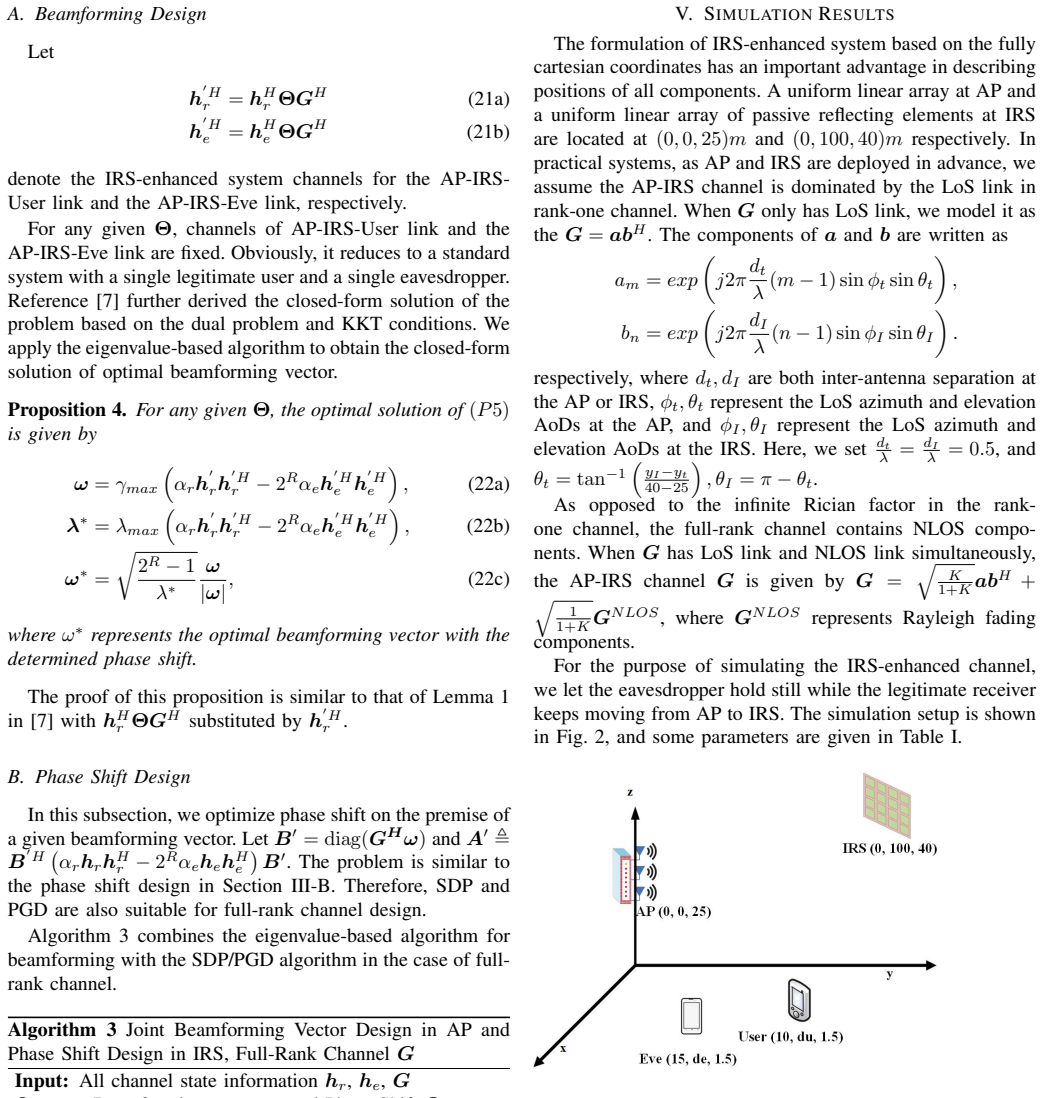
In this paper, we investigate the design of secure transmission frameworks with an intelligent reflecting surface (IRS). Our design aims to minimize the system energy consumption in cases of rank-one and full-rank access point (AP)-IRS links. To facilitate the design, the problem is divided into two parts: design of beamforming vector at AP and phase shift at IRS. In the rank-one channel model, the beamforming vector design and phase shift design are independent. A closed-form expression of beamforming vector is derived. Meanwhile, some algorithms, including the semidefinite relaxation algorithm and projected gradient algorithm, are taken to solve the phase shift problem in the case of instantaneous channel, and in the statistical channel model, the impact of phase shift on the overall system is analyzed. However, since beamforming and phase shift depend on each other in the full-rank model, we refer to conventional wiretap model and utilize an eigenvalue-based algorithm to obtain beamforming vector, while the aforementioned two phase optimization schemes are also applied. Simulation results show that the IRS-enhanced system is envisioned to improve physical layer security.
Figures


Figures from the paper (1 more)

Reference graph
Works this paper leans on
-
[7]
Secrecy rate optimization for secure multicast communications,
C. Wong and R. Cheng, “Secrecy rate optimization for secure multicast communications,” IEEEJ. Sel. Top. Sign. Proces, vol. 10, no.3, pp. 1417– 1432, Dec. 2016
work page 2016
-
[1]
Q. Wu and R. Zhang, “Intelligent reflecting surface enhanced wireless network: Joint active and passive beamforming design,” Online Avail- able: https://arxiv.org/abs/1809.01423
-
[2]
Beamforming Optimization for intelli- gent reflecting surface with discrete phase shifts,
Q. Wu and R. Zhang, “Beamforming Optimization for intelli- gent reflecting surface with discrete phase shifts,”Online Available: https://arxiv.org/abs/1810.10718
-
[3]
Large intelligent surface- assisted wireless communication exploiting Statistical CSI,
Y . Han, W. Tang, S. Jin, C. Wen, and X. Ma, “Large intelligent surface- assisted wireless communication exploiting Statistical CSI,” Online Available: https://arxiv.org/abs/1812.05429
-
[5]
Guaranteeing secrecy using artificial noise,
S. Goel, R. Negi, “Guaranteeing secrecy using artificial noise,” IEEE Trans. Wireless Commun. , vol. 7, no. 6, pp. 2180-2189, Jun. 2008
work page 2008
-
[6]
W. Liao, t. Chang, W. Ma, and C. Chi, “QoS-based transmit beamform- ing in the presence of eavesdroppers: an optimized artificial-noise-aided approach,” IEEE Trans. Signal Process. , vol. 59, no.3, pp. 1202–1216, Mar. 2011
work page 2011
-
[8]
Enabling Secure Wireless Com- munications via Intelligent Reflecting Surfaces,
X. Yu, D. Xu, and R. Schober, “Enabling Secure Wireless Com- munications via Intelligent Reflecting Surfaces,”Online Available: https://arxiv.org/abs/1904.09573
arXiv 1904
-
[9]
Secrecy Rate Maximization for Intelligent Reflecting Surface Assisted Multi-Antenna Communications
H. Shen, W. Xu, Z. He and C. Zhao, “Secrecy Rate Maximization for Intelligent Reflecting Surface Assisted Multi-Antenna Communica- tions,”Online Available: https://arxiv.org/abs/1905.10075
work page Pith review arXiv 1905
Show all 15 references
-
[10]
Secure transmission with multiple antennas I: the MISOME wiretap channel,
A. Khisti and G. W. Wornell, “Secure transmission with multiple antennas I: the MISOME wiretap channel,” IEEE Trans. Inform. Theory , vol. 56, no.7, pp. 3088–3104, Jul. 2010
2010
-
[11]
Asymptotic Analysis of Large Intelligent Surface Assisted MIMO Communication,
Q-U-A. Nadeem, A. Kammoun, A. Chaaban, M. Debbah and M-S. Alouini, “Asymptotic Analysis of Large Intelligent Surface Assisted MIMO Communication,”Online Available: https://arxiv.org/abs/1903.08127
1903 arXiv
-
[12]
Complex quadratic optimization and semidef- inite programming,
S. Zhang, and Y . Huang, “Complex quadratic optimization and semidef- inite programming,” SIAM J. OPTIM. , vol. 16, no.3, pp. 871-890, 2006
2006
-
[13]
On approximating complex quadratic optimization problems via semidefinite programming relaxations,
A. M.-C. So, J. Zhang, and Y . Ye, “On approximating complex quadratic optimization problems via semidefinite programming relaxations,” Math- ematical Programming, vol. 110, pp. 93-110, Jun. 2007
2007
-
[14]
Approximation algorithms for Max-3-Cut and other problems via complex semidefinite programming,
M. X.Geoemans, and D. P. Williamson, “Approximation algorithms for Max-3-Cut and other problems via complex semidefinite programming,” J. Comput. Syst. Sci. , vol. 68, pp. 442-470, 2004
2004
-
[15]
Large system analysis of linear precoding in correlated MISO broadcast channels under limited feedback,
S. Wagner, R. Couillet M. Debbah and D. Stock, “Large system analysis of linear precoding in correlated MISO broadcast channels under limited feedback,” IEEE Trans. Infom. Theory , vol. 58, no. 7, pp. 4509–4537, Jul. 2012
2012
-
[16]
On ergodic secrecy rate for gaussian MISO wiretap channels,
J. Li, and A. P. Petropulu, “On ergodic secrecy rate for gaussian MISO wiretap channels,” IEEE Trans. Wireless Commun. , vol. 10, no.4, pp. 1176–1187, Apr. 2011
2011
Reviewed August 14, 2026 · model on record in the stance chip above.
Discussion (0). Continue with ORCID to comment.