REVIEW 3 major objections 6 minor 90 references
Modelling Bushfire Evacuation Behaviours
T0 review · 3 major / 6 minor · reviewed 2026-08-14 · deepseek-v4-flash
Pith's one-line read The paper claims that a population-generation algorithm paired with a Belief-Desire-Intention behaviour model lets emergency planners build a synthetic community and test bushfire response strategies under different population engagement…
desk verdict A clearly written methods paper with a novel population-generation algorithm, but the community-realism claim rests on unvalidated inputs the paper itself flags. read the letter →
The pith
A machine-rendered reading of the paper's core claim, the machinery that carries it, and where it could break.
The reading
What carries the argument
The load-bearing mechanism is a stochastic plan-generation algorithm built on recursive start-time recovery. From a time-series activity distribution $\delta_{s,t_n}(\alpha_k)$ and a duration weight $d_{s,\alpha_k}$, the algorithm recovers the proportion of subgroup $s$ that starts activity $\alpha_k$ at each time step via $\xi_{s,t_n}(\alpha_k) = \delta_{s,t_n}(\alpha_k) - \sum_{j} \xi_{s,t_{n-j}}(\alpha_k)$ over the previous $d-1$ steps, then normalises and cumulates these into a probability matrix used to sample each agent's activity sequence. Locations are assigned by a locality-based gravity model: the probability an agent moves from its current locality to locality $L_i$ is proportional to $(1/\mathrm{dist}(\ell_{i_0},\ell_i)) \sum_{\ell \in L_i \cap M_{s,\alpha_k}} a_\ell$, with a pseudo-distance $\mathrm{dist}_0(\ell_{i_0},\ell_{i_0})$ that encodes the subgroup travel factor $g_s$ and gives the current-locality probability $1-g_s$. The bushfire response layer then uses two thresholds, INIT and ACT, and an additive alert ranking $r(e,\tau)=e+\tau$ over environmental and transmitted alerts, to choose among three goals: go home now, go to a dependant now, or leave now. This is what turns expert narrative about behaviour into concrete per-agent coordinates, times, and evacuation rules.
What would settle it
Run the generator for a known region and day, then compare the resulting trip start times, origins, and destinations against observed traffic counts or mobile-phone-derived origin-destination data; if the generated trips and congestion patterns do not match the observed data within a stated tolerance, the algorithm's timing and location logic is not reproducing real population movement.
Extended reading notes
Core claim
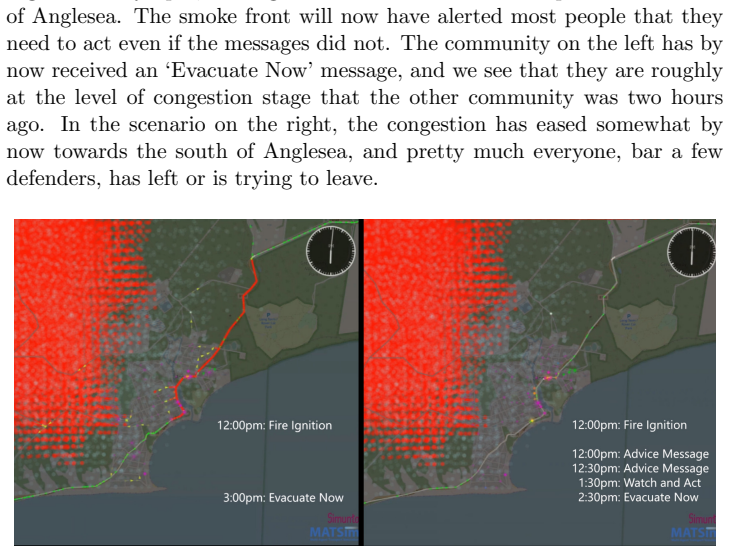
The central claim is that a single input pipeline can convert behaviour profiles into evacuation-ready agents: given subgroups, activity distributions, location mappings, allocation numbers, and travel factors, the algorithm generates a MATSim population.xml whose daily activity plans reproduce the input distributions, and then appends BDI attributes (INIT and ACT thresholds, dependant flags, go-home probabilities, evacuation and invacuation preferences) that determine what each agent does when a bushfire alert arrives. Demonstrated on Surf Coast Shire with five subgroups and 50,000 agents, the plan times match the input distributions to within about 1% for subgroups without long-duration activities and about 5% where work's four-hour duration forces a trade-off; in the evacuation scenario, earlier escalating warnings clear the town before the fire front while later messaging leaves many agents congested on the roads.
Load-bearing premise
The evacuation simulations stand or fall on the hand-built inputs—activity distributions, travel factors, and BDI threshold ranges—being a faithful description of what people in the region actually do; the paper states these inputs were not formally validated and do not necessarily reflect the real Surf Coast Shire population.
Editorial extensions
If this is right
- Emergency personnel could generate a fresh synthetic population for any scenario—tourist season, weekday, special event—by changing the input distributions and subgroup sizes, then run the same evacuation scenario on each without rewriting the simulation.
- Because the same generated plans carry BDI attributes, the tool can compare messaging strategies directly: in the Anglesea demonstration, earlier escalating warnings clear the town before the fire front while a later 'Evacuate Now' leaves many agents stuck in congestion.
- Subgroups without long-duration activities reproduce their input distributions almost exactly (under 1% error), while the four-hour work duration produces a quantified ~5% trade-off, making the algorithm a faithful sampler for simple activity sets.
- Background traffic is endogenous to the simulation rather than an externally imposed load, so pre-evacuation congestion and its effect on clearance emerge from the same synthetic population.
Reading between the lines
- A natural test is to regenerate the Surf Coast population from observed mobile-phone or GPS trip data; if the generated trips match those counts, the same pipeline would generalise to other hazards such as flood or industrial accident.
- The additive alert ranking $r(e,\tau)=e+\tau$ assumes cue substitutability—seeing fire alone equals smoke plus a 'Watch and Act' message—which is a falsifiable psychological claim that after-action surveys could test directly.
- The subgroup travel factor $g_s$ effectively sets each group's spatial range, so comparing generated trip-length distributions with census journey-to-work data would provide a cheap validation of the location and gravity parameters.
- Decoupling 'stop the day' from 'leave' with two thresholds suggests the goal-plan tree could be extended beyond evacuation to shelter-in-place or staged re-entry behaviour.
Editorial analysis
A structured set of objections, weighed in public.
Referee Report
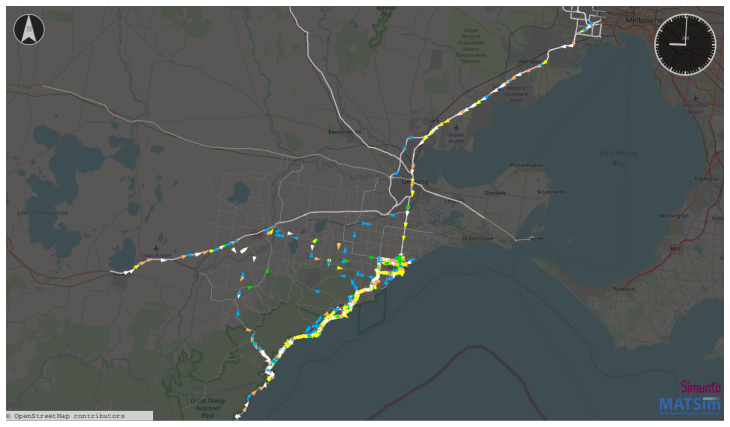
Summary. The manuscript presents an algorithm for generating synthetic daily activity plans for a population of MATSim agents, together with a Belief-Desire-Intention (BDI) component that appends bushfire-response attributes (thresholds, dependants, evacuation preferences) to those plans. The population-generation algorithm takes per-subgroup activity distributions, duration weights, location mappings, locality partitions, and a small number of travel parameters, and outputs a population.xml file. The BDI model defines environmental and transmitted alerts, an additive alert-ranking function, and per-subgroup threshold parameters that determine when agents interrupt their plans and either go home, go to a dependant, or leave. The framework is applied to the Surf Coast Shire in Victoria, with 50,000 agents across five subgroups. The paper reports agreement between the generated plans and the input activity distributions (typically within about 1%, with a maximum around 5% for subgroups that include work), describes traffic visualizations of the generated population, and illustrates two evacuation scenarios for Anglesea that differ in the schedule of warning messages.
Significance. If the approach is taken as a methodological contribution, it is a useful and well-structured step toward behaviorally heterogeneous synthetic populations for evacuation simulation, particularly for regions with large transient populations. The input schema is interpretable, the algorithm is described in pseudo-code, and the internal consistency checks in Tables 2-6 give some confidence that the algorithm reproduces its inputs. The paper is also unusually candid about its limitations. However, the paper's concluding claim that the tool allows emergency personnel to generate realistic communities and test response strategies is not supported by the present evidence: the inputs are acknowledged to be informally validated or provisional, and the evaluation is internal (output vs. input of the same unvalidated data). The evacuation scenario comparison additionally depends on an alert-ranking function that the authors themselves describe as arbitrary. The strengths and weaknesses together point to a solid framework that needs validation or careful reframing before it can support practical claims.
major comments (3)
- [Section 5.1; Section 4.1.3; Section 4.2.1] The central claim of realistic community representation is not supported by the evaluation. Section 5.1 states that "Most of the input data used in Section 4 has only been informally validated and does not necessarily reflect the actual make-up of the population in the Surf Coast Shire," and Section 4.1.3 says the activity distributions "have not been formally validated by SCSC" and are "a first attempt" for demonstration. The checks in Section 4.2.1 compare the generated plans against these same input distributions, so they establish internal consistency (within the reported ~5% error) but not external validity. Because the evacuation outcomes in Section 4.4 are downstream of these inputs, the practical-utility claim is load-bearing on an untested premise. The authors should either validate the inputs against observed trip or evacuation data, or explicitly reframe the contribution as a methodological demonstration and add a sensitivity analysis showing how outcomes vary under plausible perturbations of the input distributions and parameters.
- [Section 4.3.1; Section 4.5] The alert-ranking function r(e, tau) = e + tau is acknowledged to be "somewhat arbitrary" and produces equivalences such as (Smoke, Advice) equivalent to (Fire, no transmitted alert), which may not correspond to real threat perception. This ranking is not a peripheral detail: it determines when INIT and ACT thresholds are crossed, and the Section 4.4 comparison of evacuation scenarios is driven by the resulting differences in agent responses. The authors should either justify the ranking using behavioral evidence or show that the qualitative conclusions of the evacuation demonstration are invariant under reasonable alternative rankings, including non-additive orderings.
- [Section 4.3.2; Table 8] The BDI attribute parameters in Table 8 (prob of dependants, prob of go home, stay, and threshold ranges per subgroup) are assigned without a reproducible mapping from the cited behavioral literature or from the claimed consultation with emergency services personnel. The paper says the inputs were co-developed with domain experts, but it does not document how the archetypes of Strahan et al. (2018) or the other cited behavioral findings translate into these specific numbers. Since these parameters directly determine evacuation decisions, this is a reproducibility issue that should be addressed, for example by providing a parameter-elicitation protocol or by presenting the current values as a clearly labeled baseline for sensitivity testing.
minor comments (6)
- [Section 3.2.2, Algorithm 2] Line 11 writes the start time as "time = tn + runif(-1,1) T/2n" with n the loop variable; this appears to be a typo for sampling uniformly within a time-step of length T/N, i.e., the denominator should involve N, not the loop index. Please correct the formula or the surrounding explanation.
- [Section 3.1.3] The sentence "Note that it we may have the case" contains a typo; it should be something like "Note that we may have the case".
- [Throughout] There are inconsistent spellings: "MATsim" appears alongside "MATSim" (e.g., in Section 4.5), and "PSDLE" is written both as "PSDLE" and "PSDLE" in Section 1 and Section 2.1.1. Please standardize.
- [Tables 2-6] The meaning of "percentage variation" is not defined in the captions or text. Please state explicitly whether it is (output - input)/input x 100 and which direction is positive.
- [Figure 13] The x-axis labels appear duplicated ("11 33 55 ..."), which is likely a rendering or formatting artifact; please check the axis tick labels.
- [Section 4.1.2] The sentence "Duration is set to 2 hours for all subgroups. Note that duration here" is unfinished. Please complete the statement.
Circularity Check
No significant circularity: the plan generator is a transparent transformation of stated inputs, and the evacuation scenarios are demonstrations rather than predictions forced by construction.
full rationale
The paper's claimed derivation is a population plan generator: it takes activity distributions, durations, location mappings and travel factors as inputs (Section 3.1) and produces MATSim plans. The Section 4.2.1 check compares output counts to those same input distributions; this is an internal consistency check, not an empirical prediction, and the paper explicitly labels the ~5% discrepancy as an acceptable reproduction error rather than as validation against real trip data. The evacuation application in Section 4.4 is explicitly framed as a demonstration ('To fully demonstrate the usefulness of the algorithm'), with alert severities and threshold parameters supplied by the authors; outcomes follow from these assumptions, but no claim is made that the simulated outcome is an externally validated prediction. Section 5.1 openly states that the input data 'does not necessarily reflect the actual make-up of the population', which is a validity limitation, not a circular derivation. Self-citations to Singh et al. (2016) and the EES/JILL platform describe the simulation framework reused by the thesis but do not supply a load-bearing result equivalent to the thesis's contribution. Therefore no circular step is exhibited.
Assumptions & free parameters
free parameters (10)
- Travel factor per subgroup =
R=0.2, RP=0.3, VR=0.4, VO=0.6, VD=0.8
- Activity duration weights =
home=2h, work=4h, shop=2h, beach=2h, other=2h
- Probability of dependants per subgroup =
R=0.3, RP=0.05, VR=0, VO=0, VD=0
- Probability of going home before leaving =
R=0.5, RP=0.4, VR=0.4, VO=0.8, VD=0
- Stay and defend allowance per subgroup =
R=true, RP=true, VR=true, VO=false, VD=false
- Threshold ranges for INIT and ACT =
R=0.1-0.8, RP=0.1-0.6, VR=0.1-0.4, VO=0.2-0.4, VD=0.3-0.7
- Alert barometer scores =
Advice=0.1, Watch and Act=0.2, Evacuate Now=0.3, Fire=0.4; r=e+tau
- Activity distributions per subgroup =
Hand-crafted curves in Figures 10-11
- Time-step size =
2 hours, 12 bins
- Visual cue radii =
smoke=5km, fire=1km
assumptions (5)
- domain assumption The seven Strahan archetypes capture real self-evacuation behaviour in Australian bushfires.
- domain assumption Activity distributions and durations are decoupled yet feasible.
- domain assumption Transmitted messages reach all agents in the warned area, and all agents see environmental cues within fixed radii.
- ad hoc to paper The additive alert ranking r(e,tau)=e+tau is a valid ordering of perceived threat.
- domain assumption Home allocation numbers reflect the true population density and distribution.
Cite this review
Pith. "Pith review of Modelling Bushfire Evacuation Behaviours." pith.science (2026). https://pith.science/paper/4BM6YOBM
@misc{pith2026190900991,
  author       = {Pith},
  title        = {Pith review of: Modelling Bushfire Evacuation Behaviours},
  year         = {2026},
  howpublished = {\url{https://pith.science/paper/4BM6YOBM}},
  note         = {Machine review of arXiv:1909.00991}
}
read the original abstract
Bushfires pose a significant threat to Australia's regional areas. To minimise risk and increase resilience, communities need robust evacuation strategies that account for people's likely behaviour both before and during a bushfire. Agent-based modelling (ABM) offers a practical way to simulate a range of bushfire evacuation scenarios. However, the ABM should reflect the diversity of possible human responses in a given community. The Belief-Desire-Intention (BDI) cognitive model captures behaviour in a compact representation that is understandable by domain experts. Within a BDI-ABM simulation, individual BDI agents can be assigned profiles that determine their likely behaviour. Over a population of agents their collective behaviour will characterise the community response. These profiles are drawn from existing human behaviour research and consultation with emergency services personnel and capture the expected behaviours of identified groups in the population, both prior to and during an evacuation. A realistic representation of each community can then be formed, and evacuation scenarios within the simulation can be used to explore the possible impact of population structure on outcomes. It is hoped that this will give an improved understanding of the risks associated with evacuation, and lead to tailored evacuation plans for each community to help them prepare for and respond to bushfire.
Figures


Figures from the paper (22 more)




Reference graph
Works this paper leans on
-
[1]
, Danet, G
AdamBdimodellingsimulation2016 APACrefauthors Adam, C. , Danet, G. , Thangarajah, J. \ Dugdale, J. APACrefauthors \ 2016 . BDI Modelling and Simulation of Human Behaviours in Bushfires BDI modelling and simulation of human behaviours in bushfires . Information Systems for Crisis Response and Management in Mediterranean Countries . Information Systems for ...
2016
-
[2]
AdamModellingHumanBehaviours2017 APACrefauthors Adam, C. \ Gaudou, B. APACrefauthors \ 2017 . Modelling Human Behaviours in Disasters from Interviews : Application to Melbourne Bushfires Modelling Human Behaviours in Disasters from Interviews : Application to Melbourne Bushfires . Journal of Artificial Societies and Social Simulation 20 3 . APACrefDOI doi...
-
[3]
AndersonGravityModel2011 APACrefauthors Anderson, J E. APACrefauthors \ 2011 . The Gravity Model The Gravity Model . Annual Review of Economics 3 1 133-160 . APACrefDOI doi:10.1146/annurev-economics-111809-125114 APACrefDOI
-
[4]
AndersonACTsimpletheory1996 APACrefauthors Anderson, J R. APACrefauthors \ 1996 . ACT : A Simple Theory of Complex Cognition ACT : A simple theory of complex cognition . American Psychologist 51 4 355-365 . APACrefDOI doi:10.1037/0003-066X.51.4.355 APACrefDOI
-
[5]
AntonovicsGeneralizedModelParasitoid1995 APACrefauthors Antonovics, J. , Iwasa, Y. \ Hassell, M P. APACrefauthors \ 1995 05 . A Generalized Model of Parasitoid , Venereal , and Vector - Based Transmission Processes A Generalized Model of Parasitoid , Venereal , and Vector - Based Transmission Processes . The American Naturalist 145 5 661-675 . APACrefDOI ...
-
[6]
AuchinclossBriefintroductoryguide2015 APACrefauthors Auchincloss, A H. \ Garcia, L M T. APACrefauthors \ 2015 11 . Brief Introductory Guide to Agent-Based Modeling and an Illustration from Urban Health Research Brief introductory guide to agent-based modeling and an illustration from urban health research . Cadernos de saude publica 31 Suppl 1 65-78 . APA...
-
[7]
APACrefauthors \ 1997
AxelrodAdvancingArtSimulation1997 APACrefauthors Axelrod, R. APACrefauthors \ 1997 . Advancing the Art of Simulation in the Social Sciences Advancing the Art of Simulation in the Social Sciences . R. Conte, R. Hegselmann \ P. Terna\ ( ), Simulating Social Phenomena Simulating Social Phenomena \ ( 21-40). Springer Berlin Heidelberg
1997
-
[8]
BallasSimBritainspatialmicrosimulation2005 APACrefauthors Ballas, D. , Clarke, G. , Dorling, D. , Eyre, H. , Thomas, B. \ Rossiter, D. APACrefauthors \ 2005 01 . SimBritain : A Spatial Microsimulation Approach to Population Dynamics SimBritain : A spatial microsimulation approach to population dynamics . Population, Space and Place 11 1 13-34 . APACrefDOI...
Show all 90 references
-
[9]
, Ran, B
BarrettDevelopingDynamicTraffic2000 APACrefauthors Barrett, B. , Ran, B. \ Pillai, R. APACrefauthors \ 2000 01 . Developing a Dynamic Traffic Management Modeling Framework for Hurricane Evacuation Developing a Dynamic Traffic Management Modeling Framework for Hurricane Evacuat...
2000 doi
-
[10]
, Wahle, J
BazzanAgentsTrafficModelling1999 APACrefauthors Bazzan, A L C. , Wahle, J. \ Kl\"ugl, F. APACrefauthors \ 1999 . Agents in Traffic Modelling - from Reactive to Social Behaviour Agents in Traffic Modelling - from Reactive to Social Behaviour
1999
-
[11]
, Poggi, A
BellifemineDevelopingmultiagentsystems2001 APACrefauthors Bellifemine, F. , Poggi, A. \ Rimassa, G. APACrefauthors \ 2001 . Developing Multi-Agent Systems with a FIPA -Compliant Agent Framework Developing multi-agent systems with a FIPA -compliant agent framework . Software: P...
2001 doi
-
[12]
, Almashor, M
BeloglazovSimulationwildfireevacuation2016 APACrefauthors Beloglazov, A. , Almashor, M. , Abebe, E. , Richter, J. \ Steer, K C B. APACrefauthors \ 2016 01 . Simulation of Wildfire Evacuation with Dynamic Factors and Model Composition Simulation of wildfire evacuation with dyna...
2016 doi
-
[13]
\ Clarke, M
BirkinSynthesisSyntheticSpatial1988 APACrefauthors Birkin, M. \ Clarke, M. APACrefauthors \ 1988 12 . Synthesis A Synthetic Spatial Information System for Urban and Regional Analysis : Methods and Examples Synthesis A Synthetic Spatial Information System for Urban and Regional...
1988 doi
-
[14]
APACrefauthors \ 2002 05
BonabeauAgentbasedmodelingMethods2002 APACrefauthors Bonabeau, E. APACrefauthors \ 2002 05 . Agent-Based Modeling: Methods and Techniques for Simulating Human Systems Agent-based modeling: Methods and techniques for simulating human systems . Proceedings of the National Academ...
2002 doi
-
[15]
, H\"ubner, J F
BordiniJasonGoldenFleece2005 APACrefauthors Bordini, R H. , H\"ubner, J F. \ Vieira, R. APACrefauthors \ 2005 . Jason and the Golden Fleece of Agent - Oriented Programming Jason and the Golden Fleece of Agent - Oriented Programming . R H. Bordini, M. Dastani, J. Dix \ A. El Fa...
2005 doi
-
[16]
, Israel, D J
BratmanPlansresourceboundedpractical1988 APACrefauthors Bratman, M E. , Israel, D J. \ Pollack, M E. APACrefauthors \ 1988 09 . Plans and Resource-Bounded Practical Reasoning Plans and resource-bounded practical reasoning . Computational Intelligence 4 3 349-355 . APACrefDOI d...
1988
-
[17]
, Ronnquist, R
BusettaJACKIntelligentAgents1999 APACrefauthors Busetta, P. , Ronnquist, R. , Hodgson, A. \ Lucas, A. APACrefauthors \ 1999 . JACK Intelligent Agents - Components for Intelligent Agents in Java JACK Intelligent Agents - Components for Intelligent Agents in Java
1999
-
[18]
, Son, Y J
ChanAgentbasedsimulationtutorial2010 APACrefauthors Chan, W K V. , Son, Y J. \ Macal, C M. APACrefauthors \ 2010 12 . Agent-Based Simulation Tutorial - Simulation of Emergent Behavior and Differences between Agent-Based Simulation and Discrete-Event Simulation Agent-based simu...
2010
-
[19]
\ Zhan, F B
ChenAgentbasedmodellingsimulation2008 APACrefauthors Chen, X. \ Zhan, F B. APACrefauthors \ 2008 01 . Agent-Based Modelling and Simulation of Urban Evacuation: Relative Effectiveness of Simultaneous and Staged Evacuation Strategies Agent-based modelling and simulation of urban...
2008 doi
-
[20]
APACrefauthors \ 2007
ChristakisSpreadObesityLarge2007 APACrefauthors Christakis, N A. APACrefauthors \ 2007 . The Spread of Obesity in a Large Social Network over 32 Years The Spread of Obesity in a Large Social Network over 32 Years . The New England Journal of Medicine 370-379 . APACrefDOI doi:1...
2007 doi
-
[21]
APACrefauthors \ 2009 09
CountryFireAuthorityQualitativeReportCFA2009 APACrefauthors \ Country Fire Authority\ \ \ Sweeney Research\ . APACrefauthors \ 2009 09 . A Qualitative Report on CFA Community Engagement A Qualitative Report on CFA Community Engagement \ . Country Fire Authority
2009
-
[22]
\ Heppenstall, A J
CrooksIntroductionAgentBasedModelling2012 APACrefauthors Crooks, A T. \ Heppenstall, A J. APACrefauthors \ 2012 . Introduction to Agent - Based Modelling Introduction to Agent - Based Modelling . Agent- Based Models of Geographical Systems Agent- Based Models of Geographical S...
2012
-
[23]
\ Gladwin, H
DashEvacuationDecisionMaking2007 APACrefauthors Dash, N. \ Gladwin, H. APACrefauthors \ 2007 08 . Evacuation Decision Making and Behavioral Responses : Individual and Household Evacuation Decision Making and Behavioral Responses : Individual and Household . Natural Hazards Rev...
2007 doi
-
[24]
, Trapman, P
Davisabundancethresholdplague2008 APACrefauthors Davis, S. , Trapman, P. , Leirs, H. , Begon, M. \ Heesterbeek, J a P. APACrefauthors \ 2008 07 . The Abundance Threshold for Plague as a Critical Percolation Phenomenon The abundance threshold for plague as a critical percolatio...
2008 doi
-
[25]
, Peppe, R
Dawsonagentbasedmodelriskbased2011 APACrefauthors Dawson, R J. , Peppe, R. \ Wang, M. APACrefauthors \ 2011 10 . An Agent-Based Model for Risk-Based Flood Incident Management An agent-based model for risk-based flood incident management . Natural Hazards 59 1 167-189 . APACref...
2011 doi
-
[26]
, Hindriks, K V
deBoerAgentProgrammingDeclarative2002 APACrefauthors de Boer , F S. , Hindriks, K V. , van der Hoek , W. \ Meyer, J J C. APACrefauthors \ 2002 07 . Agent Programming with Declarative Goals Agent Programming with Declarative Goals . arXiv:cs/0207008
2002 arXiv
-
[27]
, Luck, M
DInvernodMARSArchitectureSpecification2004 APACrefauthors D'Inverno, M. , Luck, M. , Georgeff, M. , Kinny, D. \ Wooldridge, M. APACrefauthors \ 2004 07 . The dMARS Architecture : A Specification of the Distributed Multi - Agent Reasoning System The dMARS Architecture : A Speci...
2004
-
[28]
APACrefauthors \ 2009 08
EpsteinModellingcontainpandemics2009 APACrefauthors Epstein, J M. APACrefauthors \ 2009 08 . Modelling to Contain Pandemics Modelling to contain pandemics . Nature 460 7256 687-687 . APACrefDOI doi:10.1038/460687a APACrefDOI
2009 doi
-
[29]
\ Foley, D
Farmereconomyneedsagentbased2009 APACrefauthors Farmer, J D. \ Foley, D. APACrefauthors \ 2009 08 . The Economy Needs Agent-Based Modelling The economy needs agent-based modelling . Nature 460 7256 685-686 . APACrefDOI doi:10.1038/460685a APACrefDOI
2009 doi
-
[30]
, Salath\'e, M
FunkModellinginfluencehuman2010 APACrefauthors Funk, S. , Salath\'e, M. \ Jansen, V A A. APACrefauthors \ 2010 05 . Modelling the Influence of Human Behaviour on the Spread of Infectious Diseases: A Review Modelling the influence of human behaviour on the spread of infectious ...
2010
-
[31]
, Riddle, M
GaleaCausalthinkingcomplex2010 APACrefauthors Galea, S. , Riddle, M. \ Kaplan, G A. APACrefauthors \ 2010 02 . Causal Thinking and Complex System Approaches in Epidemiology Causal thinking and complex system approaches in epidemiology . International Journal of Epidemiology 39...
2010 doi
-
[32]
APACrefauthors \ 2006
GilbertWhendoessocial2006 APACrefauthors Gilbert, N. APACrefauthors \ 2006 . When Does Social Simulation Need Cognitive Models? When does social simulation need cognitive models? R. Sun\ ( ), Cognition and Multi - Agent Interaction : From Cognitive Modeling to Social Simulatio...
2006
-
[33]
\ Troitzsch, K
GilbertSimulationSocialScientist2011 APACrefauthors Gilbert, N. \ Troitzsch, K. APACrefauthors \ 2011 . Simulation for the Social Scientist Simulation for the Social Scientist \ ( 2nd \ ). UK Open University Press
2011
-
[34]
\ Sunder, S
GodeAllocativeEfficiencyMarkets1993 APACrefauthors Gode, D K. \ Sunder, S. APACrefauthors \ 1993 02 . Allocative Efficiency of Markets with Zero - Intelligence Traders : Market as a Partial Substitute for Individual Rationality Allocative Efficiency of Markets with Zero - Inte...
1993 doi
-
[35]
\ Railsback, S
GrimmIndividualbasedModellingEcology2005 APACrefauthors Grimm, V. \ Railsback, S. APACrefauthors \ 2005 . Individual-Based Modelling and Ecology Individual-based Modelling and Ecology . USA Princeton University Press
2005
-
[36]
, Heppenstall, A
HarlandCreatingrealisticsynthetic2012 APACrefauthors Harland, K. , Heppenstall, A. , Smith, D. \ Birkin, M H. APACrefauthors \ 2012 . Creating Realistic Synthetic Populations at Varying Spatial Scales: A Comparative Critique of Population Synthesis Techniques Creating realisti...
2012
-
[37]
, Handmer, J
HaynesAustralianbushfirefatalities2010 APACrefauthors Haynes, K. , Handmer, J. , McAneney, J. , Tibbits, A. \ Coates, L. APACrefauthors \ 2010 05 . Australian Bushfire Fatalities 1900 2008: Exploring Trends in Relation to the ` Prepare , Stay and Defend or Leave Early' Policy ...
2010 doi
-
[38]
, Nagel, K
HorniIntroducingMATSim2016 APACrefauthors Horni, A. , Nagel, K. \ Axhausen, K. APACrefauthors \ 2016 08 . Introducing MATSim Introducing MATSim . A. Horni, K. Nagel \ K. Axhausen\ ( ), The Multi - Agent Transport Simulation MATSim The Multi - Agent Transport Simulation MATSim ...
2016
-
[39]
, Georgeff, M P
Ingrandarchitecturerealtimereasoning1992 APACrefauthors Ingrand, F F. , Georgeff, M P. \ Rao, A S. APACrefauthors \ 1992 12 . An Architecture for Real-Time Reasoning and System Control An architecture for real-time reasoning and system control . IEEE Expert 7 6 34-44 . APACref...
1992 doi
-
[40]
, Ronald, N
JainCreatingSyntheticPopulation2015 APACrefauthors Jain, S. , Ronald, N. \ Winter, S. APACrefauthors \ 2015 12 . Creating a Synthetic Population : A Comparison of Tools Creating a Synthetic Population : A Comparison of Tools . Conference of Transportation Research Group of Ind...
2015
-
[41]
, Jarvis, D
JarvisHolonicExecutionBDI2008 APACrefauthors Jarvis, J. , Jarvis, D. \ R\"onnquist, R. APACrefauthors \ 2008 . Holonic Execution : A BDI Approach Holonic Execution : A BDI Approach . Springer Science & Business Media
2008
-
[42]
, Johnson, C E
JohnsonStayGoHuman2011 APACrefauthors Johnson, P F. , Johnson, C E. \ Sutherland, C. APACrefauthors \ 2011 . Stay or Go ? Human Behavior in Major Evacuations Stay or Go ? Human Behavior in Major Evacuations . Pedestrian and Evacuation Dynamics Pedestrian and Evacuation Dynamic...
2011
-
[43]
APACrefauthors \ 1969
JUNGCollectedWorksJung1969 APACrefauthors Jung, C G. APACrefauthors \ 1969 . Collected Works of C . G . Jung , Volume 9 ( Part 1): Archetypes and the Collective Unconscious Collected Works of C . G . Jung , Volume 9 ( Part 1): Archetypes and the Collective Unconscious \ (G. Ad...
1969
-
[44]
APACrefauthors \ 2012
KennedyModellingHumanBehaviour2012 APACrefauthors Kennedy, W G. APACrefauthors \ 2012 . Modelling Human Behaviour in Agent - Based Models Modelling Human Behaviour in Agent - Based Models . Agent- Based Models of Geographical Systems Agent- Based Models of Geographical Systems...
2012
-
[45]
\ McKendrick, A G
Kermackcontributionmathematicaltheory1927 APACrefauthors Kermack, W O. \ McKendrick, A G. APACrefauthors \ 1927 08 . A Contribution to the Mathematical Theory of Epidemics A Contribution to the Mathematical Theory of Epidemics . Proc. R. Soc. Lond. A 115 772 700-721 . APACrefD...
1927
-
[46]
APACrefauthors \ 2009
KnoopRoadIncidentsNetwork2009 APACrefauthors Knoop, V L. APACrefauthors \ 2009 . Road Incidents and Network Dynamics : Effects on Driving Behaviour and Traffic Congestion Road Incidents and Network Dynamics : Effects on driving behaviour and traffic congestion
2009
-
[47]
APACrefauthors \ 1990 10
KulashTraditionalNeighbourhoodDevelopment1990 APACrefauthors Kulash, W. APACrefauthors \ 1990 10 . Traditional Neighbourhood Development : Will the Traffic Work ? Traditional Neighbourhood Development : Will the Traffic Work ? Bellevue WA
1990
-
[48]
APACrefauthors \ 2007 07
LairdExtendingSoarCognitive2007 APACrefauthors Laird, J E. APACrefauthors \ 2007 07 . Extending the Soar Cognitive Architecture : Extending the Soar Cognitive Architecture : \ . Fort Belvoir, VA Defense Technical Information Center . APACrefDOI doi:10.21236/ADA473738 APACrefDOI
2007 doi
-
[49]
, Son, Y J
LeeIntegratedHumanDecision2010 APACrefauthors Lee, S. , Son, Y J. \ Jin, J. APACrefauthors \ 2010 11 . An Integrated Human Decision Making Model for Evacuation Scenarios Under a BDI Framework An Integrated Human Decision Making Model for Evacuation Scenarios Under a BDI Framew...
2010
-
[50]
\ Prater, C S
LindellCriticalBehavioralAssumptions2007 APACrefauthors Lindell, M K. \ Prater, C S. APACrefauthors \ 2007 03 . Critical Behavioral Assumptions in Evacuation Time Estimate Analysis for Private Vehicles : Examples from Hurricane Research and Planning Critical Behavioral Assumpt...
2007 doi
-
[51]
, Getz, W M
Lloyd-SmithFrequencydependentincidence2004 APACrefauthors Lloyd-Smith , J O. , Getz, W M. \ Westerhoff, H V. APACrefauthors \ 2004 03 . Frequency Dependent Incidence in Models of Sexually Transmitted Diseases: Portrayal of Pair Based Transmission and Effects of Illness on Cont...
2004
-
[52]
\ North, M J
MacalTutorialagentbasedmodeling2005 APACrefauthors Macal, C M. \ North, M J. APACrefauthors \ 2005 12 . Tutorial on Agent-Based Modeling and Simulation Tutorial on agent-based modeling and simulation . Proceedings of the Winter Simulation Conference , 2005. Proceedings of the ...
2005
-
[53]
, Rhodes, A
McCaffreyWildfireevacuationits2015 APACrefauthors McCaffrey, S M. , Rhodes, A. \ Stidham, M. APACrefauthors \ 2015 04 . Wildfire Evacuation and Its Alternatives: Perspectives from Four United States ' Communities Wildfire evacuation and its alternatives: Perspectives from four...
2015 doi
-
[54]
, Stidham, M
McCaffreyOutreachProgramsPeer2011 APACrefauthors McCaffrey, S M. , Stidham, M. , Toman, E. \ Shindler, B. APACrefauthors \ 2011 09 . Outreach Programs , Peer Pressure , and Common Sense : What Motivates Homeowners to Mitigate Wildfire Risk ? Outreach Programs , Peer Pressure ,...
2011 doi
-
[55]
APACrefauthors \ 1988
McClellandConnectionistmodelspsychological1988 APACrefauthors McClelland, J L. APACrefauthors \ 1988 . Connectionist Models and Psychological Evidence Connectionist models and psychological evidence . Journal of Memory and Language 27 2 107-123 . APACrefDOI doi:10.1016/0749-59...
1988 doi
-
[56]
, Elliott, G
McLennanHouseholderdecisionmakingimminent2012 APACrefauthors McLennan, J. , Elliott, G. \ Omodei, M. APACrefauthors \ 2012 . Householder Decision-Making under Imminent Wildfire Threat: Stay and Defend or Leave? Householder decision-making under imminent wildfire threat: Stay a...
2012 doi
-
[57]
APACrefauthors \ 1994
MedskerDesigndevelopmenthybrid1994 APACrefauthors Medsker, L. APACrefauthors \ 1994 . Design and Development of Hybrid Neural Network and Expert Systems Design and development of hybrid neural network and expert systems . Proceedings of 1994 IEEE International Conference on Ne...
1994
-
[58]
\ Page, S
MillerComplexAdaptiveSystems2007 APACrefauthors Miller, J. \ Page, S. APACrefauthors \ 2007 . Complex Adaptive Systems : An Introduction to Computational Models of Social Life Complex Adaptive Systems : An Introduction to Computational Models of Social Life . USA Princeton Uni...
2007
-
[59]
, Spiekermann, K
MoeckelCreatingSyntheticPopulation2003 APACrefauthors Moeckel, R. , Spiekermann, K. \ Wegener, M. APACrefauthors \ 2003 05 . Creating a Synthetic Population Creating a Synthetic Population . Computers in Urban Planning and Urban Management Computers in Urban Planning and Urban...
2003
-
[60]
\ Newman, M E J
MooreEpidemicspercolationsmallworld2000 APACrefauthors Moore, C. \ Newman, M E J. APACrefauthors \ 2000 05 . Epidemics and Percolation in Small-World Networks Epidemics and percolation in small-world networks . Physical Review E 61 5 5678-5682 . APACrefDOI doi:10.1103/PhysRevE...
2000 doi
-
[61]
, Batllori, E
MoritzLearningcoexistwildfire2014 APACrefauthors Moritz, M A. , Batllori, E. , Bradstock, R A. , Gill, A M. , Handmer, J. , Hessburg, P F. Syphard, A D. APACrefauthors \ 2014 11 . Learning to Coexist with Wildfire Learning to coexist with wildfire . Nature 515 7525 58-66 . APA...
2014 doi
-
[62]
, Sonenberg, L
NorlingEnhancingMultiAgentBased2000 APACrefauthors Norling, E. , Sonenberg, L. \ R\"onnquist, R. APACrefauthors \ 2000 07 . Enhancing Multi - Agent Based Simulation with Human - Like Decision Making Strategies Enhancing Multi - Agent Based Simulation with Human - Like Decision...
2000 doi
-
[63]
\ Takahashi, T
OkayaBDIAgentModel2011 APACrefauthors Okaya, M. \ Takahashi, T. APACrefauthors \ 2011 . BDI Agent Model Based Evacuation Simulation BDI Agent Model Based Evacuation Simulation . The 10th International Conference on Autonomous Agents and Multiagent Systems - Volume 3 The 10th I...
2011
-
[64]
, Nagel, K
PadghamIntegratingBDIAgents2014 APACrefauthors Padgham, L. , Nagel, K. , Singh, D. \ Chen, Q. APACrefauthors \ 2014 . Integrating BDI Agents into a MATSim Simulation Integrating BDI Agents into a MATSim Simulation . Proceedings of the Twenty -First European Conference on Artif...
2014 doi
-
[65]
\ Singh, D
PadghamMakingMATSimAgents2016 APACrefauthors Padgham, L. \ Singh, D. APACrefauthors \ 2016 08 . Making MATSim Agents Smarter with the Belief - Desire - Intention Framework Making MATSim Agents Smarter with the Belief - Desire - Intention Framework . K. Nagel, K. Axhausen \ A. ...
2016
-
[66]
, Carroll, M S
PaveglioAlternativesEvacuationProtecting2008 APACrefauthors Paveglio, T. , Carroll, M S. \ Jakes, P J. APACrefauthors \ 2008 03 . Alternatives to Evacuation Protecting Public Safety during Wildland Fire Alternatives to Evacuation Protecting Public Safety during Wildland Fire ....
2008 doi
-
[67]
, Bliemer, M
PelModellingTravellerBehaviour2011 APACrefauthors Pel, A. , Bliemer, M. \ Hoogendoorn, S. APACrefauthors \ 2011 . Modelling Traveller Behaviour under Emergency Evacuation Conditions Modelling Traveller Behaviour under Emergency Evacuation Conditions . European Journal of Trans...
2011
-
[68]
, Van Hentenryck, P
Pillacconflictbasedpathgenerationheuristic2016 APACrefauthors Pillac, V. , Van Hentenryck, P. \ Even, C. APACrefauthors \ 2016 01 . A Conflict-Based Path-Generation Heuristic for Evacuation Planning A conflict-based path-generation heuristic for evacuation planning . Transport...
2016 doi
-
[69]
, Bucci, A
PopoviciCoevolutionaryPrinciples2012 APACrefauthors Popovici, E. , Bucci, A. , Wiegand, R P. \ De Jong, E D. APACrefauthors \ 2012 . Coevolutionary Principles Coevolutionary Principles . G. Rozenberg, T. B\"ack \ J N. Kok\ ( ), Handbook of Natural Computing Handbook of Natural...
2012 doi
-
[70]
APACrefauthors \ 1996
RaoAgentSpeakBDIagents1996 APACrefauthors Rao, A S. APACrefauthors \ 1996 . AgentSpeak ( L ): BDI Agents Speak out in a Logical Computable Language AgentSpeak ( L ): BDI agents speak out in a logical computable language . J G. Carbonell\ . \ ( ), Agents Breaking Away Agents Br...
1996 doi
-
[71]
\ Georgeff, M P
RaoModelingRationalAgents1991 APACrefauthors Rao, A S. \ Georgeff, M P. APACrefauthors \ 1991 . Modeling Rational Agents within a BDI - Architecture Modeling Rational Agents within a BDI - Architecture . J. Allen, E. Sandewall \ R. Fikes\ ( ), 2nd International Conference on P...
1991
-
[72]
\ Georgeff, M P
RaoBDIAgentsTheory1995 APACrefauthors Rao, A S. \ Georgeff, M P. APACrefauthors \ 1995 . BDI Agents : From Theory to Practice BDI Agents : From Theory to Practice . In Proceedings of the First International Conference on Multi - Agent Systems (Icmas-95 In Proceedings of the Fi...
1995
-
[73]
\ Beilin, R
ReidWhereFireCoConstructing2014 APACrefauthors Reid, K. \ Beilin, R. APACrefauthors \ 2014 02 . Where's the Fire ? Co - Constructing Bushfire in the Everyday Landscape Where's the Fire ? Co - Constructing Bushfire in the Everyday Landscape . Society & Natural Resources 27 2 14...
2014
-
[74]
APACrefauthors \ 2017
ReynoldsHistoryPrepareStay2017 APACrefauthors Reynolds, B T. APACrefauthors \ 2017 . A History of the Prepare , Stay and Defend or Leave Early Policy in Victoria A History of the Prepare , Stay and Defend or Leave Early Policy in Victoria . 312
2017
-
[75]
, Miller, J H
RustCharacterizingeffectivetrading1994 APACrefauthors Rust, J. , Miller, J H. \ Palmer, R. APACrefauthors \ 1994 01 . Characterizing Effective Trading Strategies: Insights from a Computerized Double Auction Tournament Characterizing effective trading strategies: Insights from ...
1994 doi
-
[76]
, Murray-Tuite Pamela \ Gladwin Hugh
SadriArifMohaiminHowEvacuateModel2014 APACrefauthors Sadri Arif Mohaimin , Ukkusuri Satish V. , Murray-Tuite Pamela \ Gladwin Hugh . APACrefauthors \ 2014 01 . How to Evacuate : Model for Understanding the Routing Strategies during Hurricane Evacuation How to Evacuate : Model ...
2014
-
[77]
, Gouw, F
ScerriBushfireBLOCKSModular2010 APACrefauthors Scerri, D. , Gouw, F. , Hickmott, S. , Yehuda, I. , Zambetta, F. \ Padgham, L. APACrefauthors \ 2010 . Bushfire BLOCKS : A Modular Agent -Based Simulation Bushfire BLOCKS : A Modular Agent -based Simulation . Proceedings of the 9t...
2010
-
[78]
, Chhetri, P
ShahparvariMultiObjectiveDecisionAnalytics2015 APACrefauthors Shahparvari, S. , Chhetri, P. , Abareshi, A. \ Abbasi, B. APACrefauthors \ 2015 09 . Multi- Objective Decision Analytics for Short - Notice Bushfire Evacuation : An Australian Case Study Multi- Objective Decision An...
2015 doi
-
[79]
\ Padgham, L
SinghEmergencyEvacuationSimulator2017 APACrefauthors Singh, D. \ Padgham, L. APACrefauthors \ 2017 08 . Emergency Evacuation Simulator ( EES ) - a Tool for Planning Community Evacuations in Australia Emergency Evacuation Simulator ( EES ) - a Tool for Planning Community Evacua...
2017
-
[80]
, Padgham, L
SinghIntegratingBDIAgents2016 APACrefauthors Singh, D. , Padgham, L. \ Logan, B. APACrefauthors \ 2016 11 . Integrating BDI Agents with Agent - Based Simulation Platforms Integrating BDI Agents with Agent - Based Simulation Platforms . Autonomous Agents and Multi-Agent Systems...
2016 doi
-
[81]
, Koren, T
SongModellingscalingproperties2010 APACrefauthors Song, C. , Koren, T. , Wang, P. \ Barab\'asi, A L. APACrefauthors \ 2010 10 . Modelling the Scaling Properties of Human Mobility Modelling the scaling properties of human mobility . Nature Physics 6 10 818-823 . APACrefDOI doi:...
2010 doi
-
[82]
, Whittaker, J
StrahanSelfevacuationarchetypesAustralian2018 APACrefauthors Strahan, K. , Whittaker, J. \ Handmer, J. APACrefauthors \ 2018 03 . Self-Evacuation Archetypes in Australian Bushfire Self-evacuation archetypes in Australian bushfire . International Journal of Disaster Risk Reduct...
2018 doi
-
[83]
, Haigh, L
ThompsonPlannedultimateactions2018 APACrefauthors Thompson, K R. , Haigh, L. \ Smith, B P. APACrefauthors \ 2018 03 . Planned and Ultimate Actions of Horse Owners Facing a Bushfire Threat: Implications for Natural Disaster Preparedness and Survivability Planned and ultimate ac...
2018 doi
-
[84]
\ Whittaker, J
TibbitsStaydefendleave2007 APACrefauthors Tibbits, A. \ Whittaker, J. APACrefauthors \ 2007 01 . Stay and Defend or Leave Early: Policy Problems and Experiences during the 2003 Victorian Bushfires Stay and defend or leave early: Policy problems and experiences during the 2003 ...
2007 doi
-
[85]
, Tamminga, G
TuEvacuationplancity2010 APACrefauthors Tu, H. , Tamminga, G. , Drolenga, H. , de Wit , J. \ van der Berg , W. APACrefauthors \ 2010 . Evacuation Plan of the City of Almere: Simulating the Impact of Driving Behavior on Evacuation Clearance Time Evacuation plan of the city of a...
2010 doi
-
[86]
APACrefauthors \ 2002
WaddellUrbanSimModelingurban2002 APACrefauthors Waddell, P. APACrefauthors \ 2002 . UrbanSim : Modeling Urban Development for Land Use, Transportation, and Environmental Planning UrbanSim : Modeling urban development for land use, transportation, and environmental planning . A...
2002
-
[87]
\ Handmer, J
WhittakerCommunityBushfireSafety2010 APACrefauthors Whittaker, J. \ Handmer, J. APACrefauthors \ 2010 10 . Community Bushfire Safety : A Review of Post -Black Saturday Research Community Bushfire Safety : A Review of Post -black Saturday Research . Australian Journal of Emerge...
2010
-
[88]
, Haynes, K
WhittakerCommunitysafety20092013 APACrefauthors Whittaker, J. , Haynes, K. , Handmer, J. \ McLennan, J. APACrefauthors \ 2013 09 . Community Safety during the 2009 Australian ` Black Saturday ' Bushfires: An Analysis of Household Preparedness and Response Community safety duri...
2013 doi
-
[89]
, Singh, D
WickramasingheHeuristicDataMerging2017 APACrefauthors Wickramasinghe, B N. , Singh, D. \ Padgham, L. APACrefauthors \ 2017 . Heuristic Data Merging for Constructing Initial Agent Populations Heuristic Data Merging for Constructing Initial Agent Populations . G. Sukthankar\ J A...
2017
-
[90]
, Chun, S A
YuanTrafficevacuationsimulation2017 APACrefauthors Yuan, S. , Chun, S A. , Spinelli, B. , Liu, Y. , Zhang, H. \ Adam, N R. APACrefauthors \ 2017 05 . Traffic Evacuation Simulation Based on Multi-Level Driving Decision Model Traffic evacuation simulation based on multi-level dr...
2017
Reviewed August 14, 2026 · model on record in the stance chip above.
Discussion (0). Continue with ORCID to comment.