REVIEW 3 major objections 5 minor 13 references
Machine Learning based jet momentum reconstruction in Pb-Pb collisions measured with the ALICE detector
T0 review · 3 major / 5 minor · reviewed 2026-08-14 · deepseek-v4-flash
Pith's one-line read Machine-learning background correction extends jet measurements in Pb-Pb to record-low momenta and to R=0.6 jets.
desk verdict Solid proceedings with first Pb-Pb results from the ML jet correction; credible where checkable, but low-pT and R=0.6 claims rest on a training background and fragmentation systematic that are not fully closed. read the letter →
The pith
A machine-rendered reading of the paper's core claim, the machinery that carries it, and where it could break.
The reading
What carries the argument
The machinery is a supervised regression model, in this analysis a neural network with three hidden layers of 100, 100, and 50 neurons, that takes a set of per-jet observables and outputs a single corrected jet $p_{\mathrm{T}}$. The input features are the jet $p_{\mathrm{T}}$ corrected by the standard area-based method, the jet angularity, the number of jet constituents, and the transverse momenta of the eight hardest constituents; the training target is the detector-level true jet momentum, approximated as the reconstructed jet momentum times the PYTHIA-carried momentum fraction. The trained model is applied jet by jet, and a response matrix built from embedding vacuum jets into real Pb-Pb background handles any residual smearing and detector effects before an unfolding step produces the final spectra.
What would settle it
Embed simulated events with a known true jet $p_{\mathrm{T}}$ but with a fragmentation pattern deliberately different from the PYTHIA training sample (for example, quark-only jets or jets with strong medium-induced energy loss), run the trained ML estimator on them, and test whether the residual between corrected and true jet momentum shifts systematically with jet $p_{\mathrm{T}}$ or radius $R$; a shift that the response-matrix and unfolding procedure cannot remove would show the estimator is not robust to the fragmentation assumption.
Extended reading notes
Core claim
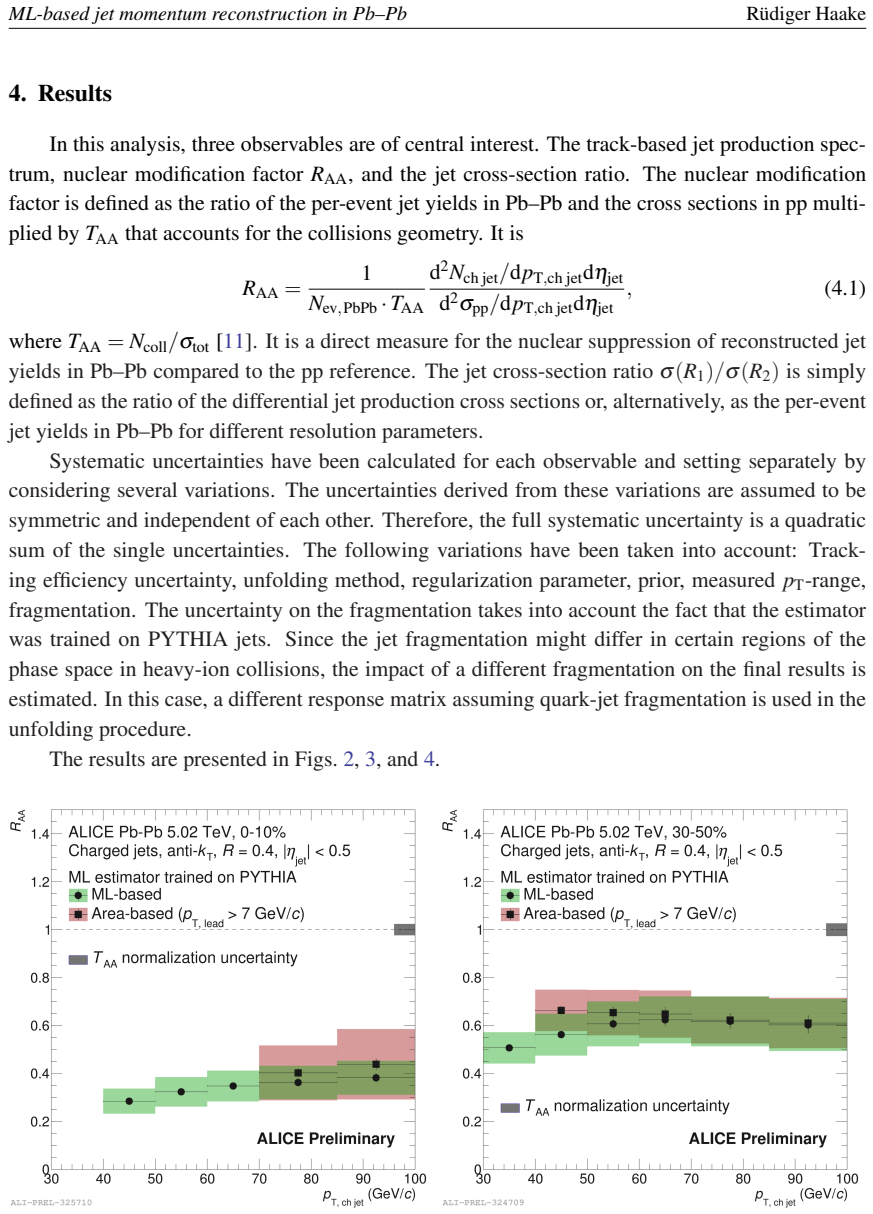
The central discovery is that a neural-network regressor can learn the mapping from raw, background-contaminated jet observables to the true jet transverse momentum well enough to replace the statistical area-based background subtraction with a per-jet correction. The paper demonstrates this by training the model on PYTHIA jets reconstructed to detector level and embedded in a thermal background, with the regression target defined as the reconstructed jet momentum multiplied by the momentum fraction carried by PYTHIA particles in the jet. The trained estimator is then applied to Pb-Pb data, and the residual fluctuations are removed by unfolding through a response matrix built from embedding vacuum jets into real data backgrounds. The result is that track-based jets are measured down to $p_{\mathrm{T}}=40$ GeV/$c$ (0-10% central) and $30$ GeV/$c$ (30-50%) for $R=0.4$, and $R=0.6$ jets are measured for the first time in heavy-ion collisions at the LHC, with spectra and nuclear modification factors compatible with the area-based method and with no significant $R$ dependence.
Load-bearing premise
The method's reliability rests on the assumption that jets embedded in a simplified thermal background, trained with the PYTHIA momentum fraction as the target, represent the true relationship between the measured jet features and the actual jet momentum in real Pb-Pb collisions; if heavy-ion jet fragmentation or background structure differs from this training model in ways the embedding tests do not capture, the corrected jet spectra will be biased.
Editorial extensions
If this is right
- Jets with resolution parameter $R=0.6$ can be measured in Pb-Pb collisions at the LHC for the first time, extending jet quenching studies to larger angular scales.
- Track-based jets at $R=0.4$ become measurable down to $40$ GeV/$c$ in 0-10% and $30$ GeV/$c$ in 30-50% central Pb-Pb collisions, a much larger low-$p_{\mathrm{T}}$ reach than the area-based method.
- The ML-corrected nuclear modification factors agree with the area-based estimator where both are available, confirming the method's consistency with an established baseline.
- No significant $R$ dependence of the nuclear modification factor is observed between $R=0.2$, $0.4$, and $0.6$, and the jet cross-section ratios are consistent with the pp baseline.
Reading between the lines
- Because the estimator is trained on the PYTHIA momentum fraction, its jet-by-jet correction inherits the fragmentation model; training instead on a mixture of quark- and gluon-initiated jets or on jets with varied energy loss could make the correction less model-dependent.
- The same regression approach could be pushed to $R=0.8$ or $0.9$ within the ALICE acceptance, exactly the regime where the area-based method's background fluctuations are most severe and where the ML method's advantage would be largest.
- The jet-by-jet idea is not limited to jet $p_{\mathrm{T}}$: similar features could estimate groomed jet momentum, subjet momentum, or the background under a jet, which would extend the method to jet-structure observables in heavy-ion collisions.
Signed reviews
Editorial analysis
A structured set of objections, weighed in public.
Referee Report
Summary. This conference proceeding reports a machine-learning-based jet momentum correction for Pb-Pb collisions at sqrt(s_NN)=5.02 TeV, applied to track-based jets with R=0.2, 0.4, and 0.6. A neural network is trained on PYTHIA jets embedded in a thermal background to map raw jet features to an estimate of the true detector-level jet pT on a jet-by-jet basis. The authors present nuclear modification factors for R=0.4 (down to 40 GeV/c in 0-10% and 30 GeV/c in 30-50% central collisions) and, for the first time, for R=0.6, together with jet cross-section ratios sigma(R=0.2)/sigma(R=0.4) and sigma(R=0.2)/sigma(R=0.6). They claim compatibility with the area-based estimator at higher pT, no significant R-dependence of R_AA, and no centrality or pp deviation in the cross-section ratios.
Significance. If the ML correction is unbiased, the method would extend ALICE jet measurements to lower pT and larger R than the standard area-based method, and the R=0.6 result would be a first in heavy-ion collisions at the LHC. The paper contains genuine validation steps: an embedding-based comparison of residual widths against the area-based estimator (Fig. 1) and a direct comparison of R_AA at R=0.4 in two centrality classes (Fig. 2). The work is a proceedings contribution and the underlying method is documented in a separate paper (ref. [4]), which is appropriately cited. However, the new physics claims (low-pT reach and first R=0.6 measurement) rest on the untested assumption that a model trained on a simplified thermal background generalizes to real Pb-Pb events; the evidence presented in this manuscript is not sufficient to establish that. The central results are therefore plausible but not yet convincingly validated.
major comments (3)
- [Sec. 3.1 and 3.3] The training background in Sec. 3.1 uses an exponential momentum tail above roughly 4 GeV/c, whereas real Pb-Pb events contain a power-law tail of high-pT particles from semi-hard and hard processes. Because the input features include the transverse momenta of the first eight leading jet constituents, a high-pT background or underlying-event particle in a real event could be misidentified by the estimator as part of the signal jet, producing a positive bias in the corrected pT. The embedding validation in Sec. 3.3 reports only the width of residual distributions; it does not show that the mean residual is consistent with zero, especially in the lowest pT bins or for R=0.6. To support the advertised low-pT reach, the authors should provide a closure test with a realistic background model that includes a power-law component, or at least report the mean residual as a function of pT for each R and centrality.
- [Sec. 4, fragmentation systematic] The fragmentation systematic variation replaces only the response matrix used in unfolding with a quark-jet response. It does not retrain or re-evaluate the ML estimator itself under altered fragmentation, even though the estimator is trained on PYTHIA jets and its input-output mapping is likely sensitive to jet fragmentation. Changing only the unfolding response cannot capture a fragmentation-dependent bias in the estimator itself. The authors should either retrain the estimator on samples with modified fragmentation and compare the final corrected spectra, or provide an argument based on the estimator's features as to why it is insensitive to fragmentation.
- [Sec. 4, Figs. 2-4] The compatibility with the area-based method shown in Fig. 2 is established only in the pT region where the area-based method is already reliable. The new claims -- jets at 40 (30) GeV/c for R=0.4 and the R=0.6 measurement -- lie precisely in the region where no such cross-check exists. The cross-section ratios in Fig. 4 and the R=0.6 R_AA in Fig. 3 therefore rest entirely on the ML estimator's extrapolation. To support these claims, the authors should provide an alternative validation in this region, for example a closure test on full heavy-ion simulations with realistic underlying events, or a comparison with an independent background subtraction technique such as constituent subtraction or soft-drop grooming.
minor comments (5)
- [Abstract and Sec. 1] The abstract and introduction state that transverse momentum spectra will be presented, but the figures show only nuclear modification factors and cross-section ratios; the spectra themselves are not displayed. Please clarify what is shown or add the spectra.
- [Fig. 1] The caption of Fig. 1 is incomplete: the left panel is described as 'the comparison of the different background estimators for R=0.4' but the reader cannot identify which curves correspond to which estimator or centrality. The right panel lacks axis labels and a legend. Please improve the figure captions and labels.
- [Sec. 4] The systematic uncertainties are described only qualitatively; no numeric values are given for any observable. For a measurement-oriented proceeding, at least the dominant systematic uncertainties at representative pT values should be stated.
- [Sec. 3.2] The regression target is defined as the reconstructed jet momentum multiplied by the momentum fraction carried by PYTHIA particles in the jet. This definition is confusing and should be clarified: it appears to approximate the true detector-level jet momentum, but the potential bias introduced by this target choice is not discussed. Please rephrase and add a sentence on the validity of this approximation.
- [Sec. 4, Eq. (4.1)] Equation (4.1) is not fully typeset: the differentials and symbols are inconsistently formatted (e.g., d2Nch jet/dpT,ch jetdηjet). Also, the definition T_AA = N_coll/sigma_tot is a rough shorthand; please use the standard definition and cite a reference.
Circularity Check
No circular derivation: the ML estimator is trained on simulation, applied to real Pb-Pb events, and the final spectra are checked against the area-based method and pp reference; the only self-citation is the method paper [4], which is not load-bearing for the new data results.
full rationale
The central chain is not circular. In Section 3.2 the regression target is defined as 'the reconstructed jet momentum multiplied by the momentum fraction that is carried by PYTHIA particles in the jet'; this is a simulation-truth training label, not the final measured observable. The trained estimator is then applied to real Pb-Pb data, and the resulting spectra are unfolded with a PYTHIA-based response matrix and compared, in Figs. 2-4, to the area-based estimator, to pp data from [7], and to Hybrid Model calculations. None of the final observables (spectra, R_AA, cross-section ratios) is equal by construction to the training target or to the ML input features. The method paper [4] is cited as the source of the ML technique and its first author overlaps with the present paper, but the proceeding independently describes the training data, input parameters, and validation, and the data results are new; this is a normal method reference rather than a load-bearing self-citation. The fragmentation limitation in Section 4 - the uncertainty is estimated only by replacing the unfolding response matrix with a quark-jet response, without retraining the ML estimator - is a genuine model-robustness weakness, but it is a validity concern, not circularity, because the measurement does not reduce to the training simulation by definition. Likewise, the exponentially falling high-pT tail of the thermal toy background in Section 3.1 is an assumption about the training distribution, not an equation that forces the final answer.
Assumptions & free parameters
free parameters (6)
- Neural network architecture =
three hidden layers: 100, 100, 50 neurons
- Track pT threshold =
0.150 GeV/c
- Jet area cut =
Ajet > 0.557 pi R^2
- Thermal background multiplicity range =
flat 0 to 3000 tracks
- Unfolding regularization parameter =
not stated
- Low pT reach cut =
40 GeV/c (0-10%), 30 GeV/c (30-50%) for R=0.4
assumptions (6)
- domain assumption PYTHIA 8 with GEANT3 simulates jet fragmentation, hadronization, and detector response accurately enough for training and response matrices.
- ad hoc to paper The thermal background toy model (flat multiplicity 0-3000 tracks, thermal pT spectrum, exponential tail above ~4 GeV/c) is representative of the real Pb-Pb underlying event for the purpose of training the ML estimator.
- ad hoc to paper The regression target, defined as reconstructed jet pT times the PYTHIA particle momentum fraction in the jet, is a valid approximation of the true detector-level jet momentum.
- domain assumption A supervised ML model trained on embedded PYTHIA jets generalizes to real Pb-Pb jets in the feature space used.
- domain assumption The measured pp reference from [7] and the TAA centrality scaling from [11] are valid for computing R_AA.
- standard math Standard jet clustering algorithms (anti-kT, kT) and the area-based background subtraction provide a valid baseline.
Cite this review
Pith. "Pith review of Machine Learning based jet momentum reconstruction in Pb-Pb collisions measured with the ALICE detector." pith.science (2026). https://pith.science/paper/YAWOXIO6
@misc{pith2026190901639,
  author       = {Pith},
  title        = {Pith review of: Machine Learning based jet momentum reconstruction in Pb-Pb collisions measured with the ALICE detector},
  year         = {2026},
  howpublished = {\url{https://pith.science/paper/YAWOXIO6}},
  note         = {Machine review of arXiv:1909.01639}
}
abstract
The precise reconstruction of jet transverse momenta in heavy-ion collisions is a challenging task. A major obstacle is the large number of uncorrelated (mainly) low-$p_\mathrm{T}$ particles overlaying the jets. Strong region-to-region fluctuations of this background complicate the jet measurement and lead to significant uncertainties. We developed a novel approach to correct jet momenta (or energies) for the underlying background in heavy-ion collisions. The approach allows the measurement of jets down to extremely low transverse momenta and for large resolution $R$ by making use of common Machine Learning techniques to estimate the jet transverse momentum based on several parameters. In this conference proceeding, we will present transverse momentum spectra and nuclear modification factors of track-based jets that have been corrected by this Machine Learning approach and comparisons to published results where possible. The analysis was performed on Pb-Pb collisions at $\sqrt{s_\mathrm{NN}} = 5.02$ TeV recorded with the ALICE detector and measures jets with large resolution parameters for low momenta, unprecedented thus far in data on heavy-ion collisions.
Figures


Figures from the paper (1 more)

Reference graph
Works this paper leans on
- [4]
-
[1]
ALICE Collaboration: The ALICE experiment at the CERN LHC, JINST 3 (2008) S08002
work page 2008
-
[2]
ALICE Collaboration: Measurement of event background fluctuations for charged particle jet reconstruction in Pb–Pb collisions at√sNN = 2.76 TeV , JHEP 03 (2012) 053
work page 2012
-
[3]
ALICE Collaboration: Measurement of charged jet suppression in Pb–Pb collisions at √sNN = 2.76 TeV , JHEP 03 (2014) 013
work page 2014
-
[5]
Sjostrand et al.: PYTHIA 6.4 – Physics and Manual, JHEP 0605 (2006) 026
T. Sjostrand et al.: PYTHIA 6.4 – Physics and Manual, JHEP 0605 (2006) 026
work page 2006
-
[6]
R. Brun et al.: GEANT Detector Description and Simulation Tool, CERN Program Library Long Writeup CERN-W-5013 (1994)
work page 1994
-
[7]
ALICE Collaboration: Measurement of charged jet cross section in pp collisions at √sNN = 5.02 TeV , submitted to PRD, cf. [nucl-ex/1905.02536]
arXiv 1905
-
[8]
M. Cacciari, G.P. Salam: Dispelling the N3 myth for the kt jet-finder, Phys. Lett. B 641, 57-61 (2006)
work page 2006
Show all 13 references
-
[9]
Cacciari, G.P
M. Cacciari, G.P. Salam, and G. Soyez: The anti- kT jet clustering algorithm, JHEP 0804 (2008) 063
2008
-
[10]
Pedregosa et al.: Scikit-learn: Machine learning in Python, Journal of Machine Learning Research 12(2011) 2825–2830
F. Pedregosa et al.: Scikit-learn: Machine learning in Python, Journal of Machine Learning Research 12(2011) 2825–2830
2011
-
[11]
ALICE Collaboration: Centrality determination in heavy-ion collisions, Public note
-
[12]
Casalderrey-Solana et al., A hybrid strong/weak coupling approach to jet quenching, JHEP 10 (2014) 019
J. Casalderrey-Solana et al., A hybrid strong/weak coupling approach to jet quenching, JHEP 10 (2014) 019
2014
-
[13]
[hep-ph/1907.12301]
Daniel Pablos, Jet suppression from small to intermediate to large radius, cf. [hep-ph/1907.12301]. 6
1907 arXiv
Reviewed August 14, 2026 · model on record in the stance chip above.
Discussion (0). Continue with ORCID to comment.