REVIEW 4 major objections 6 minor 36 references
Minimising the Levelised Cost of Electricity for Bifacial Solar Panel Arrays using Bayesian Optimisation
T0 review · 4 major / 6 minor · reviewed 2026-08-14 · deepseek-v4-flash
Pith's one-line read A Bayesian optimization over panel tilt and row spacing finds large-scale solar farm layouts that produce electricity up to 23 percent cheaper than the usual latitude-tilt, winter-solstice-spacing design rule.
desk verdict A clean, reimplementable computational study showing that rule-of-thumb tilt and spacing for bifacial farms are not LCOE-optimal; the quantitative 23% claim is model-internal and should be framed as such. read the letter →
The pith
A machine-rendered reading of the paper's core claim, the machinery that carries it, and where it could break.
The reading
What carries the argument
The central engine is a geometric illumination model for a two-dimensional periodic PV field, which decomposes each module's irradiance into four components on front and back—direct and diffuse light from the sky, and direct and diffuse light reflected from the ground—summed as eq. (1), with the ground-reflection terms computed as integrals over geometrical distribution functions in eq. (3). The model yields the annual energy yield of eq. (4), where the module is treated as current-limited by its least-illuminated position, and the cost model collapses to the closed-form LCOE expression eq. (12), namely $\mathrm{LCOE} = (\ell I_P \eta_f c_P + d c_L)/(\ell \cdot EY \cdot T)$. Bayesian optimization with a Gaussian-process surrogate and expected-improvement acquisition then navigates the (tilt, spacing) cost landscape, using the model's LCOE evaluations to identify the global minimum under each cost scenario.
What would settle it
Take a real bifacial test installation at a cloudy high-latitude site, measure the annual energy yield of several (tilt, spacing) configurations spanning the rule-of-thumb and the optimized designs, and compare the measured LCOE differences with the model's predictions; if the model overstates or reverses the yield ranking between configurations, the reported reductions would not carry over to practice.
Extended reading notes
Core claim
For large-scale bifacial photovoltaic fields, the levelized cost of electricity as a function of module tilt and row spacing is not minimized by the conventional winter-solstice design rule, and the divergence grows with land cost and with diffuse-light fraction. The paper's optimizer finds layouts with up to 23.5% lower LCOE in Seattle at land cost $c_L = 20\,\$/$m^2$ compared with tilt equal to latitude and the no-shading winter-solstice spacing; the improvement in Dallas at the same land cost is 7.4%. The optimized geometries are site-specific: higher land costs push rows closer together and tilt angles down, while bifacial arrays favor larger spacing and higher tilt than monofacial arrays. These results are computed from a two-dimensional periodic-field illumination model with annual TMY3 irradiance data, and they lead the authors to conclude that tilt and spacing should be optimized independently rather than set by rule of thumb.
Load-bearing premise
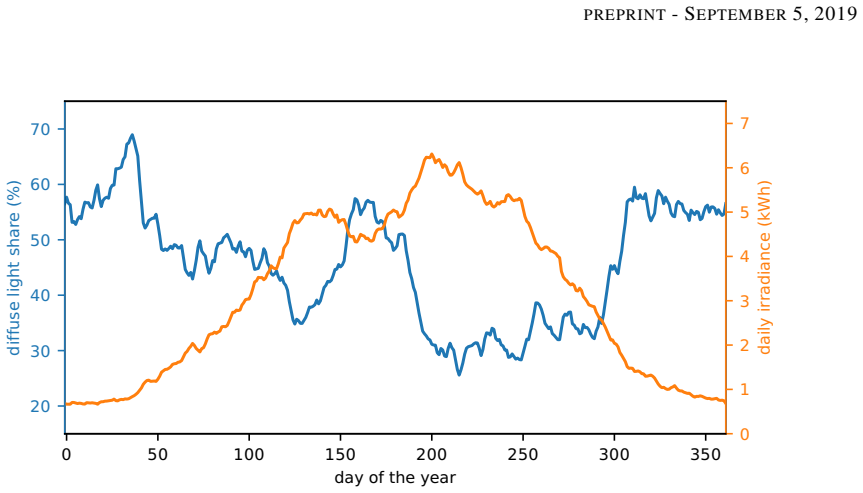
The predicted savings are only as good as the model's ability to tell how much electricity different panel layouts produce, and that model assumes evenly spaced infinite rows, non-reflective panels, and a fixed 30% ground albedo, without being validated against real field measurements.
Editorial extensions
If this is right
- At high land costs, the minimum-LCOE row spacing becomes much shorter than the winter-solstice no-shading spacing, so the rule overstates land consumption for a given power output.
- Bifacial modules are more sensitive to tilt and spacing than monofacial ones because roughly three-quarters of their rear-side illumination comes from ground reflection, so choosing geometry by rule of thumb forfeits more of their potential.
- In cloudy, high-latitude climates with expensive land, the LCOE landscape is steep, and small deviations from the optimum cost the most; Seattle's 23% reduction illustrates this.
- Because only the ratio of land cost to total cost enters LCOE, the optimized geometry is stable under proportional scaling of module and land prices, e.g. $c_L = 10\,\$/$m^2$ with $c_P = 1500\,\$/$kWp$ gives the same layout as $c_L = 5\,\$/$m^2$ with $c_P = 750\,\$/$kWp$.
- The same pipeline can be rerun for any location with TMY3 data, giving site-specific design guidelines rather than a universal tilt/spacing rule.
Reading between the lines
- Inference: if the geometric model's ranking of configurations is validated against field measurements, the same optimization could be extended to additional free parameters such as mounting height, variable ground albedo, or row segmentation, where the sweet spot is even harder to guess.
- Inference: the paper's strongest regime—cloudy high-latitude sites with expensive land—is also the regime where its fixed-albedo and isotropic-sky assumptions are most likely to matter, so the 23% figure should be treated as a model-based estimate until field data confirm the energy-yield differences.
- Inference: a practical design tool could precompute one design map per general climate class, letting developers choose tilt and spacing from land price and latitude without running an optimization themselves; the paper's cost-ratio invariance makes such a map two-dimensional rather than four-dimensional.
Editorial analysis
A structured set of objections, weighed in public.
Referee Report
Summary. The paper develops a two-dimensional, periodic illumination model for bifacial PV modules in large fields, computes annual energy yields from TMY3 data for Dallas and Seattle, and combines the yield model with a simple levelized-cost-of-electricity (LCOE) expression to optimize module tilt and row spacing by Bayesian optimization. Five land-cost scenarios are considered. The central quantitative claim is that the usual design rules, namely module tilt equal to site latitude and row spacing with no mutual shading at the winter solstice, are suboptimal: the optimizer finds configurations with up to 23% lower LCOE in Seattle at cL = 20 $/m2, with the optimized geometries depending strongly on location and cost scenario.
Significance. If the illumination model is accurate, the paper makes a useful contribution by showing, within a single internally consistent framework, that site-specific simultaneous optimization of tilt and spacing can matter more than traditional heuristic rules, and that land cost shifts the optimum toward denser layouts. The internal consistency is a genuine strength: the cost algebra in Eqs. (6)-(12) is correct, the baseline and optimized LCOE values are computed from the same forward model, and no parameter is fitted to reproduce the headline result. The series-connected current-limit assumption in Eq. (5) is also conservative for dense layouts. However, the quantitative significance is conditional on the irradiance model, which is not validated against field data or independent benchmark models, so the specific 23% figure should be treated as a model prediction rather than an established result.
major comments (4)
- [Section 2, Eqs. (4)-(5); Table 4] The central claim of up to 23% lower LCOE in Seattle at cL = 20 $/m2 is computed entirely with the Section 2 illumination model, which assumes an isotropic diffuse sky, optically black modules, and a Lambertian ground with fixed albedo A = 30%. No numerical comparison is made with measured yields or with the published models cited as related work (Marion et al., ref. 19; Kreinin et al., ref. 17). At the relevant Seattle optimum the geometry is dense (d = 3.6 m, Table 5), so rear-side ground-reflected irradiance and inter-row shading dominate the comparison. A systematic bias in these components would shift both the optimized geometry and the magnitude of the LCOE gap. To establish the headline number, the authors should benchmark the model against at least one measured system or against an independent published model, or alternatively provide a quantified sensitivity/uncertainty analysis showing how the optimized geometries and the 23% reduction change under plausible variations in the model assumptions.
- [Section 2, Eq. (3)] The illumination model is not specified in enough detail to be reproduced. Eq. (3) leaves the ground distribution functions gamma_dir(xg) and gamma_diff(xg) and the integration limits alpha1(s) and alpha2(s) undefined; the treatment of shadowed and sunlit ground fractions is described only verbally. Since the entire optimization result is generated by this model, the authors should either provide explicit closed-form definitions of these functions and integration bounds, or make a reference implementation available as supplementary code.
- [Section 4.2-4.3, Figs. 6-7] The manuscript repeatedly uses the term "global minimum" for the Bayesian optimization results, but expected-improvement Bayesian optimization is a heuristic method with no guarantee of global optimality. No iteration count, kernel choice, acquisition-function optimization settings, or convergence diagnostics are reported. The red dots in Figs. 6 and 7 should be described as the best configurations found by the optimizer, and the claims in the abstract and conclusions should be softened accordingly unless convergence to the true global optimum is demonstrated.
- [Section 3.2 and Table 5] All results fix the module height at h = 0.5 m and the albedo at A = 30%. The paper states that the bifacial gain saturates above h = 0.5 m and cites agreement with Kreinin et al., but no quantitative comparison is shown. In the high-land-cost optima of Table 5 (d = 3.2-3.6 m), rear irradiance is sensitive to both h and A. A short sensitivity sweep over these two parameters is needed to establish that the design guidelines and the reported LCOE reductions are robust rather than artifacts of the chosen fixed values.
minor comments (6)
- [Section 4.1 heading] The heading contains a typo: "Levelied cost of electricity" should be "Levelized cost of electricity" (or "Levelised" in British spelling).
- [References] References 16 and 35 are the same paper by Patel et al. in Applied Energy; the duplicate should be merged and the citation list cleaned up.
- [Abstract and Conclusions] The claim that the algorithm enables design guidelines "for most regions on Earth" is stronger than what is demonstrated, since only two locations and one TMY per location are used; this should be qualified.
- [Section 4.3, baseline definition] The rule-of-thumb baseline is defined with the 9 am winter-solstice no-shading rule. Since variants such as noon or 9 am-3 pm windows also appear in the literature, the choice should be justified and its influence on the reported LCOE reductions noted.
- [Eq. (4)-(5)] Hourly TMY3 values are treated as instantaneous irradiance when evaluating the current-limiting position in Eq. (5). Sub-hourly irradiance variability could affect the minimum-current position, and it would be helpful to state why this effect is expected to be small for annual energy totals.
- [Figs. 6-7] The color maps saturate at 4.5 and 5.4 cents/kWh respectively, which makes it difficult to read the LCOE landscape near the rule-of-thumb geometries; using a perceptually uniform scale without clipping would improve interpretability.
Circularity Check
No circularity: the LCOE landscape is computed by forward illumination and cost equations, the optimizer minimizes that objective, and the baseline rule is an external benchmark; the only self-citation is a background textbook.
full rationale
The derivation chain is self-contained and no fitted parameter is used to reproduce the headline result. The illumination model (Sec. 2, Eqs. 1-5) converts DNI/DHI, geometry, and albedo into front/back irradiance distribution functions; Eq. (4) sums these over TMY3 hours to annual energy yield; Eq. (12) combines the resulting EY with cost inputs cP and cL to LCOE. Bayesian optimization minimizes this forward-computed objective, so the optima and Table 4 reductions are consequences of the model, not inputs to it. The comparative baseline is the external winter-solstice/latitude rule, which is not derived from the model. The self-citation (Ref. 24, a textbook co-authored by K. Jäger) is used only for standard solar-position background and a generic LCOE discussion; it does not supply the illumination model, the cost model, or the optimization. The agreement with Kreinin et al. for bifacial-gain saturation is cited external work and is not a fit. The model assumptions (isotropic diffuse sky, black modules, fixed 0.3 albedo, current-limit Eq. 5) are strong and unvalidated, but they are assumptions, not circular definitions; validation concerns belong to correctness risk, not circularity. Therefore no circular step can be exhibited.
Assumptions & free parameters
free parameters (7)
- back-side efficiency eta_b =
0.18
- ground albedo A =
0.30
- system cost cP =
1000 $/kWp
- land cost cL =
1, 2.5, 5, 10, 20 $/m2
- mounting height h =
0.5 m
- lifetime T =
25 years
- module length l =
1.96 m
assumptions (6)
- domain assumption The PV field is infinite and periodic, so boundary effects are neglected (Section 2).
- domain assumption Solar modules are optically black and do not reflect light to other modules (Section 2).
- domain assumption Diffuse sky radiation is isotropic at every timestamp (Section 3.1).
- domain assumption The series-connected module current is limited by the minimum irradiance point on the module (eq. 5, Section 3.1).
- domain assumption LCOE is computed with no discounting or capital cost, with constant annual energy output over the 25-year lifetime (Section 4.1, eqs. 6-12).
- domain assumption A Typical Meteorological Year represents long-term climate at each location (Section 3.1).
Cite this review
Pith. "Pith review of Minimising the Levelised Cost of Electricity for Bifacial Solar Panel Arrays using Bayesian Optimisation." pith.science (2026). https://pith.science/paper/2K5XDWMQ
@misc{pith2026190901660,
  author       = {Pith},
  title        = {Pith review of: Minimising the Levelised Cost of Electricity for Bifacial Solar Panel Arrays using Bayesian Optimisation},
  year         = {2026},
  howpublished = {\url{https://pith.science/paper/2K5XDWMQ}},
  note         = {Machine review of arXiv:1909.01660}
}
read the original abstract
Bifacial solar module technology is a quickly growing market in the photovoltaics (PV) sector. By utilising light impinging on both, front and back sides of the module, actual limitations of conventional monofacial solar modules can be overcome at almost no additional costs. Optimising large-scale bifacial solar power plants with regard to minimum levelised cost of electricity (LCOE), however, is challenging due to the vast amount of free parameters such as module inclination angle and distance, module and land costs, character of the surroundings, weather conditions and geographic position. We present a detailed illumination model for bifacial PV modules in a large PV field and calculate the annual energy yield exemplary for two locations with different climates. By applying the Bayesian optimisation algorithm we determine the global minimum of the LCOE for bifacial and monofacial PV fields at these two exemplary locations considering land costs in the model. We find that currently established design guidelines for mono- and bifacial solar farms often do not yield the minimum LCOE. Our algorithm finds solar panel configurations yielding up to 23 % lower LCOE compared to the established configuration with the module tilt angle equal to the latitude and the module distance chosen such that no mutual shading of neighboring solar panels occurs at winter solstice. Our algorithm enables the user to extract clear design guidelines for mono- and bifacial large-scale solar power plants for most regions on Earth and further accelerates the development of competitively viable photovoltaic systems.
Figures


Figures from the paper (9 more)




Reference graph
Works this paper leans on
-
[1]
Kunta Yoshikawa, Hayato Kawasaki, Wataru Yoshida, Toru Irie, Katsunori Konishi, Kunihiro Nakano, Toshihiko Uto, Daisuke Adachi, Masanori Kanematsu, Hisashi Uzu, and Kenji Yamamoto. Silicon heterojunction solar cell with interdigitated back contacts for a photoconversion efficiency over 26%. Nature Energy, 2(5):17032, May 2017
work page 2017
-
[2]
A. Richter, M. Hermle, and S. W. Glunz. Reassessment of the Limiting Efficiency for Crystalline Silicon Solar Cells. IEEE J. Photovolt., 3(4):1184–1191, October 2013
work page 2013
-
[3]
R. Kopecek and J. Libal. Towards large-scale deployment of bifacial photovoltaics. Nature Energy, 3(6):443–446, June 2018
work page 2018
-
[4]
Stein, Radovan Kopecek, Jai Prakash Singh, Wei Luo, Yan Wang, Armin G
Tian Shen Liang, Mauro Pravettoni, Chris Deline, Joshua S. Stein, Radovan Kopecek, Jai Prakash Singh, Wei Luo, Yan Wang, Armin G. Aberle, and Yong Sheng Khoo. A review of crystalline silicon bifacial photovoltaic performance characterisation and simulation. Energy Environ. Sci., 12(1):116–148, January 2019
work page 2019
-
[5]
Bifacial solar technology report 2018 edition
Shravan Chunduri and Michael Schmela. Bifacial solar technology report 2018 edition. Technical report, TaiYang News, 2018
work page 2018
-
[6]
Sanyo Canada launches first bifacial solar module -, December 2009
Sanyo. Sanyo Canada launches first bifacial solar module -, December 2009
work page 2009
-
[7]
Yingli. Yingli’s PANDA BIFACIAL Module Became the World’s First Bifacial Module Certified by CGC, UL, and TUV Rheinland, 2018
work page 2018
-
[8]
bSolar launches High-Efficiency Bifacial Silicon Solar Cells, 2012
bSolar. bSolar launches High-Efficiency Bifacial Silicon Solar Cells, 2012
work page 2012
Show all 36 references
-
[9]
Trina Solar to launch N-type i-TOPCon double-glass bifacial modules, June 2019
TrinaSolar. Trina Solar to launch N-type i-TOPCon double-glass bifacial modules, June 2019
2019
-
[10]
10th edition of the international technology roadmap photovoltaics
ITRPV . 10th edition of the international technology roadmap photovoltaics. Technical report, VDMA, 2019
2019
-
[11]
Ishikawa and S
N. Ishikawa and S. Nishiyama. World first large scale 1.25mw bifacial pv power plant on snowy area in japan. In Presented at the 3rd Bifi PV Workshop, Miyazaki, Japan, 2016
2016
-
[12]
Economic feasibility of bifacial silicon solar cells
Fabian Fertig, Sebastian Nold, Nico Wöhrle, Johannes Greulich, Ingrid Hädrich, Karin Krauß, Max Mittag, Daniel Biro, Stefan Rein, and Ralf Preu. Economic feasibility of bifacial silicon solar cells. Prog. Photovoltaics Res. Appl., 24(6):800–817, 2016
2016
-
[13]
Appelbaum
J. Appelbaum. Bifacial photovoltaic panels field. Renewable Energy, 85:338–343, January 2016
2016
-
[14]
Ryyan Khan, Enas Sakr, Xingshu Sun, Peter Bermel, and Muhammad A
M. Ryyan Khan, Enas Sakr, Xingshu Sun, Peter Bermel, and Muhammad A. Alam. Ground sculpting to enhance energy yield of vertical bifacial solar farms. Applied Energy, 241:592–598, May 2019
2019
-
[15]
Modelling of Bifacial Gain for Stand-alone and in-field Installed Bifacial PV Modules
Ismail Shoukry, Joris Libal, Radovan Kopecek, Eckard Wefringhaus, and Jürgen Werner. Modelling of Bifacial Gain for Stand-alone and in-field Installed Bifacial PV Modules. Energy Procedia, 92:600–608, August 2016
2016
-
[16]
Tahir Patel, M
M. Tahir Patel, M. Ryyan Khan, Xingshu Sun, and Muhammad A. Alam. A worldwide cost-based design and optimization of tilted bifacial solar farms. Applied Energy, 247:467–479, August 2019
2019
-
[17]
Kreinin, A
L. Kreinin, A. Karsenty, D. Grobgeld, and N. Eisenberg. PV systems based on bifacial modules: Performance simulation vs. design factors. In 2016 IEEE 43rd Photovoltaic Specialists Conference (PVSC), pages 2688–2691, June 2016
2016
-
[18]
The new rules for latitude and solar system design, August 2018
Paul Grana. The new rules for latitude and solar system design, August 2018
2018
-
[19]
A practical irradiance model for bifacial PV modules
Bill Marion, Sara MacAlpine, Chris Deline, Amir Asgharzadeh, Fatima Toor, Daniel Riley, Joshua Stein, and Clifford Hansen. A practical irradiance model for bifacial PV modules. In 2017 IEEE 44th Photovoltaic Specialist Conference (PVSC). IEEE, jun 2017
2017
-
[20]
A simplified skyline-based method for estimating the annual solar energy potential in urban environments
Andres Calcabrini, Hesan Ziar, Olindo Isabella, and Miro Zeman. A simplified skyline-based method for estimating the annual solar energy potential in urban environments. Nature Energy, 4(3):206–215, March 2019
2019
-
[21]
U. A. Yusufoglu, T. M. Pletzer, L. J. Koduvelikulathu, C. Comparotto, R. Kopecek, and H. Kurz. Analysis of the Annual Performance of Bifacial Modules and Optimization Methods. IEEE J. Photovolt., 5(1):320–328, January 2015. 13 PREPRINT - SEPTEMBER 5, 2019
2015
-
[22]
Kreinin, N
L. Kreinin, N. Bordin, A. Karsenty, A. Drori, D. Grobgeld, and N. Eisenberg. PV module power gain due to bifacial design. Preliminary experimental and simulation data. In 2010 35th IEEE Photovoltaic Specialists Conference, pages 002171–002175, June 2010
2010
-
[23]
Users manual for tmy3 data sets
Stephen Wilcox and William Marion. Users manual for tmy3 data sets. Technical Report NREL/TP-581-43156, National Renewable Energy Laboratory, 2008
2008
-
[24]
A. H. M. Smets, K. Jäger, O. Isabella, R. A. C. M. M. van Swaaij, and M. Zeman. Solar energy : The physics and engineering of photovoltaic conversion technologies and systems. UIT Cambridge, 2016
2016
-
[25]
Pysolar, 2018
Brandon Stafford. Pysolar, 2018
2018
-
[26]
World map of the köppen-geiger climate classification updated
Markus Kottek, Jürgen Grieser, Christoph Beck, Bruno Rudolf, and Franz Rubel. World map of the köppen-geiger climate classification updated. Meteorol. Z., 15(3):259–263, jul 2006
2006
-
[27]
Average Annual Sunshine in American Cities, 2019
Liz Ozborn. Average Annual Sunshine in American Cities, 2019
2019
-
[28]
Technical report, International Organization for Standardization, Geneva, Switzerland, 1992
ISO 9845-1:1992. Technical report, International Organization for Standardization, Geneva, Switzerland, 1992
1992
-
[29]
Adams, and Nando de Freitas
Bobak Shahriari, Kevin Swersky, Ziyu Wang, Ryan P. Adams, and Nando de Freitas. Taking the Human Out of the Loop: A Review of Bayesian Optimization. Proceedings of the IEEE, 104(1):148–175, 1 2016
2016
-
[30]
Robots that can adapt like animals.Nature, 521(7553):503–507, 5 2015
Antoine Cully, Jeff Clune, Danesh Tarapore, and Jean-Baptiste Mouret. Robots that can adapt like animals.Nature, 521(7553):503–507, 5 2015
2015
-
[31]
Jasper Snoek, Hugo Larochelle, and Ryan P. Adams. Practical Bayesian Optimization of Machine Learning Algorithms, 2012
2012
-
[32]
Global optimization of complex optical structures using bayesian optimization based on gaussian processes.Proc
Philipp-Immanuel Schneider, Xavier Garcia Santiago, Carsten Rockstuhl, and Sven Burger. Global optimization of complex optical structures using bayesian optimization based on gaussian processes.Proc. SPIE, 103350:103350O, jun 2017
2017
-
[33]
Herbol, Weici Hu, Peter Frazier, Paulette Clancy, and Matthias Poloczek
Henry C. Herbol, Weici Hu, Peter Frazier, Paulette Clancy, and Matthias Poloczek. Efficient search of composi- tional space for hybrid organic–inorganic perovskites via Bayesian optimization. npj Computational Materials, 4(1):51, 12 2018
2018
-
[34]
Scikit-optimize/scikit-optimize: V0.5.2, 2018
Tim Head, MechCoder, Gilles Louppe, Iaroslav Shcherbatyi, Fcharras, Zé Vinícius, Cmmalone, Christopher Schröder, Nel215, Nuno Campos, Todd Young, Stefano Cereda, Thomas Fan, Rene-Rex, Kejia (KJ) Shi, Justus Schwabedal, Carlosdanielcsantos, Hvass-Labs, Mikhail Pak, SoManyUserna...
2018
-
[35]
Tahir Patel, M
M. Tahir Patel, M. Ryyan Khan, Xingshu Sun, and Muhammad A. Alam. A worldwide cost-based design and optimization of tilted bifacial solar farms. Applied Energy, 247:467–479, 8 2019
2019
-
[36]
Sánchez-Carbajal and P
S. Sánchez-Carbajal and P. M. Rodrigo. Optimum Array Spacing in Grid-Connected Photovoltaic Systems considering Technical and Economic Factors. International Journal of Photoenergy, 2019:1–14, 1 2019. 14 PREPRINT - SEPTEMBER 5, 2019 Supporting Information A Climate diagrams Fi...
2019
Reviewed August 14, 2026 · model on record in the stance chip above.
Discussion (0). Continue with ORCID to comment.