REVIEW 2 major objections 5 minor 32 references
Theory of nonlinear interactions between x rays and optical radiation in crystals
T0 review · 2 major / 5 minor · reviewed 2026-08-14 · deepseek-v4-flash
Pith's one-line read Band structure shows up in x-ray-optical mixing.
desk verdict Genuinely new band-structure dependence in X-ray/optical mixing, but the advertised clean separation rests on a zero-overlap Wannier assumption that is in tension with the model's nonzero bandwidth. read the letter →
The pith
A machine-rendered reading of the paper's core claim, the machinery that carries it, and where it could break.
The reading
What carries the argument
The load-bearing object is the function $I_{n_1,n_2}(\varepsilon_{\rm id},k_{\rm id})$ defined in Eq. (13): an integral over the Brillouin zone of the difference of Fermi-Dirac occupancies divided by the detuning $\varepsilon_{n_1}(q+k_{\rm id})-\varepsilon_{n_2}(q)-\varepsilon_{\rm id}$ (with damping), i.e., a generalized joint density of states for interband transitions separated by the idler wave vector. It enters both terms of the conductivity, so it carries the entire band-structure dependence. Around it sits the assumption that Wannier functions are maximally localized and real, which lets the matrix elements $\langle W_{n_2}|e^{-iG\cdot x}|W_{n_1}\rangle$ and momentum matrix elements factor out of the band integral; the remaining matrix-element combinations are written in terms of real position/momentum matrix elements $a$, $c$, $\pi_k$. The polarization symmetry of the two conductivity terms is what allows the separation: the $D_k$ term (symmetric in pump/signal indices) is measured with parallel polarizations, the $B_{ijk}$ term (antisymmetric) with orthogonal polarizations.
What would settle it
Measure the idler-energy spectrum of x-ray SPDC in a single crystal at fixed reciprocal-lattice vector, resolving the signal polarization parallel and perpendicular to the pump. If the paper is right, the parallel component should follow the induced-charge term $I_+ - I_-$ (a peak near the band gap) and the perpendicular component should follow $I_+ + I_-$, with the two spectra differing measurably. A clean observation would be that the perpendicular-to-parallel ratio changes sharply as the idler energy crosses the band gap; if both polarization components show identical spectral shapes, or the band-gap peak appears in neither, the real-Wannier factorization or the two-term separation fails for that crystal.
Extended reading notes
Core claim
The central discovery is that the nonlinear current density generated by mixing x-rays with optical/UV radiation in a crystal contains two coexisting kinds of material information, governed by different physics. The paper derives, by perturbation theory in the density-matrix formalism, the second-order conductivity for the process where an x-ray pump down-converts into a signal x-ray and an idler optical photon under momentum conservation with a reciprocal lattice vector $G$. The conductivity has a gauge-current piece $D_k(-\omega_{\rm id};G)$ that is symmetric under swapping the signal and pump polarization indices and an antisymmetric piece $B_{ijk}(\omega_{\rm id},k_{\rm id};G)$; the former is proportional to the induced charge density, the latter to band-transition matrix elements. Both are modulated by the function $I_{n_1,n_2}(\varepsilon_{\rm id},k_{\rm id})$, a Brillouin-zone integral weighted by the joint density of states of interband transitions separated by the idler wave vector. For a two-band semiconductor model, $I_+(\varepsilon_{\rm id})$ shows a sharp peak at the band-gap energy while $I_-$ decreases monotonically, so the spectral dependence of the nonlinear signal tracks the joint density of states. Because the two conductivity terms have orthogonal polarization selection rules, the paper argues that parallel and perpendicular signal polarizations can be measured separately to untangle band-structure effects from atomic-scale valence-electron information.
Load-bearing premise
The load-bearing premise is that the crystal's Wannier functions can be chosen maximally localized and real, so that atom-scale matrix elements factor out of the band integral; if that condition fails for a real material, the band-structure and valence-electron contributions mix and the paper's separation strategy collapses.
Editorial extensions
If this is right
- Measuring both polarization components of the generated signal separates band-structure (joint-density-of-states) information from valence-electron matrix elements, so one experiment yields both spectroscopic and atomic-resolution structural data.
- The idler-energy spectrum of x-ray SPDC should show a pronounced feature at the band-gap energy in the $I_+ - I_-$ channel, reproducing the enhancement seen in experiment [6].
- Because the process is parametric and intrinsically fast, the same measurement can be extended to pump-probe studies of ultrafast band-structure dynamics, population changes, charge transfer, and phase transitions.
- Scanning the idler energy by angle tuning and detection energy gives a single-apparatus probe spanning sub-eV to hundreds of eV, with the reciprocal-lattice vector selecting the momentum component.
- With more than two bands, interference among interband and intraband spectral contributions can appear where population differences exist, enriching but complicating the spectroscopy.
Reading between the lines
- If the factorization really holds, the two polarization channels could be measured as a ratio, so that common experimental efficiency factors cancel and the band-gap peak in $I_+ - I_-$ versus $I_+ + I_-$ becomes visible even in weak signals.
- The integral $I_{n_1,n_2}$ is essentially a wave-vector-resolved joint density of states; comparing its predicted spectral shape with independent optical or inelastic-scattering data on the same crystal would test whether the real-Wannier assumption is valid for that material.
- A natural next step is to compute $I_\pm$ from first-principles band structures for specific crystals and to check whether the predicted sharp polarization-dependent peak at the band gap survives in real materials with more than two bands and finite damping.
- The parametric nature of the interaction implies the same formalism could apply to transiently modified band structures, so the polarization-separated signal might serve as a direct time-resolved readout of band-structure dynamics, for example during an optically pumped phase transition, on femtosecond scales.
Signed reviews
Editorial analysis
A structured set of objections, weighed in public.
Referee Report
Summary. The manuscript develops a density-matrix perturbation theory for second-order nonlinear interactions between x-rays and optical/UV radiation in crystals, focusing on spontaneous parametric down-conversion (SPDC). The central formal result is the expression for the Fourier component of the second-order nonlinear conductivity in Eqs. (10)-(13), in which the response is written in terms of Wannier-function matrix elements and a band-structure integral I_{n1,n2}(epsilon_id,k_id) that depends on the joint density of states. The authors then assume maximally localized, real Wannier functions with no inter-site overlap, factorize the two contributions, and illustrate the idler-spectral dependence with a two-band tight-binding model, predicting a peak at the band gap and a nontrivial polarization dependence. They conclude that x-ray/optical mixing can probe both atomic-scale valence-electron structure and periodic-potential band structure, and they propose ultrafast pump-probe metrology applications.
Significance. If the formal separation holds, the paper offers a concrete route to use x-ray/optical mixing as a bulk spectroscopic probe of band structure and a way to separate that information from atomic-scale valence-electron information. The derivation is self-contained and makes a falsifiable prediction: the idler spectrum should show a joint-density-of-states peak near the band gap (Fig. 3), qualitatively supported by the experiment cited as Ref. [6]. The polarization selection rule between the gauge term and the momentum term is also a useful and testable prediction. The main caveat is that the practical value of the framework depends on an untested localization assumption, and the numerical model is illustrative only. The paper would be substantially strengthened by a realistic estimate or ab initio-based check of the neglected terms.
major comments (2)
- [Sec. II.A, Eq. (1); Sec. III, Eq. (13)] The factorization of the nonlinear conductivity into a Wannier matrix-element factor and a band-structure factor I_{n1,n2} is made exact by the assumption that the Wannier functions are very localized, with no overlap between neighboring sites. This assumption is in direct tension with the model used to illustrate the band-structure dependence: the dispersion in Eq. (17) has a nonzero bandwidth Vss, and a nonzero bandwidth requires nonvanishing inter-site Wannier overlap integrals (hopping terms). If the no-overlap condition were exact, the bands would be flat, the joint density of states in Eq. (16) would collapse to a single sharp transition, and the bandwidth-dependent peak in Fig. 3 would not appear. If the overlaps are merely small, they produce corrections to the matrix elements in Eqs. (11)-(12) that mix the band-structure and atomic-scale contributions, so the separation in Eqs. (20)-(21) is only approximate, and no error bound is given. Because the paper's central claim of distinguishing periodic-potential from valence-electron information relies on this separation, the manuscript should quantify the neglected overlap terms, for example by evaluating them in a concrete crystal with realistic Wannier functions or by deriving a perturbative estimate in powers of the inter-site hopping.
- [Sec. II.A, Eq. (1); Sec. III, Eq. (13)] The vector potential in Eq. (1) is written as A(x,t)=sum_l epsilon(omega_l)/(i omega_l) e^{-i omega_l t}, with no spatial phase. A spatially uniform vector potential cannot transfer crystal momentum, yet the band-structure function in Eq. (13) depends on the idler wavevector k_id through the shifted band energy epsilon_{n1}(q+k_id), and the phase-matching condition in Sec. II.D invokes k_p+G=k_s+k_id. As written, the Hamiltonian is therefore not sufficient to produce the central result. This is likely a notational omission, but it should be corrected: the plane-wave factor e^{i k_l . x} should appear in A, the mode wavevectors should be defined explicitly, and the derivation of the matrix elements should be checked with that factor included.
minor comments (5)
- [References] The reference list contains a duplicated number: [10] appears both as Tamasaku and Ishikawa, Acta Cryst. A 63, 437 (2007) and as I. Freund and B. Levine, Phys. Rev. Lett. 25, 1241 (1970). Please renumber the bibliography.
- [Sec. IV] In the Conclusions, 'pump-prob' should be 'pump-probe', and 'femotosecond' and 'sub-femotosecond' should be 'femtosecond' and 'sub-femtosecond'.
- [Sec. III, Eq. (19)] Equation (19) and the numerical evaluation omit the damping term i hbar gamma introduced in Eq. (16); the peak in I_+ in Fig. 3 is therefore singular in the idealized limit, and the text should state explicitly how the divergence is regularized (for example, by grid resolution or by an assumed finite broadening).
- [Sec. III, Fig. 4] The sentence introducing Fig. 4 appears incomplete in the manuscript text, and the vertical axis label '(arb. units)' is repeated; the caption should also state clearly that both curves are evaluated at tilde_epsilon_id = 1.
- [Sec. III, after Eq. (16)] The statement that epsilon_id acts as a resonance in I_+ but not in I_- would be clearer if the text noted that I_- has no pole in the plotted energy range and that the resonance in I_+ is broadened only by gamma.
Circularity Check
No significant circularity found: the derivation is self-contained and the band-gap peak follows from the assumed band dispersion rather than from fitting.
full rationale
The paper's central derivation is self-contained: it starts from the minimal-coupling Hamiltonian in Eq. (1) and uses standard density-matrix perturbation theory to obtain the second-order nonlinear conductivity in Eqs. (10)-(13). The predicted enhancement near the band gap in Fig. 3 follows from the resonance denominator in Eqs. (16) and (19), evaluated on the assumed two-band dispersion Eq. (17), and the bandwidth parameter beta is scanned in Fig. 4 rather than fitted to experimental data. The agreement with the cited experiment [6] is qualitative and not used to define the model parameters. The paper's self-citations, such as [6], [8], and [11], are used for motivation and for noting prior empirical trends, but the central theoretical claim does not rest on them. The real, maximally localized Wannier assumption introduced after Eq. (13) is an approximation with an unexamined validity, and it may be in tension with the nonzero bandwidth needed for the joint density of states, but this is a physical limitation or correctness risk, not circularity: no quantity is defined in terms of the output it is claimed to predict, and no fitted parameter is renamed as a prediction. Therefore no specific circular step can be exhibited, and the paper should be scored as having no significant circularity.
Assumptions & free parameters
free parameters (2)
- beta = 2Vss/epsilon_gap =
8 in Fig. 3; scanned over 8.5-11.5 in Fig. 4
- gamma (damping coefficient) =
0 (neglected in numerical evaluation)
assumptions (6)
- domain assumption The crystal is described by a periodic potential with Bloch eigenstates (Eqs. (1)-(2)).
- domain assumption The light-matter interaction is treated by minimal coupling and perturbation theory in the density matrix (Eqs. (1),(3)).
- ad hoc to paper The Wannier functions are maximally localized and real (Sec. II.D, after Eq. (13)).
- domain assumption The idler/optical field obeys the dipole approximation while the X-ray field does not; X-ray energies are far above electronic transitions (Sec. II.D).
- domain assumption The model uses two bands at zero temperature with a full valence band and empty conduction band, and the dispersion in Eq. (17).
- domain assumption Damping is constant and then set to zero in the numerical evaluation of I+ and I- (Eqs. (16),(19)).
Cite this review
Pith. "Pith review of Theory of nonlinear interactions between x rays and optical radiation in crystals." pith.science (2026). https://pith.science/paper/FUSODFQ6
@misc{pith2026190901662,
  author       = {Pith},
  title        = {Pith review of: Theory of nonlinear interactions between x rays and optical radiation in crystals},
  year         = {2026},
  howpublished = {\url{https://pith.science/paper/FUSODFQ6}},
  note         = {Machine review of arXiv:1909.01662}
}
read the original abstract
We show that the nonlinear interactions between x rays and longer wavelengths in crystals depend strongly on the band structure and related properties. Consequently, these types of interactions can be used as a powerful probe for fundamental properties of crystalline bulk materials. In contrast to previous work that highlighted that these types of nonlinear interactions can provide microscopic information on the valence electrons at the atomic scale resolution, we show that these interactions also contain information that is related to the periodic potential of the crystal. We explain how it is possible to distinguish between the two contributions. Our work indicates on the possibility for the development of novel multi-dimensional pump-probe metrology techniques that will provide spectroscopic information combined with structural information including ultrafast dynamics at the atomic scale.
Figures


Figures from the paper (1 more)

Reference graph
Works this paper leans on
-
[10]
J. R. Rouxel, M. Kowalewski, K. Bennett, and S.Mukamel, Physical Review Letters 120, 243902 (2018)
work page 2018
-
[15]
S. K. Sinha, Journal of Physics: Condensed Matter 13, 7511 (2001)
work page 2001
-
[6]
K. Tamasaku, K. Sawada, E. Nishibori, and T. Ishikawa, Nature Physics 7, 705 (2011)
work page 2011
-
[1]
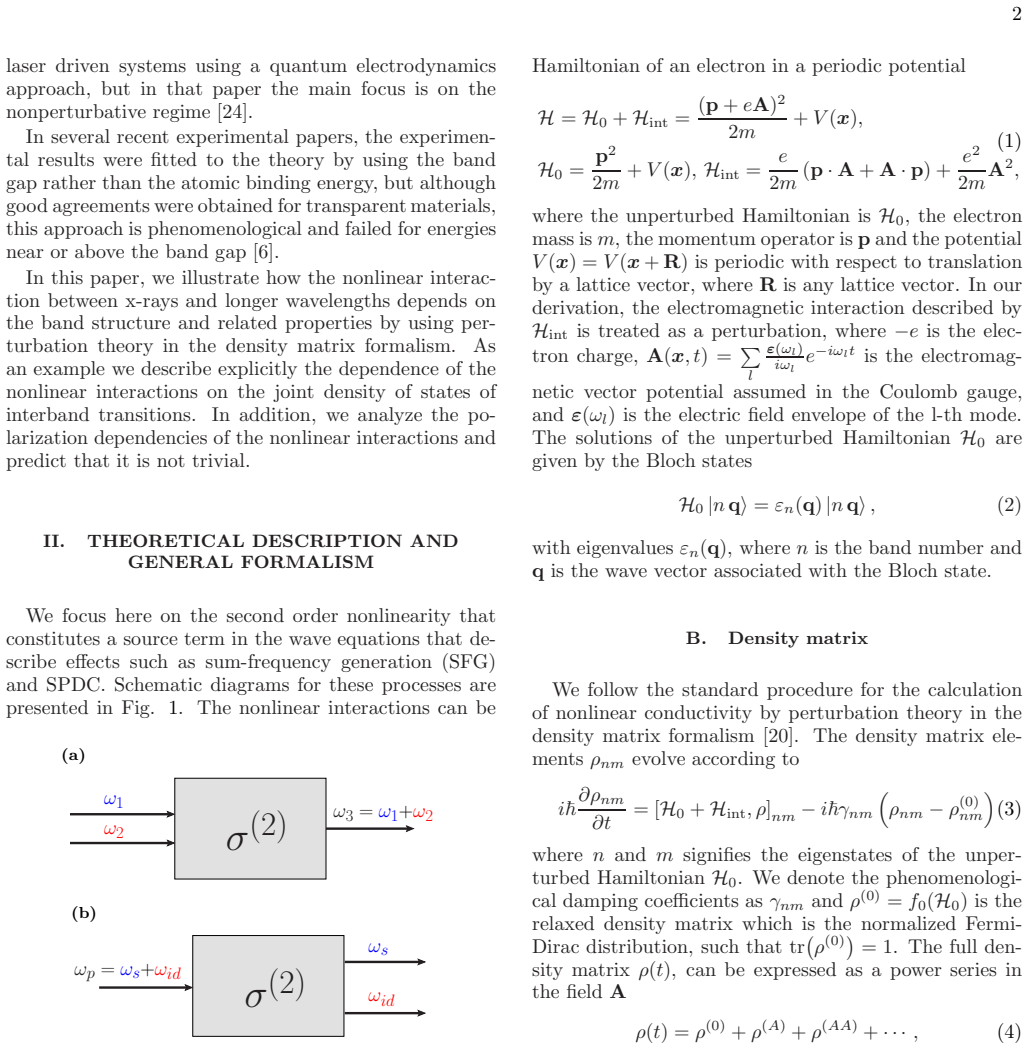
The nonlinear interactions can be (a) σ (2)ω 2 ω 1 ω 3 = ω 1+ω 2 (b) σ (2) ω p = ω s+ω id ω s ω id FIG. 1. Schematic diagrams for the nonlinear processes of SFG and SPDC. (a) SFG: Two input photons at frequencies ω 1 and ω 2 are converted to a photon at frequency ω 3 = ω 1 + ω 2. (b) SPDC: An input pump photon at frequency ω p is converted to a photon pai...
-
[2]
K. Tamasaku, K. Sawada, and T. Ishikawa, Physical re- view letters 103, 254801 (2009)
work page 2009
-
[3]
The differ- ence ˜I+(˜εid)− ˜I− (˜εid) also exhibits a very distinctive peak near the band gap energy
The prominent peak in ˜I+(˜εid) near the band gap energy is due to its strong dependence on the large number of inter-band transitions at the band gap, while ˜I− (˜εid) decreases monotonically. The differ- ence ˜I+(˜εid)− ˜I− (˜εid) also exhibits a very distinctive peak near the band gap energy. It is possible to measure this peak if the spectral resolutio...
-
[4]
we find that the second order current density is ⟨j⟩(2) (x, t ) = ⟨j⟩(2, p) + ⟨j⟩(2, A) , where ⟨j⟩(2, p) = tr ( ρ(AA) jp op(x) ) is the second order current density that arises from the mo- mentum part and ⟨j⟩(2, A) = tr ( ρ(A) jA op(x, t ) ) is the sec- ond order current density that arises from the gauge part of the current density operator. The tempora...
- [5]
Show all 32 references
-
[7]
Glover, D
T. Glover, D. Fritz, M. Cammarata, T. Allison, S. Coh, J. Feldkamp, H. Lemke, D. Zhu, Y. Feng, R. Coffee, et al., Nature 488, 603 (2012)
2012
-
[8]
Barbiellini, Y
B. Barbiellini, Y. Joly, and K. Tamasaku, Physical Re- view B 92, 155119 (2015)
2015
-
[9]
Schori, C
A. Schori, C. B¨ omer, D. Borodin, S. P. Collins, B. Detlefs, M. MorettiSala, S. Yudovich, and S. Shwartz, Physical review letters 119, 253902 (2017)
2017
-
[11]
Borodin, A
D. Borodin, A. Schori, J.-P. Rueff, J. M. Ablett, and S. Shwartz, Physical review letters 122, 023902 (2019)
2019
-
[12]
Sofer, O
S. Sofer, O. Sefi, E. Strizhevsky, S. Collins, B. Detlefs, C. J. Sahle, and S. Shwartz, arXiv preprint arXiv:1904.13146 (2019)
2019 arXiv
-
[13]
Tamasaku and T
K. Tamasaku and T. Ishikawa, Acta Crystallograph- ica Section A: Foundations of Crystallography 63, 437 (2007)
2007
-
[14]
Borodin, S
D. Borodin, S. Levy, and S. Shwartz, Applied Physics Letters 110, 131101 (2017)
2017
-
[16]
Y. J. Wang, B. Barbiellini, H. Lin, T. Das, S. Basak, P. E. Mijnarends, S. Kaprzyk, R. S. Markiewicz, and A. Bansil, Physical Review B 85, 224529 (2012)
2012
-
[17]
A. Q. Baron, arXiv preprint arXiv:1504.01098 (2015)
2015 arXiv
-
[19]
Freund and B
I. Freund and B. Levine, Physical Review Letters 25, 1241 (1970)
1970
-
[20]
Freund and B
I. Freund and B. Levine, Optics Communications 3, 101 (1971)
1971
-
[21]
Freund, Chemical Physics Letters 12, 583 (1972)
I. Freund, Chemical Physics Letters 12, 583 (1972)
1972
-
[22]
K. E. Dorfman and S. Mukamel, Physical Review A 86, 023805 (2012)
2012
-
[23]
Freund, Physical Review Letters 21, 1404 (1968)
I. Freund, Physical Review Letters 21, 1404 (1968). 8
1968
-
[24]
Jha and C
S. Jha and C. Warke, Il Nuovo Cimento B (1965-1970) 53, 120 (1968)
1968
-
[25]
Freund and B
I. Freund and B. Levine, Physical Review Letters 23, 854 (1969)
1969
-
[26]
S. S. Jha and J. W. Woo, Physical Review B 5, 4210 (1972)
1972
-
[27]
Jha and J
S. Jha and J. Woo, Il Nuovo Cimento B (1971-1996) 10, 229 (1972)
1972
-
[28]
Popova-Gorelova, D
D. Popova-Gorelova, D. A. Reis, and R. Santra, Physical Review B 98, 224302 (2018)
2018
-
[29]
Bloembergen and Y
N. Bloembergen and Y. Shen, Physical Review 133, A37 (1964)
1964
-
[30]
Callaway, Quantum theory of the solid state (Academic Press, 2013)
J. Callaway, Quantum theory of the solid state (Academic Press, 2013)
2013
- [31]
-
[32]
N. W. Ashcroft and N. D. Mermin, Solid state physics (Cengage Learning, 1976)
1976
-
[33]
Chadi and M
D. Chadi and M. L. Cohen, physica status solidi (b) 68, 405 (1975)
1975
Reviewed August 14, 2026 · model on record in the stance chip above.
Discussion (0). Continue with ORCID to comment.