REVIEW 3 major objections 7 minor 67 references
Laboratory evidence of the halting of magnetic reconnection by a weak guide field
T0 review · 3 major / 7 minor · reviewed 2026-08-14 · deepseek-v4-flash
Pith's one-line read A weak out-of-plane magnetic field of only 13% of the reconnecting field can strongly slow or halt magnetic reconnection in a controlled laboratory plasma.
desk verdict A careful laser experiment reports that a weak guide field (as low as 13% of the in-plane field) delays or suppresses symmetric reconnection; the central observation looks solid, though the proton-image phase mapping leans on 2D simulations and the 'halting' wording is a bit strong. read the letter →
The pith
A machine-rendered reading of the paper's core claim, the machinery that carries it, and where it could break.
The reading
What carries the argument
The load-bearing diagnostic object is the proton-deflectometry phase signature: in the simulated reconnection timeline, the pre-reconnection pile-up phase produces a wide 'mouth' of deflected protons, while active reconnection produces a thin focused proton line. Synthetic images from a hybrid particle-in-cell simulation and a proton-transport code let the authors transfer this mapping to the measured deflectograms; the appearance or absence of the thin line at a given time is their proxy for reconnection onset. The physical mechanism proposed for the guide-field effect is the quadrupolar (Hall) out-of-plane magnetic field—a four-lobed field structure tied to Hall currents—whose distortion by the guide field delays or prevents current-sheet formation.
What would settle it
Measure the time-resolved reconnection rate, for example the out-of-plane electric field or the decrease of in-plane magnetic flux, in the interaction region during a guide-field run; if it is comparable to the coplanar rate while the proton images still show only a 'mouth', the claimed halting is refuted.
Extended reading notes
Core claim
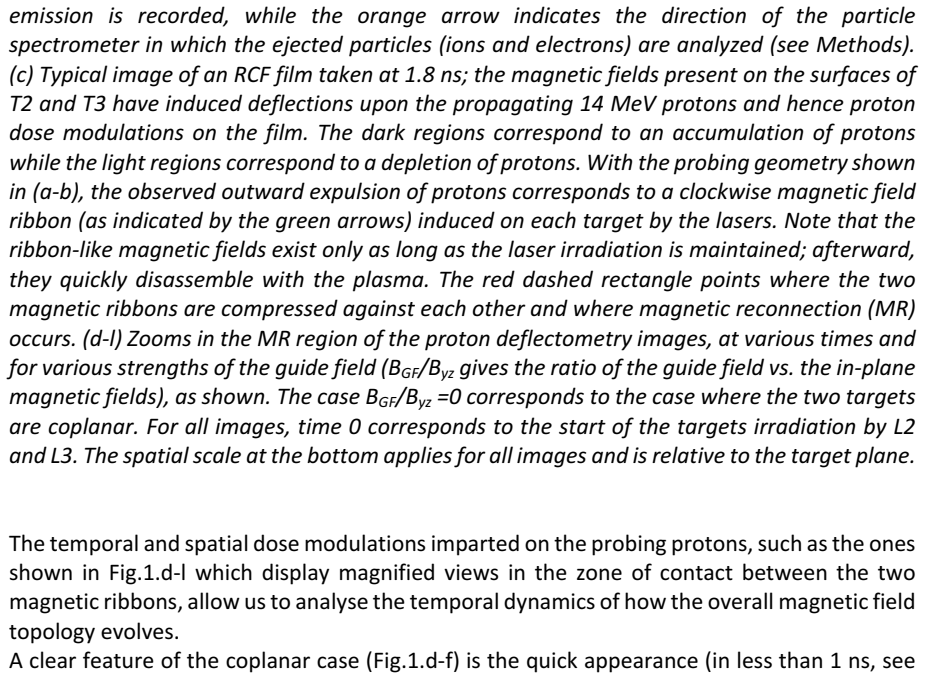
The paper's central claim is that symmetric magnetic reconnection is strongly slowed, and for a guide field at 41% of the reconnecting field halted, by an out-of-plane field far weaker than previous models suggested was relevant. The evidence comes from proton deflectometry: in the coplanar case a thin focused proton line appears within about a nanosecond, marking the onset of reconnection; when a guide field is present, that line is missing or appears much later, and the proton images instead show a widening 'mouth' of deflection that the authors interpret as magnetic flux piling up without being annihilated. The integrated field strength in the piled-up ribbons grows from roughly 3 T·mm to more than 12 T·mm in 4 ns for the weakest guide field. Optical self-emission shows that heating and plasma evacuation in the reconnection region are correspondingly delayed, and ion and electron spectra along the current-sheet axis show super-Alfvenic outflow only when the guide field is present, which the paper attributes to slingshot-Fermi or betatron acceleration in the compressed magnetic field rather than to the reconnection exhaust. The authors propose that the guide field distorts the quadrupolar Hall magnetic field, whose growth is a necessary precursor to current-sheet formation, so the current sheet thins more slowly or not at all.
Load-bearing premise
The claim collapses if the thin proton line is not a reliable marker of active reconnection, because the paper infers halting from that line's absence rather than from a direct measurement of the reconnection rate.
Editorial extensions
If this is right
- In a continuously driven system, guide-field strength acts as a switch: at 13% the reconnection onset is delayed by a few nanoseconds, at 41% it never appears within the field's lifetime.
- The pile-up phase is long-lived and stores more magnetic energy as the guide field grows, so the energy ultimately released by any subsequent reconnection is larger.
- Particle energization can occur before reconnection begins, in the compressed pile-up, so the presence of super-Alfvenic outflows is not by itself proof that reconnection has occurred.
- Earth's magnetopause and solar coronal loops contain such weak out-of-plane field components; the result constrains when those environments can be expected to reconnect.
Reading between the lines
- A direct test the paper leaves implicit: measuring the time-resolved reconnection rate during a guide-field run, for example with Faraday rotation of a probe beam across the current sheet, would verify that field annihilation is truly suppressed rather than just visually hidden.
- The result suggests guide-field strength can act as a controllable knob in laser-driven experiments to separate pre-reconnection pile-up acceleration from exhaust acceleration.
- Since the simulations are two-dimensional and break field lines with a numerical hyperviscous term, a three-dimensional simulation with continuous flux injection would show whether the suppression is complete or only shifts onset outside the observed window.
- A satellite-data search for the 'mouth' pile-up pattern ahead of observed reconnection at the magnetopause—where relative guide-field strengths like these occur—could test the same mechanism in space.
Signed reviews
Editorial analysis
A structured set of objections, weighed in public.
Referee Report
Summary. This paper reports a laser-driven laboratory experiment on symmetric magnetic reconnection in two colliding plasma bubbles, where an adjustable out-of-plane guide field is imposed by tilting the two target foils. Using proton deflectometry, streaked optical pyrometry, and ion/electron spectrometry, the authors find that even a weak guide field (BGF/Byz = 0.13) substantially delays the onset of reconnection, and that for a stronger guide field (0.41) no onset is observed within the field lifetime. The proton images are interpreted by comparing them with synthetic images generated from two-dimensional HECKLE hybrid simulations, which identify a 'mouth' pattern with pre-reconnection flux pile-up (phase II) and a thin proton line with ongoing reconnection (phase III). The simulations reproduce the delay and attribute it to destabilization of the Hall quadrupolar field. The paper concludes that 3D effects associated with even a weak guide field strongly slow or halt symmetric reconnection.
Significance. If the central claim is correct, the result is notable: it provides controlled laboratory evidence that a guide field as small as ~13% of the reconnecting field can strongly modify the reconnection onset, and it constrains models of reconnection in the solar corona and magnetopause. The experiment's strengths are the three mutually supporting diagnostics, the use of synthetic proton radiography for phase identification, and the hybrid simulations that reproduce the qualitative delay. The field pile-up is quantified (increase from ~3 T.mm to >12 T.mm). However, the claim of 'halting' rests on a null observation within a finite window, and the phase identification depends on a 2D simulation geometry that does not capture the tilted-target 3D setup; these points require substantial additional support.
major comments (3)
- [Fig. 4 and Methods: The HECKLE code] The mapping of proton-deflectometry patterns to reconnection phases is derived from 2D hybrid simulations with a uniform out-of-plane guide field, whereas the experimental guide field is produced by tilting the foils by ±θ/2 (Fig. 1b). The resulting 3D geometry changes the line-of-sight integration of the proton beam and the ribbon topology. The comparison in Figs. 1 and 4 is visual only; the paper does not provide a quantitative metric (e.g., cross-correlation or fitting of synthetic images to experimental images) that would rule out a geometric origin of the 'mouth' pattern in the tilted configuration. Without this, the absence of the thin proton line in guide-field runs does not directly prove that reconnection is halted; it shows a field-topology change that is interpretable only if the simulation geometry faithfully represents the experiment. This is load-bearing for the central claim.
- [Methods: The HECKLE code and Fig. 5] Reconnection in HECKLE is enabled by a hyperviscous term that breaks field lines at the grid scale; the paper neither gives the value of the hyperviscous coefficient nor demonstrates that the simulated delay is insensitive to it and to the grid resolution. Since the experimental reconnection rate is not directly measured, the simulation's quantitative support for the delay (Fig. 5c) is contingent on numerical resistivity. A convergence or sensitivity study is needed to establish that the guide-field delay is physical rather than an artifact of the hyperviscous model.
- [Fig. 1(g-l) and Supplementary note 4] The statement that for BGF/Byz = 0.41 the authors 'do not even witness the onset of reconnection during the magnetic field lifetime' is a null result within a finite observation window (~5 ns). The paper's own Fig. 2 shows the self-emission decreases after 5 ns as the laser switches off and the field disassembles. The data therefore support a delay that increases with guide-field strength, but the stronger claim of 'halting' requires showing that the thin-line phase would never appear on longer timescales, which is not available. The title and abstract should be tempered accordingly.
minor comments (7)
- [Fig. 2 caption] The phrase 'one of the target is tilted by 45°' should be 'one of the targets is tilted by 45°'.
- [Fig. 1 caption] The symbol Byz is not explicitly defined; please state that it denotes the in-plane magnetic field magnitude in the y-z plane.
- [References] Reference 62 is incomplete, listing only 'No Title'; a full citation is needed.
- [Methods: The HECKLE code] The hyperviscous coefficient is not quoted numerically; giving its value and the grid spacing in physical units would make the simulation setup reproducible.
- [Fig. 3] The legend that panel (f) is supposed to show is not visible in the figure as printed; please ensure the legend is actually displayed and readable.
- [Fig. 2(d)] The lineouts in Fig. 2(d) would be easier to interpret if the guide-field ratio were labeled directly on each curve, as the linestyles may be hard to distinguish in print.
- [Abstract and text] The spelling of 'co-planar' is inconsistent with 'coplanar' elsewhere in the text; please choose one form and use it consistently.
Circularity Check
No significant circularity: the central delay/halting claim is an independent laboratory measurement, and the only self-citation concerns a secondary mechanism interpretation.
full rationale
The paper's central claim is an experimental observation, not a derived prediction. The BGF/Byz ratios are set by geometric target tilts (0, 0.13, 0.27, 0.41 from θ=0°, 15°, 30°, 45°), and the proton deflectometry, streaked self-emission, and particle spectra are independent diagnostics. The phase mapping that identifies the 'mouth' as pre-reconnection pile-up (phase II) and the thin proton line as active reconnection (phase III) is established by the HECKLE hybrid simulation and the ILZ synthetic proton imager; this is an interpretive model applied to the data, not a quantity fitted to the data, so the observed delay does not reduce to the simulation by construction. The guide-field HECKLE simulation (Fig. 5) independently shows a delayed thinning phase, but the experimental conclusion is not derived from that simulation. The self-citation to Ref. 45 ('we have recently suggested45 that the reconnection process and the appearance of the quadrupolar magnetic field are rather both consequences of the formation of a thin ... current sheet') motivates a mechanistic explanation for the delay but is not used to infer the delay itself, and no uniqueness claim is imported from it. Possible weaknesses in the 2D simulation geometry or hyperviscous reconnection are correctness or modeling risks, not circularity.
Assumptions & free parameters
free parameters (2)
- hyperviscous coefficient in HECKLE Ohm's law =
not specified
- background ion population density =
1/5 of maximum density
assumptions (4)
- domain assumption The hybrid-PIC model with massless isothermal electrons and the generalized Ohm's law (ideal + Hall + electron pressure + hyperviscous) is a valid description of the reconnection dynamics in the experiment.
- domain assumption The azimuthal magnetic ribbon on each target is well described by a simple toroidal field, and the guide field generated by tilting is uniform over the reconnection region with magnitude BGF/Byz = tan(θ/2).
- domain assumption The thin proton line in deflectometry corresponds to magnetic reconnection (field annihilation), and the mouth-shaped pattern corresponds to pre-reconnection pile-up.
- domain assumption The plasma in the reconnection region is optically thin and its self-emission follows about ne^2/Te^0.5, so a decrease in self-emission indicates evacuation and heating by reconnection.
Cite this review
Pith. "Pith review of Laboratory evidence of the halting of magnetic reconnection by a weak guide field." pith.science (2026). https://pith.science/paper/5YJDF4JN
@misc{pith2026190901684,
  author       = {Pith},
  title        = {Pith review of: Laboratory evidence of the halting of magnetic reconnection by a weak guide field},
  year         = {2026},
  howpublished = {\url{https://pith.science/paper/5YJDF4JN}},
  note         = {Machine review of arXiv:1909.01684}
}
read the original abstract
Magnetic reconnection occurs when two plasmas having co-planar but anti-parallel magnetic fields meet. At the contact point, the field is locally annihilated and the magnetic energy can be released into the surrounding plasma. Theory and numerical modelling still face many challenges in handling this complex process, the predictability of which remains elusive. Here we test, through a laboratory experiment conducted in a controlled geometry, the effect of changing the field topology from two-dimensional to three-dimensional. This is done by imposing an out-of-plane (guide) magnetic field of adjustable strength. A strong slowing down or even halting of symmetric reconnection is observed, even for a weak guide-field. Concomitantly, we observe a delayed heating of the plasma in the reconnection region and modified particle acceleration, with super-Alfvenic outflows ejected along the reconnection layer. These observations highlight the importance of taking into account three-dimensional effects in the many reconnection events taking place in natural and laboratory environments.
Figures


Figures from the paper (1 more)

Reference graph
Works this paper leans on
-
[1]
Aulanier, G. et al. Slipping Magnetic Reconnection in Coronal Loops. Science. 318, 1588–1591 (2007)
work page 2007
-
[3]
de Gouveia Dal Pino, E. M., Piovezan, P. P. & Kadowaki, L. H. S. The role of magnetic reconnection on jet/accretion disk systems. Astron. Astrophys. 518, A5 (2010)
work page 2010
-
[4]
Sweet, P. A. The Neutral Point Theory of Solar Flares. in Electromagnetic Phenomena in Cosmical Physics 6, 123 (1958)
work page 1958
-
[5]
The grid size is 0.2 (ion inertial length) and the time step is 0.001 (inverse of proton gyroperiod), which is small enough to correctly treat the high frequency whistler modes. The results of two simulations are shown, namely using a ratio between the plasma and magnetic pressure (β= pplasma/pmagnetic ) =1, as well as using β =20. These two values are ch...
work page 2020
-
[6]
Parker, E. N. Sweet’s mechanism for merging magnetic fields in conducting fluids. J. Geophys. Res. 62, 509 (1957)
work page 1957
-
[7]
Ji, H. et al. Magnetic reconnection with Sweet-Parker characteristics in two-dimensional laboratory plasmas. Phys. Plasmas 6, 1743–1750 (1999)
work page 1999
-
[8]
F., Samtaney, R., Schekochihin, A
Loureiro, N. F., Samtaney, R., Schekochihin, A. A. & Uzdensky, D. A. Magnetic reconnection and stochastic plasmoid chains in high-Lundquist-number plasmas. Phys. Plasmas 19, 042303 (2012)
work page 2012
-
[9]
Pucci, F. & Velli, M. Reconnection of quasi-singular current sheets: The ‘ideal’ tearing mode. Astrophys. J. Lett. 780, 4–7 (2014)
work page 2014
Show all 67 references
-
[10]
& Zenitani, S
Hesse, M., Neukirch, T., Schindler, K., Kuznetsova, M. & Zenitani, S. The Diffusion Region in Collisionless Magnetic Reconnection. Space Sci. Rev. 160, 3–23 (2011)
2011
-
[11]
& Horiuchi, R
Ishizawa, A. & Horiuchi, R. Suppression of Hall-Term Effects by Gyroviscous Cancellation in Steady Collisionless Magnetic Reconnection. 045003, 2–5 (2005)
2005
-
[12]
Fox, W. et al. Experimental Verification of the Role of Electron Pressure in Fast Magnetic Reconnection with a Guide Field. Phys. Rev. Lett. 118, 125002 (2017)
2017
-
[13]
Katz, N. et al. Laboratory Observation of Localized Onset of Magnetic Reconnection. Phys. Rev. Lett. 104, 255004 (2010)
2010
-
[14]
Li, C. K. et al. Observation of Megagauss-Field Topology Changes due to Magnetic Reconnection in Laser-Produced Plasmas. Phys. Rev. Lett. 99, 055001 (2007)
2007
-
[15]
Hare, J. D. et al. Anomalous Heating and Plasmoid Formation in a Driven Magnetic Reconnection Experiment. Phys. Rev. Lett. 118, 085001 (2017)
2017
-
[16]
U., Daughton, W
Ricci, P., Brackbill, J. U., Daughton, W. & Lapenta, G. Collisionless magnetic reconnection in the presence of a guide field. Phys. Plasmas 11, 4102–4114 (2004)
2004
-
[17]
& Bhattacharjee, A
Huang, Y.-M. & Bhattacharjee, A. Turbulent magnetohydrodynamic reconnection mediated by the plasmoid instability. Astrophys. J. 818, 20 (2016)
2016
-
[18]
J., Mulcock, J
Trattner, K. J., Mulcock, J. S., Petrinec, S. M. & Fuselier, S. A. Location of the reconnection line at the magnetopause during southward IMF conditions. Geophys. Res. Lett. 34, L03108 (2007)
2007
-
[19]
J., Hill, N
Qiu, J., Liu, W. J., Hill, N. & Kazachenko, M. Reconnection and energetics in two-ribbon 17 flares: A revisit of the bastille-day flare. Astrophys. J. 725, 319–330 (2010)
2010
-
[20]
N., Chacón, L
Stanier, A., Simakov, A. N., Chacón, L. & Daughton, W. Fast magnetic reconnection with large guide fields. Phys. Plasmas 22, 010701 (2015)
2015
-
[21]
Pritchett, P. L. & Coroniti, F. V. Three-dimensional collisionless magnetic reconnection in the presence of a guide field. J. Geophys. Res. 109, A01220 (2004)
2004
-
[22]
Huba, J. D. Hall magnetic reconnection: Guide field dependence. Phys. Plasmas 12, 012322 (2005)
2005
-
[23]
& Hesse, M
Birn, J. & Hesse, M. Energy release and transfer in guide field reconnection. Phys. Plasmas 17, 012109 (2010)
2010
-
[24]
Nilson, P. M. et al. Magnetic Reconnection and Plasma Dynamics in Two-Beam Laser-Solid Interactions. Phys. Rev. Lett. 97, 255001 (2006)
2006
-
[25]
Willingale, L. et al. Proton probe measurement of fast advection of magnetic fields by hot electrons. Plasma Phys. Control. Fusion 53, 124026 (2011)
2011
-
[26]
Rosenberg, M. J. et al. Characterization of single and colliding laser-produced plasma bubbles using Thomson scattering and proton radiography. Phys. Rev. E 86, 056407 (2012)
2012
-
[27]
S., Thomas, A
Joglekar, A. S., Thomas, A. G. R., Fox, W. & Bhattacharjee, A. Magnetic Reconnection in Plasma under Inertial Confinement Fusion Conditions Driven by Heat Flux Effects in Ohm’s Law. Phys. Rev. Lett. 112, 105004 (2014)
2014
-
[28]
& Germaschewski, K
Fox, W., Bhattacharjee, A. & Germaschewski, K. Magnetic reconnection in high-energy-density laser-produced plasmas. Phys. Plasmas 19, 056309 (2012)
2012
-
[29]
Lancia, L. et al. Topology of Megagauss Magnetic Fields and of Heat-Carrying Electrons Produced in a High-Power Laser-Solid Interaction. Phys. Rev. Lett. 113, 235001 (2014)
2014
-
[30]
Stamper, J. A. et al. Spontaneous Magnetic Fields in Laser-Produced Plasmas. Phys. Rev. Lett. 26, 1012–1015 (1971)
1971
-
[31]
Gao, L. et al. Precision Mapping of Laser-Driven Magnetic Fields and Their Evolution in High-Energy-Density Plasmas. Phys. Rev. Lett. 114, 215003 (2015)
2015
-
[32]
G., Bogdanov, S
Frank, A. G., Bogdanov, S. Y., Dreiden, G. V., Markov, V. S. & Ostrovskaya, G. V. Structure of the current sheet plasma in the magnetic field with an X line as evidence of the two-fluid plasma properties. Phys. Lett. A 348, 318–325 (2006)
2006
-
[33]
Tharp, T. D. et al. Quantitative study of guide-field effects on hall reconnection in a laboratory plasma. Phys. Rev. Lett. 109, 2–6 (2012)
2012
-
[34]
Zhong, J. et al. Modelling loop-top X-ray source and reconnection outflows in solar flares with intense lasers. Nat. Phys. 6, 984–987 (2010)
2010
-
[35]
Zhong, J. Y. et al. Relativistic Electrons Produced By Reconnecting Electric Fields in a Laser-Driven Bench-Top Solar Flare. Astrophys. J. Suppl. Ser. 225, 30 (2016)
2016
-
[36]
Stochastic Particle Acceleration in Multiple Magnetic Islands during Reconnection
Hoshino, M. Stochastic Particle Acceleration in Multiple Magnetic Islands during Reconnection. Phys. Rev. Lett. 108, 135003 (2012)
2012
-
[37]
Egedal, J., Daughton, W. & Le, A. Large-scale electron acceleration by parallel electric fields during magnetic reconnection. Nat. Phys. 8, 321–324 (2012)
2012
-
[38]
Raymond, A. E. et al. Relativistic-electron-driven magnetic reconnection in the laboratory. Phys. Rev. E 98, 043207 (2018)
2018
-
[39]
F., Swisdak, M., Che, H
Drake, J. F., Swisdak, M., Che, H. & Shay, M. A. Electron acceleration from contracting magnetic islands during reconnection. 443, 553–556 (2006)
2006
-
[40]
Fox, W. et al. Astrophysical particle acceleration mechanisms in colliding magnetized laser-produced plasmas. Phys. Plasmas 24, 092901 (2017)
2017
-
[41]
R., Abel, T
Totorica, S. R., Abel, T. & Fiuza, F. Particle acceleration in laser-driven magnetic 18 reconnection. Phys. Plasmas 24, 041408 (2017)
2017
-
[42]
Wang, S. et al. Particle-in-cell simulations of electron energization in laser-driven magnetic reconnection. New J. Phys. 18, 013051 (2016)
2016
-
[43]
Rosenberg, M. J. et al. A laboratory study of asymmetric magnetic reconnection in strongly driven plasmas. Nat. Commun. 6, 6190 (2015)
2015
-
[44]
Lezhnin, K. V. et al. Regimes of magnetic reconnection in colliding laser-produced magnetized plasma bubbles. Phys. Plasmas 25, 093105 (2018)
2018
-
[45]
Karimabadi, H., Huba, J. D. & Omidi, N. On the generation and structure of the quadrupole magnetic field in the reconnection process : Comparative simulation study. 31, 3–6 (2004)
2004
-
[46]
& Fuchs, J
Smets, R., Aunai, N., Belmont, G., Boniface, C. & Fuchs, J. On the relationship between quadrupolar magnetic field and collisionless reconnection. Phys. Plasmas 21, 062111 (2014)
2014
-
[47]
Scurry, L., Russell, C. T. & Gosling, J. T. Geomagnetic activity and the beta dependence of the dayside reconnection rate. 99, 1–4 (1994)
1994
-
[48]
Phan, T. D. et al. The dependence of magnetic reconnection on plasma β and magnetic shear: Evidence from magnetopause observations. Geophys. Res. Lett. 40, 11–16 (2013)
2013
-
[49]
Reale, F. et al. 3D MHD modeling of twisted coronal loops. Astrophys. J. 830, 21 (2016)
2016
-
[50]
Albertazzi, B. et al. Production of large volume, strongly magnetized laser-produced plasmas by use of pulsed external magnetic fields. Rev. Sci. Instrum. 84, 043505 (2013)
2013
-
[51]
Cecchetti, C. A. et al. Magnetic field measurements in laser-produced plasmas via proton deflectometry. Phys. Plasmas 16, 043102 (2009)
2009
-
[52]
Bolton, P. R. et al. Instrumentation for diagnostics and control of laser-accelerated proton (ion) beams. Phys. Medica 30, 255–270 (2014)
2014
-
[53]
Wilks, S. C. et al. Energetic proton generation in ultra-intense laser–solid interactions. Phys. Plasmas 8, 542–549 (2001)
2001
-
[54]
Cowan, T. E. et al. Ultralow Emittance, Multi-MeV Proton Beams from a Laser Virtual-Cathode Plasma Accelerator. Phys. Rev. Lett. 92, 204801 (2004)
2004
-
[55]
Mancic, A. et al. Isochoric heating of solids by laser-accelerated protons: Experimental characterization and self-consistent hydrodynamic modeling. High Energy Density Phys. 6, 21–28 (2010)
2010
-
[56]
Dromey, B. et al. Picosecond metrology of laser-driven proton bursts. Nat. Commun. 7, 10642 (2016)
2016
-
[57]
Chen, S. N. et al. Absolute dosimetric characterization of Gafchromic EBT3 and HDv2 films using commercial flat-bed scanners and evaluation of the scanner response function variability. Rev. Sci. Instrum. 87, 073301 (2016)
2016
-
[58]
Faenov, A. Y. et al. High-performance x-ray spectroscopic devices for plasma microsources investigations. Phys. Scr. 50, 333–338 (1994)
1994
-
[59]
Revet, G. et al. Laboratory unraveling of matter accretion in young stars. Sci. Adv. 3, e1700982 (2017)
2017
-
[60]
Rybicki, G. B. & Lightman, A. P. Radiative Processes in Astrophysics. Physics Bulletin 31, (Wiley-VCH Verlag GmbH & Co. KGaA, 1985)
1985
-
[61]
Cowan, T. E. et al. High energy electrons, nuclear phenomena and heating in petawatt laser-solid experiments. Laser Part. Beams 17, 773–783 (1999). 19
1999
-
[62]
Boutoux, G. et al. Study of imaging plate detector sensitivity to 5-18 MeV electrons. Rev. Sci. Instrum. 86, 113304 (2015)
2015
-
[63]
& Rezeau, L
Smets, R., Belmont, G., Aunai, N. & Rezeau, L. Plasma diffusion in self-consistent fluctuations. Phys. Plasmas 18, (2011)
2011
-
[64]
Boris, J. P. Relativistic plasma simulation—Optimization of a hybridcode. in Proceedings of 4th Conference on Numerical Simulation of Plasmas 3–67 (1970)
1970
-
[65]
Harned, D. S. Quasineutral hybrid simulation of macroscopic plasma phenomena. J. Comput. Phys. 47, 452–462 (1982)
1982
-
[66]
Lui, A. T. Y. A synthesis of magnetospheric substorm models. J. Geophys. Res. Sp. Phys. 96, 1849–1856 (1991)
1991
-
[67]
Highland, V. L. Some practical remarks on multiple scattering. Nucl. Instruments Methods 129, 497–499 (1975)
1975
-
[68]
Groom, D. E. & Klein, S. R. Passage of particles through matter. Eur. Phys. J. C 15, 163–173 (2000)
2000
Reviewed August 14, 2026 · model on record in the stance chip above.
Discussion (0). Continue with ORCID to comment.