REVIEW 3 major objections 4 minor 1 cited by
Multi-epoch X-ray spectral analysis of the narrow-line Seyfert 1 galaxy Mrk 478
T0 review · 3 major / 4 minor · reviewed 2026-08-14 · deepseek-v4-flash
Pith's one-line read All XMM-Newton and Suzaku spectra of Mrk 478 from 2001 to 2017, modelled four ways, point to blurred reflection off the inner disc as the origin of its X-rays.
desk verdict A careful, transparent multi-epoch study that adds new data and a sensible PCA-model comparison, but the central preference for blurred reflection rests on a diagnostic the authors themselves concede is non-unique. read the letter →
The pith
A machine-rendered reading of the paper's core claim, the machinery that carries it, and where it could break.
The reading
What carries the argument
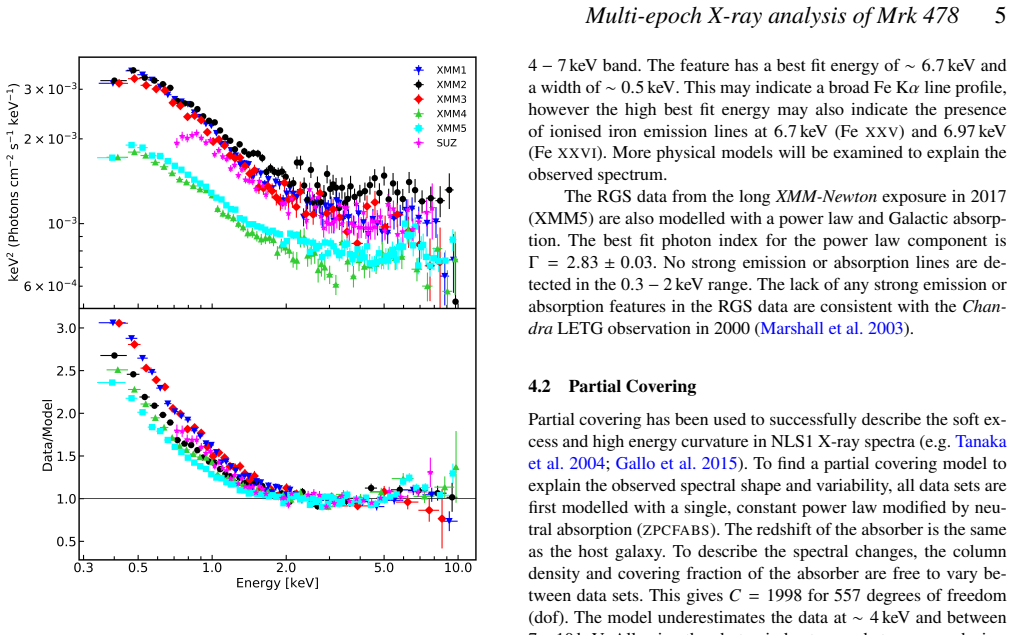
The discriminative tool is the principal component analysis (PCA) of the combined XMM-Newton epoch spectra. PC1 accounts for about 90 per cent of the variability and is nearly flat in energy, the signature seen when a single model component changes only in normalisation. The paper computes PCAs for 100 simulated data sets per model: partial covering and the soft-Comptonisation model produce strongly curved first components, while the blurred reflection models (relxill and reflionx, the latter convolved with the kerrconv relativistic blurring kernel) keep PC1 flat. This flatness, together with nearly constant hardness ratios, is the load-bearing bridge from statistically similar spectral fits to the preference for blurred reflection.
What would settle it
Take a long, high signal-to-noise NuSTAR observation of Mrk 478 covering $3$–$79$ keV. If the $15$–$100$ keV flux is detected at about $2\times10^{-12}$ erg cm$^{-2}$ s$^{-1}$, the level the soft-Comptonisation model predicts and that sits just at the Swift BAT threshold, the reflection preference would be falsified; the partial-covering and blurred-reflection models predict fluxes below that threshold. A second check: a narrow 6.4 keV neutral-iron line with equivalent width above about 90 eV would contradict the models' lack of a neutral distant reflector.
Extended reading notes
Core claim
The central claim is that the X-ray spectrum and variability of Mrk 478 are best explained by blurred reflection from the inner accretion disc, not by partial covering or a warm Comptonising corona. Over sixteen years the source changes by about a factor of two in 0.3–10 keV flux while its spectral shape stays nearly constant; this pattern is reproduced when the flux of a single dominant component varies, as in the reflection model. Within the reflection interpretation, the two codes disagree on whether the spectrum is reflection-dominated or power-law-dominated: relxill requires high ionisation ($\log\xi\approx3$) and $R\approx2$–$3.5$, while reflionx favours $\xi\approx50$ and $R\approx0.7$–$1.3$. They agree on the fundamental parameters, a spin of $a\approx0.94$–$0.98$, a low inclination below roughly $31^\circ$, and an iron abundance near $0.5$ times solar. Every model also requires a narrow $\approx6.7$ keV emission line attributable to Fe XXV, while no narrow 6.4 keV neutral-iron line is detected.
Load-bearing premise
The load-bearing premise is that a flat first principal component uniquely indicates that a single spectral component is changing only in normalisation; the paper itself notes that multiple variable absorption zones can also produce an overall flat PCA (Miller et al. 2008), so the data may not discriminate a single variable reflection component from more complex absorption variability.
Editorial extensions
If this is right
- If blurred reflection is the right picture, the observed variability of Mrk 478 is largely normalisation changes in the coronal power law, with the disc response set by the illumination pattern.
- The black hole in Mrk 478 is spinning near the maximum allowed value ($a\approx0.94$–$0.98$) and is viewed at low inclination ($i\lesssim31^\circ$), so the inner disc is seen close to face-on.
- The iron abundance in the reflecting material is sub-solar, roughly 0.4–0.8 times the solar value depending on the code, making Mrk 478 one of the few AGN requiring under-abundant iron.
- The lack of a narrow 6.4 keV line and the persistent 6.7 keV Fe XXV feature imply that there is no significant neutral reflecting torus along the line of sight, and that ionised iron emission arises further out, possibly in the torus inner layers or the broad-line region.
- Hard X-ray observations, for example with NuSTAR, should distinguish the models, because the soft-Comptonisation model predicts a 15–100 keV flux near the Swift BAT survey threshold while the reflection models predict fluxes below it.
Reading between the lines
- A NuSTAR detection of Mrk 478 at the 15–100 keV flux predicted by the soft-Comptonisation model, just at the Swift BAT threshold, would not only falsify the reflection preference but would also make the warm-corona picture the leading explanation.
- If the sub-solar iron abundance is real, it would make Mrk 478 a test case for chemical-enrichment histories in AGN discs: low star-formation efficiency, a deficit of Type Ia supernovae, or cosmic-ray spallation are the mechanisms the paper lists, and each makes a different prediction for other element abundances that future high-resolution spectra could check.
- The flatness of PC1 could be probed with a dedicated monitoring campaign that splits the light curve into many short segments; if the flat shape persists while soft and hard bands remain correlated, the single-component reflection interpretation would be strengthened against multi-zone absorption alternatives like the one Miller et al. (2008) describe.
Signed reviews
Editorial analysis
A structured set of objections, weighed in public.
Referee Report
Summary. The paper presents a multi-epoch X-ray spectral and variability analysis of the narrow-line Seyfert 1 galaxy Mrk 478, using all available XMM-Newton and Suzaku observations from 2001 to 2017. Four physical scenarios are fitted to the EPIC-pn and Suzaku FI spectra: a two-absorber partial-covering model, the OPTXAGNF soft-Comptonisation model, and blurred reflection models using RELXILL and REFLIONX. The spectra are statistically comparable across models, and the variability is characterized through light curves, hardness ratios, and principal component analysis (PCA). The authors argue that the flat shape of the first principal component, together with low hardness-ratio variability, favors the blurred reflection interpretation, and they report a rapidly spinning black hole, low inclination, and sub-solar iron abundance. A narrow 6.7 keV Fe XXV line is required by all models, while no narrow 6.4 keV line is detected.
Significance. If the central claim were fully established, the paper would provide a valuable addition to the debate on the origin of the soft excess in NLS1 galaxies and would support a blurred-reflection interpretation for Mrk 478 over its 16-year baseline. The analysis has notable strengths: it assembles the complete archival X-ray coverage of the source, uses MCMC to propagate parameter uncertainties, and carries out a PCA-based posterior predictive check of the competing models. The authors are also transparent about limitations, explicitly noting that multiple variable absorption zones can produce a flat PCA shape. However, the quantitative evidence for the central claim is currently incomplete: the favored reflection models produce PCA chi-squared values that are formally poor, and the flat-PCA diagnostic is conceded to be non-unique. The paper's conclusions are therefore conditional on additional model-comparison work.
major comments (3)
- [Section 4.5 and Section 5.2] The PCA comparison is the primary quantitative support for the central claim, but the reported statistics do not support the strength of the conclusion. The paper states that the simulated PCA for RELXILL and REFLIONX yield chi-squared per degree of freedom of 4 and 6, respectively, for 50 degrees of freedom. These values are formally unacceptable at any conventional significance level, and the statement in Section 4.5 that 'the overall shape is very close' is qualitative rather than statistical. To make the claim that the reflection model best reproduces the observed PCA, the authors need to calibrate the PCA chi-squared statistic, for example by computing posterior predictive p-values or the distribution of the statistic under simulated datasets from each model. Without such calibration, the conclusion in Section 5.2 that 'the reflection model is the most likely physical explanation' is not established.
- [Section 4.5 and Section 4.2] The flatness of the first principal component is not a unique diagnostic of a single variable component. The paper itself concedes in Section 4.5 that 'more complex physical scenarios, such as multiple variable absorption zones, can in some cases produce an overall flat PCA shape,' citing Miller et al. (2008). This concession is directly relevant to the partial-covering model, whose best fit in Section 4.2 already requires two absorbers and, as the authors note, requires non-spherically symmetric absorption to avoid detectable Fe K alpha lines. The authors state that the available data are insufficient to model more complex scenarios, but this means the preference for reflection over partial covering is an assumption rather than a tested result. The paper should either simulate a two-zone absorption model with varying column densities and covering fractions to show whether it can reproduce the observed PCA and hardness ratios, or soften the central claim accordingly.
- [Section 4 and Abstract] The abstract states that all models are a similar statistical fit, but the reported C-statistics and degrees of freedom are C/dof = 667/544 for partial covering, 609/546 for OPTXAGNF, 593/539 for RELXILL, and 606/539 for REFLIONX. The difference of roughly 74 in C-statistic between partial covering and RELXILL, even accounting for the non-Gaussian nature of the C-statistic, does not seem negligible, and the paper does not provide a calibrated model-comparison statistic such as AIC, BIC, or a posterior predictive check of the spectra themselves. Since the paper relies on the similarity of the spectral fits to motivate the variability-based comparison, this claim should be quantified or reworded.
minor comments (4)
- [Section 4.5] The text twice refers to 'first principle components'; the correct spelling is 'principal components'.
- [Section 4.5 and Figure 9] The upturn in PC1 above about 8.5 keV is attributed to background variations. It would strengthen the analysis to show that the PCA conclusions are unchanged if the band above 8.5 keV is excluded, given that several spectra are background-dominated at these energies.
- [Section 3] In the paragraph describing the long-term light curve, the phrase 'deviations from the mean are on the order of 80 per cent at the extremes' should specify whether this refers to count rate, flux, or fractional variability amplitude, to avoid ambiguity.
- [Section 4.2] In the discussion of the predicted Fe K alpha equivalent widths, the sentence beginning 'It is also, however, interesting to consider the ionisation on the other absorber' is awkwardly worded and should be revised for clarity.
Circularity Check
No significant circularity: the PCA-based model comparison and external consistency checks are independent of the model fitting; self-citations are not load-bearing.
full rationale
The paper's derivation chain is: (i) fit partial-covering, soft-Comptonisation, and blurred-reflection models to the multi-epoch X-ray spectra; (ii) compute a model-independent principal component analysis of the observed spectral variability; (iii) simulate PCA shapes from each best-fit model using the same allowed parameter variations; and (iv) compare the simulated PC1 shapes to the observed PC1. The observed PCA is not used as an input to any spectral fit, and the simulated PCA shapes are forward-modeled outputs of the fitted models, so no fitted quantity is being renamed as a prediction. The spin, inclination, and iron abundance are reported as best-fit parameters, not as predictions. The hardness-ratio flatness and alpha_ox values are independent diagnostics. The only self-citations, notably Zoghbi et al. (2008), are prior analyses of the same data used for context and comparison; the present paper recomputes its own hardness ratios and light curves, and the PCA model-selection argument does not rest on the previous paper's conclusions. Section 4.5 explicitly concedes that 'more complex physical scenarios, such as multiple variable absorption zones, can in some cases produce an overall flat PCA shape (see Miller et al. 2008), however, the available data are insufficient to model with more complex scenarios.' That is a stated limitation on discriminating power, not a circular reduction of the conclusion to its inputs. No equation or fitted parameter is defined in terms of the target claim, and no load-bearing uniqueness theorem is imported from the authors' prior work. Therefore the paper is self-contained against external benchmarks and shows no significant circularity.
Assumptions & free parameters
free parameters (6)
- Black hole spin a =
0.94+/-0.02 (REFLIONX), 0.98+/-0.01 (RELXILL)
- Inclination i =
<22 deg (REFLIONX), 31+/-8 deg (RELXILL)
- Iron abundance A_Fe =
0.44+/-0.28 (REFLIONX), 0.84+/-0.14 (RELXILL)
- Reflection fraction R =
0.7-1.3 (REFLIONX), 2.0-3.5 (RELXILL)
- Ionisation parameter xi =
63+/-35 (REFLIONX), ~1000 (RELXILL)
- Narrow line energy E =
6.6-6.7 keV
assumptions (4)
- domain assumption Relativistic reflection models RELXILL and REFLIONX accurately describe the disc reflection spectrum and atomic physics.
- domain assumption A flat first principal component of spectral variability indicates a single variable component's normalization.
- domain assumption Black hole spin, inclination, and iron abundance do not vary between 2001 and 2017.
- domain assumption The Galactic hydrogen column toward Mrk 478 is fixed at 1.08e20 cm^-2 from Willingale et al. (2013).
Cite this review
Pith. "Pith review of Multi-epoch X-ray spectral analysis of the narrow-line Seyfert 1 galaxy Mrk 478." pith.science (2026). https://pith.science/paper/5ROCBTGP
@misc{pith2026190901897,
  author       = {Pith},
  title        = {Pith review of: Multi-epoch X-ray spectral analysis of the narrow-line Seyfert 1 galaxy Mrk 478},
  year         = {2026},
  howpublished = {\url{https://pith.science/paper/5ROCBTGP}},
  note         = {Machine review of arXiv:1909.01897}
}
read the original abstract
A multi-epoch X-ray spectral and variability analysis is conducted for the narrow-line Seyfert 1 (NLS1) active galactic nucleus (AGN) Mrk 478. All available X-ray data from XMM-Newton and Suzaku satellites, spanning from 2001 to 2017, are modelled with a variety of physical models including partial covering, soft-Comptonisation, and blurred reflection, to explain the observed spectral shape and variability over the 16 years. All models are a similar statistical fit to the data sets, though the analysis of the variability between data sets favours the blurred reflection model. In particular, the variability can be attributed to changes in flux of the primary coronal emission. Different reflection models fit the data equally well, but differ in interpretation. The use of reflionx predicts a low disc ionisation and power law dominated spectrum, while relxill predicts a highly ionised and blurred reflection dominated spectrum. A power law dominated spectrum might be more consistent with the normal X-ray-to-UV spectral shape (aox). Both blurred reflection models suggest a rapidly spinning black hole seen at a low inclination angle, and both require a sub-solar (~0.5) abundance of iron. All physical models require a narrow emission feature at 6.7 keV likely attributable to Fe xxv emission, while no evidence for a narrow 6.4 keV line from neutral iron is detected.
Figures


Figures from the paper (6 more)


Forward citations
Cited by 1 Pith paper
-
The emergence of X-ray emission lines during relativistic radio-jet formation in the changing-look active galactic nucleus 1ES 1927+654
X-ray emission lines and a broad iron feature emerged in changing-look AGN 1ES 1927+654 concurrently with radio-jet formation and declining ionized outflows from 2022 to 2025.
Reference graph
Works this paper leans on
-
[1]
Alston W. N., et al., 2019, @doi [ ] 10.1093/mnras/sty2527 , https://ui.adsabs.harvard.edu/abs/2019MNRAS.482.2088A 482, 2088
-
[2]
Antonucci R., 1993, @doi [ ] 10.1146/annurev.aa.31.090193.002353 , https://ui.adsabs.harvard.edu/abs/1993ARA&A..31..473A 31, 473
arXiv 1993
-
[3]
A., 1996, in Jacoby G
Arnaud K. A., 1996, in Jacoby G. H., Barnes J., eds, Astronomical Society of the Pacific Conference Series Vol. 101, Astronomical Data Analysis Software and Systems V. p. 17
1996
-
[4]
Bianchi S., Matt G., 2002, @doi [ ] 10.1051/0004-6361:20020372 , https://ui.adsabs.harvard.edu/abs/2002A&A...387...76B 387, 76
-
[5]
Boella G., et al., 1997, @doi [ ] 10.1051/aas:1997138 , https://ui.adsabs.harvard.edu/abs/1997A&AS..122..327B 122, 327
-
[6]
N., Fink H., 1996, , https://ui.adsabs.harvard.edu/abs/1996A&A...305...53B 305, 53
Boller T., Brandt W. N., Fink H., 1996, , https://ui.adsabs.harvard.edu/abs/1996A&A...305...53B 305, 53
work page 1996
-
[7]
Bonson K., Gallo L. C., 2016, @doi [ ] 10.1093/mnras/stw466 , https://ui.adsabs.harvard.edu/abs/2016MNRAS.458.1927B 458, 1927
-
[8]
Bonson K., Gallo L. C., Vasudevan R., 2015, @doi [ ] 10.1093/mnras/stv444 , https://ui.adsabs.harvard.edu/abs/2015MNRAS.450..857B 450, 857
Show all 77 references
-
[9]
A., Green R
Boroson T. A., Green R. F., 1992, @doi [ ] 10.1086/191661 , https://ui.adsabs.harvard.edu/abs/1992ApJS...80..109B 80, 109
1992 doi
-
[10]
N., Fabian A
Brandt W. N., Fabian A. C., Dotani T., Nagase F., Inoue H., Kotani T., Segawa Y., 1996, @doi [ ] 10.1093/mnras/283.3.1071 , https://ui.adsabs.harvard.edu/abs/1996MNRAS.283.1071B 283, 1071
1996 doi
-
[11]
N., Mathur S., Elvis M., 1997, @doi [ ] 10.1093/mnras/285.3.L25 , https://ui.adsabs.harvard.edu/abs/1997MNRAS.285L..25B 285, L25
Brandt W. N., Mathur S., Elvis M., 1997, @doi [ ] 10.1093/mnras/285.3.L25 , https://ui.adsabs.harvard.edu/abs/1997MNRAS.285L..25B 285, L25
1997 doi
-
[13]
W., Reynolds C
Brenneman L. W., Reynolds C. S., 2006, @doi [ ] 10.1086/508146 , https://ui.adsabs.harvard.edu/abs/2006ApJ...652.1028B 652, 1028
2006 doi
-
[14]
N., et al., 2005, @doi [ ] 10.1007/s11214-005-5097-2 , https://ui.adsabs.harvard.edu/abs/2005SSRv..120..165B 120, 165
Burrows D. N., et al., 2005, @doi [ ] 10.1007/s11214-005-5097-2 , https://ui.adsabs.harvard.edu/abs/2005SSRv..120..165B 120, 165
2005 doi
-
[15]
Cash W., 1979, @doi [ ] 10.1086/156922 , https://ui.adsabs.harvard.edu/abs/1979ApJ...228..939C 228, 939
1979 doi
-
[16]
S., Korista K., Ebrero J., Arav N., Kriss G., Steenbrugge K
Costantini E., Kaastra J. S., Korista K., Ebrero J., Arav N., Kriss G., Steenbrugge K. C., 2010, @doi [ ] 10.1051/0004-6361/200912555 , https://ui.adsabs.harvard.edu/abs/2010A&A...512A..25C 512, A25
2010 doi
-
[17]
W., Jin C., Blaes O., Ward M., 2012, @doi [ ] 10.1111/j.1365-2966.2011.19779.x , https://ui.adsabs.harvard.edu/abs/2012MNRAS.420.1848D 420, 1848
Done C., Davis S. W., Jin C., Blaes O., Ward M., 2012, @doi [ ] 10.1111/j.1365-2966.2011.19779.x , https://ui.adsabs.harvard.edu/abs/2012MNRAS.420.1848D 420, 1848
2012
-
[18]
Ehler H. J. S., Gonzalez A. G., Gallo L. C., 2018, @doi [ ] 10.1093/mnras/sty1306 , https://ui.adsabs.harvard.edu/abs/2018MNRAS.478.4214E 478, 4214
2018 doi
-
[19]
A., et al., 2009, @doi [ ] 10.1111/j.1365-2966.2009.14913.x , https://ui.adsabs.harvard.edu/abs/2009MNRAS.397.1177E 397, 1177
Evans P. A., et al., 2009, @doi [ ] 10.1111/j.1365-2966.2009.14913.x , https://ui.adsabs.harvard.edu/abs/2009MNRAS.397.1177E 397, 1177
2009
-
[20]
C., Rees M
Fabian A. C., Rees M. J., Stella L., White N. E., 1989, @doi [ ] 10.1093/mnras/238.3.729 , https://ui.adsabs.harvard.edu/abs/1989MNRAS.238..729F 238, 729
1989 doi
-
[23]
C., Parker M
Gallant D., Gallo L. C., Parker M. L., 2018, @doi [ ] 10.1093/mnras/sty1987 , https://ui.adsabs.harvard.edu/abs/2018MNRAS.480.1999G 480, 1999
2018 doi
-
[25]
9-13 April 2018
Gallo L., 2018, in Revisiting narrow-line Seyfert 1 galaxies and their place in the Universe. 9-13 April 2018. Padova Botanical Garden. p. 34 ( @eprint arXiv 1807.09838 )
2018 arXiv
-
[26]
C., et al., 2015, @doi [ ] 10.1093/mnras/stu2108 , https://ui.adsabs.harvard.edu/abs/2015MNRAS.446..633G 446, 633
Gallo L. C., et al., 2015, @doi [ ] 10.1093/mnras/stu2108 , https://ui.adsabs.harvard.edu/abs/2015MNRAS.446..633G 446, 633
2015 doi
-
[27]
C., Randhawa J
Gallo L. C., Randhawa J. S., Waddell S. G. H., Hani M. H., Garc \' a J. A., Reynolds C. S., 2019a, @doi [ ] 10.1093/mnras/stz260 , https://ui.adsabs.harvard.edu/abs/2019MNRAS.484.3036G 484, 3036
-
[28]
C., et al., 2019b, @doi [ ] 10.1093/mnras/stz274 , https://ui.adsabs.harvard.edu/abs/2019MNRAS.484.4287G 484, 4287
Gallo L. C., et al., 2019b, @doi [ ] 10.1093/mnras/stz274 , https://ui.adsabs.harvard.edu/abs/2019MNRAS.484.4287G 484, 4287
-
[29]
S., Kallman T
Garc \' a J., Dauser T., Reynolds C. S., Kallman T. R., McClintock J. E., Wilms J., Eikmann W., 2013, @doi [ ] 10.1088/0004-637X/768/2/146 , https://ui.adsabs.harvard.edu/abs/2013ApJ...768..146G 768, 146
2013 doi
-
[30]
Garc \' a J., et al., 2014, @doi [ ] 10.1088/0004-637X/782/2/76 , https://ui.adsabs.harvard.edu/abs/2014ApJ...782...76G 782, 76
2014 doi
-
[31]
Gehrels N., et al., 2004, @doi [ ] 10.1086/422091 , https://ui.adsabs.harvard.edu/abs/2004ApJ...611.1005G 611, 1005
2004 doi
-
[32]
Goodman J., Weare J., 2010, @doi [Communications in Applied Mathematics and Computational Science] 10.2140/camcos.2010.5.65 , https://ui.adsabs.harvard.edu/abs/2010CAMCS...5...65G 5, 65
2010 doi
-
[33]
W., 1989, @doi [ ] 10.1086/167586 , https://ui.adsabs.harvard.edu/abs/1989ApJ...342..224G 342, 224
Goodrich R. W., 1989, @doi [ ] 10.1086/167586 , https://ui.adsabs.harvard.edu/abs/1989ApJ...342..224G 342, 224
1989 doi
-
[34]
A., Heckman T
Groves B. A., Heckman T. M., Kauffmann G., 2006, @doi [ ] 10.1111/j.1365-2966.2006.10812.x , https://ui.adsabs.harvard.edu/abs/2006MNRAS.371.1559G 371, 1559
2006
-
[35]
C., Beuermann K., 2001, @doi [ ] 10.1051/0004-6361:20000429 , https://ui.adsabs.harvard.edu/abs/2001A&A...367..470G 367, 470
Grupe D., Thomas H. C., Beuermann K., 2001, @doi [ ] 10.1051/0004-6361:20000429 , https://ui.adsabs.harvard.edu/abs/2001A&A...367..470G 367, 470
2001 doi
-
[36]
M., 2010, in Maraschi L., Ghisellini G., Della Ceca R., Tavecchio F., eds, Astronomical Society of the Pacific Conference Series Vol
Grupe D., Komossa S., Leighly K. M., 2010, in Maraschi L., Ghisellini G., Della Ceca R., Tavecchio F., eds, Astronomical Society of the Pacific Conference Series Vol. 427, Accretion and Ejection in AGN: a Global View. p. 86
2010
-
[37]
Guainazzi M., Loiseau N., Matt G., Orr A., 2004, @doi [Progress of Theoretical Physics Supplement] 10.1143/PTPS.155.243 , https://ui.adsabs.harvard.edu/abs/2004PThPS.155..243G 155, 243
2004 doi
-
[38]
Jansen F., et al., 2001, @doi [ ] 10.1051/0004-6361:20000036 , https://ui.adsabs.harvard.edu/abs/2001A&A...365L...1J 365, L1
2001 doi
-
[39]
S., Bleeker J
Kaastra J. S., Bleeker J. A. M., 2016, @doi [ ] 10.1051/0004-6361/201527395 , https://ui.adsabs.harvard.edu/abs/2016A&A...587A.151K 587, A151
2016 doi
-
[40]
M., 1999, @doi [ ] 10.1086/313287 , https://ui.adsabs.harvard.edu/abs/1999ApJS..125..317L 125, 317
Leighly K. M., 1999, @doi [ ] 10.1086/313287 , https://ui.adsabs.harvard.edu/abs/1999ApJS..125..317L 125, 317
1999 doi
-
[41]
L., Edelson R
Marshall H. L., Edelson R. A., Vaughan S., Malkan M., O'Brien P., Warwick R., 2003, @doi [ ] 10.1086/345820 , https://ui.adsabs.harvard.edu/abs/2003AJ....125..459M 125, 459
2003 doi
-
[42]
O., et al., 2001, @doi [ ] 10.1051/0004-6361:20000044 , https://ui.adsabs.harvard.edu/abs/2001A&A...365L..36M 365, L36
Mason K. O., et al., 2001, @doi [ ] 10.1051/0004-6361:20000044 , https://ui.adsabs.harvard.edu/abs/2001A&A...365L..36M 365, L36
2001 doi
-
[43]
Mathur S., 2000, @doi [ ] 10.1046/j.1365-8711.2000.03530.x , https://ui.adsabs.harvard.edu/abs/2000MNRAS.314L..17M 314, L17
2000
-
[44]
C., Ross R
Matt G., Fabian A. C., Ross R. R., 1996, @doi [ ] 10.1093/mnras/278.4.1111 , https://ui.adsabs.harvard.edu/abs/1996MNRAS.278.1111M 278, 1111
1996 doi
-
[45]
J., Reeves J
Miller L., Turner T. J., Reeves J. N., 2008, @doi [ ] 10.1051/0004-6361:200809590 , https://ui.adsabs.harvard.edu/abs/2008A&A...483..437M 483, 437
2008 doi
-
[47]
Mitsuda K., et al., 2007, @doi [ ] 10.1093/pasj/59.sp1.S1 , https://ui.adsabs.harvard.edu/abs/2007PASJ...59S...1M 59, S1
2007 doi
-
[48]
Miyakawa T., Ebisawa K., Inoue H., 2012, @doi [ ] 10.1093/pasj/64.6.140 , https://ui.adsabs.harvard.edu/abs/2012PASJ...64..140M 64, 140
2012 doi
-
[49]
arXiv:1306.2307
Nandra K., et al., 2013, arXiv e-prints, https://ui.adsabs.harvard.edu/abs/2013arXiv1306.2307N p. arXiv:1306.2307
2013 arXiv
-
[50]
A., et al., 2011, @doi [ ] 10.1088/0004-637X/728/1/13 , https://ui.adsabs.harvard.edu/abs/2011ApJ...728...13N 728, 13
Nowak M. A., et al., 2011, @doi [ ] 10.1088/0004-637X/728/1/13 , https://ui.adsabs.harvard.edu/abs/2011ApJ...728...13N 728, 13
2011 doi
-
[51]
Oh K., et al., 2018, @doi [ ] 10.3847/1538-4365/aaa7fd , https://ui.adsabs.harvard.edu/abs/2018ApJS..235....4O 235, 4
2018 doi
-
[52]
E., Pogge R
Osterbrock D. E., Pogge R. W., 1985, @doi [ ] 10.1086/163513 , https://ui.adsabs.harvard.edu/abs/1985ApJ...297..166O 297, 166
1985 doi
-
[53]
L., Walton D
Parker M. L., Walton D. J., Fabian A. C., Risaliti G., 2014, @doi [ ] 10.1093/mnras/stu712 , https://ui.adsabs.harvard.edu/abs/2014MNRAS.441.1817P 441, 1817
2014 doi
-
[54]
L., et al., 2015, @doi [ ] 10.1093/mnras/stu2424 , https://ui.adsabs.harvard.edu/abs/2015MNRAS.447...72P 447, 72
Parker M. L., et al., 2015, @doi [ ] 10.1093/mnras/stu2424 , https://ui.adsabs.harvard.edu/abs/2015MNRAS.447...72P 447, 72
2015 doi
-
[55]
R., Reeves J
Patrick A. R., Reeves J. N., Porquet D., Markowitz A. G., Braito V., Lobban A. P., 2012, @doi [ ] 10.1111/j.1365-2966.2012.21868.x , https://ui.adsabs.harvard.edu/abs/2012MNRAS.426.2522P 426, 2522
2012
-
[56]
Ponti G., et al., 2010, @doi [ ] 10.1111/j.1365-2966.2010.16852.x , https://ui.adsabs.harvard.edu/abs/2010MNRAS.406.2591P 406, 2591
2010
-
[57]
N., O'Brien P., Brinkmann W., 2004, @doi [ ] 10.1051/0004-6361:20047108 , https://ui.adsabs.harvard.edu/abs/2004A&A...422...85P 422, 85
Porquet D., Reeves J. N., O'Brien P., Brinkmann W., 2004, @doi [ ] 10.1051/0004-6361:20047108 , https://ui.adsabs.harvard.edu/abs/2004A&A...422...85P 422, 85
2004 doi
-
[58]
Porquet D., et al., 2018, @doi [ ] 10.1051/0004-6361/201731290 , https://ui.adsabs.harvard.edu/abs/2018A&A...609A..42P 609, A42
2018 doi
-
[59]
S., Fabian A
Reynolds C. S., Fabian A. C., Brenneman L. W., Miniutti G., Uttley P., Gallo L. C., 2009, @doi [ ] 10.1111/j.1745-3933.2009.00676.x , https://ui.adsabs.harvard.edu/abs/2009MNRAS.397L..21R 397, L21
2009
-
[60]
Rivers E., Markowitz A., Rothschild R., 2013, @doi [ ] 10.1088/0004-637X/772/2/114 , https://ui.adsabs.harvard.edu/abs/2013ApJ...772..114R 772, 114
2013 doi
-
[61]
R., Fabian A
Ross R. R., Fabian A. C., 2005, @doi [ ] 10.1111/j.1365-2966.2005.08797.x , https://ui.adsabs.harvard.edu/abs/2005MNRAS.358..211R 358, 211
2005
-
[62]
R., Fabian A
Ross R. R., Fabian A. C., Young A. J., 1999, @doi [ ] 10.1046/j.1365-8711.1999.02528.x , https://ui.adsabs.harvard.edu/abs/1999MNRAS.306..461R 306, 461
1999
-
[63]
G., 1997, @doi [ ] 10.1086/303829 , https://ui.adsabs.harvard.edu/abs/1997ApJ...478..522S 478, 522
Skibo J. G., 1997, @doi [ ] 10.1086/303829 , https://ui.adsabs.harvard.edu/abs/1997ApJ...478..522S 478, 522
1997 doi
-
[64]
Str \"u der L., et al., 2001, @doi [ ] 10.1051/0004-6361:20000066 , https://ui.adsabs.harvard.edu/abs/2001A&A...365L..18S 365, L18
2001 doi
-
[65]
S., 1994, , https://ui.adsabs.harvard.edu/abs/1994PASJ...46L..37T 46, L37
Tanaka Y., Inoue H., Holt S. S., 1994, , https://ui.adsabs.harvard.edu/abs/1994PASJ...46L..37T 46, L37
1994
-
[66]
Tanaka Y., Ueda Y., Boller T., 2003, @doi [ ] 10.1046/j.1365-8711.2003.06110.x , https://ui.adsabs.harvard.edu/abs/2003MNRAS.338L...1T 338, L1
2003
-
[67]
Tanaka Y., Boller T., Gallo L., Keil R., Ueda Y., 2004, @doi [ ] 10.1093/pasj/56.3.L9 , https://ui.adsabs.harvard.edu/abs/2004PASJ...56L...9T 56, L9
2004 doi
-
[68]
Tananbaum H., et al., 1979, @doi [ ] 10.1086/183100 , https://ui.adsabs.harvard.edu/abs/1979ApJ...234L...9T 234, L9
1979 doi
-
[69]
Tashiro M., et al., 2018, in . p. 1069922, @doi 10.1117/12.2309455
2018 doi
-
[70]
Tripathi S., Waddell S. G. H., Gallo L. C., Welsh W. F., Chiang C.-Y., 2019, arXiv e-prints, https://ui.adsabs.harvard.edu/abs/2019arXiv190707048T p. arXiv:1907.07048
2019 arXiv
-
[71]
J., Miller L., 2010, @doi [ ] 10.1088/0004-637X/709/2/1230 , https://ui.adsabs.harvard.edu/abs/2010ApJ...709.1230T 709, 1230
Turner T. J., Miller L., 2010, @doi [ ] 10.1088/0004-637X/709/2/1230 , https://ui.adsabs.harvard.edu/abs/2010ApJ...709.1230T 709, 1230
2010 doi
-
[72]
Turner M. J. L., et al., 2001, @doi [ ] 10.1051/0004-6361:20000087 , https://ui.adsabs.harvard.edu/abs/2001A&A...365L..27T 365, L27
2001 doi
-
[73]
M., Padovani P., 1995, @doi [ ] 10.1086/133630 , https://ui.adsabs.harvard.edu/abs/1995PASP..107..803U 107, 803
Urry C. M., Padovani P., 1995, @doi [ ] 10.1086/133630 , https://ui.adsabs.harvard.edu/abs/1995PASP..107..803U 107, 803
1995 doi
-
[74]
Vagnetti F., Antonucci M., Trevese D., 2013, @doi [ ] 10.1051/0004-6361/201220443 , https://ui.adsabs.harvard.edu/abs/2013A&A...550A..71V 550, A71
2013 doi
-
[75]
C., Ballantyne D
Vaughan S., Fabian A. C., Ballantyne D. R., De Rosa A., Piro L., Matt G., 2004, @doi [ ] 10.1111/j.1365-2966.2004.07769.x , https://ui.adsabs.harvard.edu/abs/2004MNRAS.351..193V 351, 193
2004
-
[76]
C., Brinkman B., Canizares C., Garmire G., Murray S., Van Speybroeck L
Weisskopf M. C., Brinkman B., Canizares C., Garmire G., Murray S., Van Speybroeck L. P., 2002, @doi [ ] 10.1086/338108 , https://ui.adsabs.harvard.edu/abs/2002PASP..114....1W 114, 1
2002 doi
-
[77]
R., Gallo L
Wilkins D. R., Gallo L. C., Grupe D., Bonson K., Komossa S., Fabian A. C., 2015, @doi [ ] 10.1093/mnras/stv2130 , https://ui.adsabs.harvard.edu/abs/2015MNRAS.454.4440W 454, 4440
2015 doi
-
[78]
R., Gallo L
Wilkins D. R., Gallo L. C., Silva C. V., Costantini E., Brandt W. N., Kriss G. A., 2017, @doi [ ] 10.1093/mnras/stx1814 , https://ui.adsabs.harvard.edu/abs/2017MNRAS.471.4436W 471, 4436
2017 doi
-
[79]
Willingale R., Starling R. L. C., Beardmore A. P., Tanvir N. R., O'Brien P. T., 2013, @doi [ ] 10.1093/mnras/stt175 , https://ui.adsabs.harvard.edu/abs/2013MNRAS.431..394W 431, 394
2013 doi
-
[80]
Wilms J., Allen A., McCray R., 2000, @doi [ ] 10.1086/317016 , https://ui.adsabs.harvard.edu/abs/2000ApJ...542..914W 542, 914
2000 doi
-
[81]
C., Gallo L
Zoghbi A., Fabian A. C., Gallo L. C., 2008, @doi [ ] 10.1111/j.1365-2966.2008.14078.x , https://ui.adsabs.harvard.edu/abs/2008MNRAS.391.2003Z 391, 2003
2008
-
[82]
W., et al., 2001, @doi [ ] 10.1051/0004-6361:20000058 , https://ui.adsabs.harvard.edu/abs/2001A&A...365L...7D 365, L7
den Herder J. W., et al., 2001, @doi [ ] 10.1051/0004-6361:20000058 , https://ui.adsabs.harvard.edu/abs/2001A&A...365L...7D 365, L7
2001 doi
Reviewed August 14, 2026 · model on record in the stance chip above.
Discussion (0). Continue with ORCID to comment.