REVIEW 3 major objections 4 minor 76 references
Structural and electronic phenomena at oxyfluoride KTaO$_3$/K$M$F$_3$ ($M$ = Zn and Ni) superlattices: Rashba splitting and 2DEG
T0 review · 3 major / 4 minor · reviewed 2026-08-14 · deepseek-v4-flash
Pith's one-line read Oxyfluoride superlattices of KTaO3 with KZnF3 or KNiF3 are predicted to produce two-dimensional electron and hole gases and a cubic Rashba spin splitting roughly four times larger than that of LaAlO3/SrTiO3.
desk verdict Useful computational paper that genuinely opens a new oxyfluoride interface family; the headline Rashba numbers are extracted from empty high-lying bands and extrapolated to the 2DEG without direct verification. read the letter →
The pith
A machine-rendered reading of the paper's core claim, the machinery that carries it, and where it could break.
The reading
What carries the argument
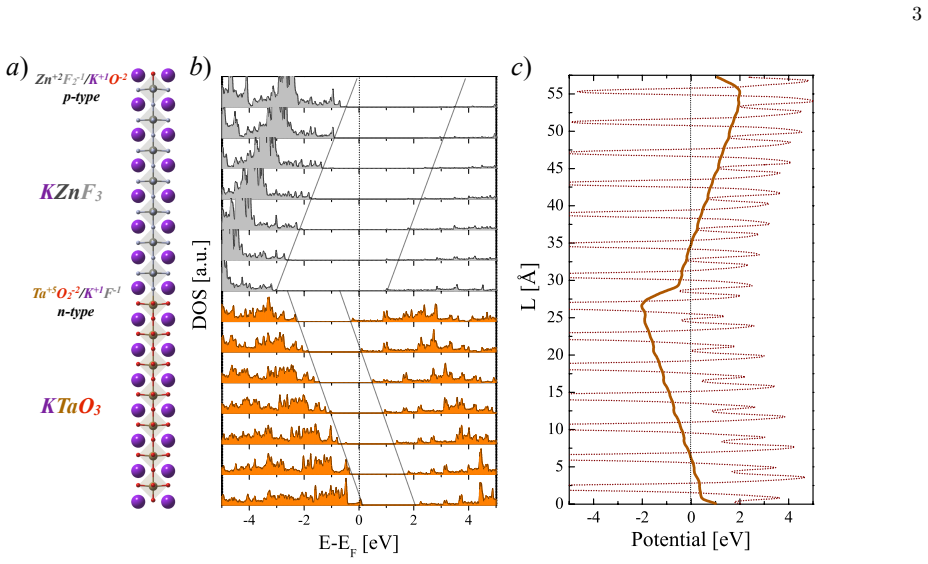
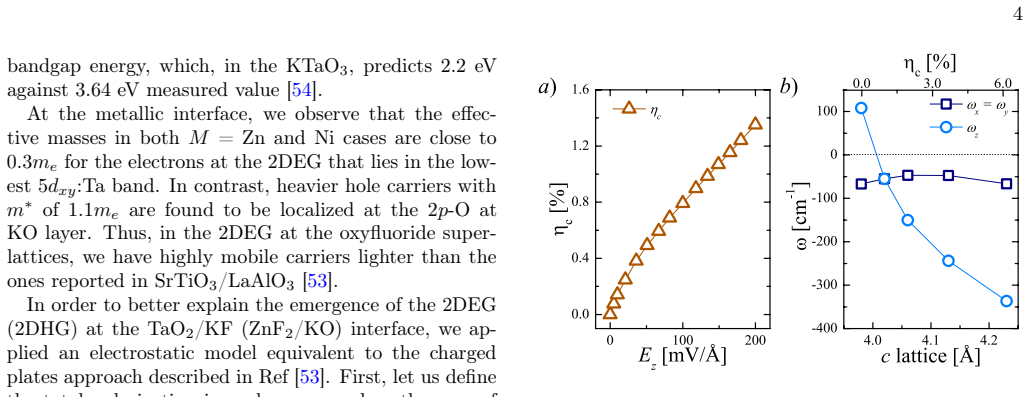
The central mechanism is the polar catastrophe at the alternating n-type TaO2/KF and p-type MF2/KO interfaces, described by a charged-plates electrostatic model and checked against the ab initio electrostatic potential. The argument is carried by the internal electric field, 105 mV/Å for KZnF3 and 98 mV/Å for KNiF3 versus 58 mV/Å for LaAlO3/SrTiO3, and by the phonon response: an electric field along z expands the KTaO3 c-axis and switches its polar instability from Amm2 to P4mm, explaining why a bulk-only electrostatic model underestimates the field. The spin splitting is described by the cubic Rashba Hamiltonian $H_{R3} = \alpha_3 E_z i(k_-^3 \sigma_+ - k_+^3 \sigma_-)$ giving $E_\pm(k) = \hbar^2 k^2/2m^* \pm \alpha_3 k^3$, and is extracted from spin-resolved band structures computed with spin-orbit coupling.
What would settle it
Compute the spin-orbit-coupled band structure of the 7/7 KTaO3/KZnF3 superlattice at its metallic Fermi level; if the Rashba $\Delta k$ and $\Delta E$ there do not approach $0.044\,\AA^{-1}$ and $64\,\mathrm{meV}$, or if no Rashba-split bands cross the Fermi energy, the extrapolation from the insulating 4/4 case fails. Alternatively, a grown 7/7 film measured by angle-resolved photoemission would reveal whether such spin-split bands exist at the Fermi level.
Extended reading notes
Core claim
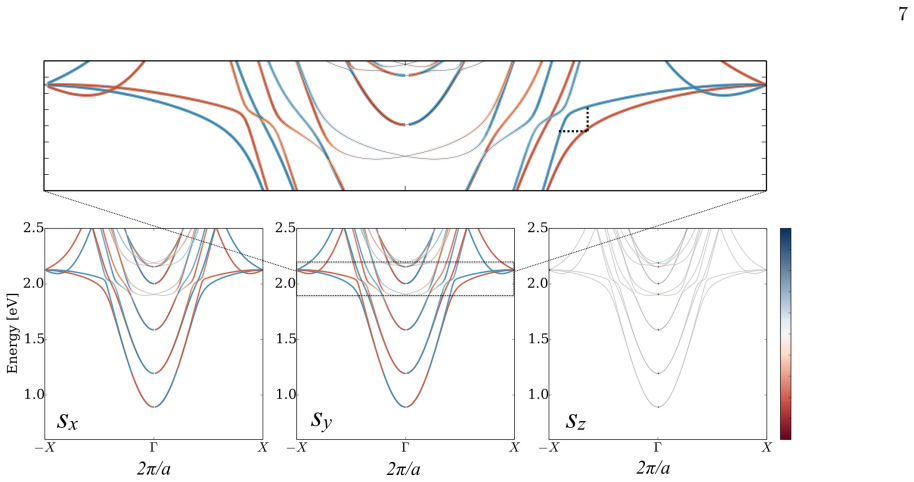
The paper predicts that stacking insulating KTaO3 with the fluoride perovskites KZnF3 or KNiF3 produces alternating n- and p-type interfaces whose uncompensated electric fields drive a polar-catastrophe insulator-to-metal transition once each slab exceeds six unit cells. At the transition, a two-dimensional electron gas appears in Ta 5dxy states at the TaO2/KF interface and a two-dimensional hole gas in O 2p states at the MF2/KO interface, both confined to the oxide layers, with internal fields of 105 mV/Å for the Zn system and 98 mV/Å for the Ni system. The same structures show a cubic Rashba spin splitting described by the Hamiltonian $H_{R3} = \alpha_3 E_z i(k_-^3 \sigma_+ - k_+^3 \sigma_-)$ with $\Delta k = 0.044\,\AA^{-1}$ and $\Delta E = 64\,\mathrm{meV}$ in the 4/4 superlattice, about four times the values computed for LaAlO3/SrTiO3 and twice those of a KTaO3-based transistor. For M = Ni, the G-type antiferromagnetic order of bulk KNiF3 survives, so the heterostructure can combine a 2DEG, a 2DHG, spin splitting, and magnetism.
Load-bearing premise
The Rashba splitting is computed in the 4/4 superlattice, which is still insulating, and the paper assumes the same splitting survives in the thicker n > 6 superlattices where the 2DEG actually appears.
Editorial extensions
If this is right
- The 2DEG/2DHG appears at n > 6 unit cells, a lower critical thickness than the roughly 8/8 threshold in LaAlO3/SrTiO3, so thinner superlattices could create conducting oxide interfaces.
- Because electrons and holes remain in the KTaO3 layers while the fluoride acts as a condensing barrier, the conductive channel is spatially separated from the magnetic fluoride when M = Ni.
- The cubic Rashba splitting, $\Delta k = 0.044\,\AA^{-1}$ and $\Delta E = 64\,\mathrm{meV}$, is large enough to produce spin-polarized bands in the kx–ky plane, and in the magnetic case the system can host a 2DEG, a 2DHG, k^3 Rashba splitting, and G-type antiferromagnetism simultaneously.
- Tuning the n/l ratio shifts the Ta 5d bands relative to the Fermi energy, providing a control knob for the size of the splitting and for spin-transport properties.
Reading between the lines
- The headline Rashba numbers come from an insulating 4/4 superlattice, and the paper assumes they carry over to the metallic n > 6 case; a direct calculation or measurement at the 7/7 interface could find that band filling and the internal field alter $\Delta k$ and $\Delta E$, so those values should be treated as an upper-bound estimate until checked.
- The same alternating n/p interface construction could be tried with other 4d or 5d oxide perovskites paired with fluorides, since fluoride lattices are large enough to accommodate heavy cations with strong spin-orbit coupling; the paper hints at this idea but does not test it.
- The O 2p hole gas is an unusual feature, and if hole mobilities can be improved, oxyfluoride interfaces might become a platform for hole-based spin-orbitronics, a direction the paper does not develop.
- The predicted electrostriction-driven switch from Amm2 to P4mm polarization in KTaO3 suggests that strain state and c/a ratio control both the 2DEG and the Rashba strength, so external strain could tune the splitting continuously, which is not tested in this paper.
Signed reviews
Editorial analysis
A structured set of objections, weighed in public.
Referee Report
Summary. The manuscript reports first-principles DFT+U and hybrid-functional calculations for (KTaO3)n/(KMF3)n superlattices with M = Zn and Ni. The authors find a polar-catastrophe-driven insulator-to-metal transition for n > 6 unit cells, with a two-dimensional electron gas (2DEG) and two-dimensional hole gas (2DHG) confined to the oxide layers of the heterostructure. They analyze local structure, Born effective charges, phonon instabilities, and magnetic ordering for M = Ni (G-type AFM with small induced Ta moments). In the electronic-structure section, they report a cubic Rashba-type spin splitting at the 4/4 superlattice, quantified as Δk = 0.044 Å⁻¹ and ΔE = 64 meV at an energy about 2 eV above the Fermi level, and claim this is roughly four times larger than in LaAlO3/SrTiO3 and twice that of KTaO3-based transistors. The central claim of the paper is that these oxyfluoride interfaces host both a 2DEG/2DHG and a sizeable Rashba splitting, with potential for multifunctional spintronic applications.
Significance. If the central claims hold, the oxyfluoride perovskite heterostructures studied here would constitute a new platform combining a polar-catastrophe 2DEG/2DHG, a k-cubic Rashba effect, and (for M = Ni) G-type antiferromagnetism in one system. The work is exploratory and computational, but the qualitative finding that fluoride-terminated interfaces confine carriers to the oxide layers and exhibit large internal fields is of interest to the oxide-electronics and materials-design communities. The study also contains useful methodological elements: multiple exchange-correlation functionals, DFT+U calibrated to HSE06, phonon analysis, and Berry-phase polarization calculations. However, the headline quantitative claim — the size of the Rashba splitting — is currently extracted from an insulating superlattice at energies far above the Fermi level and extrapolated to the metallic 2DEG regime without a direct calculation or a rigorous scaling argument, which limits the significance of that claim until verified.
major comments (3)
- [Cubic-Rashba spin-splitting section, Fig. 3 and Eqs. (4)-(5)] The Rashba splitting is computed in the 4/4 superlattice, which is insulating, and the quoted Δk = 0.044 Å⁻¹ and ΔE = 64 meV are read from conduction bands about 2 eV above the Fermi level. In the metallic 7/7 system, the 2DEG occupies the bottom of these same dxy-derived bands, where the Fermi level lies; the k-cubic dispersion of Eq. (5) makes the splitting strongly k-dependent, so a value at 2 eV above E_F is not representative of the splitting at E_F. The statement that “the results presented here can be extrapolated to larger n/l superlattices” is an assertion, not a derivation. The authors should either compute the band structure of the metallic 7/7 (or n>6) superlattice with spin-orbit coupling and report Δk and ΔE at the Fermi surface, or provide a quantitative argument (e.g., via the carrier density and the k-dependence of the splitting) that the 4/4 result transfers unchanged.
- [Electrostatic model, Eqs. (1)-(3) and Table II] The electrostatic model uses bulk polarization and dielectric constants as inputs and yields fields of 40–54 mV/Å, about half the DFT-computed internal field; the authors attribute the difference to electrostriction and phonon renormalization. However, both the model and the layer-by-layer polarization values in Table II are derived for the insulating 4/4 system. In the metallic n>6 regime, mobile carriers screen the polar field, so one cannot use the 4/4 field (or its extrapolation) as the effective Ez that enters Eq. (4) for the 2DEG. The paper should clarify how the field relevant to the proposed Rashba effect in the metallic state is determined, or explicitly state that the Rashba calculation is for the insulating interface only.
- [Comparison with LaAlO3/SrTiO3, paragraph after Fig. 3] The authors state that they computed the spin-texture of SrTiO3/LaAlO3 under the same conditions in a 4/4 superlattice and found Δk = 0.011 Å⁻¹ and ΔE = 11 meV, but the comparison is not shown and no computational details (same U, same energy window, same SOC treatment) are provided. Because the claim of “four-times larger” splitting is the main quantitative headline, the comparison should be documented in a figure or table with sufficient detail for the reader to judge whether the comparison is apples-to-apples.
minor comments (4)
- [Results and Discussion, subsection on 2DEG/2DHG] The text uses “ITM transition” where “IMT” (insulator-to-metal transition) is meant; please correct the abbreviation for consistency.
- [Magnetic ordering subsection] The sentence “we noticed that the same spin-texture remains at the TaO2/KO” appears to be a typo: the n-type interface is TaO2/KF, not TaO2/KO. Clarify the intended interface.
- [Cubic-Rashba spin-splitting section] The authors mention that the band structure was computed with PyProcar and analyzed “up to the 4/4 superlattice,” but Fig. 3 is not explicitly labeled with the superlattice size and composition; please add the system designation (e.g., 4/4 KTO/KZF) to the figure or its caption.
- [Table II] The labeling “Layer 1 2 3 4 5 6 7 8” would benefit from indicating which layers are oxide and which are fluoride, since the polarization sign changes between the two compounds.
Circularity Check
No meaningful circularity: the U calibration and electrostatic model are not fitted to the Rashba or 2DEG outcomes, and self-citations are motivational or tool-related.
full rationale
The central claims—2DEG/2DHG formation for n>6, critical thickness, interfacial electric fields, magnetic ordering, and the cubic-Rashba Δk/ΔE—are computed from first-principles DFT+U and hybrid-functional electronic structures and Berry-phase polarizations. The only explicitly fitted quantity is the Hubbard U, calibrated to reproduce the HSE06 gap and magnetic moment in the 1/1 superlattice (Computational Details); that calibration does not encode the Rashba splitting, the 2DEG, or the critical thickness, so the subsequent predictions are not forced by the fit. The electrostatic model (Eqs. 1–3) uses bulk polarization and dielectric constants as inputs and is then compared with DFT, not fitted to the target Rashba values; the paper even reports disagreement between the model and the DFT electrostatic potential. Self-citations (Refs. 12–14 for fluoride background, Ref. 68 for the PyProcar analysis tool) are motivational or instrumental and are not load-bearing for the main conclusions. The statement that the 4/4 Rashba results 'can be extrapolated to larger n/l superlattices' is an asserted transferability assumption, not a circular definition; whether that extrapolation is valid is a scientific-risk issue, not a circularity issue. No equation in the paper reduces to its own input by construction.
Assumptions & free parameters
free parameters (2)
- Hubbard U for Ni 3d =
Not explicitly stated; text notes U > 6.0 eV stabilizes G-AFM in VASP
- Energy at which Rashba splitting is evaluated =
2.0 eV above the Fermi level
assumptions (4)
- domain assumption DFT with the PBEsol exchange-correlation functional accurately describes oxyfluoride compounds.
- domain assumption The polar catastrophe and electronic reconstruction model for oxide interfaces applies to these oxyfluoride superlattices.
- ad hoc to paper The Rashba splitting computed in the 4/4 superlattice can be extrapolated to the 7/7 system where the 2DEG forms.
- domain assumption KTaO3 under the superlattice strain and electric field develops a P4mm polarization along z.
Cite this review
Pith. "Pith review of Structural and electronic phenomena at oxyfluoride KTaO$_3$/K$M$F$_3$ ($M$ = Zn and Ni) superlattices: Rashba splitting and 2DEG." pith.science (2026). https://pith.science/paper/SMUCRG3Y
@misc{pith2026190901921,
  author       = {Pith},
  title        = {Pith review of: Structural and electronic phenomena at oxyfluoride KTaO$_3$/K$M$F$_3$ ($M$ = Zn and Ni) superlattices: Rashba splitting and 2DEG},
  year         = {2026},
  howpublished = {\url{https://pith.science/paper/SMUCRG3Y}},
  note         = {Machine review of arXiv:1909.01921}
}
abstract
Here, we present the theoretical analysis of the structural and electronic degrees of freedom of two different oxide/fluoride perovskite superlattices, KTaO$_3$/KZnF$_3$ and KTaO$_3$/KNiF$_3$. Using first-principles calculations, we found the appearance of a two-dimensional electron, 2DEG, and hole, 2DHG, gases as a function of the number of layers of the different pristine materials. We demonstrate that the phonon-dynamics at the KTO/K$M$F superlattices play a crucial role in the appearance of these effects. Additionally, our results reveal a rather sizeable Rashba-type spin-splitting at these interfaces in comparison to another oxide/oxide counterparts.
Figures
Reference graph
Works this paper leans on
-
[1]
H. Y. Hwang, Y. Iwasa, M. Kawasaki, B. Keimer, N. Na- gaosa, and Y. Tokura, Nature Materials11, 103 (2012)
2012
- [2]
-
[3]
J. Mannhart, D. Blank, H. Hwang, A. Millis, and J.-M. Triscone, MRS Bulletin33, 1027 (2008)
work page 2008
- [4]
-
[5]
S. Caprara, F. Peronaci, and M. Grilli, Phys. Rev. Lett. 109, 196401 (2012)
work page 2012
- [6]
-
[7]
B.R.K.NandaandS.Satpathy,Phys.Rev.B 81,224408 (2010)
work page 2010
-
[8]
E. Bousquet, M. Dawber, N. Stucki, C. Lichtensteiger, P. Hermet, S. Gariglio, J.-M. Triscone, and P. Ghosez, Nature 452, 732 (2008)
work page 2008
Show all 76 references
-
[9]
Benedek and C
N. Benedek and C. Fennie, Phys. Rev. Lett.106, 107204 (2011)
2011
-
[10]
A. T. Mulder, N. A. Benedek, J. M. Rondinelli, and C. J. Fennie, Advanced Functional Materials23, 4810 (2013)
2013
-
[11]
Zanolli, J
Z. Zanolli, J. C. WojdeÅĆ, J. Íñiguez, and P. Ghosez, Phys. Rev. B88, 060102 (2013)
2013
-
[12]
A. C. Garcia-Castro, N. A. Spaldin, A. H. Romero, and E. Bousquet, Phys. Rev. B89, 104107 (2014)
2014
-
[13]
A. C. Garcia-Castro, A. H. Romero, and E. Bousquet, Phys. Rev. Lett.116, 117202 (2016)
2016
-
[14]
M. Yang, A. KC, A. C. Garcia-Castro, P. Borisov, E. Bousquet, D. Lederman, A. H. Romero, and C. Cen, Scientific Reports7, 7182 (2017)
2017
-
[15]
M. A. Carpenter, E. K. H. Salje, and C. J. Howard, Phys. Rev. B85, 224430 (2012)
2012
-
[16]
D. P. Dobson, S. A. Hunt, A. Lindsay-Scott, and I. G. Wood, Physics of the Earth and Planetary Interiors189, 171 (2011)
2011
-
[17]
P. J. Edwardson, L. L. Boyer, R. L. Newman, D. H. Fox, J.R.Hardy, J.W.Flocken, R.A.Guenther, andW.Mei, Phys. Rev. B39, 9738 (1989)
1989
-
[18]
C.-g. Duan, W. N. Mei, J. Liu, W.-G. Yin, J. R. Hardy, R. W. Smith, M. J. Mehl, and L. L. Boyer, Phys. Rev. B 69, 033102 (2004)
2004
-
[19]
W. Pang, R. L. Stamps, L. Malkinski, Z. Celinski, and D. Skrzypek, Journal of Applied Physics95, 7309 (2004)
2004
-
[20]
Widuch, R
S. Widuch, R. L. Stamps, D. Skrzypek, and Z. Celinski, Journal of Physics D: Applied Physics44, 415003 (2011)
2011
-
[21]
polar catastrophe
where substantial changes in the electric conductiv- ity and transport properties have been demonstrated. This mainly due to an induced change in the nomi- nal oxidation state of the Fe cation. Then, and even more surprising, multifunctional properties such as su- perconductiv...
1909 arXiv
-
[22]
AI-Mamouri, P
M. AI-Mamouri, P. P. Edwards, C. Greaves, and M. Slaski, Nature369, 382 (1994)
1994
-
[23]
E. J. Moon, Y. Xie, E. D. Laird, D. J. Keavney, C. Y. Li, and S. J. May, Journal of the American Chemical Society 136, 2224 (2014)
2014
-
[24]
Sturza, H
M. Sturza, H. Kabbour, S. Daviero-Minaud, D. Fil- imonov, K. Pokholok, N. Tiercelin, F. Porcher, L. Al- don, and O. Mentre, Journal of the American Chemical Society 133, 10901 (2011)
2011
-
[25]
Sturza, S
M. Sturza, S. Daviero-Minaud, H. Kabbour, O. Gardoll, and O. Mentre, Chemistry of Materials22, 6726 (2010)
2010
-
[26]
Yang and H
X. Yang and H. Su, Scientific Reports5, 15849 (2015)
2015
-
[27]
Yang and H
X. Yang and H. Su, Scientific Reports4, 5420 (2014)
2014
-
[28]
Charles, R
N. Charles, R. J. Saballos, and J. M. Rondinelli, Chem- istry of Materials30, 3528 (2018)
2018
-
[29]
Deng, ChemNanoMat3, 146 (2017)
D. Deng, ChemNanoMat3, 146 (2017)
2017
-
[30]
J. K. Harada, N. Charles, K. R. Poeppelmeier, and J. M. Rondinelli, Advanced Materials1805295, 1805295 (2019)
2019
-
[31]
Kageyama, K
H. Kageyama, K. Hayashi, K. Maeda, J. P. Attfield, Z. Hiroi, J. M. Rondinelli, and K. R. Poeppelmeier, Nature Communications 9 (2018), 10.1038/s41467-018- 02838-4
2018 doi
-
[32]
Kohn and L
W. Kohn and L. J. Sham, Phys. Rev.140, A1133 (1965)
1965
-
[33]
Hohenberg and W
P. Hohenberg and W. Kohn, Phys. Rev. 136, B864 (1964)
1964
-
[34]
Kresse and D
G. Kresse and D. Joubert, Phys. Rev. B59, 1758 (1999)
1999
-
[35]
Kresse and J
G. Kresse and J. Furthmüller, Phys. Rev. B54, 11169 (1996)
1996
-
[36]
J. P. Perdew, A. Ruzsinszky, G. I. Csonka, O. A. Vydrov, G.E.Scuseria, L.A.Constantin, X.Zhou, andK.Burke, Phys. Rev. Lett.100, 136406 (2008)
2008
-
[37]
P. E. Blöchl, Phys. Rev. B50, 17953 (1994)
1994
-
[38]
A. I. Liechtenstein, V. I. Anisimov, and J. Zaanen, Phys. Rev. B52, R5467 (1995)
1995
-
[39]
Charles and J
N. Charles and J. M. Rondinelli, Phys. Rev. B94, 174108 (2016)
2016
-
[40]
A. V. Krukau, O. A. Vydrov, A. F. Izmaylov, and G. E. Scuseria, The Journal of Chemical Physics125, 224106 (2006)
2006
-
[41]
J. Heyd, G. E. Scuseria, and M. Ernzerhof, The Journal of Chemical Physics118, 8207 (2003)
2003
-
[42]
Gonze and C
X. Gonze and C. Lee, Phys. Rev. B55, 10355 (1997)
1997
-
[43]
Hobbs, G
D. Hobbs, G. Kresse, and J. Hafner, Phys. Rev. B62, 11556 (2000)
2000
-
[44]
Roberto, O
D. Roberto, O. Roberto, C. Bartolomeo, R. Carla, S. V. R., and Z.-W. C. M., Zeitschrift fr Kristallographie - Crystalline Materials220, 571 (2005)
2005
-
[45]
Togo and I
A. Togo and I. Tanaka, Scr. Mater.108, 1 (2015)
2015
-
[46]
A. D. Becke, The Journal of Chemical Physics98, 1372 (1993)
1993
-
[47]
D. I. Bilc, R. Orlando, R. Shaltaf, G.-M. Rignanese, J. Íñiguez, and P. Ghosez, Phys. Rev. B 77, 165107 (2008)
2008
-
[48]
J. P. Perdew, M. Ernzerhof, and K. Burke, The Journal 9 of Chemical Physics105, 9982 (1996)
1996
-
[49]
A. D. Becke, The Journal of Chemical Physics96, 2155 (1992)
1992
-
[50]
Knox, Acta Crystallographica14, 583 (1961)
K. Knox, Acta Crystallographica14, 583 (1961)
1961
-
[51]
ktao3 crystal structure, lattice parameters, thermal expan- sion,
O. Madelung, U. Rössler, and M. Schulz, eds., “ktao3 crystal structure, lattice parameters, thermal expan- sion,” inTernary Compounds, Organic Semiconductors (Springer Berlin Heidelberg, Berlin, Heidelberg, 2000) pp. 1–3
2000
-
[52]
G. Pari, S. Mathi Jaya, and R. Asokamani, Phys. Rev. B 50, 8166 (1994)
1994
-
[53]
Okazaki, Y
A. Okazaki, Y. Suemune, and T. Fuchikami, Journal of the Physical Society of Japan14, 1823 (1959)
1959
-
[54]
G. E. Jellison, I. Paulauskas, L. A. Boatner, and D. J. Singh, Phys. Rev. B74, 155130 (2006)
2006
-
[55]
N. C. Bristowe, E. Artacho, and P. B. Littlewood, Phys. Rev. B80, 045425 (2009)
2009
-
[56]
D.Vanderbilt,JournalofPhysicsandChemistryofSolids 61, 147 (2000)
2000
-
[57]
Tyunina, J
M. Tyunina, J. Narkilahti, M. Plekh, R. Oja, R. M. Nieminen, A. Dejneka, and V. Trepakov, Phys. Rev. Lett. 104, 227601 (2010)
2010
-
[58]
Bousquet, J
E. Bousquet, J. Junquera, and P. Ghosez, Phys. Rev. B 82, 045426 (2010)
2010
-
[59]
Cancellieri, D
C. Cancellieri, D. Fontaine, S. Gariglio, N. Reyren, A. D. Caviglia, A.Fête, S.J.Leake, S.A.Pauli, P.R.Willmott, M. Stengel, P. Ghosez, and J.-M. Triscone, Phys. Rev. Lett. 107, 056102 (2011)
2011
-
[60]
Y. A. Bychkov and E. I. Rashba, Journal of Physics C: Solid State Physics17, 6039 (1984)
1984
-
[61]
P. Yu, Y. Chu, and R. Ramesh, Materials Today15, 320 (2012)
2012
-
[62]
Z.Zhong, A.Tóth, andK.Held,Phys.Rev.B 87,161102 (2013)
2013
-
[63]
104,126803 (2010)
A.D.Caviglia, M.Gabay, S.Gariglio, N.Reyren, C.Can- cellieri, andJ.-M.Triscone,Phys.Rev.Lett. 104,126803 (2010)
2010
-
[64]
Nakamura, T
H. Nakamura, T. Koga, and T. Kimura, Phys. Rev. Lett. 108, 206601 (2012)
2012
-
[65]
Hurand, A
S. Hurand, A. Jouan, C. Feuillet-Palma, G. Singh, J. Bis- caras, E. Lesne, N. Reyren, A. Barthélémy, M. Bibes, J. E. Villegas, C. Ulysse, X. Lafosse, M. Pannetier- Lecoeur, S. Caprara, M. Grilli, J. Lesueur, and N. Bergeal, Scientific Reports5, 12751 EP (2015)
2015
-
[66]
Lee and H
H. Lee and H. J. Choi, Phys. Rev. B86, 045437 (2012)
2012
-
[67]
Nakamura and T
H. Nakamura and T. Kimura, Phys. Rev. B80, 121308 (2009)
2009
-
[68]
Herath, P
U. Herath, P. Tavadze, X. He, E. Bousquet, S. Singh, F. Muñoz, and A. H. Romero, arXiv preprint arXiv:1906.11387 (2019)
2019 arXiv
-
[69]
S. R. Park and C. Kim, Journal of Electron Spectroscopy and Related Phenomena201, 6 (2015), special issue on electron spectroscopy for Rashba spin-orbit interaction
2015
-
[70]
The linear-Rashba effect has theE vs.k form: E±(k) = (¯h2k2/2m∗)± α|k| coming from the Hamiltonian of the form HR = αEzi(k−σ+−k+σ−)
-
[71]
Shanavas, Journal of Electron Spectroscopy and Re- lated Phenomena201, 121 (2015)
K. Shanavas, Journal of Electron Spectroscopy and Re- lated Phenomena201, 121 (2015)
2015
-
[72]
P. D. C. King, R. H. He, T. Eknapakul, P. Buaphet, S.-K. Mo, Y. Kaneko, S. Harashima, Y. Hikita, M. S. Bahramy, C. Bell, Z. Hussain, Y. Tokura, Z.-X. Shen, H. Y. Hwang, F. Baumberger, and W. Meevasana, Phys. Rev. Lett. 108, 117602 (2012)
2012
-
[73]
Ishizaka, M
K. Ishizaka, M. S. Bahramy, H. Murakawa, M. Sakano, T. Shimojima, T. Sonobe, K. Koizumi, S. Shin, H. Miyahara, A. Kimura, K. Miyamoto, T. Okuda, H. Namatame, M. Taniguchi, R. Arita, N. Nagaosa, K. Kobayashi, Y. Murakami, R. Kumai, Y. Kaneko, Y. Onose, and Y. Tokura, Nat Mater1...
2011
-
[74]
Moriya, K
R. Moriya, K. Sawano, Y. Hoshi, S. Masubuchi, Y. Shi- raki, A. Wild, C. Neumann, G. Abstreiter, D. Bougeard, T. Koga, and T. Machida, Phys. Rev. Lett.113, 086601 (2014)
2014
-
[75]
O.BleibaumandS.Wachsmuth,Phys.Rev.B 74,195330 (2006)
2006
-
[110]
When compressive epitaxialxy-strain is 5 applied, a single polar phonon mode along thez-axis be- comes unstable, which drives the system to aP 4mm fer- roelectric ground state
direction. When compressive epitaxialxy-strain is 5 applied, a single polar phonon mode along thez-axis be- comes unstable, which drives the system to aP 4mm fer- roelectric ground state. Thus, under thein-plane expan- sionstrainconditionsintheKTO/K MFsuperlattices, an Amm2 gr...
Reviewed August 14, 2026 · model on record in the stance chip above.
Discussion (0). Continue with ORCID to comment.