REVIEW 4 major objections 6 minor 92 references
ApproxNet: Content and Contention-Aware Video Analytics System for Embedded Clients
T0 review · 4 major / 6 minor · reviewed 2026-08-14 · deepseek-v4-flash
Pith's one-line read ApproxNet claims that one DNN with two runtime approximation knobs keeps video classification at 30 fps on embedded devices while adapting to content and contention, beating ensemble and early-exit baselines.
desk verdict A genuinely new single-model adaptive video classification system with solid engineering, but the MSDNet comparison is unfair and the FCE-based accuracy guarantee is softer than claimed. read the letter →
The pith
A machine-rendered reading of the paper's core claim, the machinery that carries it, and where it could break.
The reading
What carries the argument
The load-bearing mechanism is the approximation branch: a named execution path through one DNN defined by a specific input shape and a specific outport depth, with a spatial pyramid pooling layer at each outport so that smaller input shapes still feed a fixed-size fully connected classifier. The branches supply the accuracy-latency tradeoff space, and because they share weights, switching from one branch to another does not require loading a new model. The offline profiler turns that space into lookup tables linking frame-complexity categories to per-branch accuracy, contention levels to per-branch latency, and any pair of branches to its switching cost; the scheduler then solves a small optimization over those tables to satisfy the user requirement.
What would settle it
Run ApproxNet on a video where the camera slowly pans across a highly textured but semantically easy scene, such as a blank patterned wall, and then across a semantically hard scene with the same mean edge value; if the scheduler keeps choosing the same branch but accuracy falls below the user target, the edge-value correlation that the Frame Complexity Estimator depends on is falsified.
Extended reading notes
Core claim
The paper claims that combining two approximation knobs inside one DNN — seven input shapes (224 down to 80 pixels) and six output depths (after layers 11, 15, 19, 23, 27, and 33 of a ResNet-34 base) — yields 30 approximation branches whose accuracy-latency behavior forms Pareto frontiers for each frame-complexity category and contention level. The total training loss is a shape-normalized weighted average of per-outport softmax losses, so every branch is trained jointly. At runtime, a Frame Complexity Estimator computes the mean edge value of a frame, with a scene-change detector limiting how often that runs, and a Resource Contention Estimator infers contention from the recent inference latency of the current branch. The scheduler then chooses a branch that satisfies the user's accuracy or latency requirement while amortizing the one-time switching cost over an expected window of use. The evaluation claims that ApproxNet meets the 33 ms per-frame budget under CPU and GPU contention, keeps switching overhead orders of magnitude below ensemble approaches, and achieves a better accuracy-latency tradeoff than ResNet, MCDNN, MobileNets, NestDNN, and MSDNet on the ILSVRC VID and ImageNet datasets.
Load-bearing premise
The system's content-awareness rests on the premise that a frame's mean edge value reliably predicts how accurate each approximation branch will be for that frame's content, a correlation validated on one video dataset and one embedded board.
Editorial extensions
If this is right
- A single ApproxNet model (about 89 MB of storage and at most about 2.1 GB of RAM) can cover the accuracy-latency range that an ensemble like MCDNN needs multiple separately loaded models to cover.
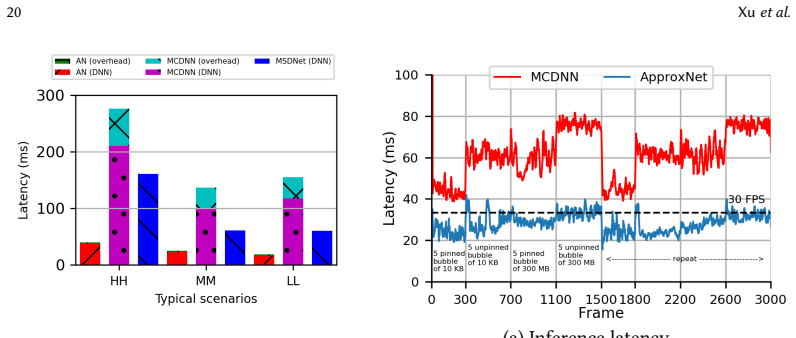
- Under CPU or GPU contention, the scheduler can shift to a lighter branch and hold latency near the 33 ms frame budget, where a fixed non-adaptive model would blow the budget by roughly 85 percent.
- Frame-complexity awareness adds about 2.0 percent accuracy in a high-accuracy scenario at a cost of about 3.6 ms per frame, compared with a content-agnostic scheduler.
- Because switching cost is amortized over an expected window of use, frequent switches between branches do not produce the multi-second latency spikes seen when models must be reloaded from flash.
- The design generalizes to any CNN with convolutional and fully connected layers, so the same two-knob single-model idea could be applied to other base architectures without changing the scheduler or profiler structure.
Reading between the lines
- This suggests the edge-value complexity proxy could be swapped for a learned frame-complexity predictor trained on the target deployment; the architecture and scheduler would survive, while the accuracy estimates might become more portable across content domains.
- A natural testable extension is to apply the same two-knob design to object detection or semantic segmentation, where early-exit and input-resolution tradeoffs exist but the interaction between content complexity and branch choice is less explored.
- Because the contention estimator observes one latency sample per frame, contention that oscillates faster than the frame rate would be invisible to it; adding a lightweight micro-benchmark probe could extend the design to faster-changing contention.
- The accuracy profiles are built offline on one dataset and one board, so an online calibration step using frames the model classifies with high confidence could make the system's accuracy guarantees transfer to new environments.
Signed reviews
Editorial analysis
A structured set of objections, weighed in public.
Referee Report
Summary. ApproxNet is a video object classification system for embedded and mobile clients. It uses a single ResNet-based DNN with two approximation knobs, input shape and outport depth, yielding 30 approximation branches. An offline profiler builds per-branch accuracy profiles for frame complexity categories and per-branch latency profiles under resource contention; an online scheduler, aided by a Frame Complexity Estimator and a Resource Contention Estimator, selects a branch to satisfy user latency or accuracy requirements. The paper evaluates ApproxNet on ILSVRC VID and ImageNet IMG on an NVIDIA Jetson TX2, reporting that ApproxNet meets 30 fps, has lower switching overhead than MCDNN and NestDNN, and provides better accuracy-latency tradeoffs than ResNet, MCDNN, MobileNets, NestDNN, and MSDNet.
Significance. If the results are robust, the single-model multi-knob design with content- and contention-aware runtime scheduling is a valuable contribution to on-device video analytics. The evaluation is generally careful: it uses disjoint validation and test sets, includes system overheads in reported latencies, and breaks down the overheads of FCE, RCE, and the scheduler. However, the central accuracy-guarantee mechanism is not validated on the test set, and the comparison with MSDNet is not fully specified, so the paper's broad claims currently outrun the evidence.
major comments (4)
- [Sec. 5.4, 5.6; Table 3; Eq. (4)] The HH scenario is defined as an accuracy loss of less than 10% relative to ResNet-34; Table 3(d) lists ResNet-34's VID validation accuracy as 85.86%, so the HH requirement is about 77.3%. The scheduler's lookup table in Table 3(a) lists the HH Pareto branch at 82.12% validation accuracy, but Section 5.6 reports that ApproxNet-HH achieves 67.7% accuracy on the disjoint test set. Because Eq. (4) enforces A_B,F >= A_tau using the validation-derived profile, this test result shows the accuracy constraint is violated on the test set. The note under Table 3 acknowledges that validation accuracy overstates true performance, yet no calibration or safety margin is introduced. The Figure 10 caption claim that 'ApproxNet is able to meet the accuracy requirement for all three scenarios' is therefore not supported for the HH scenario.
- [Sec. 5.3; Table 3(c); Sec. 5.6] The paper does not describe how MSDNet is adapted from its 1000-class ImageNet model to the 30-class VID task, while the ResNet baselines are explicitly described as having the last FC layer modified and the whole model fine-tuned. Table 3(c) reports MSDNet validation accuracy of 95.98% to 96.89%, far above ResNet-34's 85.86% and ApproxNet's 82.12% in the same table; later, Section 5.6 reports MSDNet test accuracy of 72.0% to 76.2%, which is not reconciled with the validation numbers. Without a description of MSDNet's training/evaluation protocol, the comparison against MSDNet is not interpretable, and the abstract's claim of improvement over MSDNet is not established.
- [Sec. 5.8; Figs. 14 and 17] Key latency and accuracy results under CPU and GPU contention are reported as single-run point estimates with no error bars, confidence intervals, or repeated-trial counts. The abstract and Section 3.1 claim 'low and stable latency' under changing runtime conditions; substantiating stability requires a measure of run-to-run or phase-to-phase variability. Without such information, the reader cannot assess whether the reported values are representative or the product of favorable runs.
- [Sec. 4.2; Eqs. (3) and (4)] The Frame Complexity Estimator uses mean edge value as the sole feature for content-aware accuracy estimation, and the paper itself states that 'some counterexamples may show the edge value is not relevant.' The accuracy profile A_B,F is derived on a single dataset (ILSVRC VID) and a single board (Jetson TX2), and the scheduler treats A_B,F as a hard constraint with no uncertainty. For video content whose classification difficulty is not monotone in edge density, the selected branch can silently miss the user's accuracy requirement. The paper should provide error statistics for the per-category accuracy estimates or calibrate the constraint with a safety margin before claiming that content awareness reliably enforces accuracy requirements.
minor comments (6)
- [Abstract; Sec. 1; Sec. 5.6] The abstract and introduction claim 'improvement in accuracy and latency over ResNet, MCDNN, MobileNets, NestDNN, and MSDNet,' but Section 5.6 shows ApproxNet-HH has 1.1% lower accuracy than MCDNN-HH and substantially lower accuracy than MSDNet; the claim should be qualified as a tradeoff improvement rather than a simultaneous improvement in both metrics.
- [Sec. 4.5] The definition of W, the 'expected time window over which this AB can be used,' is not operationalized; the paper does not state how W is computed or set, even though it directly appears in the scheduler objective and affects switching behavior.
- [Sec. 4.4] The derivation of the 7 frame complexity categories and the quantization of contention into 10 GPU and 20 CPU/memory levels is described without sensitivity analysis; the authors should justify these choices or show that the conclusions are insensitive to them.
- [Table 1; Sec. 5.11] Table 1 lists ApproxNet as 'Open-sourced,' but Section 5.11 provides only a demo website and no link to a source code repository; the open-source claim is not verifiable from the manuscript.
- [Sec. 5.7] The statement 'in 97.3% cases the frame complexity category of the video will change within every 100 frames' is ambiguous; it should clarify whether it refers to the fraction of sliding 100-frame windows containing at least one category change or some other statistic.
- [Sec. 5.2.1] The conversion of the VID detection dataset into a classification task, where a prediction is considered correct if it matches any one of the ground-truth object classes, is nonstandard and should be discussed as a potential source of optimistic accuracy relative to single-object classification; the paper notes that 89% of frames have a single class, but the remaining 11% may still bias comparisons.
Circularity Check
No significant circularity: ApproxNet's profiles are fitted on a validation split and evaluated on a separate test set; scheduling is ordinary constrained optimization, and self-citations are not load-bearing.
full rationale
The paper's central claims are supported by an independent training/validation/test split: 90% of the constructed dataset trains the DNN, 10% is used to build the offline accuracy/latency/switching profiles (Section 5.2.1), and the reported HH/MM/LL and contention results use the ILSVRC 2015 VID validation set as the test set. The scheduling objectives (Eqs. 3 and 4) are ordinary constrained selections over the profiled quantities A_B,F, L_B,C, and L_Bp->B; they do not define the accuracy or latency outcomes they are used to predict. The FCE's mean-edge-value feature is an empirical, explicitly hedged design choice ('Although some counterexamples may show the edge value is not relevant, we show empirically that with this feature, the FCE is able to predict well the accuracy of each AB'), and the paper itself warns that validation accuracy 'does not reflect the true performance' (Table 3 note), so the lookup table is not presented as ground truth. Self-citations (VideoChef [77], Pythia [78], ApproxDet [80]) appear as related work, background, or concurrent systems, not as the load-bearing justification for ApproxNet's architecture or scheduler. No load-bearing step reduces to its own inputs by construction; the evaluation is self-contained against external baselines and a held-out test set.
Assumptions & free parameters
free parameters (6)
- FCC category boundaries =
7 categories, thresholds on mean edge value (not enumerated)
- SCD threshold =
45% of total pixels
- RCE averaging window N =
30 frames
- Scheduler hysteresis window W =
not specified
- Contention level quantization =
10 levels GPU, 20 levels CPU/memory
- Input shapes and outports =
7 shapes (80-224), 6 outports (layers 11-33)
assumptions (5)
- domain assumption Mean edge value is a sufficient predictor of per-branch classification accuracy across video content.
- domain assumption Resource contention increases DNN inference latency but does not change accuracy.
- domain assumption The synthetic contention generator reproduces real-world contention sufficiently for the offline latency profile to transfer online.
- domain assumption The multi-outport joint loss in Eq. (1) trains a single weight set that serves all input shapes and outports without harmful conflicts.
- domain assumption ResNet's residual structure guarantees that shallower exits are no less accurate than deeper ones with the same input.
Cite this review
Pith. "Pith review of ApproxNet: Content and Contention-Aware Video Analytics System for Embedded Clients." pith.science (2026). https://pith.science/paper/ZFMLXEB6
@misc{pith2026190902068,
  author       = {Pith},
  title        = {Pith review of: ApproxNet: Content and Contention-Aware Video Analytics System for Embedded Clients},
  year         = {2026},
  howpublished = {\url{https://pith.science/paper/ZFMLXEB6}},
  note         = {Machine review of arXiv:1909.02068}
}
read the original abstract
Videos take a lot of time to transport over the network, hence running analytics on the live video on embedded or mobile devices has become an important system driver. Considering that such devices, e.g., surveillance cameras or AR/VR gadgets, are resource constrained, creating lightweight deep neural networks (DNNs) for embedded devices is crucial. None of the current approximation techniques for object classification DNNs can adapt to changing runtime conditions, e.g., changes in resource availability on the device, the content characteristics, or requirements from the user. In this paper, we introduce ApproxNet, a video object classification system for embedded or mobile clients. It enables novel dynamic approximation techniques to achieve desired inference latency and accuracy trade-off under changing runtime conditions. It achieves this by enabling two approximation knobs within a single DNN model, rather than creating and maintaining an ensemble of models (e.g., MCDNN [MobiSys-16]. We show that ApproxNet can adapt seamlessly at runtime to these changes, provides low and stable latency for the image and video frame classification problems, and show the improvement in accuracy and latency over ResNet [CVPR-16], MCDNN [MobiSys-16], MobileNets [Google-17], NestDNN [MobiCom-18], and MSDNet [ICLR-18].
Figures


Figures from the paper (10 more)




Reference graph
Works this paper leans on
-
[1]
Rachata Ausavarungnirun, Vance Miller, Joshua Landgraf, Saugata Ghose, Jayneel Gandhi, Adwait Jog, Christopher J Rossbach, and Onur Mutlu. 2018. Mask: Redesigning the GPU memory hierarchy to support multi-application concurrency. In ACM SIGPLAN Notices, Vol. 53. ACM, 503–518
2018
-
[2]
Saurabh Bagchi, Tarek F Abdelzaher, Ramesh Govindan, Prashant Shenoy, Akanksha Atrey, Pradipta Ghosh, and Ran Xu. 2020. New Frontiers in IoT: Networking, Systems, Reliability, and Security Challenges. IEEE Internet of Things Journal 7, 12 (2020), 11330–11346
2020
-
[3]
Sourav Bhattacharya and Nicholas D Lane. 2016. Sparsification and separation of deep learning layers for constrained resource inference on wearables. In Proceedings of the 14th ACM Conference on Embedded Network Sensor Systems (Sensys). ACM, 176–189
2016
-
[4]
Maurizio Cardaci, Vito Di Gesù, Maria Petrou, and Marco Elio Tabacchi. 2009. A fuzzy approach to the evaluation of image complexity. Fuzzy Sets and Systems 160, 10 (2009), 1474–1484
2009
-
[5]
Wenlin Chen, James Wilson, Stephen Tyree, Kilian Weinberger, and Yixin Chen. 2015. Compressing neural networks with the hashing trick. In International Conference on Machine Learning . 2285–2294
2015
-
[6]
Yu-Hsin Chen, Tushar Krishna, Joel S Emer, and Vivienne Sze. 2017. Eyeriss: An energy-efficient reconfigurable accelerator for deep convolutional neural networks. IEEE Journal of Solid-State Circuits 52, 1 (2017), 127–138
2017
-
[7]
NVIDIA Corporation. 2018. Jetson TX2 Module. Retrieved May 5, 2020 from https://developer.nvidia.com/embedded/ buy/jetson-tx2
2018
-
[8]
Christina Delimitrou and Christos Kozyrakis. 2013. Paragon: QoS-aware scheduling for heterogeneous datacenters. ACM SIGPLAN Notices 48, 4 (2013), 77–88
2013
Show all 92 references
-
[9]
Jia Deng, Wei Dong, Richard Socher, Li-Jia Li, Kai Li, and Li Fei-Fei. 2009. Imagenet: A large-scale hierarchical image database. In Computer Vision and Pattern Recognition, 2009. CVPR 2009. IEEE Conference on . Ieee, 248–255
2009
-
[10]
Emily L Denton, Wojciech Zaremba, Joan Bruna, Yann LeCun, and Rob Fergus. 2014. Exploiting linear structure within convolutional networks for efficient evaluation. In Advances in neural information processing systems . 1269–1277
2014
-
[11]
Biyi Fang, Xiao Zeng, and Mi Zhang. 2018. Nestdnn: Resource-aware multi-tenant on-device deep learning for contin- uous mobile vision. In Proceedings of the 24th Annual International Conference on Mobile Computing and Networking . ACM, 115–127
2018
-
[12]
Sadjad Fouladi, Riad S Wahby, Brennan Shacklett, Karthikeyan Balasubramaniam, William Zeng, Rahul Bhalerao, Anirudh Sivaraman, George Porter, and Keith Winstein. 2017. Encoding, Fast and Slow: Low-Latency Video Processing Using Thousands of Tiny Threads.. In NSDI. 363–376. , V...
2017
-
[13]
Mingyu Gao, Jing Pu, Xuan Yang, Mark Horowitz, and Christos Kozyrakis. 2017. Tetris: Scalable and efficient neural network acceleration with 3d memory. ACM SIGOPS Operating Systems Review 51, 2 (2017), 751–764
2017
-
[14]
Asish Ghoshal, Ananth Grama, Saurabh Bagchi, and Somali Chaterji. 2015. An ensemble svm model for the accurate prediction of non-canonical microrna targets. InProceedings of the 6th ACM Conference on Bioinformatics, Computational Biology and Health Informatics . 403–412
2015
-
[15]
Suyog Gupta, Ankur Agrawal, Kailash Gopalakrishnan, and Pritish Narayanan. 2015. Deep learning with limited numerical precision. In International Conference on Machine Learning . 1737–1746
2015
-
[16]
Song Han, Xingyu Liu, Huizi Mao, Jing Pu, Ardavan Pedram, Mark A Horowitz, and William J Dally. 2016. EIE: efficient inference engine on compressed deep neural network. In Computer Architecture (ISCA), 2016 ACM/IEEE 43rd Annual International Symposium on. IEEE, 243–254
2016
-
[17]
Song Han, Jeff Pool, John Tran, and William Dally. 2015. Learning both weights and connections for efficient neural network. In Advances in neural information processing systems . 1135–1143
2015
-
[18]
Seungyeop Han, Haichen Shen, Matthai Philipose, Sharad Agarwal, Alec Wolman, and Arvind Krishnamurthy. 2016. Mcdnn: An approximation-based execution framework for deep stream processing under resource constraints. In Proceedings of the 14th Annual International Conference on M...
2016
-
[19]
Wei Han, Pooya Khorrami, Tom Le Paine, Prajit Ramachandran, Mohammad Babaeizadeh, Honghui Shi, Jianan Li, Shuicheng Yan, and Thomas S Huang. 2016. Seq-nms for video object detection. arXiv preprint arXiv:1602.08465 (2016)
2016 arXiv
-
[20]
Mark Harris. 2017. Unified Memory for CUDA Beginners . Retrieved May 5, 2020 from https://devblogs.nvidia.com/ unified-memory-cuda-beginners/
2017
-
[21]
Kaiming He, Xiangyu Zhang, Shaoqing Ren, and Jian Sun. 2014. Spatial pyramid pooling in deep convolutional networks for visual recognition. In european conference on computer vision . Springer, 346–361
2014
-
[22]
Kaiming He, Xiangyu Zhang, Shaoqing Ren, and Jian Sun. 2016. Deep residual learning for image recognition. In Proceedings of the IEEE conference on computer vision and pattern recognition . 770–778
2016
-
[23]
Andrew G Howard, Menglong Zhu, Bo Chen, Dmitry Kalenichenko, Weijun Wang, Tobias Weyand, Marco Andreetto, and Hartwig Adam. 2017. Mobilenets: Efficient convolutional neural networks for mobile vision applications. arXiv preprint arXiv:1704.04861 (2017)
2017 arXiv
-
[24]
Kevin Hsieh, Ganesh Ananthanarayanan, Peter Bodik, Paramvir Bahl, Matthai Philipose, Phillip B Gibbons, and Onur Mutlu. 2018. Focus: Querying large video datasets with low latency and low cost. arXiv preprint arXiv:1801.03493 (2018)
2018 arXiv
-
[25]
Gao Huang, Danlu Chen, Tianhong Li, Felix Wu, Laurens van der Maaten, and Kilian Q Weinberger. 2018. Multi-scale dense networks for resource efficient image classification. In International Conference on Learning Representations (ICLR)
2018
-
[26]
Gao Huang, Zhuang Liu, Laurens Van Der Maaten, and Kilian Q Weinberger. 2017. Densely connected convolutional networks. In Proceedings of the IEEE conference on computer vision and pattern recognition . 4700–4708
2017
-
[27]
Itay Hubara, Matthieu Courbariaux, Daniel Soudry, Ran El-Yaniv, and Yoshua Bengio. 2017. Quantized Neural Networks: Training Neural Networks with Low Precision Weights and Activations. Journal of Machine Learning Research 18 (2017), 187–1
2017
-
[28]
Loc N Huynh, Youngki Lee, and Rajesh Krishna Balan. 2017. Deepmon: Mobile gpu-based deep learning framework for continuous vision applications. In Proceedings of the 15th Annual International Conference on Mobile Systems, Applications, and Services. ACM, 82–95
2017
-
[29]
Forrest N Iandola, Song Han, Matthew W Moskewicz, Khalid Ashraf, William J Dally, and Kurt Keutzer. 2016. Squeezenet: Alexnet-level accuracy with 50x fewer parameters and< 0.5 mb model size. ICLR (2016)
2016
-
[30]
Amazon Web Services Inc. 2018. A WS Lambda. Retrieved May 5, 2020 from https://aws.amazon.com/lambda/
2018
-
[31]
1999.Handbook of computer vision and applications
Bernd Jähne, Horst Haussecker, and Peter Geissler. 1999.Handbook of computer vision and applications . Vol. 2. Citeseer
1999
-
[32]
Shuiwang Ji, Wei Xu, Ming Yang, and Kai Yu. 2013. 3D convolutional neural networks for human action recognition. IEEE transactions on pattern analysis and machine intelligence 35, 1 (2013), 221–231
2013
-
[33]
Angela H Jiang, Daniel L-K Wong, Christopher Canel, Lilia Tang, Ishan Misra, Michael Kaminsky, Michael A Kozuch, Padmanabhan Pillai, David G Andersen, and Gregory R Ganger. 2018. Mainstream: Dynamic Stem-Sharing for Multi-Tenant Video Processing. In 2018 USENIX Annual Technica...
2018
-
[34]
Junchen Jiang, Ganesh Ananthanarayanan, Peter Bodik, Siddhartha Sen, and Ion Stoica. 2018. Chameleon: scal- able adaptation of video analytics. In Proceedings of the 2018 Conference of the ACM Special Interest Group on Data Communication. ACM, 253–266
2018
-
[35]
Daniel Kang, John Emmons, Firas Abuzaid, Peter Bailis, and Matei Zaharia. 2017. NoScope: optimizing neural network queries over video at scale. Proceedings of the VLDB Endowment 10, 11 (2017), 1586–1597
2017
-
[36]
Kai Kang, Hongsheng Li, Junjie Yan, Xingyu Zeng, Bin Yang, Tong Xiao, Cong Zhang, Zhe Wang, Ruohui Wang, Xiaogang Wang, et al. 2017. T-CNN: Tubelets with convolutional neural networks for object detection from videos. IEEE Transactions on Circuits and Systems for Video Technol...
2017
-
[37]
Onur Kayiran, Nachiappan Chidambaram Nachiappan, Adwait Jog, Rachata Ausavarungnirun, Mahmut T Kandemir, Gabriel H Loh, Onur Mutlu, and Chita R Das. 2014. Managing GPU concurrency in heterogeneous architectures. In 2014 47th Annual IEEE/ACM International Symposium on Microarch...
2014
-
[38]
Alex Krizhevsky, Geoffrey Hinton, et al. 2009. Learning multiple layers of features from tiny images. (2009)
2009
-
[39]
Nicholas D Lane, Sourav Bhattacharya, Petko Georgiev, Claudio Forlivesi, Lei Jiao, Lorena Qendro, and Fahim Kawsar
-
[40]
Michael A Laurenzano, Parker Hill, Mehrzad Samadi, Scott Mahlke, Jason Mars, and Lingjia Tang. 2016. Input responsiveness: using canary inputs to dynamically steer approximation. ACM SIGPLAN Notices 51, 6 (2016), 161–176
2016
-
[41]
Quoc V Le, Jiquan Ngiam, Adam Coates, Abhik Lahiri, Bobby Prochnow, and Andrew Y Ng. 2011. On optimization methods for deep learning. In Proceedings of the 28th International Conference on International Conference on Machine Learning. Omnipress, 265–272
2011
-
[42]
Yann LeCun, Léon Bottou, Yoshua Bengio, and Patrick Haffner. 1998. Gradient-based learning applied to document recognition. Proc. IEEE 86, 11 (1998), 2278–2324
1998
-
[43]
Jun Liu, Amir Shahroudy, Dong Xu, and Gang Wang. 2016. Spatio-temporal lstm with trust gates for 3d human action recognition. In European Conference on Computer Vision . Springer, 816–833
2016
-
[44]
Luyang Liu, Hongyu Li, and Marco Gruteser. 2019. Edge assisted real-time object detection for mobile augmented reality. (2019)
2019
-
[45]
Wei Liu, Dragomir Anguelov, Dumitru Erhan, Christian Szegedy, Scott Reed, Cheng-Yang Fu, and Alexander C Berg
-
[46]
David Lo, Liqun Cheng, Rama Govindaraju, Parthasarathy Ranganathan, and Christos Kozyrakis. 2015. Heracles: Improving resource efficiency at scale. In International Symposium on Computer Architecture (ISCA) , Vol. 43. ACM, 450–462
2015
-
[47]
In European conference on computer vision
Ssd: Single shot multibox detector. In European conference on computer vision . Springer, 21–37
-
[48]
Ashraf Mahgoub, Alexander Michaelson Medoff, Rakesh Kumar, Subrata Mitra, Ana Klimovic, Somali Chaterji, and Saurabh Bagchi. 2020. OptimusCloud: Heterogeneous Configuration Optimization for Distributed Databases in the Cloud. In 2020 USENIX Annual Technical Conference (USENIX ...
2020
-
[49]
Zongqing Lu, Swati Rallapalli, Kevin Chan, and Thomas La Porta. 2017. Modeling the resource requirements of convolutional neural networks on mobile devices. InProceedings of the 25th ACM international conference on Multimedia. ACM, 1663–1671
2017
-
[50]
Ashraf Mahgoub, Karthick Shankar, Subrata Mitra, Ana Klimovic, Somali Chaterji, and Saurabh Bagchi. 2021. SONIC: Application-aware Data Passing for Chained Serverless Applications. In 2021 USENIX Annual Technical Conference (USENIX ATC 21). 1–15
2021
-
[51]
Ashraf Mahgoub, Karthick Shankar, Subrata Mitra, Ana Klimovic, Somali Chaterji, and Saurabh Bagchi. 2019. Sophia: Online reconfiguration of clustered nosql databases for time-varying workloads. In 2021 USENIX Annual Technical Conference (USENIX ATC 19). 223–240
2019
-
[52]
Jason Mars, Lingjia Tang, Robert Hundt, Kevin Skadron, and Mary Lou Soffa. 2011. Bubble-up: Increasing utilization in modern warehouse scale computers via sensible co-locations. In Proceedings of the 44th annual IEEE/ACM International Symposium on Microarchitecture. ACM, 248–259
2011
-
[53]
I Mario, M Chacon, D Alma, and S Corral. 2005. Image complexity measure: a human criterion free approach. In NAFIPS 2005-2005 Annual Meeting of the North American Fuzzy Information Processing Society . IEEE, 241–246
2005
-
[54]
Rajesh Krishna Panta, Saurabh Bagchi, and Samuel P Midkiff. 2011. Efficient incremental code update for sensor networks. ACM Transactions on Sensor Networks (TOSN) 7, 4 (2011), 1–32
2011
-
[55]
Priyadarshini Panda, Abhronil Sengupta, and Kaushik Roy. 2016. Conditional deep learning for energy-efficient and enhanced pattern recognition. In 2016 Design, Automation & Test in Europe Conference & Exhibition (DATE) . IEEE, 475–480
2016
-
[56]
Eunhyeok Park, Dongyoung Kim, Soobeom Kim, Yong-Deok Kim, Gunhee Kim, Sungroh Yoon, and Sungjoo Yoo. 2015. Big/little deep neural network for ultra low power inference. In Proceedings of the 10th International Conference on Hardware/Software Codesign and System Synthesis . IEE...
2015
-
[57]
Angshuman Parashar, Minsoo Rhu, Anurag Mukkara, Antonio Puglielli, Rangharajan Venkatesan, Brucek Khailany, Joel Emer, Stephen W Keckler, and William J Dally. 2017. Scnn: An accelerator for compressed-sparse convolutional neural networks. In ACM SIGARCH Computer Architecture N...
2017
-
[58]
Ronald Poppe. 2010. A survey on vision-based human action recognition. Image and vision computing 28, 6 (2010), 976–990
2010
-
[59]
Omkar M Parkhi, Andrea Vedaldi, Andrew Zisserman, et al. 2015. Deep face recognition.. In BMVC, Vol. 1. 6
2015
-
[60]
Mohammad Rastegari, Vicente Ordonez, Joseph Redmon, and Ali Farhadi. 2016. Xnor-net: Imagenet classification using binary convolutional neural networks. In European Conference on Computer Vision . Springer, 525–542
2016
-
[61]
Canal Max Power. 2016. Sport Cars Drag Race Video . Retrieved May 5, 2020 from https://www.youtube.com/watch?v= Qj21A8HLQ0M , Vol. 1, No. 1, Article . Publication date: July 2021. 26 Xu et al
2016
-
[62]
Joseph Redmon, Santosh Divvala, Ross Girshick, and Ali Farhadi. 2016. You only look once: Unified, real-time object detection. In Proceedings of the IEEE conference on computer vision and pattern recognition . 779–788
2016
-
[63]
Brandon Reagen, Paul Whatmough, Robert Adolf, Saketh Rama, Hyunkwang Lee, Sae Kyu Lee, José Miguel Hernández- Lobato, Gu-Yeon Wei, and David Brooks. 2016. Minerva: Enabling low-power, highly-accurate deep neural network accelerators. In ACM SIGARCH Computer Architecture News, ...
2016
-
[64]
Berg, and Li Fei-Fei
Olga Russakovsky, Jia Deng, Hao Su, Jonathan Krause, Sanjeev Satheesh, Sean Ma, Zhiheng Huang, Andrej Karpathy, Aditya Khosla, Michael Bernstein, Alexander C. Berg, and Li Fei-Fei. 2015. ImageNet Large Scale Visual Recognition Challenge. International Journal of Computer Visio...
2015 doi
-
[65]
Shaoqing Ren, Kaiming He, Ross Girshick, and Jian Sun. 2015. Faster r-cnn: Towards real-time object detection with region proposal networks. In Advances in neural information processing systems . 91–99
2015
-
[66]
Karthick Shankar, Pengcheng Wang, Ran Xu, Ashraf Mahgoub, and Somali Chaterji. 2020. JANUS: Benchmarking Commercial and Open-Source Cloud and Edge Platforms for Object and Anomaly Detection Workloads. In Proceedings of the IEEE International Conference on Cloud Computing . 1–9
2020
-
[67]
Florian Schroff, Dmitry Kalenichenko, and James Philbin. 2015. Facenet: A unified embedding for face recognition and clustering. In Proceedings of the IEEE conference on computer vision and pattern recognition . 815–823
2015
-
[68]
Karen Simonyan and Andrew Zisserman. 2014. Very deep convolutional networks for large-scale image recognition. arXiv preprint arXiv:1409.1556 (2014)
2014 arXiv
-
[69]
Karen Simonyan and Andrew Zisserman. 2014. Two-stream convolutional networks for action recognition in videos. In Advances in neural information processing systems . 568–576
2014
-
[70]
Yaniv Taigman, Ming Yang, Marc’Aurelio Ranzato, and Lior Wolf. 2014. Deepface: Closing the gap to human-level performance in face verification. In Proceedings of the IEEE conference on computer vision and pattern recognition . 1701–1708
2014
-
[71]
Christian Szegedy, Wei Liu, Yangqing Jia, Pierre Sermanet, Scott Reed, Dragomir Anguelov, Dumitru Erhan, Vincent Vanhoucke, and Andrew Rabinovich. 2015. Going deeper with convolutions. In Proceedings of the IEEE conference on computer vision and pattern recognition . 1–9
2015
-
[72]
Tara Elizabeth Thomas, Jinkyu Koo, Somali Chaterji, and Saurabh Bagchi. 2018. Minerva: A reinforcement learning- based technique for optimal scheduling and bottleneck detection in distributed factory operations. In 2018 10th International Conference on Communication Systems & ...
2018
-
[73]
Surat Teerapittayanon, Bradley McDanel, and HT Kung. 2016. Branchynet: Fast inference via early exiting from deep neural networks. In 2016 23rd International Conference on Pattern Recognition (ICPR) . IEEE, 2464–2469
2016
-
[74]
Wei Wen, Chunpeng Wu, Yandan Wang, Yiran Chen, and Hai Li. 2016. Learning structured sparsity in deep neural networks. In Advances in Neural Information Processing Systems . 2074–2082
2016
-
[75]
Robert J Wang, Xiang Li, and Charles X Ling. 2018. Pelee: A real-time object detection system on mobile devices. In Advances in Neural Information Processing Systems . 1963–1972
2018
-
[76]
Zuxuan Wu, Tushar Nagarajan, Abhishek Kumar, Steven Rennie, Larry S Davis, Kristen Grauman, and Rogerio Feris
-
[77]
Yandong Wen, Kaipeng Zhang, Zhifeng Li, and Yu Qiao. 2016. A discriminative feature learning approach for deep face recognition. In European Conference on Computer Vision . Springer, 499–515
2016
-
[78]
Ran Xu, Subrata Mitra, Jason Rahman, Peter Bai, Bowen Zhou, Greg Bronevetsky, and Saurabh Bagchi. 2018. Pythia: Improving Datacenter Utilization via Precise Contention Prediction for Multiple Co-located Workloads. In Proceedings of the 19th International Middleware Conference ...
2018
-
[79]
Ran Xu, Haoliang Wang, Stefano Petrangeli, Viswanathan Swaminathan, and Saurabh Bagchi. 2020. Closing-the-Loop: A Data-Driven Framework for Effective Video Summarization. In Proceedings of the 22nd IEEE International Symposium on Multimedia (ISM). 201–205
2020
-
[80]
Ran Xu, Jinkyu Koo, Rakesh Kumar, Peter Bai, Subrata Mitra, Sasa Misailovic, and Saurabh Bagchi. 2018. Videochef: efficient approximation for streaming video processing pipelines. In2018 USENIX Annual Technical Conference (USENIX ATC 18). USENIX Association, 43–56
2018
-
[81]
Hailong Yang, Alex Breslow, Jason Mars, and Lingjia Tang. 2013. Bubble-flux: Precise online qos management for increased utilization in warehouse scale computers. In International Symposium on Computer Architecture (ISCA) , Vol. 41. ACM, 607–618. , Vol. 1, No. 1, Article . Pub...
2013
-
[82]
Honghai Yu and Stefan Winkler. 2013. Image complexity and spatial information. In 2013 Fifth International Workshop on Quality of Multimedia Experience (QoMEX) . IEEE, 12–17
2013
-
[83]
Ran Xu, Chen-lin Zhang, Pengcheng Wang, Jayoung Lee, Subrata Mitra, Somali Chaterji, Yin Li, and Saurabh Bagchi
-
[84]
Shijin Zhang, Zidong Du, Lei Zhang, Huiying Lan, Shaoli Liu, Ling Li, Qi Guo, Tianshi Chen, and Yunji Chen. 2016. Cambricon-x: An accelerator for sparse neural networks. In The 49th Annual IEEE/ACM International Symposium on Microarchitecture. IEEE Press, 20
2016
-
[85]
Xiangyu Zhang, Xinyu Zhou, Mengxiao Lin, and Jian Sun. 2018. Shufflenet: An extremely efficient convolutional neural network for mobile devices. In Proceedings of the IEEE Conference on Computer Vision and Pattern Recognition (CVPR). 6848–6856
2018
-
[86]
Yunqi Zhang, Michael A Laurenzano, Jason Mars, and Lingjia Tang. 2014. Smite: Precise qos prediction on real-system smt processors to improve utilization in warehouse scale computers. In 2014 47th Annual IEEE/ACM International Symposium on Microarchitecture. IEEE, 406–418
2014
-
[87]
Haoyu Zhang, Ganesh Ananthanarayanan, Peter Bodik, Matthai Philipose, Paramvir Bahl, and Michael J Freedman
-
[92]
Shuchang Zhou, Yuxin Wu, Zekun Ni, Xinyu Zhou, He Wen, and Yuheng Zou. 2016. Dorefa-net: Training low bitwidth convolutional neural networks with low bitwidth gradients. arXiv preprint arXiv:1606.06160 (2016). , Vol. 1, No. 1, Article . Publication date: July 2021
2016 arXiv
-
[2016]
In Proceedings of the 15th International Conference on Information Processing in Sensor Networks
Deepx: A software accelerator for low-power deep learning inference on mobile devices. In Proceedings of the 15th International Conference on Information Processing in Sensor Networks . IEEE Press, 23
-
[2017]
In NSDI, Vol
Live Video Analytics at Scale with Approximation and Delay-Tolerance.. In NSDI, Vol. 9. 1
-
[2018]
In Proceedings of the IEEE Conference on Computer Vision and Pattern Recognition
Blockdrop: Dynamic inference paths in residual networks. In Proceedings of the IEEE Conference on Computer Vision and Pattern Recognition . 8817–8826
-
[2020]
In Proceedings of the 18th Conference on Embedded Networked Sensor Systems
ApproxDet: content and contention-aware approximate object detection for mobiles. In Proceedings of the 18th Conference on Embedded Networked Sensor Systems . 449–462
Reviewed August 14, 2026 · model on record in the stance chip above.
Discussion (0). Continue with ORCID to comment.