REVIEW 3 major objections 5 minor 26 references
Utilizing Temporal Information in Deep Convolutional Network for Efficient Soccer Ball Detection and Tracking
T0 review · 3 major / 5 minor · reviewed 2026-08-14 · deepseek-v4-flash
Pith's one-line read Soccer ball detection improves when the detector sees a 20-frame history: recall rises to 0.987 and F1 to 0.981 over the single-frame baseline, with a temporal convolution adding only 1.1 ms.
desk verdict The central claim that temporal context improves detection is confounded by extra real-data fine-tuning; the paper is solid engineering with a useful dataset but needs a matched baseline before the F1 gain means anything. read the letter →
The pith
A machine-rendered reading of the paper's core claim, the machinery that carries it, and where it could break.
The reading
What carries the argument
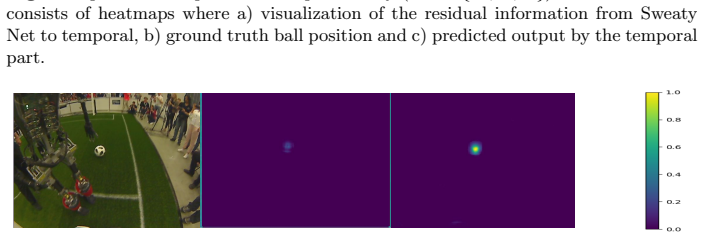
The load-bearing mechanism is an encoder-decoder heatmap network extended by a temporal layer and a learned residual gate. The base network (SweatyNet-1) produces a 160x120 probability map; meanwhile the outputs of its second and sixth encoder blocks are concatenated, passed through a 7x7 convolution, multiplied by a learnable weight $w$, and added element-wise to the base heatmap. This gated residual is the input to the temporal layer—a TCN made of dilated causal convolutions, or a ConvLSTM, or a ConvGRU—which consumes $h=20$ heatmaps and outputs the prediction for the next frame. The TCN's dilated causal convolutions are what make the practical claim credible: they extend the receptive field over time in a feed-forward manner, capturing long-range dependencies at a cost of only 1.1 ms.
What would settle it
Take a fresh RoboCup video sequence, hold out all of its frames from training and fine-tuning, freeze the base SweatyNet weights, and compare single-image detection against temporal detection on those frames; if temporal recall and F1 do not exceed SweatyNet's on the held-out sequence, the claimed benefit of history collapses.
Extended reading notes
Core claim
The central claim is that spatiotemporal context, not just the current image, determines where the ball is: given the network's own heatmaps for frames $t-h$ to $t-1$ ($h=20$), a temporal model predicts the heatmap at $t$ and does so more accurately than the same single-frame network. The decisive comparison is SweatyNet-1 with dropout 0.5 (recall 0.972, F1 0.973) against the same network with a temporal layer (best recall 0.987, best F1 0.981). The authors also claim that pre-training the temporal stack on artificially generated ball trajectories and then fine-tuning it on real RoboCup 2018 sequences improves over fine-tuning on real data alone, and that TCN matches or nearly matches ConvLSTM and ConvGRU accuracy while being far faster.
Load-bearing premise
The load-bearing premise is that the temporal models were evaluated on a held-out test set that does not overlap with the real RoboCup 2018 sequences used to fine-tune them; the paper does not state that temporal split.
Editorial extensions
If this is right
- A robot can keep a ball estimate through short occlusions and missed detections, because the temporal model continues to produce a heatmap when the single-frame network's confidence is low.
- For real-time RoboCup play, TCN is the preferred temporal choice: it gives the same detection quality as recurrent variants at a fraction of their added latency.
- Adding synthetic pre-training to the temporal stack reduces the amount of labeled real video needed, improving results over real-only fine-tuning.
- The trained network generalizes to two balls in one frame even though it was trained on single-ball sequences.
- The same architecture could be reused to detect other soccer objects such as goalposts and robots, as the authors note in their conclusion.
Reading between the lines
- Because the temporal layer consumes heatmaps rather than raw pixels, the same residual-gated design could in principle be attached to any single-frame heatmap detector; the paper only demonstrates it with SweatyNet.
- An ablation that freezes the base SweatyNet weights while training only the temporal layer would separate the contribution of trajectory history from the contribution of extra fine-tuning on RoboCup footage; the paper does not report that split.
- A natural next experiment is to vary the history length $h$ and prediction horizon $p$; the paper fixes $h=20, p=1$, so the minimum context needed to recover a ball after occlusion remains unknown.
Signed reviews
Editorial analysis
A structured set of objections, weighed in public.
Referee Report
Summary. The paper proposes extending a single-image fully convolutional soccer-ball detector (SweatyNet) with temporal sequence models—TCN, ConvLSTM, and ConvGRU—to exploit the history of frames for ball detection and tracking. The authors introduce SoccerData, a new dataset of 4562 annotated images, and also extract real RoboCup 2018 sequences for fine-tuning. The temporal models are pre-trained on synthetic sequences and/or fine-tuned on real sequences, and the reported results show small F1 improvements over the SweatyNet-1 baseline (F1 0.973 to 0.980–0.981) together with an added TCN inference cost of only 1.1 ms. The central claim is that temporal context improves detection, especially in challenging and occluded scenarios.
Significance. If the central claim were established, the work would be a useful, low-cost enhancement for real-time soccer ball detection in RoboCup, and the released dataset and code would support reproducibility. The paper honestly reports three temporal architectures, distinguishes pretraining from direct fine-tuning, and measures inference time on the actual robot platform. The main weakness is that the quantitative evidence for the claim is weak and confounded: the comparison in Table 2(b) changes both the architecture and the training data at once, the training/test split for the real sequences is not documented, and no variance or significance information is provided. The reported effect is small, so these issues are load-bearing for the paper's main conclusion rather than cosmetic.
major comments (3)
- [Section 4.1, Table 2(b)] The central comparison is confounded by training-data differences. The SweatyNet-1 (0.5) row in Table 2(b) is numerically identical to the SweatyNet-1 (0.5) test row in Table 1, which was trained only on SoccerData images. In contrast, Section 4.1 states that the temporal models are fine-tuned on real sequences extracted from RoboCup 2018 games, and Table 2(b) says 'real denotes that training of the sequential part is performed only on real data.' Thus the temporal rows benefit from both the temporal architecture and additional fine-tuning on a new real-data domain. The reported F1 gain of about 0.008 could therefore be due to extra data or domain adaptation rather than temporal context. A necessary control is a single-image SweatyNet-1 fine-tuned on the same real RoboCup sequences with the same schedule, without any temporal layer; that control is absent.
- [Section 4.1, Section 5, Table 2(b)] The temporal train/test split is not stated. The paper does not say whether the 20 sets of consecutive real frames (average length 60) are split into training and test sets, how many sequences are used for fine-tuning versus evaluation, or whether any test frames overlap with fine-tuning frames. Without this information, the test-set metrics in Table 2(b) cannot be interpreted as held-out performance. The test split should be described explicitly, and a guarantee that no fine-tuning frames overlap with the test frames should be stated.
- [Section 5, Table 2(b)] No variance, error bars, or significance tests are reported, despite the small effect size. The F1 differences are 0.973 versus 0.980–0.981, and all values come from a single split. Given typical run-to-run variation in deep-network training, these differences could easily be within noise. Reporting results over multiple random initializations or per-sequence evaluation would be needed to support the claim that the temporal models 'give an improvement over the SweatyNet.'
minor comments (5)
- [Section 1] There is an orphan fragment 'research 1.' immediately after the sentence about releasing data and implementation on GitHub; this appears to be a leftover footnote marker and should be removed or converted into a proper footnote.
- [Section 4.1] The word 'experimet' should be 'experiment' in the sentence 'In the second experimet, we evaluated our temporal approach.'
- [Algorithm 1] The postprocessing algorithm uses thresholds M > 0.1 and a minimum contour area A_min, but the chosen numerical values for these parameters are not reported. These should be specified for reproducibility.
- [Table 2(a)] The caption says 'For sequential models, we report time on top of the base model,' but it is unclear whether the reported times are additive overhead or total inference time. Please clarify the timing protocol.
- [Figures 2, 4, and 5] The multiple-ball generalization is supported only by qualitative examples. A quantitative evaluation on the two-ball scenario, even a small one, would strengthen the generalization claim.
Circularity Check
No circular derivation: the paper's claims are empirical comparisons, not results derived from their own definitions.
full rationale
The paper contains no first-principles derivation whose output is equivalent to its input by construction. Its central claim, that adding TCN, ConvLSTM, or ConvGRU layers improves soccer-ball detection over a SweatyNet baseline, is supported by training and evaluation on data with reported metrics (FDR, PR, RC, F1, Acc) in Table 2(b). The temporal models use the authors' prior SweatyNet as a feature extractor and baseline; this self-citation is transparent and does not make the comparison circular. The SweatyNet baseline is an external prior model from Schnekenburger et al. (2017), while the temporal extensions are newly added architectures trained separately. No equation is defined in terms of the quantity it is claimed to predict, and no fitted parameter is renamed as a prediction. The one legitimate concern is experimental control: the temporal rows are fine-tuned on real RoboCup 2018 sequences, while the SweatyNet-1 (0.5) baseline row appears to be the model from Table 1 trained only on SoccerData, so the reported F1 gain may reflect additional training data rather than temporal context. That is a validity and confound concern, not circularity, because it does not reduce a predicted quantity to an input by construction. Therefore no circular step is identified.
Assumptions & free parameters
free parameters (6)
- history length h =
20
- prediction horizon p =
1
- residual learnable weight w =
0.57 with pretraining, 0.49 without
- true-positive distance threshold gamma =
5
- minimum contour area A_min =
area of smallest ball in training set
- baseline dropout probability =
0.5
assumptions (4)
- domain assumption The manual bounding-box annotations in SoccerData are correct.
- domain assumption A binormal heatmap centered in the bounding box is an adequate supervision signal for ball detection.
- domain assumption Pre-training on synthetically generated ball trajectories transfers to real RoboCup footage.
- domain assumption The single-frame baseline and the temporal models are evaluated on the same held-out test set, with no temporal fine-tuning frames overlapping that test set.
Cite this review
Pith. "Pith review of Utilizing Temporal Information in Deep Convolutional Network for Efficient Soccer Ball Detection and Tracking." pith.science (2026). https://pith.science/paper/VHORBQQI
@misc{pith2026190902406,
  author       = {Pith},
  title        = {Pith review of: Utilizing Temporal Information in Deep Convolutional Network for Efficient Soccer Ball Detection and Tracking},
  year         = {2026},
  howpublished = {\url{https://pith.science/paper/VHORBQQI}},
  note         = {Machine review of arXiv:1909.02406}
}
read the original abstract
Soccer ball detection is identified as one of the critical challenges in the RoboCup competition. It requires an efficient vision system capable of handling the task of detection with high precision and recall and providing robust and low inference time. In this work, we present a novel convolutional neural network (CNN) approach to detect the soccer ball in an image sequence. In contrast to the existing methods where only the current frame or an image is used for the detection, we make use of the history of frames. Using history allows to efficiently track the ball in situations where the ball disappears or gets partially occluded in some of the frames. Our approach exploits spatio-temporal correlation and detects the ball based on the trajectory of its movements. We present our results with three convolutional methods, namely temporal convolutional networks (TCN), ConvLSTM, and ConvGRU. We first solve the detection task for an image using fully convolutional encoder-decoder architecture, and later, we use it as an input to our temporal models and jointly learn the detection task in sequences of images. We evaluate all our experiments on a novel dataset prepared as a part of this work. Furthermore, we present empirical results to support the effectiveness of using the history of the ball in challenging scenarios.
Figures


Figures from the paper (5 more)



Reference graph
Works this paper leans on
-
[1]
IEEE transactions on pat- tern analysis and machine intelligence 39(12), 2481–2495 (2017)
Badrinarayanan, V., Kendall, A., Cipolla, R.: Segnet: A deep convolutional encoder-decoder architecture for image segmentation. IEEE transactions on pat- tern analysis and machine intelligence 39(12), 2481–2495 (2017)
2017
-
[2]
arXiv preprint arXiv:1803.01271 (2018)
Bai, S., Kolter, J.Z., Koltun, V.: An empirical evaluation of generic convolutional and recurrent networks for sequence modeling. arXiv preprint arXiv:1803.01271 (2018)
arXiv 2018
-
[3]
Ballas, N., Yao, L., Pal, C., Courville, A.: Delving deeper into convolutional net- works for learning video representations. In: ICLR (2016)
work page 2016
-
[4]
In: proceedings of the IEEE Conference on Computer Vision and Pattern Recognition
Carreira, J., Zisserman, A.: Quo vadis, action recognition? a new model and the kinetics dataset. In: proceedings of the IEEE Conference on Computer Vision and Pattern Recognition. pp. 6299–6308 (2017)
2017
-
[5]
arXiv preprint arXiv:1412.3555 (2014)
Chung, J., Gulcehre, C., Cho, K., Bengio, Y.: Empirical evaluation of gated recur- rent neural networks on sequence modeling. arXiv preprint arXiv:1412.3555 (2014)
arXiv 2014
-
[6]
Deep Learning for Semantic Segmentation on Minimal Hardware
van Dijk, S.G., Scheunemann, M.M.: Deep learning for semantic segmentation on minimal hardware. arXiv preprint arXiv:1807.05597 (2018)
work page Pith review arXiv 2018
-
[7]
In: Proceedings of 10th Workshop on Hu- manoid Soccer Robots, IEEE-RAS Int
Farazi, H., Allgeuer, P., Behnke, S.: A monocular vision system for playing soccer in low color information environments. In: Proceedings of 10th Workshop on Hu- manoid Soccer Robots, IEEE-RAS Int. Conference on Humanoid Robots. Seoul, Korea (2015)
work page 2015
-
[8]
Farazi, H., Karimi, M., Hosseini, M., Jegarian, M., Rahmati, D., Aghaeizadeh, F., Sadeghnejad, S., Ghidary, S.S.: Autman kid-size team description 2013. Tech. rep., Amirkabir University of Technology (2013)
work page 2013
Show all 26 references
-
[9]
In: 2018 IEEE-RAS 18th International Conference on Humanoid Robots (Humanoids)
Ficht, G., Farazi, H., Brandenburger, A., Rodriguez, D., Pavlichenko, D., Allgeuer, P., Hosseini, M., Behnke, S.: Nimbro-op2x: Adult-sized open-source 3d printed humanoid robot. In: 2018 IEEE-RAS 18th International Conference on Humanoid Robots (Humanoids). pp. 1–9. IEEE (2018)
2018
-
[10]
In: European Symposium on Artificial Neural Networks, Computational Intelligence and Machine Learning (ESANN)
Hafez Farazi, Behnke, S.: Frequency domain transformer networks for video pre- diction. In: European Symposium on Artificial Neural Networks, Computational Intelligence and Machine Learning (ESANN). Bruges, Belgium (2019)
2019
-
[11]
Neural computation 9(8), 1735–1780 (1997)
Hochreiter, S., Schmidhuber, J.: Long short-term memory. Neural computation 9(8), 1735–1780 (1997)
1997
-
[12]
arXiv preprint arXiv:1807.08405 (2018)
Houliston, T., Chalup, S.K.: Visual mesh: Real-time object detection using con- stant sample density. arXiv preprint arXiv:1807.08405 (2018)
2018 arXiv
-
[13]
In: Robot World Cup
Javadi, M., Azar, S.M., Azami, S., Ghidary, S.S., Sadeghnejad, S., Baltes, J.: Hu- manoid robot detection using deep learning: a speed-accuracy tradeoff. In: Robot World Cup. pp. 338–349. Springer (2017)
2017
-
[14]
arXiv preprint arXiv:1412.6980 (2014) 14 A
Kingma, D.P., Ba, J.: Adam: A method for stochastic optimization. arXiv preprint arXiv:1412.6980 (2014) 14 A. Kukleva, A. Khan et al
2014 arXiv
-
[15]
In: Proceedings of the first international conference on Au- tonomous agents
Kitano, H., Asada, M., Kuniyoshi, Y., Noda, I., Osawa, E.: Robocup: The robot world cup initiative. In: Proceedings of the first international conference on Au- tonomous agents. pp. 340–347. ACM (1997)
1997
-
[16]
In: proceedings of the IEEE Con- ference on Computer Vision and Pattern Recognition
Lea, C., Flynn, M.D., Vidal, R., Reiter, A., Hager, G.D.: Temporal convolutional networks for action segmentation and detection. In: proceedings of the IEEE Con- ference on Computer Vision and Pattern Recognition. pp. 156–165 (2017)
2017
-
[17]
arXiv preprint arXiv:1811.12493 (2018)
Leiva, F., Cruz, N., Bugue˜ no, I., Ruiz-del Solar, J.: Playing soccer without colors in the spl: A convolutional neural network approach. arXiv preprint arXiv:1811.12493 (2018)
2018 arXiv
-
[18]
In: 3D Vision (3DV), 2016 Fourth International Conference on
Milletari, F., Navab, N., Ahmadi, S.A.: V-net: Fully convolutional neural networks for volumetric medical image segmentation. In: 3D Vision (3DV), 2016 Fourth International Conference on. pp. 565–571. IEEE (2016)
2016
-
[19]
Paszke, A., Gross, S., Chintala, S., Chanan, G., Yang, E., DeVito, Z., Lin, Z., Desmaison, A., Antiga, L., Lerer, A.: Automatic differentiation in pytorch (2017)
2017
-
[20]
In: International Conference on Medical image computing and computer-assisted intervention
Ronneberger, O., Fischer, P., Brox, T.: U-net: Convolutional networks for biomedi- cal image segmentation. In: International Conference on Medical image computing and computer-assisted intervention. pp. 234–241. Springer (2015)
2015
-
[21]
In: Proceedings of the 12th Workshop on Humanoid Soccer Robots, IEEE-RAS Inter- national Conference on Humanoid Robots, Birmingham (2017)
Schnekenburger, F., Scharffenberg, M., W¨ ulker, M., Hochberg, U., Dorer, K.: De- tection and localization of features on a soccer field with feedforward fully con- volutional neural networks (fcnn) for the adultsize humanoid robot sweaty. In: Proceedings of the 12th Workshop on...
2017
-
[22]
In: Proc
Schulz, H., Strasdat, H., Behnke, S.: A ball is not just orange: Using color and lu- minance to classify regions of interest. In: Proc. of Second Workshop on Humanoid Soccer Robots, Pittsburgh (2007)
2007
-
[23]
In: Robot World Cup
Speck, D., Barros, P., Weber, C., Wermter, S.: Ball localization for robocup soccer using convolutional neural networks. In: Robot World Cup. pp. 19–30. Springer (2016)
2016
-
[24]
The Journal of Machine Learning Research 15(1), 1929–1958 (2014)
Srivastava, N., Hinton, G., Krizhevsky, A., Sutskever, I., Salakhutdinov, R.: Dropout: a simple way to prevent neural networks from overfitting. The Journal of Machine Learning Research 15(1), 1929–1958 (2014)
2014
-
[25]
International journal of computer vision 103(1), 60–79 (2013)
Wang, H., Kl¨ aser, A., Schmid, C., Liu, C.L.: Dense trajectories and motion bound- ary descriptors for action recognition. International journal of computer vision 103(1), 60–79 (2013)
2013
-
[26]
In: Advances in neural information processing systems
Xingjian, S., Chen, Z., Wang, H., Yeung, D.Y., Wong, W.K., Woo, W.c.: Convo- lutional lstm network: A machine learning approach for precipitation nowcasting. In: Advances in neural information processing systems. pp. 802–810 (2015)
2015
Reviewed August 14, 2026 · model on record in the stance chip above.
Discussion (0). Continue with ORCID to comment.