REVIEW 3 major objections 6 minor 26 references
Effect of Oxygen on Hydrogen Diffusivity in hcp-Zirconium
T0 review · 3 major / 6 minor · reviewed 2026-08-14 · deepseek-v4-flash
Pith's one-line read Dissolved oxygen slows hydrogen diffusion in hexagonal close-packed zirconium, with reductions up to about 99% at low temperature.
desk verdict Qualitatively, O clearly slows H in hcp-Zr and the mechanism is plausible; the quantitative high-concentration numbers rest on an unverified uniform-O assumption that should be flagged in review. read the letter →
The pith
A machine-rendered reading of the paper's core claim, the machinery that carries it, and where it could break.
The reading
What carries the argument
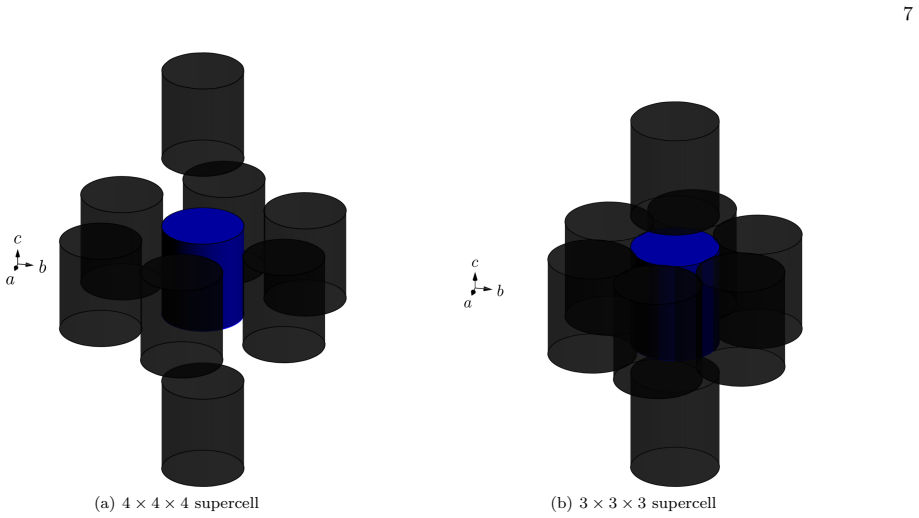
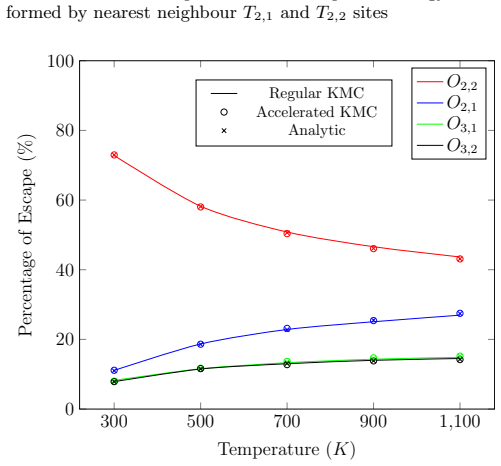
The load-bearing machinery is a multi-scale hopping model. Hydrogen is treated as occupying tetrahedral and octahedral interstitial sites in the hcp zirconium lattice; oxygen sits on octahedral sites and is assumed stationary because it diffuses much more slowly. For each distinct hop, first-principles calculations give the activation energy and vibrational frequencies, which are converted into temperature-dependent hopping rates by semi-classical harmonic transition state theory, including zero-point energy and quantum tunneling. Because nearest-neighbour tetrahedral sites form 'pseudo-energy basins' that would consume most kinetic Monte Carlo steps, the paper uses a mean-rate method that treats each basin's internal sites as transient states and the exits as absorbing states, collapsing each basin into a single effective site. The central objects are the modified energy landscape around oxygen—a deep stable well at the T2,2 tetrahedral site, unstable T1,1 sites, and the trap formed by the T2,1–T2,2 pseudo basin together with nearby octahedral sites.
What would settle it
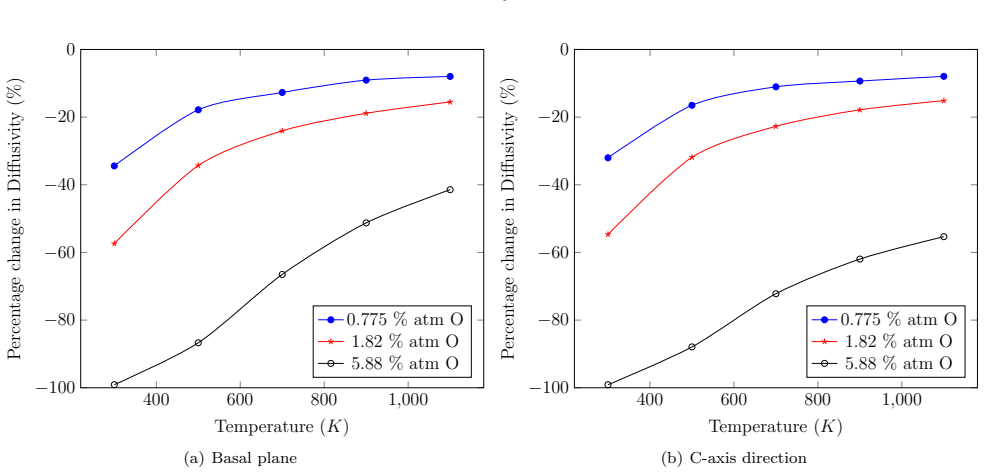
A diffusion experiment on zirconium-oxygen solid solutions with 0.775, 1.82, and 5.88 at.% oxygen, tracking hydrogen by permeation or an electrochemical method over 300-1100 K, would test the claim directly: the predicted low-temperature drops (about 35%, 57%, and 99%) and the rising activation energy should show up if the mechanism is right.
Extended reading notes
Core claim
The paper's central claim is that oxygen is not passive in the zirconium-hydrogen system: at moderate concentrations it is the dominant factor lowering hydrogen diffusivity. Using a one-oxygen supercell and an eight-oxygen supercell, the authors first map how interstitial oxygen changes the energies of nearby tetrahedral and octahedral sites, then compute hop-wise rates and evolve them in kinetic Monte Carlo. They find that oxygen increases the activation energy for hydrogen diffusion—from 0.384 to 0.535 eV in the basal plane and from 0.392 to 0.533 eV along the c-axis at 5.88 at.% oxygen—and that the diffusivity no longer follows a single exponential activation law at the highest concentration. The atomistic reason is two-fold: hopping rates are suppressed in oxygen-affected regions, and specific site combinations, such as the T2,1–T2,2 pseudo-basin paired with nearby octahedral sites, act as traps that hold hydrogen for several steps. The authors take these results to validate the hypothesis that oxygen encourages hydride-depleted zones near the metal-oxide interface.
Load-bearing premise
The calculations assume oxygen atoms are spread evenly through the zirconium lattice and that each oxygen's effect on hydrogen hopping rates can be added independently, an assumption the paper itself flags as questionable at 5.88 at.% oxygen.
Editorial extensions
If this is right
- At 5.88 at.% oxygen, the activation energy for hydrogen diffusion rises from 0.384 eV to 0.535 eV in the basal plane and from 0.392 eV to 0.533 eV along the c-axis, so any model of hydrogen transport in oxidized zirconium must include oxygen content.
- The simple exponential temperature dependence holds well at low to moderate oxygen concentrations, but fails at 5.88 at.% oxygen, where trapping and flickering events dominate the trajectories.
- Diffusion paths in oxygen-affected regions show that hydrogen spends most of its time in the oxygen-affected volume even when the majority of interstitial sites are untouched, confirming that these regions act as sinks.
- The diffusivity values from this study can be used in precipitation models to predict hydride size and distribution at different oxygen concentrations.
- The computed reduction in diffusivity—up to roughly 99%—directly supports the hypothesis that oxygen promotes hydride-depleted zones near the metal-oxide interface.
Reading between the lines
- If oxygen atoms cluster rather than distribute evenly at higher concentrations, the trapping network could be stronger or weaker than computed; the uniform-distribution assumption is the paper's main open uncertainty.
- The same two-part mechanism—slowed hops plus combined-site traps—may apply to hydrogen diffusion in other hcp metals containing oxygen, notably titanium, so the approach is a template for impurity-aware transport coefficients.
- A direct experimental target follows from the numbers: at 300 K, well-controlled Zr-O solid solutions should show diffusivity drops of roughly 35%, 57%, and 99% at 0.775, 1.82, and 5.88 at.% oxygen; this is sharp enough to falsify the picture.
- If the slowdown is as strong as computed, hydride-depleted zones near oxide interfaces are at least partly a kinetic signature—hydrogen arrives late or stays trapped—rather than a purely thermodynamic exclusion, which would change how scrape-sample monitoring is interpreted.
Signed reviews
Editorial analysis
A structured set of objections, weighed in public.
Referee Report
Summary. The paper uses DFT/NEB calculations combined with accelerated kinetic Monte Carlo (KMC) simulations to study the effect of interstitial oxygen on hydrogen diffusivity in hcp (α) zirconium. The authors report that hydrogen diffusion is reduced with increasing oxygen concentration, with reductions of approximately 35%, 57%, and 99% at 0.775, 1.82, and 5.88 at.% O respectively at low temperatures, and attribute this to decreased hopping rates and the formation of H traps from combinations of interstitial sites. The pure-Zr activation energies and hopping rates are validated against prior DFT/KMC work, and the KMC diffusivities are stated to converge to less than 0.1% statistical spread. The paper concludes that the results support the hypothesis that oxygen slows hydrogen diffusion, which may explain hydride-denuded zones observed near metal-oxide interfaces in Zr pressure tubes.
Significance. If the quantitative results are reliable, this is a useful first-principles confirmation of an operating hypothesis for delayed hydride cracking and hydride monitoring in Zr pressure tubes. The work is careful in several respects: activation energies and vibration frequencies for pure Zr agree with earlier calculations; the accelerated KMC scheme is validated against direct KMC and analytic results for a representative pseudo-basin; and the KMC statistics are reported as tightly converged. The central qualitative conclusion—that interstitial oxygen lowers H diffusivity and that the effect grows with O concentration—is internally consistent and supported by the trap mechanism identified in the simulations. The main limitation is that the quantitative high-concentration values rest on an untested single-O additivity assumption and a single periodic O arrangement, so the specific magnitudes, especially the ~99% reduction at 5.88 at.% O, are conditional rather than fully established.
major comments (3)
- [III.B.1 and III.B.2] The KMC simulations at 1.82% and 5.88% O reuse hopping rates derived from a single O in a 4x4x4 supercell and from one 8-O arrangement. For the 3x3x3 supercell, the text asserts that overlapping influence regions 'will only affect T3,1 interstitial sites' without recomputing those barriers, and for the 8-O case only one periodic arrangement is considered. Since the reported activation energies in Tables IV and V and the ~99% diffusivity reduction at 5.88% O depend directly on these rates, this is a load-bearing assumption. I recommend either computing the overlapping-region barriers explicitly, testing several O arrangements, or restricting the quantitative claims to the regime where the additivity assumption is demonstrably valid.
- [III.B.1 and Supplemental Material reference [24]] The activation energies and vibration frequencies for all O-affected transitions are said to be provided in a supplemental file, but that file is not included in the submission. These tables are the central numerical input for the KMC simulations, and without them the reader cannot independently audit how the hopping rates were obtained. The manuscript should include the rate tables or otherwise make the data available.
- [IV. Conclusions] The conclusions concede that 'at these concentrations the uniform distribution of O interstitials may not be a valid assumption,' yet the high-concentration diffusivity values are presented in Tables IV and V and in Figure 10 as quantitative results, not as conditional estimates. Given the acknowledged limitation, the paper should either add a sensitivity analysis or uncertainty estimate for the 1.82% and 5.88% cases, or explicitly reframe those numbers as illustrative upper/lower bounds rather than definitive predictions.
minor comments (6)
- [Abstract] The title says 'hcp-Zirconium' while the body uses 'α-Zirconium' and 'hcp Zr'; please harmonize the terminology throughout.
- [I. Introduction] There is a typo in the first sentence: 'Zirconium and it's alloys' should be 'Zirconium and its alloys'.
- [Tables III-V and throughout] The diffusivity units are written as 'cm2/w'; this should be 'cm²/s'. Also, '0.775% atm O' is nonstandard and should be expressed as at.% O.
- [II. Computational Details] Please clarify what the 'smallest repeating cell' is for each KMC simulation; in particular, state the number of Zr atoms and the cell dimensions used in the KMC supercells, since this affects the interpretation of the O concentration.
- [III.A and Fig. 2] Figure 2 has no axis labels; the y-axis is ln(D) but the units of D are not shown. Consider adding labels or a caption note.
- [III.B.1] The sentence 'To simplify the NEB calculations to be preformed' contains a typo: 'preformed' should be 'performed'.
Circularity Check
No circularity in the central claim: O-dependent H diffusivity is computed from DFT/NEB rates via KMC; the only self-citation is non-load-bearing context.
full rationale
The paper's central claim—that interstitial oxygen reduces hydrogen diffusivity in hcp-Zr—is not an input to the model. Hopping rates are obtained from first-principles DFT and NEB calculations with SC-HTST (Appendix A), and those rates are then supplied to KMC simulations. The O effect is not fitted to a target diffusivity and is not defined in terms of the conclusion; rather, it emerges from recomputed interstitial-site energies, activation barriers, and vibration frequencies. The pure-Zr methodology is validated against independent prior calculations (Zhang et al. [16], Domain et al. [20], Christensen et al. [22]), including activation energies and vibration frequencies shown in Tables I and II. The only self-citation is Liyanage et al. [23], cited for the sentence 'Reasons for this variation are discussed in one of our previous papers,' which is contextual discussion of anisotropy in pure Zr and is not load-bearing for the O dependence. No fitted parameter is renamed as a prediction, no uniqueness theorem is imported, and no ansatz is smuggled in through a self-citation. The main caveats are quantitative transferability, not circularity: the 1.82% and 5.88% O results rely on a single-O additivity and uniform-arrangement assumption, which the paper itself concedes when it states that at higher concentrations 'the uniform distribution of O interstitials may not be a valid assumption,' and the O-affected activation energies and vibration frequencies are relegated to an absent supplemental file. These are completeness and robustness concerns, not evidence that the derivation reduces to its own inputs. The qualitative result is therefore self-contained and independently supported by the reported DFT/NEB/KMC chain.
Assumptions & free parameters
free parameters (1)
- O influence cutoff =
0.01 eV
assumptions (6)
- standard math Hopping rates follow SC-HTST with quantum tunneling correction (Eqs. A1-A4) and the absorbing Markov chain mean-rate method (Eqs. B1-B7).
- standard math PBE-GGA DFT with PAW pseudopotentials gives accurate enough energies and barriers.
- domain assumption O occupies only octahedral interstitial sites.
- domain assumption H atoms diffuse independently of each other.
- domain assumption O atoms are stationary relative to H atoms.
- domain assumption Uniform O distribution and no other defects in the Zr lattice.
Cite this review
Pith. "Pith review of Effect of Oxygen on Hydrogen Diffusivity in hcp-Zirconium." pith.science (2026). https://pith.science/paper/MSQGB5HX
@misc{pith2026190902486,
  author       = {Pith},
  title        = {Pith review of: Effect of Oxygen on Hydrogen Diffusivity in hcp-Zirconium},
  year         = {2026},
  howpublished = {\url{https://pith.science/paper/MSQGB5HX}},
  note         = {Machine review of arXiv:1909.02486}
}
read the original abstract
Zirconium and its alloys are extensively used as cladding material in nuclear reactors. They are vulnerable to hydrogen degradation under the harsh service conditions of the reactors, which necessitates continuous monitoring for the hydride concentration. The presence of hydride denuded zones in the latter stages of the pressure tube's life hinders the monitoring process, which is carried out by scrape samples taken from the surface of pressure tubes. We investigated the effect of oxygen on diffusivity of hydrogen in hcp-Zr, to check the hypothesis that oxygen slows the diffusion of hydrogen and thereby encourages the occurrence of hydride denuded zones. From the study we found that oxygen indeed decreases the diffusivity of hydrogen in hcp-Zr for moderate O concentrations, supporting the hypothesis. We investigated the diffusion processes of individual H atoms, which showed that the reduction in diffusivity is caused by a decrease in the hopping rates and the formation of hydrogen traps by the combination of several interstitial sites.
Figures


Figures from the paper (9 more)






Reference graph
Works this paper leans on
-
[1]
In the first system H occupying each interstitial site is only affected by one O atom
Effect of oxygen on neighboring interstitial sites For the first principle calculations, we used two 4×4×4 Zr supercells with one and eight O atoms respectively. In the first system H occupying each interstitial site is only affected by one O atom. For ease of referencing we in- dexed each distinct interstitial site using the number of stepsi to the O in the ...
-
[2]
Variations of diffusivity for each concentrations are as shown in Fig
Effect of oxygen on diffusivity Using the hopping rates determined, we performed KMC simulations for the three difference O concentra- tions. Variations of diffusivity for each concentrations are as shown in Fig. 9 for basal plane and c-axis directions. As can be seen from this graph when the O concentration increases the H diffusivity reduces, proving the hyp...
-
[3]
R. Krishnan and M. K. Asundi, Zirconium alloys in nu- clear technology, in Proceedings of the Indian Academy of Sciences Section C: Engineering Sciences , Vol. 4 (Springer India, 1981) pp. 41–56
work page 1981
-
[4]
S. Banerjee, Nuclear applications: Zirconium alloys, in Encyclopedia of Materials: Science and Technol- ogy, edited by K. Buschow, R. Cahn, M. Flemings, B. Ilschner, E. Kramer, S. Mahajan, and P. Veyssiere (Elsevier, 2001) pp. 6287–6299, 2nd ed
work page 2001
-
[5]
D. F´ eron, Overview of nuclear materials and nuclear cor- rosion science and engineering, in Nuclear Corrosion Sci- ence and Engineering , edited by D. F´ eron (Woodhead Publishing, 2012) Chap. 2, pp. 31–56
work page 2012
- [6]
-
[7]
M. De Las Heras, S. Parodi, L. Ponzoni, J. Mieza, S. M¨ uller, S. Alcantar, and G. Domizzi, Effect of ther- mal cycles on delayed hydride cracking in Zr-2.5Nb alloy, J. Nucl. Mater. 509, 600 (2018)
work page 2018
-
[8]
T. N. Murty, R. Singh, and P. St˚ ahle, Delayed hydride cracking of Zr-2.5%nb pressure tube material due to par- tially constrained precipitates, J. Nucl. Mater. 513, 129 (2019)
work page 2019
Show all 26 references
-
[9]
Hardie, The effect of oxygen on the precipitation of hydrogen from zirconium, J
D. Hardie, The effect of oxygen on the precipitation of hydrogen from zirconium, J. Nucl. Mater. 17, 88 (1965)
1965
-
[10]
Cha, K.-N
H.-J. Cha, K.-N. Jang, J.-H. An, and K.-T. Kim, The effect of hydrogen and oxygen contents on hydride reori- entation of zirconium alloy cladding tubes, Phys. Rev. B 54, 11169 (1996)
1996
-
[11]
Kresse and J
G. Kresse and J. Hafner, Ab initio molecular dynamics for liquid metals, Phys. Rev. B 47, 558 (1993)
1993
-
[12]
Kresse and J
G. Kresse and J. Furthm¨ uller, Efficiency of ab-initio total energy calculations for metals and semiconductors using a plane-wave basis set, Comput. Mater. Sci. 6, 15 (1996)
1996
-
[13]
Kresse and J
G. Kresse and J. Furthm¨ uller, Efficient iterative schemes for ab initio total-energy calculations using a plane-wave basis set, Phys. Rev. B 54, 11169 (1996)
1996
-
[14]
J. P. Perdew, K. Burke, and M. Ernzerhof, Generalized gradient approximation made simple, Phys. Rev. Lett. 77, 3865 (1996)
1996
-
[15]
Henkelman, B
G. Henkelman, B. P. Uberuaga, and H. J´ onsson, Climb- ing image nudged elastic band method for finding saddle points and minimum energy paths, J. Chem. Phys. 113, 9901 (2000)
2000
-
[16]
J. T. Fermann and S. Auerbach, Modeling proton mobil- ity in acidic zeolite clusters: II. room temperature tunnel- ing effects from semiclassical rate theory, J. Chem. Phys. 112, 6787 (2000)
2000
-
[17]
Bhatia and D
B. Bhatia and D. S. Sholl, Quantitative assessment of hy- drogen diffusion by activated hopping and quantum tun- neling in ordered intermetallics, Phys. Rev. B 72, 224302 (2005)
2005
-
[18]
Zhang, C
Y. Zhang, C. Jiang, and X. Bai, Anisotropic hydrogen diffusion inα-Zr and zircaloy predicted by accelerated ki- netic monte carlo simulations, Sci. Rep. 7, 41033 (2017)
2017
-
[19]
Puchala, M
B. Puchala, M. L. Falk, and K. Garikipati, An energy basin finding algorithm for kinetic monte carlo accelera- tion, J. Chem. Phys. 132, 134104 (2010)
2010
-
[20]
J. P. Pemsler, Diffusion of oxygen in zirconium and its relation to oxidation and corrosion, J. Electrochem. Soc. 105, 315 (1958)
1958
-
[21]
M. V. Glazoff, Modeling of Some Physical Properties of Zirconium Alloys for Nuclear Applications in Support of UFD Campaign, Tech. Rep. (Idaho National Laboratory, UFD Campaign, Idaho Falls, Idaho 83415, 2013)
2013
-
[22]
Domain, R
C. Domain, R. Besson, and A. Legris, Atomic-scale ab- initio study of the Zr-H system: I. bulk properties, Acta Mater. 50, 3513 (2002)
2002
-
[23]
P. A. Burr, S. T. Murphy, S. C. Lumley, M. R. Wen- man, and R. W. Grimes, Hydrogen accommodation in Zr second phase particles: Implications for H pick-up and hydriding of zircaloy-2 and zircaloy-4, Corros. Sci. 69, 1 (2013)
2013
-
[24]
Christensen, W
M. Christensen, W. Wolf, C. Freeman, E. Wimmer, R. B. Adamson, L. Hallstadius, P. E. Cantonwine, and E. V. Mader, H in α-Zr and in zirconium hydrides: Solubility, effect on dimensional changes, and the role of defects, J. Phys. Condens. Matter 27, 025402 (2015)
2015
-
[25]
Liyanage, R
M. Liyanage, R. E. Miller, and R. K. N. D. Rajapakse, Multi-scale approach for determining hydrogen diffusiv- ity in zirconium, Model. Simul. Mater. Sci. Eng. 26, 085002 (2018)
2018
-
[26]
See Supplemental Material at [URL] for activation en- ergies and vibration frequencies used for calculation of hopping energies of hydrogen diffusion in zirconium un- der the influence of oxygen
Reviewed August 14, 2026 · model on record in the stance chip above.
Discussion (0). Continue with ORCID to comment.