REVIEW 3 major objections 5 minor 59 references
Causal Effects of Brevity on Style and Success in Social Media
T0 review · 3 major / 5 minor · reviewed 2026-08-14 · deepseek-v4-flash
Pith's one-line read Brevity causally improves judged tweet success: shortened versions beat originals up to a 40% cut, with a 10–20% optimum.
desk verdict First controlled experiment on brevity and tweet success; the core finding is credible, and the acknowledged semantic-preservation caveat is real but not disqualifying. read the letter →
The pith
A machine-rendered reading of the paper's core claim, the machinery that carries it, and where it could break.
The reading
What carries the argument
The load-bearing mechanism is a five-task crowdsourcing pipeline that separates content production from content consumption. First, comprehension questions are extracted from each original tweet and validated; then workers shorten the tweet to a randomly assigned target-length bucket; then other workers verify the shortened tweet still answers the comprehension questions; finally, raters see the original and shortened versions side by side and choose which would get more retweets. The treatment is the imposed character budget, the control is the original tweet, and an edited-but-not-shortened baseline separates the effect of brevity from the effect of mere editing such as fixing typos. The outcome is a binary vote aggregated into a probability of success, and the full factorial design (every tweet exposed to every target length) is what lets the authors ascribe differences in success to brevity rather than to topic, author, or timing.
What would settle it
Post the original and shortened versions of the same tweets under matched accounts and timing in the field, and compare actual retweet counts: if the versions judged better by crowd workers are not retweeted more often, or if the 10–20% optimum disappears with real engagement, the paper's causal conclusion fails. A scaled-down version would be a randomized field experiment on one platform where posts are shortened by 10–20% and actual engagement is measured.
Extended reading notes
Core claim
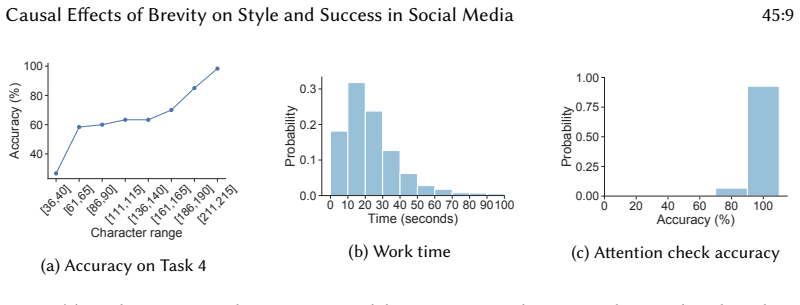
The central claim is that, holding semantic content fixed, shorter tweets are judged more likely to succeed, up to a point. The experiment takes 60 original tweets of exactly 250 characters; crowd workers shorten each to eight length buckets plus an edited-but-essentially-unchanged baseline; a different set of raters then answers comprehension questions and casts binary votes on which version "would get more retweets." The paper reports that concise versions beat the original on average until the cut reaches 30–40% of the original length, and that the best results cluster at 10–20% reduction, corresponding to 211–215 characters. This pattern is robust across rater subpopulations and strongest for daily social-media users. The paper also claims that the linguistic signature of successful shortening is systematic: verbs, negations, and affect—especially negative emotion—are preserved, while articles, adverbs, conjunctions, and auxiliary verbs are dropped. Because all tweets are exposed to all treatments and meaning is validated via comprehension questions, the authors attribute the difference in judged success to the brevity constraint itself.
Load-bearing premise
The experiment measures success as crowd workers' guesses about which tweet would get more retweets, not as actual retweets; the paper acknowledges this in the 'Limitations and future work' part of Section 7, where it calls crowdsourced ratings only a proxy for actual perception of success on social media. If those guesses diverge from real sharing behavior, the causal claim about success is not established.
Editorial extensions
If this is right
- Shortening a 250-character tweet by 10–20% should, on average, make it judged more likely to be retweeted than the original, with a benefit window that extends to a 30–40% cut.
- The benefit is not an artifact of one rater group: it holds across genders, ages, education levels, and Twitter account ownership, and is largest for daily social-media users.
- Brevity does not work by simple extraction; extractiveness metrics do not predict success, but preserving verbs, negations, and negative affect does, so a good shortening keeps the informational and emotional core.
- In practice, effective editing deletes non-essential function words and splits long sentences with commas or periods, while deleting hashtags, question marks, and exclamation marks tends to backfire.
- Platform-level character limits can act as a quality-improving constraint rather than a pure restriction, because the constraint forces edits that make content clearer and more direct.
Reading between the lines
- Inference: if the causal effect transfers to real platforms, a platform could A/B test treating its character limit as an editing nudge—shortening the allowed length of a post by roughly 10–20% might raise engagement rather than merely capping it.
- Inference: the preservation pattern suggests brevity may work partly through processing fluency and negativity bias; a follow-up could measure reading time or cognitive load to test whether the benefit is fluency-driven rather than content-driven.
- Inference: the per-token strategy analysis is correlational, since each tweet was shortened once per target length; randomly assigning individual edit operations across tweets would convert the list of effective and ineffective strategies into causal editing rules.
- Inference: the 10–20% optimum is estimated for 250-character English tweets from mid-size accounts; testing other original lengths, languages, and account influence would show whether the sweet spot is a general property of attention or a Twitter-specific artifact.
Editorial analysis
A structured set of objections, weighed in public.
Referee Report
Summary. The paper reports a crowdsourced experiment on the causal effect of brevity on the perceived success of tweets. Starting from 60 tweets of exactly 250 characters, crowd workers produced shortened versions at eight length buckets plus an edited-but-not-shortened baseline; a separate set of 27,000 binary votes compared shortened versions against originals. The authors report that shortening improves perceived success up to 30–40% reduction, with an optimum at 10–20% reduction, that this holds across rater subpopulations, and that shortening disproportionately preserves verbs, negations, and negative affect. A final analysis correlates specific editing strategies (deleting function words, inserting punctuation, deleting hashtags) with success.
Significance. If the causal claim were fully established, this would be a valuable contribution: it is one of the first controlled experimental studies of brevity in social media, with a careful full-factorial design, a baseline that separates editing from shortening, extensive validation of shortened content, and a shared dataset. The linguistic analyses of which parts of speech survive shortening are also interesting and methodologically transparent, with bootstrap confidence intervals and multiple-testing corrections. However, the central causal claim is not as clean as the manuscript asserts: the treatment is length-constrained rewriting rather than brevity with semantic content held fixed, and the outcome is a proxy (crowd prediction of retweets) rather than actual sharing behavior. These issues are acknowledged in the limitations but they bear directly on the headline conclusion, so they need to be addressed or the claims need to be reframed.
major comments (3)
- [§4 (RQ1, first paragraph) and §7 (Limitations)] The identification claim that 'length is the only difference between the original, unshortened tweets and the tweets shortened to prespecified lengths' is contradicted by the manuscript's own example and its stated limitation. In Table 3, the 30–40% shortened version omits the information that addiction is difficult, yet this version is rated more successful than the original. The paper also states in Section 7 that 'our experimental setup may not fully guarantee that the semantic content of tweets is entirely preserved in the process of shortening.' Consequently, the contrast does not isolate length: it compares an original tweet with a rewritten tweet under a length constraint, and the rewrite can change informativeness, tone, and meaning. This is an internal validity concern. I recommend either reframing the estimand as the effect of 'length-constrained rewriting' on perceived success, or adding an analysis that restricts to shortened versions whose content is verified to be semantically equivalent by a stricter method than three comprehension questions, for example by checking that all propositional units of the original are present.
- [§4, length-centric analysis (Fig. 3)] The claim that the optimal reduction is 10–20% of the original length rests on point estimates in Figure 3, but no significance test is reported for the comparison between adjacent length buckets. The bootstrap confidence intervals appear to overlap substantially between neighboring buckets (e.g., 10–20% versus 20–30%), so the point estimates alone do not establish that 10–20% is statistically better than nearby levels. The paper should report a formal test for the optimal bucket, such as a mixed-effect logistic regression with length as a factor and tweet as a random effect, or pairwise comparisons with appropriate multiple-testing correction. Without such a test, the precise 'optimal range' claim is not supported.
- [§3.1.2 (Task 5) and §7 (Limitations)] The dependent variable is crowd workers' prediction of which tweet 'will get more retweets,' not actual retweet counts or other observed sharing behavior. The abstract and introduction state the result as an effect on 'message success' in social media. The paper cites prior evidence that crowd predictions correlate with actual sharing at 73% accuracy, and it acknowledges in Section 7 that 'crowdsourced ratings are only a proxy for actual perception of success on social media,' but the headline claim is still phrased in terms of success. Since this is a load-bearing point for external validity, I recommend either consistently qualifying the outcome as 'perceived success' throughout the title, abstract, and conclusions, or providing a validation experiment that links the crowd predictions to real retweet outcomes.
minor comments (5)
- [§4 (subpopulation analysis)] The text 'p < 010−9' appears to be a typo; it should likely read 'p < 10^{-9}'.
- [Table 4] The tokens in the two columns are not visually separated by punctuation or spacing, which makes the table hard to read; adding commas or whitespace between tokens would improve clarity.
- [§3.2 (Input tweets)] The description says tweets were 'randomly sampled' but then lists several exclusion criteria; please describe the sampling procedure in more detail, including how many candidate tweets were available and how the 60 were selected, to make the sample reproducible.
- [§4 ('Does success imply brevity?')] The 'improve the tweet' control experiment does not report the number of tweets or workers involved, nor how 'a small subset' was chosen; please add these details so the reader can judge the strength of this supplementary evidence.
- [Fig. 8] The x-axis label 'Response Percentage' is ambiguous; please clarify whether this is the percentage of responses mentioning a justification, and state whether a single response could contribute to multiple categories (as the text indicates).
Circularity Check
No significant circularity: the paper's central claim is a direct experimental measurement, not a derived or self-referential quantity.
full rationale
The paper's central result—that tweets are more successful at 10–20% shortening and remain no worse up to 30–40%—is obtained by a controlled crowdsourcing experiment, not by derivation from an assumed model. The outcome variable (fraction of Task 5 votes favoring the shortened tweet) is directly observed, and the brevity levels are assigned treatments. No effect estimate is defined in terms of the outcome, and no fitted parameter is renamed as a prediction. The power analysis in Section 3.2 selects the sample size but does not enter the estimated success probabilities, so it is not circular. The one external support invoked for the dependent variable, the 73% accuracy of crowd workers in predicting retweeted messages, comes from Tan et al. [53], an independent source, and is used only as validation of the proxy, not as an input that constrains the shape of the measured effect. The paper's citation of the authors' own prior natural-experiment work [20] is used for related-work context, not as load-bearing justification for the current experiment's findings. The paper's own limitation in Section 7—that semantic content may not be fully preserved and that crowdsourced ratings are only a proxy for real social-media success—is a threat to internal and external validity, but it is not an instance of the derivation reducing to its inputs by construction. No equation, parameter, or uniqueness claim is imported from the authors' prior work, and no ansatz is smuggled in via citation. The result stands as an empirical measurement with acknowledged limitations, so the circularity score is 0.
Assumptions & free parameters
free parameters (4)
- Task 5 attention accuracy threshold =
80%
- Task 5 minimum work time threshold =
10 seconds per pair
- Task 5 side-choice exclusion criterion =
Not specified
- Meaning-preservation passing threshold =
3 of 3 comprehension questions correct, except at 10-20% length
assumptions (4)
- domain assumption Crowd workers' pairwise judgments about which tweet would receive more retweets approximate actual retweet success.
- domain assumption The three comprehension questions authored by the researchers capture the essential information of each tweet.
- domain assumption Shortened tweets that pass comprehension validation are semantically equivalent enough that quality differences can be attributed to length rather than content.
- domain assumption The 60 sampled tweets represent the class of messages the conclusion targets.
Cite this review
Pith. "Pith review of Causal Effects of Brevity on Style and Success in Social Media." pith.science (2026). https://pith.science/paper/ZAUGZUCW
@misc{pith2026190902565,
  author       = {Pith},
  title        = {Pith review of: Causal Effects of Brevity on Style and Success in Social Media},
  year         = {2026},
  howpublished = {\url{https://pith.science/paper/ZAUGZUCW}},
  note         = {Machine review of arXiv:1909.02565}
}
read the original abstract
In online communities, where billions of people strive to propagate their messages, understanding how wording affects success is of primary importance. In this work, we are interested in one particularly salient aspect of wording: brevity. What is the causal effect of brevity on message success? What are the linguistic traits of brevity? When is brevity beneficial, and when is it not? Whereas most prior work has studied the effect of wording on style and success in observational setups, we conduct a controlled experiment, in which crowd workers shorten social media posts to prescribed target lengths and other crowd workers subsequently rate the original and shortened versions. This allows us to isolate the causal effect of brevity on the success of a message. We find that concise messages are on average more successful than the original messages up to a length reduction of 30-40%. The optimal reduction is on average between 10% and 20%. The observed effect is robust across different subpopulations of raters and is the strongest for raters who visit social media on a daily basis. Finally, we discover unique linguistic and content traits of brevity and correlate them with the measured probability of success in order to distinguish effective from ineffective shortening strategies. Overall, our findings are important for developing a better understanding of the effect of brevity on the success of messages in online social media.
Figures


Figures from the paper (7 more)


Reference graph
Works this paper leans on
-
[1]
2018. CSCW 2018 Call For Papers. https://web.archive.org/web/20180722041917/http://cscw.acm.org/2018/submit/ papers.html
-
[2]
Yoav Artzi, Patrick Pantel, and Michael Gamon. 2012. Predicting responses to microblog posts. In Proc. Conference of the North American Chapter of the Association for Computational Linguistics
work page 2012
-
[3]
Lars Backstrom, Eytan Bakshy, Jon M Kleinberg, Thomas M Lento, and Itamar Rosenn. 2011. Center of attention: How Facebook users allocate attention across friends. Proc. International Conference on Web and Social Media (2011)
work page 2011
-
[4]
Eytan Bakshy, Jake M Hofman, Winter A Mason, and Duncan J Watts. 2011. Everyone’s an influencer: Quantifying influence on Twitter. In Proc. ACM International Conference on Web Search and Data Mining
work page 2011
-
[5]
Roy F Baumeister, Ellen Bratslavsky, Catrin Finkenauer, and Kathleen D Vohs. 2001. Bad is stronger than good. Review of General Psychology 5, 4 (2001), 323
work page 2001
-
[6]
David Bawden and Lyn Robinson. 2009. The dark side of information: Overload, anxiety and other paradoxes and pathologies. Journal of Information Science 35, 2 (2009), 180–191
work page 2009
-
[7]
Jonah Berger and Katherine L Milkman. 2012. What makes online content viral? Journal of Marketing Research 49, 2 (2012), 192–205. Proc. ACM Hum.-Comput. Interact., Vol. 3, No. CSCW, Article 45. Publication date: November 2019. 45:22 Gligorić, Anderson, and West
work page 2012
-
[8]
Michael S Bernstein, Greg Little, Robert C Miller, Björn Hartmann, Mark S Ackerman, David R Karger, David Crowell, and Katrina Panovich. 2015. Soylent: A word processor with a crowd inside. Commun. ACM 58, 8 (2015), 85–94
work page 2015
Show all 59 references
-
[9]
Yann Bramoulle and Lorenzo Ductor. 2018. Title length. Journal of Economic Behavior & Organization 150 (2018), 311–324
2018
-
[10]
Steven Burrows, Martin Potthast, and Benno Stein. 2013. Paraphrase acquisition via crowdsourcing and machine learning. ACM Transactions on Intelligent Systems and Technology 4, 3 (2013), 43
2013
-
[11]
Ziqiang Cao, Chengyao Chen, Wenjie Li, Sujian Li, Furu Wei, and Ming Zhou. 2016. TGSum: Build tweet guided multi-document summarization dataset. In Proc. AAAI Conference on Artificial Intelligence
2016
-
[12]
Raman Chandrasekar and Bangalore Srinivas. 1997. Automatic induction of rules for text simplification. Knowledge- Based Systems 10, 3 (1997), 183–190
1997
-
[13]
Justin Cheng, Michael Bernstein, Cristian Danescu-Niculescu-Mizil, and Jure Leskovec. 2017. Anyone can become a troll: Causes of trolling behavior in online discussions. In Proc. ACM Conference on Computer Supported Cooperative Work and Social Computing
2017
-
[14]
Cristian Danescu-Niculescu-Mizil, Moritz Sudhof, Dan Jurafsky, Jure Leskovec, and Christopher Potts. 2013. A computational approach to politeness with application to social factors. Proc. Annual Meeting of the Association for Computational Linguistics (2013)
2013
-
[15]
Marie-Paule Daniel and Michel Denis. 2004. The production of route directions: Investigating conditions that favour conciseness in spatial discourse. Applied Cognitive Psychology 18, 1 (2004), 57–75
2004
-
[16]
Christopher Dougherty. 2011. Introduction to Econometrics. Oxford University Press
2011
-
[17]
Marko Dragojevic and Howard Giles. 2016. I don’t like you because you’re hard to understand: The role of processing fluency in the language attitudes process. Human Communication Research 42, 3 (2016), 396–420
2016
-
[18]
Jacob Eisenstein. 2013. What to do about bad language on the internet. In Proc. Conference of the North American Chapter of the Association for Computational Linguistics
2013
-
[19]
Boris Fritscher and Yves Pigneur. 2009. Supporting business model modelling: A compromise between creativity and constraints. In Proc. International Workshop on Task Models and Diagrams
2009
-
[20]
Kristina Gligorić, Ashton Anderson, and Robert West. 2018. How constraints affect content: The case of Twitter’s switch from 140 to 280 characters. In Proc. International Conference on Web and Social Media
2018
-
[21]
Manuel Gómez-Rodríguez, Krishna P Gummadi, and Bernhard Schölkopf. 2014. Quantifying information overload in social media and its impact on social contagions. In Proc. International Conference on Web and Social Media
2014
-
[22]
Marco Guerini, Carlo Strapparava, and Gözde Özbal. 2011. Exploring text virality in social networks. In Proc. Interna- tional Conference on Web and Social Media
2011
-
[23]
Beth A Hennessey. 1989. The effect of extrinsic constraints on children’s creativity while using a computer. Creativity Research Journal 2, 3 (1989), 151–168
1989
-
[24]
Yuheng Hu, Kartik Talamadupula, and Subbarao Kambhampati. 2013. Dude, srsly?: The surprisingly formal nature of Twitter’s language. In Proc. International Conference on Web and Social Media
2013
-
[25]
Bo Jiang, Nidhi Hegde, Laurent Massoulié, and Don Towsley. 2013. How to optimally allocate your budget of attention in social networks. In Proc. IEEE International Conference on Computer Communications
2013
-
[26]
Quentin Jones, Gilad Ravid, and Sheizaf Rafaeli. 2004. Information overload and the message dynamics of online interaction spaces: A theoretical model and empirical exploration. Information Systems Research 15, 2 (2004), 194–210
2004
-
[27]
Caneel K Joyce. 2009. The Blank Page: Effects of Constraint on Creativity . PhD thesis, UC Berkeley
2009
-
[28]
Daniel Jurafsky, Alan Bell, Michelle Gregory, and William D Raymond. 2001. Probabilistic relations between words: Evidence from reduction in lexical production. Typological Studies in Language 45 (2001), 229–254
2001
-
[29]
Chiranjeev Kohli, Sunil Thomas, and Rajneesh Suri. 2013. Are you in good hands? Slogan recall: What really matters. Journal of Advertising Research 53, 1 (2013), 31–42
2013
-
[30]
Nevin Laib. 1990. Conciseness and amplification. College Composition and Communication 41, 4 (1990), 443–459
1990
-
[31]
Sotiris Lamprinidis, Daniel Hardt, and Dirk Hovy. 2018. Predicting news headline popularity with syntactic and semantic knowledge using multi-task learning. InProc. Conference on Empirical Methods in Natural Language Processing
2018
-
[32]
Walter S Lasecki, Luz Rello, and Jeffrey P Bigham. 2015. Measuring text simplification with the crowd. In Proc. ACM Web for All Conference
2015
-
[33]
Paul Levinson. 2011. The long story about the short medium: Twitter as a communication medium in historical, present, and future context. Journal of Communication Research 48 (2011), 7–28
2011
-
[34]
Chin-Yew Lin. 2004. Rouge: A package for automatic evaluation of summaries. Text Summarization Branches Out (2004)
2004
-
[35]
Elena Lloret and Manuel Palomar. 2013. Towards automatic tweet generation: A comparative study from the text summarization perspective in the journalism genre. Expert Systems with Applications 40, 16 (2013), 6624–6630
2013
-
[36]
Miriam A Locher and Richard J Watts. 2008. Relational work and impoliteness: Negotiating norms of linguistic behaviour . Mouton de Gruyter. Proc. ACM Hum.-Comput. Interact., Vol. 3, No. CSCW, Article 45. Publication date: November 2019. Causal Effects of Brevity on Style and S...
2008
-
[37]
Marshall McLuhan. 1964. Understanding Media: The Extensions of Man . McGraw-Hill
1964
-
[38]
J McPhee. 2015. Omission: Choosing what to leave out. https://web.archive.org/save/https://www.newyorker.com/ magazine/2015/09/14/omission. The New Yorker (2015)
2015
-
[39]
Gaia Melloni, Ariela Caglio, and Paolo Perego. 2017. Saying more with less? Disclosure conciseness, completeness and balance in Integrated Reports. Journal of Accounting and Public Policy (2017)
2017
-
[40]
Page C Moreau and Darren W Dahl. 2005. Designing the solution: The impact of constraints on consumers’ creativity. Journal of Consumer Research 32, 1 (2005), 13–22
2005
-
[41]
Dhiraj Murthy. 2012. Towards a sociological understanding of social media: Theorizing Twitter. Sociology 46, 6 (2012), 1059–1073
2012
-
[42]
Myers, Aneesh Sharma, Pankaj Gupta, and Jimmy Lin
Seth A. Myers, Aneesh Sharma, Pankaj Gupta, and Jimmy Lin. 2014. Information network or social network? The structure of the Twitter follow graph. In Proc. International Conference on World Wide Web
2014
-
[43]
Balder Onarheim and Michael Biskjaer. 2013. An introduction to creativity constraints. Proc. ISPIM Innovation Conference (2013)
2013
-
[44]
Balder Onarheim and Michael Biskjaer. 2015. Balancing constraints and the sweet spot as coming topics for creativity research. Creativity in Design: Understanding, Capturing, Supporting (2015)
2015
-
[45]
Daniel M Oppenheimer. 2006. Consequences of erudite vernacular utilized irrespective of necessity: Problems with using long words needlessly. Applied Cognitive Psychology 20, 2 (2006), 139–156
2006
-
[46]
Ethan Pancer and Maxwell Poole. 2016. The popularity and virality of political social media: hashtags, mentions, and links predict likes and retweets of 2016 U.S. presidential nominees tweets. Social Influence 11, 4 (2016), 259–270
2016
-
[47]
James W Pennebaker, Roger J Booth, and Martha E Francis. 2007. LIWC2007: Linguistic inquiry and word count. LIWC.net
2007
-
[48]
Aaditya Prakash, Sadid A Hasan, Kathy Lee, Vivek Datla, Ashequl Qadir, Joey Liu, and Oladimeji Farri. 2016. Neural paraphrase generation with stacked residual LSTM networks. arXiv preprint arXiv:1610.03098 (2016)
2016 arXiv
-
[49]
Eddie Shleyner. 2018. The ideal social media post length: A guide for every platform. https://web.archive.org/web/ 20181104085718/https://blog.hootsuite.com/ideal-social-media-post-length/
2018
-
[50]
Zbyněk Šidák. 1967. Rectangular confidence regions for the means of multivariate normal distributions. J. Amer. Statist. Assoc. 62, 318 (1967), 626–633
1967
-
[51]
Priya Sidhaye and Jackie Chi Kit Cheung. 2015. Indicative tweet generation: An extractive summarization problem?. In Proc. Conference on Empirical Methods in Natural Language Processing
2015
-
[52]
Brenda S Sloane. 2003. Say it straight: Teaching conciseness. Teaching English in the Two Year College (2003)
2003
-
[53]
Chenhao Tan, Lillian Lee, and Bo Pang. 2014. The effect of wording on message propagation: Topic- and author- controlled natural experiments on Twitter. In Proc. Annual Meeting of the Association for Computational Linguistics
2014
-
[54]
Jacob Thebault-Spieker, Daniel Kluver, Maximilian A Klein, Aaron Halfaker, Brent Hecht, Loren Terveen, and Joseph A Konstan. 2017. Simulation experiments on (the absence of) ratings bias in reputation systems. In Proc. ACM Conference on Computer Supported Cooperative Work and ...
2017
-
[55]
Amiel D Vardi. 2000. Brevity, conciseness, and compression in Roman poetic criticism and the text of Gellius’ Noctes Atticae 19.9. 10. American Journal of Philology (2000)
2000
-
[56]
Jui-Yu Weng, Cheng-Lun Yang, Bo-Nian Chen, Yen-Kai Wang, and Shou-De Lin. 2011. IMASS: An intelligent microblog analysis and summarization system. In Proc. Annual Meeting of the Association for Computational Linguistics
2011
-
[57]
Richard Wright. 1997. Lexical competition and reduction in speech: A preliminary report.Research on Spoken Language Processing Progress Report 2 (1997)
1997
-
[58]
Mark Yatskar, Bo Pang, Cristian Danescu-Niculescu-Mizil, and Lillian Lee. 2010. For the sake of simplicity: Unsupervised extraction of lexical simplifications from Wikipedia. InProc. Conference of the North American Chapter of the Association for Computational Linguistics
2010
-
[59]
Wenpeng Yin and Hinrich Schütze. 2015. Convolutional neural network for paraphrase identification. InProc. Conference of the North American Chapter of the Association for Computational Linguistics . Received April 2019; revised June 2019; accepted August 2019 Proc. ACM Hum.-Co...
2015
Reviewed August 14, 2026 · model on record in the stance chip above.
Discussion (0). Continue with ORCID to comment.