REVIEW 4 major objections 5 minor 18 references
TEASPN: Framework and Protocol for Integrated Writing Assistance Environments
T0 review · 4 major / 5 minor · reviewed 2026-08-14 · deepseek-v4-flash
Pith's one-line read TEASPN claims a single protocol can unify writing-assistance technologies in any editor, and a demo of it won preference from 10 of 12 writers.
desk verdict A useful protocol for writing-assistance integration, undermined by a user study whose fluency metric is too entangled with the demo's own GPT-2 suggestions. read the letter →
The pith
A machine-rendered reading of the paper's core claim, the machinery that carries it, and where it could break.
The reading
What carries the argument
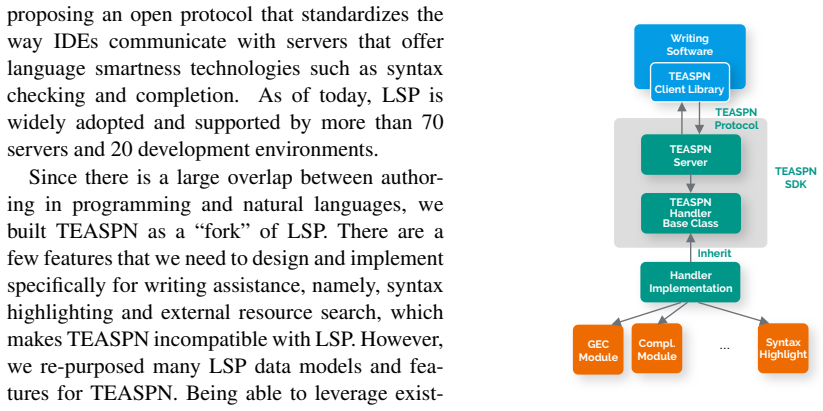
The load-bearing object is TEASPN itself: a JSON-RPC-based protocol, forked from the Language Server Protocol, in which writing software is a client and assistance technologies are servers. The protocol defines request/response types for eight features, including two (syntax highlighting and search) that go beyond LSP; a server can push suggestions and the client can request completions, corrections, paraphrases, definitions, coreference jumps, and corpus searches. The TEASPN SDK provides a Python handler base class so that a WAT developer only implements the NLP logic—the sample completion handler is a few lines—while the library handles connection, text synchronization, and protocol details. That machinery reduces the integration problem from N×M pairs to N client implementations plus M server implementations.
What would settle it
Take the texts from the integrated and baseline conditions, match them by prompt and by length (e.g., same number of words), and recompute GPT-2 perplexity or have independent raters judge fluency. If the perplexity gap disappears while human ratings do not favor the integrated texts, the paper's fluency conclusion is not supported.
Extended reading notes
Core claim
The paper proposes that the long-standing 'great divide' between NLP writing-assistance research and real writing software can be closed by a standardized client-server protocol rather than by any single model or product. TEASPN forks the Language Server Protocol, reusing its data models and adding two features—server-side syntax highlighting and external-resource search—that natural-language writing needs. The demo implementation integrates eight assistance technologies under one protocol, and the user study reports that 10 of 12 participants rated the integrated environment better than using the same editor with no assistance plus external tools, 40% judged the integrated-condition text as better, and integrated-condition texts achieved lower perplexity (26.4 vs 37.8). The authors conclude that integrated writing assistance environments built on TEASPN provide a better writing experience and potentially help users write more fluent text.
Load-bearing premise
The claim that TEASPN helps people write more fluently assumes GPT-2 perplexity measures text quality, but the integrated-condition texts were shorter and the two conditions used different prompts assigned at random, so lower perplexity could come from brevity or topic rather than better writing.
Editorial extensions
If this is right
- For writing-software developers, supporting TEASPN means writing one client library once; every TEASPN-compatible server (GEC, completion, paraphrase, search) becomes available without per-technology work.
- For WAT researchers and developers, the SDK removes the need to write editor-specific integrations; a single server implementation exposes a model to any TEASPN client.
- For writers, the integration shifts assistance from separate web apps and checkers into the editor itself, so features like example search, paraphrasing, and dictionary hover are one action away.
- If the authors' results hold, integrated writing assistance changes writing behavior: participants voluntarily used an average of 3.2 features, indicating that low integration cost leads to broad feature adoption.
- The observed lower perplexity of integrated-condition texts (26.4 vs 37.8) is the paper's evidence that the environment helps writers produce more typical, fluent English, not just that they enjoy the tool.
Reading between the lines
- The N×M-to-N+M argument means the protocol's value grows quadratically with ecosystem size: once enough editors and WAT servers exist, integration cost is no longer a per-pair problem, which could shift the field's bottleneck to quality of the individual NLP components and latency of live suggestions.
- Because the study's participants were mostly non-native English speakers, the fluency gain may be larger for L2 writers; a replication with native speakers would clarify whether integrated assistance primarily closes knowledge gaps (grammar, vocabulary, usage) or improves writing generally.
- The same client-server pattern could extend beyond prose writing to other assisted-authoring domains, such as slide decks, scientific papers, or code comments, where NLP models currently need bespoke integrations.
- A direct test of the fluency claim would replace GPT-2 perplexity with human-rated fluency or error counts on length-matched and prompt-matched texts; the paper's current evidence leaves room for the perplexity gap to be driven by text length or prompt assignment.
Signed reviews
Editorial analysis
A structured set of objections, weighed in public.
Referee Report
Summary. The paper proposes TEASPN, a protocol and open-source framework for integrated writing assistance environments, built as a fork of the Language Server Protocol (LSP). It standardizes client-server communication between writing software and writing assistance technologies (WATs), provides an SDK to ease WAT integration, and reports a demo system with features including syntax highlighting, grammatical error detection/correction, completion, rewriting, jump, hover, and search. The authors evaluate the demo with twelve participants who wrote short English texts under an INTEGRATED condition (editor with TEASPN) and a BASELINE condition (same editor without WATs, but with access to external tools). The evaluation reports that most participants preferred the integrated experience, that a minority believed their texts were better in the integrated condition, and that integrated-condition texts had lower GPT-2 perplexity, which the authors interpret as evidence of more fluent writing.
Significance. If the empirical claims held, the paper would make a useful systems contribution: it addresses a real integration bottleneck in writing-assistance technology, and its protocol design builds pragmatically on LSP, the SDK is released as open source, and the sample client reportedly requires under 200 lines of code. The protocol and framework are technically plausible and the demo appears functional. However, the load-bearing empirical claim that the integrated environment helps users write more fluent text is weakly supported by the evidence presented, for reasons detailed in the major comments. The framework contribution itself remains credible and potentially valuable to the NLP and CALL communities, so the paper is worth revising rather than rejecting.
major comments (4)
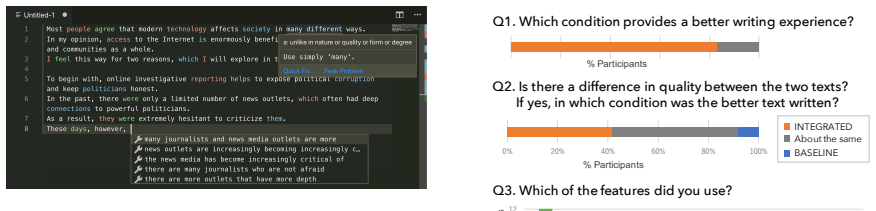
- [§4.2, §5, Table 2] The perplexity comparison is confounded by a circularity: the demo's phrase-completion feature uses a neural language model (Section 4.2, Radford et al. 2019), and the fluency metric in Section 5 is GPT-2 small perplexity. If participants accepted any GPT-2-based completion suggestions, the resulting text is partially generated by the same model family used as the metric, so lower integrated-condition perplexity could partly reflect self-consistency of accepted suggestions rather than improved writer fluency. The paper does not report how often participants accepted phrase completions, or analyze the texts with completion usage controlled. This undermines the specific claim that 'the integrated writing environment helped them write more fluent and/or typical English text.'
- [§5, Table 2] The empirical comparison is statistically uninterpretable as reported: with n=12, no significance tests are given for the perplexity difference (37.8 vs. 26.4) or for the questionnaire responses, and the integrated-condition texts were shorter (335 vs. 379 characters on average). Since GPT-2 perplexity is sensitive to text length and topical predictability, and the two prompts ('activity you enjoy' vs. 'hometown') have different lexical predictability, the observed perplexity gap may reflect brevity or prompt assignment rather than fluency. The authors should report per-prompt results, statistical tests (or effect sizes with confidence intervals), and ideally account for text length.
- [§5, Figure 5] The subjective-quality result is overstated relative to the abstract and conclusion. Q1 shows 10/12 (83.3%) preferred the integrated experience, which is a valid user-experience claim, but Q2 shows only 40% believed they wrote better texts in the INTEGRATED condition, with 40% reporting 'about the same' and the remainder (20%) favoring BASELINE. With twelve participants, 40% is not distinguishable from chance, and it does not support the conclusion that users 'can write more fluent text.' The paper should either temper the fluency claim to a user-experience/preference claim or provide stronger quality evidence.
- [§4.1, §5] The BASELINE condition allowed participants to use any external writing tools (e.g., Grammarly, web dictionaries), but the paper does not report whether or how much these tools were actually used. Without measuring external-tool usage in the BASELINE condition, the comparison conflates the integrated environment with the mere presence of assistance features, weakening the claim that the integrated TEASPN environment specifically provides benefit. A usage log or post-session questionnaire about external tool use is needed.
minor comments (5)
- [§5, Figure 5] The reported 40% for Q2 corresponds to about 5 of 12 participants; the paper should state exact counts rather than rounded percentages to avoid ambiguity.
- [§1] There is a typographical artifact in the abstract/introduction: 'TEASPN1' should be 'TEASPN' with the footnote marker separated cleanly, and 'W ATs' appears with an inconsistent space throughout.
- [§5] The sentence 'the quality of the inidividual W ATs improve' contains a typo ('inidividual' should be 'individual').
- [§2] The text says 'RDL/OWL-based format' for the NLP Interchange Format; the standard is RDF/OWL, so this appears to be a typo.
- [§4.2] The paper should specify the GPT-2 model size used for phrase completion, since the evaluation uses GPT-2 small for perplexity; if a different size was used for completion, that should be stated explicitly.
Circularity Check
Fluency evidence partially circular: the integrated demo's phrase-completion feature and the fluency metric both use GPT-2, so lower perplexity may reflect accepted model completions rather than independent writer fluency.
-
other
[Section 4.2 (Implementation of the Demo System) and Section 5 (Results and Analysis), Table 2]
"We implemented two types of completion features: one which suggests the likely next phrases given the context using a neural language model (Radford et al., 2019) ... Perplexity was calculated using the pretrained GPT-2 model (small, 117M parameters) (Radford et al., 2019). The texts written in the INTEGRATED condition had lower perplexity, suggesting that the integrated writing environment helped them write more fluent and/or typical English text."
Both the completion feature and the fluency metric invoke the same GPT-2 model (Radford et al., 2019). A phrase completion suggested by the neural LM is by construction a continuation with high probability under that LM, so any text incorporating an accepted completion will have low GPT-2 perplexity regardless of the writer's own skill. Since Q3 reports an average of 3.2 features used and the paper does not report acceptance counts, the 26.4 vs 37.8 perplexity gap conflates model self-consistency with writer fluency. This makes the 'more fluent text' conclusion partially circular, although the protocol and SDK claims are unaffected.
full rationale
The paper's central engineering contributions—the TEASPN protocol, SDK, sample client under 200 lines of TypeScript, and demo server integrating LanguageTool, SpaCy, coreference, WordNet, and Tatoeba/Elasticsearch—are concrete and independent of the fluency metric; they do not reduce to fitted parameters or self-citations. The user-experience preference (10/12) is also not circular. The only questionable link is the Section 5 fluency analysis: the integrated demo's phrase-completion feature and the perplexity metric both use the GPT-2 model (Radford et al., 2019). Accepted completions are likely continuations under GPT-2, so they lower GPT-2 perplexity by construction. The paper neither reports acceptance counts nor controls for this overlap, so the 26.4 vs 37.8 perplexity gap supports the 'more fluent text' claim only partially; it is at least partly a self-consistency artifact, compounded by the reported length difference (335 vs 379 chars) and prompt heterogeneity. This is a partial circularity in one supporting analysis, not a circularity of the protocol design. Hence a moderate score of 4 rather than 0 or 6.
Assumptions & free parameters
assumptions (3)
- domain assumption The Language Server Protocol is a suitable foundation for a natural-language writing assistance protocol.
- domain assumption GPT-2 perplexity is a valid measure of written text fluency or quality.
- domain assumption Self-reported writing experience is a reliable indicator of writing assistance quality.
Cite this review
Pith. "Pith review of TEASPN: Framework and Protocol for Integrated Writing Assistance Environments." pith.science (2026). https://pith.science/paper/QC33OUXV
@misc{pith2026190902621,
  author       = {Pith},
  title        = {Pith review of: TEASPN: Framework and Protocol for Integrated Writing Assistance Environments},
  year         = {2026},
  howpublished = {\url{https://pith.science/paper/QC33OUXV}},
  note         = {Machine review of arXiv:1909.02621}
}
read the original abstract
Language technologies play a key role in assisting people with their writing. Although there has been steady progress in e.g., grammatical error correction (GEC), human writers are yet to benefit from this progress due to the high development cost of integrating with writing software. We propose TEASPN, a protocol and an open-source framework for achieving integrated writing assistance environments. The protocol standardizes the way writing software communicates with servers that implement such technologies, allowing developers and researchers to integrate the latest developments in natural language processing (NLP) with low cost. As a result, users can enjoy the integrated experience in their favorite writing software. The results from experiments with human participants show that users use a wide range of technologies and rate their writing experience favorably, allowing them to write more fluent text.
Figures


Figures from the paper (1 more)
Reference graph
Works this paper leans on
-
[1]
URL: " 'urlintro :=
ENTRY address author booktitle chapter edition editor howpublished institution journal key month note number organization pages publisher school series title type volume year eprint doi pubmed url lastchecked label extra.label sort.label short.list INTEGERS output.state before.all mid.sentence after.sentence after.block STRINGS urlintro eprinturl eprintpr...
-
[2]
write newline
" write newline "" before.all 'output.state := FUNCTION n.dashify 't := "" t empty not t #1 #1 substring "-" = t #1 #2 substring "--" = not "--" * t #2 global.max substring 't := t #1 #1 substring "-" = "-" * t #2 global.max substring 't := while if t #1 #1 substring * t #2 global.max substring 't := if while FUNCTION word.in bbl.in capitalize " " * FUNCT...
-
[3]
Jim Chang and Jason Chang. 2015. https://doi.org/10.3115/v1/N15-3022 W rite A head2: Mining lexical grammar patterns for assisted writing . In Proceedings of the NAACL 2015 System Demonstrations , pages 106--110
-
[4]
Mei-Hua Chen, Shih-Ting Huang, Hung-Ting Hsieh, Ting-Hui Kao, and Jason S. Chang. 2012. https://www.aclweb.org/anthology/P12-3027 FLOW : A first-language-oriented writing assistant system . In Proceedings of ACL 2012 System Demonstrations , pages 157--162
work page 2012
-
[5]
Gmail Smart Compose: Real-Time Assisted Writing
Mia Xu Chen, Benjamin N Lee, Gagan Bansal, Yuan Cao, Shuyuan Zhang, Justin Lu, Jackie Tsay, Yinan Wang, Andrew M. Dai, Zhifeng Chen, Timothy Sohn, and Yonghui Wu. 2019. https://arxiv.org/pdf/1906.00080.pdf Gmail smart compose: Real-time assisted writing
work page Pith review arXiv 2019
-
[6]
Anne Vandeventer Faltin. 2003. Natural language processing tools for computer assisted language learning. Linguistik Online, 17(5):137--153
work page 2003
-
[7]
Maarten van Gompel, Iris Hendrickx, Antal van den Bosch, Els Lefever, and V \'e ronique Hoste. 2014. https://doi.org/10.3115/v1/S14-2005 S em E val 2014 task 5 - L 2 writing assistant . In Proceedings of S em E val 2014 , pages 36--44
-
[8]
Sebastian Hellmann, Jens Lehmann, and Soren Auer. 2012. NIF : An ontology-based and linked-data-aware NLP interchange format. Technical report, Working Draft
work page 2012
Show all 18 references
-
[9]
Toru Ishida. 2006. L anguage G rid: An infrastructure for intercultural collaboration. In IEEE/IPSJ Symposium on Applications and the Internet (SAINT 2006), pages 96--100
2006
-
[10]
Corrado, L \'a szl \'o Luk \'a cs, Marina Ganea, Peter Young, and Vivek Ramavajjala
Anjuli Kannan, Karol Kurach, Sujith Ravi, Tobias Kaufmann, Andrew Tomkins, Balint Miklos, Gregory S. Corrado, L \'a szl \'o Luk \'a cs, Marina Ganea, Peter Young, and Vivek Ramavajjala. 2016. Smart reply: Automated response suggestion for email. In Proceedings of KDD 2016
2016
-
[11]
Philippe Langlais, George Foster, and Guy Lapalme. 2000. https://www.aclweb.org/anthology/W00-0507 T rans T ype: a computer-aided translation typing system . In ANLP - NAACL 2000 Workshop: Embedded Machine Translation Systems
2000
-
[12]
Claudia Leacock, Martin Chodorow, Michael Gamon, and Joel Tetreault. 2010. Automated Grammatical Error Detection for Language Learners. Morgan & Claypool
2010
-
[13]
Alec Radford, Jeffrey Wu, Rewon Child, David Luan, Dario Amodei, and Ilya Sutskever. 2019. Language models are unsupervised multitask learners. Technical report, OpenAI
2019
-
[14]
Hubert Soyer, Goran Topi \'c , Pontus Stenetorp, and Akiko Aizawa. 2015. https://doi.org/10.3115/v1/N15-3019 C ro V e WA : Crosslingual vector-based writing assistance . In Proceedings of NAACL 2015 System Demonstrations , pages 91--95, Denver, Colorado
2015 doi
-
[15]
Irena Srdanović. 2011. https://www.aclweb.org/anthology/P12-3027 Evaluating e-resources for J apanese language learning . In Proceedings of eLex 2011 , pages 260--267
2011
-
[16]
Kiri Wagstaff. 2012. Machine learning that matters. In Proceedings of the Twenty-Ninth International Conference on Machine Learning (ICML), pages 529--536
2012
-
[17]
John Wieting and Kevin Gimpel. 2018. https://www.aclweb.org/anthology/P18-1042 P ara NMT -50 M : Pushing the limits of paraphrastic sentence embeddings with millions of machine translations . In Proceedings of ACL 2018, pages 451--462
2018
-
[18]
Tzu-Hsi Yen, Jian-Cheng Wu, Jim Chang, Joanne Boisson, and Jason Chang. 2015. https://doi.org/10.3115/v1/P15-4024 W rite A head: Mining grammar patterns in corpora for assisted writing . In Proceedings of ACL - IJCNLP 2015 System Demonstrations , pages 139--144
2015 doi
Reviewed August 14, 2026 · model on record in the stance chip above.
Discussion (0). Continue with ORCID to comment.