REVIEW 3 major objections 4 minor 39 references
Privacy-Utility Tradeoffs in Routing Cryptocurrency over Payment Channel Networks
T0 review · 3 major / 4 minor · reviewed 2026-08-14 · deepseek-v4-flash
Pith's one-line read For shortest-path routing, privacy plus utility cannot exceed one
desk verdict The diagonal bound is a genuine, well-proved result; the overreach is in equating U(D) with success rate, where Theorem 5.1 undercuts the paper's own practical claims. read the letter →
The pith
A machine-rendered reading of the paper's core claim, the machinery that carries it, and where it could break.
The reading
What carries the argument
The load-bearing object is the path trace: the set of directed edges that the noise mechanism truthfully updates after a transaction, which is all a passive observer can see. Under shortest-path routing, the endpoints of any nonempty path trace are uniquely determined by the trace, regardless of graph topology, so the adversary's best guess is simply an endpoint of the trace. That uniqueness converts the privacy-utility tradeoff into a one-dimensional identity: privacy is lost exactly when the first or last hop is revealed, and utility is exactly the probability that a given edge is revealed, giving Π(D) ≤ 1 − U(D). The all-or-nothing mechanism, which reveals the entire path or nothing, is the matching construction that saturates the bound.
What would settle it
Run the paper's own simulator on a real Lightning snapshot with a periodic rebalancing heuristic and find a region where a small privacy sacrifice produces a large success-rate gain, or exhibit a shortest-path network and mechanism with measured privacy strictly greater than 1 − measured utility; either observation would refute the claim that the diagonal bound governs practical PCN tradeoffs.
Extended reading notes
Core claim
The central discovery is Theorem 3.2, the diagonal bound. On any network whose usable paths are all shortest paths, for any probabilistic balance-release mechanism D, Π(D) ≤ 1 − U(D), where U(D) is the worst-case probability that a revealed edge balance equals the true balance after a transaction and Π(D) is the worst-case probability that a passive adversary fails to identify the source or destination. The proof works through the notion of a path trace, the set of oriented edges whose balances are truthfully updated, and shows that on a shortest-path graph the endpoints of any nonempty trace are unique, so an adversary who sees an update near a transaction's first hop can identify an endpoint. Since hiding interior edges never hides endpoints, the best the designer can do is the all-or-nothing mechanism, which updates every edge of a path or none and achieves privacy (1 − 2/n)(1 − U) on any reachable network, matching the bound as n grows. A second result, Theorem 5.1, shows that in the same model the long-run success rate is zero for any useful noise level because channels eventually deadlock, which the paper treats as a caveat for its utility metric.
Load-bearing premise
The load-bearing premise is that the utility metric U(D), the worst-case probability that a public balance equals the true balance, is a faithful stand-in for the transaction success rate that system designers actually care about; if those two quantities are not monotonically related in real workloads, the diagonal bound does not directly constrain the practical privacy-versus-success-rate tradeoff.
Editorial extensions
If this is right
- In any deployed PCN that routes along shortest paths, noisy balance release cannot offer a favorable middle ground: raising utility by 0.1 units forces privacy down by at least 0.1 units.
- The all-or-nothing mechanism is asymptotically optimal for shortest-path routing, so interior-edge noise mechanisms gain nothing over it.
- If a network can use the user-server structure, keeping user-to-server channels hidden while applying all-or-nothing noise on server links strictly improves privacy at no utility cost, with the gain growing with the number of users per server.
- Routing over longer paths, as on a complete graph with alternating or i.i.d. edge updates, can break the diagonal bound, but gains diminish as path length grows and come with higher routing fees.
- For success rate rather than the worst-case utility metric, sacrificing a little privacy can yield little or even negative gain because channels deadlock; effective use of noisy balances requires deadlock alleviation.
Reading between the lines
- Beyond the paper: if the diagonal bound transfers to success rate in real deployments, then a privacy-conscious PCN should use the all-or-nothing scheme at the all-privacy extreme rather than any partial-release scheme, since partial releases only add deadlock risk.
- Beyond the paper: the deadlock result suggests that any practical privacy-preserving balance-release mechanism needs an out-of-band rebalancing layer, and the paper's two heuristics (periodic rebalance, zero-value transactions) point at a design space the privacy metric does not yet cover.
- Beyond the paper: because the privacy metric only considers a single transaction and a passive adversary, the tradeoff is likely worse under traffic analysis across time or active adversarial relays; the diagonal bound is thus an optimistic ceiling.
- Beyond the paper: a testable extension is to check whether privacy-preserving multi-path (packet-switched) routing, which spreads updates over many edges, shifts the effective tradeoff away from the diagonal in the same way long paths do in the complete-graph analysis.
Signed reviews
Editorial analysis
A structured set of objections, weighed in public.
Referee Report
Summary. This paper studies privacy-utility tradeoffs in routing transactions over payment channel networks (PCNs) when noisy channel balances are publicly released. It defines a worst-case privacy metric (the minimax probability that a passive adversary fails to guess an endpoint of the first transaction) and a worst-case utility metric (the minimum probability, over paths and edges, that a public balance is updated to the true balance). The central result is Theorem 3.2: if routing is restricted to shortest paths, then for any noise mechanism D, Π(D) ≤ 1 − U(D). The authors prove this diagonal bound, show it is asymptotically tight for reachable networks via the all-or-nothing mechanism, and then explore two ways to break it: adding endpoint uncertainty through a user-server network model and adding path uncertainty on complete graphs. They also prove a deadlock theorem (Theorem 5.1) showing that under certain assumptions the asymptotic success rate is zero, and they supplement this with simulations on synthetic and Lightning-like topologies. The formal shortest-path bound is clean and well argued, but the paper's practical conclusion about success rates rests on an unvalidated bridge between the utility metric U(D) and transaction success rate, and Section 4.1 implicitly changes the utility metric without redefining U.
Significance. If taken as a statement about the paper's own utility metric, Theorem 3.2 is a valuable and surprisingly general impossibility result: for shortest-path routing, every unit of worst-case truthful-update utility costs one unit of worst-case endpoint privacy. The proof is elegant, the all-or-nothing construction correctly demonstrates asymptotic tightness up to the 2/n term, and the exact characterizations for alternating and i.i.d. noise on complete graphs are nontrivial contributions. The deadlock theorem is also a useful cautionary result, showing that naive public-balance updates can drive a PCN to zero success rate even when utility is high. However, the paper's headline message is framed in terms of success rate, and that framing is not established by the formal results. In particular, Theorem 5.1 shows that U(D) and success rate can be completely uncorrelated in the model, and the simulations that replace this missing link are not backed by released code or data. The Section 4.1 user-server result is also presented as a point above the diagonal bound, yet it uses a different effective utility quantity than the one defined in Eq. (2.2).
major comments (3)
- [Section 4.1, Eq. (2.2), Proposition 4.1] The improvement over the diagonal bound in Proposition 4.1 is computed with a different utility metric than the one defined in Eq. (2.2). Under Eq. (2.2), U(D) is the minimum over all edges of all paths in P, including user-server edges. Since user-server channels are never updated, any path containing such an edge contributes probability zero for that edge, so U(D_N) = 0 for the described mechanism, regardless of α. The quantity α in Eq. (4.1) is the probability that the all-or-nothing mechanism updates the server-side edges; it is not U(D_N) as defined. The paper should either redefine U for the user-server model and state explicitly that the comparison with Theorem 3.2 is on the redefined metric, or re-derive the user-server tradeoff under the original global utility metric.
- [Section 5, Theorem 5.1 and Section 2.2] The paper's own Theorem 5.1 shows that U(D) and success rate are not monotonically related under the Section 2 model: for the all-or-nothing mechanism with utility α in (0,1), every edge has a positive probability of being left unupdated, so the asymptotic success rate is zero even when α is close to one. This undermines the claim in Section 2.2 that 'we show in Section 5 that under certain workloads and network conditions, our utility metric and the success rate of a PCN appear to be monotonically related' and it undermines the abstract's translation of the diagonal bound into a privacy-success rate tradeoff. The paper should either restrict the practical claim to the worst-case truthful-update utility metric, or provide a formal statement of the extra assumptions (finite horizons, sender knowledge of adjacent balances, rebalancing, etc.) under which monotonicity of success rate in U is claimed.
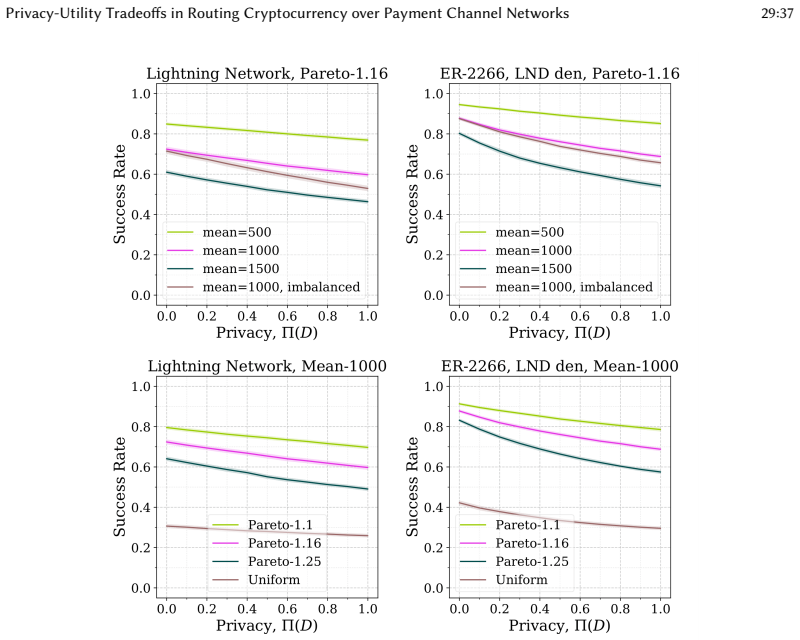
- [Section 6, Figures 10 and 11] The simulation results that carry the practical conclusion assume that senders know their own adjacent balances and include deadlock-alleviating heuristics; as the paper notes, these assumptions violate the conditions of Theorem 5.1. No formal theorem states that success rate is monotone in U under the simulation model, and no code or data are released to reproduce the experiments. Since the theoretical results only establish the diagonal bound for U(D), the success-rate conclusions in the abstract and Section 6 should be presented as conditional empirical findings, and the experimental artifacts should be made available to support reproducibility.
minor comments (4)
- [Section 3, first paragraph] There is a typo in 'we want the the privacy and utility metrics'; 'the' is duplicated.
- [Section 5, Theorem 5.1 statement] The assumption 'there exists an edge on the path, whose public balance is not updated with probability at least β > 0' is ambiguous about the quantifier over paths and over transactions; the proof appears to require that for every transaction path there is some edge with update-failure probability at least β. The statement should make this quantifier explicit.
- [Appendix A.4, proof of Theorem 4.4] The adversary strategy AT is described with indicator-function expressions such as I[2L < n]/L + I[2L = n]/n; a sentence explaining the three cases would improve readability.
- [Section 6] The paper would benefit from releasing the simulation code and the December 2018 Lightning Network snapshot; as written, the empirical privacy-success rate curves in Figures 10 and 11 are not independently verifiable.
Circularity Check
No significant circularity: the diagonal bound is derived from the paper's own definitions and graph-theoretic lemmas, with no fitted inputs or load-bearing self-citations.
full rationale
Theorem 3.2 is a direct mathematical consequence of the privacy metric defined in (2.1), the utility metric defined in (2.2), and the Lemma that every path trace on a shortest path has a unique source/destination pair; the proof in Appendix A.1 derives the bound Π(D) ≤ 1 − U(D) from these definitions without fitting any parameter to data. The tightness result for the all-or-nothing mechanism is likewise computed from the same metrics, and the Section 4 constructions explicitly relax assumptions rather than relabeling the original bound. Self-citations appear only in related-work and simulation-context passages and are not load-bearing for the theorem. The paper also candidly separates its utility metric from transaction success rate, stating in Section 5 that the relation is complicated and proving in Theorem 5.1 that under its own model success rate can be uncorrelated with utility; that is a limitation about external validity, not a circular derivation. No step in the paper's derivation chain reduces to its own inputs by construction.
Assumptions & free parameters
free parameters (4)
- Noise mechanism utility parameter α (also U(D)) =
Design choice, swept over [0,1]
- Pareto transaction value parameters (β, v_m) =
β=1.16, v_m=1000
- Channel capacity and initial balances (simulations) =
Capacity 1000, 500 per side
- Workload size and number of independent runs =
100,000 transactions, 50 runs
assumptions (6)
- domain assumption Transactions are processed sequentially and instantaneously, with no concurrency.
- domain assumption Channel balances are updated only on edges of the chosen path, and updated public balances always equal the true balance.
- domain assumption The set of usable paths P consists only of shortest paths for Theorem 3.2.
- domain assumption Initial public balances equal true balances on all channels at time 0.
- domain assumption For the tightness result, the network is reachable in the sense of Definition 3.4.
- domain assumption For the path-uncertainty theorems, the graph is complete and paths have a fixed length L.
Cite this review
Pith. "Pith review of Privacy-Utility Tradeoffs in Routing Cryptocurrency over Payment Channel Networks." pith.science (2026). https://pith.science/paper/YWX3GQZA
@misc{pith2026190902717,
  author       = {Pith},
  title        = {Pith review of: Privacy-Utility Tradeoffs in Routing Cryptocurrency over Payment Channel Networks},
  year         = {2026},
  howpublished = {\url{https://pith.science/paper/YWX3GQZA}},
  note         = {Machine review of arXiv:1909.02717}
}
read the original abstract
Payment channel networks (PCNs) are viewed as one of the most promising scalability solutions for cryptocurrencies today. Roughly, PCNs are networks where each node represents a user and each directed, weighted edge represents funds escrowed on a blockchain; these funds can be transacted only between the endpoints of the edge. Users efficiently transmit funds from node A to B by relaying them over a path connecting A to B, as long as each edge in the path contains enough balance (escrowed funds) to support the transaction. Whenever a transaction succeeds, the edge weights are updated accordingly. However, in deployed PCNs, channel balances (i.e., edge weights) are not revealed to users for privacy reasons; users know only the initial weights at time 0. Hence, when routing transactions, users first guess a path, then check if it supports the transaction. This guess-and-check process dramatically reduces the success rate of transactions. At the other extreme, knowing full channel balances can give substantial improvements in success rate at the expense of privacy. In this work, we study whether a network can reveal noisy channel balances to trade off privacy for utility. We show fundamental limits on such a tradeoff, and propose noise mechanisms that achieve the fundamental limit for a general class of graph topologies. Our results suggest that in practice, PCNs should operate either in the low-privacy or low-utility regime; it is not possible to get large gains in utility by giving up a little privacy, or large gains in privacy by sacrificing a little utility.
Figures


Figures from the paper (14 more)




Reference graph
Works this paper leans on
-
[1]
https://github.com/lightningnetwork/lnd
Lightning network daemon. https://github.com/lightningnetwork/lnd
- [2]
-
[3]
What is privacy worth? The Journal of Legal Studies , 42(2):249–274, 2013
Alessandro Acquisti, Leslie K John, and George Loewenstein. What is privacy worth? The Journal of Legal Studies , 42(2):249–274, 2013
work page 2013
-
[4]
Bitcoin just crossed a huge adoption milestone
Billy Bambrough. Bitcoin just crossed a huge adoption milestone. Forbes, 2019
work page 2019
-
[5]
Unwillingness to pay for privacy: A field experiment
Alastair R Beresford, Dorothea Kübler, and Sören Preibusch. Unwillingness to pay for privacy: A field experiment. Economics letters, 117(1):25–27, 2012
work page 2012
-
[6]
Secure and privacy-preserving communication in hybrid ad hoc networks
Srdjan Capkun, Jean-Pierre Hubaux, and Markus Jakobsson. Secure and privacy-preserving communication in hybrid ad hoc networks. Technical report, 2004
work page 2004
-
[7]
The dining cryptographers problem: Unconditional sender and recipient untraceability
David Chaum. The dining cryptographers problem: Unconditional sender and recipient untraceability. Journal of cryptology, 1(1):65–75, 1988
work page 1988
-
[8]
Optimal attack and reinforcement of a network
William H Cunningham. Optimal attack and reinforcement of a network. Journal of the ACM (JACM) , 32(3):549–561, 1985
work page 1985
Show all 39 references
-
[9]
Tor: The second-generation onion router
Roger Dingledine, Nick Mathewson, and Paul Syverson. Tor: The second-generation onion router. Technical report, Naval Research Lab Washington DC, 2004
2004
-
[10]
Celer network: Bring internet scale to every blockchain
Mo Dong, Qingkai Liang, Xiaozhou Li, and Junda Liu. Celer network: Bring internet scale to every blockchain. arXiv preprint arXiv:1810.00037, 2018
2018 arXiv
-
[11]
Differential privacy
Cynthia Dwork. Differential privacy. Encyclopedia of Cryptography and Security , pages 338–340, 2011
2011
-
[12]
Dynamically protecting privacy, under uncertainty
Mine Su Erturk and Kuang Xu. Dynamically protecting privacy, under uncertainty. arXiv preprint arXiv:1911.08875, 2019
1911 arXiv
-
[13]
Bitcoin-ng: A scalable blockchain protocol
Ittay Eyal, Adem Efe Gencer, Emin Gün Sirer, and Robbert Van Renesse. Bitcoin-ng: A scalable blockchain protocol. In 13th{USENIX} Symposium on Networked Systems Design and Implementation ({NSDI} 16), pages 45–59, 2016
2016
-
[14]
Hiding the rumor source
Giulia Fanti, Peter Kairouz, Sewoong Oh, Kannan Ramchandran, and Pramod Viswanath. Hiding the rumor source. IEEE Transactions on Information Theory , 63(10):6679–6713, 2017
2017
-
[15]
Giulia Fanti, Peter Kairouz, Sewoong Oh, and Pramod Viswanath. Spy vs. spy: Rumor source obfuscation. InProceedings of the 2015 ACM SIGMETRICS International Conference on Measurement and Modeling of Computer Systems , pages 271–284, 2015
2015
-
[16]
Lightning network: What is it and can it solve bitcoin’s scaling problem? Investopedia, March 2018
David Floyd. Lightning network: What is it and can it solve bitcoin’s scaling problem? Investopedia, March 2018
2018
-
[17]
Tarzan: A peer-to-peer anonymizing network layer
Michael J Freedman and Robert Morris. Tarzan: A peer-to-peer anonymizing network layer. In Proceedings of the 9th ACM conference on Computer and communications security , pages 193–206. ACM, 2002
2002
-
[18]
Atomic Multi-Path to help Bitcoin become a formidable payment instrument
Julio Gil-Pulgar. Atomic Multi-Path to help Bitcoin become a formidable payment instrument. Bitcoinist, February 2018
2018
-
[19]
Herbivore: A scalable and efficient protocol for anonymous communication
Sharad Goel, Mark Robson, Milo Polte, and Emin Sirer. Herbivore: A scalable and efficient protocol for anonymous communication. Technical report, Cornell University, 2003
2003
-
[20]
Design of network topology in an adversarial environment
Assane Gueye, Jean C Walrand, and Venkat Anantharam. Design of network topology in an adversarial environment. In International Conference on Decision and Game Theory for Security , pages 1–20. Springer, 2010
2010
-
[21]
A network topology design game: How to choose communi- cation links in an adversarial environment
Assane Gueye, Jean C Walrand, and Venkat Anantharam. A network topology design game: How to choose communi- cation links in an adversarial environment. In Proc. of the 2nd international icst conference on game theory for networks, gamenets, volume 11, page 5, 2011
2011
-
[22]
Extremal mechanisms for local differential privacy
Peter Kairouz, Sewoong Oh, and Pramod Viswanath. Extremal mechanisms for local differential privacy. In Advances in neural information processing systems , pages 2879–2887, 2014
2014
-
[23]
Revive: Rebalancing off-blockchain payment networks
Rami Khalil and Arthur Gervais. Revive: Rebalancing off-blockchain payment networks. In Proceedings of the 2017 ACM SIGSAC Conference on Computer and Communications Security , pages 439–453. ACM, 2017
2017
-
[24]
Silentwhispers: Enforcing security and privacy in decentralized credit networks
Giulio Malavolta, Pedro Moreno-Sanchez, Aniket Kate, and Matteo Maffei. Silentwhispers: Enforcing security and privacy in decentralized credit networks. In NDSS, 2017
2017
-
[25]
Concurrency and privacy with payment-channel networks
Giulio Malavolta, Pedro Moreno-Sanchez, Aniket Kate, Matteo Maffei, and Srivatsan Ravi. Concurrency and privacy with payment-channel networks. In Proceedings of the 2017 ACM SIGSAC Conference on Computer and Communications Security, pages 455–471. ACM, 2017
2017
-
[26]
P3: A privacy preserving personalization middleware for recommendation-based services
Animesh Nandi, Armen Aghasaryan, and Makram Bouzid. P3: A privacy preserving personalization middleware for recommendation-based services. In Hot Topics in Privacy Enhancing Technologies Symposium , 2011
2011
-
[27]
Split payments in payment networks
Dmytro Piatkivskyi and Mariusz Nowostawski. Split payments in payment networks. In Data Privacy Management, Cryptocurrencies and Blockchain Technology, pages 67–75. Springer, 2018
2018
-
[28]
The bitcoin lightning network: Scalable off-chain instant payments, 2016
Joseph Poon and Thaddeus Dryja. The bitcoin lightning network: Scalable off-chain instant payments, 2016
2016
-
[29]
Anonymous web transactions with crowds
Michael K Reiter and Aviel D Rubin. Anonymous web transactions with crowds. Communications of the ACM , 42(2):32–48, 1999. Proc. ACM Meas. Anal. Comput. Syst., Vol. 4, No. 2, Article 29. Publication date: June 2020. Privacy-Utility Tradeoffs in Routing Cryptocurrency over Paym...
1999
-
[30]
Settling payments fast and private: Efficient decentralized routing for path-based transactions
Stefanie Roos, Pedro Moreno-Sanchez, Aniket Kate, and Ian Goldberg. Settling payments fast and private: Efficient decentralized routing for path-based transactions. arXiv preprint arXiv:1709.05748, 2017
2017 arXiv
-
[31]
P5: A protocol for scalable anonymous communication
Rob Sherwood, Bobby Bhattacharjee, and Aravind Srinivasan. P5: A protocol for scalable anonymous communication. Journal of Computer Security , 13(6):839–876, 2005
2005
-
[32]
Routing cryptocurrency with the spider network
Vibhaalakshmi Sivaraman, Shaileshh Bojja Venkatakrishnan, Mohammad Alizadeh, Giulia Fanti, and Pramod Viswanath. Routing cryptocurrency with the spider network. In HotNets, 2019
2019
-
[33]
High throughput cryptocurrency routing in payment channel networks
Vibhaalakshmi Sivaraman, Shaileshh Bojja Venkatakrishnan, Kathleen Ruan, Parimarjan Negi, Lei Yang, Radhika Mittal, Giulia Fanti, and Mohammad Alizadeh. High throughput cryptocurrency routing in payment channel networks. In NSDI, 2020
2020
-
[34]
Greg maxwell: Lightning network better than sidechains for scaling bitcoin
Kyle Torpey. Greg maxwell: Lightning network better than sidechains for scaling bitcoin. Bitcoin Magazine, April 2016
2016
-
[35]
Stress test prepares visanet for the most wonderful time of the year
Manny Trillo. Stress test prepares visanet for the most wonderful time of the year. http:stress-test-prepares-visanet- for-the-most-wonderful-time-of-the-year///www.visa.com/blogarchives/us/2013/10/10/index.html, 2013
2013
-
[36]
Delay-predictability trade-offs in reaching a secret goal
John N Tsitsiklis and Kuang Xu. Delay-predictability trade-offs in reaching a secret goal. Operations Research , 66(2):587–596, 2018
2018
-
[37]
Lightning network has 1 percent success rate with transactions larger than $200, controversial research says
Neel Varshney. Lightning network has 1 percent success rate with transactions larger than $200, controversial research says. Hard Fork, June 2018
2018
-
[38]
Avoiding deadlocks in payment channel networks
Shira Werman and Aviv Zohar. Avoiding deadlocks in payment channel networks. In Data Privacy Management, Cryptocurrencies and Blockchain Technology, pages 175–187. Springer, 2018
2018
-
[39]
odd" group and
Haifeng Yu, Ivica Nikolic, Ruomu Hou, and Prateek Saxena. Ohie: Blockchain scaling made simple. arXiv preprint arXiv:1811.12628, 2018. Proc. ACM Meas. Anal. Comput. Syst., Vol. 4, No. 2, Article 29. Publication date: June 2020. 29:24 Tang, et al. APPENDIX A PROOFS We include p...
2018 arXiv
Reviewed August 14, 2026 · model on record in the stance chip above.
Discussion (0). Continue with ORCID to comment.