Steady-state squeezing transfer in hybrid optomechanics
Pith reviewed 2026-05-24 13:48 UTC · model grok-4.3
The pith
A three-level atom mediates steady-state transfer of mechanical squeezing to an optical cavity in hybrid optomechanics.
A machine-rendered reading of the paper's core claim, the machinery that carries it, and where it could break.
Core claim
In the hybrid system a three-level atom enables transfer of squeezed states (TSS) from the mechanical part to the optical cavity in the steady state. The first procedure applies a coherent pump of squeezed phonons; the second places the mechanical mode in contact with a phonon squeezed bath. The model shows that TSS occurs with high fidelity under these conditions.
What carries the argument
The three-level atom serving as the intermediate element that couples the mechanical and optical modes to allow steady-state squeezing transfer.
If this is right
- Squeezed states can be transferred and maintained using a coherent pump of squeezed phonons.
- Squeezed states can be transferred by coupling the mechanics to a squeezed phonon bath.
- The transfer reaches high fidelity in the modeled optomechanical system.
- The scheme operates in the steady state without requiring time-dependent control after initial setup.
Where Pith is reading between the lines
- If the transfer works, one could generate continuous optical squeezing from a mechanical source that is easier to cool or control.
- The two procedures might be combined or switched to tune the amount of transferred squeezing without changing the hardware.
- Extension to multiple atoms or cavities could allow distribution of squeezing across a small network while remaining in steady state.
Load-bearing premise
The three-level atom functions as an effective lossless intermediary that produces the steady-state transfer for the two procedures.
What would settle it
A master-equation simulation or experiment that finds no steady-state optical squeezing, or fidelity well below the reported high values, when the atom is driven or the bath is squeezed according to the described protocols.
Figures


read the original abstract
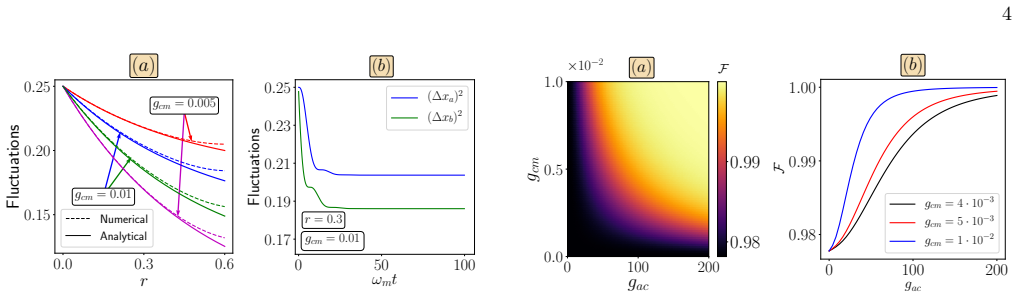
A hybrid scheme is presented that allows the transfer of squeezed states (TSS) from the mechanical part to an optical cavity in the steady-state. In a standard optomechanical scheme, a three-level atom acts as an intermediate element for TSS. Two different procedures are developed that allow the visualization of the TSS effect: In the first one, we apply a coherent pump of squeezed phonons in our hybrid system, and the second method is achieved by placing the system in contact with a phonon squeezed bath. Our model and procedures show that in optomechanical systems TSS can be achieved with a high fidelity.
Editorial analysis
A structured set of objections, weighed in public.
Referee Report
Summary. The manuscript proposes a hybrid optomechanical system in which a three-level atom mediates steady-state transfer of squeezing (TSS) from the mechanical oscillator to the optical cavity. Two procedures are presented: (i) coherent pumping of squeezed phonons and (ii) coupling to a squeezed phonon bath, both claimed to achieve high-fidelity TSS.
Significance. If the underlying master equation confirms that the atom functions as a lossless intermediary, the work would supply a concrete route to steady-state squeezing transfer in optomechanics without continuous measurement or strong driving, using two distinct protocols. This could be relevant for hybrid quantum information platforms, though the absence of explicit derivations or numerics in the provided abstract limits immediate assessment of impact.
major comments (1)
- [Abstract] Abstract: the central claim of 'high fidelity' TSS is asserted without any Hamiltonian, master equation, or numerical evidence. The three-level atom is described as an effective intermediary, but no Lindblad operators for atomic spontaneous emission or dephasing are supplied, leaving open whether atomic decay channels degrade the transferred squeezing (see skeptic note on master-equation verification).
Simulated Author's Rebuttal
We thank the referee for their careful reading of the manuscript and for highlighting the need for greater clarity in the abstract regarding the underlying model and the treatment of atomic decays. We address the comment point by point below.
read point-by-point responses
-
Referee: [Abstract] Abstract: the central claim of 'high fidelity' TSS is asserted without any Hamiltonian, master equation, or numerical evidence. The three-level atom is described as an effective intermediary, but no Lindblad operators for atomic spontaneous emission or dephasing are supplied, leaving open whether atomic decay channels degrade the transferred squeezing (see skeptic note on master-equation verification).
Authors: We agree that the abstract is too concise and does not convey the key technical elements. The full manuscript (Section II) presents the system Hamiltonian, including the three-level atom coupled to both the mechanical mode and the cavity field. The master equation is derived in Section III, with explicit Lindblad operators for atomic spontaneous emission (rate γ) and pure dephasing (rate γ_φ), in addition to the cavity and mechanical damping terms. The two protocols (coherent squeezed-phonon pump and squeezed phonon bath) are solved in the steady state, and Section IV reports numerical results showing that the transferred squeezing fidelity exceeds 0.9 for realistic atomic decay rates, because the coherent atom-mediated interaction dominates over the dissipative channels in the chosen parameter regime. We will revise the abstract to state that the master equation includes atomic decay channels and that numerical solution of the steady-state density matrix confirms high-fidelity transfer. revision: yes
Circularity Check
No circularity; derivation self-contained against external benchmarks
full rationale
The abstract and context provide no equations, self-citations, or derivation steps. The TSS claim is stated as following from the model and procedures without any self-definitional reduction, fitted-input-as-prediction, or load-bearing self-citation visible. No load-bearing step reduces to its own inputs by construction, satisfying the default expectation of non-circularity.
Axiom & Free-Parameter Ledger
axioms (1)
- domain assumption Three-level atom mediates squeezing transfer in steady state
Lean theorems connected to this paper
-
IndisputableMonolith/Cost/FunctionalEquation.leanwashburn_uniqueness_aczel unclear?
unclearRelation between the paper passage and the cited Recognition theorem.
H0 = Σ ωi σii + ωc a†a + ωm b†b + i gac (a σ21+ − a† σ21−) − i gcm a†a (b† − b)
-
IndisputableMonolith/Foundation/RealityFromDistinction.leanreality_from_one_distinction unclear?
unclearRelation between the paper passage and the cited Recognition theorem.
dρ/dt = −i[H̃2 + H̃E, ρ] + γ21/2 L[σ21]ρ + … + κb/2 Lsq[b]ρ
What do these tags mean?
- matches
- The paper's claim is directly supported by a theorem in the formal canon.
- supports
- The theorem supports part of the paper's argument, but the paper may add assumptions or extra steps.
- extends
- The paper goes beyond the formal theorem; the theorem is a base layer rather than the whole result.
- uses
- The paper appears to rely on the theorem as machinery.
- contradicts
- The paper's claim conflicts with a theorem or certificate in the canon.
- unclear
- Pith found a possible connection, but the passage is too broad, indirect, or ambiguous to say the theorem truly supports the claim.
Reference graph
Works this paper leans on
-
[1]
M. Aspelmeyer, T. J. Kippenberg, and F. Marquardt, Cavity optomechanics, Rev. Mod. Phys. 86, 1391 (2014)
work page 2014
-
[2]
C. S´ anchez Mu˜ noz, A. Lara, J. Puebla, and F. Nori, Hy- brid systems for the generation of nonclassical mechanical states via quadratic interactions, Phys. Rev. Lett. 121, 123604 (2018)
work page 2018
-
[3]
M. Mirhosseini, A. Sipahigil, M. Kalaee, and O. Painter, Superconducting qubit to optical photon transduction, Nature 588, 599 (2020)
work page 2020
- [4]
-
[5]
G. A. Steele, A. K. H¨ uttel, B. Witkamp, M. Poot, H. B. Meerwaldt, L. P. Kouwenhoven, and H. S. J. van der Zant, Strong coupling between single-electron tunneling and nanomechanical motion, Science 325, 1103 (2009)
work page 2009
-
[6]
S. G. Carter, A. S. Bracker, G. W. Bryant, M. Kim, C. S. Kim, M. K. Zalalutdinov, M. K. Yakes, C. Czarnocki, J. Casara, M. Scheibner, and D. Gammon, Spin- mechanical coupling of an inas quantum dot embedded in a mechanical resonator, Phys. Rev. Lett. 121, 246801 (2018)
work page 2018
-
[7]
E. R. MacQuarrie, T. A. Gosavi, S. A. Bhave, and G. D. Fuchs, Continuous dynamical decoupling of a single di- amond nitrogen-vacancy center spin with a mechanical resonator, Phys. Rev. B 92, 224419 (2015)
work page 2015
-
[8]
M. Abdi, M.-J. Hwang, M. Aghtar, and M. B. Plenio, Spin-mechanical scheme with color centers in hexagonal boron nitride membranes, Phys. Rev. Lett. 119, 233602 (2017)
work page 2017
-
[9]
I. Marinkovi´ c, A. Wallucks, R. Riedinger, S. Hong, M. Aspelmeyer, and S. Gr¨ oblacher, Optomechanical bell test, Phys. Rev. Lett. 121, 220404 (2018)
work page 2018
-
[10]
N. Aggarwal, T. J. Cullen, J. Cripe, G. D. Cole, R. Lanza, A. Libson, D. Follman, P. Heu, T. Corbitt, and N. Maval- vala, Room-temperature optomechanical squeezing, Na- ture Physics 16, 784 (2020)
work page 2020
-
[11]
K. Stannigel, P. Rabl, A. S. Sørensen, P. Zoller, and M. D. Lukin, Optomechanical transducers for long- distance quantum communication, Phys. Rev. Lett. 105, 220501 (2010)
work page 2010
-
[12]
R. Riedinger, S. Hong, R. A. Norte, J. A. Slater, J. Shang, A. G. Krause, V. Anant, M. Aspelmeyer, and S. Gr¨ oblacher, Non-classical correlations between single photons and phonons from a mechanical oscillator, Na- ture 530, 313 (2016)
work page 2016
-
[13]
A. P. Reed, K. H. Mayer, J. D. Teufel, L. D. Burkhart, W. Pfaff, M. Reagor, L. Sletten, X. Ma, R. J. Schoelkopf, E. Knill, and K. W. Lehnert, Faithful conversion of prop- agating quantum information to mechanical motion, Na- ture Physics 13, 1163 (2017)
work page 2017
-
[14]
L. Robledo, L. Childress, H. Bernien, B. Hensen, P. F. A. Alkemade, and R. Hanson, High-fidelity projective read- out of a solid-state spin quantum register, Nature 477, 574 (2011)
work page 2011
-
[15]
D. D. B. Rao, S. A. Momenzadeh, and J. Wrachtrup, Heralded control of mechanical motion by single spins, Phys. Rev. Lett. 117, 077203 (2016)
work page 2016
-
[16]
V. Giovannetti, S. Lloyd, and L. Maccone, Quantum metrology, Phys. Rev. Lett. 96, 010401 (2006)
work page 2006
-
[17]
B. E. Anderson, P. Gupta, B. L. Schmittberger, T. Hor- rom, C. Hermann-Avigliano, K. M. Jones, and P. D. Lett, Phase sensing beyond the standard quantum limit with a variation on the su(1,1) interferometer, Optica 4, 752 (2017)
work page 2017
-
[18]
N. S. Kampel, R. W. Peterson, R. Fischer, P.-L. Yu, K. Cicak, R. W. Simmonds, K. W. Lehnert, and C. A. Regal, Improving broadband displacement detection with quantum correlations, Phys. Rev. X 7, 021008 (2017)
work page 2017
- [19]
-
[20]
J. Aasi, Enhanced sensitivity of the ligo gravitational wave detector by using squeezed states of light, Nature Photonics 7, 613 (2013)
work page 2013
- [21]
-
[22]
P. E. Allain, L. Schwab, C. Mismer, M. Gely, E. Mairi- aux, M. Hermouet, B. Walter, G. Leo, S. Hentz, M. Faucher, G. Jourdan, B. Legrand, and I. Favero, Op- tomechanical resonating probe for very high frequency sensing of atomic forces, Nanoscale 12, 2939 (2020)
work page 2020
-
[23]
F. He, J. Liu, and K.-D. Zhu, Optomechanical atomic force microscope, Nanotechnology 32, 085505 (2020)
work page 2020
-
[24]
X.-Y. L¨ u, J.-Q. Liao, L. Tian, and F. Nori, Steady-state mechanical squeezing in an optomechanical system via duffing nonlinearity, Phys. Rev. A 91, 013834 (2015)
work page 2015
- [25]
-
[26]
J.-S. Zhang and A.-X. Chen, Large mechanical squeezing beyond 3db of hybrid atom-optomechanical systems in a highly unresolved sideband regime, Opt. Express 28, 12827 (2020)
work page 2020
-
[27]
D.-Y. Wang, C.-H. Bai, S. Liu, S. Zhang, and H.-F. Wang, Dissipative bosonic squeezing via frequency modu- lation and its application in optomechanics, Opt. Express 28, 28942 (2020)
work page 2020
-
[28]
D. W. C. Brooks, T. Botter, S. Schreppler, T. P. Purdy, N. Brahms, and D. M. Stamper-Kurn, Non-classical light generated by quantum-noise-driven cavity optomechan- ics, Nature 488, 476 (2012)
work page 2012
-
[29]
A. H. Safavi-Naeini, S. Gr¨ oblacher, J. T. Hill, J. Chan, M. Aspelmeyer, and O. Painter, Squeezed light from a sil- icon micromechanical resonator, Nature 500, 185 (2013)
work page 2013
-
[30]
T. P. Purdy, P.-L. Yu, R. W. Peterson, N. S. Kampel, and 6 C. A. Regal, Strong optomechanical squeezing of light, Phys. Rev. X 3, 031012 (2013)
work page 2013
-
[31]
J.-M. Pirkkalainen, E. Damsk¨ agg, M. Brandt, F. Mas- sel, and M. A. Sillanp¨ a¨ a, Squeezing of quantum noise of motion in a micromechanical resonator, Phys. Rev. Lett. 115, 243601 (2015)
work page 2015
-
[32]
E. E. Wollman, C. U. Lei, A. J. Weinstein, J. Suh, A. Kronwald, F. Marquardt, A. A. Clerk, and K. C. Schwab, Quantum squeezing of motion in a mechanical resonator, Science 349, 952 (2015), https://science.sciencemag.org/content/349/6251/952.full.pdf
work page 2015
-
[33]
C. F. Ockeloen-Korppi, E. Damsk¨ agg, G. S. Paraoanu, F. Massel, and M. A. Sillanp¨ a¨ a, Revealing hidden quan- tum correlations in an electromechanical measurement, Phys. Rev. Lett. 121, 243601 (2018)
work page 2018
-
[34]
E. Massoni and M. Orszag, Squeezing transfer from vi- brations to a cavity field in an ion-trap laser, Optics Com- munications 190, 239 (2001)
work page 2001
- [35]
-
[36]
M. Wallquist, K. Hammerer, P. Zoller, C. Genes, M. Lud- wig, F. Marquardt, P. Treutlein, J. Ye, and H. J. Kimble, Single-atom cavity qed and optomicromechanics, Phys. Rev. A 81, 023816 (2010)
work page 2010
-
[37]
F. Momeni and M. H. Naderi, Atomic quadrature squeez- ing and quantum state transfer in a hybrid atom– optomechanical cavity with two duffing mechanical os- cillators, J. Opt. Soc. Am. B 36, 775 (2019)
work page 2019
- [38]
-
[39]
D. F. Walls, Nature. 306, 5939 (1983)
work page 1983
-
[40]
J. R. Johansson, P. D. Nation, and F. Nori, Comp. Phys. Comm. 184, 1234 (2013)
work page 2013
-
[41]
M. A. Nielsen and I. L. Chuang, Quantum Computation and Quantum Information (Cambridge University Press, 2010)
work page 2010
discussion (0)
Sign in with ORCID, Apple, or X to comment. Anyone can read and Pith papers without signing in.