Active particles in a tube: a generalized entropy potential approach
Pith reviewed 2026-05-24 13:29 UTC · model grok-4.3
The pith
Active particles in varying tubes are described by a generalized entropy potential renormalized by activity.
A machine-rendered reading of the paper's core claim, the machinery that carries it, and where it could break.
Core claim
The variation of the particle density along the tube is well described by a one-dimensional generalized entropy potential. This potential resembles its passive counterpart, albeit with an effective temperature and an effective tube width that are renormalized by the activity.
What carries the argument
The generalized entropy potential derived from moment expansion in the Fick-Jacobs reduction for active particles.
If this is right
- The steady-state density distribution along the tube follows directly from the shape of the generalized entropy potential.
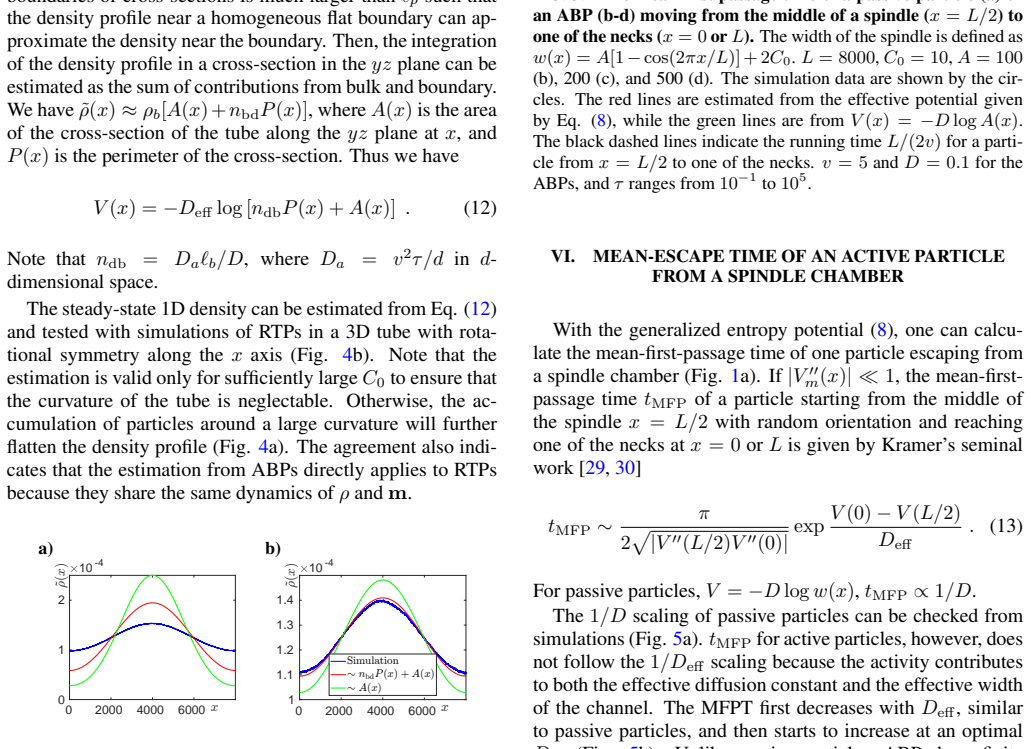
- The mean escape time out of a spindle chamber follows from the potential in the same way as for passive particles.
- Including higher-order corrections to the effective potential accounts for spontaneous ratchet flows in asymmetric channels.
Where Pith is reading between the lines
- The same renormalization of temperature and width might simplify calculations for active particles in other slowly varying confinements such as biological channels.
- The effective parameters could be measured as functions of activity strength to test scaling across different particle types.
- Extending the moment expansion to include weak interactions might produce a next-order correction to the potential without losing the one-dimensional reduction.
Load-bearing premise
The tube width is large and changes slowly, and the particles do not interact with each other.
What would settle it
Numerical simulations or experiments measuring particle density profiles in a tube with controlled width variation that deviate from the profiles predicted by the generalized entropy potential would falsify the central claim.
Figures

read the original abstract
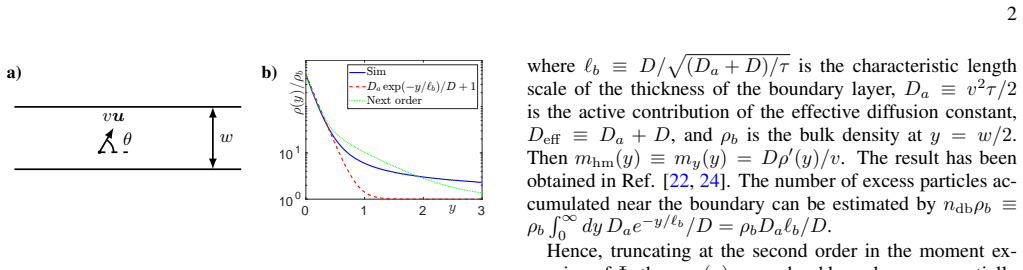
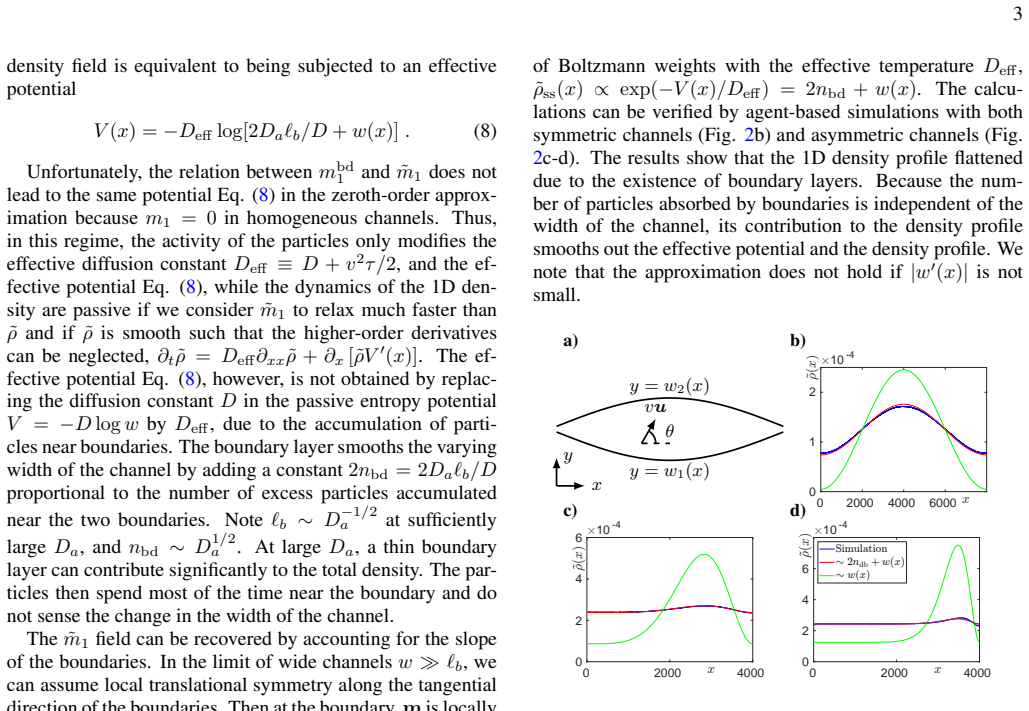
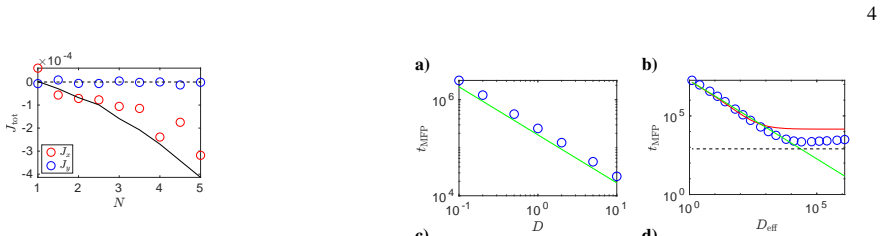
We study the transport of self-propelled noninteracting active Brownian particles (ABPs) and run-and-tumble particles (RTPs) in long tubes of varying widths. Using a moment expansion, we construct a generalized Fick-Jacobs framework for the active particles when the tube width is large and slowly varying. We show that the variation of the particle density along the tube is well described by a one-dimensional generalized entropy potential. This potential resembles its passive counterpart, albeit with an effective temperature and an effective tube width that are renormalized by the activity. Our generalized entropy potential approach allows us to predict the steady-state density distribution along the tube as well as the mean escape time out of a spindle chamber. Finally, we show how to account for the emergence of spontaneous ratchet flows in asymmetric channel by including higher-order corrections neglected in the effective entropy potential approach.
Editorial analysis
A structured set of objections, weighed in public.
Referee Report
Summary. The manuscript develops a moment-expansion approach to derive a generalized Fick-Jacobs description for noninteracting ABPs and RTPs in long tubes whose width w(x) is large and slowly varying. The resulting one-dimensional effective entropy potential incorporates activity via renormalized effective temperature and tube width; this potential is used to predict the steady-state longitudinal density profile and the mean escape time from a spindle-shaped chamber. Higher-order moment corrections are added to capture spontaneous ratchet currents in asymmetric channels.
Significance. If the truncation error remains controlled, the construction supplies a parameter-free reduction of active-particle transport to an effective 1D equilibrium-like problem, extending the classical Fick-Jacobs framework in a controlled way. The explicit renormalization factors and the escape-time formula are potentially useful for analytic estimates in microfluidic or biological confinement problems.
major comments (2)
- [moment-expansion derivation and Fick-Jacobs reduction] The central claim that the longitudinal density is 'well described' by the generalized entropy potential rests on the moment-expansion truncation. No a-priori error bound or systematic comparison against the persistence length relative to the local curvature scale of w(x) is supplied; the remark that higher-order terms are required for ratchets already indicates that the leading closure is incomplete in geometries with comparable scales.
- [steady-state density and escape-time sections] The effective-temperature and effective-width renormalizations are obtained after closing the orientational moment hierarchy. It is not shown whether the resulting 1D potential reproduces the exact steady-state density when the tube width varies on a scale comparable to the persistence length; a direct numerical test of this regime would be needed to substantiate the claim.
minor comments (2)
- Notation for the renormalized quantities (T_eff, w_eff) should be introduced once and used consistently; several symbols are redefined in passing.
- The manuscript would benefit from an explicit statement of the range of validity (e.g., w(x)/l_p >> 1 and |dw/dx| << 1) together with a brief comparison to existing active Fick-Jacobs literature.
Simulated Author's Rebuttal
We thank the referee for their careful reading and positive evaluation of our manuscript. We address the two major comments below, providing clarifications on the validity of our approximations and proposing revisions to strengthen the presentation of the regime of applicability.
read point-by-point responses
-
Referee: [moment-expansion derivation and Fick-Jacobs reduction] The central claim that the longitudinal density is 'well described' by the generalized entropy potential rests on the moment-expansion truncation. No a-priori error bound or systematic comparison against the persistence length relative to the local curvature scale of w(x) is supplied; the remark that higher-order terms are required for ratchets already indicates that the leading closure is incomplete in geometries with comparable scales.
Authors: We agree that no a-priori error bound for the truncation is supplied. Our moment-expansion approach is predicated on the slow variation of the tube width relative to the persistence length, under which the leading-order closure provides a good description of the longitudinal density for symmetric channels, consistent with the numerical results presented. The requirement for higher-order terms in asymmetric ratchet geometries stems from the fact that net currents arise from additional moment couplings due to asymmetry, even under slow variation. We will add a discussion section clarifying the validity regime and acknowledging the lack of a rigorous error bound as an inherent limitation of the perturbative approach. revision: partial
-
Referee: [steady-state density and escape-time sections] The effective-temperature and effective-width renormalizations are obtained after closing the orientational moment hierarchy. It is not shown whether the resulting 1D potential reproduces the exact steady-state density when the tube width varies on a scale comparable to the persistence length; a direct numerical test of this regime would be needed to substantiate the claim.
Authors: Our claims and derivations are explicitly limited to the regime of slowly varying tube width, where the Fick-Jacobs reduction applies. In this regime, the generalized entropy potential is designed to match the steady-state density obtained from the closed moment equations. When the width variation scale approaches the persistence length, the underlying assumptions fail, and the effective 1D description is not expected to hold exactly; this regime lies outside the scope of the approximation. We will revise the manuscript to explicitly state that our validations are confined to the slow-variation limit and that no claim is made for comparable scales. revision: partial
Circularity Check
Moment-expansion derivation is self-contained with no reduction to inputs
full rationale
The paper starts from the underlying ABP/RTP Fokker-Planck or master equation, performs a moment expansion in the orientational degrees of freedom, and applies a Fick-Jacobs reduction under the stated assumptions of large, slowly varying tube width. The resulting 1D generalized entropy potential (with renormalized temperature and width) is obtained directly as an output of that expansion; it is not defined in terms of itself, fitted to the target density data, or justified solely by a self-citation whose content is unverified. Higher-order terms are introduced only for the separate ratchet-flow case and are not required for the central density prediction. No load-bearing step matches any of the enumerated circularity patterns.
Axiom & Free-Parameter Ledger
Lean theorems connected to this paper
-
IndisputableMonolith/Cost/FunctionalEquation.leanwashburn_uniqueness_aczel echoes?
echoesECHOES: this paper passage has the same mathematical shape or conceptual pattern as the Recognition theorem, but is not a direct formal dependency.
the variation of the particle density along the tube is well described by a one-dimensional generalized entropy potential... with an effective temperature and an effective tube width that are renormalized by the activity
-
IndisputableMonolith/Foundation/AbsoluteFloorClosure.leanreality_from_one_distinction unclear?
unclearRelation between the paper passage and the cited Recognition theorem.
Using a moment expansion, we construct a generalized Fick-Jacobs framework... when the tube width is large and slowly varying
What do these tags mean?
- matches
- The paper's claim is directly supported by a theorem in the formal canon.
- supports
- The theorem supports part of the paper's argument, but the paper may add assumptions or extra steps.
- extends
- The paper goes beyond the formal theorem; the theorem is a base layer rather than the whole result.
- uses
- The paper appears to rely on the theorem as machinery.
- contradicts
- The paper's claim conflicts with a theorem or certificate in the canon.
- unclear
- Pith found a possible connection, but the passage is too broad, indirect, or ambiguous to say the theorem truly supports the claim.
Reference graph
Works this paper leans on
-
[1]
J. chun Wu, Q. Chen, and B. quan Ai, Entropic transport of active particles driven by a transverse ac force, Physics Letters A 379, 3025 (2015)
work page 2015
-
[2]
L. Caprini, F. Cecconi, and U. Marini Bettolo Marconi, Transport of active particles in an open-wedge channel, The Journal of Chemical Physics 150, 144903 (2019), https://doi.org/10.1063/1.5090104
-
[3]
B.-Q. Ai, Y .-F. He, and W.-R. Zhong, Entropic ratchet transport of interacting active brownian particles, The Journal of Chemical Physics 141, 194111 (2014), https://doi.org/10.1063/1.4901896
-
[4]
P. Malgaretti and H. Stark, Model microswimmers in channels with varying cross section, The Journal of Chemical Physics 146, 174901 (2017), https://doi.org/10.1063/1.4981886
-
[5]
L. Shi, B. Yu, C.-H. Cai, W. Huang, B.-J. Zheng, D. K. Smith, and J.-D. Huang, Combined prokaryotic–eukaryotic delivery and expression of therapeutic factors through a primed auto- catalytic positive-feedback loop, Journal of Controlled Release 222, 130 (2016)
work page 2016
-
[6]
M. E. Cates and J. Tailleur, When are active Brownian particles and run-and-tumble particles equivalent? Consequences for motility-induced phase separation, Europhys. Lett. 101, 20010 (2013)
work page 2013
-
[7]
A. P. Solon, M. E. Cates, and J. Tailleur, Active brownian par- ticles and run-and-tumble particles: A comparative study, The European Physical Journal Special Topics 224, 1231 (2015)
work page 2015
-
[8]
H. C. Berg and D. A. Brown, Chemotaxis in Escherichia coli analysed by three-dimensional tracking, Nature 239, 500 (1972)
work page 1972
-
[9]
L. G. Wilson, V . A. Martinez, J. Schwarz-Linek, J. Tailleur, G. Bryant, P. N. Pusey, and W. C. K. Poon, Differential dynamic microscopy of bacterial motility, Phys. Rev. Lett. 106, 018101 (2011)
work page 2011
-
[10]
V . A. Martinez, R. Besseling, O. A. Croze, J. Tailleur, M. Reufer, J. Schwarz-Linek, L. G. Wilson, M. A. Bees, and W. C. K. Poon, Differential dynamic microscopy: A high- throughput method for characterizing the motility of microor- ganisms, Biophys. J. 103, 1637 (2012)
work page 2012
-
[11]
A. Curatolo, N. Zhou, Y . Zhao, C. Liu, A. Daerr, J. Tailleur, and J. Huang, Cooperative pattern formation in multi-component bacterial systems through reciprocal motility regulation, Nat. Phys. , 1 (2020)
work page 2020
-
[12]
M. H. Jacobs, Diffusion Process (Springer-Verlag, 1967)
work page 1967
-
[13]
Zwanzig, Diffusion past an entropy barrier, The Journal of Physical Chemistry 96, 3926 (1992)
R. Zwanzig, Diffusion past an entropy barrier, The Journal of Physical Chemistry 96, 3926 (1992)
work page 1992
-
[14]
D. Reguera and J. M. Rub ´ı, Kinetic equations for diffusion in the presence of entropic barriers, Phys. Rev. E 64, 061106 (2001)
work page 2001
-
[15]
D. Reguera, G. Schmid, P. S. Burada, J. M. Rub ´ı, P. Reimann, and P. H¨anggi, Entropic transport: Kinetics, scaling, and control mechanisms, Phys. Rev. Lett. 96, 130603 (2006)
work page 2006
-
[16]
P. S. Burada, G. Schmid, D. Reguera, J. M. Rub´ı, and P. H¨anggi, Biased diffusion in confined media: Test of the fick-jacobs approximation and validity criteria, Phys. Rev. E 75, 051111 (2007)
work page 2007
-
[17]
X. Yang, C. Liu, Y . Li, F. Marchesoni, P. H ¨anggi, and H. P. Zhang, Hydrodynamic and entropic effects on col- loidal diffusion in corrugated channels, Proceedings of the National Academy of Sciences 114, 9564 (2017), https://www.pnas.org/content/114/36/9564.full.pdf
work page 2017
-
[18]
S. Marbach, D. S. Dean, and L. Bocquet, Transport and dis- persion across wiggling nanopores, Nature Physics 14, 1108 (2018)
work page 2018
-
[19]
X. Yang, Q. Zhu, C. Liu, W. Wang, Y . Li, F. Marchesoni, P. H¨anggi, and H. P. Zhang, Diffusion of colloidal rods in cor- rugated channels, Phys. Rev. E 99, 020601(R) (2019). 6
work page 2019
-
[20]
P. S. Burada, G. Schmid, D. Reguera, M. H. Vainstein, J. M. Rubi, and P. H¨anggi, Entropic stochastic resonance, Phys. Rev. Lett. 101, 130602 (2008)
work page 2008
-
[21]
P. K. Ghosh, F. Marchesoni, S. E. Savel’ev, and F. Nori, Ge- ometric stochastic resonance, Phys. Rev. Lett. 104, 020601 (2010)
work page 2010
-
[22]
J. Elgeti and G. Gompper, Wall accumulation of self-propelled spheres, EPL (Europhysics Letters) 101, 48003 (2013)
work page 2013
-
[23]
A. P. Solon, Y . Fily, A. Baskaran, M. E. Cates, Y . Kafri, M. Kar- dar, and J. Tailleur, Pressure is not a state function for generic active fluids, Nature Physics 11, 673 (2015)
work page 2015
-
[24]
A. Duzgun and J. V . Selinger, Active brownian particles near straight or curved walls: Pressure and boundary layers, Phys. Rev. E 97, 032606 (2018)
work page 2018
-
[25]
L. Caprini and U. Marini Bettolo Marconi, Active particles un- der confinement and effective force generation among surfaces, Soft Matter 14, 9044 (2018)
work page 2018
-
[26]
L. Angelani, Confined run-and-tumble swimmers in one dimen- sion, Journal of Physics A: Mathematical and Theoretical 50, 325601 (2017)
work page 2017
- [27]
- [28]
-
[29]
H. Kramers, Brownian motion in a field of force and the diffu- sion model of chemical reactions, Physica 7, 284 (1940)
work page 1940
-
[30]
A factor of 1/4 appears because the particles can escape from two sides, and we only calculate the time ending at the peak of the entropy potential when particles have probability 1/2 to escape
-
[31]
J. Elgeti and G. Gompper, Self-propelled rods near surfaces, EPL (Europhysics Letters) 85, 38002 (2009)
work page 2009
-
[32]
P. D. Neta, M. Tasinkevych, M. M. Telo da Gama, and C. S. Dias, Wetting of a solid surface by active matter, Soft Matter 17, 2468 (2021)
work page 2021
discussion (0)
Sign in with ORCID, Apple, or X to comment. Anyone can read and Pith papers without signing in.