Classification of Symmetric Four-Body Dziobek Central Configurations and Application to the Earth--Moon System
Pith reviewed 2026-05-24 12:18 UTC · model grok-4.3
The pith
A framework determines the number of symmetric four-body Dziobek central configurations directly from mass parameters.
A machine-rendered reading of the paper's core claim, the machinery that carries it, and where it could break.
Core claim
The central claim is that a new framework allows the explicit determination of the number of admissible symmetric four-body Dziobek central configurations directly from the mass parameters, without requiring prior knowledge of their geometric structure. Combined with previously established semi-analytical relations, this approach provides a systematic characterization of symmetric configurations in terms of mass ratios. As a physically relevant application, the framework is applied to the Earth-Moon system to determine the possible symmetric four-body central configurations involving Earth- and Moon-mass bodies and an additional object of arbitrary mass, identifying both isolated and family-
What carries the argument
The mass-parameter classification framework that counts admissible symmetric Dziobek configurations using semi-analytical relations.
If this is right
- For any four given masses the number of symmetric Dziobek configurations can be read off directly.
- The Earth-Moon system admits both isolated four-body equilibria and continuous families of them.
- The notion of libration points extends from the three-body to the four-body problem through these equilibria.
- The semi-analytical approach supplies a foundation for further studies of equilibrium structures in multi-body gravitational systems.
Where Pith is reading between the lines
- The counting method could be tested on other mass sets such as Sun-Earth-asteroid configurations to check consistency with known three-body limits.
- Spacecraft trajectory design in four-body environments might use the predicted families as starting points for low-energy transfers.
- If the mass-ratio characterization holds, it suggests a route to enumerate equilibria in five-body problems by successive reduction.
Load-bearing premise
The assumption that symmetric four-body Dziobek configurations can be fully classified and counted using the developed method combined with previously established semi-analytical relations.
What would settle it
A specific set of four masses for which the framework predicts a certain number of configurations but an independent algebraic or numerical enumeration finds a different number.
Figures




read the original abstract
Central configurations are fundamental equilibrium solutions of the Newtonian $n$-body problem and play a key role in understanding the structure and dynamics of gravitational systems. However, the classification and enumeration of such configurations remain incomplete in the four-body case, particularly for symmetric configurations. In this work, we develop a framework for determining and classifying symmetric four-body Dziobek configurations. The method allows the explicit determination of the number of admissible configurations directly from the mass parameters, without requiring prior knowledge of their geometric structure. Combined with previously established semi-analytical relations, this approach provides a systematic characterization of symmetric configurations in terms of mass ratios. As a physically relevant application, we apply the framework to the Earth--Moon system and determine the possible symmetric four-body central configurations involving Earth- and Moon-mass bodies and an additional object of arbitrary mass. We identify both isolated configurations and continuous families of equilibrium solutions, extending the concept of libration points to the four-body problem. The presented semi-analytical approach contributes to the understanding of equilibrium structures in multi-body gravitational systems and provides a foundation for further studies in celestial mechanics, planetary dynamics, and spacecraft motion in complex gravitational environments.
Editorial analysis
A structured set of objections, weighed in public.
Referee Report
Summary. The manuscript develops a framework for classifying symmetric four-body Dziobek central configurations. It claims that this framework, when combined with previously established semi-analytical relations, permits explicit determination of the number of admissible configurations directly from the mass parameters without requiring prior knowledge of their geometric structure. The approach is used to characterize configurations in terms of mass ratios and is applied to the Earth-Moon system, where it identifies both isolated configurations and continuous families of equilibria involving Earth- and Moon-mass bodies plus a third body of arbitrary mass.
Significance. If the central claims hold, the work provides a systematic semi-analytical method for enumerating symmetric Dziobek configurations in the four-body problem, addressing an area where classifications remain incomplete. The Earth-Moon application illustrates the identification of new equilibrium families, extending concepts like libration points and offering potential utility for planetary dynamics and spacecraft motion in multi-body gravitational environments. The parameter-based counting procedure, if validated, represents a methodological contribution to celestial mechanics.
major comments (2)
- Abstract: The description supplies no derivation details, error analysis, or validation steps for the framework or the counting procedure, preventing assessment of whether the explicit determination of configuration numbers from mass parameters is free of hidden geometric assumptions or circular reliance on the cited semi-analytical relations.
- The central claim rests on combining the new framework with 'previously established semi-analytical relations'; without explicit statements on the independence of these relations from the authors' prior work or a concrete example of the counting algorithm applied to a specific mass set, the novelty and non-circularity of the enumeration method cannot be verified.
Simulated Author's Rebuttal
We thank the referee for their detailed review and insightful comments. We address each major comment below and agree to revise the manuscript accordingly to enhance clarity on the framework's derivation and the enumeration procedure.
read point-by-point responses
-
Referee: Abstract: The description supplies no derivation details, error analysis, or validation steps for the framework or the counting procedure, preventing assessment of whether the explicit determination of configuration numbers from mass parameters is free of hidden geometric assumptions or circular reliance on the cited semi-analytical relations.
Authors: The abstract is intended as a high-level summary and therefore omits detailed derivations, error analyses, and validation steps, which are presented in the body of the paper (Sections 2-4). The framework is derived without assuming specific geometries, relying instead on algebraic relations from the Dziobek equations. To address the concern, we will revise the abstract to briefly reference the validation through application to the Earth-Moon system and the independence from geometric priors. revision: yes
-
Referee: The central claim rests on combining the new framework with 'previously established semi-analytical relations'; without explicit statements on the independence of these relations from the authors' prior work or a concrete example of the counting algorithm applied to a specific mass set, the novelty and non-circularity of the enumeration method cannot be verified.
Authors: The semi-analytical relations are drawn from established literature in the field (e.g., references to works on central configurations predating our contributions) and are independent of the authors' prior work. We will add an explicit statement in the introduction clarifying this independence. Furthermore, we will include a concrete numerical example of the counting algorithm for a specific mass set in the revised manuscript to illustrate the non-circular nature of the procedure. revision: yes
Circularity Check
No significant circularity detected
full rationale
The paper develops a new framework whose core claim is the explicit counting of admissible symmetric four-body Dziobek configurations directly from mass parameters without prior geometric knowledge. This is presented as an independent methodological advance. The abstract notes combination with 'previously established semi-analytical relations,' but no load-bearing self-citation chain, self-definitional step, or fitted-input-renamed-as-prediction is exhibited in the given text. The Earth-Moon application is described as an illustration yielding isolated points and families. Without any quoted equation or section that reduces the claimed result to its own inputs by construction, the derivation chain is self-contained against external benchmarks.
Axiom & Free-Parameter Ledger
axioms (1)
- domain assumption Newtonian gravity governs the motion of point masses in the n-body problem
Reference graph
Works this paper leans on
-
[1]
However, the number of concave deltoid configurations is between 0 and 4
So, their masses uniquely determine the shape of the configuration. However, the number of concave deltoid configurations is between 0 and 4. III. AN APPLICATION: PSCCFB HAVING EARTH’S AND MOON’S MASSES As an application of the results of Sect. II, here we study the PSCCFB in such cases, where the bodies have Earth’s and Moon’s masses. Let m′ 1, m′ 2, m′ 3 ...
-
[2]
regardless of the labelling of m′ 3 and m′
-
[3]
The only constraint is that the bodies with mass m′ 1 and m′ 2 in that order have to be on the long and short bases of the trapezoid. 7 Eqs. (4) has a unique solution for any of its three parameters (giving one, the other two can be uniquely determined). Forµ = 0.0122, it follows that α = 66.7803◦ and β = 54.1463◦ (see Fig. 10). FIG. 10: Isosceles trapezo...
-
[4]
depending on the value of m′′. We determined the locations of the equal-mass bodies m′ 3 and m′ 4 relative to the bodies m′ 1 and m′ 2 based on the value of m′′, where the four bodies can form deltoid-type central configurations with the Earth-Moon axis being as 8 FIG. 12: The coloured curve indicates the positions of the pairs (m1,m 2) for values of m′′ b...
-
[5]
Note, that there are three P2 (and P2) points in accordance with Table II
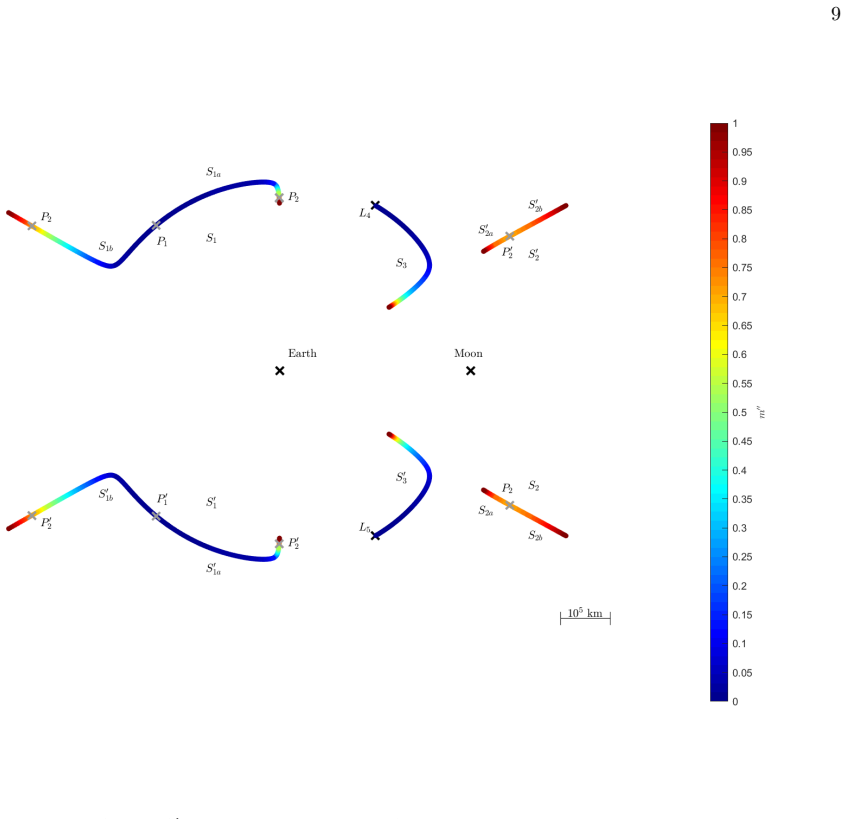
when m′′ = ν2 (similarly P2 for m′ 3 and P′ 2 for m′ 4). Note, that there are three P2 (and P2) points in accordance with Table II. The curves S3 and S′ 3 represent the locations of the equal-mass bodies that lead to convex configurations. Equal-mass bodies on the curves S1 and S′ 1 or S2 and S′ 2 result in a concave configuration. The curves S1 and S′ 1 co...
-
[6]
The curves Mi and Si are coloured according to the value of m′′
is the inner body. The curves Mi and Si are coloured according to the value of m′′. The colour-scale is linear in Earth-mass. TABLE V: The configurations parameters calculated in Case C at the endpoints of the curves Si and Mi in Figs. 16 and 17 Positions Parameters Curves Points m′′ α[deg] β[deg] m1 m2 S1 and M1 starting points 0 59.99◦ 15.77◦ 0.9759 0.01...
-
[7]
form a convex central configuration. The curves Ei and Si for i ={1, 2} represent the locations of the bodies m′ 3 and m′ 4, respectively, leading to concave configurations when the inner body of the configuration is the Moon ( m′
-
[8]
21), and for i ={4, 5} when the inner body is the body m′ 4 (see Fig
(see Fig. 21), and for i ={4, 5} when the inner body is the body m′ 4 (see Fig. 22). The masses m1 and m2 defined by Eqs. (11) are the same at the endpoints of the curves Ei and Si. When m′′ = 0, then m1 = 0 and m2 = 0.0061, and when m′′ = 1, then m1 = 0.3320 and m2 = 0.0041. Table VI contains the angles α and β calculated at the endpoints of the curves Ei...
-
[9]
The colour-scale is linear in Earth-mass
The curves Ei and Si are coloured according to the value of m′′. The colour-scale is linear in Earth-mass. TABLE VI: The configuration angle parameters α and β calculated in Case D at the endpoints of the curves Ei and Si. Positions Parameters Curves Points α[deg] β[deg] S1 and E1 starting points 63.63◦ 59.99◦ ending points 59.99◦ 29.99◦ S2 and E2 starting...
-
[10]
Albouy A., Cabral H. E., and Santos A. A. (2012). Some problems on the classical n-body problem. Celestial Mechanics and Dynamical Astronomy, 113(4):369–375
work page 2012
-
[11]
Czirj´ ak Z. and´Erdi B. (2019). A study on the planar symmetric central configurations of four bodies using angles.Romanian Astronomical Journal, 29(1):59–74
work page 2019
-
[12]
´Erdi B. and Czirj´ ak Z. (2016). Central configurations of four bodies with an axis of symmetry. Celestial Mechanics and 14 Dynamical Astronomy, 125(1):33–70
work page 2016
-
[13]
Euler L. (1767). De motu rectilineo trium corporum se mutuo attrahentium. Novi commentarii academiae scientiarum Petropolitanae, 11:144–151
-
[14]
Lagrange J.L. (1772). Essai sur le probleme des trois corps. Prix de l’acad´ emie royale des Sciences de paris, 9:292
-
[15]
Laplace P. S. (1789). Sur quelques points du systeme du monde. M´ emoires de l’Acad´ emie royale des Sciences de Paris, page 553
-
[16]
Saari D. G. (2011). Central configuration - A problem for the twenty-first century. Exped. Math. MAA Spectrum , pages 283–295
work page 2011
-
[17]
Smale S. (1970). Topology and mechanics. II. Inventiones mathematicae, 11(1): 45–64
work page 1970
-
[18]
Smale S. (1998). Mathematical problems for the next century. The mathematical intelligencer , 20(2):7–15. 15 Appendix A: The a0, a1, b0, b1 coefficients Convex case: a0 = tanα ( cos3α− 1 8 ) , b0 = tanβ ( cos3β− 1 8 ) , a1 = 1 (tanα + tanβ)2 + tanβ (1 8− cos3α− cos3β ) − tanα 8 , b1 = 1 (tanα + tanβ)2 + tanα (1 8− cos3α− cos3β ) − tanβ 8 , Concave case: a0 ...
work page 1998
discussion (0)
Sign in with ORCID, Apple, or X to comment. Anyone can read and Pith papers without signing in.