Quantum scar affecting the motion of three interacting particles in a circular trap
Pith reviewed 2026-05-24 10:28 UTC · model grok-4.3
The pith
Three interacting particles in a circular trap have some eigenstates scarred by an unstable classical periodic trajectory in a chaotic region.
A machine-rendered reading of the paper's core claim, the machinery that carries it, and where it could break.
Core claim
Some of the quantum eigenstates are scarred by a classically unstable periodic trajectory, in the vicinity of which the classical analog exhibits chaos. Towers of scarred quantum states are fully explained in terms of the unstable classical trajectory underlying the scar.
What carries the argument
Scarring of quantum eigenstates by localization along one unstable classical periodic orbit that organizes the observed towers.
If this is right
- The scar is stabilized purely by quantum mechanics despite classical instability.
- Each tower of scarred states corresponds directly to the underlying unstable trajectory.
- The three-particle system in a circular trap is accessible with current Rydberg-atom trapping methods.
Where Pith is reading between the lines
- The same orbit-scarring pattern may appear in other few-body trapped systems once interactions are tuned similarly.
- Detection of the towers would give a direct experimental link between one classical orbit and a discrete set of quantum levels.
- The mechanism offers a minimal setting to test how quantum scarring suppresses local chaos in small particle numbers.
Load-bearing premise
Numerical diagonalization correctly identifies the scarred eigenstates without significant discretization or truncation artifacts.
What would settle it
Absence of the predicted tower structure in the energy spectrum or lack of scarring density in the corresponding wave functions along the identified orbit.
Figures




read the original abstract
We theoretically propose a quantum scar affecting the motion of three interacting particles in a circular trap. We numerically calculate the quantum eigenstates of the system and show that some of them are scarred by a classically unstable periodic trajectory, in the vicinity of which the classical analog exhibits chaos. The few-body scar we consider is stabilized by quantum mechanics, and we analyze it along the lines of the original quantum scarring mechanism [Heller, Phys. Rev. Lett. 53, 1515 (1984)]. In particular, we identify towers of scarred quantum states which we fully explain in terms of the unstable classical trajectory underlying the scar. Our proposal is within experimental reach owing to very recent advances in Rydberg atom trapping.
Editorial analysis
A structured set of objections, weighed in public.
Referee Report
Summary. The paper claims that certain eigenstates of three interacting particles in a circular trap exhibit quantum scarring along a classically unstable periodic orbit surrounded by chaos. Numerical diagonalization reveals these scarred states, whose towers are fully accounted for by the underlying classical trajectory via the Heller mechanism; the proposal is presented as experimentally accessible with Rydberg atoms.
Significance. If the numerical evidence is robust, the work supplies a concrete few-body example of scarring stabilized by quantum mechanics, with the explicit tower structure providing a direct quantitative link to the classical orbit. This extends scarring studies beyond single-particle or many-body regimes and highlights an experimentally relevant platform.
major comments (2)
- [Numerical results / eigenstate calculation] The description of the numerical eigenstates (in the section presenting the quantum results) supplies no information on basis size, truncation scheme, or convergence tests with respect to basis dimension. Because the scarring identification rests entirely on the spatial structure of these eigenstates, the absence of such checks leaves open the possibility that apparent localization is a discretization artifact rather than a genuine scar.
- [Classical trajectory analysis] The classical analysis (in the section classifying the periodic trajectory) does not report the integration method, total integration time, or quantitative diagnostics (e.g., Lyapunov exponents or Poincaré sections) used to establish orbital instability and the surrounding chaotic region. These details are load-bearing for the claim that the scar is associated with an unstable orbit embedded in chaos.
minor comments (2)
- Figure captions and the main text would benefit from explicit quantitative measures (overlap integrals or scarring strength metrics) comparing the quantum probability density to the classical orbit, rather than relying solely on visual inspection.
- The interaction potential between the three particles is not stated explicitly in the Hamiltonian definition; adding its functional form would improve reproducibility.
Simulated Author's Rebuttal
We thank the referee for the positive evaluation of our work and for the detailed comments. We address each major comment below. Both points identify missing technical details that we will supply in the revised manuscript.
read point-by-point responses
-
Referee: [Numerical results / eigenstate calculation] The description of the numerical eigenstates (in the section presenting the quantum results) supplies no information on basis size, truncation scheme, or convergence tests with respect to basis dimension. Because the scarring identification rests entirely on the spatial structure of these eigenstates, the absence of such checks leaves open the possibility that apparent localization is a discretization artifact rather than a genuine scar.
Authors: We agree that these details are necessary for reproducibility and to rule out artifacts. In the revised manuscript we will add an explicit description of the basis (a truncated product basis of single-particle eigenstates in the circular trap), the total dimension employed, the truncation criteria, and quantitative convergence tests (e.g., overlap of scarred wave functions and energy differences) obtained by successively enlarging the basis. These tests confirm that the observed scarring persists and is not a finite-basis artifact. revision: yes
-
Referee: [Classical trajectory analysis] The classical analysis (in the section classifying the periodic trajectory) does not report the integration method, total integration time, or quantitative diagnostics (e.g., Lyapunov exponents or Poincaré sections) used to establish orbital instability and the surrounding chaotic region. These details are load-bearing for the claim that the scar is associated with an unstable orbit embedded in chaos.
Authors: We accept that these specifics should have been included. The revised manuscript will state the numerical integrator (fourth-order Runge-Kutta with adaptive step-size control), the total integration time used to locate and verify the periodic orbit, the value of the largest Lyapunov exponent (positive, confirming instability), and representative Poincaré sections that display the surrounding chaotic sea. These additions will directly support the claim that the scar is associated with an unstable orbit in a chaotic region. revision: yes
Circularity Check
No significant circularity; central claim rests on independent numerical comparison
full rationale
The paper numerically diagonalizes the three-particle Hamiltonian to obtain eigenstates and compares their probability density to an independently integrated classical unstable periodic orbit (with surrounding chaos). No self-definitional steps, fitted inputs renamed as predictions, or load-bearing self-citations appear in the provided abstract or reader's summary. The Heller reference is external. The derivation chain does not reduce to its inputs by construction; the numerical evidence is load-bearing but not circular.
Axiom & Free-Parameter Ledger
Reference graph
Works this paper leans on
-
[1]
by impacting some [18, chap. 22] quantum eigen- states. Hence, it is also called ‘many–body scarring’ [19]. A similar phenomenon has been predicted in the context of the Dicke model [20], where the quantum scars are due to the collective light–matter interaction and impact many quantum eigenstates [21]. Despite the intense theoretical scrutiny [22], only ...
-
[2]
(A1) Equation A1 is written in the dimensional form of Ref
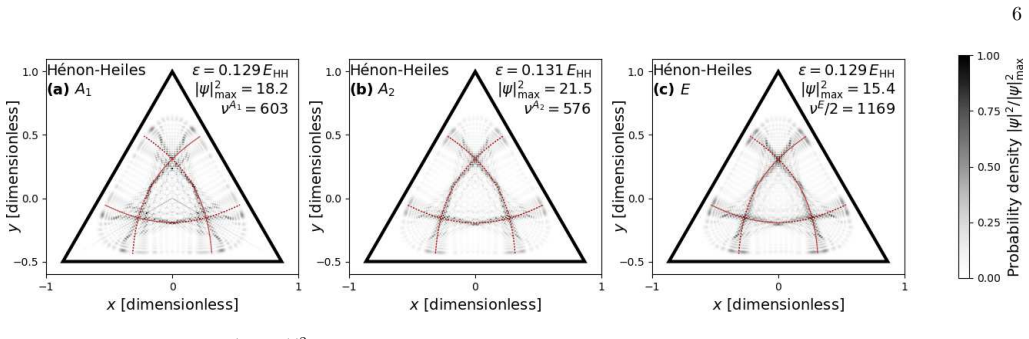
Quantum scars in the H´ enon–Heiles model In this Section, we briefly describe our results, anal- ogous to those of the main text, for the Henon–Heiles Hamiltonian [34] HHH = (p2 x +p2 y)/ (2m) +VHH, where: VHH =mω 2 0(x2 +y2)/ 2 +α (x2y −y3/ 3) . (A1) Equation A1 is written in the dimensional form of Ref. [64, §5.6.4] which assumes that the coordinates x ...
work page 2000
-
[3]
Boundary conditions defining a basis of quantum stationary states In this Section, we exploit the spatial symmetries of the point group C3v and time–reversal symmetry to state boundary conditions uniquely defining a basis of quan- tum stationary states. We state our reasoning in terms of the system considered in the main text, but it ap- plies without chang...
-
[4]
A. Polkovnikov, K. Sengupta, A. Silva, and M. Vengalat- tore, Rev. Mod. Phys. 83, 863 (2011)
work page 2011
-
[5]
Sutherland, Beautiful models (World Scientific, 2004)
B. Sutherland, Beautiful models (World Scientific, 2004)
work page 2004
-
[6]
D. A. Abanin, E. Altman, I. Bloch, and M. Serbyn, Rev. Mod. Phys. 91, 021001 (2019)
work page 2019
- [7]
-
[8]
Q. Zhu, Z. H. Sun, M. Gong, F. Chen, Y. R. Zhang, Y. Wu, Y. Ye, C. Zha, S. Li, S. Guo, H. Qian, H. L. Huang, J. Yu, H. Deng, H. Rong, J. Lin, Y. Xu, L. Sun, C. Guo, N. Li, F. Liang, C. Z. Peng, H. Fan, X. Zhu, and J. W. Pan, Phys. Rev. Lett. 128, 160502 (2022)
work page 2022
- [9]
-
[10]
R. Bl¨ umel and W. P. Reinhardt,Chaos in atomic physics (Cambridge University Press, 1997)
work page 1997
- [11]
-
[12]
M. Courtney, N. Spellmeyer, H. Jiao, and D. Kleppner, Phys. Rev. A 51, 3604 (1995)
work page 1995
- [13]
- [14]
-
[15]
H. Bernien, S. Schwartz, A. Keesling, H. Levine, A. Omran, H. Pichler, S. Choi, A. S. Zibrov, M. En- dres, M. Greiner, V. Vuleti´ c, and M. D. Lukin, Nature 551, 579 (2017)
work page 2017
-
[16]
C. J. Turner, A. A. Michailidis, D. A. Abanin, M. Serbyn, and Z. Papi´ c, Nat. Phys. 14, 745 (2018)
work page 2018
- [17]
-
[18]
E. J. Heller, Phys. Rev. Lett. 53, 1515 (1984)
work page 1984
- [19]
- [20]
-
[21]
E. J. Heller, The semiclassical way to physics and spec- troscopy (Princeton University Press, 2018)
work page 2018
-
[22]
P. N. Jepsen, Y. K. Lee, H. Liu, I. Dimitrova, Y. Margalit, W. W. Ho, and W. Ketterle, Nat. Phys. 18, 899 (2022)
work page 2022
- [23]
-
[24]
S. Pilatowsky-Cameo, D. Villase˜ nor, M. A. Bastarrachea- Magnani, S. Lerma-Hern´ andez, L. F. Santos, and J. G. Hirsch, Nat. Commun. 12, 852 (2021)
work page 2021
-
[25]
S. Moudgalya, B. A. Bernevig, and N. Regnault, Rep. Prog. Phys. 85, 086501 (2022)
work page 2022
- [26]
-
[27]
W. W. Ho, S. Choi, H. Pichler, and M. D. Lukin, Phys. Rev. Lett. 122, 040603 (2019)
work page 2019
-
[28]
C. J. Turner, J. Y. Desaules, K. Bull, and Z. Papi´ c, Phys. Rev. X 11, 021021 (2021)
work page 2021
-
[29]
A. A. Michailidis, C. J. Turner, Z. Papi´ c, D. A. Abanin, and M. Serbyn, Phys. Rev. X 10, 011055 (2020)
work page 2020
-
[30]
P. N. Jepsen, W. W. Ho, J. Amato-Grill, I. Dimitrova, E. Demler, and W. Ketterle, Phys. Rev. X 11, 041054 (2021)
work page 2021
- [31]
-
[32]
D. Barredo, V. Lienhard, P. Scholl, S. de L´ es´ eleuc, T. Boulier, A. Browaeys, and T. Lahaye, Phys. Rev. Lett. 124, 023201 (2020)
work page 2020
-
[33]
R. G. Corti˜ nas, M. Favier, B. Ravon, P. M´ ehaignerie, Y. Machu, J. M. Raimond, C. Sayrin, and M. Brune, Phys. Rev. Lett. 124, 123201 (2020)
work page 2020
-
[34]
M. C. Gutzwiller, Chaos in classical and quantum me- chanics (Springer, 1990)
work page 1990
-
[35]
E. J. Heller, in Les Houches Session LII (1989): chaos and quantum physics , edited by M. J. Giannoni, A. Voros, and J. Zinn-Justin (Elsevier, 1991)
work page 1989
-
[36]
S. Choi, C. J. Turner, H. Pichler, W. W. Ho, A. A. Michailidis, Z. Papi´ c, M. Serbyn, M. D. Lukin, and D. A. Abanin, Phys. Rev. Lett. 122, 220603 (2019)
work page 2019
- [37]
-
[38]
M. A. Baranov, M. Dalmonte, G. Pupillo, and P. Zoller, Chem. Rev. 112, 5012 (2012)
work page 2012
-
[39]
T. L. Nguyen, J. M. Raimond, C. Sayrin, R. Corti˜ nas, T. Cantat-Moltrecht, F. Assemat, I. Dotsenko, S. Gleyzes, S. Haroche, G. Roux, T. Jolicoeur, and M. Brune, Phys. Rev. X 8, 011032 (2018)
work page 2018
-
[40]
A. J. Lichtenberg and M. A. Lieberman, Regular and stochastic dynamics , 2nd ed. (Springer, 1992)
work page 1992
-
[41]
L. D. Faddeev and S. P. Merkuriev, Quantum scattering theory for several particle systems (Springer, 1993)
work page 1993
-
[42]
The full plane group characterizing the symmetries of v(x,y ) is p6mm [67, Part 6]
-
[43]
L. D. Landau and E. M. Lifshitz, Quantum mechanics, non-relativistic theory (Butterworth-Heinemann, 1977)
work page 1977
-
[44]
M. Baranger, K. T. R. Davies, and J. H. Mahoney, Ann. Phys. 186, 95 (1988)
work page 1988
-
[45]
K. T. R. Davies, T. E. Huston, and M. Baranger, Chaos 2, 215 (1992)
work page 1992
-
[46]
D. J. Papoular and B. Zumer, In preparation (2023)
work page 2023
-
[47]
Ozorio de Almeida, Hamiltonian systems: chaos and quantization (Cambridge University Press, 1988)
A. Ozorio de Almeida, Hamiltonian systems: chaos and quantization (Cambridge University Press, 1988)
work page 1988
-
[48]
J. P. Keating and S. D. Prado, Proc. R. Soc. Lond. A 457, 1855 (2001)
work page 2001
-
[49]
S. D. Prado, E. Vergini, R. M. Benito, and F. Borondo, EPL 88, 40003 (2009)
work page 2009
-
[50]
A. A. Zembekov, F. Borondo, and R. M. Benito, J. Chem. Phys. 107, 7934 (1997). 9
work page 1997
-
[51]
F. G. Gustavson, Astron. J. 71, 670 (1966)
work page 1966
-
[52]
V. I. Arnold, Mathematical methods of classical mechan- ics, 2nd ed. (Springer, 1989)
work page 1989
- [53]
-
[54]
M. D. Feit, J. A. Fleck, J. A. Fleck, Jr., and A. Steiger, J. Comput. Phys. 47, 412 (1982)
work page 1982
- [55]
- [56]
-
[57]
J. M. Robbins, Phys. Rev. A 40, 2128 (1989)
work page 1989
- [58]
- [59]
- [60]
-
[61]
S. E. Anderson, K. C. Younge, and G. Raithel, Phys. Rev. Lett. 107, 263001 (2011)
work page 2011
- [62]
-
[63]
D. Bluvstein, A. Omran, H. Levine, A. Keesling, G. Se- meghini, S. Ebadi, T. T. Wang, A. A. Michailidis, N. Maskara, W. W. Ho, S. Choi, M. Serbyn, M. Greiner, V. Vuleti´ c, and M. D. Lukin, Science 371, 1355 (2021)
work page 2021
-
[64]
A. Hudomal, J. Y. Desaules, B. Mukherjee, G. X. Su, J. C. Halimeh, and Z. Papi´ c, Phys. Rev. B 106, 104302 (2022)
work page 2022
-
[65]
L. D. Landau and E. M. Lifshitz, Mechanics, 3rd ed. (Butterworth-Heinemann, 1976)
work page 1976
-
[66]
D. V. Else, C. Monroe, C. Nayak, and N. Y. Yao, Annu. Rev. Condens. Matter Phys. 11, 467 (2020)
work page 2020
- [67]
-
[68]
M. J. David and E. J. Heller, J. Chem. Phys. 71, 3383 (1979)
work page 1979
- [69]
-
[70]
T. Hahn, ed., International tables for crystallography vol- ume A: space-group symmetry (Springer, 2005)
work page 2005
discussion (0)
Sign in with ORCID, Apple, or X to comment. Anyone can read and Pith papers without signing in.