REVIEW 6 major objections 5 minor 64 references
Less is More: Masking Elements in Image Condition Features Avoids Content Leakages in Style Transfer Diffusion Models
T0 review · 6 major / 5 minor · reviewed 2026-08-08 · deepseek-v4-flash
Pith's one-line read This paper claims that dropping selected image-feature elements—masking content-correlated coordinates—reduces content leakage and improves style transfer without any parameter tuning.
desk verdict The masking trick is a genuine empirical contribution, but the advertised theoretical validation reverses Jensen's inequality and does not follow, so the paper's real value is experimental, not theoretical. read the letter →
The pith
A machine-rendered reading of the paper's core claim, the machinery that carries it, and where it could break.
The reading
What carries the argument
The load-bearing object is the element-wise product feature $e_p^i = e_1^i \cdot e_2^i$ between a CLIP image embedding $e_1$ and a content-text embedding $e_2$, clustered (the paper uses K-means) to produce a mask $m$; the denoising condition becomes $e_1 \odot m$ instead of $e_1$ or $e_1 - e_2$. The product is the criterion that identifies which dimensions of the image feature carry the reference's content, and zeroing those dimensions is what removes content leakage while keeping style dimensions intact. The argument is carried by two divergence comparisons: Theorem 1 compares full-conditioned versus masked-conditioned denoising under a convex divergence, an independence assumption, and an assumed inequality, while Theorem 2 compares a learned image-side adapter with a learned text-side adapter under a determinism assumption on content given the style reference.
What would settle it
Estimate both divergences directly on the paper's own evaluation data: sample style references, compute $D(q(x\mid e_1,e_2,e_3)\|p_\theta(x\mid e_1^{\le s},e_2,e_3))$ and the masked variant $D_2$, using a sample-based estimator. If for typical references the full-condition divergence is not larger than the masked-condition divergence, the assumed inequality fails and the theorem does not establish the claim. A second check is to compare the proposed content-correlated mask with a random mask of the same cardinality; if random masking performs equally, the clustering criterion is not the active ingredient.
Extended reading notes
Core claim
On the paper's own terms, the central discovery is that content leaks into style-transfer outputs through specific elements of the style-reference image embedding, and those elements can be located and removed without touching model weights. The removal rule is: compute the element-wise product $e_1 \odot e_2$ of the style image feature with the CLIP text feature of the reference's content, cluster the $d$ products into $K$ classes, and set to zero the image-feature elements in the highest-mean cluster. The paper claims this masking yields both higher text fidelity and style preservation compared with InstantStyle's feature subtraction, and that a similar advantage holds for a tuning-based "Image-Adapter" over a "Text-Adapter." Formally, it claims $D_2 \le D_1$ under stated assumptions, where $D_1$ is the divergence for the InstantStyle-conditioned model and $D_2$ the divergence for the masked-condition model.
Load-bearing premise
The theoretical case rests on the premise that conditioning on fewer image-feature elements never increases the divergence between generated and real image distributions, together with the premise that the elements of a CLIP image feature are independent; the first premise is an inequality information theory usually runs in the opposite direction, and the second is not true of CLIP embeddings.
Editorial extensions
If this is right
- No model parameters and no image-condition coefficient need to be tuned: the mask is computed from the reference image and one text phrase, then inserted into existing IP-Adapter-style pipelines.
- Because the operation stays within the image-feature space, it avoids the image-text misalignment that the paper attributes to InstantStyle's cross-modal subtraction.
- The same masking recipe applied on top of StyleShot's style encoder improves text fidelity on the 73-style StyleBench benchmark while keeping image alignment competitive.
- A tuning-based variant that removes content inside the image-feature space ("Image-Adapter") is claimed to beat one that removes content via a learned text feature ("Text-Adapter"), supporting the fewer-conditions conclusion outside the training-free setting.
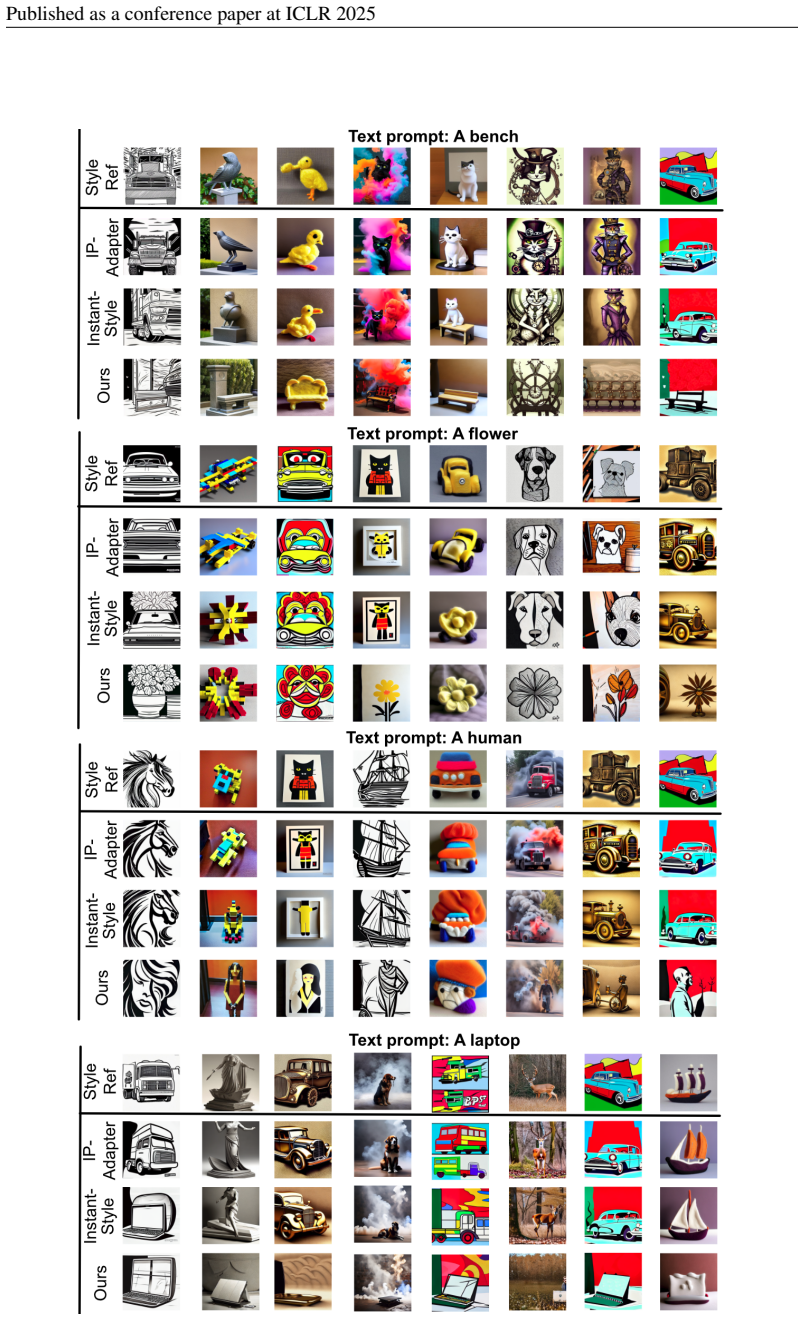
- On the constructed evaluation set, the method reports the lowest leakage score (0.478) and highest fidelity score (0.972) among compared methods, and the largest share of human preference (36.7%).
Reading between the lines
- A broader consequence implied by the paper is that "fewer conditions" means discarding the dimensions that carry the wrong information, not discarding information indiscriminately; the same logic could apply to other conditioning modalities, such as depth maps, segmentation masks, or reference audio, where leakage is a known failure.
- The product-feature clustering could serve as a general content-leakage probe: comparing which coordinates are consistently masked across many references of the same class might yield a catalog of content-correlated CLIP dimensions that transfers across style-transfer tasks.
- A testable extension would rank masked elements by mutual information between each image-feature coordinate and the content text rather than by the highest-mean cluster, which would reveal whether the clustering step is the optimal selection rule or just a convenient one.
Editorial analysis
A structured set of objections, weighed in public.
Referee Report
Summary. The paper proposes a training-free masking method for style transfer in text-to-image diffusion models: content-related elements in a style-reference image feature are identified by clustering the element-wise product of the image feature and a content-text feature, and those elements are set to zero before the image condition is injected via an IP-Adapter-style cross-attention module. The authors claim that this 'less is more' principle is validated both theoretically (Proposition 1, Theorems 1 and 2) and experimentally, and they report strong results on a custom content-leakage dataset and on the StyleBench benchmark, including the best human-preference scores and best fidelity/leakage scores among the compared methods.
Significance. If the claims held, the paper would be a useful contribution: a parameter-free intervention that improves content-style disentanglement without retraining, backed by an extensive comparison and publicly released code. The empirical core is plausible and appears to be well executed, with the masking method winning human preference on both evaluation setups and achieving the best leakage and fidelity scores on the custom dataset. However, the theoretical validation advertised in the abstract and Section 3.2 is not sound: the proof of Theorem 1 reverses Jensen's inequality, the main assumption is generally false, the independence assumption is false for CLIP features, and Theorem 1 does not actually formalize the proposed method. The paper's central scientific claim therefore rests on the empirical comparison alone.
major comments (6)
- [Appendix A.2, Eq. (6)] The proof of Theorem 1 applies Jensen's inequality in the wrong direction. For a convex divergence D, E_z D(q_z || p_z) >= D(E_z q_z || E_z p_z), not <=. Both inequalities in the displayed chain of Eq. (6) assert the opposite ordering, so the chain does not establish D2 <= D1. This is a load-bearing error in the claimed theoretical validation.
- [Section 3.2, Theorem 1 assumption] The assumption E_{e1^1..d} D(q(x|e1^1..d) || p_theta(x|e1^1..s)) <= E_{e1^1..s} D(q(x|e1^1..s) || p_theta(x|e1^1..s)) is generally false: by Jensen's inequality, the reverse inequality holds for any fixed p_theta. The assumption is not derived, is not verified empirically, and is in fact contradicted by the same convexity argument used elsewhere in the paper.
- [Section 3.2, Theorem 1] The theorem assumes the elements of the image feature are independent of each other, which is false for CLIP image embeddings, and this independence is load-bearing because the final equality of Eq. (6) factorizes the expectation over e1^1..d. No empirical check of the independence or of the main assumption is provided, so the proof fails even if the Jensen-direction error were corrected.
- [Section 3.2, definitions of D1 and D2] Theorem 1 does not formalize the proposed method. The divergence D2 conditions on (e1^1..s, e2, e3), i.e., it still includes the content text feature e2 as a condition, whereas the actual masking method (Algorithm 1 and Section 3.1) conditions on e1 ⊙ m and e3 only, without e2. Similarly, D1 models InstantStyle as conditioning on (e1, e2, e3), while InstantStyle in practice uses e1 - e2 and e3. The theorem therefore compares two models that neither of the two methods actually uses.
- [Appendix A.2, Proposition 1 proof] Proposition 1 is not proven. The text asserts that clustering on e1·e2 'enforces' the selected component to have the closest distance to e2 and hence yields the highest energy score, but no formal derivation is given, and the claim that this implies maximal energy for e2 is not established. The simulation in Table 6 is empirical evidence, not a proof, and it does not test the theoretical statement of the proposition.
- [Appendix A.2, Theorem 2 proof, Eqs. (7)-(10)] The proof of Theorem 2 also contains an unjustified step: line (8) replaces E_{q(c2|c1,c3)} D(q(x|c1,c2,c3) || p_theta,psi(x|c1,c3)) with D(q(x|c1,c3) || p_theta,psi(x|c1,c3)), but Jensen's inequality gives the former >= the latter, not equality. Consequently the chain to Eq. (10) does not establish the claimed inequality between the Image-Adapter and Text-Adapter objectives.
minor comments (5)
- [Notations 1 and 2] The superscript notation e^i,...,d_1 is confusing and is typeset inconsistently; please clarify whether i is an index or a range and use a consistent notation such as e1^{1..s} and e1^{s+1..d}.
- [Section 3.1 and Figure 3] The caption of Figure 3(b) says 'Liner+LN'; this should be 'Linear+LN'. Also, the phrase 'The experiment results' and 'showcasing' in Section 3.1 should be grammatically corrected.
- [Algorithm 2, line 9] The optimization objectives in Algorithm 2 include a term with coefficient λ that is described as 'maximizing the difference' between two noise predictions, but the printed expression has a minus sign before λ; please clarify the intended sign convention and the role of λ.
- [Appendix A.4, leakage score definition] The leakage score formula in Eq. (11) is missing normalization: it should be cos(e_g, e_2)/cos(e_1, e_2) with explicit cosine similarities, not the unnormalized inner products as written.
- [Section 4.2 and Algorithm 1] Algorithm 1 takes a 'default style reference content text prompt c2' as input, but the StyleBench evaluation does not have a fixed content text; the paper states that the CLIP text feature 'person, animal, plant, or object in the foreground' is used. Please state this choice in the algorithm and clarify how the content text is selected in each experimental setting.
Circularity Check
The theoretical 'less is more' proof is circular: Theorem 1 assumes the conclusion it claims to prove, and the appendix proof reverses Jensen's inequality.
-
self definitional
[Section 3.2, Theorem 1 (assumption also used in the proof, Appendix A.2)]
"With the assumption: E_{q(e^{i,...,d}_1)}D(q(x|e^{i,...,d}_1)||pθ(x|e^{i,...,s}_1)) ≤ E_{q(e^{i,...,s}_1)}D(q(x|e^{i,...,s}_1)||pθ(x|e^{i,...,s}_1)) and by Jensen's inequality, we have D2 ≤ D1."
The displayed assumption asserts that, for the image feature alone, conditioning the model on the masked subset e^{1..s}_1 gives a smaller divergence than conditioning on the full feature e^{1..d}_1. That is exactly the 'less is more' principle Theorem 1 is supposed to prove, now with e2 and e3 added. The paper does not derive this assumption from any external fact; it is a premise. The following 'and by Jensen's inequality' does not supply the missing content, so the conclusion D2 ≤ D1 is the assumption restated rather than a derived result.
-
self definitional
[Section 3.1, Proposition 1 (proof in Appendix A.2)]
"The proposed masking strategy enforces the selected component e^m_1 to have the closest distance with the content text feature e_2. Therefore, according to the relation between energy and distance as defined in Equation 3, the masking strategy with clustering on e^i_1 · e^i_2 can lead to the highest energy score for the content text feature e_2 when compared to other masking methods."
The energy score in Equation 3 is defined as the cosine similarity between the CLIP embedding of the condition, here e_2, and the image. The masking rule selects elements by clustering e^i_1 · e^i_2, i.e., by using exactly the alignment with e_2 that the energy score measures. Asserting that this rule yields the highest energy score for e_2 is therefore a restatement of the construction of the mask, not an independent theorem. Table 6 then measures the same energy quantity the selection rule was built to maximize, so it cannot validate Proposition 1 as a discovery.
full rationale
The paper's empirical contribution is self-contained and not circular: the mask is selected from e1 and e2, applied to held-out style references, and compared against external baselines on a purpose-built content-leakage dataset and StyleBench. The circularity is confined to the advertised theoretical validation. Theorem 1 states that fewer conditions give a smaller divergence, but its only substantive premise is the displayed assumption that the same fewer-conditions inequality already holds for the image feature alone; that assumption is the theorem's conclusion in miniature, and no independent derivation is provided. The proof in Appendix A.2 is additionally invalid: Eq. (6)'s first inequality applies Jensen's inequality in the wrong direction, since for a convex divergence D, E_z D(q_z||p_z) ≥ D(E_z q_z||E_z p_z). Thus the chain does not establish D2 ≤ D1, and the theorem's content reduces to the assumed inequality. Proposition 1 is similarly definitional because the energy score is the cosine similarity with the content text feature, so a mask built from the element-wise product e^i_1·e^i_2 is constructed to maximize that same quantity. There are no load-bearing self-citations. The experimental comparisons may still support the method's practical effectiveness, but the abstract's claim of validation both theoretically and experimentally overstates the theoretical support; the theoretical claim reduces to its own assumption.
Assumptions & free parameters
free parameters (3)
- K (number of clusters) =
2
- Content text prompt e2 for StyleBench =
"person, animal, plant, or object in the foreground"
- lambda (Algorithm 2) =
not reported
assumptions (6)
- standard math Divergence D is convex
- domain assumption Elements of the image feature are independent of each other
- domain assumption Energy guidance approximation E(c,xt) ≈ E_{p(x0|xt)} Dθ(c,x0)
- ad hoc to paper Theorem 1 assumption: E_{e1^{1..d}} D(q(x|e1^{1..d}) || pθ(x|e1^{1..s})) ≤ E_{e1^{1..s}} D(q(x|e1^{1..s}) || pθ(x|e1^{1..s}))
- domain assumption Assumption 1 (Theorem 2): c1 and c3 independent; c2 uniquely determined by c1
- ad hoc to paper Masking the highest-mean product cluster yields the highest energy for content text e2
Cite this review
Pith. "Pith review of Less is More: Masking Elements in Image Condition Features Avoids Content Leakages in Style Transfer Diffusion Models." pith.science (2026). https://pith.science/paper/223ARXCJ
@misc{pith2026250207466,
  author       = {Pith},
  title        = {Pith review of: Less is More: Masking Elements in Image Condition Features Avoids Content Leakages in Style Transfer Diffusion Models},
  year         = {2026},
  howpublished = {\url{https://pith.science/paper/223ARXCJ}},
  note         = {Machine review of arXiv:2502.07466}
}
read the original abstract
Given a style-reference image as the additional image condition, text-to-image diffusion models have demonstrated impressive capabilities in generating images that possess the content of text prompts while adopting the visual style of the reference image. However, current state-of-the-art methods often struggle to disentangle content and style from style-reference images, leading to issues such as content leakages. To address this issue, we propose a masking-based method that efficiently decouples content from style without the need of tuning any model parameters. By simply masking specific elements in the style reference's image features, we uncover a critical yet under-explored principle: guiding with appropriately-selected fewer conditions (e.g., dropping several image feature elements) can efficiently avoid unwanted content flowing into the diffusion models, enhancing the style transfer performances of text-to-image diffusion models. In this paper, we validate this finding both theoretically and experimentally. Extensive experiments across various styles demonstrate the effectiveness of our masking-based method and support our theoretical results.
Figures


Figures from the paper (19 more)




Reference graph
Works this paper leans on
-
[1]
write newline
" write newline "" before.all 'output.state := FUNCTION n.dashify 't := "" t empty not t #1 #1 substring "-" = t #1 #2 substring "--" = not "--" * t #2 global.max substring 't := t #1 #1 substring "-" = "-" * t #2 global.max substring 't := while if t #1 #1 substring * t #2 global.max substring 't := if while FUNCTION format.date year duplicate empty "emp...
-
[2]
Probability and measure theory
Robert B Ash and Catherine A Dol \'e ans-Dade. Probability and measure theory. Academic press, 2000
work page 2000
-
[3]
Jiwoo Chung, Sangeek Hyun, and Jae-Pil Heo. Style injection in diffusion: A training-free approach for adapting large-scale diffusion models for style transfer. In Proceedings of the IEEE/CVF Conference on Computer Vision and Pattern Recognition, pp.\ 8795--8805, 2024
work page 2024
-
[4]
Diffedit: Diffusion-based semantic image editing with mask guidance
Guillaume Couairon, Jakob Verbeek, Holger Schwenk, and Matthieu Cord. Diffedit: Diffusion-based semantic image editing with mask guidance. arXiv preprint arXiv:2210.11427, 2022
arXiv 2022
-
[5]
Bermano, Gal Chechik, and Daniel Cohen-Or
Rinon Gal, Yuval Alaluf, Yuval Atzmon, Or Patashnik, Amit H. Bermano, Gal Chechik, and Daniel Cohen-Or. An image is worth one word: Personalizing text-to-image generation using textual inversion, 2022. URL https://arxiv.org/abs/2208.01618
arXiv 2022
-
[6]
Styleshot: A snapshot on any style
Junyao Gao, Yanchen Liu, Yanan Sun, Yinhao Tang, Yanhong Zeng, Kai Chen, and Cairong Zhao. Styleshot: A snapshot on any style. arXiv preprint arXiv:2407.01414, 2024
arXiv 2024
-
[7]
Masked diffusion transformer is a strong image synthesizer
Shanghua Gao, Pan Zhou, Ming-Ming Cheng, and Shuicheng Yan. Masked diffusion transformer is a strong image synthesizer. In Proceedings of the IEEE/CVF International Conference on Computer Vision, pp.\ 23164--23173, 2023
work page 2023
-
[8]
Mismatch quest: Visual and textual feedback for image-text misalignment
Brian Gordon, Yonatan Bitton, Yonatan Shafir, Roopal Garg, Xi Chen, Dani Lischinski, Daniel Cohen-Or, and Idan Szpektor. Mismatch quest: Visual and textual feedback for image-text misalignment. arXiv preprint arXiv:2312.03766, 2023
arXiv 2023
Show all 64 references
-
[9]
Diffusion-enhanced patchmatch: A framework for arbitrary style transfer with diffusion models
Mark Hamazaspyan and Shant Navasardyan. Diffusion-enhanced patchmatch: A framework for arbitrary style transfer with diffusion models. In Proceedings of the IEEE/CVF Conference on Computer Vision and Pattern Recognition, pp.\ 797--805, 2023
2023
-
[10]
Unified auto-encoding with masked diffusion
Philippe Hansen-Estruch, Sriram Vishwanath, Amy Zhang, and Manan Tomar. Unified auto-encoding with masked diffusion. arXiv preprint arXiv:2406.17688, 2024
2024 arXiv
-
[11]
Style aligned image generation via shared attention, 2024
Amir Hertz, Andrey Voynov, Shlomi Fruchter, and Daniel Cohen-Or. Style aligned image generation via shared attention, 2024. URL https://arxiv.org/abs/2312.02133
2024 arXiv
-
[12]
Classifier-free diffusion guidance, 2022
Jonathan Ho and Tim Salimans. Classifier-free diffusion guidance, 2022. URL https://arxiv.org/abs/2207.12598
2022 arXiv
-
[13]
Denoising diffusion probabilistic models, 2020
Jonathan Ho, Ajay Jain, and Pieter Abbeel. Denoising diffusion probabilistic models, 2020. URL https://arxiv.org/abs/2006.11239
2020 arXiv
-
[14]
Learning disentangled identifiers for action-customized text-to-image generation
Siteng Huang, Biao Gong, Yutong Feng, Xi Chen, Yuqian Fu, Yu Liu, and Donglin Wang. Learning disentangled identifiers for action-customized text-to-image generation. In Proceedings of the IEEE/CVF Conference on Computer Vision and Pattern Recognition, pp.\ 7797--7806, 2024
2024
-
[15]
Visual style prompting with swapping self-attention, 2024
Jaeseok Jeong, Junho Kim, Yunjey Choi, Gayoung Lee, and Youngjung Uh. Visual style prompting with swapping self-attention, 2024. URL https://arxiv.org/abs/2402.12974
2024 arXiv
-
[16]
K-Means Clustering, pp.\ 563--564
Xin Jin and Jiawei Han. K-Means Clustering, pp.\ 563--564. Springer US, Boston, MA, 2010. ISBN 978-0-387-30164-8. doi:10.1007/978-0-387-30164-8_425. URL https://doi.org/10.1007/978-0-387-30164-8_425
2010 doi
-
[17]
Misalign, contrast then distill: Rethinking misalignments in language-image pretraining, 2023
Bumsoo Kim, Yeonsik Jo, Jinhyung Kim, and Seung Hwan Kim. Misalign, contrast then distill: Rethinking misalignments in language-image pretraining, 2023. URL https://arxiv.org/abs/2312.12661
2023 arXiv
-
[18]
Adam: A method for stochastic optimization
Diederik P Kingma. Adam: A method for stochastic optimization. arXiv preprint arXiv:1412.6980, 2014
2014 arXiv
-
[19]
Learning multiple layers of features from tiny images.(2009), 2009
Alex Krizhevsky, Geoffrey Hinton, et al. Learning multiple layers of features from tiny images.(2009), 2009
2009
-
[20]
Diffusion-based image translation using disentangled style and content representation
Gihyun Kwon and Jong Chul Ye. Diffusion-based image translation using disentangled style and content representation. arXiv preprint arXiv:2209.15264, 2022
2022 arXiv
-
[21]
Styleid: Identity disentanglement for anonymizing faces
Minh-Ha Le and Niklas Carlsson. Styleid: Identity disentanglement for anonymizing faces. arXiv preprint arXiv:2212.13791, 2022
2022 arXiv
-
[22]
Masked diffusion models are fast learners
Jiachen Lei, Peng Cheng, Zhongjie Ba, and Kui Ren. Masked diffusion models are fast learners. arXiv preprint arXiv:2306.11363, 2023
2023 arXiv
-
[23]
Blip-diffusion: Pre-trained subject representation for controllable text-to-image generation and editing
Dongxu Li, Junnan Li, and Steven Hoi. Blip-diffusion: Pre-trained subject representation for controllable text-to-image generation and editing. Advances in Neural Information Processing Systems, 36, 2024
2024
-
[24]
Blip-2: Bootstrapping language-image pre-training with frozen image encoders and large language models
Junnan Li, Dongxu Li, Silvio Savarese, and Steven Hoi. Blip-2: Bootstrapping language-image pre-training with frozen image encoders and large language models. In International conference on machine learning, pp.\ 19730--19742. PMLR, 2023
2023
-
[25]
Ctrl-x: Controlling structure and appearance for text-to-image generation without guidance
Kuan Heng Lin, Sicheng Mo, Ben Klingher, Fangzhou Mu, and Bolei Zhou. Ctrl-x: Controlling structure and appearance for text-to-image generation without guidance. arXiv preprint arXiv:2406.07540, 2024
2024 arXiv
-
[26]
Stylecrafter: Enhancing stylized text-to-video generation with style adapter
Gongye Liu, Menghan Xia, Yong Zhang, Haoxin Chen, Jinbo Xing, Xintao Wang, Yujiu Yang, and Ying Shan. Stylecrafter: Enhancing stylized text-to-video generation with style adapter. arXiv preprint arXiv:2312.00330, 2023
2023 arXiv
-
[27]
Owens, and Yixuan Li
Weitang Liu, Xiaoyun Wang, John D. Owens, and Yixuan Li. Energy-based out-of-distribution detection, 2021. URL https://arxiv.org/abs/2010.03759
2021 arXiv
-
[28]
Specialist diffusion: Plug-and-play sample-efficient fine-tuning of text-to-image diffusion models to learn any unseen style
Haoming Lu, Hazarapet Tunanyan, Kai Wang, Shant Navasardyan, Zhangyang Wang, and Humphrey Shi. Specialist diffusion: Plug-and-play sample-efficient fine-tuning of text-to-image diffusion models to learn any unseen style. In Proceedings of the IEEE/CVF Conference on Computer Vi...
2023
-
[29]
Mace: Mass concept erasure in diffusion models
Shilin Lu, Zilan Wang, Leyang Li, Yanzhu Liu, and Adams Wai-Kin Kong. Mace: Mass concept erasure in diffusion models. In Proceedings of the IEEE/CVF Conference on Computer Vision and Pattern Recognition, pp.\ 6430--6440, 2024
2024
-
[30]
Lego: Learning to disentangle and invert concepts beyond object appearance in text-to-image diffusion models
Saman Motamed, Danda Pani Paudel, and Luc Van Gool. Lego: Learning to disentangle and invert concepts beyond object appearance in text-to-image diffusion models. arXiv preprint arXiv:2311.13833, 2023
2023 arXiv
-
[31]
Glide: Towards photorealistic image generation and editing with text-guided diffusion models
Alex Nichol, Prafulla Dhariwal, Aditya Ramesh, Pranav Shyam, Pamela Mishkin, Bob McGrew, Ilya Sutskever, and Mark Chen. Glide: Towards photorealistic image generation and editing with text-guided diffusion models. arXiv preprint arXiv:2112.10741, 2021
2021 arXiv
-
[32]
Masked diffusion as self-supervised representation learner
Zixuan Pan, Jianxu Chen, and Yiyu Shi. Masked diffusion as self-supervised representation learner. arXiv preprint arXiv:2308.05695, 2023
2023 arXiv
-
[33]
Text-to-image synthesis for any artistic styles: Advancements in personalized artistic image generation via subdivision and dual binding
Junseo Park, Beomseok Ko, and Hyeryung Jang. Text-to-image synthesis for any artistic styles: Advancements in personalized artistic image generation via subdivision and dual binding. arXiv preprint arXiv:2404.05256, 2024
2024 arXiv
-
[34]
Sdxl: Improving latent diffusion models for high-resolution image synthesis, 2023
Dustin Podell, Zion English, Kyle Lacey, Andreas Blattmann, Tim Dockhorn, Jonas Müller, Joe Penna, and Robin Rombach. Sdxl: Improving latent diffusion models for high-resolution image synthesis, 2023. URL https://arxiv.org/abs/2307.01952
2023 arXiv
-
[35]
Deadiff: An efficient stylization diffusion model with disentangled representations
Tianhao Qi, Shancheng Fang, Yanze Wu, Hongtao Xie, Jiawei Liu, Lang Chen, Qian He, and Yongdong Zhang. Deadiff: An efficient stylization diffusion model with disentangled representations. In Proceedings of the IEEE/CVF Conference on Computer Vision and Pattern Recognition, pp....
2024
-
[36]
Learning transferable visual models from natural language supervision, 2021
Alec Radford, Jong Wook Kim, Chris Hallacy, Aditya Ramesh, Gabriel Goh, Sandhini Agarwal, Girish Sastry, Amanda Askell, Pamela Mishkin, Jack Clark, Gretchen Krueger, and Ilya Sutskever. Learning transferable visual models from natural language supervision, 2021. URL https://ar...
2021 arXiv
-
[37]
Hierarchical text-conditional image generation with clip latents
Aditya Ramesh, Prafulla Dhariwal, Alex Nichol, Casey Chu, and Mark Chen. Hierarchical text-conditional image generation with clip latents. arXiv preprint arXiv:2204.06125, 1 0 (2): 0 3, 2022
2022 arXiv
-
[38]
High-resolution image synthesis with latent diffusion models
Robin Rombach, Andreas Blattmann, Dominik Lorenz, Patrick Esser, and Bj \"o rn Ommer. High-resolution image synthesis with latent diffusion models. In Proceedings of the IEEE/CVF conference on computer vision and pattern recognition, pp.\ 10684--10695, 2022
2022
-
[39]
Rb-modulation: Training-free personalization of diffusion models using stochastic optimal control
Litu Rout, Yujia Chen, Nataniel Ruiz, Abhishek Kumar, Constantine Caramanis, Sanjay Shakkottai, and Wen-Sheng Chu. Rb-modulation: Training-free personalization of diffusion models using stochastic optimal control. arXiv preprint arXiv:2405.17401, 2024
2024 arXiv
-
[40]
Dreambooth: Fine tuning text-to-image diffusion models for subject-driven generation
Nataniel Ruiz, Yuanzhen Li, Varun Jampani, Yael Pritch, Michael Rubinstein, and Kfir Aberman. Dreambooth: Fine tuning text-to-image diffusion models for subject-driven generation. In Proceedings of the IEEE/CVF conference on computer vision and pattern recognition, pp.\ 22500-...
2023
-
[41]
Photorealistic text-to-image diffusion models with deep language understanding
Chitwan Saharia, William Chan, Saurabh Saxena, Lala Li, Jay Whang, Emily L Denton, Kamyar Ghasemipour, Raphael Gontijo Lopes, Burcu Karagol Ayan, Tim Salimans, et al. Photorealistic text-to-image diffusion models with deep language understanding. Advances in neural information...
2022
-
[42]
Styledrop: Text-to-image synthesis of any style
Kihyuk Sohn, Lu Jiang, Jarred Barber, Kimin Lee, Nataniel Ruiz, Dilip Krishnan, Huiwen Chang, Yuanzhen Li, Irfan Essa, Michael Rubinstein, et al. Styledrop: Text-to-image synthesis of any style. Advances in Neural Information Processing Systems, 36, 2024
2024
-
[43]
Denoising diffusion implicit models, 2022
Jiaming Song, Chenlin Meng, and Stefano Ermon. Denoising diffusion implicit models, 2022. URL https://arxiv.org/abs/2010.02502
2022 arXiv
-
[44]
Sgdiff: A style guided diffusion model for fashion synthesis
Zhengwentai Sun, Yanghong Zhou, Honghong He, and PY Mok. Sgdiff: A style guided diffusion model for fashion synthesis. In Proceedings of the 31st ACM International Conference on Multimedia, pp.\ 8433--8442, 2023
2023
-
[45]
Instantstyle: Free lunch towards style-preserving in text-to-image generation
Haofan Wang, Qixun Wang, Xu Bai, Zekui Qin, and Anthony Chen. Instantstyle: Free lunch towards style-preserving in text-to-image generation. arXiv preprint arXiv:2404.02733, 2024 a
2024 arXiv
-
[46]
Instantstyle-plus: Style transfer with content-preserving in text-to-image generation
Haofan Wang, Peng Xing, Renyuan Huang, Hao Ai, Qixun Wang, and Xu Bai. Instantstyle-plus: Style transfer with content-preserving in text-to-image generation. arXiv preprint arXiv:2407.00788, 2024 b
2024 arXiv
-
[47]
Stylediffusion: Controllable disentangled style transfer via diffusion models
Zhizhong Wang, Lei Zhao, and Wei Xing. Stylediffusion: Controllable disentangled style transfer via diffusion models. In Proceedings of the IEEE/CVF International Conference on Computer Vision, pp.\ 7677--7689, 2023 a
2023
-
[48]
Styleadapter: A single-pass lora-free model for stylized image generation, 2023 b
Zhouxia Wang, Xintao Wang, Liangbin Xie, Zhongang Qi, Ying Shan, Wenping Wang, and Ping Luo. Styleadapter: A single-pass lora-free model for stylized image generation, 2023 b . URL https://arxiv.org/abs/2309.01770
2023 arXiv
-
[49]
Csgo: Content-style composition in text-to-image generation
Peng Xing, Haofan Wang, Yanpeng Sun, Qixun Wang, Xu Bai, Hao Ai, Renyuan Huang, and Zechao Li. Csgo: Content-style composition in text-to-image generation. arXiv preprint arXiv:2408.16766, 2024
2024 arXiv
-
[50]
Freetuner: Any subject in any style with training-free diffusion
Youcan Xu, Zhen Wang, Jun Xiao, Wei Liu, and Long Chen. Freetuner: Any subject in any style with training-free diffusion. arXiv preprint arXiv:2405.14201, 2024
2024 arXiv
-
[51]
Ip-adapter: Text compatible image prompt adapter for text-to-image diffusion models
Hu Ye, Jun Zhang, Sibo Liu, Xiao Han, and Wei Yang. Ip-adapter: Text compatible image prompt adapter for text-to-image diffusion models. arXiv preprint arXiv:2308.06721, 2023
2023 arXiv
-
[52]
Freedom: Training-free energy-guided conditional diffusion model
Jiwen Yu, Yinhuai Wang, Chen Zhao, Bernard Ghanem, and Jian Zhang. Freedom: Training-free energy-guided conditional diffusion model. In Proceedings of the IEEE/CVF International Conference on Computer Vision, pp.\ 23174--23184, 2023
2023
-
[53]
Text-to-image diffusion models in generative ai: A survey
Chenshuang Zhang, Chaoning Zhang, Mengchun Zhang, and In So Kweon. Text-to-image diffusion models in generative ai: A survey. arXiv preprint arXiv:2303.07909, 2023 a
2023 arXiv
-
[54]
Adding conditional control to text-to-image diffusion models
Lvmin Zhang, Anyi Rao, and Maneesh Agrawala. Adding conditional control to text-to-image diffusion models. In Proceedings of the IEEE/CVF International Conference on Computer Vision, pp.\ 3836--3847, 2023 b
2023
-
[55]
Separating style and content for generalized style transfer
Yexun Zhang, Ya Zhang, and Wenbin Cai. Separating style and content for generalized style transfer. In Proceedings of the IEEE conference on computer vision and pattern recognition, pp.\ 8447--8455, 2018 a
2018
-
[56]
A unified framework for generalizable style transfer: Style and content separation, 2018 b
Yexun Zhang, Ya Zhang, and Wenbin Cai. A unified framework for generalizable style transfer: Style and content separation, 2018 b . URL https://arxiv.org/abs/1806.05173
2018 arXiv
-
[57]
Inversion-based style transfer with diffusion models, 2023 c
Yuxin Zhang, Nisha Huang, Fan Tang, Haibin Huang, Chongyang Ma, Weiming Dong, and Changsheng Xu. Inversion-based style transfer with diffusion models, 2023 c . URL https://arxiv.org/abs/2211.13203
2023 arXiv
-
[58]
Artbank: Artistic style transfer with pre-trained diffusion model and implicit style prompt bank
Zhanjie Zhang, Quanwei Zhang, Wei Xing, Guangyuan Li, Lei Zhao, Jiakai Sun, Zehua Lan, Junsheng Luan, Yiling Huang, and Huaizhong Lin. Artbank: Artistic style transfer with pre-trained diffusion model and implicit style prompt bank. In Proceedings of the AAAI Conference on Art...
2024
-
[59]
Identifying and solving conditional image leakage in image-to-video diffusion model
Min Zhao, Hongzhou Zhu, Chendong Xiang, Kaiwen Zheng, Chongxuan Li, and Jun Zhu. Identifying and solving conditional image leakage in image-to-video diffusion model. arXiv preprint arXiv:2406.15735, 2024 a
2024 arXiv
-
[60]
Uni-controlnet: All-in-one control to text-to-image diffusion models
Shihao Zhao, Dongdong Chen, Yen-Chun Chen, Jianmin Bao, Shaozhe Hao, Lu Yuan, and Kwan-Yee K Wong. Uni-controlnet: All-in-one control to text-to-image diffusion models. Advances in Neural Information Processing Systems, 36, 2024 b
2024
-
[61]
Conditional text image generation with diffusion models
Yuanzhi Zhu, Zhaohai Li, Tianwei Wang, Mengchao He, and Cong Yao. Conditional text image generation with diffusion models. In Proceedings of the IEEE/CVF Conference on Computer Vision and Pattern Recognition, pp.\ 14235--14245, 2023
2023
-
[62]
@esa (Ref
\@ifxundefined[1] #1\@undefined \@firstoftwo \@secondoftwo \@ifnum[1] #1 \@firstoftwo \@secondoftwo \@ifx[1] #1 \@firstoftwo \@secondoftwo [2] @ #1 \@temptokena #2 #1 @ \@temptokena \@ifclassloaded agu2001 natbib The agu2001 class already includes natbib coding, so you should ...
-
[63]
\@lbibitem[] @bibitem@first@sw\@secondoftwo \@lbibitem[#1]#2 \@extra@b@citeb \@ifundefined br@#2\@extra@b@citeb \@namedef br@#2 \@nameuse br@#2\@extra@b@citeb \@ifundefined b@#2\@extra@b@citeb @num @parse #2 @tmp #1 NAT@b@open@#2 NAT@b@shut@#2 \@ifnum @merge>\@ne @bibitem@firs...
-
[64]
@open @close @open @close and [1] URL: #1 \@ifundefined chapter * \@mkboth \@ifxundefined @sectionbib * \@mkboth * \@mkboth\@gobbletwo \@ifclassloaded amsart * \@ifclassloaded amsbook * \@ifxundefined @heading @heading NAT@ctr thebibliography [1] @ \@biblabel @NAT@ctr \@bibset...
Reviewed August 8, 2026 · model on record in the stance chip above.
Discussion (0). Continue with ORCID to comment.