REVIEW 3 major objections 3 minor 1 cited by
Scaling solutions in quintessential inflation
T0 review · 3 major / 3 minor · reviewed 2026-08-14 · deepseek-v4-flash
Pith's one-line read Quintessential inflation never reaches the radiation-era scaling solution, so a single exponential tail in the potential is enough to produce both inflation and late-time acceleration.
desk verdict The paper makes a useful point for steep exponential tails, but the universal 'scaling never reached' claim rests on one parameter set and an approximation that fails for γ near 2. read the letter →
The pith
A machine-rendered reading of the paper's core claim, the machinery that carries it, and where it could break.
The reading
What carries the argument
The central object is the matched quintessential-inflation potential $V(\phi)=\lambda M_{\rm pl}^4\left(1-e^{\phi/M_{\rm pl}}+(M/M_{\rm pl})^4\right)$ for $\phi\le0$ and $V(\phi)=\lambda M^4 e^{-\gamma\phi/M_{\rm pl}}$ for $\phi\ge0$, together with the explicit potential-free radiation-era solution (Eq. 27). The exponential tail plays two roles: for $\gamma>2$ it would admit a scaling solution, but the field is never near it; for $0<\gamma<\sqrt2$ it admits a tracker solution that the field does reach. The analysis also uses the standard autonomous-system variables $\tilde x=\dot\phi/(\sqrt6 M_{\rm pl}H)$ and $\tilde y=\sqrt V/(\sqrt3 M_{\rm pl}H)$, whose fixed points encode the scaling and tracker attractors.
What would settle it
Run the same numerical integration for a steep tail with $\gamma$ just above 2, say $\gamma=2.1$, and the same initial conditions; if $\Omega_\phi$ approaches $4/\gamma^2$ before matter-radiation equality, the claim that the scaling regime is never reached fails. Equivalently, find a reheating temperature at which the potential cannot be neglected throughout radiation and the field's trajectory crosses into the scaling basin.
Extended reading notes
Core claim
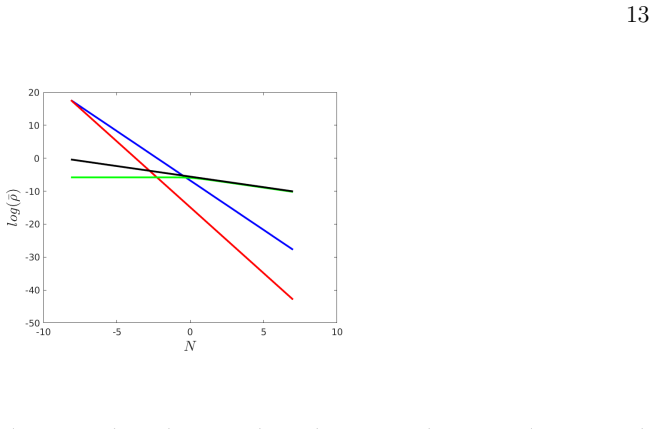
During radiation, the real quintessential-inflation field evolves as if the potential were absent, following $\phi(t)=\phi_{\rm rh}+2\dot\phi_{\rm rh}t_{\rm rh}(1-\sqrt{t_{\rm rh}/t})$ (Eq. 27), so its kinetic energy stays far above its potential energy all the way to matter-radiation equality. The scaling solution, by contrast, has kinetic energy exactly twice its potential energy and $\Omega_\phi=4/\gamma^2$; for the worked example $\gamma=10$ the scaling value is $1/25$, while the real field has $\Omega_\phi\sim 10^{-38}$ at equality. Thus the real solution does not belong to the basin of attraction of the scaling solution, and the paper concludes that the scaling regime is never reached for the scalar field. With only a single exponential tail of slope $0<\gamma<\sqrt2$, the field later joins the tracker solution and produces late-time acceleration with effective equation of state $w_{\rm eff}=\gamma^2/3-1$.
Load-bearing premise
The argument assumes the exponential tail's potential can be neglected during the entire radiation era, so the field follows $\phi(t)=\phi_{\rm rh}+2\dot\phi_{\rm rh}t_{\rm rh}(1-\sqrt{t_{\rm rh}/t})$; this is verified only for one parameter set ($\gamma=10$, $M=10^{-8}M_{\rm pl}$, $T_{\rm rh}=10^9$ GeV), and for $\gamma$ closer to 2 the potential decays more slowly than the kinetic term, so the field might enter the scaling attractor.
Editorial extensions
If this is right
- A single exponential tail with $0<\gamma<\sqrt2$ can simultaneously satisfy early-universe density bounds and drive late-time acceleration.
- Quintessential inflation models need no double exponential potential and no neutrino coupling to exit scaling behavior.
- The field's density parameter at matter-radiation equality is extremely small, around $\Omega_\phi\sim10^{-38}$ for the worked example, safely below BBN and recombination bounds.
- At late times the field converges to the tracker solution, with the effective equation of state approaching $\gamma^2/3-1$, about $-0.786$ for the chosen $\gamma=0.8$.
Reading between the lines
- If the central claim holds, the known double-exponential and neutrino-coupling exit mechanisms are unnecessary in quintessential inflation; the inflationary initial conditions already place the field outside the scaling basin.
- This also suggests a model-building simplification: a steep tail with $\gamma>2$ is not needed for an intermediate scaling epoch, so a single tracker tail with $0<\gamma<\sqrt2$ suffices.
- A concrete extension would be to scan reheating temperatures and slopes $\gamma$ to map where the potential-free radiation solution (Eq. 27) breaks down and the field actually approaches the scaling attractor.
Signed reviews
Editorial analysis
A structured set of objections, weighed in public.
Referee Report
Summary. The paper studies scaling and tracker solutions for a quintessence field with an exponential potential in the context of quintessential inflation. Section II derives the standard radiation scaling solution for γ>2 and the late-time tracker solution for 0<γ<√6. Section III argues that, because the field starts from inflationary initial conditions and passes through a kination phase, at the beginning of radiation it is far from the scaling solution and, according to the paper, never enters the basin of attraction of that solution during the whole radiation epoch; the argument uses the approximation of neglecting the potential, Eq. (27), and is illustrated numerically for γ=10, giving Ω_φ(eq) ≈ 5.84×10^-38. Section IV constructs a viable model with a shallow exponential tail (γ=0.8) whose late-time trajectory converges to the tracker solution. The abstract concludes that a single exponential tail suffices for quintessential inflation, so no double exponential potential or neutrino coupling is needed to exit the scaling regime.
Significance. If the universal claim in Section III is correct, the paper makes a genuinely useful simplification: quintessential inflation with an exponential tail resolves the 'exit from scaling' problem by initial conditions alone, removing two common model-building mechanisms. The Section II derivations are standard and correct, and the reported numerical value Ω_φ(eq) ≈ 5.8×10^-38 is consistent with the analytic estimate, which is a point in the paper's favor. The model in Section IV also works as presented, with the tracker convergence clearly demonstrated. However, the paper's main contribution is the claim that the scaling regime is never reached for any γ>2, and that claim is currently supported only for one steep value, γ=10. Since the claimed universality is exactly what makes the result significant, the missing analysis for γ near 2 is load-bearing rather than cosmetic.
major comments (3)
- [Section III, Eqs. (27)-(30)] The central claim that the scaling regime is never reached rests on dropping V(φ) during the whole radiation epoch and using Eq. (27). This approximation is validated only a posteriori for the single parameter set γ=10, M=10^-8 M_pl, T_rh=10^9 GeV. For the same parameters with γ close to 2, using the trajectory predicted by Eq. (27), the ratio at matter-radiation equality is V(φ_eq)/ρ_eq = (6×10^-43 e^{-25.23γ})/(2.48×10^-110) ≈ 2.4×10^67 e^{-25.23γ}, which exceeds unity for γ≲6. Thus for γ just above 2 the potential would dominate long before equality, Eq. (27) is invalid, and the possibility of approaching the scaling attractor is not excluded. The universal statement in the abstract and in Section III therefore needs either an analytic basin-of-attraction proof or a parameter scan covering γ near 2.
- [Section III.1, Figs. 1 and 2] The numerical integration is performed only for γ=10. Since the autonomous system (7) has an attractor at (x̃,ỹ)=(2√(2/3)/γ, 2/(√3 γ)) for every γ>2, whether a given kination-era trajectory falls into its basin can depend on γ. A single trajectory cannot establish the paper's 'never reached for the scalar field' conclusion for all γ>2. The authors should either scan γ values, in particular γ in (2,6), or supply a rigorous basin-of-attraction argument that does not rely on the potential being negligible.
- [Section III, Eq. (26) and surrounding text] The argument that the real solution cannot coincide with the scaling solution at reheating because this would require M≫M_pl is not sufficient to prove that the trajectory remains outside the basin of attraction; a solution that differs from an attractor at one instant may converge to it later. The no-basin conclusion therefore depends entirely on the validity of Eq. (27) throughout radiation, which, as noted above, is demonstrated only for large γ. This logical gap should be addressed explicitly.
minor comments (3)
- [Section III, paragraph before Eq. (27)] The phrase 'on could continue disregarding the potential' appears to contain a typo: it should read 'one could continue disregarding the potential.'
- [Section III.1] The word 'analsysi' in 'A remarkable conclusion from our analsysi' is a typo for 'analysis.'
- [Section III, Eq. (30)] The order-of-magnitude statement V(φ_eq) ≪ φ̇_eq²/2 is verified only for γ=10; for smaller γ the same inequality should be checked quantitatively, since it is exactly the condition that fails near γ≈6.
Circularity Check
No significant circularity: the non-scaling result follows from stated kination initial conditions and standard equations; the universal claim for all gamma>2 is under-supported but not circular.
full rationale
The derivation that the scalar field at reheating is far from the scaling attractor and remains so through radiation is not circular. The field value and velocity at reheating (Eqs. (22)-(23)) follow from the kination solution (20) and the assumed reheating temperature; Eq. (27) is the explicit solution of the Klein-Gordon equation with the potential neglected; Eqs. (28)-(29) evaluate it at matter-radiation equality; and the resulting Omega_phi,eq ~ 1e-38 is checked numerically for gamma=10 (Figs. 1-2). Lambda is fixed by CMB normalization (17) and M=1e-8 M_pl is chosen to allow kination, but neither parameter is fitted to Omega_phi,eq: the analytical estimate of Omega_phi,eq depends on these parameters only logarithmically through phi_rh, not as a best fit to the target quantity. The self-citations are not load-bearing: Ref. [20] supplies the reheating-temperature input and Ref. [21]'s gamma in (0,sqrt(2)) range is independently re-derived in Eq. (14) via weff = gamma^2/3 - 1. No equation reduces to its own input by construction and no fitted parameter is renamed as a prediction. The paper's universal statement 'the scaling regime is never reached' for all gamma>2 is stronger than what is demonstrated—Eq. (30) checks only gamma=10, and for gamma near 2 the neglected potential can grow relative to the kinetic term before equality—but this is a robustness/correctness concern, not circularity.
Assumptions & free parameters
free parameters (4)
- lambda =
~6e-11
- gamma =
10 (illustrative scaling case); 0.8 (viable model)
- M (mass scale in the potential) =
M = 1e-8 M_pl in Sec. III; \bar{M} = 9.48e-4 in Sec. IV
- T_rh (reheating temperature) =
~1e9 GeV
assumptions (6)
- standard math FLRW geometry with Friedmann and Klein-Gordon equations governs the background dynamics.
- domain assumption The universe contains radiation, matter, and a canonical scalar field with an exponential potential V = V0 e^{-gamma phi/M_pl}.
- domain assumption The quintessential inflation potential is the matched potential of Eq. (15), with an exponential SUSY inflation piece and an exponential tail.
- domain assumption The scalar field potential can be neglected during kination and throughout the radiation era, so Eq. (27) gives the field's evolution.
- domain assumption Reheating occurs via instant preheating at T_rh ~ 1e9 GeV with no energy drop between the end of inflation and the start of kination.
- standard math The slow-roll formulas n_s ~ 1 - 2/N and r ~ 8/N^2 hold for the SUSY inflation piece.
Cite this review
Pith. "Pith review of Scaling solutions in quintessential inflation." pith.science (2026). https://pith.science/paper/224IE6WY
@misc{pith2026190801516,
  author       = {Pith},
  title        = {Pith review of: Scaling solutions in quintessential inflation},
  year         = {2026},
  howpublished = {\url{https://pith.science/paper/224IE6WY}},
  note         = {Machine review of arXiv:1908.01516}
}
read the original abstract
In quintessence scalar field theories, the presence of scaling solutions are important during the radiation and matter epoch due to having their attractor character. Usually, it is assumed that the initial conditions of the quintessence field are in the basin of attraction of the scaling solutions. However, in order to reproduce the current cosmic acceleration, at late times, a mechanism to exit this behavior is needed. In the present work we show that the quintessential inflation models could be an excellent candidate to exhibit the above behavior. However, the crucial point of quintessential inflation is that the initial conditions has to be taken during the inflation, and at the beginning of the radiation era, the scalar field does not belong to the basin of attraction of the scaling solution. This means that, in the case where quintessence is depicted via exponential potentials, only a single exponential in the tail of the { quintessential inflation} potential is enough to depict the evolution of our universe.
Figures


Figures from the paper (1 more)

Forward citations
Cited by 1 Pith paper
-
Solving an Interacting Quintessence Model with a Sound Horizon Initial Condition and its Observational Constraints
An interacting quintessence model with initial conditions set by the CMB sound horizon angle increases H0 with coupling strength, but observational constraints show it does not resolve the H0 or S8 tensions.
Reference graph
Works this paper leans on
-
[1]
Guth, The inflationary universe: a possible solution to the horizon and flatness problems , Phys
A. Guth, The inflationary universe: a possible solution to the horizon and flatness problems , Phys. Rev. D 23, 347 (1981)
work page 1981
-
[2]
The first exponential function of this double exponential potential dominates during the radiation dominated era and the second exponential potential dominates during the matter dominated era [8], and gives an effective γ(ϕ) varying smoothly between two desired values. Alternatively, one could introduce a non-minimal coupling between the quintessence field a...
work page 2018
-
[3]
Finally, in Section V, we present the conclusions of our work. The units used throughout the paper are, ℏ =c = 1, and we denote the reduced Planck’s mass by Mpl≡ 1√ 8πG ∼= 2.44× 10¹⁸ GeV. II. SCALING AND TRACKER SOLUTIONS Assuming, as usual, the flat Friedmann-Lemaˆ ıtre-Robertson-Walker (FLRW) geometry of our universe, in this Section we consider an expon...
work page 2017
-
[4]
A. Linde, A new inflationary universe scenario: A possible solution of the horizon, flatness, homogeneity, isotropy and primordial monopole problems , Phys. Lett. B 108, 389 (1982)
work page 1982
-
[5]
R. R. Caldwell, R. Dave and P. J. Steinhardt, Cosmological imprint of an energy component with general equation of state, Phys. Rev. Lett. 80, 1582 (1998) [astro-ph/9708069]
arXiv 1998
-
[6]
E. J. Copeland, M. Sami and S. Tsujikawa, Dynamics of dark energy , Int. J. Mod. Phys. D 15, 1753 (2006) [arXiv:0603057]
work page 2006
-
[7]
C. Q. Geng, C. C. Lee, M. Sami, E. N. Saridakis and A. A. Starobinsky, Observational constraints on successful model of quintessential Inflation, JCAP 1706, no. 06, 011 (2017) [arXiv:1705.01329 [gr-qc]]
arXiv 2017
-
[8]
P. J. Steinhardt, L. M. Wang and I. Zlatev, Cosmological tracking solutions, Phys. Rev. D 59, 123504 (1999) [astro-ph/9812313]
arXiv 1999
Show all 37 references
-
[9]
Ratra and P
B. Ratra and P. J. E. Peebles, Cosmological consequences of a rolling homogeneous scalar field, Phys. Rev. D 37, 3406 (1988). 16
1988
-
[10]
Barreiro, E
T. Barreiro, E. J. Copeland and N. J. Nunes, Quintessence arising from exponential potentials, Phys. Rev. D 61, 127301 (2000) [arXiv:9910214]
2000
-
[11]
C. Q. Geng, Md. W. Hossain, R. Myrzakulov, M. Sami and E. N. Saridakis, Quintessential inflation with canonical and noncanonical scalar fields and Planck 2015 results , Phys. Rev. D 92, 023522 (2015) [arXiv:1502.03597 [gr-qc]]
2015 arXiv
-
[12]
P. J. E. Peebles and A. Vilenkin, Quintessential inflation , Phys. Rev. D 59, 063505 (1999) [arXiv:9810509]
1999
-
[13]
Dimopoulos and J
K. Dimopoulos and J. W. F. Valle, Modeling Quintessential Inflation , Astropart. Phys. 18, 287 (2002) [arXiv:0111417]
2002
-
[14]
Md. W. Hossain, R. Myrzakulov, M. Sami and E. N. Saridakis, A class of quintessential inflation models with parameter space consistent with BICEP2 , Phys. Rev. D 89, 123513 (2014) [arXiv:1404.1445 [gr-qc]]
2014 arXiv
-
[15]
de Haro, J
J. de Haro, J. Amor´ os and S. Pan,Simple inflationary quintessential model , Phys. Rev. D 93, 084018 (2016) [arXiv:1601.08175]
2016 arXiv
-
[16]
de Haro and E
J. de Haro and E. Elizalde, Inflation and late-time acceleration from a double-well potential with cosmological constant, Gen. Rel. Grav. 48, no. 6, 77 (2016) [arXiv:1602.03433 [gr-qc]]
2016 arXiv
-
[17]
de Haro, On the viability of quintessential inflation models from observational data, Gen
J. de Haro, On the viability of quintessential inflation models from observational data, Gen. Rel. Grav. 49, no. 1, 6 (2017) [arXiv:1602.07138 [gr-qc]]
2017 arXiv
-
[18]
de Haro, J
J. de Haro, J. Amor´ os and S. Pan, Simple inflationary quintessential model II: Power law potentials, Phys. Rev. D 94, 064060 (2016) [arXiv:1607.06726]
2016 arXiv
-
[19]
de Haro and L
J. de Haro and L. Arest´ e Sal´ o,Reheating constraints in quintessential inflation, Phys. Rev. D 95, no. 12, 123501 (2017) [arXiv:1702.04212 [gr-qc]]
2017 arXiv
-
[20]
Arest´ e Sal´ o and J
L. Arest´ e Sal´ o and J. de Haro,Quintessential inflation at low reheating temperatures, Eur. Phys. J. C 77, no. 11, 798 (2017) [arXiv:1707.02810 [gr-qc]]
2017 arXiv
-
[21]
Haro and S
J. Haro and S. Pan, Bulk viscous quintessential inflation, Int. J. Mod. Phys. D 27, no. 05, 1850052 (2018) [arXiv:1512.03033 [gr-qc]]
2018 arXiv
-
[22]
Haro, Different reheating mechanisms in quintessence inflation , Phys
J. Haro, Different reheating mechanisms in quintessence inflation , Phys. Rev. D99, 043510 (2019) [arXiv:1807.07367]
2019 arXiv
-
[23]
J. Haro, J. Amor´ os and S. Pan,The Peebles - Vilenkin quintessential inflation model revisited , Eur. Phys. J. C 79, no. 6, 505 (2019) [arXiv:1901.00167 [gr-qc]]
2019 arXiv
-
[24]
E. D. Stewart, Inflation, supergravity and superstrings , Phys. Rev. D 51, 6847 (1995) 17 [arXiv:9405389]
1995
-
[25]
Akrami et al., Planck 2018 results
Y. Akrami et al., Planck 2018 results. X. Constraints on inflation , [arXiv:1807.06211]
2018 arXiv
-
[26]
Akrami et al., Planck 2018 results
Y. Akrami et al., Planck 2018 results. VI. Cosmological parameters , [arXiv:1807.06209]
2018 arXiv
-
[27]
Joyce, Electroweak Baryogenesis and the Expansion Rate of the Universe , Phys
M. Joyce, Electroweak Baryogenesis and the Expansion Rate of the Universe , Phys. Rev. D 55, 1875 (1997) [arXiv:9606223]
1997
-
[28]
L. A. Ure˜ na-L´ opez and T. Matos,A New cosmological tracker solution for quintessence, Phys. Rev. D 62, 081302 (2000) [astro-ph/0003364]
2000 arXiv
-
[29]
Martin, C
J. Martin, C. Ringeval and V. Vennin, Encyclopaedia Inflationaris, Phys. Dark Univ. 5-6, 75 (2014) [arXiv:1303.3787]
2014 arXiv
-
[30]
J. Haro, W. Yang and S. Pan, Reheating in quintessential inflation via gravitational pro- duction of heavy massive particles: A detailed analysis , JCAP 1901, no. 01, 023 (2019) [arXiv:1811.07371 [gr-qc]]
2019 arXiv
-
[31]
Hashiba and J
S. Hashiba and J. Yokoyama, Gravitational reheating through conformally coupled superheavy scalar particles, JCAP 01, 028 (2019) [arXiv:1809.05410]
2019 arXiv
-
[32]
Felder, L
G. Felder, L. Kofman and A. Linde, Instant Preheating, Phys. Rev. D 59, 123523 (1999) [arXiv:9812289]
1999
-
[33]
Felder, L
G. Felder, L. Kofman and A. Linde, Inflation and Preheating in NO models , Phys. Rev. D 60, 103505 (1999) [arXiv:9903350]
1999
-
[34]
Rehagen and G
T. Rehagen and G. B. Gelmini, Low reheating temperatures in monomial and binomial infla- tionary potentials , JCAP 06, 039 (2015) [arXiv:1504.03768]
2015 arXiv
-
[35]
R. Bean, S. H. Hansen and A. Melchiorri, Early-universe constraints on a Primordial Scaling Field Phys. Rev. D 64, 103508 (2001) [arXiv:0104162]
2001
-
[36]
P. A. R. Ade et al., Planck 2015 results. XIII. Cosmological parameters , Astron & Astrophys 594, A13 (2016) [arXiv:1502.01589]
2016 arXiv
-
[37]
Aghanim et al
N. Aghanim et al. [Planck Collaboration], Planck 2018 results. V. CMB power spectra and likelihoods, arXiv:1907.12875 [astro-ph.CO]
2018 arXiv
Reviewed August 14, 2026 · model on record in the stance chip above.
Discussion (0). Continue with ORCID to comment.