REVIEW 4 major objections 4 minor 69 references
Efficient and Scalable Estimation of Distributional Treatment Effects with Multi-Task Neural Networks
T0 review · 4 major / 4 minor · reviewed 2026-08-06 · deepseek-v4-flash
Pith's one-line read A single multi-task neural network with a monotonic output layer estimates distributional treatment effects at all thresholds at once, cutting MSE by 50–65% and replacing many separate regressions.
desk verdict Solid applied paper: new monotonic multi-task NN for regression-adjusted DTE, backed by credible simulations and two real experiments; the main gap is that the efficiency theory covers only the oracle adjustment, not the feasible NN estimator. read the letter →
The pith
A machine-rendered reading of the paper's core claim, the machinery that carries it, and where it could break.
The reading
What carries the argument
The load-bearing object is the regression-adjusted CDF estimator in equation (1), combined with a multi-task neural network that outputs all thresholds at once. The network's last hidden layer computes non-negative values \(g(h^H_m)\), forms cumulative sums \(\tilde h^H_j = \sum_{m\le j} g(h^H_m)\), and maps them through a monotone function \(f\), so the \(M\) output probabilities are automatically nondecreasing in the threshold. This cumulative-sum layer is the mechanism that enforces the shape constraint by construction rather than by post-hoc correction. The efficiency argument rests on Assumption 3, that the cost \(\tilde P\) of training one multi-output model is \(o(P\cdot M)\), the cost of training \(M\) separate models; the paper verifies this theoretically for linear regression and reports operation counts for several network architectures, while noting that boosting trees do not satisfy it.
What would settle it
On the same hardware, fold split, and threshold grid used in the paper's streaming-platform experiment, train the proposed multi-task network and \(M\) single-task networks with identical architecture and measure total wall-clock time; if the multi-task run is not cheaper than the sum of the single-task runs, Assumption 3 fails for the method as implemented.
Extended reading notes
Core claim
The central claim is that distributional treatment effects can be estimated by rewriting the task as a single multi-label classification problem: for each treatment group, one neural network predicts the conditional probability \(\$gamma^{{(w)}}$_y(X) = \Pr($Y^{{(w)}}$\le y\mid X)\) at every threshold \(y\in\tilde{\mathcal Y}\) simultaneously, and these predictions are plugged into the regression-adjusted estimator \(\hat F_{$Y^{{(w)}}$}(y) = $n_w^{{-1}}$\sum_{i:W_i=w}(\mathbf{1}\{Y_i\le y\}-\hat\$gamma^{{(w)}}$_y(X_i)) + $n^{{-1}}$\sum_i\hat\$gamma^{{(w)}}$_y(X_i)\). The final layer accumulates non-negative hidden units with a cumulative sum before a monotone link, guaranteeing \(\hat F(y_s)\ge \hat F(y_t)\) whenever \(y_s\ge y_t\). The authors argue that joint training shares statistical strength across thresholds — helping where labels are imbalanced, such as at the 90th percentile — and that, under a sublinear-cost assumption on multi-output training, one network is far cheaper than \(M\) single-task networks. Their simulations show a 50–65% MSE reduction over the unadjusted empirical estimator and a roughly 80% runtime saving over single-task adjustment, and the two real experiments show standard-error reductions of 0–30% and 0–16%.
Load-bearing premise
The scalability claim rests on Assumption 3: that a single multi-task model for all thresholds can be trained at strictly less cost than one model per threshold; the paper proves this for linear regression and reports operation counts for generic architectures, but does not verify it for the actual networks used in its experiments, and notes that boosting trees violate it.
Editorial extensions
If this is right
- Distributional treatment effects become practical at industrial scale: instead of \(M\) regression fits, one network fit supplies all threshold probabilities, and the runtime gap grows with \(M\).
- Tail regions, where labels are imbalanced and single-task models struggle, receive the largest variance reduction, so the method is most useful when rare outcomes or extreme quantiles matter.
- Because the monotonic constraint is enforced by construction, the fitted CDF estimates are always nondecreasing in the threshold, removing a common source of irregular estimates and improving interpretability.
- The same estimator extends to any functional of CDFs, such as interval probabilities (PTE), so applied users get a whole distributional summary from one training run instead of separate analyses.
Reading between the lines
- If Assumption 3 holds generally, the computational advantage should grow with the number of thresholds \(M\), making the method increasingly attractive for fine grids or continuous outcomes; for very small \(M\), the overhead of a multi-task network may offset the savings.
- The cumulative-sum monotonic layer is a generic device that could be transplanted to other ordered-output problems, such as conditional quantile regression, survival curves, or calibration of probabilistic classifiers, where monotonicity is structural.
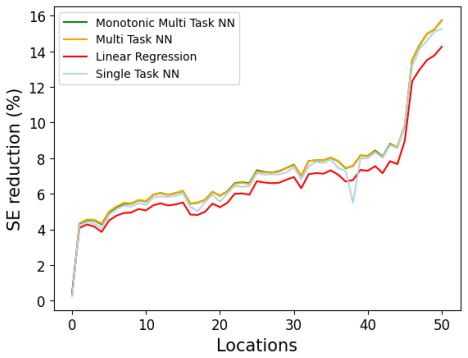
- The streaming-platform experiment shows almost no gain from the monotonic constraint at roughly 4.3 million observations, suggesting the constraint's value is concentrated in smaller samples and tail regions; practitioners with very large data might reasonably drop it to save tuning effort.
- A testable next step is to compare the calibration of the multi-task predictions against observed frequencies; if shared representations improve calibration as well as variance, the confidence bands would be expected to show better coverage than the standard-error comparison alone indicates.
Editorial analysis
A structured set of objections, weighed in public.
Referee Report
Summary. The paper proposes a multi-task neural network (NN) regression-adjustment estimator for distributional treatment effects (DTE) in randomized experiments. The method reformulates conditional CDF estimation at multiple outcome thresholds as multi-label classification, trains a single network for all thresholds, and enforces monotonicity across thresholds via a cumulative-sum construction. The authors present a theorem on variance reduction for an infeasible oracle estimator that uses the true conditional CDF, and they evaluate the feasible estimator in a Monte Carlo simulation and two real applications: a water conservation field experiment and a large-scale ABEMA streaming A/B test. They report 50-65% MSE reductions relative to the empirical estimator in simulation, 0-30% and 0-16% SE reductions in the two real applications, and computational speedups of roughly 71-93% over single-task NN adjustment.
Significance. If the empirical claims hold, the paper makes a useful practical contribution: a computationally cheaper regression-adjustment method for DTE in large randomized experiments, with an open-source Python implementation and a reproducible public-data experiment. The strengths include the clear randomized-experiment setting, the honest reporting of some negative results (e.g., the monotonic constraint's lack of benefit in the ABEMA data), and the use of cross-fitting and multiplier bootstrap in the empirical studies. However, the main theoretical support (Theorem 1) applies only to an infeasible oracle estimator, and no theoretical rate or finite-sample guarantee is provided for the neural-network nuisance estimator actually used. The efficiency claim therefore rests on empirical evidence that currently lacks uncertainty quantification, and the scalability claim rests on an assumption not directly verified for the deployed model.
major comments (4)
- [Section 4.2, Eq. (1), Theorem 1] Theorem 1 establishes variance reduction only for the infeasible estimator that plugs in the true conditional distribution gamma; the feasible estimator in Eq. (1) replaces gamma with a multi-task neural network, and no theorem or rate condition shows that this replacement preserves the variance reduction or makes the multiplier bootstrap in Appendix C asymptotically valid. Standard DML theory requires the nuisance estimator to converge sufficiently fast (e.g., o(n^{-1/4}) in the relevant norm), and the paper neither verifies such a rate for the three-layer network nor cites NN-specific DML results. Because Sections 5.2 and 5.3 report bootstrap SE reductions as evidence, this gap is load-bearing for the central efficiency claim.
- [Section 4.2, Assumption 3, Table 1] The computational-efficiency and scalability claims rest on Assumption 3, that a single multi-task model can be trained at sublinear cost in the number of thresholds M compared with M separate models. Appendix G.1 proves this for multivariate linear regression and Table A8 reports MAC counts for generic architectures, but the actual multi-task NN used in Sections 5.2 and 5.3 is not tested for how its wall-clock training time scales with M under the cross-fitting scheme; Table 1 reports only fixed-M comparisons at one M per experiment. A direct measurement of training time versus M (with folds, epochs, and batch size held fixed) is needed to substantiate the 'scalable' characterization, especially because the text notes that boosting trees do not satisfy Assumption 3.
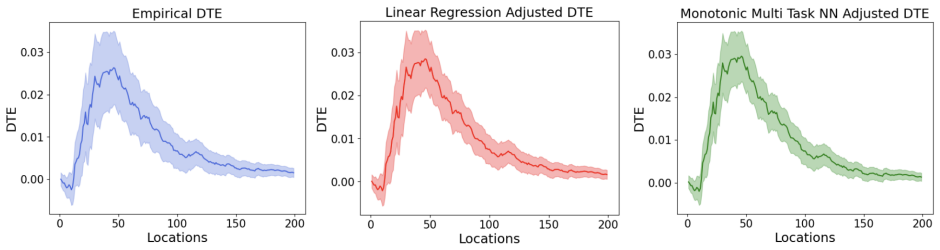
- [Sections 5.1-5.3, Figure 3, Table A3-A7] The reported MSE and SE reductions are point estimates without Monte Carlo confidence intervals. For the simulation with S=500, standard errors of the MSE reductions are directly computable; for the real-data SE reductions based on B=5,000 multiplier draws, the bootstrap itself has simulation error. Without uncertainty intervals, it is hard to judge whether the differences between methods (e.g., multi-task versus single-task) are statistically meaningful, particularly in the water data where the summary distributions overlap substantially.
- [Section 5.3, Table A7, Conclusion] The monotonic constraint provides no clear improvement in the ABEMA experiment (Table A7 shows nearly identical SE reductions for multi-task and monotonic multi-task), and the text concedes this. Nevertheless, the abstract and conclusion attribute precision enhancement to the monotonic shape constraint. The claim should be qualified to settings where the constraint actually helps, or presented as a secondary contribution rather than a general advantage.
minor comments (4)
- [Section 5.1] The sentence 'Since all estimators used in the experiment are unbiased' is asserted without proof for the NN-based estimators; under cross-fitting, unbiasedness is not immediate and should be either proven or replaced by a statement about approximate unbiasedness.
- [Appendix G.2] Table A8 reports MAC counts, which are an analytical proxy, but the text says the sub-linear assumption is 'empirically validate[d]'; MAC counts do not measure wall-clock training time and should be described as architectural complexity evidence rather than empirical validation.
- [Table A2] The relationship between the last hidden layer size h3 and the number of locations M should be stated explicitly: for the water experiment h3=200 and for ABEMA h3=51, which appear equal to M, but the simulation's h3=19 equals the number of quantiles; clarifying this avoids confusion about whether the architecture changes with M.
- [Figure 5] The pointwise SE reductions are computed across 200 locations in the water experiment, but no adjustment is made for multiple comparisons or for dependence across thresholds; a sentence acknowledging this would help the reader interpret the claimed improvements.
Circularity Check
No significant circularity: the central estimator is benchmarked externally and the oracle theorem is proved in-appendix.
full rationale
The paper's central claim is empirical: the multi-task neural-network adjustment reduces DTE MSE/SE relative to the empirical estimator. That claim is tested against a Monte Carlo ground truth from 10^5 fresh samples, the public Ferraro and Price water data, and an internal ABEMA experiment; no parameter is fitted to the target DTE and then reported as a prediction. The only theoretical efficiency result, Theorem 1, concerns the infeasible oracle estimator that uses the true conditional CDF, and although its proof begins by citing the authors' prior work [8], the full proof is supplied in Appendix B using an elementary Lagrange/Bergstrom lemma, so the citation is not load-bearing. The feasible estimator's theoretical gap (no rate condition for the NN nuisance) and Assumption 3's lack of verification for the exact NN architecture are genuine correctness risks, but they are not circularity: they are missing support for an external benchmark claim, not an input redefined as an output. No equation in the paper reduces by construction to a fitted quantity or to a self-citation chain.
Assumptions & free parameters
free parameters (1)
- Neural network hyperparameters (learning rate, batch size, hidden sizes, folds) =
See Table A2 (e.g., lr 0.01/0.001, batch 16/64/128, L=2)
assumptions (4)
- domain assumption Assumption 1 and 2: unconfoundedness and overlap of treatment assignment
- ad hoc to paper Assumption 3: multi-task model training cost is sublinear in the number of target variables
- standard math DML regularity conditions from Chernozhukov et al. (2018)
- standard math Monotonicity of the true conditional CDF in y
Cite this review
Pith. "Pith review of Efficient and Scalable Estimation of Distributional Treatment Effects with Multi-Task Neural Networks." pith.science (2026). https://pith.science/paper/22AE3FIY
@misc{pith2026250707738,
  author       = {Pith},
  title        = {Pith review of: Efficient and Scalable Estimation of Distributional Treatment Effects with Multi-Task Neural Networks},
  year         = {2026},
  howpublished = {\url{https://pith.science/paper/22AE3FIY}},
  note         = {Machine review of arXiv:2507.07738}
}
read the original abstract
We propose a novel multi-task neural network approach for estimating distributional treatment effects (DTE) in randomized experiments. While DTE provides more granular insights into the experiment outcomes over conventional methods focusing on the Average Treatment Effect (ATE), estimating it with regression adjustment methods presents significant challenges. Specifically, precision in the distribution tails suffers due to data imbalance, and computational inefficiencies arise from the need to solve numerous regression problems, particularly in large-scale datasets commonly encountered in industry. To address these limitations, our method leverages multi-task neural networks to estimate conditional outcome distributions while incorporating monotonic shape constraints and multi-threshold label learning to enhance accuracy. To demonstrate the practical effectiveness of our proposed method, we apply our method to both simulated and real-world datasets, including a randomized field experiment aimed at reducing water consumption in the US and a large-scale A/B test from a leading streaming platform in Japan. The experimental results consistently demonstrate superior performance across various datasets, establishing our method as a robust and practical solution for modern causal inference applications requiring a detailed understanding of treatment effect heterogeneity.
Figures


Figures from the paper (5 more)


Reference graph
Works this paper leans on
-
[1]
Bootstrap tests for distributional treatment effects in instrumental variable models
Alberto Abadie. Bootstrap tests for distributional treatment effects in instrumental variable models. Journal of the American Statistical Association, 97:284–292, 2002
work page 2002
-
[2]
Andreas Argyriou, Theodoros Evgeniou, and Massimiliano Pontil. Multi-task feature learning. Ad- vances in Neural Information Processing Systems, 19:41–48, 2007
work page 2007
-
[3]
Susan Athey and Guido W. Imbens. Identification and inference in nonlinear difference-in-differences models. Econometrica, 74:431–497, 2006
work page 2006
-
[4]
Richard E. Barlow. Statistical inference under order restrictions : the theory and application of iso- tonic regression. Wiley, 1972
work page 1972
-
[5]
Program evalu- ation and causal inference with high-dimensional data
Alexandre Belloni, Victor Chernozhukov, Ivan Fernandez-Val, and Christian Hansen. Program evalu- ation and causal inference with high-dimensional data. Econometrica, 85(1):233–298, 2017
work page 2017
-
[6]
Covari- ance adjustments for the analysis of randomized field experiments
Richard Berk, Emil Pitkin, Lawrence Brown, Andreas Buja, Edward George, and Linda Zhao. Covari- ance adjustments for the analysis of randomized field experiments. Evaluation review, 37:170–196, 2013
work page 2013
-
[7]
On efficient estimation of distri- butional treatment effects under covariate-adaptive randomization
Undral Byambadalai, Tomu Hirata, Tatsushi Oka, and Shota Yasui. On efficient estimation of distri- butional treatment effects under covariate-adaptive randomization. arXiv preprint arXiv:2506.05945, 2025
arXiv 2025
-
[8]
Undral Byambadalai, Tatsushi Oka, and Shota Yasui. Estimating distributional treatment effects in randomized experiments: Machine learning for variance reduction. 2024
work page 2024
Show all 69 references
-
[9]
Quantile treatment effects in difference in differences models with panel data
Brantly Callaway and Tong Li. Quantile treatment effects in difference in differences models with panel data. Quantitative economics, 10:1579–1618, 2019
2019
-
[10]
Quantile treatment effects in difference in differences models under dependence restrictions and with only two time periods
Brantly Callaway, Tong Li, and Tatsushi Oka. Quantile treatment effects in difference in differences models under dependence restrictions and with only two time periods. Journal of Econometrics , 206(2):395–413, 2018
2018
-
[11]
Multitask learning
Rich Caruana. Multitask learning. Machine Learning, 28(1):41–75, 1997
1997
-
[12]
Double/debiased machine learning for treatment and structural parameters
Victor Chernozhukov, Denis Chetverikov, Mert Demirer, Esther Duflo, Christian Hansen, Whitney Newey, and James Robins. Double/debiased machine learning for treatment and structural parameters. The Econometrics Journal, 21(1):C1–C68, 01 2018
2018
-
[13]
Locally robust semiparametric estimation
Victor Chernozhukov, Juan Carlos Escanciano, Hidehiko Ichimura, Whitney K Newey, and James M Robins. Locally robust semiparametric estimation. Econometrica, 90(4):1501–1535, 2022
2022
-
[14]
Inference on counterfactual distributions
Victor Chernozhukov, Iv´an Fern´andez-Val, and Blaise Melly. Inference on counterfactual distributions. Econometrica, 81(6):2205–2268, 2013
2013
-
[15]
Inference on counterfactual distributions
Victor Chernozhukov, Iv´an Fern´andez-Val, and Blaise Melly. Inference on counterfactual distributions. Econometrica, 81:2205–2268, 2013
2013
-
[16]
Generic inference on quantile and quantile effect functions for discrete outcomes
Victor Chernozhukov, Iv ´an Fern ´andez-Val, Blaise Melly, and Kaspar W ¨uthrich. Generic inference on quantile and quantile effect functions for discrete outcomes. Journal of the American Statistical Association, 115:123–137, 2020. 14
2020
-
[17]
An iv model of quantile treatment effects
Victor Chernozhukov and Christian Hansen. An iv model of quantile treatment effects. Econometrica, 73:245–261, 2005
2005
-
[18]
The econometrics of shape restrictions
Denis Chetverikov, Andres Santos, and Azeem M Shaikh. The econometrics of shape restrictions. Annual review of economics, 10:31–63, 2018
2018
-
[19]
Chipman, Edward I
Hugh A. Chipman, Edward I. George, and Robert E. McCulloch. Bart: Bayesian additive regression trees. The Annals of Applied Statistics, 4(1), March 2010
2010
-
[20]
Shape constraints for set functions
Andrew Cotter, Maya Gupta, Heinrich Jiang, Erez Louidor, James Muller, Tamann Narayan, Serena Wang, and Tao Zhu. Shape constraints for set functions. In International conference on machine learning, pages 1388–1396. PMLR, 2019
2019
-
[21]
Multi-task learning with deep neural networks: A survey
Michael Crawshaw. Multi-task learning with deep neural networks: A survey. CoRR, abs/2009.09796, 2020
2009 arXiv
-
[22]
On label depen- dence and loss minimization in multi-label classification
Krzysztof Dembczy ´nski, Willem Waegeman, Weiwei Cheng, and Eyke H¨ullermeier. On label depen- dence and loss minimization in multi-label classification. Machine Learning, 88:5–45, 2012
2012
-
[23]
Improving the sensitivity of online controlled ex- periments by utilizing pre-experiment data
Alex Deng, Ya Xu, Ron Kohavi, and Toby Walker. Improving the sensitivity of online controlled ex- periments by utilizing pre-experiment data. In Proceedings of the Sixth ACM International Conference on Web Search and Data Mining, pages 123–132. Association for Computing Machin...
2013
-
[24]
Shape-constrained statistical inference
Lutz D ¨umbgen. Shape-constrained statistical inference. Annual review of statistics and its application, 11:373–391, 2024
2024
-
[25]
Ferraro and Michael K
Paul J. Ferraro and Michael K. Price. Using nonpecuniary strategies to influence behavior: Evidence from a large-scale field experiment. The review of economics and statistics, 95:64–73, 2013
2013
-
[26]
Efficient semiparametric estimation of quantile treatment effects
Sergio Firpo. Efficient semiparametric estimation of quantile treatment effects. Econometrica, 75(1):259–276, 2007
2007
-
[27]
The design of experiments
Ronald Aylmer Fisher. The design of experiments. Oliver and Boyd, 2nd ed. edition, 1937
1937
-
[28]
Decomposition methods in economics
Nicole Fortin, Thomas Lemieux, and Sergio Firpo. Decomposition methods in economics. 4:1–102, 2011
2011
-
[29]
Freedman
David A. Freedman. Statistical models for causation: What inferential leverage do they provide? Evaluation review, 30:691–713, 2006
2006
-
[30]
Unconditional quantile treatment effects under endogeneity.Journal of Business & Economic Statistics, 31(3):346–357, 2013
Markus Fr ¨olich and Blaise Melly. Unconditional quantile treatment effects under endogeneity.Journal of Business & Economic Statistics, 31(3):346–357, 2013
2013
-
[31]
Diminishing returns shape constraints for interpretability and regularization
Maya Gupta, Dara Bahri, Andrew Cotter, and Kevin Canini. Diminishing returns shape constraints for interpretability and regularization. Advances in neural information processing systems, 31, 2018
2018
-
[32]
Monotonic calibrated interpolated look-up tables
Maya Gupta, Andrew Cotter, Jan Pfeifer, Konstantin V oevodski, Kevin Canini, Alexander Mangylov, Wojciech Moczydlowski, and Alexander Van Esbroeck. Monotonic calibrated interpolated look-up tables. Journal of Machine Learning Research, 17(109):1–47, 2016
2016
-
[33]
Trevor. Hastie. Generalized additive models. Chapman and Hall, 1st ed edition, 1990
1990
-
[34]
Horowitz and Sokbae Lee
Joel L. Horowitz and Sokbae Lee. Nonparametric estimation and inference under shape restrictions. Journal of econometrics, 201:108–126, 2017. 15
2017
-
[35]
Improving regression performance with distributional losses
Ehsan Imani and Martha White. Improving regression performance with distributional losses. 2018
2018
-
[36]
Imbens and Donald B
Guido W. Imbens and Donald B. Rubin. Causal Inference for Statistics, Social, and Biomedical Sci- ences. Cambridge University Press, 2015
2015
-
[37]
Regression-adjusted estimation of quantile treatment effects under covariate-adaptive randomizations
Liang Jiang, Peter CB Phillips, Yubo Tao, and Yichong Zhang. Regression-adjusted estimation of quantile treatment effects under covariate-adaptive randomizations. Journal of Econometrics , 234(2):758–776, 2023
2023
-
[38]
Localized debiased machine learning: Efficient inference on quantile treatment effects and beyond
Nathan Kallus, Xiaojie Mao, and Masatoshi Uehara. Localized debiased machine learning: Efficient inference on quantile treatment effects and beyond. Journal of Machine Learning Research, 25(16):1– 59, 2024
2024
-
[39]
Trustworthy online controlled experiments : a practical guide to A/B testing
Ron Kohavi. Trustworthy online controlled experiments : a practical guide to A/B testing. Cambridge University Press, 2020
2020
-
[40]
Quantile-optimal treatment regimes
Rui Song Lan Wang, Yu Zhou and Ben Sherwood. Quantile-optimal treatment regimes. Journal of the American Statistical Association, 113(523):1243–1254, 2018. PMID: 30416233
2018
-
[41]
The unfavorable economics of measuring the returns to advertising
Randall A Lewis and Justin M Rao. The unfavorable economics of measuring the returns to advertising. The Quarterly Journal of Economics, 130(4):1941–1973, 2015
1941
-
[42]
Bondell, and Brian J
Rui Li, Howard D. Bondell, and Brian J. Reich. Deep distribution regression, 2019
2019
-
[43]
Agnostic notes on regression adjustments to experimental data: Reexamining freedman’s critique
Winston Lin. Agnostic notes on regression adjustments to experimental data: Reexamining freedman’s critique. The annals of applied statistics, 7:295–318, 2013
2013
-
[44]
List, Ian Muir, and Gregory Sun
John A. List, Ian Muir, and Gregory Sun. Using machine learning for efficient flexible regression adjustment in economic experiments. Econometric reviews, pages 1–39, 2024
2024
-
[45]
Rosa L. Matzkin. Chapter 42 Restrictions of economic theory in nonparametric methods , volume 4, pages 2523–2558. Elsevier B.V , 1994
1994
-
[46]
Regression adjustment for estimating distributional treatment effects in randomized controlled trials
Tatsushi Oka, Shota Yasui, Yuta Hayakawa, and Undral Byambadalai. Regression adjustment for estimating distributional treatment effects in randomized controlled trials. 2024
2024
-
[47]
Pytorch: An imperative style, high-performance deep learning library, 2019
Adam Paszke, Sam Gross, Francisco Massa, Adam Lerer, James Bradbury, Gregory Chanan, Trevor Killeen, Zeming Lin, Natalia Gimelshein, Luca Antiga, Alban Desmaison, Andreas K ¨opf, Edward Yang, Zach DeVito, Martin Raison, Alykhan Tejani, Sasank Chilamkurthy, Benoit Steiner, Lu F...
2019
-
[48]
Rosenbaum
Paul R. Rosenbaum. Covariance adjustment in randomized experiments and observational studies. Statistical science, 17:286–304, 2002
2002
-
[49]
Simple, efficient estimators of treatment effects in randomized trials using generalized linear models to leverage baseline variables
Michael Rosenblum and Mark J van der Laan. Simple, efficient estimators of treatment effects in randomized trials using generalized linear models to leverage baseline variables. The International Journal of Biostatistics, 6:13–Article 13, 2010
2010
-
[50]
Nonparametric estimation of distributional policy effects
Christoph Rothe. Nonparametric estimation of distributional policy effects. Journal of Econometrics, 155(1):56–70, 2010
2010
-
[51]
Estimating causal effects of treatments in randomized and nonrandomized studies
Donald B Rubin. Estimating causal effects of treatments in randomized and nonrandomized studies. Journal of educational psychology, 66:688–701, 1974. 16
1974
-
[52]
Randomization analysis of experimental data: The fisher randomization test com- ment, 1980
Donald B Rubin. Randomization analysis of experimental data: The fisher randomization test com- ment, 1980
1980
-
[53]
An overview of multi-task learning in deep neural networks
Sebastian Ruder. An overview of multi-task learning in deep neural networks. arXiv preprint arXiv:1706.05098, 2017
2017 arXiv
-
[54]
Zlpr: A novel loss for multi-label classification, 2022
Jianlin Su, Mingren Zhu, Ahmed Murtadha, Shengfeng Pan, Bo Wen, and Yunfeng Liu. Zlpr: A novel loss for multi-label classification, 2022
2022
-
[55]
Single-model uncertainties for deep learning
Nadezhda Tagasovska and David Lopez-Paz. Single-model uncertainties for deep learning. In Ad- vances in Neural Information Processing Systems 32, pages 6417–6428, 2019
2019
-
[56]
Overlapping experiment infrastruc- ture: More, better, faster experimentation
Diane Tang, Ashish Agarwal, Deirdre O’Brien, and Mike Meyer. Overlapping experiment infrastruc- ture: More, better, faster experimentation. In Proceedings of the 16th ACM SIGKDD international conference on Knowledge discovery and data mining, pages 17–26, 2010
2010
-
[57]
Deep learning for multi-label learning: A comprehensive survey, 2024
Adane Nega Tarekegn, Mohib Ullah, and Faouzi Alaya Cheikh. Deep learning for multi-label learning: A comprehensive survey, 2024
2024
-
[58]
Tsiatis, Marie Davidian, Min Zhang, and Xiaomin Lu
Anastasios A. Tsiatis, Marie Davidian, Min Zhang, and Xiaomin Lu. Covariate adjustment for two- sample treatment comparisons in randomized clinical trials: A principled yet flexible approach. Statis- tics in medicine, 27:4658–4677, 2008
2008
-
[59]
Nonparametric estimation of conditional quantiles using neural networks
Halbert White. Nonparametric estimation of conditional quantiles using neural networks. In Com- puting Science and Statistics: Statistics of Many Parameters: Curves, Images, Spatial Models , pages 190–199. Springer, 1992
1992
-
[60]
Dnet: Distri- butional network for distributional individualized treatment effects
Guojun Wu, Ge Song, Xiaoxiang Lv, Shikai Luo, Chengchun Shi, and Hongtu Zhu. Dnet: Distri- butional network for distributional individualized treatment effects. In Proceedings of the 29th ACM SIGKDD Conference on Knowledge Discovery and Data Mining , KDD ’23, page 5215–5224, N...
2023
-
[61]
Improving the sensitivity of online controlled experiments: Case studies at netflix
Huizhi Xie and Juliette Aurisset. Improving the sensitivity of online controlled experiments: Case studies at netflix. In Proceedings of the 22nd ACM SIGKDD International Conference on Knowledge Discovery and Data Mining, pages 645–654, 2016
2016
-
[62]
Improving the sensitivity of online controlled experiments: Case studies at netflix
Huizhi Xie and Juliette Aurisset. Improving the sensitivity of online controlled experiments: Case studies at netflix. In Proceedings of the 22nd ACM SIGKDD International Conference on Knowledge Discovery and Data Mining, pages 645–654. ACM, 2016
2016
-
[63]
Daniels, and Almut G
Dandan Xu, Michael J. Daniels, and Almut G. Winterstein. A bayesian nonparametric approach to causal inference on quantiles. Biometrics, 74(3):986–996, 2018
2018
-
[64]
Efficiency study of estimators for a treatment effect in a pretest- posttest trial
Li Yang and Anastasios A Tsiatis. Efficiency study of estimators for a treatment effect in a pretest- posttest trial. The American statistician, 55:314–321, 2001
2001
-
[65]
Deep lattice networks and partial monotonic functions
Seungil You, David Ding, Kevin Canini, Jan Pfeifer, and Maya Gupta. Deep lattice networks and partial monotonic functions. In I Guyon, U V on Luxburg, S Bengio, H Wallach, R Fergus, S Vish- wanathan, and R Garnett, editors, Advances in Neural Information Processing Systems , v...
2017
-
[66]
Multilabel neural networks with applications to functional genomics and text categorization
Min-Ling Zhang and Zhi-Hua Zhou. Multilabel neural networks with applications to functional genomics and text categorization. IEEE Transactions on Knowledge and Data Engineering , 18(10):1338–1351, 2006. 17
2006
-
[67]
A review on multi-label learning algorithms
Min-Ling Zhang and Zhi-Hua Zhou. A review on multi-label learning algorithms. IEEE Transactions on Knowledge and Data Engineering, 26(8):1819–1837, 2014
2014
-
[68]
An overview of multi-task learning
Yu Zhang and Qiang Yang. An overview of multi-task learning. National Science Review, 5(1):30–43, 2018
2018
-
[69]
A survey on multi-task learning
Yu Zhang and Qiang Yang. A survey on multi-task learning. IEEE Transactions on Knowledge and Data Engineering, 34(12):5586–5609, 2021. 18 Appendix The Appendix is structured as follows. Appendix A summarizes the notations used in the main text and the Appendix. Appendix B prov...
2021
Reviewed August 6, 2026 · model on record in the stance chip above.
Discussion (0). Sign in to comment.