REVIEW 3 major objections 4 minor 81 references
Approaching Kasteleyn transition in frustrated quantum Heisenberg antiferromagnets
T0 review · 3 major / 4 minor · reviewed 2026-08-03 · deepseek-v4-flash
Pith's one-line read A frustrated Heisenberg antiferromagnet can host emergent Kasteleyn criticality through an exact mapping to a tunable monomer-dimer model on the honeycomb lattice.
desk verdict Solid paper: the Kasteleyn crossover in a Heisenberg magnet is convincingly realized; the effective dimer mapping is derived, not fitted, and the only real soft spot is that thermodynamic-limit sharpening is shown for the effective model, not the quantum model. read the letter →
The pith
A machine-rendered reading of the paper's core claim, the machinery that carries it, and where it could break.
The reading
What carries the argument
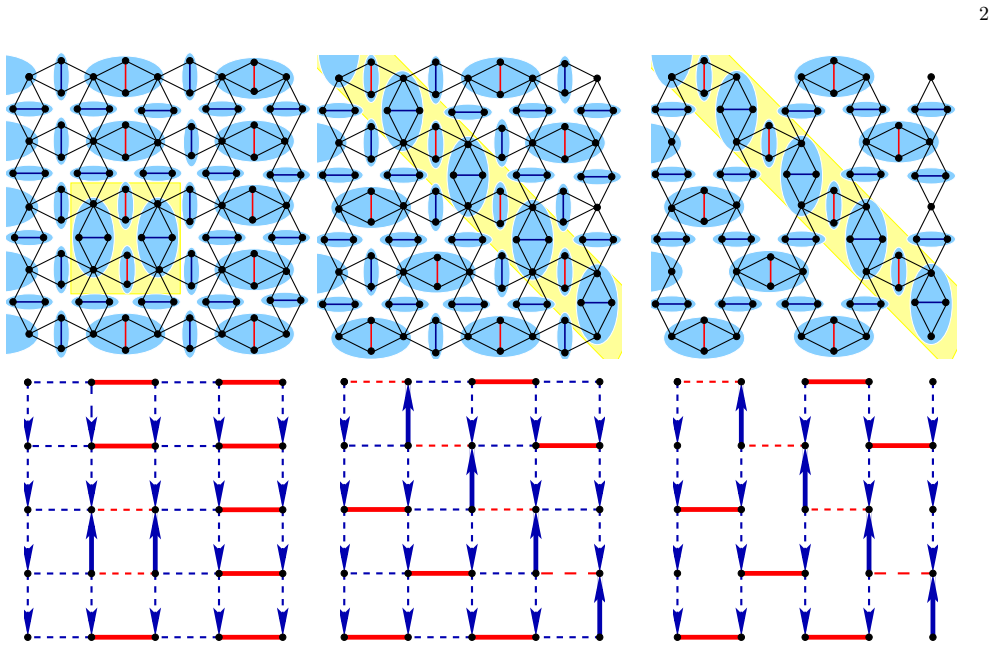
The central object is the effective monomer-dimer model on the anisotropic honeycomb lattice, obtained by identifying each singlet tetramer with a dimer occupying a honeycomb bond, each singlet dimer with an empty bond, and each pair of free spins with a monomer. The partition function is Z = sum_C exp(-N_T Delta'/T) exp(-N_V Delta/T) 2^{N_M}, with Delta = J2 - 2J1 and Delta' = J2' - 2J1, imposing the hard constraint that every site is covered exactly once. This mapping reduces the quantum Heisenberg model to the classical hard-dimer problem, whose exact solution exhibits the Kasteleyn singularity, while the monomer terms enforce Lieb's theorem and convert the singularity into a sharp crosso
What would settle it
Compute the specific heat of the original Heisenberg model at J2 = 1.3, J2' = 1.32 on progressively larger clusters using dimer-basis quantum Monte Carlo down to T around 0.0289: if the low-temperature peak does not sharpen with system size and approach the exact EDM/EMDM predictions, or if triplet-dimer excitations are found to contribute at energies comparable to J2' - J2, the effective monomer-dimer mapping fails.
Extended reading notes
Core claim
The paper's central claim is that the low-temperature thermodynamics of the weakly anisotropic spin-1/2 Heisenberg model on the diamond-decorated honeycomb lattice are accurately captured by an effective monomer-dimer model on the honeycomb lattice. The ground-state singlet tetramers and singlet dimers map onto hard dimers, while pairs of unpaired spins map onto monomers carrying an extra twofold spin degeneracy. The anisotropy J2' - J2 acts as the dimer activity difference, and the exactly solved pure dimer limit gives a specific-heat singularity at the Kasteleyn temperature TK = (J2' - J2)/ln 2. Because the monomer density is finite but tunable to arbitrarily small values, the singularity
Load-bearing premise
The effective monomer-dimer description assumes that the only low-energy degrees of freedom are singlet tetramers, singlet dimers, and free monomer pairs, and that triplet-dimer excitations are high enough in energy to be irrelevant at the Kasteleyn crossover temperature; this was validated only on small clusters and by the gap structure, not in the thermodynamic limit of the original quantum model.
Editorial extensions
If this is right
- If the mapping is correct, the low-temperature specific-heat peak of the Heisenberg model should sharpen with increasing system size and asymptotically approach the inverse-square-root divergence of the pure dimer model as the monomer density is tuned to zero.
- The Kasteleyn temperature TK = (J2' - J2)/ln 2 is directly controlled by the lattice anisotropy, providing a tunable energy scale for the emergent critical crossover.
- The crossover corresponds to the proliferation of string-like defects that connect monomers, visible in CTMRG snapshots as finite string segments terminating at monomers.
- No true phase transition occurs at finite monomer density, consistent with the absence of a thermodynamic singularity in two-dimensional monomer-dimer models and with the Mermin-Wagner prohibition on SU(2) symmetry breaking.
- The same mechanism extends to the diamond-decorated square lattice, but only for staggered (not columnar) anisotropy, indicating that the geometry of the distortion controls whether Kasteleyn physics emerges.
Reading between the lines
- A testable extension is to apply a magnetic field to tune the monomer activity directly: since monomers carry free spin-1/2 degrees of freedom, a field would change their Boltzmann weight and could sharpen or soften the Kasteleyn crossover in a controlled way.
- The authors' observation that only staggered anisotropy produces Kasteleyn enhancement suggests a design rule: any distortion that lifts the macroscopic degeneracy while preserving a bipartite dimer-covering structure may produce similar crossover criticality on other decorated lattices.
- The mapping implies that the quantum model's low-temperature entropy, correlation length, and string content are all governed by classical dimer combinatorics, so measurements of the specific-heat peak position versus anisotropy could serve as a clean probe of the effective dimer activities.
- The proposed organo-metallic realization, though not demonstrated, gives a concrete path: replacing the nonmagnetic hexacyanoferrate units in known coordination polymers with paramagnetic hexacyanometallates could yield a physical system where the predicted peak and its sharpening could be sought in specific-heat experiments.
Editorial analysis
A structured set of objections, weighed in public.
Referee Report
Summary. The paper studies the spin-1/2 Heisenberg antiferromagnet on the diamond-decorated honeycomb lattice. In the dimer-tetramer (DT) phase, the authors show that a family of exact eigenstates—products of singlet dimers and singlet tetramers—maps onto monomer-dimer configurations on the honeycomb lattice. From this they derive an effective monomer-dimer model (EMDM) whose dimer activities are parameter-free expressions in the original couplings: Δ = J2 - 2J1, Δ' = J2' - 2J1, and monomer degeneracy 2. Exact diagonalization plus finite-temperature Lanczos (ED+FTLM) on N=32 systems, QMC on larger systems, transfer-matrix calculations, and CTMRG in the thermodynamic limit are used to analyze the specific heat. For a small anisotropy δ = J2' - J2, the EMDM develops a sharp crossover near the Kasteleyn temperature TK = δ/ln2, approaching the inverse-square-root singularity of the pure honeycomb dimer model as the monomer density becomes exponentially small. The paper argues that this provides an example of emergent Kasteleyn criticality in a frustrated SU(2) Heisenberg magnet, with possible extensions to the diamond-decorated square lattice and to organometallic coordination polymers.
Significance. If the central claim holds, this is a significant bridge between frustrated quantum magnetism and classical Kasteleyn criticality. The effective mapping is derived from the Hamiltonian with no fitted parameters, and the low-temperature specific heat of the quantum model is quantitatively reproduced by the EDM/EMDM on small clusters. The use of multiple complementary numerical methods (ED+FTLM, QMC, transfer matrix, CTMRG) and the exact benchmark of the pure dimer model are strengths. The paper is also honest about the fact that monomers round the transition in accordance with Lieb's theorem, and it frames the result as a tunable crossover rather than a true transition. The generalization to the square lattice and the connection to candidate materials increase its potential impact.
major comments (3)
- [End Matter, Eq. (2) and Fig. 6; footnote [56]] The load-bearing step is the claim that the EMDM faithfully represents the low-temperature thermodynamics of the Heisenberg model at the Kasteleyn crossover temperature. The manuscript itself concedes in footnote [56] that for J2=1.3, J2'=1.32 there are out-of-subspace excitations (e.g., Ntrip=5) at energies below the monomer excitations. The validation of the EMDM against ED+FTLM is limited to N=32, and the gaps in Fig. 6 are N=32 data only; no scaling of these gaps with system size is provided. Since the thermodynamic-limit sharpening of the peak is demonstrated in the classical EMDM, transferring this conclusion to the quantum model requires that the out-of-subspace gap remains large compared to TK=δ/ln2 as N→∞. Please provide a quantitative estimate (including multiplicities) of the contribution of these states at T≈TK, or a gap-scaling study, or explicitly restrict the sharp-crossov
- [Main text near Fig. 3 and Fig. 4] The statement that the low-temperature peak 'sharpens with increasing system size' is supported by comparing a 2×2 cluster (N=32) of the quantum model with an ∞×10 tube of the effective model. This is a comparison across two different models and geometries, not a finite-size scaling of the quantum model. The QMC data at N=288 cannot access the low-temperature peak, so the quantum-model evidence for sharpening is indirect. Please clarify explicitly that the system-size sharpening is a property demonstrated for the EMDM and that the corresponding quantum-model verification at larger N remains an open numerical problem. This distinction matters for the abstract's claim that the Heisenberg phase itself exhibits an arbitrarily sharp crossover version of the Kasteleyn transition.
- [Abstract and Conclusion] The phrase 'arbitrarily sharp crossover version of the Kasteleyn transition' is potentially overstrong. For a fixed anisotropy δ, the EMDM has a rounded peak with finite correlation length; the sharpness is achieved only in the joint limit δ→0 and T→0 with T∼TK. This is stated in the paper, but the abstract could be read as claiming a sharp feature at any small δ. Rephrasing as 'a crossover that can be made arbitrarily close to the Kasteleyn singularity by reducing the anisotropy' would be more precise and would better match the quantitative results in Fig. 4.
minor comments (4)
- [Footnote [56]] Typo: 'temperartures' should be 'temperatures'.
- [End Matter after Eq. (4)] The definition m = -Δ/2 - T ln2 is central to the monomer activity but the derivation is terse. A short sentence explaining the factor 2^NM and the normalization to the MD ground state would improve readability.
- [Fig. 1] The phase boundaries are said to come from DMRG on a 4×4 system (N=128). It would be useful to state the convergence criteria or to note the expected finite-size uncertainty on the phase-boundary positions, since the DT phase is the focus of the paper.
- [References] Reference [33] mixes a journal DOI with an arXiv identifier in an unusual format; please format consistently.
Circularity Check
No significant circularity: the effective dimer-model parameters are derived from the Heisenberg couplings, the Kasteleyn temperature is an external exact result, and the self-citations are methodological only.
full rationale
The paper's derivation chain is self-contained at the level of its central claim. The effective monomer-dimer partition function, End Matter Eq. (2), uses dimer activities Δ = J2 − 2J1 and Δ′ = J2′ − 2J1 obtained from the exact energies of singlet dimers and singlet tetramers in the original Heisenberg Hamiltonian, together with a monomer degeneracy 2 coming from free spin-1/2 degrees of freedom; these parameters are derived, not fitted to the data being predicted. The Kasteleyn temperature TK = δ/ln 2, Eq. (6), is taken from the external exact solution of the hard-dimer problem [9], and the EDM/EMDM are then solved by transfer-matrix and CTMRG methods and compared to ED+FTLM and sign-problem-free QMC data on the original model (Figs. 2–3): the agreement is a validation, not a fit. The self-citations to the authors' prior square-lattice work are used for numerical implementation details (ED sector decomposition, FTLM post-processing) and do not carry the load-bearing argument. The main soft spot—that the low-energy sector is assumed to be exhausted by singlet tetramers/dimers and monomers—is validated only on N = 32 and explicitly qualified in footnote [56], where the EMDM is admitted to lose quantitative accuracy at higher temperatures because other excitations lie below monomer energies. That is a correctness/robustness caveat about the extrapolation from the 32-site quantum model to the thermodynamic-limit effective model, not a circular reduction of the prediction to its inputs. The thermodynamic-limit sharpening is demonstrated in the effective model, and whether it transfers to the full quantum model at T ≈ TK remains an open extrapolation risk, but the paper does not rename a fit as a prediction or derive the Kasteleyn singularity from its own assumptions.
Assumptions & free parameters
assumptions (3)
- domain assumption Total spin of each J2/J2' dimer is conserved
- domain assumption DT ground-state manifold maps exactly to dimer coverings of the honeycomb lattice
- domain assumption Low-energy excitations are only singlet tetramers and monomer pairs; triplet excitations are gapped
Cite this review
Pith. "Pith review of Approaching Kasteleyn transition in frustrated quantum Heisenberg antiferromagnets." pith.science (2026). https://pith.science/paper/22PCGAQ3
@misc{pith2026260114382,
  author       = {Pith},
  title        = {Pith review of: Approaching Kasteleyn transition in frustrated quantum Heisenberg antiferromagnets},
  year         = {2026},
  howpublished = {\url{https://pith.science/paper/22PCGAQ3}},
  note         = {Machine review of arXiv:2601.14382}
}
read the original abstract
We show that the Kasteleyn transition, the abrupt proliferation of infinite strings of defects in classical dimer and related models, can also be relevant for frustrated 2d quantum magnets. This is explicitly demonstrated in a phase of the spin-1/2 Heisenberg diamond-decorated honeycomb lattice where a family of exact eigenstates built as products of dimer and plaquette singlets can be mapped onto the dimer coverings of the honeycomb lattice. The low-temperature properties of this phase are accurately described by an effective dimer model with anisotropic activities and a small, tunable density of monomers, leading to an arbitrarily sharp crossover version of the Kasteleyn transition. The generalization to other geometries and the possibility to realize this model in organo-metallic compounds are briefly discussed.
Figures


Figures from the paper (5 more)



Reference graph
Works this paper leans on
-
[56]
H. L. C. Grande, S. R. Salinas, and F. A. da Costa, Fermionic representation of two-dimensional dimer mod- els, Braz. J. Phys. 41, 86 (2011)
2011
-
[1]
This phase remains massively degener- ate, but has no residual entropy, distinguishing it from typical highly frustrated states
The sys- tem either favors a non-degenerate dimer-tetramer solid (DTS) phase, which has an ordered pattern of singlet tetramers on all vertical bonds, or the dimer-tetramer liquid (DTL) phase, where singlet tetramers form along diagonal bonds. This phase remains massively degener- ate, but has no residual entropy, distinguishing it from typical highly fru...
-
[2]
Lower panel: Schematic illustrations of the various phases characterized in the main text. On the decorated honeycomb lattice, Kasteleyn physics appears because the low-energy sector maps onto an effective dimer model on the honeycomb lattice, with however a small and tunable density of monomers. This implies that there cannot be a true Kasteleyn transitio...
-
[3]
This phase resembles classical ferrimagnetic order, but with a small quantum reduction of the magnetization
For J2 = J ′ 2 < 0.9548, the system re- alizes the 2d-Lieb-Mattis (LM) phase, where all dimers are triplets and the monomeric spins are predominantly oriented in the opposite direction. This phase resembles classical ferrimagnetic order, but with a small quantum reduction of the magnetization. For J2 = J ′ 2 > 2, the system enters the monomer-dimer (MD) p...
-
[4]
The macroscopically degenerate DT phase then splits into two distinct regimes, compare Fig
-
[5]
This model is precisely the model for which Kasteleyn discovered the transition that bears his name [ 4, 9]
If that is the case, the very same low-temperature peak should be present in a simple EDM description of the low-energy excitations with different energies on verti- cal and tilted bonds. This model is precisely the model for which Kasteleyn discovered the transition that bears his name [ 4, 9]. To extend this effective description to higher energies, we no...
2020
-
[6]
Kasteleyn, The statistics of dimers on a lattice: I
P. Kasteleyn, The statistics of dimers on a lattice: I. The number of dimer arrangements on a quadratic lattice, Physica 27, 1209 (1961)
1961
-
[7]
H. N. V. Temperley and M. E. Fisher, Dimer problem in statistical mechanics-an exact result, Philos. Mag.-J. Theor. Exp. Appl. Phys. 6, 1061 (1961)
1961
Show all 81 references
-
[8]
J. F. Nagle, C. S. O. Yokoi, and S. M. Bhattacharjee, Dimer models on anisotropic lattices, in Phase transitions and Critical Phenomena , Vol. 13, edited by C. Domb and J. Lebowitz (Academic Press Limited, London, 1989) Chap. 2, pp. 236–297
1989
-
[10]
Kenyon, Lectures on dimers (2009), arXiv:0910.3129 [math.PR]
R. Kenyon, Lectures on dimers (2009), arXiv:0910.3129 [math.PR]
2009 arXiv
-
[11]
Coulomb phase
C. L. Henley, The “Coulomb phase” in frustrated systems, Annu. Rev. Condens. Matter Phys. 1, 179 (2010)
2010
-
[12]
Moessner and K
R. Moessner and K. S. Raman, Quantum dimer models, in Introduction to Frustrated Magnetism: Materials, Ex- periments, Theory, edited by C. Lacroix, P. Mendels, and F. Mila (Springer Berlin Heidelberg, Berlin, Heidelberg,
-
[13]
J. Shah, L. Shou, J. Shuler, and V. Galitski, Breakdown of the thermodynamic limit in quantum spin and dimer models (2025), arXiv:2506.15769 [cond-mat.stat-mech]
2025 arXiv
-
[14]
P. W. Kasteleyn, Dimer statistics and phase transitions, J. Math. Phys. 4, 287 (1963)
1963
-
[15]
F. Y. Wu, Remarks on the modified potassium dihydro- gen phosphate model of a ferroelectric, Phys. Rev. 168, 539 (1968)
1968
-
[16]
J. F. Nagle, Critical points for dimer models with 3 2 -order transitions, Phys. Rev. Lett. 34, 1150 (1975)
1975
-
[17]
E. H. Lieb, Exact solution of the F model of an antifer- roelectric, Phys. Rev. Lett. 18, 1046 (1967)
1967
-
[18]
M. E. Fisher, On the dimer solution of planar Ising mod- els, J. Math. Phys. 7, 1776 (1966)
1966
-
[20]
F. Y. Wu, Exactly soluble model of the ferroelectric phase transition in two dimensions, Phys. Rev. Lett. 18, 605 (1967)
1967
-
[21]
Lhuillier and G
C. Lhuillier and G. Misguich, Frustrated quantum mag- nets, in High Magnetic Fields: Applications in Condensed Matter Physics and Spectroscopy , edited by C. Berthier, L. P. Lévy, and G. Martinez (Springer Berlin Heidelberg, Berlin, Heidelberg, 2001) pp. 161–190
2001
-
[22]
Morita and N
K. Morita and N. Shibata, Exact nonmagnetic ground state and residual entropy of S = 1 /2 Heisenberg dia- mond spin lattices, J. Phys. Soc. Jpn. 85, 033705 (2016)
2016
-
[23]
M. R. Mahapatra and R. Kumar, Exact staggered dimer ground state and its stability in a two-dimensional mag- net, Phys. Rev. B 110, 104402 (2024)
2024
-
[24]
Wilkins and S
N. Wilkins and S. Powell, Topological sectors, dimer cor- relations, and monomers from the transfer-matrix so- lution of the dimer model, Phys. Rev. E 104, 014145 (2021)
2021
-
[25]
Wilkins and S
N. Wilkins and S. Powell, Derivation of field theory for the classical dimer model using bosonization, Phys. Rev. E 107, 054126 (2023)
2023
-
[26]
Powell, Quantum Kasteleyn transition, Phys
S. Powell, Quantum Kasteleyn transition, Phys. Rev. B 105, 064413 (2022)
2022
-
[27]
R. A. Borzi, F. A. Gómez Albarracín, H. D. Rosales, G. L. Rossini, A. Steppke, D. Prabhakaran, A. P. Mackenzie, D. C. Cabra, and S. A. Grigera, Intermediate magne- tization state and competing orders in Dy 2Ti2O7 and Ho2Ti2O7, Nat. Commun. 7, 12592 (2016)
2016
-
[28]
Fennell, S
T. Fennell, S. T. Bramwell, D. F. McMorrow, P. Manuel, and A. R. Wildes, Pinch points and Kasteleyn transitions in kagome ice, Nat. Phys. 3, 566 (2007)
2007
-
[29]
L. D. C. Jaubert, J. T. Chalker, P. C. W. Holdsworth, and R. Moessner, Three-dimensional Kasteleyn transi- tion: Spin ice in a [100] field, Phys. Rev. Lett. 100, 6 067207 (2008)
2008
-
[30]
N. D. Mermin and H. Wagner, Absence of ferromag- netism or antiferromagnetism in one- or two-dimensional isotropic Heisenberg models, Phys. Rev. Lett. 17, 1307 (1966)
1966
-
[31]
Hirose, A
Y. Hirose, A. Oguchi, and Y. Fukumoto, Exact realiza- tion of a quantum-dimer model in Heisenberg antiferro- magnets on a diamond-like decorated lattice, J. Phys. Soc. Jpn. 85, 094002 (2016)
2016
-
[32]
Hirose, A
Y. Hirose, A. Oguchi, and Y. Fukumoto, Ground states of spin-1/2 Heisenberg antiferromagnets with frustration on a diamond-like-decorated square lattice, J. Phys. Soc. Jpn. 86, 014002 (2017)
2017
-
[33]
Hirose, S
Y. Hirose, S. Miura, C. Yasuda, and Y. Fukumoto, Ground-state properties of spin-1/2 Heisenberg antiferro- magnets with frustration on the diamond-like-decorated square and triangular lattices, AIP Advances 8, 101427 (2018)
2018
-
[34]
Hirose, A
Y. Hirose, A. Oguchi, and Y. Fukumoto, Quantum dimer model containing Rokhsar-Kivelson point expressed by spin- 1 2 Heisenberg antiferromagnets, Phys. Rev. B 101, 174440 (2020)
2020
-
[35]
N. Caci, K. Karl’ová, T. Verkholyak, J. Strečka, S. Wes- sel, and A. Honecker, Phases of the spin- 1 2 Heisenberg antiferromagnet on the diamond-decorated square lattice in a magnetic field, Phys. Rev. B 107, 115143 (2023)
2023
-
[36]
Karl’ová, A
K. Karl’ová, A. Honecker, N. Caci, S. Wessel, J. Strečka, and T. Verkholyak, Thermodynamic properties of the macroscopically degenerate tetramer-dimer phase of the spin- 1 2 Heisenberg model on the diamond-decorated square lattice, Phys. Rev. B 110, 214429 (2024)
2024
-
[37]
D. V. Dmitriev, V. Y. Krivnov, and O. A. Vasilyev, Macroscopic ground state degeneracy of the Heisenberg model with ferromagnetic and antiferromagnetic interac- tions on diamond-decorated lattices, Phys. Rev. B 112, 094426 (2025)
2025
-
[38]
D. V. Dmitriev, V. Y. Krivnov, and O. A. Vasi- lyev, Phase diagram and macroscopic ground state degeneracy of frustrated spin-1/2 anisotropic Heisen- berg model on diamond-decorated lattices, Zeitschrift für Naturforschung A doi:10.1515/zna-2025-0334 (2026), https://doi.org/10...
2025 doi
-
[39]
Zhang, Y.-X
H.-X. Zhang, Y.-X. Tong, Z.-N. Chen, K.-B. Yu, and B.-S. Kang, Cyano-bridged extended heteronuclear supramolecular architectures with hexacyanoferrates(II) as building blocks, J. Organomet. Chem. 598, 63 (2000)
2000
-
[40]
Trávníček, Z
Z. Trávníček, Z. Smékal, A. Escuer, and J. Marek, Synthesis, structure and magnetic behaviour of a two-dimensional cyano-bridged complex [{Cu(ept)} 3Fe (CN)6](ClO4)2 · 5H2O [ept = N -(2-aminoethyl)-1,3-di- aminopropane], New J. Chem. 25, 655 (2001)
2001
-
[41]
O. J. Heilmann and E. H. Lieb, Monomers and dimers, Phys. Rev. Lett. 24, 1412 (1970)
1970
-
[42]
Otsuka, Classical dimer model with anisotropic inter- actions on the square lattice, Phys
H. Otsuka, Classical dimer model with anisotropic inter- actions on the square lattice, Phys. Rev. E 80, 011140 (2009)
2009
-
[43]
S. Li, W. Li, and Z. Chen, Kosterlitz-Thouless transitions and phase diagrams of the interacting monomer-dimer model on a checkerboard lattice, Phys. Rev. E 90, 052104 (2014)
2014
-
[44]
Otsuka, Monomer-dimer mixture on a honeycomb lat- tice, Phys
H. Otsuka, Monomer-dimer mixture on a honeycomb lat- tice, Phys. Rev. Lett. 106, 227204 (2011)
2011
-
[45]
Otsuka, Emergent criticalities and phase transitions in a monomer–dimer mixture on a honeycomb lattice, J
H. Otsuka, Emergent criticalities and phase transitions in a monomer–dimer mixture on a honeycomb lattice, J. Korean Phys. Soc. 63, 493 (2013)
2013
-
[46]
Jaklič and P
J. Jaklič and P. Prelovšek, Finite-temperature conduc- tivity in the planar t-J model, Phys. Rev. B 50, 7129 (1994)
1994
-
[47]
Prelovšek and J
P. Prelovšek and J. Bonča, Ground state and finite temperature Lanczos methods, in Strongly Correlated Systems: Numerical Methods , edited by A. A vella and F. Mancini (Springer Berlin Heidelberg, 2013) pp. 1–30
2013
-
[48]
Wietek, P
A. Wietek, P. Corboz, S. Wessel, B. Normand, F. Mila, and A. Honecker, Thermodynamic properties of the Shastry-Sutherland model throughout the dimer-product phase, Phys. Rev. Research 1, 033038 (2019)
2019
-
[49]
S. R. White, Density matrix formulation for quantum renormalization groups, Phys. Rev. Lett. 69, 2863 (1992)
1992
-
[50]
A. W. Sandvik and J. Kurkijärvi, Quantum Monte Carlo simulation method for spin systems, Phys. Rev. B 43, 5950 (1991)
1991
-
[51]
O. F. Syljuåsen and A. W. Sandvik, Quantum Monte Carlo with directed loops, Phys. Rev. E 66, 046701 (2002)
2002
-
[52]
A. W. Sandvik and O. F. Syljuåsen, The directed-loop algorithm, AIP Conf. Proc. 690, 299 (2003)
2003
-
[53]
Stapmanns, P
J. Stapmanns, P. Corboz, F. Mila, A. Honecker, B. Nor- mand, and S. Wessel, Thermal critical points and quan- tum critical end point in the frustrated bilayer Heisenberg antiferromagnet, Phys. Rev. Lett. 121, 127201 (2018)
2018
-
[54]
Weber, A
L. Weber, A. Honecker, B. Normand, P. Corboz, F. Mila, and S. Wessel, Quantum Monte Carlo simulations in the trimer basis: first-order transitions and thermal critical points in frustrated trilayer magnets, SciPost Phys. 12, 054 (2022)
2022
-
[55]
There we also provide complementary results for the diamond- decorated square lattice
See Supplemental Material for details on ED, FTLM, CTMRG, and the transfer-matrix methods. There we also provide complementary results for the diamond- decorated square lattice
-
[57]
Nishino and K
T. Nishino and K. Okunishi, Corner transfer matrix renormalization group method, J. Phys. Soc. Jpn. 65, 891 (1996)
1996
-
[58]
Orús, A practical introduction to tensor networks: Matrix product states and projected entangled pair states, Ann
R. Orús, A practical introduction to tensor networks: Matrix product states and projected entangled pair states, Ann. Phys. (N. Y.) 349, 117 (2014)
2014
-
[59]
Bauer, L
B. Bauer, L. D. Carr, H. G. Evertz, A. Feiguin, J. Freire, S. Fuchs, L. Gamper, J. Gukelberger, E. Gull, S. Guertler, A. Hehn, R. Igarashi, S. V. Isakov, D. Koop, P. N. Ma, P. Mates, H. Matsuo, O. Parcol- let, G. Pawłowski, J. D. Picon, L. Pollet, E. Santos, V. W. Scarola, U. ...
2011
-
[60]
G. H. Wannier, Antiferromagnetism. The triangular Ising net, Phys. Rev. 79, 357 (1950)
1950
-
[61]
6, such that the EMDM no longer yields a quantitatively ac- curate description either at these higher temperartures
Note, however, that for J2 = 1 .3, there are further exci- tations at energies below the monomer ones, see Fig. 6, such that the EMDM no longer yields a quantitatively ac- curate description either at these higher temperartures
-
[62]
Lacroix, P
C. Lacroix, P. Mendels, and F. Mila, eds., Introduction to Frustrated Magnetism , Springer Series in Solid-State Sciences, Vol. 164 (Springer Berlin, Heidelberg, Berlin, Heidelberg, 2011). 7
2011
-
[63]
H. T. Diep, Frustrated Spin Systems , 3rd ed. (World Sci- entific, 2020)
2020
-
[64]
W. Nernst, Ueber die Berechnung chemischer Gle- ichgewichte aus thermischen Messungen, Nachrichten von der Gesellschaft der Wissenschaften zu Göttingen, Mathematisch-Physikalische Klasse 1906, 1 (1906)
1906
-
[65]
K. Ueda, R. Otani, Y. Nishio, A. Gendiar, and T. Nishino, Snapshot Observation for 2D Classical Lat- tice Models by Corner Transfer Matrix Renormalization Group, J. Phys. Soc. Jpn. 74, 111 (2005)
2005
-
[66]
Approaching Kasteleyn transition in frustrated quantum Heisenberg antiferromagnets
A. Rufino, S. Nyckees, J. Colbois, and F. Mila, Topolog- ical devil’s staircase in a constrained kagome Ising anti- ferromagnet (2025), arXiv:2505.05889 [cond-mat.str-el] . 8 J 1 J 2 J ' 2 FIG. 5. Part of the diamond-decorated honeycomb lattice with the unit cell shown in the y...
2025
-
[67]
Until this point, the procedure for both non-uniform models with columnar and staggered anisotropies are identical
can be expressed as Z = e−βE (0) MD yNc/2Tr [ ∏ Ly i=1 Vi,i+1 ] . Until this point, the procedure for both non-uniform models with columnar and staggered anisotropies are identical. Differences arise only when specifying the explicit form of the transfer matrix for each case. C...
-
[68]
(7) The total transfer matrix can be accordingly written as Vtotal = (V evenV odd)Ly/2 = V Ly , where V 2 = V even 3 V2[V odd 3 ]†[V2]†
above and the operators V odd/even 3 are defined as V odd 3 = exp Lx/2∑ i=1 [ α1σ− 2i−1σ− 2i + α2σ− 2iσ− 2i+1 ] , V even 3 = exp Lx/2∑ i=1 [ α2σ− 2i−1σ− 2i + α1σ− 2iσ− 2i+1 ] . (7) The total transfer matrix can be accordingly written as Vtotal = (V evenV odd)Ly/...
-
[69]
by substituting therein the largest eigenvalue of the transfer matrix ( 8). COLUMNAR AND ST AGGERED DIMER MODELS ON THE SQUARE LA TTICE: EXACT RESUL TS In case of closely-packed dimers, the problem reduces to a pure dimer model without monomer contributions, which admits exact...
-
[70]
explicit, we need to adjust the notation ∆V = J ′ 2 − 2J1, ∆H2 = J2 − 2J1, and, consequently, α2 = e−β(J2−J ′ 2). 6
-
[71]
N. Caci, K. Karl’ová, T. Verkholyak, J. Strečka, S. Wessel, and A. Honecker, Phases of the spin- 1 2 Heisenberg antiferro- magnet on the diamond-decorated square lattice in a magnetic field, Phys. Rev. B 107, 115143 (2023)
2023
-
[72]
Karl’ová, A
K. Karl’ová, A. Honecker, N. Caci, S. Wessel, J. Strečka, and T. Verkholyak, Thermodynamic properties of the macroscop- ically degenerate tetramer-dimer phase of the spin- 1 2 Heisenberg model on the diamond-decorated square lattice, Phys. Rev. B 110, 214429 (2024)
2024
-
[73]
Jaklič and P
J. Jaklič and P. Prelovšek, Finite-temperature conductivity in the planar t-J model, Phys. Rev. B 50, 7129 (1994)
1994
-
[74]
Prelovšek and J
P. Prelovšek and J. Bonča, Ground state and finite temperature Lanczos methods, in Strongly Correlated Systems: Nu- merical Methods , edited by A. A vella and F. Mancini (Springer Berlin Heidelberg, 2013) pp. 1–30
2013
-
[75]
Wietek, P
A. Wietek, P. Corboz, S. Wessel, B. Normand, F. Mila, and A. Honecker, Thermodynamic properties of the Shastry- Sutherland model throughout the dimer-product phase, Phys. Rev. Research 1, 033038 (2019)
2019
-
[76]
Morita and N
K. Morita and N. Shibata, Exact nonmagnetic ground state and residual entropy of S = 1 /2 Heisenberg diamond spin lattices, J. Phys. Soc. Jpn. 85, 033705 (2016)
2016
-
[77]
Otsuka, Classical dimer model with anisotropic interactions on the square lattice, Phys
H. Otsuka, Classical dimer model with anisotropic interactions on the square lattice, Phys. Rev. E 80, 011140 (2009)
2009
-
[78]
E. H. Lieb, Solution of the dimer problem by the transfer matrix method, J. Math. Phys. 8, 2339 (1967)
1967
-
[79]
F. Y. Wu, Dimers on two-dimensional lattices, Int. J. Mod. Phys. B 20, 5357 (2006)
2006
-
[80]
N. S. Izmailian, C.-K. Hu, and R. Kenna, Exact solution of the dimer model on the generalized finite checkerboard lattice, Phys. Rev. E 91, 062139 (2015)
2015
-
[81]
Chen, C.-K
C.-N. Chen, C.-K. Hu, N. S. Izmailian, and M.-C. Wu, Specific heat and partition function zeros for the dimer model on the checkerboard b lattice: Finite-size effects, Phys. Rev. E 99, 012102 (2019)
2019
-
[82]
Indeed, all DT ground states are topologically equivalent for the N = 40 square lattice
-
[83]
H. L. C. Grande, S. R. Salinas, and F. A. da Costa, Fermionic representation of two-dimensional dimer models, Braz. J. Phys. 41, 86 (2011)
2011
Reviewed August 3, 2026 · model on record in the stance chip above.
Discussion (0). Continue with ORCID to comment.